
Why Your Vial Looks the Same | Southern Aminos :root{ --sa-blue:#0b5ed7; --sa-blue2:#1e88e5; --sa-navy:#071a33; --sa-text:#1f2937; --s
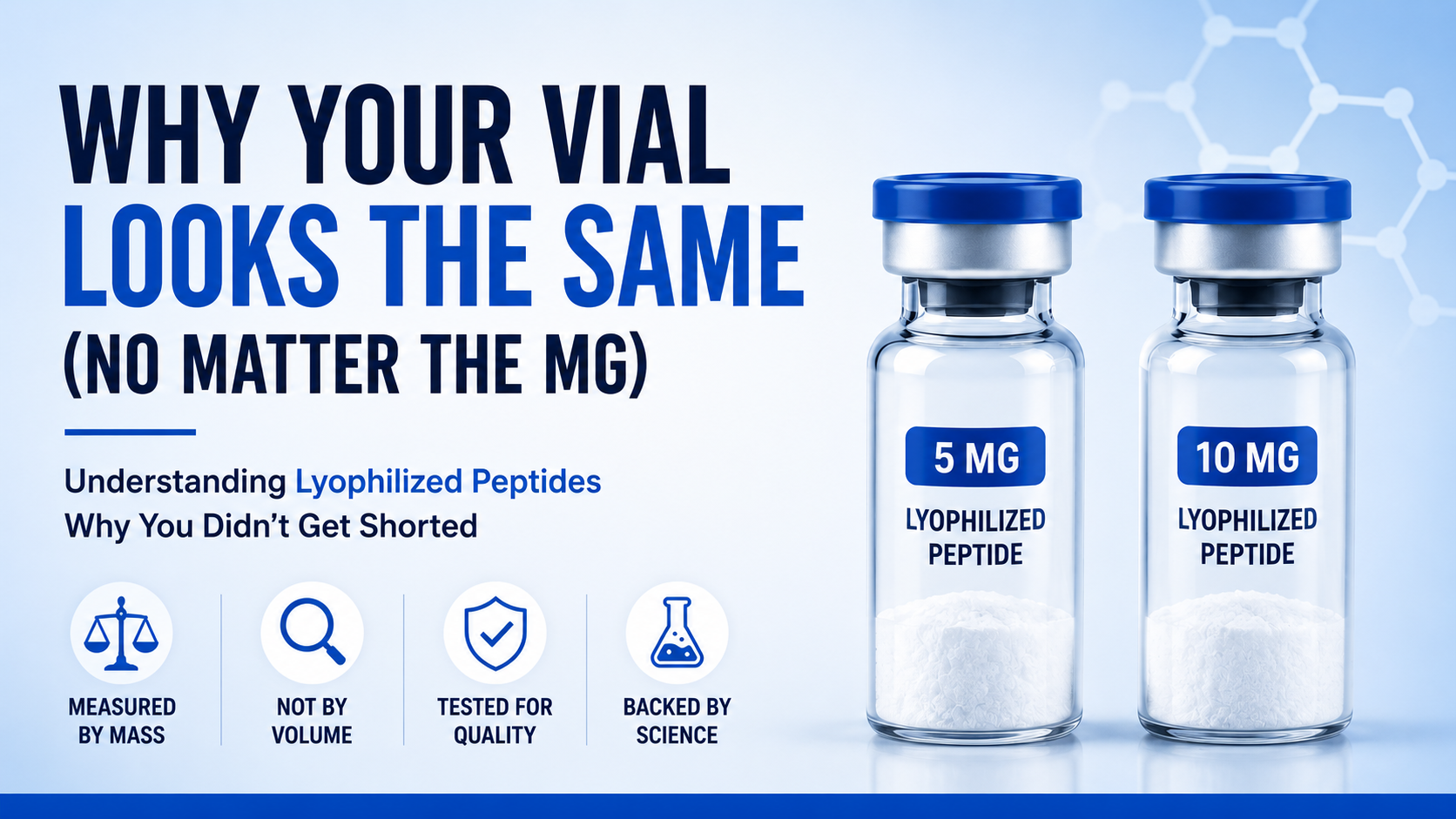
Why Your Vial Looks the Same No Matter the MG
Understanding lyophilized research compounds, visual powder volume, and why a higher milligram amount does not always mean more visible powder inside the vial.

Click the image to enlarge.
1 “Did I Get Shorted?”
No — a similar-looking vial does not mean you were shorted.
If you have ever compared two research compound vials, such as a 5mg vial and a 10mg vial, you may notice something surprising: they can appear to contain nearly the same amount of visible powder.
At first glance, that can raise concern. However, visible powder volume is not a reliable way to measure milligram content.
2 What Is Lyophilized Powder?
Many research peptides and laboratory compounds are supplied as lyophilized, or freeze-dried, powder. Lyophilization removes water and leaves behind a dry, stable cake inside the vial.
The important part is that the physical size of that cake is not a dependable indicator of how much compound is present.
3 What Actually Determines MG Strength
When a vial is labeled 5mg, 10mg, 15mg, or any other strength, that number refers to mass.
4 Why 10mg May Not Look Like Double 5mg
Different strengths can look nearly identical for several reasons:
5 The Visual Illusion: More Powder ≠ More Product
Your eyes see volume. The label states mass. Those are not the same thing.
A helpful comparison is feathers and sand. The same visible volume can have completely different weight depending on density. Lyophilized compounds can behave similarly.
6 How Quality Is Actually Measured
At Southern Aminos, visual fill appearance is not the primary quality standard. What matters is verified documentation, testing, and batch consistency.
7 Common Misconception
Misconception: “A 10mg vial should look twice as full as a 5mg vial.”
Reality: Incorrect. Volume does not equal mass in lyophilized research products.
8 Simple Takeaway
- Research peptides and compounds are measured by mass, shown as MG.
- Your eyes see volume, height, and powder appearance.
- Mass and visual volume are not the same thing.
- A similar appearance does not automatically indicate an incorrect fill.
- Testing, documentation, COAs, and batch integrity are what matter most.