MOTS-c: What It Is, How It Works, Benefits, and Research Overview
A comprehensive, evidence-graded review of MOTS-c, a 16-amino-acid mitochondrial-derived peptide encoded within the mitochondrial 12S rRNA region and investigated for metabolic homeostasis, skeletal-muscle glucose uptake, AMPK signaling, exercise adaptation, cellular stress resistance, healthy aging, mitochondrial function, and inflammatory regulation.
What Is MOTS-c?
MOTS-c stands for mitochondrial open reading frame of the 12S rRNA type-c. It is a 16-amino-acid mitochondrial-derived peptide encoded by a short open reading frame within the mitochondrial MT-RNR1 gene, traditionally known for producing 12S ribosomal RNA.
16 amino acids
MRWQEMGYIFYPRKLR
MT-RNR1 / 12S rRNA
Approximately 2174.6 Da
Skeletal muscle
No
Major research themes
- Glucose uptake and insulin sensitivity
- AMPK activation and energy sensing
- Folate and methionine-cycle signaling
- Skeletal-muscle metabolism
- Exercise adaptation and physical performance
- Cellular stress resistance
- Nuclear gene regulation
- Mitochondrial bioenergetics
- Healthy aging and metabolic resilience
🧬 Structure, Sequence, and Molecular Properties
🧪 Amino-acid sequence
H-Met-Arg-Trp-Gln-Glu-Met-Gly-Tyr-Ile-Phe-Tyr-Pro-Arg-Lys-Leu-Arg-OH
MRWQEMGYIFYPRKLR
| Length | 16 amino acids |
|---|---|
| Molecular formula | C101H152N28O22S2 |
| Average molecular weight | Approximately 2174.6 g/mol |
| PubChem CID | 146675088 |
| CAS number commonly listed | 1627580-64-6 |
| N terminus | Free amino group |
| C terminus | Free carboxyl group |
| Sulfur-containing residues | Met1 and Met6 |
| Disulfide bonds | None |
Oxidation sensitivity
MOTS-c contains two methionine residues and multiple aromatic residues. Methionine oxidation is a major stability concern and may alter mass, conformation, potency, and chromatographic behavior.
Salt forms
Commercial material may be supplied as free peptide, acetate, TFA, or another salt. Gross vial weight can exceed actual MOTS-c content because of water, counterions, and excipients.
Mitochondrial Origin and Production
Encoded inside mitochondrial DNA
MOTS-c is unusual because its sequence originates from a mitochondrial genomic region historically classified as ribosomal RNA rather than a conventional protein-coding gene.
Alternative mitochondrial genetic code
Mitochondrial and nuclear translation use different genetic-code rules. Research suggests that MOTS-c translation is likely completed in the cytoplasm using the standard genetic code after mitochondrial RNA-related processing or export, although its precise endogenous biosynthetic pathway remains under investigation.
Circulating peptide
MOTS-c has been detected in plasma and multiple tissues, supporting its classification as a mitochondrial-derived signaling peptide with endocrine-like activity.
Age and physiologic state
Reported MOTS-c concentrations vary by age, sex, metabolic health, exercise status, tissue, assay, and sample handling.
📅 Discovery and Research Timeline
- 2015: MOTS-c was described as a mitochondrial-derived peptide that improved metabolic homeostasis and reduced obesity and insulin resistance in mice.
- 2016: Reviews positioned MOTS-c as a novel mitochondrial signal connecting skeletal muscle, glucose metabolism, obesity, diabetes, and aging.
- 2018: Research reported stress-induced nuclear translocation and regulation of adaptive nuclear gene expression.
- 2021: Exercise studies showed that endogenous MOTS-c increased in human skeletal muscle and circulation after exercise and improved physical performance and healthspan in older mice.
- 2021: A mitochondrial m.1382A>C variant producing K14Q-MOTS-c was associated with reduced metabolic activity and sex-specific diabetes risk.
- 2023: Reviews expanded potential roles in cardiovascular, bone, kidney, inflammatory, and fibrotic disease models.
- 2024: Casein kinase 2 was identified as a direct functional target involved in skeletal-muscle glucose uptake and atrophy resistance.
- 2025–2026: Work continued on mitochondrial bioenergetics, muscle function, cardiac metabolism, exercise interaction, and translational barriers.
- Current status: MOTS-c remains experimental with no FDA-approved therapeutic product.
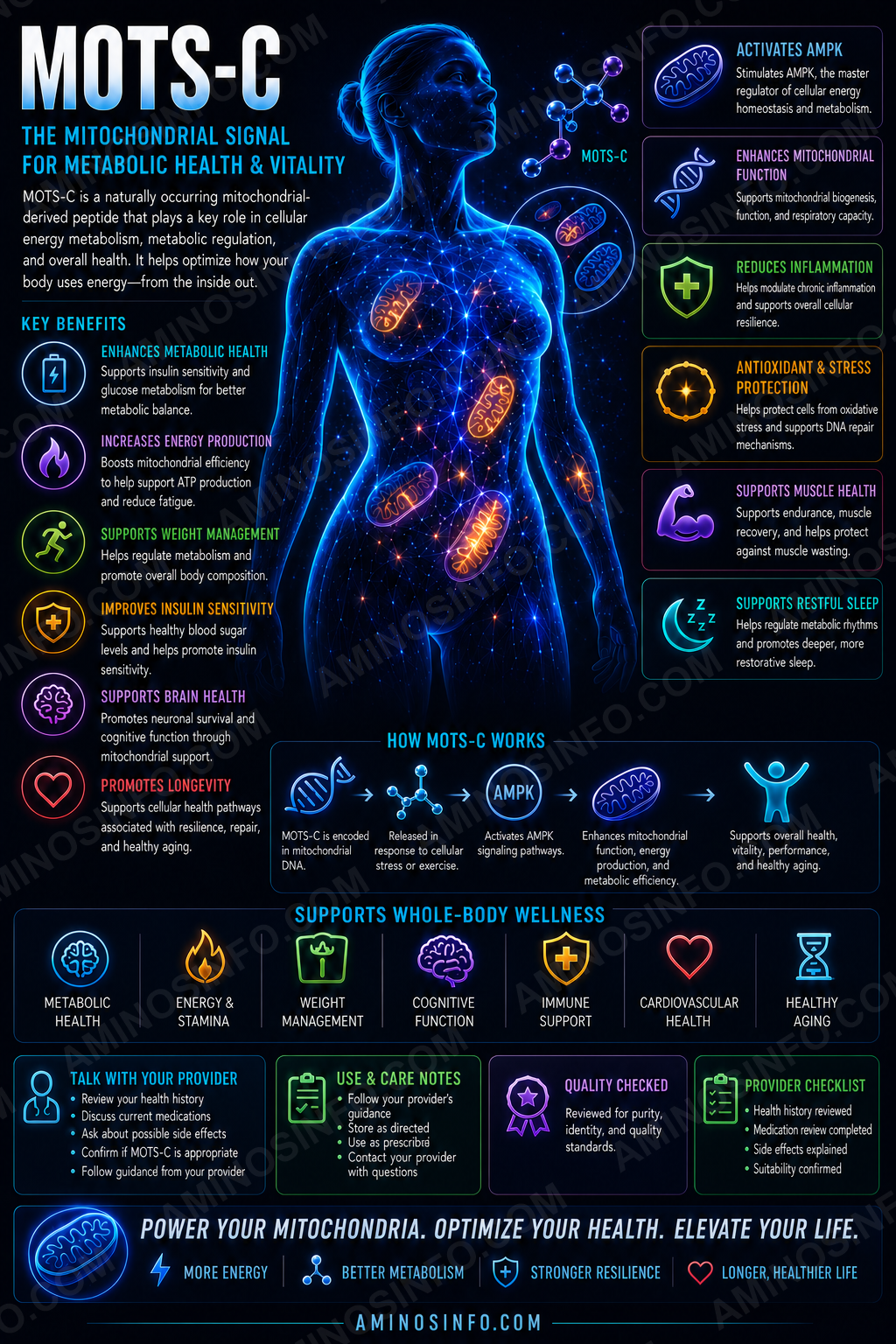
🧠 How Does MOTS-c Work?
1. Energy-sensing pathways
MOTS-c activates AMP-activated protein kinase, a major sensor of cellular energy stress.
2. Metabolic substrate redistribution
Research suggests MOTS-c shifts glucose utilization and promotes skeletal-muscle glucose uptake without acting as insulin itself.
3. Nuclear gene regulation
Under metabolic stress, MOTS-c can move into the nucleus and interact with transcriptional systems that regulate antioxidant defense, adaptation, and cellular homeostasis.
4. Mitochondrial-nuclear communication
MOTS-c represents retrograde signaling: a mitochondrial-encoded peptide influences nuclear gene expression and whole-cell physiology.
5. Tissue specificity
Recent studies indicate that MOTS-c effects differ by tissue and may depend on AMPK, PGC-1α, CK2, age, sex, genotype, and metabolic state.
AMPK, Folate, Purine, and Methionine-Cycle Signaling
Folate-cycle inhibition
The original mechanistic research reported that MOTS-c inhibited the folate cycle and reduced de novo purine biosynthesis.
AICAR accumulation
Reduced purine synthesis may increase levels of AICAR, an endogenous AMPK activator.
AMPK activation
AMPK promotes glucose uptake, fatty-acid oxidation, mitochondrial adaptation, and energy conservation during stress.
Methionine metabolism
MOTS-c has been linked to the methionine cycle, NAD⁺/SIRT1 pathways, and broader nutrient-sensing systems.
mTOR interaction
Some cell studies report reduced mTORC1 activity, consistent with a shift from growth signaling toward stress adaptation and cellular maintenance.
Nuclear Translocation and Stress-Response Signaling
Stress-induced movement
During glucose restriction, oxidative stress, or other metabolic challenges, MOTS-c can translocate from the cytoplasm into the nucleus.
Transcription-factor interactions
MOTS-c has been associated with NRF2, ATF1, ATF7, and other stress-responsive transcriptional systems.
Adaptive gene expression
Reported effects include increased expression of antioxidant, metabolic, and stress-resistance genes.
Mitohormesis
MOTS-c is often discussed within mitohormesis—the concept that controlled mitochondrial stress triggers protective adaptation.
CK2 and Skeletal-Muscle Signaling
Direct CK2 interaction
A 2024 study identified casein kinase 2 as a direct functional MOTS-c target.
Glucose uptake
CK2 activity contributed to MOTS-c-mediated skeletal-muscle glucose uptake in mouse models.
Muscle atrophy
MOTS-c reduced muscle atrophy in experimental models, and the benefit was weakened when CK2 signaling was suppressed.
Mechanistic expansion
This work suggests that MOTS-c activity is not explained by AMPK alone and may involve direct protein interactions.
Glucose, Insulin, Obesity, and Metabolic Research
High-fat-diet mouse models
MOTS-c reduced weight gain, improved glucose tolerance, and enhanced insulin sensitivity in several mouse studies.
Skeletal-muscle glucose disposal
The peptide appears to direct metabolic effects toward skeletal muscle, a major site of insulin-mediated glucose uptake.
Insulin-independent signaling
MOTS-c is not insulin but may increase glucose uptake through AMPK, CK2, and metabolic-stress pathways.
Sex-specific effects
Several studies indicate different responses in male and female models, particularly around menopause-related metabolic changes and the K14Q variant.
Human biomarker studies
Circulating MOTS-c levels have been associated with obesity, diabetes, kidney disease, muscle function, and metabolic health, but findings are not always consistent.
No established weight-loss therapy
There is no controlled clinical evidence establishing injected MOTS-c as an effective or safe obesity treatment.
Exercise, Endurance, and Performance Research
Exercise-induced endogenous MOTS-c
Human studies found that acute exercise increased endogenous MOTS-c in skeletal muscle and circulation.
Older-mouse performance
Systemic MOTS-c administration improved running capacity, physical performance, and metabolic flexibility in older mice.
Exercise mimetic concept
MOTS-c is sometimes called an exercise mimetic because it activates pathways also stimulated by physical activity. It does not reproduce all mechanical, cardiovascular, neurological, or musculoskeletal benefits of exercise.
Mitochondrial efficiency
Recent mouse research reports improved skeletal-muscle mitochondrial bioenergetic health through AMPK- and PGC-1α-dependent mechanisms.
Athletic use
Performance-enhancement claims remain unsupported by controlled human trials, and use is prohibited in tested sport.
Healthy-Aging and Longevity Research
Age-related decline
Some studies report reduced endogenous MOTS-c with aging, although levels vary by population and assay.
Healthspan in mice
Older mice receiving MOTS-c showed improved physical capacity and selected healthspan-related measures.
Cellular senescence
MOTS-c has improved mitochondrial and metabolic characteristics in aged stem-cell models and influenced AMPK, mTOR, and stress-response pathways.
Longevity interpretation
Improved healthspan measures in mice do not establish lifespan extension or anti-aging efficacy in humans.
Cardiovascular and Cardiac Research
Endothelial function
MOTS-c has been investigated for endothelial protection, vascular inflammation, and nitric-oxide-related signaling.
Diabetic cardiomyopathy
Animal studies report improved cardiac metabolism, mitochondrial function, oxidative stress, and functional measures in diabetes models.
Ischemic injury
Preclinical work suggests protection against ischemia-reperfusion injury and stress-related cardiac damage.
Blood-pressure biology
MOTS-c may influence vascular tone and endothelial function, but human therapeutic effects remain unestablished.
Inflammation, Antioxidant Defense, and Stress Resistance
Inflammatory cytokines
Animal and cell studies report reductions in TNF-α, IL-1β, IL-6, and other inflammatory mediators.
NRF2 signaling
MOTS-c has been associated with NRF2-mediated antioxidant responses and increased stress-defense proteins.
Reactive oxygen species
Research reports reduced oxidative damage and improved redox balance in several disease models.
Inflammasome pathways
Recent studies have explored effects on NLRP3 inflammasome activation and inflammatory cell death.
Context matters
Oxidative and inflammatory signaling also support normal immune defense and adaptation. Broad suppression is not automatically beneficial.
Other Organ and Disease Research
Bone
MOTS-c has been studied in osteoporosis, osteoblast, and age-related bone-loss models.
Kidney
Research includes diabetic kidney disease, chronic kidney disease biomarkers, and renal stress models.
Lung
Reviews and preclinical studies explore pulmonary fibrosis, inflammation, and oxidative injury.
Joint and cartilage
Recent cell and animal work includes chondrocyte mitochondrial dysfunction and osteoarthritis-related pathways.
Brain and cognition
Research has explored neuroinflammation, cognition, stress, and neurodegenerative mechanisms, but human efficacy is unproven.
Cancer complexity
Metabolic and stress-response pathways can affect tumor biology differently by cancer type. MOTS-c is not an established cancer therapy or preventive agent.
Human Evidence
Exercise physiology
Human studies show that exercise can increase endogenous MOTS-c expression in skeletal muscle and circulation.
Observational biomarker research
MOTS-c levels have been measured in people with obesity, type 2 diabetes, chronic kidney disease, cardiovascular conditions, and age-related differences.
Genetic cohort research
A large multi-cohort study linked the K14Q mitochondrial variant to sex- and activity-dependent diabetes risk.
No established administration trials
FDA states that it has not identified human exposure data on drug products containing administered MOTS-c. Observing endogenous MOTS-c in people does not establish the safety of synthetic injection.
What remains unknown
- Human pharmacokinetics and half-life
- Bioavailability by injection, oral, nasal, or other routes
- Therapeutic dose and dosing interval
- Long-term immune and organ safety
- Clinical efficacy for obesity, diabetes, exercise, or aging
- Drug interactions
- Pregnancy and reproductive safety
K14Q-MOTS-c Genetic Variant
m.1382A>C polymorphism
A mitochondrial DNA variant changes lysine at position 14 to glutamine, producing K14Q-MOTS-c.
Reduced experimental activity
K14Q-MOTS-c showed reduced insulin-sensitizing activity in high-fat-fed male mice compared with the reference peptide.
Human association
Across large cohorts, male carriers showed increased type 2 diabetes prevalence under lower physical-activity conditions, while the association was not observed in the same way in females.
Quality-control importance
Reference MOTS-c and K14Q-MOTS-c have different sequences and masses. A COA must confirm residue 14 as lysine unless the variant is specifically intended.
FDA, Compounding, and WADA Status
FDA approval
MOTS-c is not FDA approved for any indication.
FDA compounding concerns
FDA states that compounded MOTS-c may present immunogenicity risks and peptide-related impurity and active-ingredient characterization challenges. FDA also states that it lacks sufficient human exposure information to determine whether administration would cause harm.
503A evaluation
In 2026 FDA briefing materials proposed that MOTS-c free base and MOTS-c acetate not be included on the 503A Bulks List.
WADA prohibition
The 2026 WADA Prohibited List explicitly includes MOTS-c among prohibited metabolic modulators.
Research-use labeling
A “research use only” label does not establish human safety, legality of administration, or compliance with sports rules.
Major Evidence Limitations
- Most intervention evidence comes from cells and animals
- Human research primarily measures endogenous MOTS-c
- No validated therapeutic human dosing
- No established human pharmacokinetic profile
- Assay methods for endogenous MOTS-c vary substantially
- Sex, age, genotype, and metabolic status influence findings
- Animal exercise performance may not translate to humans
- Long-term cancer, immune, and organ effects are unknown
- Synthetic peptide may differ from endogenous production and localization
- Commercial products may contain oxidized methionine, wrong sequence, or inaccurate net content
- No FDA-reviewed finished-product specification exists
Potential Side Effects and Safety Considerations
No established human safety profile
There are no adequately powered clinical trials establishing the frequency or severity of adverse effects after synthetic MOTS-c administration.
Potential risks
- Injection-site pain, redness, swelling, or infection
- Hypersensitivity and anti-peptide antibodies
- Unexpected changes in glucose or energy metabolism
- Potential hypoglycemia when combined with glucose-lowering drugs
- Unknown cardiovascular and blood-pressure effects
- Unknown liver and kidney handling
- Unknown reproductive and developmental effects
- Microbial contamination, endotoxin, or particulate exposure
Metabolic pathway interactions
MOTS-c influences AMPK, folate, purine, methionine, mTOR, SIRT1, and mitochondrial pathways. These systems are involved in many medications and diseases, making interaction risk difficult to predict.
Oxidized material
Methionine oxidation or other degradation may reduce potency or create uncharacterized impurities.
Cancer uncertainty
Energy sensing, AMPK, stress adaptation, and mitochondrial function can influence cancer biology differently across tissues. Long-term oncology safety is not established.
🧪 Laboratory Testing Methods
| Method | Purpose | Important limitation |
|---|---|---|
| RP-HPLC / UPLC | Separates intact MOTS-c from deletions, oxidation products, and synthesis impurities | Area purity does not prove sequence or potency |
| LC-HRMS | Confirms intact mass near 2174.6 Da | Does not alone prove complete sequence or stereochemistry |
| MS/MS peptide mapping | Confirms MRWQEMGYIFYPRKLR residue order | Aromatic and basic residues require optimized fragmentation |
| Amino-acid analysis | Confirms composition and supports net-content assignment | Does not prove sequence order |
| Chiral amino-acid analysis | Detects D-amino acids and epimerization | Hydrolysis can introduce racemization artifacts |
| Methionine-oxidation assay | Measures oxidation at Met1 and Met6 | Oxidation can occur during sample preparation |
| Variant assay | Distinguishes reference K14 from K14Q-MOTS-c | Requires sequence-specific standards |
| Net peptide-content assay | Measures actual intact MOTS-c mass | Must correct for water, salts, and counterions |
| Counterion assay | Measures TFA, acetate, or other counterions | Gross vial weight may overstate active content |
| Residual-solvent testing | Measures synthesis and purification solvents | Does not establish potency |
| SEC-HPLC / DLS | Measures aggregates and particles | Small oligomers may require orthogonal methods |
| AMPK phosphorylation assay | Measures canonical metabolic signaling | AMPK activation is not unique to MOTS-c |
| CK2 binding/activity assay | Measures direct target interaction and function | Requires validated target-specific methods |
| Glucose-uptake assay | Measures skeletal-muscle or cell glucose transport | Cell models do not establish human efficacy |
| Nuclear-translocation assay | Measures stress-induced movement into the nucleus | Antibody specificity and tagging can affect results |
| Transcriptomic assay | Measures adaptive nuclear gene-expression changes | Results are tissue and stress dependent |
| Mitochondrial bioenergetics assay | Measures respiration, ATP, coupling, and efficiency | Effects vary by tissue and substrate |
| Protease-stability assay | Measures degradation in plasma and tissue fluids | In-vitro stability may not predict human exposure |
| Immunogenicity assessment | Evaluates anti-drug antibodies and immune activation | Predictive models remain imperfect |
| Sterility, endotoxin, and particles | Required for finished injectable evaluation | Research-grade purity cannot establish injectable safety |
| Stability-indicating assay | Tracks oxidation, hydrolysis, aggregation, adsorption, and potency loss | Requires validated forced-degradation studies |
📄 How to Interpret a MOTS-c COA
- Verify the exact 16-residue sequence: MRWQEMGYIFYPRKLR.
- Confirm molecular formula C₁₀₁H₁₅₂N₂₈O₂₂S₂.
- Confirm intact molecular weight near 2174.6 Da.
- Use MS/MS mapping rather than intact mass alone.
- Confirm all residues are in the L configuration.
- Confirm lysine—not glutamine—at position 14 unless K14Q is intended.
- Measure oxidation separately at Met1 and Met6.
- State the terminal form and salt form.
- Report net peptide content after correcting for water and counterions.
- Measure deletion peptides, epimers, oxidation products, and synthesis impurities.
- Include AMPK, CK2, glucose-uptake, or another qualified functional assay.
- Include protease stability and aggregation testing.
- For finished injectables, require sterility, endotoxin, particles, fill accuracy, container closure, and post-reconstitution stability.
- A COA does not establish human safety, efficacy, or FDA approval.
📊 Comparison Tables
MOTS-c vs Humanin vs HNG vs SS-31
| Feature | MOTS-c | Humanin | HNG | SS-31 |
|---|---|---|---|---|
| Main focus | Metabolism and exercise signaling | Endogenous cytoprotection | Potent Humanin analogue | Mitochondrial membrane protection |
| Origin | Mitochondrial 12S rRNA region | Mitochondrial-derived peptide | Synthetic Humanin analogue | Synthetic mitochondria-targeting peptide |
| Primary pathway | AMPK, CK2, nuclear stress response | Anti-apoptotic signaling | Enhanced Humanin signaling | Cardiolipin and inner-membrane biology |
| FDA approved | No | No | No | No approval; clinical development history |
MOTS-c vs Metformin vs Exercise
| Feature | MOTS-c | Metformin | Exercise |
|---|---|---|---|
| Primary research effect | Metabolic stress signaling | Glucose-lowering drug | Whole-body physiologic adaptation |
| AMPK involvement | Yes | Yes, among other mechanisms | Yes |
| Human efficacy evidence | Not established as treatment | Extensive | Extensive |
| FDA approved | No | Yes for labeled indications | Not a drug |
MOTS-c vs AICAR vs SLU-PP-332
| Feature | MOTS-c | AICAR | SLU-PP-332 |
|---|---|---|---|
| Type | Mitochondrial-derived peptide | AMP analogue/metabolic activator | Small-molecule ERR agonist |
| Main pathway | AMPK, CK2, nuclear signaling | AMPK activation | ERR-mediated oxidative metabolism |
| Exercise-mimetic research | Yes | Yes | Yes |
| Approved therapy | No | No for performance use | No |
Raw MOTS-c vs Research-Qualified Material
| Attribute | Basic raw peptide | Research-qualified MOTS-c |
|---|---|---|
| Identity | HPLC and parent mass | MS/MS sequence, chirality, K14 identity, termini, and salt form |
| Content | Gross vial weight | Net peptide corrected for water and counterions |
| Degradation | Often not specified | Met1/Met6 oxidation and full impurity panel |
| Potency | Often untested | AMPK, CK2, glucose uptake, or nuclear-translocation assay |
| Human equivalence | Neither establishes an FDA-approved therapeutic product | |
🖼️ Original Diagram Specifications
- Mitochondrial origin: mtDNA MT-RNR1 region, short open reading frame, MOTS-c production, and release.
- Sequence architecture: Full MRWQEMGYIFYPRKLR sequence with Met1, Met6, and Lys14 highlighted.
- AMPK pathway: Folate-cycle inhibition, reduced purine synthesis, AICAR accumulation, and AMPK activation.
- Nuclear signaling: Stress-induced MOTS-c translocation and adaptive gene-expression pathways.
- Skeletal-muscle mechanism: CK2, AMPK, PGC-1α, glucose uptake, and mitochondrial efficiency.
- Evidence pyramid: Cell and mouse intervention studies, human exercise and biomarker studies, absent therapeutic trials.
- COA workflow: Sequence, K14 variant, methionine oxidation, intact mass, potency, sterility, and stability.
❓ Frequently Asked Questions
Is MOTS-c a peptide?
Yes. It is a 16-amino-acid mitochondrial-derived peptide.
What is the exact sequence?
Met-Arg-Trp-Gln-Glu-Met-Gly-Tyr-Ile-Phe-Tyr-Pro-Arg-Lys-Leu-Arg.
What is the molecular formula?
C₁₀₁H₁₅₂N₂₈O₂₂S₂.
What is the molecular weight?
Approximately 2174.6 Da.
Where is MOTS-c encoded?
Within the mitochondrial MT-RNR1 gene region that encodes 12S ribosomal RNA.
What does MOTS-c stand for?
Mitochondrial open reading frame of the 12S rRNA type-c.
What is MOTS-c studied for?
Glucose metabolism, insulin sensitivity, exercise adaptation, skeletal-muscle function, cellular stress resistance, mitochondrial biology, and aging.
Does MOTS-c cause weight loss?
Mouse studies report reduced weight gain and improved metabolism, but controlled human weight-loss evidence is absent.
Is MOTS-c an exercise mimetic?
It activates some exercise-related metabolic pathways but cannot reproduce all benefits of exercise.
Has administered MOTS-c been tested in humans?
FDA states that it has not identified human exposure data for administered MOTS-c drug products.
Is MOTS-c FDA approved?
No.
Is MOTS-c prohibited in sports?
Yes. It is listed by WADA as a prohibited metabolic modulator.
What is K14Q-MOTS-c?
A naturally occurring mitochondrial genetic variant in which lysine 14 is replaced by glutamine, reducing activity in some models.
Does 99% HPLC purity prove authentic MOTS-c?
No. Sequence, residue 14, stereochemistry, methionine oxidation, net content, potency, endotoxin, sterility, and stability also matter.
Is there an established injectable dose?
No FDA-approved or clinically validated dose exists.
Final Thoughts
MOTS-c is one of the most scientifically important mitochondrial-derived peptides because it links mitochondrial genetics with nuclear gene regulation, skeletal-muscle metabolism, exercise adaptation, and systemic energy homeostasis.
Its best-supported mechanisms include folate and purine-cycle modulation, AICAR accumulation, AMPK activation, stress-induced nuclear translocation, adaptive transcription, and direct CK2-related skeletal-muscle signaling. These pathways have improved glucose metabolism, physical performance, mitochondrial function, and healthspan-related outcomes in animal models.
The human evidence is much narrower. Exercise increases endogenous MOTS-c, observational studies link circulating concentrations to metabolic and muscular phenotypes, and a mitochondrial K14Q variant has been associated with altered diabetes risk. These findings do not establish the safety or efficacy of injecting synthetic MOTS-c.
FDA continues to cite immunogenicity, peptide-impurity, active-ingredient characterization, and missing human-exposure concerns. WADA prohibits MOTS-c in competitive sport. Analytical authentication requires the full 16-residue sequence, correct Lys14 identity, intact mass, L stereochemistry, separate measurement of Met1 and Met6 oxidation, net peptide content, biological potency, and route-specific microbiological quality.
📚 References
- Lee C, et al. The Mitochondrial-Derived Peptide MOTS-c Promotes Metabolic Homeostasis and Reduces Obesity and Insulin Resistance. Cell Metabolism. 2015.
- Lee C, et al. MOTS-c: A Novel Mitochondrial-Derived Peptide Regulating Muscle and Fat Metabolism. Free Radical Biology and Medicine. 2016.
- Kim KH, et al. The Mitochondrial-Encoded Peptide MOTS-c Translocates to the Nucleus to Regulate Nuclear Gene Expression in Response to Metabolic Stress. Cell Metabolism. 2018.
- Reynolds JC, et al. MOTS-c Is an Exercise-Induced Mitochondrial-Encoded Regulator of Age-Dependent Physical Decline and Muscle Homeostasis. Nature Communications. 2021.
- Zempo H, et al. A Pro-Diabetogenic mtDNA Polymorphism in the Mitochondrial-Derived Peptide MOTS-c. Aging. 2021.
- Kumagai H, et al. MOTS-c Modulates Skeletal Muscle Function by Directly Binding to Casein Kinase 2. Nature Communications. 2024.
- Gudiksen A, et al. MOTS-c Improves Intrinsic Muscle Mitochondrial Bioenergetic Health and Efficiency in a PGC-1α/AMPK-Dependent Manner. 2026.
- Zheng Y, et al. MOTS-c: A Promising Mitochondrial-Derived Peptide for Therapeutic Exploitation. Frontiers in Endocrinology. 2023.
- Wan W, et al. Mitochondria-Derived Peptide MOTS-c: Effects and Mechanisms Related to Stress, Metabolism and Aging. Journal of Translational Medicine. 2023.
- Mohtashami Z, et al. MOTS-c, the Most Recent Mitochondrial Derived Peptide in Human Aging and Age-Related Diseases. International Journal of Molecular Sciences. 2022.
- Kong BS, et al. Mitochondrial-Encoded Peptide MOTS-c, Diabetes, and Aging-Related Diseases. Diabetes & Metabolism Journal. 2023.
- Yoon TK, et al. Exercise, Mitohormesis, and Mitochondrial ORF of the 12S rRNA Type-c. 2022.
- Hyatt JPK, et al. MOTS-c Increases in Skeletal Muscle Following Long-Term Physical Activity and Muscle Stress. Physiological Reports. 2022.
- Yu WD, et al. The Mitochondrial-Derived Peptide MOTS-c Promotes Homeostasis in Aged Human Stem Cells. 2021.
- Tang M, et al. The Role of MOTS-c-Mediated Antioxidant Defense in Aerobic Exercise and Diabetic Myocardial Injury. 2023.
- Pham T, et al. Mitochondria-Derived Peptide MOTS-c Restores Cardiac Bioenergetic Function in Metabolic Disease. 2025.
- PubChem. MOTS-c, CID 146675088.
- U.S. Food and Drug Administration. Certain Bulk Drug Substances for Use in Compounding That May Present Significant Safety Risks: MOTS-c.
- U.S. Food and Drug Administration. Pharmacy Compounding Advisory Committee Briefing Materials for MOTS-c. 2026.
- World Anti-Doping Agency. 2026 Prohibited List.
- United States Anti-Doping Agency. What Is the MOTS-c Peptide?
- International Council for Harmonisation. ICH Q1A(R2), Q2(R2), Q3A, Q3B, Q3C, and Q6B.
- United States Pharmacopeia General Chapters <621>, <71>, <85>, and <788>.
Sequence, chemistry, mitochondrial origin, metabolic and exercise mechanisms, human evidence, FDA and WADA status, safety, and analytical information reviewed in July 2026.