Orforglipron (Foundayo): What It Is, How It Works, Benefits, and Research Overview
A comprehensive, evidence-graded review of orforglipron, the once-daily oral nonpeptide GLP-1 receptor agonist approved in the United States as Foundayo for chronic weight management in eligible adults.
What Is Orforglipron?
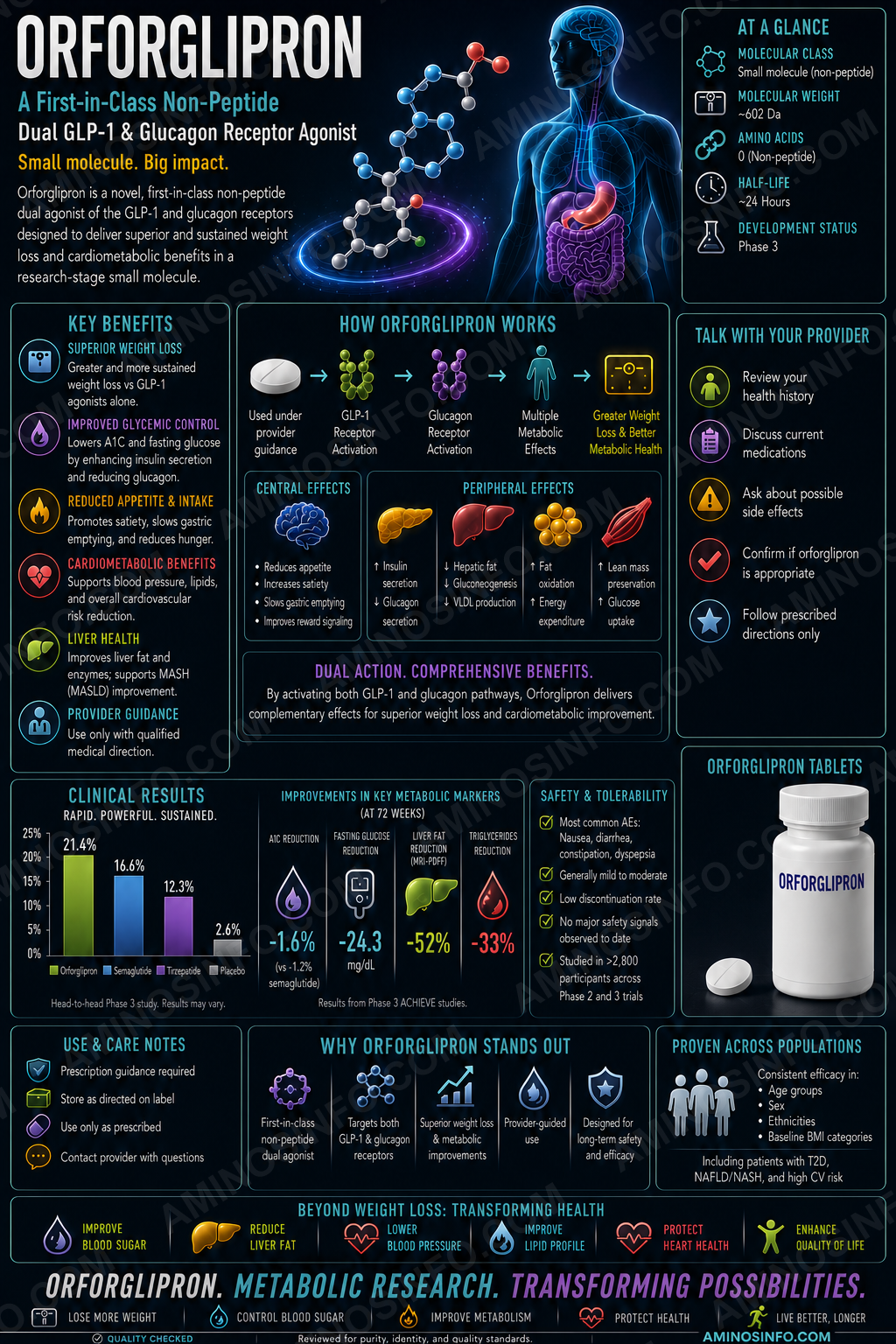
Orforglipron is a once-daily oral, nonpeptide agonist of the human glucagon-like peptide-1 receptor. It was developed to deliver GLP-1 receptor activity in a conventional tablet that can be taken with or without food.
The FDA approved it on April 1, 2026 under the brand name Foundayo to reduce excess body weight and maintain long-term weight reduction in adults with obesity, or adults with overweight and at least one weight-related comorbid condition, together with a reduced-calorie diet and increased physical activity.
Oral nonpeptide GLP-1 receptor agonist
Foundayo
April 1, 2026
Once-daily oral tablet
Orforglipron calcium
17.2 mg once daily
🧬 Chemical Structure and Molecular Properties
Orforglipron is a stereochemically defined, fluorinated, heterocyclic small molecule. It has no amino-acid sequence, peptide length, disulfide bonds, or peptide molecular architecture.
| Form | Orforglipron calcium |
|---|---|
| Molecular formula | C48H47F2N10O5·0.5Ca |
| Molecular weight | 902.0 g/mol |
| Physical description | White to practically white to light brown hygroscopic solid |
| Water solubility | Insoluble in water |
| Peptide sequence | None |
Salt-equivalent dosing
Foundayo strengths are expressed as milligrams of orforglipron, while the tablets contain slightly larger masses of orforglipron calcium. For example, 17.2 mg of labeled orforglipron corresponds to approximately 17.57 mg of orforglipron calcium.
Why stereochemistry matters
The approved chemical name specifies multiple stereocenters. Incorrect stereoisomers can have different receptor potency, metabolism, impurity profiles, and safety. Ordinary HPLC purity alone cannot prove correct stereochemical identity.
📅 Discovery and Approval Timeline
Chugai discovery program
Orforglipron originated from small-molecule GLP-1 receptor agonist research at Chugai Pharmaceutical.
Lilly development
Eli Lilly advanced LY3502970 through clinical pharmacology, obesity, and type 2 diabetes programs.
2023: Phase 2 publications
Phase 2 studies reported dose-related reductions in body weight and glycated hemoglobin, with gastrointestinal adverse effects similar to the GLP-1 receptor agonist class.
2025: ATTAIN-1 phase 3 publication
ATTAIN-1 enrolled 3,127 adults with obesity or overweight without diabetes and found significantly greater weight reduction with all studied doses than with placebo over 72 weeks.
April 1, 2026: FDA approval
The FDA approved Foundayo as a new molecular entity for chronic weight management in eligible adults.
🧠 How Does Orforglipron Work?
Human GLP-1 receptor activation
Orforglipron binds to and activates the human GLP-1 receptor. Unlike peptide GLP-1 analogues, it engages the receptor as a structurally unrelated small molecule.
Appetite and food intake
GLP-1 receptors are present in brain regions involved in appetite. The FDA label describes decreased food intake and appetite as the likely primary mediators of weight loss.
Glucose regulation
GLP-1 receptor activation enhances glucose-dependent insulin secretion and reduces inappropriate glucagon signaling during hyperglycemia.
Gastric emptying
Orforglipron delays gastric emptying. The effect is greatest after the first dose and diminishes over time.
Clinical Evidence
ATTAIN-1
| Investigational capsule dose | Mean weight change at 72 weeks |
|---|---|
| 6 mg | −7.5% |
| 12 mg | −8.4% |
| 36 mg | −11.2% |
| Placebo | −2.1% |
At the highest dose, 54.6% of participants lost at least 10% of baseline weight, 36.0% lost at least 15%, and 18.4% lost at least 20%. Waist circumference, systolic blood pressure, triglycerides, and non-HDL cholesterol also improved.
Phase 2 obesity research
A 36-week randomized trial in adults without diabetes found dose-related weight reduction across daily doses of 12 to 45 mg.
Type 2 diabetes research
Phase 2 and phase 3 studies reported reductions in A1C, fasting glucose, and body weight. These data support the broader metabolic profile, although the current Foundayo label is for weight management.
Maintenance research
Studies have also evaluated switching from injectable semaglutide or tirzepatide to oral orforglipron to help maintain previously achieved weight loss.
FDA-Approved Use and Administration
Approved indication
Foundayo is used with a reduced-calorie diet and increased physical activity to reduce excess body weight and maintain weight reduction long term in eligible adults.
Administration
- Take once daily.
- May be taken with or without food.
- Swallow tablets whole.
- Do not crush, break, or chew.
- Do not take more than one tablet per day.
| Stage | Dose |
|---|---|
| Starting dose | 0.8 mg once daily for at least 30 days |
| First escalation | 2.5 mg once daily for at least 30 days |
| Second escalation | 5.5 mg once daily for at least 30 days |
| Additional levels | 9 mg, 14.5 mg, or 17.2 mg once daily |
| Maximum | 17.2 mg once daily |
Concomitant use with another GLP-1 receptor agonist is not recommended.
Warnings, Contraindications, and Side Effects
Boxed warning
Foundayo carries a boxed warning concerning potential thyroid C-cell tumors. It is contraindicated in people with a personal or family history of medullary thyroid carcinoma or Multiple Endocrine Neoplasia syndrome type 2.
Common adverse reactions
- Nausea
- Constipation
- Diarrhea
- Vomiting
- Dyspepsia
- Abdominal pain or distension
- Headache
- Fatigue
- Eructation
- Gastroesophageal reflux
- Flatulence
- Hair loss
Important warnings
- Acute pancreatitis
- Severe gastrointestinal reactions
- Not recommended in severe gastroparesis
- Acute kidney injury from volume depletion
- Hypoglycemia with insulin or insulin secretagogues
- Serious hypersensitivity reactions
- Diabetic retinopathy monitoring in susceptible patients
- Acute gallbladder disease
- Pulmonary aspiration risk during anesthesia or deep sedation
Drug interactions
The maximum dose is 9 mg daily with a strong CYP3A4 inhibitor. Strong CYP3A4 inducers should be avoided. Simvastatin should not exceed 20 mg daily. Delayed gastric emptying can alter absorption of oral medicines.
Pregnancy and oral contraceptives
Foundayo may cause fetal harm and should be discontinued when pregnancy is recognized. The label advises a non-oral contraceptive or an added barrier method for 30 days after initiation and after each dose escalation.
🧪 Laboratory Testing Methods
| Method | Purpose | Key limitation |
|---|---|---|
| HPLC / UPLC | Assay and related substances | Does not prove stereochemistry or salt conversion |
| LC-HRMS | Molecular identity | Needs orthogonal structural confirmation |
| NMR | Confirms heterocyclic scaffold and substitution pattern | Trace impurities may be below detection |
| Chiral HPLC / SFC | Enantiomeric and diastereomeric purity | Requires qualified stereochemical standards |
| Calcium assay | Confirms salt stoichiometry | Does not prove organic identity |
| XRPD | Solid-state form | Form can change during processing |
| DSC / TGA | Thermal behavior, hydrates, solvates | Must be interpreted with XRPD |
| Karl Fischer | Hygroscopic moisture | Potency requires moisture correction |
| Residual solvents by GC | Manufacturing solvents | Does not establish receptor potency |
| ICP-MS | Elemental impurities | Limits depend on daily exposure |
| Human GLP-1R cAMP assay | Functional agonist potency | Cell system can influence EC50 |
| Dissolution | Tablet drug release | Raw API purity cannot predict tablet performance |
| Content uniformity | Tablet-to-tablet dose accuracy | Critical at low strengths |
| Photostability | Confirms labeled light sensitivity | Packaging must also be qualified |
📄 How to Interpret an Orforglipron COA
- Confirm the material is orforglipron calcium.
- Verify formula and molecular weight: C₄₈H₄₇F₂N₁₀O₅·0.5Ca and 902.0 g/mol.
- Confirm exact stereochemistry with chiral chromatography.
- Require LC-MS and NMR identity testing.
- Measure calcium stoichiometry, water, and solid-state form.
- Review epimers, degradants, residual solvents, elemental impurities, and process impurities.
- Report potency as orforglipron equivalent, not merely calcium-salt mass.
- Require human GLP-1 receptor functional testing.
- For tablets, require dissolution, content uniformity, friability, moisture, packaging, and photostability.
- A raw-material COA does not establish equivalence to Foundayo.
📊 Comparison Tables
Orforglipron vs Semaglutide vs Tirzepatide
| Feature | Orforglipron | Semaglutide | Tirzepatide |
|---|---|---|---|
| Type | Small molecule | Peptide | Peptide |
| Route | Daily oral tablet | Weekly injection or selected oral forms | Weekly injection |
| Receptors | GLP-1R | GLP-1R | GIPR + GLP-1R |
| Food restrictions | None in label | Depends on product | None for injection |
Orforglipron vs Tesofensine
| Feature | Orforglipron | Tesofensine |
|---|---|---|
| Mechanism | GLP-1R agonist | NET/DAT/SERT inhibitor |
| FDA status | Approved | Not approved |
| Main safety pattern | GI, gallbladder, pancreatitis, dehydration | Heart rate, sleep, psychiatric, monoamine interactions |
Orforglipron vs Retatrutide
| Feature | Orforglipron | Retatrutide |
|---|---|---|
| Type | Oral nonpeptide | Injectable peptide |
| Receptors | GLP-1R | GIPR, GLP-1R, glucagon receptor |
| Status July 2026 | FDA approved | Investigational |
🖼️ Original Diagram Specifications
- Nonpeptide identity: compare orforglipron’s small-molecule scaffold with a peptide chain.
- GLP-1R signaling: receptor binding, Gs, cAMP, appetite and glucose pathways.
- Appetite pathway: brain appetite centers, reduced intake, fat-mass loss.
- Gastric emptying: strong initial delay that attenuates over time.
- ATTAIN-1 chart: −7.5%, −8.4%, −11.2%, and −2.1% placebo.
- Dose escalation: 0.8 → 2.5 → 5.5 → 9 → 14.5 → 17.2 mg.
- COA workflow: stereochemistry, LC-MS, NMR, calcium, XRPD, cAMP potency, dissolution, uniformity, and photostability.
❓ Frequently Asked Questions
Is orforglipron a peptide?
No. It is a small-molecule, nonpeptide GLP-1 receptor agonist.
What is the brand name?
Foundayo.
Is it FDA approved?
Yes. FDA approved Foundayo on April 1, 2026 for chronic weight management in eligible adults.
What is the approved active form?
Orforglipron calcium.
What is the molecular formula?
C₄₈H₄₇F₂N₁₀O₅·0.5Ca.
What is the molecular weight?
902.0 g/mol.
Can it be taken with food?
Yes, with or without food.
What is the starting dose?
0.8 mg once daily.
What is the maximum dose?
17.2 mg once daily.
Does it require refrigeration?
No. Store at controlled room temperature and protect from light.
Can it be used with another GLP-1 medicine?
Concomitant use with another GLP-1 receptor agonist is not recommended.
Does a COA prove equivalence to Foundayo?
No. FDA equivalence requires validated finished-product performance and an approved regulatory pathway.
Final Thoughts
Orforglipron is the first FDA-approved oral nonpeptide GLP-1 receptor agonist for chronic weight management. It offers a once-daily tablet that can be taken without food or water restrictions.
Phase 3 research demonstrated meaningful weight reduction, with the highest ATTAIN-1 dose producing an average 11.2% loss at 72 weeks compared with 2.1% on placebo. Its safety profile remains recognizably GLP-1-like and requires appropriate screening, gradual dose escalation, and monitoring.
Because Foundayo contains a stereochemically defined calcium salt in a carefully engineered tablet, raw powder cannot be authenticated through HPLC purity alone. Proper evaluation requires structural, stereochemical, calcium, solid-state, receptor-potency, impurity, dissolution, uniformity, stability, and packaging controls.
📚 References
- U.S. Food and Drug Administration. Foundayo (orforglipron) Prescribing Information. April 2026.
- U.S. Food and Drug Administration. FDA Approves First New Molecular Entity Under National Priority Voucher Program. April 1, 2026.
- U.S. Food and Drug Administration. Novel Drug Approvals for 2026.
- Wharton S, et al. Orforglipron, an Oral Small-Molecule GLP-1 Receptor Agonist for Obesity Treatment. New England Journal of Medicine. 2025.
- Wharton S, et al. Daily Oral GLP-1 Receptor Agonist Orforglipron for Adults with Obesity. New England Journal of Medicine. 2023.
- Frias JP, et al. Efficacy and safety of oral orforglipron in patients with type 2 diabetes. Lancet. 2023.
- Pratt E, et al. Orforglipron, a novel oral non-peptide GLP-1 receptor agonist in early clinical development. Lancet. 2023.
- Horn DB, et al. Orforglipron in adults with obesity or overweight and type 2 diabetes. Lancet. 2026.
- ClinicalTrials.gov. ATTAIN-1, NCT05869903.
- ClinicalTrials.gov. ATTAIN-2, NCT05872620.
- Eli Lilly and Company. Foundayo approval and clinical-development materials. 2026.
- Drucker DJ. Mechanisms of action and therapeutic application of GLP-1. Cell Metabolism.
- Nauck MA, Meier JJ. Incretin hormones and GLP-1 receptor agonists. Lancet Diabetes & Endocrinology.
- Müller TD, et al. Glucagon-like peptide 1 molecular physiology and therapeutic applications. Nature Reviews Drug Discovery.
- Holst JJ. The physiology of glucagon-like peptide 1. Physiological Reviews.
- Wilding JPH, et al. Once-weekly semaglutide in adults with overweight or obesity. New England Journal of Medicine.
- Jastreboff AM, et al. Tirzepatide once weekly for obesity. New England Journal of Medicine.
- Lincoff AM, et al. Semaglutide and cardiovascular outcomes in obesity without diabetes. New England Journal of Medicine.
- International Council for Harmonisation. ICH Q1A(R2), Q1B, Q2(R2), Q3A, Q3B, Q3C, Q3D, Q6A, and M10.
- United States Pharmacopeia General Chapters <621>, <711>, <905>, <921>, <467>, <232>, and <233>.
Regulatory status, prescribing information, chemistry, clinical trial results, safety, interactions, and analytical recommendations were reviewed in July 2026.