Ovagen Scientific Overview: Identity, Mechanism, Evidence, and Testing
For example, Ovagen scientific overview content should distinguish the verified Glu–Asp–Leu tripeptide from the unsupported AEDS ovarian-peptide description. Ovagen appears in renal-cell, hepatoprotection, and DNA-binding research classifications, but it remains an unapproved research peptide.
Important Scientific Correction
First, a 2021 systematic review of peptide regulation lists the following identity and research classification:
| Name | Sequence | Reported research classification |
|---|---|---|
| Ovagen | EDL — Glu–Asp–Leu | Meanwhile, Regulation of renal-cell function, hepatoprotection, and DNA-binding research |
| Epitalon | AEDG | Likewise, Pineal, circadian, and aging research |
| Testagen | KEDG | In addition, Male reproductive-system research classification |
| Bronchogen | AEDL | Moreover, Lung-cell function and differentiation |
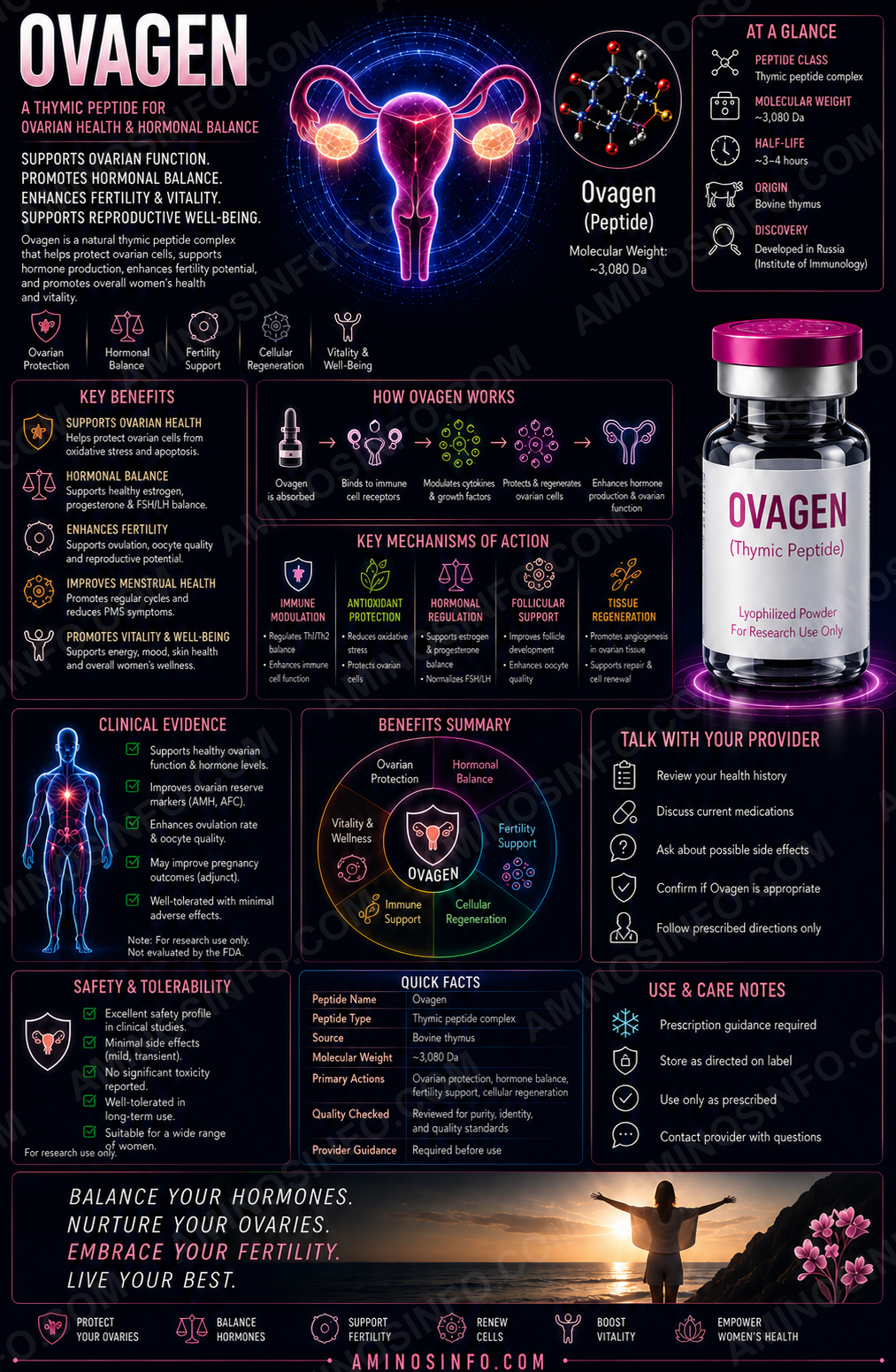
However, no reliable primary source was found identifying Ovagen as AEDS or as a standardized ovarian peptide. The similar name may have encouraged later commercial confusion with “ova,” ovary, or female reproductive products.
What Is Ovagen?
First, Ovagen is a commercial and research name for the ultrashort tripeptide Glu–Asp–Leu, abbreviated EDL. It is included in the Khavinson-school literature on short peptide bioregulators.
Next, peer-reviewed review literature associates EDL with renal-cell regulation, hepatoprotection, and proposed DNA interaction. Commercial vendors more often describe it as a liver or gastrointestinal research peptide. These descriptions remain hypotheses or limited experimental classifications rather than established medical indications.
Ovagen
Glu–Asp–Leu
EDL
Linear tripeptide
Renal cells and hepatoprotection
No
🧬 Molecular Structure
First, Ovagen is a linear tripeptide composed of L-glutamic acid, L-aspartic acid, and L-leucine. The commonly represented research form has a free N-terminus and free C-terminal carboxyl group.
🧪 Amino-Acid Sequence
H-Glu-Asp-Leu-OH
One-letter notation: EDL
| Residue | Chemical feature | Analytical relevance |
|---|---|---|
| Glutamic acid | By contrast, Acidic amino acid with a side-chain carboxyl group | Also, Can form pyroglutamate-related impurities if the N-terminus cyclizes. |
| Aspartic acid | Consequently, Acidic amino acid with a shorter side chain | However, Can undergo isomerization or form isoaspartyl-related degradants. |
| Leucine | Therefore, Hydrophobic branched-chain amino acid | For example, Contributes hydrophobicity and helps distinguish EDL from other acidic ultrashort peptides. |
⚛️ Molecular Weight and 🧫 Formula
| Neutral molecular formula | Meanwhile, C15H25N3O8 |
|---|---|
| Average molecular weight | Approximately 375.38 g/mol |
| Peptide length | 3 amino acids |
| Expected terminal form | Likewise, Free N-terminus and free C-terminal carboxyl group |
| Common notation | EDL |
Importantly, EDL, ELD, DEL, DLE, LED, and LDE share the same elemental composition and nominal mass. Exact sequence order requires tandem mass spectrometry or another sequence-specific method.
📅 Research Timeline and History
1970s–1990s: Tissue-derived peptide complexes studied
First, Russian and Eastern European programs investigated low-molecular-weight peptide fractions from multiple organs, including liver, kidney, thymus, pineal tissue, vessels, and other systems.
1990s–2000s: Defined ultrashort peptides developed
Next, researchers synthesized short sequences intended to model selected activities attributed to complex tissue extracts.
2010s: DNA-binding and gene-regulation theories expand
Moreover, Khavinson-related studies proposed that selected dipeptides, tripeptides, and tetrapeptides may enter cells and alter transcription through interactions with DNA, histones, or regulatory proteins.
2021: Systematic review identifies Ovagen as EDL
In addition, the review classified Ovagen as Glu–Asp–Leu and associated it with renal-cell function, hepatoprotection, and DNA-binding research.
2025–2026: Commercial research market expands
Meanwhile, research vendors increasingly market EDL under the Ovagen name for liver and gastrointestinal investigations. Commercial availability does not establish clinical validity.
Current status
Finally, Ovagen remains an unapproved research peptide without a recognized human prescribing label, defined pharmacokinetic profile, or large independent clinical-development program.
Renal, Hepatic, and Gastrointestinal Research Context
Kidney-cell regulation
First, the kidney contains multiple specialized cell populations, including podocytes, tubular epithelial cells, endothelial cells, mesangial cells, and interstitial cells. A meaningful renal-regulatory claim would require defined effects on filtration, tubular transport, fibrosis, inflammation, oxidative stress, or cell survival.
Hepatoprotection
Next, hepatoprotection is a broad term that may include reduced oxidative damage, improved mitochondrial function, lower inflammatory injury, reduced fibrosis, improved bile handling, or enhanced survival after toxic exposure. Direct EDL evidence for each of these outcomes is limited.
Liver regeneration
Moreover, the liver can regenerate through hepatocyte proliferation and coordinated signaling involving growth factors, cytokines, extracellular matrix, and vascular cells. No reliable evidence establishes EDL as a clinically effective liver-regeneration therapy.
Gastrointestinal claims
However, commercial sources often connect Ovagen with gastrointestinal function. The peer-reviewed classification identified in this review emphasizes kidney and liver biology more clearly than a defined intestinal mechanism.
“Detoxification” claims
Finally, no validated evidence shows that EDL directly increases cytochrome P450 activity, glutathione conjugation, urea-cycle function, bile secretion, or renal toxin clearance in humans.
🧠 Proposed Mechanisms of Action
Importantly, researchers have not established a validated receptor-level mechanism for Ovagen.
Organ targeting and clinical benefit remain unproven
1. Peptide transport
First, as a tripeptide, EDL may interact with proton-coupled oligopeptide transporters or be hydrolyzed into smaller peptides and amino acids. Intact absorption, half-life, tissue distribution, and renal or liver accumulation remain poorly characterized.
2. DNA-binding hypothesis
Next, EDL is listed as a DNA-binding peptide in a systematic review. The exact binding sequence, affinity, nuclear concentration, and physiological relevance require stronger independent validation.
3. Gene-expression hypothesis
Moreover, the broader bioregulator model proposes that short peptides influence transcription and protein synthesis. This does not establish predictable correction of liver or kidney disease.
4. Cytoprotection hypothesis
In addition, hepatoprotection or renal resilience could theoretically involve mitochondrial, antioxidant, inflammatory, apoptotic, or repair pathways. These mechanisms must be tested directly rather than inferred from the peptide’s name.
5. Tissue-selectivity hypothesis
However, no confirmed transporter, receptor, or targeting motif demonstrates selective delivery of EDL to hepatocytes, renal tubular cells, or gastrointestinal epithelium.
🎯 Target and Pathway Profile
| Target or pathway | Evidence status |
|---|---|
| DNA interaction | In addition, Reported in short-peptide review literature; physiological significance uncertain. |
| Moreover, Histone or chromatin interaction | By contrast, this remains a general ultrashort-peptide hypothesis, and EDL-specific data remain limited. |
| PEPT transporters | Also, General tripeptide transport plausibility; organ selectivity unproven. |
| Cytochrome P450 enzymes | Consequently, No established direct effect. |
| Glutathione pathways | However, No validated direct effect. |
| Renin–angiotensin system | Therefore, No established receptor or enzyme interaction. |
| Ovarian hormone receptors | For example, No established direct activity. |
Evidence Quality and Clinical Interpretation
Direct Ovagen Evidence Remains Limited
First, the most authoritative source located for identity and biological classification is a systematic review from the same research tradition that developed many of these peptides.
Independent Replication Remains Limited
Moreover, many mechanistic and biological claims come from overlapping research groups. Broader independent confirmation is needed.
No established clinical endpoints
In addition, no strong evidence demonstrates improved liver enzymes, fibrosis, estimated glomerular filtration rate, albuminuria, gastrointestinal symptoms, hospitalization, transplantation risk, or survival.
No established ovarian outcomes
Likewise, no evidence establishes improved anti-Müllerian hormone, antral-follicle count, ovulation, estradiol, progesterone, pregnancy, or live birth.
No substitute for diagnosis
Finally, abnormal liver tests, jaundice, abdominal pain, kidney dysfunction, blood in urine, edema, or reproductive symptoms require appropriate clinical evaluation.
Why the Ovarian Description Is Unsupported
The name is misleading
First, “Ovagen” may sound like “ovary” or “ova,” but naming resemblance is not biochemical evidence.
The verified sequence differs
Next, the original draft listed AEDS. The verified peptide-regulation review lists EDL.
The reported organ association differs
Moreover, the same review associates EDL with renal-cell regulation and hepatoprotection, not ovarian tissue.
No ovarian receptor profile
In addition, EDL has no established direct activity at FSH receptors, LH receptors, estrogen receptors, progesterone receptors, AMH receptors, or ovarian growth-factor receptors.
No fertility evidence
Finally, no reliable controlled human studies establish effects on follicular development, ovarian reserve, egg quality, ovulation, fertility treatment response, pregnancy, or reproductive lifespan.
Safety and Regulatory Considerations
No standardized human safety profile
First, no FDA-approved prescribing information defines dose, route, pharmacokinetics, contraindications, interactions, pregnancy safety, or long-term risk.
Kidney and liver disease
Moreover, patients with impaired renal or hepatic function may handle peptides and metabolites differently. No formal dose-adjustment or toxicity guidance exists.
Pregnancy and fertility treatment
In addition, an unapproved peptide should not replace or be added to fertility treatment without specialist oversight. Embryonic, fetal, and reproductive toxicology data are inadequate.
Product-quality risk
However, unapproved material may contain incorrect sequence, sequence isomers, free amino acids, residual solvents, microbial contamination, endotoxin, or inaccurate content.
Regulatory status
Finally, Ovagen/EDL is not FDA approved as a drug or biologic. Research-use labeling does not establish safety for human use.
🧪 Laboratory Testing Methods
Identity, Sequence, and Purity Testing
| Method | Purpose | Important limitation |
|---|---|---|
| Meanwhile, RP-HPLC, ion-pair HPLC, or UPLC | Likewise, Separates EDL from amino acids, deletion peptides, and degradants. | In addition, Small acidic peptides require carefully validated methods. |
| LC-MS / HRMS | Moreover, Confirms exact intact mass. | By contrast, Cannot distinguish sequence permutations by mass alone. |
| MS/MS sequencing | Confirms Glu–Asp–Leu order. | Also, Requires authentic standards and validated fragmentation. |
| Chiral amino-acid analysis | Consequently, Confirms L-Glu, L-Asp, and L-Leu. | However, Hydrolysis may introduce artifacts. |
| Net peptide-content assay | Therefore, Measures actual EDL concentration. | For example, analysts must not infer net peptide content from HPLC area purity. |
| Sequence-isomer analysis | Meanwhile, Detects ELD, DEL, DLE, LED, and LDE. | Likewise, Isomers may be difficult to resolve. |
| Pyroglutamate analysis | In addition, Detects N-terminal glutamate cyclization. | Moreover, analysts may need specialized LC-MS methods. |
| Isoaspartate analysis | Evaluates Asp isomerization. | By contrast, Can be challenging in a short peptide. |
| Free amino-acid analysis | Also, Detects hydrolysis and incomplete synthesis. | Requires adequate resolution. |
| Consequently, Water, residual solvents, and elemental impurities | However, Measures nonpeptide mass and process contamination. | Therefore, Does not prove biological activity. |
| For example, Renal or hepatic cell assay | Meanwhile, Could measure viability, oxidative stress, inflammation, fibrosis, or gene expression. | Likewise, In vitro effects do not prove organ protection in humans. |
| In addition, Microbial limits, sterility, and endotoxin | Moreover, Evaluates route-specific microbiological quality. | By contrast, Requirements differ by intended use. |
| Stability testing | Also, Tracks hydrolysis, cyclization, isomerization, assay, and appearance. | Consequently, Must reflect final formulation and storage conditions. |
📄 How to Interpret an Ovagen COA
COA Review and Route-Specific Quality
- However, Verify the exact sequence: H-Glu-Asp-Leu-OH or EDL.
- Therefore, Reject AEDS labeling: AEDS is not the verified Ovagen sequence.
- For example, Confirm sequence order: Mass alone cannot distinguish EDL from its five sequence isomers.
- Meanwhile, Verify stereochemistry: Expected research material is typically L-Glu–L-Asp–L-Leu.
- Likewise, Separate identity, purity, and net content: These are different analytical measurements.
- In addition, Review pyroglutamate, isoaspartate, hydrolysis, and free amino acids.
- Moreover, Match testing to the route: Raw-powder purity does not establish suitability for injection or ingestion.
- By contrast, Do not infer organ benefit: A COA cannot prove liver, kidney, gastrointestinal, ovarian, fertility, or anti-aging efficacy.
📊 Ovagen vs Livagen vs Vesugen vs Epitalon
Sequence and Research-Association Differences
| Feature | Ovagen | Livagen | Vesugen | Epitalon |
|---|---|---|---|---|
| Sequence | EDL | KEDA | KED | AEDG |
| Length | 3 amino acids | 4 amino acids | 3 amino acids | 4 amino acids |
| Common research association | Also, Renal-cell regulation and hepatoprotection | Liver-related bioregulator research | Vascular/endothelial research | Consequently, Pineal and aging research |
| FDA approved? | Moreover, No FDA approval applies. | In addition, Regulators have not approved this compound. | However, No approved indication exists. | This remains unapproved. |
Ovagen vs the Original Ovarian Description
Evidence-Based Identity Corrections
| Original claim | Evidence-based correction |
|---|---|
| AEDS tetrapeptide | However, Ovagen is EDL, a tripeptide. |
| Ovarian tissue peptide | Therefore, Peer-reviewed classification associates EDL with renal cells and hepatoprotection. |
| FSH responsiveness | For example, No validated direct evidence. |
| Meanwhile, Estrogen and progesterone support | Likewise, No established direct effect. |
| In addition, Ovarian reserve or fertility benefit | Moreover, No reliable clinical evidence. |
Ovagen vs Ovarian Biologic Research
| Approach | Research basis | Same as Ovagen? |
|---|---|---|
| Kisspeptin | By contrast, Defined KISS1R reproductive signaling | Therefore, No FDA approval applies. |
| FSH and gonadotropins | Also, Established ovarian follicle stimulation | Likewise, Regulators have not approved this compound. |
| Ovarian platelet-rich plasma | Consequently, Experimental local biologic procedure | For example, No approved indication exists. |
| Ovagen EDL | However, Ultrashort peptide with renal/hepatic research classification | Therefore, Not an ovarian therapy |
🔗 Related Peptides and Pathways
- Livagen: First, KEDA tetrapeptide associated with liver bioregulator research.
- Vesugen: Next, KED tripeptide associated with vascular research.
- Epitalon: Also, AEDG tetrapeptide associated with pineal and aging research.
- PEPT1 and PEPT2: Moreover, Proton-coupled oligopeptide transporters relevant to short-peptide handling.
- Hepatocyte stress pathways: In addition, Include oxidative stress, apoptosis, inflammation, and fibrosis.
- Renal tubular pathways: Likewise, Include transport, mitochondrial function, inflammation, and fibrosis.
🖼️ Original Diagram Specifications
Diagram 1: Ovagen molecular structure
For example, Show H-Glu-Asp-Leu-OH with both acidic side chains, leucine’s branched hydrophobic side chain, peptide bonds, and free termini.
Diagram 2: Identity correction
Meanwhile, Contrast verified EDL renal/hepatic classification with unsupported AEDS ovarian claims.
Diagram 3: Sequence-isomer chart
Likewise, Show EDL beside ELD, DEL, DLE, LED, and LDE, noting identical formula and mass.
Diagram 4: Proposed short-peptide pathway
In addition, Show peptide transport, hydrolysis, possible cellular uptake, proposed DNA interaction, altered gene expression, and unresolved organ selectivity.
Diagram 5: Kidney and liver research map
Moreover, Show renal tubular cells, podocytes, hepatocytes, sinusoidal endothelium, oxidative stress, inflammation, fibrosis, and repair endpoints.
Diagram 6: Evidence ladder
By contrast, Show chemical identity, DNA-binding hypothesis, cell assays, animal studies, controlled human organ-disease trials, and regulatory approval. Place Ovagen near early-stage evidence.
Diagram 7: COA workflow
Also, Show exact mass, MS/MS sequence, stereochemistry, sequence isomers, pyroglutamate, isoaspartate, free amino acids, assay, microbiology, and stability.
❓ Frequently Asked Questions
Is Ovagen a peptide?
Consequently, Yes. It is a synthetic tripeptide.
What is the correct sequence?
H-Glu-Asp-Leu-OH, abbreviated EDL.
Is Ovagen AEDS?
However, No. The authoritative peptide-regulation review identifies Ovagen as EDL.
What is its molecular weight?
Therefore, Approximately 375.38 g/mol for neutral EDL.
Is Ovagen an ovarian peptide?
For example, No reliable primary evidence supports that description.
What is Ovagen studied for?
Meanwhile, Review literature associates EDL with renal-cell regulation, hepatoprotection, and DNA-binding research.
Does it improve fertility?
Likewise, No reliable clinical evidence establishes fertility or ovarian-reserve benefits.
Does it protect the liver?
In addition, review literature classifies it as hepatoprotective, but strong human clinical evidence remains lacking.
Does it improve kidney function?
Moreover, No high-quality evidence establishes improvement in eGFR, albuminuria, or kidney-disease outcomes.
Is Ovagen FDA approved?
No.
Does a 99% HPLC result prove biological activity?
By contrast, No. Sequence, stereochemistry, content, functional effects, pharmacokinetics, safety, and clinical outcomes must be established separately.
Ovagen Scientific Overview: Final Thoughts
In conclusion, the original article assigned Ovagen the wrong structure and organ system. The most authoritative peptide-regulation source located identifies Ovagen as the tripeptide Glu–Asp–Leu and associates it with renal-cell regulation, hepatoprotection, and DNA-binding research.
However, no reliable evidence supports describing Ovagen as AEDS, an ovarian peptide, a fertility treatment, an ovarian-aging intervention, or a hormone-balancing compound. Even the renal and hepatic classifications remain early-stage and are not equivalent to validated clinical treatment.
Therefore, analysts should verify legitimate material for exact EDL sequence order, L-amino-acid stereochemistry, terminal chemistry, sequence isomers, pyroglutamate and isoaspartate formation, free amino acids, net peptide content, route-specific microbiological quality, and stability.
📚 References
- Also, Khavinson V, et al. Peptide Regulation of Gene Expression: A Systematic Review. Molecules. 2021.
- Consequently, Khavinson V, et al. Peptide regulation of gene expression. 2021.
- However, Anisimov VN, Khavinson VK. Peptide bioregulation of aging: results and prospects. Biogerontology. 2010.
- Therefore, Khavinson VK, Kuznik BI. Peptide Bioregulators: The New Class of Geroprotectors. 2014.
- For example, Khavinson VK. Peptides, Genome, and Aging. Research monograph.
- Meanwhile, Solovyev AY, et al. Interaction of amino acids, peptides, and proteins with DNA. 2015.
- Likewise, Wang J, et al. Exogenous bioactive peptides and aging-related disease research. Frontiers in Pharmacology. 2022.
- In addition, Avolio F, et al. Peptides regulating proliferative activity and inflammatory pathways. International Journal of Molecular Sciences. 2022.
- Moreover, Daniel H. Molecular and integrative physiology of intestinal peptide transport. Annual Review of Physiology.
- By contrast, Brandsch M. Drug transport via the intestinal peptide transporter PepT1. Current Opinion in Pharmacology.
- Also, Smith DE, Clémençon B, Hediger MA. Proton-coupled oligopeptide transporter family SLC15. Molecular Aspects of Medicine.
- Consequently, Newstead S. Molecular insights into proton-coupled peptide transport. Trends in Pharmacological Sciences.
- However, Michalopoulos GK, Bhushan B. Liver regeneration: biological and pathological mechanisms and implications. Nature Reviews Gastroenterology & Hepatology.
- Therefore, Forbes SJ, Newsome PN. Liver regeneration—mechanisms and models to clinical application. Nature Reviews Gastroenterology & Hepatology.
- For example, Taub R. Liver regeneration: from myth to mechanism. Nature Reviews Molecular Cell Biology.
- Meanwhile, Rinella ME, et al. AASLD practice guidance on metabolic dysfunction-associated steatotic liver disease.
- Likewise, European Association for the Study of the Liver. Clinical practice guidelines for liver disease.
- In addition, Ramsay RR, Rashed MS, Nelson SD. In vitro effects of peptide and amino-acid metabolites on hepatic pathways. Biochemical literature.
- Moreover, Gewin LS. Renal fibrosis: primacy of the proximal tubule. Matrix Biology.
- By contrast, Humphreys BD. Mechanisms of renal fibrosis. Annual Review of Physiology.
- Also, Webster AC, et al. Chronic kidney disease. Lancet. 2017.
- Consequently, Kidney Disease: Improving Global Outcomes. CKD evaluation and management guideline.
- However, Kellum JA, Romagnani P, Ashuntantang G, et al. Acute kidney injury. Nature Reviews Disease Primers.
- Therefore, Gekle M. Renal tubule peptide and amino-acid transport. Physiological Reviews and renal-transport literature.
- Moreover, Plant TM. The hypothalamo-pituitary-gonadal axis. Journal of Endocrinology.
- In addition, Hsueh AJW, Kawamura K, Cheng Y, Fauser BCJM. Intraovarian control of early folliculogenesis. Endocrine Reviews.
- However, Richards JS, Pangas SA. The ovary: basic biology and clinical implications. Journal of Clinical Investigation.
- Therefore, Practice Committee of the American Society for Reproductive Medicine. Testing and interpretation of ovarian reserve.
- Likewise, ESHRE guideline on ovarian stimulation for IVF/ICSI.
- For example, Jankowska-Ziemak H, et al. Ovarian angiogenesis and signaling pathways. 2025.
- Moreover, Ivaskiene T, et al. Platelet-rich plasma and ovarian research. 2025.
- In addition, International Council for Harmonisation. ICH Q2(R2): Validation of Analytical Procedures.
- However, United States Pharmacopeia. General Chapter <621>, Chromatography.
- Therefore, United States Pharmacopeia. General Chapters <61> and <62>, Microbiological Examination of Nonsterile Products.
- Likewise, United States Pharmacopeia. General Chapter <71>, Sterility Tests.
- For example, United States Pharmacopeia. General Chapter <85>, Bacterial Endotoxins Test.
- Moreover, United States Pharmacopeia. General Chapters <232> and <233>, Elemental Impurities.
- In addition, International Council for Harmonisation. ICH Q3C: Impurities—Guideline for Residual Solvents.
- However, International Council for Harmonisation. ICH Q1A(R2): Stability Testing of New Drug Substances and Products.
Ovagen, Peptide-Regulation, and Organ-Biology Sources
Renal, Hepatic, Reproductive, and Analytical Sources
Identity, molecular properties, renal/hepatic research classification, ovarian claim correction, evidence limitations, safety, and regulatory status were reviewed in July 2026. Finally, Ovagen remains an unapproved research peptide.