PAL-GHK (Palmitoyl Tripeptide-1): What It Is, How It Works, Benefits, and Research Overview
A comprehensive, evidence-graded review of PAL-GHK, also known as palmitoyl tripeptide-1, a lipid-modified GHK signal peptide used primarily in topical cosmetic research for collagen, extracellular-matrix remodeling, skin firmness, fine-line appearance, and barrier-support applications.
What Is PAL-GHK?
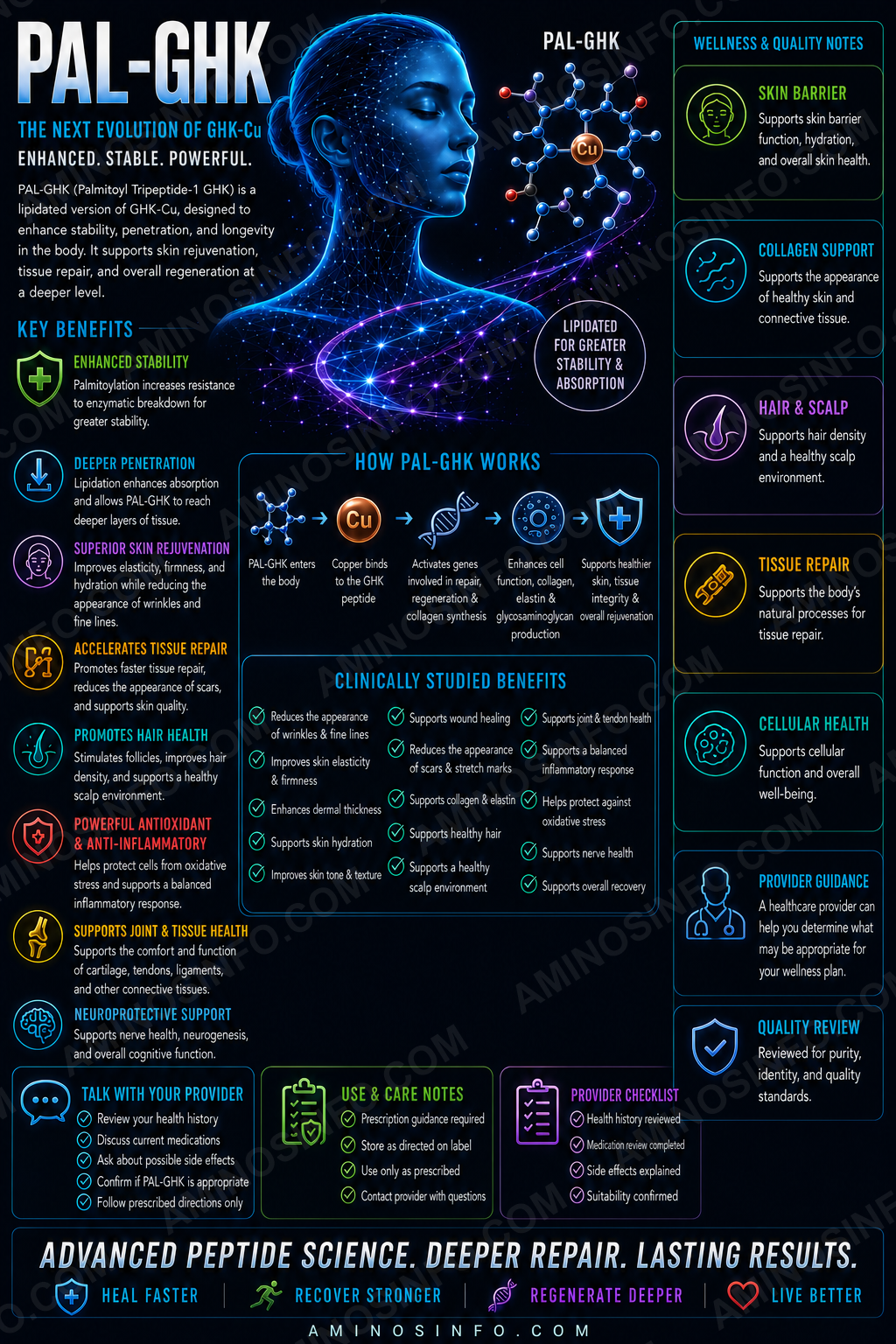
PAL-GHK, formally known as palmitoyl tripeptide-1, is a synthetic lipopeptide consisting of the natural tripeptide GHK—glycine, histidine, and lysine—modified with palmitic acid at its N terminus.
Palmitoyl Tripeptide-1
Pal-Gly-His-Lys-OH
3 amino acids plus C16 lipid
578.8 Da
147732-56-7
Topical cosmetic ingredient
Primary research and cosmetic themes
- Collagen and extracellular-matrix signaling
- Fine-line and wrinkle appearance
- Skin firmness and elasticity
- Fibroblast communication
- Dermal remodeling
- Improved topical delivery compared with unmodified GHK
🧬 Structure, Sequence, and Molecular Properties
🧪 Chemical sequence
Palmitoyl-Gly-His-Lys-OH
The palmitoyl group is a 16-carbon saturated fatty-acid chain attached through an amide bond to the N-terminal amino group of glycine.
| Molecular formula | C30H54N6O5 |
|---|---|
| Molecular weight | 578.8 g/mol |
| CAS number | 147732-56-7 |
| PubChem CID | 10231864 |
| Peptide sequence | Gly-His-Lys |
| Lipid modification | Palmitic acid, C16:0 |
| Attachment site | N-terminal glycine |
| Disulfide bonds | None |
| Copper content | None unless separately complexed or formulated |
Structural identity matters
Free GHK, GHK-Cu, palmitoyl-GHK, and palmitoyl-GHK formulated with copper are different chemical entities. A product name or blue color cannot substitute for direct analytical confirmation.
Why Is GHK Palmitoylated?
Increased lipophilicity
Native GHK is small but hydrophilic. Adding palmitic acid increases affinity for lipid-rich skin environments and cosmetic emulsion systems.
Improved skin retention
The lipid tail can increase partitioning into the stratum corneum and support prolonged local residence compared with free GHK.
Greater formulation compatibility
Palmitoylation can improve incorporation into creams, emulsions, liposomes, and other lipid-containing delivery systems.
Possible biological tradeoffs
Adding a lipid changes solubility, aggregation, membrane interaction, receptor access, degradation, and distribution. PAL-GHK should not be assumed to behave identically to native GHK or GHK-Cu.
📅 Development and Research Timeline
- 1970s: GHK was identified in human plasma and later studied for copper binding and tissue remodeling.
- 1980s–1990s: Research established GHK and GHK-Cu effects on collagen, fibroblasts, extracellular matrix, wound repair, and skin biology.
- Late 1990s–2000s: Palmitoylated signal peptides were developed to improve topical delivery and cosmetic performance.
- 2000s: Palmitoyl tripeptide-1 became widely used in anti-aging cosmetic formulations and in Matrixyl 3000 blends.
- 2014–2018: The Cosmetic Ingredient Review Expert Panel evaluated tripeptide-1 and related palmitoylated derivatives and concluded they were safe in cosmetics at current practices and concentrations.
- 2020s: Reviews continued to classify palmitoyl tripeptide-1 as a topical signal peptide associated with extracellular-matrix and collagen-related cosmetic claims.
- Current status: Widely used in cosmetics, but not an approved injectable or systemic therapeutic peptide.
🧠 How Does PAL-GHK Work?
1. Signal-peptide concept
GHK resembles a small fragment that may be released during extracellular-matrix turnover. Cells may interpret such fragments as signals that remodeling or repair is needed.
2. Fibroblast signaling
Palmitoyl tripeptide-1 is commonly described as supporting fibroblast pathways involved in collagen and other matrix proteins.
3. TGF-β-related pathways
Reviews and supplier research frequently associate palmitoyl tripeptide-1 with TGF-β-linked signaling, although the exact receptor-level mechanism remains incompletely established in independent human research.
4. Matrix turnover
The parent GHK peptide has been associated with both synthesis and controlled breakdown of collagen, glycosaminoglycans, and matrix components, supporting organized remodeling rather than simple accumulation.
5. Local cosmetic action
The intended use is topical and local. Evidence does not establish that systemic exposure is necessary or beneficial.
Collagen and Extracellular-Matrix Research
Collagen synthesis
Palmitoyl tripeptide-1 is used as a signal peptide intended to support collagen production and dermal matrix renewal.
Fibronectin and glycosaminoglycans
GHK-related signaling has been associated with fibronectin, proteoglycan, dermatan sulfate, chondroitin sulfate, and other matrix pathways.
Matrix metalloproteinases
The parent GHK system can influence matrix metalloproteinases and their inhibitors, suggesting a role in balanced remodeling.
Palmitoyl modification versus copper complex
PAL-GHK is optimized primarily for topical delivery. GHK-Cu additionally provides copper-binding and copper-dependent enzyme biology. Their mechanisms overlap but are not identical.
Skin-Aging and Cosmetic Research
Fine lines and wrinkles
Topical formulations containing palmitoyl tripeptide-1 have been studied and marketed for reducing the visible appearance of fine lines and wrinkles over repeated use.
Firmness and elasticity
Improved extracellular-matrix support may contribute to firmer-looking and more resilient skin.
Combination formulations
Many studies evaluate finished products containing multiple peptides, humectants, antioxidants, or retinoid alternatives, making it difficult to isolate the exact contribution of PAL-GHK.
Time course
Cosmetic peptide effects are generally gradual and depend on concentration, formulation, penetration, adherence, sun protection, and baseline skin condition.
Not a substitute for medical treatment
PAL-GHK is not established as treatment for scars, ulcers, burns, acne, eczema, psoriasis, rosacea, or skin cancer.
Barrier and Wound-Related Research
Parent-peptide rationale
GHK and GHK-Cu have extensive preclinical literature involving repair, collagen organization, fibroblast migration, angiogenesis, and epithelial recovery.
PAL-GHK evidence
Direct wound-healing evidence for palmitoyl tripeptide-1 is less extensive than the evidence for GHK-Cu. Its main established role is cosmetic signal-peptide use.
Barrier support
Improved matrix organization and formulation lipids may support skin texture and barrier appearance, but finished-product effects cannot always be attributed to PAL-GHK alone.
Open wounds
Cosmetic palmitoyl tripeptide-1 products are not automatically appropriate for open wounds, infected tissue, or compromised skin unless specifically evaluated for that use.
PAL-GHK, Matrixyl, and Matrixyl 3000
PAL-GHK
One defined ingredient: palmitoyl tripeptide-1.
Matrixyl
The original Matrixyl is commonly associated with palmitoyl pentapeptide-4, a different peptide.
Matrixyl 3000
A proprietary cosmetic blend commonly containing palmitoyl tripeptide-1 and palmitoyl tetrapeptide-7.
Why the distinction matters
Clinical or supplier data for a multi-peptide branded complex cannot automatically be assigned to isolated PAL-GHK.
Formulation and Skin-Delivery Challenges
Water solubility
The palmitoyl chain reduces water solubility compared with native GHK, often requiring suitable solvents, surfactants, liposomes, or emulsions.
Aggregation
Lipopeptides may form micelles, aggregates, or adsorb to surfaces depending on concentration, pH, ionic strength, and formulation.
Skin penetration
Improved lipophilicity does not guarantee deep dermal delivery. Molecular size, formulation vehicle, concentration, skin condition, and residence time remain important.
Oxidation and hydrolysis
Histidine and the peptide backbone may undergo degradation, while the lipid tail may contribute to oxidation under unfavorable conditions.
Container compatibility
PAL-GHK can adsorb to plastic, glass, filters, or packaging components. Finished-product recovery should be measured rather than assumed.
Major Evidence Limitations
- Much of the efficacy literature comes from supplier-sponsored or finished-formulation studies
- Many products contain multiple active ingredients
- Independent randomized trials of isolated PAL-GHK are limited
- Topical cosmetic findings do not establish injectable safety
- Exact effective concentration depends on formulation and delivery
- Skin penetration is variable
- Parent GHK or GHK-Cu data cannot be fully transferred to PAL-GHK
- Matrixyl 3000 data cannot be attributed solely to palmitoyl tripeptide-1
- No established systemic pharmacokinetic or therapeutic profile
Potential Side Effects and Safety Considerations
Topical cosmetic safety
The Cosmetic Ingredient Review Expert Panel concluded that palmitoyl tripeptide-1 and related ingredients are safe in cosmetics under current practices and concentrations reviewed.
Possible topical reactions
- Redness
- Itching
- Burning or stinging
- Contact irritation
- Rare sensitization
- Breakouts caused by the finished formulation rather than the peptide itself
Eye-area caution
Finished products should be used according to their intended application. Raw material should not be assumed safe for direct ocular exposure.
Injectable and systemic use
There is no established human injectable dose, sterility specification, pharmacokinetic profile, or long-term systemic safety program for PAL-GHK.
Copper confusion
Because PAL-GHK does not inherently contain copper, claims about copper-dependent antioxidant enzymes or wound healing require a separate copper source and direct evidence.
🧪 Laboratory Testing Methods
| Method | Purpose | Important limitation |
|---|---|---|
| RP-HPLC / UPLC | Separates intact PAL-GHK from free GHK, truncated peptides, palmitic acid, and related impurities | Area purity does not prove exact lipid attachment or net content |
| LC-HRMS | Confirms intact mass near 578.8 Da | Does not alone prove sequence order or attachment site |
| MS/MS fragmentation | Confirms Gly-His-Lys order and N-terminal palmitoylation | Requires optimized fragmentation for lipopeptides |
| Amino-acid analysis | Confirms Gly, His, and Lys composition | Does not prove residue order or lipid attachment |
| Fatty-acid analysis | Confirms C16:0 palmitic acid | Does not prove covalent attachment to GHK |
| NMR | Supports amide linkage, structure, and purity | Requires sufficient sample and expertise |
| Chiral amino-acid analysis | Confirms L stereochemistry and detects epimers | Hydrolysis can introduce racemization artifacts |
| Free GHK assay | Measures unpalmitoylated peptide | Requires separation from related degradation products |
| Free palmitic-acid assay | Measures unconjugated lipid | Low levels may require sensitive methods |
| Net peptide-content assay | Measures actual PAL-GHK mass | Must correct for solvents, water, and counterions |
| SEC-HPLC / DLS | Measures aggregates, micelles, and particles | Lipopeptide self-assembly is concentration dependent |
| Solubility and partition testing | Measures behavior in water, oils, emulsions, and skin-mimetic systems | Finished-product performance depends on the full formulation |
| Skin-permeation assay | Measures stratum-corneum and dermal delivery | In-vitro skin models vary by donor and method |
| Fibroblast collagen assay | Measures functional signaling | Cell-culture potency does not prove visible clinical benefit |
| Cytotoxicity and irritation testing | Evaluates keratinocyte, fibroblast, and reconstructed-skin safety | Does not capture every sensitization risk |
| Preservative-efficacy and microbiology | Evaluates finished topical product safety | Raw ingredient purity does not establish finished-product preservation |
| Stability-indicating assay | Tracks hydrolysis, oxidation, deacylation, aggregation, and adsorption | Requires validated forced-degradation methods |
📄 How to Interpret a PAL-GHK COA
- Verify the exact identity: Palmitoyl-Gly-His-Lys-OH.
- Confirm molecular formula C₃₀H₅₄N₆O₅ and mass near 578.8 Da.
- Use MS/MS to confirm Gly-His-Lys order.
- Confirm the palmitic-acid chain is covalently attached to the N terminus.
- Measure free GHK and free palmitic acid separately.
- Confirm all amino acids are in the L configuration.
- Report net PAL-GHK content, not merely gross powder mass.
- Measure residual solvents, water, counterions, and synthesis reagents.
- Assess aggregation or micelle formation at the intended concentration.
- For topical use, include skin penetration, irritation, and formulation stability.
- For finished cosmetics, include preservative efficacy and microbial limits.
- Do not infer copper content unless copper is directly measured.
- A COA does not establish injectable safety or medical efficacy.
📊 Comparison Tables
PAL-GHK vs GHK vs GHK-Cu
| Feature | PAL-GHK | GHK | GHK-Cu |
|---|---|---|---|
| Structure | Palmitoylated GHK | Free GHK tripeptide | GHK coordinated with copper |
| Main design goal | Topical lipid compatibility and skin delivery | Native signaling motif | Copper transport and regenerative signaling |
| Copper present | No | No | Yes |
| Molecular weight | 578.8 Da | 340.38 Da | Depends on complex representation |
| Primary use | Cosmetic signal peptide | Research | Topical and regenerative research |
PAL-GHK vs Matrixyl 3000 vs Matrixyl
| Feature | PAL-GHK | Matrixyl 3000 | Original Matrixyl |
|---|---|---|---|
| Composition | Palmitoyl tripeptide-1 | Palmitoyl tripeptide-1 + palmitoyl tetrapeptide-7 | Generally palmitoyl pentapeptide-4 |
| Single ingredient? | Yes | No | Usually one defined peptide active |
| Main theme | Matrix signaling | Combined matrix and inflammatory signaling | Collagen-related signal peptide |
| Interchangeable? | No | ||
PAL-GHK vs Palmitoyl Tripeptide-5 vs Palmitoyl Tetrapeptide-7
| Feature | PAL-GHK | Palmitoyl Tripeptide-5 | Palmitoyl Tetrapeptide-7 |
|---|---|---|---|
| Sequence class | Pal-GHK | Different tripeptide | Different tetrapeptide |
| Primary claimed pathway | Matrix remodeling | TGF-β/collagen signaling | Inflammatory and matrix signaling |
| Common formulation role | Signal peptide | Signal peptide | Often paired in Matrixyl 3000 |
| Same molecule? | No | ||
Raw PAL-GHK vs Finished Cosmetic
| Attribute | Raw PAL-GHK | Finished topical product |
|---|---|---|
| Identity | Requires chemical confirmation | Active plus full formulation |
| Skin delivery | Unknown without vehicle | Depends on emulsion, solvent, pH, and packaging |
| Microbiology | Ingredient-level limits | Preservative efficacy and finished-product testing |
| Stability | Raw-material stability | Formula-specific real-time stability |
| Clinical performance | Cannot be inferred | Requires finished-product evidence |
🖼️ Original Diagram Specifications
- Molecular architecture: C16 palmitic chain attached to Gly-His-Lys.
- Identity comparison: GHK, GHK-Cu, and PAL-GHK side by side.
- Skin-delivery concept: Hydrophilic GHK versus lipid-modified PAL-GHK partitioning into the stratum corneum.
- Matrix-signaling pathway: Fibroblast activation, collagen, fibronectin, glycosaminoglycans, and remodeling.
- Matrixyl family map: PAL-GHK, Matrixyl 3000, palmitoyl tetrapeptide-7, and palmitoyl pentapeptide-4.
- Formulation risks: Aggregation, poor solubility, oxidation, adsorption, and packaging interactions.
- COA workflow: Sequence, palmitoylation site, intact mass, free GHK, free palmitate, net content, penetration, and stability.
❓ Frequently Asked Questions
Is PAL-GHK a peptide?
Yes. It is a lipopeptide composed of the GHK tripeptide with a C16 palmitic-acid chain.
What is its exact sequence?
Palmitoyl-Gly-His-Lys-OH.
What is the molecular formula?
C₃₀H₅₄N₆O₅.
What is the molecular weight?
Approximately 578.8 Da.
What is the CAS number?
147732-56-7.
Is PAL-GHK the same as GHK-Cu?
No. PAL-GHK contains palmitic acid; GHK-Cu contains copper coordinated to GHK.
Does PAL-GHK contain copper?
No, not inherently.
Is PAL-GHK FDA approved?
It is used as a cosmetic ingredient, not approved as an injectable or therapeutic drug.
What is PAL-GHK studied for?
Collagen-related signaling, extracellular-matrix remodeling, skin firmness, elasticity, and fine-line appearance.
Is PAL-GHK the same as Matrixyl 3000?
No. Matrixyl 3000 is a blend that commonly contains PAL-GHK plus palmitoyl tetrapeptide-7.
Does PAL-GHK penetrate skin?
Palmitoylation improves lipid compatibility and may improve skin partitioning, but penetration depends heavily on the finished formulation.
Can PAL-GHK be injected?
There is no established approved injectable use, dose, or systemic safety profile.
Does 99% HPLC purity prove authentic PAL-GHK?
No. The sequence, N-terminal attachment, fatty-acid identity, free GHK, free palmitate, stereochemistry, and net content must also be confirmed.
Can mass spectrometry distinguish PAL-GHK from a positional isomer?
Intact mass alone may not. MS/MS and structural analysis are needed to confirm the attachment site.
What is the most important formulation issue?
Maintaining solubility, skin delivery, stability, and low aggregation in the intended topical vehicle.
Final Thoughts
PAL-GHK is a defined topical cosmetic lipopeptide created by attaching palmitic acid to the natural GHK tripeptide. The modification increases lipophilicity and formulation compatibility, helping the GHK motif partition into skin and lipid-rich cosmetic systems.
Its primary scientific rationale is as a signal peptide for fibroblast and extracellular-matrix pathways involving collagen, fibronectin, glycosaminoglycans, and organized dermal remodeling. This makes it a common ingredient in products marketed for firmness, elasticity, fine lines, and skin texture.
However, PAL-GHK should not be confused with GHK-Cu, free GHK, original Matrixyl, or Matrixyl 3000. Data from those ingredients and blends cannot be transferred without qualification. Independent clinical evidence for isolated PAL-GHK remains more limited than marketing claims often imply.
Analytical authentication requires confirmation of the GHK sequence, N-terminal C16 palmitoylation, intact mass, stereochemistry, free GHK, free palmitic acid, net content, aggregation, skin-delivery behavior, irritation potential, microbial quality, and finished-formulation stability. Cosmetic topical safety does not establish injectable or systemic safety.
📚 References
- PubChem. Palmitoyl Tripeptide-1, CID 10231864.
- Johnson W Jr, et al. Safety Assessment of Tripeptide-1, Hexapeptide-12, Their Metal Salts and Fatty Acyl Derivatives as Used in Cosmetics. International Journal of Toxicology. 2018.
- Cosmetic Ingredient Review Expert Panel. Safety Assessment of Tripeptide-1, Hexapeptide-12, Their Metal Salts and Fatty Acyl Derivatives. 2014.
- Pickart L, Margolina A. Regenerative and Protective Actions of the GHK-Cu Peptide in the Light of New Gene Data. International Journal of Molecular Sciences. 2018.
- Pickart L, Vasquez-Soltero JM, Margolina A. GHK Peptide as a Natural Modulator of Multiple Cellular Pathways in Skin Regeneration. BioMed Research International. 2015.
- Pickart L. The Human Tripeptide GHK and Tissue Remodeling. Journal of Biomaterials Science, Polymer Edition. 2008.
- Veiga E, et al. Anti-Aging Peptides for Advanced Skincare. Journal of Drug Delivery Science and Technology. 2023.
- Pintea A, et al. Peptides: Emerging Candidates for Prevention and Treatment of Skin Aging. 2025.
- Adnan SB, et al. Exploring the Role of Tripeptides in Wound Healing and Skin Regeneration. International Journal of Medical Sciences. 2025.
- Lintner K, Peschard O. Biologically Active Peptides: From a Laboratory Bench Curiosity to a Functional Skin Care Product. International Journal of Cosmetic Science.
- Schagen SK. Topical Peptide Treatments with Effective Anti-Aging Results. Cosmetics. 2017.
- Gorouhi F, Maibach HI. Role of Topical Peptides in Preventing or Treating Aged Skin. International Journal of Cosmetic Science.
- Robinson LR, et al. Topical Palmitoyl Pentapeptide Provides Improvement in Photoaged Human Facial Skin. International Journal of Cosmetic Science.
- International Council for Harmonisation. ICH Q1A(R2), Q2(R2), Q3A, Q3B, Q3C, and Q6B.
- United States Pharmacopeia General Chapter <621>: Chromatography.
- United States Pharmacopeia General Chapter <61> and <62>: Microbial Examination.
- United States Pharmacopeia General Chapter <51>: Antimicrobial Effectiveness Testing.
Identity, chemistry, cosmetic safety, collagen and skin research, formulation, testing, and regulatory distinctions were reviewed in July 2026.