Pancragen Scientific Overview: Identity, Mechanism, Evidence, and Testing
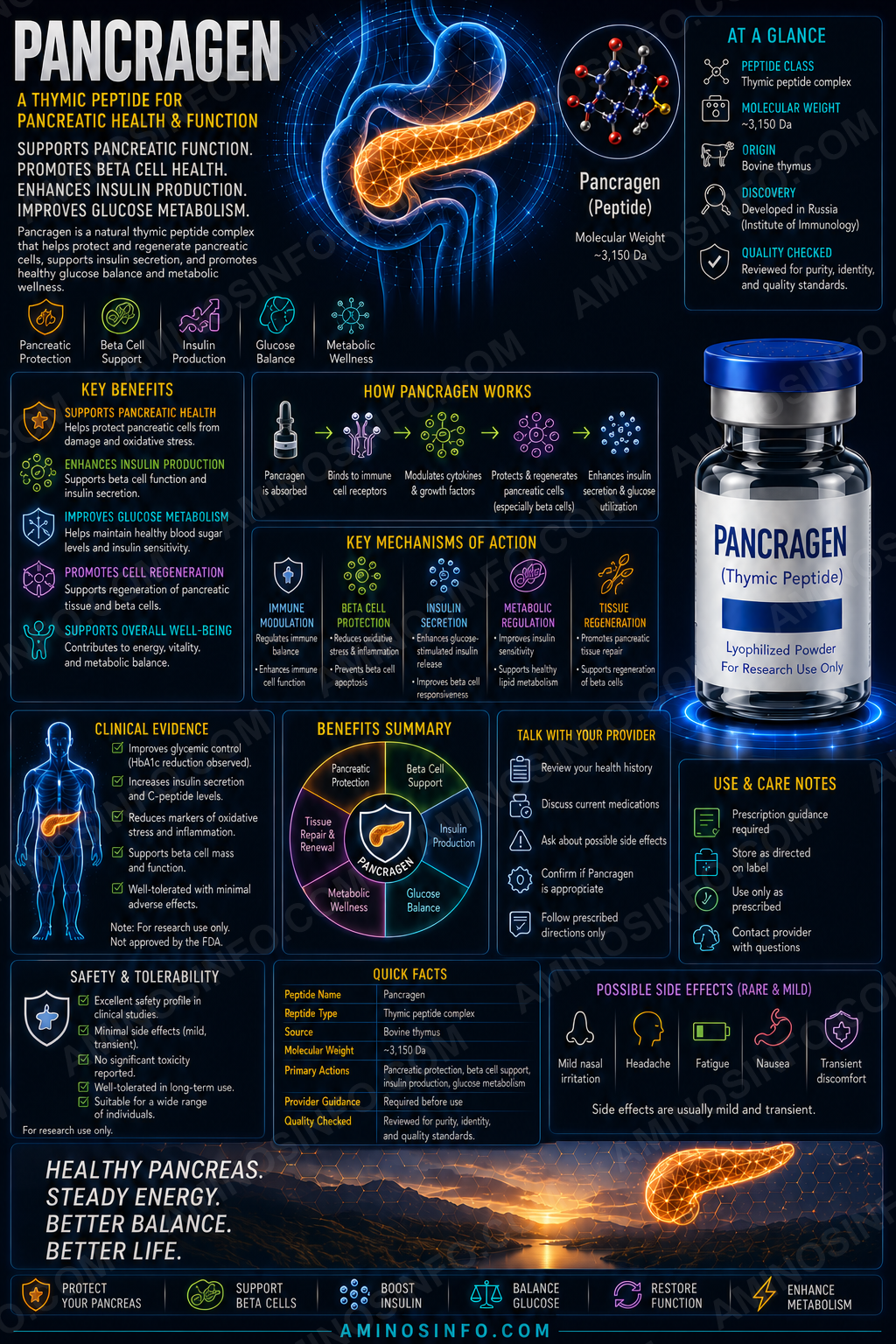
First, Pancragen scientific overview content should distinguish the verified Lys–Glu–Asp–Trp tetrapeptide from AEDG and from claims of proven diabetes or pancreatic-disease treatment. Pancragen has direct pancreatic-cell and primate research, but it remains an unapproved investigational peptide.
Important Scientific Correction
| Name | Correct sequence | Primary research association |
|---|---|---|
| Pancragen | KEDW — Lys–Glu–Asp–Trp | Moreover, Pancreatic-cell differentiation and metabolic aging |
| Epitalon | AEDG — Ala–Glu–Asp–Gly | Finally, Pineal, circadian, and aging research |
| Bronchogen | AEDL — Ala–Glu–Asp–Leu | Moreover, Bronchial and lung-cell differentiation |
| Testagen | KEDG — Lys–Glu–Asp–Gly | In addition, Short-peptide differentiation and endocrine claims |
However, Peer-reviewed Pancragen studies specifically identify the peptide as Lys–Glu–Asp–Trp. The AEDG assignment in the original draft would incorrectly make Pancragen chemically identical to Epitalon.
What Is Pancragen?
Finally, Pancragen is a synthetic tetrapeptide with the amino-acid sequence Lys–Glu–Asp–Trp, abbreviated KEDW. It was developed as a structural analog of a short peptide associated with pancreatic tissue extracts.
Importantly, Research has focused on age-related changes in pancreatic endocrine function, pancreatic-cell differentiation markers, impaired glucose tolerance, insulin and C-peptide responses, and the broader hypothesis that ultrashort peptides regulate gene expression.
Pancragen
Lys–Glu–Asp–Trp
KEDW
Linear tetrapeptide
Pancreatic differentiation and glucose regulation
No
🧬 Molecular Structure
Likewise, Pancragen is a linear tetrapeptide composed of L-lysine, L-glutamic acid, L-aspartic acid, and L-tryptophan. The standard research structure is generally represented with a free N-terminus and a free C-terminal carboxyl group.
🧪 Amino-Acid Sequence
H-Lys-Glu-Asp-Trp-OH
One-letter notation: KEDW
| Residue | Chemical feature | Analytical relevance |
|---|---|---|
| Lysine | In addition, Basic side-chain amino group | However, Contributes positive charge and counterion binding. |
| Glutamic acid | However, Acidic side-chain carboxyl group | Likewise, Can contribute to sequence isomers and cyclization-related impurities. |
| Aspartic acid | Therefore, Acidic side-chain carboxyl group | Moreover, Can undergo isomerization or form isoaspartyl-related products. |
| Tryptophan | Aromatic indole-containing residue | Finally, Provides UV absorbance near 280 nm and is susceptible to oxidation. |
⚛️ Molecular Weight and 🧫 Formula
| Neutral molecular formula | Importantly, C26H36N6O9 |
|---|---|
| Average molecular weight | Approximately 576.60 g/mol |
| Monoisotopic mass | Approximately 576.254 g/mol |
| Peptide length | Tetrapeptide; four residues |
| Expected terminal form | Moreover, Free N-terminus and free C-terminal carboxyl group |
In addition, Some vendor pages list approximately 576.25 as the “molecular weight”; this is closer to the monoisotopic mass. The average molecular weight is approximately 576.60 g/mol.
📅 Discovery Timeline
1970s–1990s: Tissue-derived peptide bioregulators investigated
However, Russian and Eastern European researchers studied low-molecular-weight peptide fractions isolated from organs, including the pancreas.
2000s: Defined KEDW synthesized
Finally, Pancragen was developed as a defined synthetic tetrapeptide intended to reproduce selected regulatory effects associated with pancreatic extracts.
2011: Elderly-human insulin-resistance report
Importantly, A regional study reported changes in carbohydrate-metabolism indices in elderly participants receiving Pancragen. Public methodological detail is limited, and the findings require independent confirmation.
2013: Pancreatic-cell differentiation study
Likewise, Pancragen increased expression of transcription factors associated with acinar and islet-cell differentiation in young and aged pancreatic-cell cultures.
2014: Nonhuman-primate endocrine study
First, A study in female rhesus monkeys evaluated Pancragen’s effects on age-related pancreatic endocrine dysfunction.
2015–2017: Impaired-glucose-tolerance comparison
Next, Older rhesus monkeys with impaired glucose tolerance were studied with Pancragen or glimepiride. Pancragen was reported to reduce basal glucose and normalize insulin and C-peptide patterns.
2021–2023: Reviews and regenerative-pancreas research cite KEDW
Moreover, Systematic reviews and pancreatic differentiation papers continued to cite KEDW as a peptide associated with expression of pancreatic developmental markers.
Current status
In addition, No large independent randomized clinical program, regulatory approval, or standard medical indication has been established.
📖 Research History
However, Pancragen research combines three main concepts: organ-derived peptide bioregulation, direct regulation of pancreatic differentiation genes, and possible correction of age-associated metabolic dysfunction.
Finally, Most positive results originate from a relatively narrow group of investigators. Independent replication, modern trial registration, full pharmacokinetics, standardized product characterization, and clinically relevant long-term outcomes remain limited.
Pancreatic Physiology
Endocrine pancreas
Importantly, The islets of Langerhans contain beta cells that produce insulin, alpha cells that produce glucagon, delta cells that produce somatostatin, PP cells that produce pancreatic polypeptide, and other specialized cell populations.
Exocrine pancreas
Likewise, Acinar cells produce digestive enzymes, while ductal cells secrete bicarbonate-rich fluid and support enzyme transport into the intestine.
Glucose-stimulated insulin secretion
First, Beta cells sense glucose through metabolic pathways that increase ATP, close ATP-sensitive potassium channels, depolarize the membrane, open calcium channels, and trigger insulin granule release.
Insulin resistance
Next, Insulin resistance arises mainly in muscle, liver, and adipose tissue. Beta cells initially compensate by increasing insulin secretion, but function may deteriorate over time.
Type 2 diabetes
Moreover, Type 2 diabetes reflects combined insulin resistance, beta-cell dysfunction, altered glucagon signaling, incretin changes, hepatic glucose production, adipose dysfunction, and other metabolic factors.
🧠 Proposed Mechanisms of Action
In addition, No single receptor-level mechanism has been validated for Pancragen. Published work emphasizes cellular differentiation and gene-expression changes.
Clinical diabetes efficacy remains unproven
1. Pancreatic transcription-factor expression
However, Cell studies reported increased expression of PDX1, PTF1A, PAX4, PAX6, FOXA2, and NKX2.2—factors involved in pancreatic development, endocrine differentiation, or mature-cell function.
2. Islet-cell differentiation hypothesis
Finally, Pancragen was reported to promote phenotypic markers associated with insulin-, glucagon-, somatostatin-, and pancreatic-polypeptide-producing cells.
3. Age-related cellular effects
Importantly, Expression of pancreatic differentiation markers declined in aged cultures, and KEDW was reported to partially restore selected markers.
4. DNA and chromatin interaction hypothesis
Likewise, Khavinson-school literature proposes direct interaction of ultrashort peptides with DNA or chromatin. The specific binding sites, affinities, intracellular concentrations, and independent reproducibility for KEDW require further validation.
5. Insulin and C-peptide regulation
First, Primate studies reported normalization of insulin and C-peptide patterns. This could reflect altered beta-cell secretion, improved insulin sensitivity, or other systemic effects, but the precise mechanism was not fully established.
🎯 Target and Pathway Profile
| Target or pathway | Evidence status |
|---|---|
| PDX1 | Moreover, Expression increased in pancreatic-cell studies. |
| PTF1A | However, Associated with acinar-cell differentiation; increased in experimental work. |
| PAX4 and PAX6 | Importantly, Pancreatic endocrine differentiation factors reported as responsive. |
| FOXA2 and NKX2.2 | First, Developmental/endocrine markers increased in cell studies. |
| Insulin receptor | Moreover, No established direct agonist activity. |
| GLP-1 receptor | However, No established direct agonist activity. |
| Finally, Sulfonylurea receptor / KATP channel | Importantly, No validated direct mechanism like glimepiride. |
| DNA or chromatin | First, Proposed interaction in short-peptide literature; exact KEDW pharmacology remains uncertain. |
Pancreatic-Cell Differentiation Research
Young and aged pancreatic cultures
Next, A 2013 study reported age-associated reductions in differentiation markers and increased marker expression after Pancragen exposure.
Acinar-cell markers
Moreover, PDX1 and PTF1A were evaluated in relation to exocrine pancreatic differentiation.
Islet-cell markers
In addition, PDX1, PAX4, PAX6, FOXA2, and NKX2.2 were evaluated as factors involved in endocrine-cell development and maturation.
Transdifferentiation interpretation
However, Changes in marker expression do not automatically prove generation of fully mature, glucose-responsive beta cells. Mature identity requires functional insulin synthesis, processing, stimulus-dependent secretion, electrophysiology, and long-term stability.
Cancer-cell-line limitations
Finally, Some work used MIA PaCa-2 cells, a pancreatic cancer-derived line. Results in transformed cells cannot be assumed to reflect normal human acinar or islet cells.
Primate and Human Metabolic Research
Female rhesus-monkey study
Importantly, Researchers evaluated age-related endocrine pancreatic changes in nonhuman primates and reported improvements in selected insulin-related measures after Pancragen.
Impaired-glucose-tolerance study
Likewise, In older monkeys with impaired glucose tolerance, Pancragen and glimepiride both reduced basal glucose. Pancragen was reported to normalize insulin and C-peptide levels, while glimepiride produced a more pronounced and delayed hypoglycemic effect.
Elderly-human report
First, A 2011 publication described Pancragen as a possible approach to insulin resistance in elderly individuals. The report is brief, regionally published, and not equivalent to a modern large randomized diabetes trial.
What remains unknown
- Long-term HbA1c effects
- Likewise, Effects on diabetes complications
- For example, Durability after treatment stops
- Moreover, Hypoglycemia risk across populations
- Finally, Interaction with insulin and glucose-lowering drugs
- Importantly, Effects on pancreatic inflammation, fibrosis, or cancer risk
Evidence Limitations and Clinical Interpretation
Small and specialized evidence base
Likewise, The direct evidence includes cell models, a limited number of primate studies, and small regional human observations.
No large randomized diabetes trials
First, No modern multicenter program establishes reductions in HbA1c, diabetes complications, hospitalization, cardiovascular events, kidney disease, retinopathy, neuropathy, or mortality.
No established beta-cell regeneration
Next, Increased developmental markers do not prove clinically meaningful regeneration of insulin-producing beta cells.
No established treatment for pancreatitis
Moreover, Pancragen has not been proven to treat acute pancreatitis, chronic pancreatitis, pancreatic pain, exocrine insufficiency, or pancreatic cysts.
No evidence for pancreatic cancer treatment
In addition, Pancragen should not be represented as preventing or treating pancreatic cancer. Increased differentiation or proliferation signals may have different implications in malignant cells.
Safety and Regulatory Considerations
No standardized human safety profile
However, No FDA-approved label defines dose, route, pharmacokinetics, contraindications, drug interactions, pregnancy safety, or long-term adverse effects.
Glucose-lowering uncertainty
Finally, If Pancragen lowers glucose or changes insulin secretion, combining it with insulin, sulfonylureas, or other medicines could theoretically increase hypoglycemia risk.
Pancreatic-cell growth and differentiation
Importantly, Any compound that changes developmental or proliferation pathways requires careful evaluation for abnormal growth, dysplasia, or tumor-related effects.
Tryptophan oxidation
Likewise, The tryptophan residue can oxidize during synthesis, storage, or light exposure, creating impurities with unknown activity.
Product-quality risk
First, Unapproved material may contain the wrong sequence, sequence isomers, free amino acids, deletion peptides, residual solvents, microbial contamination, endotoxin, or inaccurate content.
Regulatory status
Next, Pancragen is not FDA approved as a drug or biologic.
🧪 Laboratory Testing Methods
Identity, Sequence, and Stability Testing
| Method | Purpose | Important limitation |
|---|---|---|
| RP-HPLC or UPLC | In addition, Separates KEDW from deletion peptides, free amino acids, and degradants. | However, Purity does not prove sequence or biological activity. |
| LC-MS / HRMS | Confirms intact mass. | Likewise, Cannot distinguish all sequence permutations by mass alone. |
| MS/MS sequencing | Confirms Lys–Glu–Asp–Trp order. | Moreover, Requires validated fragmentation and authentic standards. |
| Chiral amino-acid analysis | However, Confirms L-Lys, L-Glu, L-Asp, and L-Trp. | Finally, Hydrolysis may create analytical artifacts. |
| Net peptide-content assay | In addition, Measures actual KEDW concentration. | First, Must not be inferred from HPLC area purity. |
| Sequence-isomer analysis | Moreover, Detects other permutations of K, E, D, and W. | In addition, Isomers may have identical mass and similar chromatography. |
| Tryptophan-oxidation analysis | However, Detects oxidized Trp-related impurities. | Importantly, Requires light- and oxygen-controlled sample handling. |
| Therefore, Pyroglutamate and isoaspartate analysis | Likewise, Evaluates cyclization and isomerization. | Next, Specialized LC-MS methods may be necessary. |
| Free amino-acid analysis | In addition, Detects hydrolysis or incomplete synthesis. | For example, Requires adequate chromatographic resolution. |
| Cell-differentiation assay | Importantly, Measures PDX1, PTF1A, PAX4, PAX6, FOXA2, or NKX2.2. | Likewise, Marker expression does not prove mature beta-cell function. |
| Insulin-secretion assay | Next, Evaluates basal and glucose-stimulated insulin release. | Moreover, Must use validated, physiologically relevant cell systems. |
| In addition, Microbial limits, sterility, and endotoxin | Moreover, Evaluates route-specific microbiological quality. | Finally, Requirements differ by intended use. |
| Stability testing | Likewise, Tracks hydrolysis, oxidation, isomerization, assay, and appearance. | First, Must reflect final formulation, packaging, light, and temperature. |
📄 How to Interpret a Pancragen COA
COA Review and Route-Specific Quality
- Next, Verify the exact sequence: H-Lys-Glu-Asp-Trp-OH or KEDW.
- Moreover, Reject AEDG labeling: AEDG is not Pancragen.
- In addition, Confirm sequence order: Intact mass alone is not enough.
- However, Verify stereochemistry: Expected material generally uses L-amino acids.
- Finally, Separate identity, purity, and net content: These are distinct measurements.
- Importantly, Review tryptophan oxidation, sequence isomers, pyroglutamate, isoaspartate, and hydrolysis.
- Likewise, Match testing to the intended route: Raw-powder purity does not establish injectable or oral suitability.
- First, Do not infer metabolic efficacy: A COA cannot prove lower glucose, higher insulin, beta-cell regeneration, diabetes control, or safety.
📊 Pancragen vs Epitalon vs Bronchogen vs Testagen
Sequence and Research-Association Differences
| Feature | Pancragen | Epitalon | Bronchogen | Testagen |
|---|---|---|---|---|
| Sequence | KEDW | AEDG | AEDL | KEDG |
| Length | Four-residue tetrapeptide | Tetrapeptide; four residues | Four-residue tetrapeptide | Tetrapeptide; four residues |
| Main research association | In addition, Pancreatic differentiation and metabolism | However, Pineal and aging research | Bronchial/lung-cell differentiation | Therefore, Differentiation and endocrine claims |
| FDA approved? | Likewise, No approved indication exists. | This remains unapproved. | For example, No FDA authorization applies. | Moreover, No approved indication exists. |
Pancragen vs GLP-1 Agonists vs Insulin vs Glimepiride
Experimental Peptide Versus Established Glucose-Lowering Therapies
| Feature | Pancragen | GLP-1 receptor agonists | Insulin | Glimepiride |
|---|---|---|---|---|
| Established target | None validated | GLP-1 receptor | Insulin receptor | SUR1/KATP channel complex |
| Main proposed effect | In addition, Differentiation and metabolic regulation | However, Glucose-dependent insulin secretion, glucagon reduction, appetite effects | Finally, Direct glucose uptake and metabolic signaling | However, Stimulates pancreatic insulin release |
| Human evidence | Limited regional studies | Large clinical programs | Extensive clinical use | Established clinical use |
| FDA approved? | This remains unapproved. | Approved products exist for specific indications. | Yes; established clinical products exist. | Regulators have approved defined products. |
Pancragen vs Pancreatic Polypeptide
| Feature | Pancragen | Pancreatic polypeptide |
|---|---|---|
| Structure | Synthetic KEDW tetrapeptide | Endogenous 36-amino-acid hormone |
| Primary biology | Experimental cell differentiation | Importantly, Y-receptor signaling, appetite, GI and pancreatic regulation |
| Same compound? | Therefore, No FDA authorization applies. | Likewise, No approved indication exists. |
🔗 Related Peptides, Hormones, and Pathways
- Moreover, Insulin: Beta-cell hormone controlling glucose and nutrient metabolism.
- In addition, Glucagon: Alpha-cell hormone increasing hepatic glucose output.
- However, GLP-1: Incretin hormone supporting glucose-dependent insulin secretion.
- Finally, PDX1: Central pancreatic development and beta-cell transcription factor.
- Importantly, PTF1A: Important in exocrine pancreatic development.
- Likewise, PAX4, PAX6, FOXA2, NKX2.2: Pancreatic endocrine differentiation factors.
- First, Epitalon: AEDG peptide distinct from Pancragen.
🖼️ Original Diagram Specifications
Diagram 1: Pancragen molecular structure
Next, Show H-Lys-Glu-Asp-Trp-OH with the lysine side-chain amine, two acidic side chains, tryptophan indole ring, peptide bonds, and free termini.
Diagram 2: Identity correction
Moreover, Contrast Pancragen KEDW with Epitalon AEDG and explain why they are not interchangeable.
Diagram 3: Pancreatic anatomy
In addition, Show exocrine acini and ducts alongside endocrine islets containing beta, alpha, delta, and PP cells.
Diagram 4: Pancreatic differentiation network
However, Show PDX1, PTF1A, PAX4, PAX6, FOXA2, and NKX2.2 across acinar and endocrine-cell pathways.
Diagram 5: Proposed KEDW mechanism
Finally, Show possible uptake, proposed nuclear interaction, transcription-factor expression, differentiation markers, and unresolved functional beta-cell outcome.
Diagram 6: Evidence ladder
Importantly, Show chemistry, cell markers, aged cultures, primate studies, small human observations, large randomized trials, and FDA approval. Place Pancragen before confirmatory clinical evidence.
Diagram 7: COA workflow
Likewise, Show exact mass, MS/MS sequence, stereochemistry, sequence isomers, tryptophan oxidation, pyroglutamate, isoaspartate, net content, microbiology, and stability.
❓ Frequently Asked Questions
Is Pancragen a peptide?
First, Yes. It is a synthetic tetrapeptide.
What is the correct sequence?
H-Lys-Glu-Asp-Trp-OH, abbreviated KEDW.
Is Pancragen AEDG?
Moreover, No. AEDG is generally identified as Epitalon.
What is its molecular weight?
In addition, Approximately 576.60 g/mol average molecular weight, with a monoisotopic mass near 576.254.
Does Pancragen increase insulin?
However, Primate studies reported normalization of insulin-related measures, but reliable large human evidence is lacking.
Does it regenerate beta cells?
Finally, No. Increased differentiation markers do not prove clinically meaningful beta-cell regeneration.
Does Pancragen treat diabetes?
Importantly, No approved indication or large confirmatory diabetes trial exists.
Does it improve insulin resistance?
Likewise, Limited regional studies suggest possible effects, but the evidence is not sufficient for routine treatment.
Can it replace insulin or metformin?
No.
Is it studied for pancreatitis?
Next, It is not an established treatment for acute or chronic pancreatitis.
Is Pancragen FDA approved?
No.
Does 99% HPLC purity prove metabolic activity?
In addition, No. Sequence, stereochemistry, net content, functional potency, pharmacokinetics, safety, and clinical outcomes must be established separately.
Pancragen Scientific Overview: Final Thoughts
However, The original draft assigned Pancragen the wrong sequence. Pancragen is the tetrapeptide Lys–Glu–Asp–Trp, not AEDG.
Finally, KEDW has direct pancreas-related research involving developmental transcription factors, young and aged pancreatic-cell cultures, nonhuman primates, and limited elderly-human metabolic observations. These findings make Pancragen more directly studied than many vendor-defined bioregulator peptides, but they still do not establish approved treatment of diabetes, insulin resistance, pancreatitis, or pancreatic insufficiency.
Importantly, Legitimate research material should be verified for exact KEDW sequence order, L-amino-acid stereochemistry, terminal chemistry, sequence isomers, tryptophan oxidation, pyroglutamate, isoaspartate, free amino acids, net peptide content, route-specific microbiological quality, and stability.
📚 References
- Likewise, Khavinson VK, et al. Effects of Pancragen on the differentiation of pancreatic cells during aging. Bulletin of Experimental Biology and Medicine. 2013.
- First, Khavinson VK, et al. Effects of Pancragen on pancreatic-cell differentiation. Springer full record. 2013.
- Next, Goncharova ND, et al. Impact of tetrapeptide Pancragen on endocrine function of the pancreas in nonhuman primates. 2014.
- Moreover, Goncharova ND, et al. Correction of impaired glucose tolerance using Pancragen and glimepiride in old rhesus monkeys. 2015.
- In addition, Korkushko OV, et al. Prospects of using Pancragen for correction of metabolic disturbances in elderly patients. 2011.
- However, Khavinson V, et al. Peptide Regulation of Gene Expression: A Systematic Review. Molecules. 2021.
- Finally, Heaton ES, et al. Extracellular matrix-derived peptide stimulates generation of islet-like organoids. 2023.
- Importantly, Khavinson VK, Kuznik BI. Peptide Bioregulators: The New Class of Geroprotectors. 2014.
- Likewise, Anisimov VN, Khavinson VK. Peptide bioregulation of aging: results and prospects. Biogerontology. 2010.
- First, Solovyev AY, et al. Interaction of amino acids, peptides, and proteins with DNA. 2015.
- Next, Daniel H. Molecular and integrative physiology of intestinal peptide transport. Annual Review of Physiology.
- Moreover, Brandsch M. Drug transport via the intestinal peptide transporter PepT1. Current Opinion in Pharmacology.
- In addition, Smith DE, Clémençon B, Hediger MA. Proton-coupled oligopeptide transporter family SLC15. Molecular Aspects of Medicine.
- However, Newstead S. Molecular insights into proton-coupled peptide transport. Trends in Pharmacological Sciences.
- Finally, Pan FC, Wright C. Pancreas organogenesis: from bud to plexus to gland. Developmental Dynamics.
- Importantly, Shih HP, Wang A, Sander M. Pancreas organogenesis: from lineage determination to morphogenesis. Annual Review of Cell and Developmental Biology.
- Likewise, Jennings RE, et al. Development of the human pancreas from foregut to endocrine commitment. Diabetes.
- First, Artner I, et al. MafA and beta-cell maturation. Diabetes.
- Next, Jonsson J, et al. PDX1 is required for pancreatic development. Nature.
- Moreover, Krapp A, et al. PTF1A controls exocrine pancreas development. Genes & Development.
- In addition, Sosa-Pineda B. The gene Pax4 is essential for differentiation of insulin-producing beta cells. Nature.
- However, St-Onge L, et al. Pax6 is required for differentiation of glucagon-producing alpha cells. Nature.
- Finally, Sussel L, et al. Mice lacking Nkx2.2 develop diabetes due to arrested pancreatic endocrine differentiation. Development.
- Importantly, Lee CS, et al. Foxa2 controls pancreatic beta-cell function and development. Genes & Development.
- Likewise, Rorsman P, Ashcroft FM. Pancreatic beta-cell electrical activity and insulin secretion. Physiological Reviews.
- First, Ashcroft FM, Rorsman P. Diabetes mellitus and the beta cell. Cell.
- Next, DeFronzo RA, Ferrannini E, Groop L, et al. Type 2 diabetes mellitus. Nature Reviews Disease Primers.
- Moreover, Holst JJ. The physiology of glucagon-like peptide 1. Physiological Reviews.
- In addition, Drucker DJ. Mechanisms of action and therapeutic application of GLP-1. Cell Metabolism.
- However, American Diabetes Association. Standards of Care in Diabetes—2026.
- Finally, Davies MJ, et al. Management of hyperglycemia in type 2 diabetes: ADA/EASD consensus.
- Importantly, International Council for Harmonisation. ICH Q2(R2): Validation of Analytical Procedures.
- Likewise, United States Pharmacopeia. General Chapter <621>, Chromatography.
- First, United States Pharmacopeia. General Chapters <61> and <62>, Microbiological Examination of Nonsterile Products.
- Next, United States Pharmacopeia. General Chapter <71>, Sterility Tests.
- Moreover, United States Pharmacopeia. General Chapter <85>, Bacterial Endotoxins Test.
- In addition, United States Pharmacopeia. General Chapters <232> and <233>, Elemental Impurities.
- However, International Council for Harmonisation. ICH Q3C: Impurities—Guideline for Residual Solvents.
- Finally, International Council for Harmonisation. ICH Q1A(R2): Stability Testing of New Drug Substances and Products.
Pancragen, Pancreatic-Cell, and Metabolic Sources
Pancreatic Biology, Diabetes, and Analytical Sources
Importantly, Identity, molecular properties, pancreatic-cell research, primate and human metabolic evidence, safety limitations, and regulatory status were reviewed in July 2026. Pancragen remains an unapproved research peptide.