PTD-DBM Scientific Overview: Structure, Mechanism, Evidence, and Testing
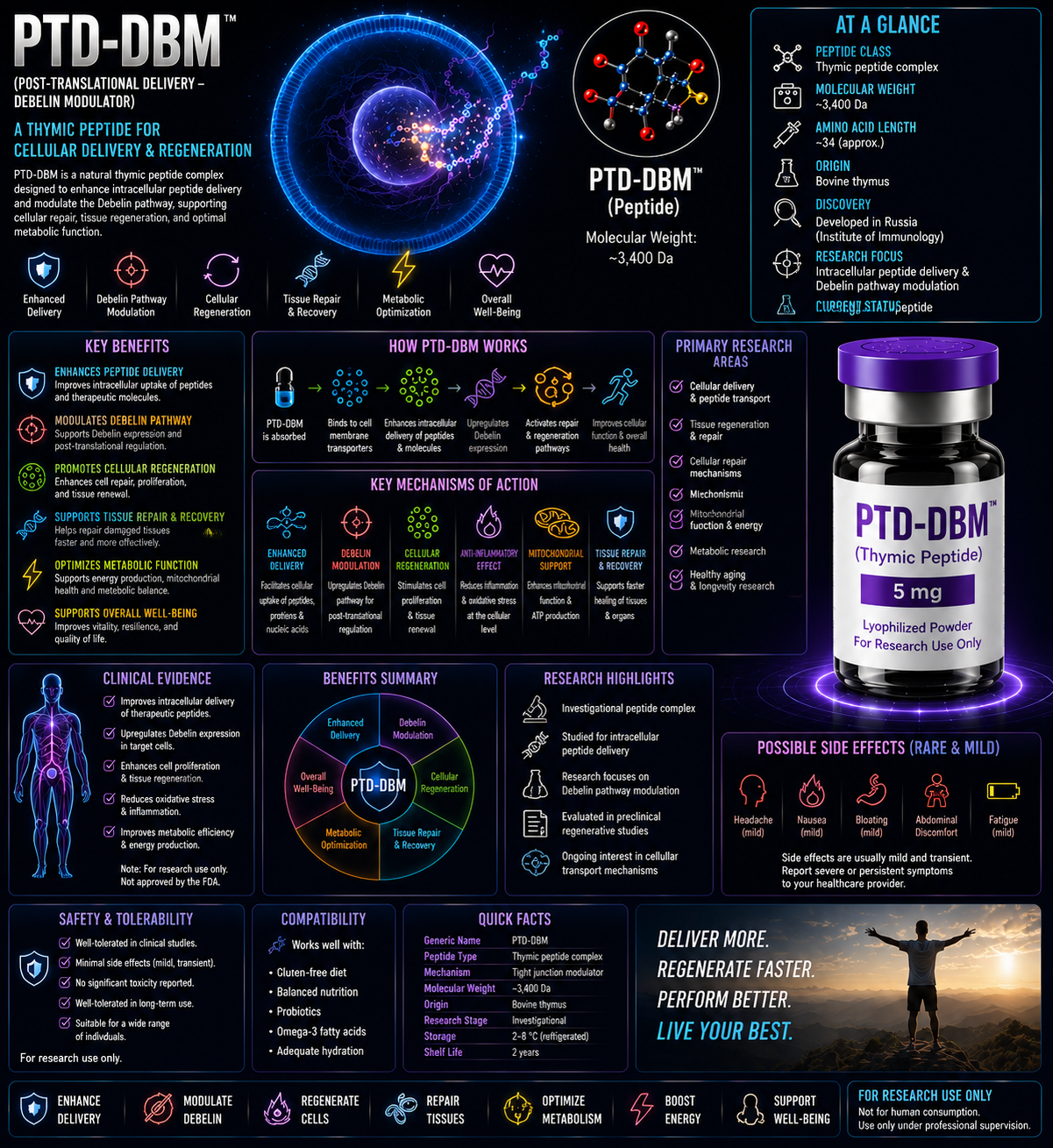
For example, PTD-DBM scientific overview content should distinguish mechanistic and animal evidence from established human efficacy. This 25-amino-acid cell-penetrating fusion peptide designed to disrupt the CXXC5–Dishevelled interaction and restore Wnt/β-catenin signaling in preclinical models.
What Is PTD-DBM?
First, PTD-DBM means protein transduction domain–fused Dishevelled-binding motif. It is a synthetic fusion peptide designed to enter cells and competitively disrupt the interaction between the cytosolic protein CXXC5 and Dishevelled (Dvl), an upstream component of canonical Wnt/β-catenin signaling.
Next, CXXC5 acts in the cytoplasm as a negative-feedback regulator of Wnt signaling by binding Dvl. For example, pTD-DBM contains the Dvl-binding motif from CXXC5, allowing the peptide to compete for Dvl binding and potentially release this inhibitory brake.
Moreover, researchers developed the peptide by researchers associated with Yonsei University and was first investigated for cutaneous wound healing, followed by hair regrowth and wound-induced hair-follicle neogenesis.
Cell-penetrating fusion peptide
25 amino acids in the commonly studied R₈-G₄-DBM construct
CXXC5–Dvl interaction
Canonical Wnt/β-catenin signaling
Hair regrowth and cutaneous wound healing
No
🧬 Molecular Structure
First, the commonly studied construct contains three functional sections:
- R₈ protein-transduction domain: First, Eight arginine residues intended to promote cellular uptake.
- G₄ linker: Next, Four glycine residues providing flexibility and spatial separation.
- DBM: Also, A 13-residue motif derived from the Dvl-binding region of CXXC5/CXXC4.
🧪 Amino-Acid Sequence
H-Arg-Arg-Arg-Arg-Arg-Arg-Arg-Arg-Gly-Gly-Gly-Gly-Arg-Lys-Thr-Gly-His-Gln-Ile-Cys-Lys-Phe-Arg-Lys-Cys-OH
One-letter notation:
RRRRRRRRGGGGRKTGHQICKFRKC
| Region | Sequence | Proposed role |
|---|---|---|
| PTD | RRRRRRRR | Meanwhile, Highly cationic cell-penetrating domain. |
| Linker | GGGG | Likewise, Flexible spacer between uptake and binding domains. |
| DBM | RKTGHQICKFRKC | In addition, Competes with CXXC5 for Dvl binding. |
⚛️ Molecular Weight and 🧫 Formula
| Reported neutral formula | Moreover, C124H225N61O28S2 |
|---|---|
| Average molecular weight | Approximately 3,082.6 g/mol |
| Peptide length | 25 amino acids |
| Approximate charge character | By contrast, Strongly cationic because of the polyarginine and lysine residues |
| C-terminal form | Also, Free carboxylic acid in the commonly listed construct |
Therefore, counterions such as trifluoroacetate or acetate can materially change gross powder weight. Meanwhile, a COA should state whether molecular content is reported as salt-free peptide, peptide salt, or “as is” material.
📅 Discovery Timeline
2000s: CXXC proteins identified as Wnt regulators
First, researchers characterized CXXC4 and CXXC5 as Dvl-binding negative-feedback regulators of canonical Wnt/β-catenin signaling.
2015: CXXC5 linked to cutaneous wound healing
Next, a study in the Journal of Experimental Medicine showed that CXXC5 binds Dvl, suppresses Wnt/β-catenin signaling, and limits cutaneous wound healing. CXXC5-deficient mice showed faster closure and increased keratin and collagen markers.
2015: PTD-DBM wound-healing patent literature
Moreover, patent filings described the R₈-fused DBM construct and reported enhanced re-epithelialization and wound-healing markers in mouse models.
2017: Hair regrowth and WIHN study
In addition, topical PTD-DBM promoted hair regrowth and wound-induced hair neogenesis in mice. Likewise, combination with valproic acid produced stronger Wnt/β-catenin activation and regenerative effects.
2021–2023: Small-molecule mimetics expand the target
Meanwhile, researchers developed compounds such as KY19382 and KY19334 to interfere with the same CXXC5–Dvl interaction, often while affecting additional Wnt-related targets.
2023: DHT–PGD₂–CXXC5 pathway described
Likewise, research linked dihydrotestosterone and prostaglandin D₂ signaling to increased CXXC5 and suppressed Wnt/β-catenin activity in androgenetic-alopecia models. In addition, pTD-DBM reversed hair suppression in experimental systems.
Current status
Finally, PTD-DBM remains a preclinical research peptide. Moreover, published work continues to investigate the CXXC5–Dvl interaction, but no FDA-approved product or established human treatment regimen exists.
CXXC5, Dishevelled, and Wnt/β-Catenin Biology
Canonical Wnt signaling
First, Wnt ligands bind Frizzled and LRP5/6 receptors. By contrast, activated Dishevelled suppresses the β-catenin destruction complex, allowing β-catenin to accumulate, enter the nucleus, and regulate genes involved in proliferation, differentiation, stem-cell behavior, and tissue remodeling.
CXXC5 as a negative-feedback regulator
Next, CXXC5 is a multifunctional protein. Also, in the nucleus, it can regulate transcription and DNA-associated processes. In the cytoplasm, it binds Dvl through its Dvl-binding motif and suppresses Wnt signaling.
Why cytosolic targeting matters
However, complete elimination of CXXC5 is not necessarily desirable because nuclear CXXC5 can support other biological functions, including aspects of endothelial differentiation and gene regulation. Consequently, pTD-DBM was designed to block the cytosolic CXXC5–Dvl interaction rather than remove all CXXC5 activity.
Hair-follicle relevance
Moreover, canonical Wnt signaling is required for hair-follicle development, anagen initiation, dermal-papilla activity, and wound-induced follicle formation. Excessive or mistimed Wnt activity, however, can also contribute to fibrosis, abnormal growth, and tumor biology.
🧠 Proposed Mechanism of Action
1. Cell entry through the polyarginine domain
First, the R₈ region interacts with negatively charged cell-surface components and promotes uptake through endocytic and other cell-penetrating-peptide mechanisms.
2. Competition for Dvl binding
Next, the DBM region resembles the CXXC5 motif that normally binds Dvl. However, the fusion peptide acts as a competitive decoy.
3. Restoration of Wnt signaling
Moreover, disrupting the inhibitory protein-protein interaction allows Dvl to participate more effectively in Wnt signal transmission, reducing β-catenin degradation.
4. β-Catenin-dependent gene expression
In addition, stabilized β-catenin enters the nucleus and associates with TCF/LEF transcription factors, increasing expression of genes involved in proliferation, migration, hair-follicle activity, and tissue repair.
5. Synergy with GSK-3β inhibition
Finally, valproic acid and some small molecules inhibit GSK-3β, another component of the β-catenin destruction machinery. Therefore, combining two mechanistically distinct Wnt-activating actions produced stronger effects in animal models.
🎯 Target and Pathway Profile
| Target or pathway | PTD-DBM relevance |
|---|---|
| CXXC5–Dvl protein interaction | Consequently, Primary intended competitive target. |
| Dishevelled | However, Direct binding partner of the DBM segment. |
| β-Catenin | Therefore, Downstream signaling effector whose stability increases indirectly. |
| GSK-3β | For example, Not directly inhibited by PTD-DBM; targeted by valproic acid and KY19382. |
| TCF/LEF transcription | Meanwhile, Downstream nuclear Wnt transcriptional output. |
| CXXC5 nuclear activity | Likewise, Not intentionally blocked by the peptide’s cytosolic competition mechanism. |
Hair-Regrowth and Follicle-Neogenesis Research
Androgenetic-alopecia models
First, researchers reported that CXXC5 to be elevated in bald human scalp samples and in androgen-related experimental models. For example, dHT increased prostaglandin D synthase and PGD₂-related signaling, which increased CXXC5 and reduced β-catenin signaling.
Mouse hair-regrowth studies
Next, topically applied PTD-DBM increased visible hair regrowth and markers including β-catenin, alkaline phosphatase, proliferating-cell nuclear antigen, keratin 14, and ERK activity in mouse models.
Wound-induced hair neogenesis
Moreover, large skin wounds in certain mammals can generate new follicles through WIHN. Meanwhile, pTD-DBM increased follicle neogenesis in mouse wounds, especially when combined with valproic acid.
Human evidence limitation
However, observing CXXC5 in human bald scalp supports target relevance but does not establish clinical efficacy. Likewise, mouse hair cycles, skin thickness, wound responses, and follicle regeneration differ substantially from human scalp biology.
Microneedling claims
Finally, microneedling is sometimes proposed as a delivery enhancer, but no standardized human PTD-DBM microneedling protocol with established safety and efficacy has been validated. In addition, barrier disruption can increase systemic exposure, irritation, infection, and off-target effects.
Wound-Healing and Tissue-Regeneration Research
Acute cutaneous wounds
First, PTD-DBM accelerated closure in mouse models and increased re-epithelialization, keratin 14, collagen I, and other repair markers.
Keratinocyte and fibroblast migration
Next, Wnt restoration increased migration and regenerative behavior in cultured skin cells.
Collagen and fibrosis balance
Moreover, collagen deposition is necessary for healing but excessive Wnt activation can contribute to fibrosis. Moreover, faster closure should not automatically be interpreted as superior scar quality.
Diabetic wounds
However, later work primarily used small-molecule CXXC5–Dvl inhibitors such as KY19334 rather than PTD-DBM itself. By contrast, these compounds improved angiogenesis and healing in diabetic mouse models. Results from related small molecules should not be automatically attributed to the peptide.
Bone and growth-plate research
Finally, the CXXC5–Dvl interaction has been studied in bone formation and growth-plate senescence, but much of this work uses genetic deletion or small-molecule inhibitors. Also, pTD-DBM should not be described as a clinically established bone-growth peptide.
Safety and Translational Limitations
No established human safety profile
First, there is no approved prescribing information, validated human dose, pharmacokinetic profile, fertility assessment, carcinogenicity program, or long-term dermatologic safety database.
Wnt-pathway risk
Importantly, Wnt/β-catenin signaling is essential for regeneration but is also involved in fibrosis and many cancers. Consequently, local, transient activation may differ from chronic or systemic activation. Long-term oncologic risk has not been established.
Cell-penetrating domain effects
Moreover, polyarginine peptides can interact nonspecifically with membranes, proteins, nucleic acids, and extracellular matrix. However, uptake is not necessarily confined to hair-follicle cells.
Highly cationic formulation behavior
In addition, the peptide may aggregate, bind container surfaces, interact with anionic excipients, or exhibit concentration-dependent cellular toxicity.
Combination with valproic acid
Likewise, valproic acid is a prescription drug with teratogenic, hepatic, neurological, and metabolic risks. Therefore, animal-study synergy does not support unsupervised topical or systemic combination use.
Commercial-product uncertainty
However, products marketed online as PTD-DBM may differ in sequence, purity, counterion, dose, vehicle, preservation, sterility, and stability. The term “hair-growth peptide” does not establish equivalence to the published construct.
Regulatory status
Finally, PTD-DBM is not FDA approved as a drug or biologic and has no established indication for androgenetic alopecia, alopecia areata, scarring alopecia, wounds, or bone regeneration.
🧪 Laboratory Testing Methods
| Method | Purpose | Important limitation |
|---|---|---|
| RP-HPLC or UPLC | In addition, Measures chromatographic purity and deletion or truncation impurities. | Moreover, Highly cationic peptides may require specialized columns and mobile phases. |
| LC-MS / HRMS | By contrast, Confirms intact molecular mass and major impurity masses. | Also, Does not prove cellular uptake or Dvl-binding activity. |
| MS/MS peptide mapping | Consequently, Confirms the R₈-G₄-DBM sequence. | However, Arginine-rich peptides can produce challenging fragmentation patterns. |
| Amino-acid analysis | Therefore, Supports composition and quantitative content. | For example, Does not independently establish sequence order. |
| Meanwhile, Thiol and disulfide analysis | Likewise, Evaluates the two cysteine residues and unintended oxidation or intermolecular disulfides. | In addition, The native listed construct is linear; oxidation can create aggregates not intended by the sequence. |
| Moreover, SEC or analytical ultracentrifugation | By contrast, Assesses aggregation and high-molecular-weight species. | Also, Small peptide aggregates may require orthogonal methods. |
| Counterion analysis | Consequently, Measures trifluoroacetate, acetate, or other synthesis-related counterions. | However, Counterion burden affects gross mass and concentration. |
| Therefore, Assay / net peptide content | For example, Measures actual PTD-DBM quantity. | Meanwhile, analysts must not infer net peptide content from HPLC area percentage. |
| Dvl-binding assay | Likewise, Measures competition with CXXC5 for Dishevelled binding. | In addition, Binding does not prove cellular or clinical efficacy. |
| Moreover, TOPFlash or β-catenin reporter assay | By contrast, Measures functional Wnt/β-catenin activation. | Strong reporter activation may also indicate off-target or unsafe pathway stimulation. |
| Cell-uptake imaging | Also, Assesses intracellular delivery of labeled peptide. | Consequently, Fluorescent labeling can alter uptake and distribution. |
| However, Microbial limits or sterility | Therefore, Evaluates microbiological quality based on product route. | For example, A cosmetic topical and an injectable require different standards. |
| Stability testing | Meanwhile, Tracks oxidation, aggregation, hydrolysis, adsorption, assay, and appearance. | Likewise, Must reflect the final vehicle, packaging, temperature, and light exposure. |
📄 How to Interpret a PTD-DBM COA
1. Verify the entire 25-residue sequence
First, the commonly studied construct is RRRRRRRRGGGGRKTGHQICKFRKC. A shorter DBM-only peptide is not the same material and may not enter cells similarly.
2. Confirm the terminal forms
Next, the published construct is commonly represented with a free N-terminus and free C-terminal carboxyl group. Acetylation or amidation changes mass, charge, and activity.
3. Separate identity, purity, and content
- Identity First, confirms the exact fusion sequence.
- Purity Next, estimates relative chromatographic composition.
- Net peptide content Also, measures actual PTD-DBM quantity after accounting for water and counterions.
4. Review cysteine oxidation
Moreover, the DBM contains two cysteine residues. Uncontrolled oxidation can produce intramolecular or intermolecular disulfides and alter binding or aggregation.
5. Check aggregation and adsorption
In addition, arginine-rich peptides can bind glass, plastics, filters, excipients, and anionic surfaces. Recovery and concentration should be validated.
6. Require functional testing for mechanistic claims
Likewise, laboratories should test a high-purity peptide for Dvl competition, Wnt reporter activity, or another validated functional endpoint before claiming equivalence to published PTD-DBM.
7. Do not infer human hair growth from a COA
However, a COA establishes analytical properties of a batch. It cannot demonstrate scalp penetration, follicular target engagement, hair-count improvement, or long-term safety.
📊 PTD-DBM vs GHK-Cu vs BPC-157 vs Thymosin Beta-4
Mechanisms and Evidence Differences
| Feature | PTD-DBM | GHK-Cu | BPC-157 | Thymosin Beta-4 / TB-500 |
|---|---|---|---|---|
| Compound type | 25-residue fusion peptide | Copper-binding tripeptide complex | 15-residue synthetic peptide | In addition, 43-residue endogenous peptide; TB-500 products may differ |
| Main research focus | Moreover, CXXC5–Dvl and Wnt signaling | By contrast, Matrix remodeling, skin, and hair biology | Preclinical tissue-injury models | Also, Actin dynamics, migration, and repair |
| Primary proposed target | CXXC5–Dvl interaction | Consequently, Multiple copper-dependent and gene-regulatory pathways | However, No single validated receptor target | Therefore, G-actin binding and cell migration |
| Hair evidence | For example, Mouse regrowth and WIHN models | Meanwhile, Preclinical and cosmetic research | Likewise, Not a primary established hair target | Limited hair-related research |
| Human efficacy trials | In addition, No established completed program | Moreover, Limited and formulation specific | By contrast, No major formal efficacy trials | Also, Limited for specific medical formulations |
| FDA approved? | The FDA has not approved this compound. | No approved indication exists. | Regulators have not granted approval. | Consequently, No FDA-approved TB-500 product |
PTD-DBM vs Minoxidil vs Finasteride
Preclinical Peptide Versus Approved Hair-Loss Drugs
| Feature | PTD-DBM | Minoxidil | Finasteride |
|---|---|---|---|
| Development status | Preclinical experimental peptide | However, FDA-approved topical hair-loss drug | Therefore, FDA-approved oral drug for male pattern hair loss |
| Main mechanism | For example, Disrupts CXXC5–Dvl inhibition of Wnt | Meanwhile, Multiple follicular and vascular mechanisms | Likewise, Type II 5α-reductase inhibition and reduced DHT |
| Human evidence | Not established | Extensive | In addition, Extensive in indicated men |
| Major limitation | Moreover, Unknown human safety and efficacy | By contrast, Ongoing use and irritation or unwanted hair growth | Also, Sexual, reproductive, and other adverse effects; pregnancy restrictions |
PTD-DBM vs KY19382 and KY19334
| Property | PTD-DBM | KY19382 | KY19334 |
|---|---|---|---|
| Type | Fusion peptide | Small molecule | Small molecule |
| CXXC5–Dvl inhibition | For example, Yes; the study reported this target. | Moreover, Yes; the study reported this target. | In addition, Yes; the study reported this target. |
| Additional GSK-3β activity | Consequently, No established direct inhibition | However, Yes; the study reported this target. | However, Mechanism differs by study |
| Main published models | Therefore, Hair regrowth and acute wound healing | For example, Hair, bone, and wound models | Meanwhile, Diabetic wound and metabolic models |
| Same compound? | This remains unapproved. | No FDA approval applies. | Approval has not been established. |
🔗 Related Proteins and Pathways
- CXXC5: First, Nuclear and cytosolic regulatory protein that inhibits Dvl-dependent Wnt signaling in the cytoplasm.
- Dishevelled: Next, Central Wnt signal-transduction scaffold.
- β-Catenin: Also, Canonical Wnt effector controlling gene transcription.
- GSK-3β: Moreover, Part of the β-catenin destruction complex.
- PGD₂: In addition, Prostaglandin implicated in androgenetic-alopecia signaling.
- Valproic acid: Likewise, Prescription drug and GSK-3β-related Wnt activator used in preclinical combination studies.
- KY19382 and KY19334: Finally, Small-molecule inhibitors developed around the CXXC5–Dvl target.
🖼️ Original Diagram Specifications
Diagram 1: PTD-DBM domain map
Likewise, Show the 25-residue peptide divided into R₈ protein-transduction domain, G₄ linker, and 13-residue DBM. Highlight the two cysteines and the strongly cationic arginine-rich region.
Diagram 2: CXXC5–Dvl inhibitory complex
In addition, Illustrate cytosolic CXXC5 binding Dishevelled and suppressing β-catenin stabilization.
Diagram 3: Competitive-decoy mechanism
Moreover, Show PTD-DBM entering a cell, binding Dvl, displacing CXXC5, stabilizing β-catenin, and increasing TCF/LEF transcription.
Diagram 4: Hair-cycle pathway
By contrast, Show DHT → prostaglandin D synthase → PGD₂ → CXXC5 increase → Wnt suppression, with PTD-DBM acting only at the CXXC5–Dvl step.
Diagram 5: Wound-induced hair neogenesis
Also, Show a large mouse skin wound, re-epithelialization, Wnt activation, placode formation, and new follicle development. Clearly label the model as preclinical and species dependent.
Diagram 6: COA workflow
Consequently, Show sequence verification, intact mass, MS/MS mapping, cysteine oxidation, aggregation, counterion, net content, Dvl binding, Wnt reporter testing, microbiology, and stability.
❓ Frequently Asked Questions
Is PTD-DBM a peptide?
Yes. First, the commonly studied construct is a synthetic 25-amino-acid fusion peptide.
What is the sequence?
However, The commonly published R₈-G₄-DBM construct is RRRRRRRRGGGGRKTGHQICKFRKC.
What does PTD mean?
Therefore, Protein transduction domain. In this construct, eight arginine residues are used to promote cellular uptake.
What does DBM mean?
For example, Dishevelled-binding motif. It is the peptide region intended to compete with CXXC5 for Dvl binding.
Does PTD-DBM regrow human hair?
Meanwhile, Human efficacy has not been established. Published evidence is mainly from cells, mouse skin, organ culture, and mechanistic studies.
Is PTD-DBM FDA approved?
No.
Is it the same as minoxidil or finasteride?
Likewise, No. It is an experimental Wnt-pathway peptide, whereas minoxidil and finasteride are approved drugs with substantial human evidence.
Does it directly activate Wnt receptors?
In addition, No. It is designed to remove CXXC5-mediated inhibition of Dishevelled, indirectly restoring canonical Wnt signaling.
Is PTD-DBM the same as KY19382?
No. KY19382 is a small molecule that targets CXXC5–Dvl and also affects GSK-3β. PTD-DBM is a peptide decoy.
Could Wnt activation be risky?
Moreover, Yes. Wnt signaling is involved in regeneration, fibrosis, and cancer biology. Long-term or off-target safety is not established.
Does a 99% HPLC result prove the peptide is active?
By contrast, No. The sequence, terminal forms, cysteine state, aggregation, net content, cellular uptake, Dvl binding, and functional Wnt activity must be assessed separately.
PTD-DBM Scientific Overview: Final Thoughts
In conclusion, PTD-DBM is a mechanistically targeted cell-penetrating fusion peptide designed to disrupt the inhibitory CXXC5–Dishevelled protein interaction. In preclinical models, this restored Wnt/β-catenin signaling and promoted hair regrowth, wound healing, and wound-induced hair-follicle neogenesis.
However, the concept is scientifically compelling because it targets a defined protein-protein interaction rather than broadly stimulating growth. However, Wnt biology is highly context dependent, and mouse regenerative outcomes cannot be assumed to translate to human scalp treatment.
Finally, PTD-DBM remains experimental. No approved formulation, standardized human dose, established clinical efficacy, or long-term safety profile exists. Analytical evaluation must verify the complete 25-residue construct, cysteine oxidation state, aggregation, counterion burden, net peptide content, and functional Dvl/Wnt activity.
📚 References
- Therefore, Lee SH, Seo SH, Lee DH, et al. Targeting of CXXC5 by a competing peptide stimulates hair regrowth and wound-induced hair neogenesis. Journal of Investigative Dermatology. 2017;137:2260–2269.
- Likewise, Lee SH, Kim MY, Kim HY, et al. The Dishevelled-binding protein CXXC5 negatively regulates cutaneous wound healing. Journal of Experimental Medicine. 2015.
- For example, Ryu YC, et al. CXXC5 mediates DHT-induced androgenetic alopecia via PGD₂. Cells. 2023.
- Moreover, Ryu YC, et al. CXXC5 mediates DHT-induced androgenetic alopecia via PGD₂. Full text.
- In addition, United States Patent Application. Composition for promoting wound healing. Includes R₈ PTD and DBM sequence disclosures.
- However, European Patent Application. Composition for promoting wound healing. Includes DBM sequence RKTGHQICKFRKC.
- Therefore, Korean Patent KR101721028B1. Protein-transduction domains and DBM wound-healing compositions.
- Likewise, Kim E, et al. Inhibiting the cytosolic function of CXXC5 accelerates diabetic wound healing by enhancing angiogenesis and skin repair. Experimental & Molecular Medicine. 2023.
- For example, Kim E, et al. Inhibiting the cytosolic function of CXXC5 accelerates diabetic wound healing. Full text.
- Moreover, Choi S, et al. Approaches for regenerative healing of cutaneous wounds. 2023.
- In addition, Yoon M, et al. KY19382 accelerates cutaneous wound healing via activation of Wnt/β-catenin signaling. 2023.
- However, Ryu YC, et al. KY19382, a novel activator of Wnt/β-catenin signaling, promotes hair regrowth and hair-follicle neogenesis. 2021.
- Therefore, Mehta A, et al. Follicle neogenesis, Wnt/β-catenin signaling, and emerging hair-loss therapies. 2025.
- Likewise, Mehta A, et al. Follicle neogenesis, Wnt/β-catenin signaling, and emerging therapies. Full text.
- For example, Fan C, et al. Overview of short peptides for hair loss. 2026.
- Moreover, Lee SH, et al. Molecular signaling pathways in wound-induced hair-follicle neogenesis. 2025.
- In addition, Xiong X, et al. CXXC5: a regulator and coordinator of TGF-β, BMP, and Wnt signaling. 2018.
- However, Ayaz G, et al. A prelude to proximity interaction mapping of CXXC5. Scientific Reports. 2021.
- Therefore, Clevers H, Nusse R. Wnt/β-catenin signaling and disease. Cell. 2012.
- Likewise, Nusse R, Clevers H. Wnt/β-catenin signaling, disease, and emerging therapeutic modalities. Cell. 2017.
- For example, MacDonald BT, Tamai K, He X. Wnt/β-catenin signaling: components, mechanisms, and diseases. Developmental Cell. 2009.
- Moreover, Stamos JL, Weis WI. The β-catenin destruction complex. Cold Spring Harbor Perspectives in Biology. 2013.
- In addition, Lim X, Nusse R. Wnt signaling in skin development, homeostasis, and disease. Cold Spring Harbor Perspectives in Biology. 2013.
- However, Myung PS, et al. Wnt signaling in hair-follicle development and regeneration. Journal of Clinical Investigation.
- Therefore, Ito M, et al. Wnt-dependent de novo hair-follicle regeneration in adult mouse skin after wounding. Nature. 2007.
- Likewise, Gay D, et al. Fgf9 from dermal γδ T cells induces hair-follicle neogenesis after wounding. Nature Medicine. 2013.
- Garza LA, et al. Prostaglandin D₂ inhibits hair growth and is elevated in bald scalp. Science Translational Medicine. 2012.
- Kang JI, et al. Wnt pathway activation and hair-follicle regeneration. Experimental Dermatology.
- Guschin DY, et al. Cell-penetrating polyarginine peptides: uptake, endocytosis, and cargo delivery. Reviews in peptide delivery literature.
- Futaki S. Membrane-permeable arginine-rich peptides and transport mechanisms. Advanced Drug Delivery Reviews.
- Bechara C, Sagan S. Cell-penetrating peptides: mechanisms and applications. FEBS Letters. 2013.
- Kristensen M, Birch D, Mørck Nielsen H. Applications and challenges for cell-penetrating peptides. International Journal of Molecular Sciences. 2016.
- International Council for Harmonisation. ICH Q2(R2): Validation of Analytical Procedures.
- United States Pharmacopeia. General Chapter <621>, Chromatography.
- United States Pharmacopeia. General Chapters <61> and <62>, Microbiological Examination of Nonsterile Products.
- United States Pharmacopeia. General Chapter <71>, Sterility Tests.
- United States Pharmacopeia. General Chapter <85>, Bacterial Endotoxins Test.
- International Council for Harmonisation. ICH Q3C: Impurities—Guideline for Residual Solvents.
- International Council for Harmonisation. ICH Q6B: Specifications—Test Procedures and Acceptance Criteria for Biotechnological/Biological Products.
- International Council for Harmonisation. ICH Q1A(R2): Stability Testing of New Drug Substances and Products.
PTD-DBM, CXXC5, and Regeneration Sources
Wnt Biology, Delivery, and Analytical Sources
Sequence, mechanism, animal evidence, wound-healing research, and current translational status were reviewed in July 2026. Finally, PTD-DBM remains an unapproved preclinical research peptide.