Semax: What It Is, How It Works, Benefits, and Research Overview
A corrected, evidence-graded review of Semax, including its seven-amino-acid ACTH-derived sequence, molecular properties, PGP stabilization, neurotrophin and gene-expression research, BDNF/TrkB signaling, ischemic-stroke models and regional clinical studies, cognition, stress, inflammation, optic-nerve research, safety, analytical testing, and COA interpretation.
What Is Semax?
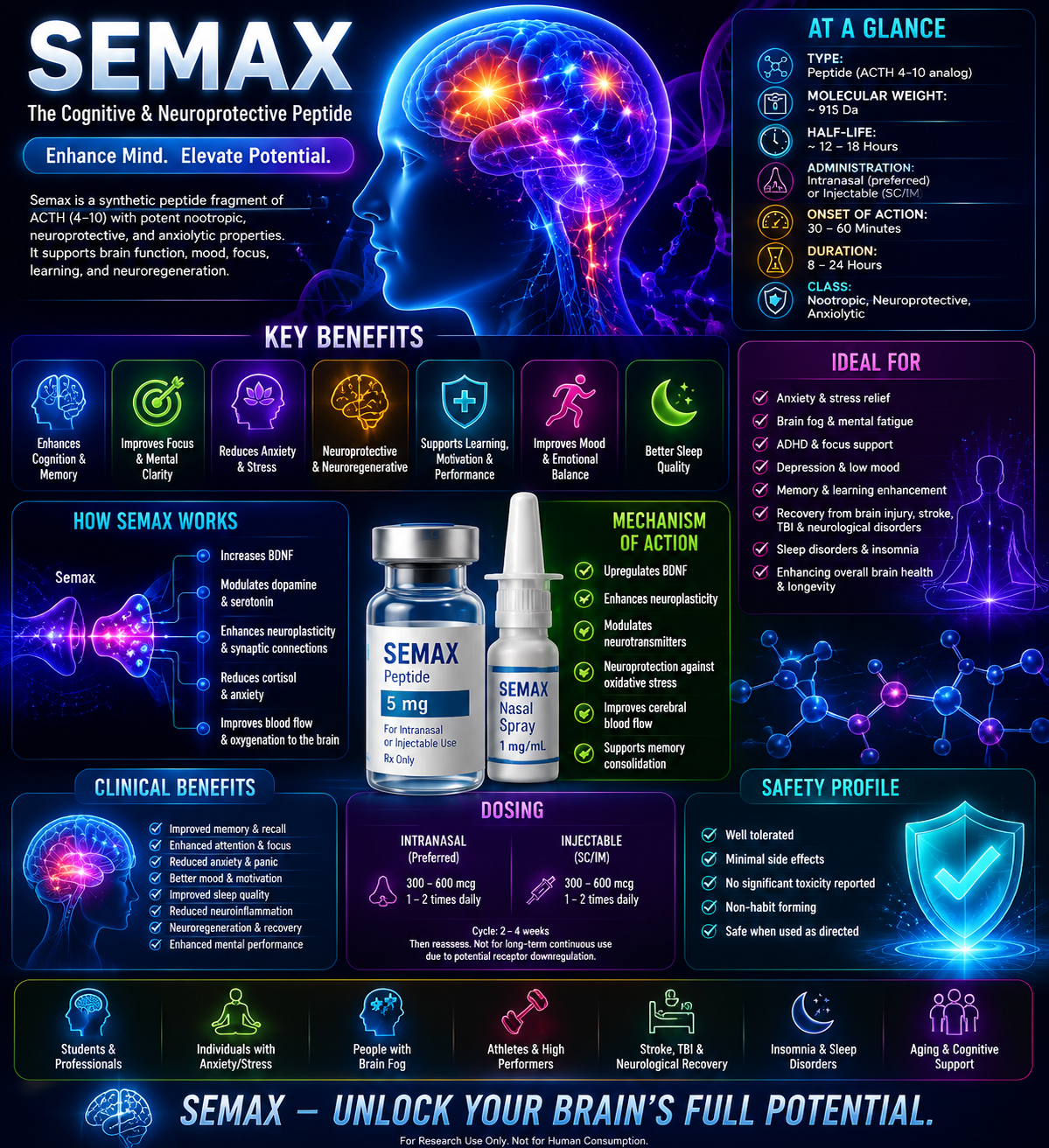
Semax is a synthetic heptapeptide developed from a short fragment of adrenocorticotropic hormone (ACTH). It combines the ACTH(4–7) sequence Met-Glu-His-Phe with the C-terminal tripeptide Pro-Gly-Pro.
The design aimed to retain neuroactive properties associated with the ACTH fragment while removing corticotropic and adrenal-stimulating activity. The PGP tail was added to improve resistance to enzymatic degradation.
Met-Glu-His-Phe-Pro-Gly-Pro
MEHFPGP
7 amino acids
C₃₇H₅₁N₉O₁₀S
Approximately 813.9 g/mol
No
Researchers investigate Semax in relation to:
- Cerebral ischemia and stroke recovery
- BDNF, NGF, and neurotrophin signaling
- Learning, memory, and attention
- Stress and fatigue adaptation
- Inflammatory and immune signaling
- Oxidative stress and mitochondrial stability
- Optic-nerve and retinal injury
- Monoamine and dopaminergic signaling
🧬 Molecular Structure
🧪 Complete amino-acid sequence
L-Methionyl-L-Glutamyl-L-Histidyl-L-Phenylalanyl-L-Prolyl-Glycyl-L-Proline
Met-Glu-His-Phe-Pro-Gly-Pro
MEHFPGP
Terminal chemistry
The classical free peptide is generally represented as:
H-Met-Glu-His-Phe-Pro-Gly-Pro-OH
Structural characteristics
- Seven amino acids
- Linear peptide
- No cysteine residues
- No disulfide bonds
- One methionine residue vulnerable to oxidation
- Two proline residues that influence conformation and protease resistance
- PGP tail associated with metabolic stabilization
⚛️ Molecular Weight and 🧫 Formula
| Molecular formula | C37H51N9O10S |
|---|---|
| Average molecular weight | Approximately 813.9 g/mol |
| Monoisotopic mass | Approximately 813.348 Da |
| Common CAS number | 80714-61-0 |
| PubChem CID | 9811102 |
| Disulfide bonds | None |
Semax acetate
Semax acetate is a salt form with a different total formula and molecular weight. PubChem lists Semax acetate as C₃₉H₅₅N₉O₁₂S with a molecular weight near 874.0 g/mol. A COA must specify whether results refer to the free peptide or acetate salt.
📅 Discovery Timeline and Research History
1970s–1980s: ACTH fragment research
Researchers investigated short ACTH fragments for behavioral and neurological effects independent of adrenal stimulation.
1980s–1990s: Semax development
Russian peptide researchers fused ACTH(4–7) to Pro-Gly-Pro to create a more metabolically stable neuroactive compound.
1990s: Stroke and cognition studies
Preclinical and regional human studies examined Semax in acute ischemic stroke, memory, attention, and prolonged mental work.
1997–1999: Clinical stroke publications
Russian studies reported faster neurological recovery and explored immunobiochemical mechanisms in acute hemispheric ischemic stroke.
2006: BDNF/TrkB research
Studies reported that intranasal Semax increased BDNF and influenced TrkB-related signaling in rat basal forebrain and hippocampus.
2009–2010: Neurotrophin transcription after ischemia
Semax and PGP were reported to regulate Bdnf, Ngf, and receptor transcripts after middle cerebral artery occlusion.
2014: Transcriptome study
Genome-wide analysis found broad changes in immune, vascular, neurotransmitter, and trophic-response genes in ischemic rat cortex.
2018: Regional stroke rehabilitation study
A study of stroke patients reported increased plasma BDNF and faster motor recovery when Semax was combined with early rehabilitation.
2020–2025: Multi-omics and mechanistic studies
Transcriptomic and proteomic research continued to map inflammatory, vascular, mitochondrial, and synaptic pathways.
Current status
Semax remains regionally registered in Russia but lacks FDA approval and broad independent international clinical validation.
ACTH Origin and PGP Stabilization
ACTH(4–7)
The N-terminal four-residue core is Met-Glu-His-Phe, corresponding to positions 4–7 of ACTH.
No corticotropic activity
Semax was designed to lack the hormonal activity of full-length ACTH and is not considered a replacement for ACTH, cortisol, or adrenal hormones.
PGP tail
Pro-Gly-Pro is a naturally occurring peptide motif associated with protease resistance and biological signaling.
Hybrid concept
The ACTH fragment provides neuroactive signaling, while the PGP tail improves stability and may contribute independent anti-inflammatory or vascular effects.
Not ACTH(4–10)
Older literature sometimes calls Semax an ACTH(4–10) analogue because it occupies a similar seven-residue design space. The actual commercial/reference sequence is ACTH(4–7)-PGP, not unmodified ACTH(4–10).
🧠 Proposed Mechanism of Action
1. Neurotrophin regulation
Semax rapidly alters BDNF, NGF, and receptor expression in rat brain.
2. Gene-expression modulation
Transcriptomic studies show broad regulation of immune, vascular, synaptic, neurotransmitter, and stress-response genes.
3. Anti-inflammatory signaling
Semax suppresses selected pro-inflammatory transcripts after experimental cerebral ischemia.
4. Vascular and nitric-oxide pathways
Research describes effects on vascular signaling, nitric-oxide synthesis, and cerebral perfusion-related pathways.
5. Mitochondrial stabilization
Cell and animal studies report improved resistance to calcium dysregulation, oxidative stress, and mitochondrial injury.
6. Monoamine modulation
Dopamine, serotonin, and other neurotransmitter systems may be altered, but no single direct receptor explains the full profile.
🎯 Receptor and Signaling Profile
| Target or pathway | Evidence status |
|---|---|
| Melanocortin receptors | Semax is ACTH-derived, but classical melanocortin-receptor agonism does not fully explain its effects. |
| BDNF | Expression and protein levels increased in several rat studies. |
| TrkB | Expression and activation influenced in hippocampal and basal-forebrain research. |
| NGF | Transcript regulation reported after cerebral ischemia. |
| Inflammatory mediators | Multiple cytokine and immune transcripts altered after ischemia. |
| Nitric oxide | Inhibition or modulation reported in selected models. |
| Dopamine pathways | Changes in dopamine-related behavior and neurochemistry reported. |
| Single validated receptor | Not established. |
BDNF, NGF, and TrkB Research
BDNF expression
Intranasal Semax increased BDNF expression in rat hippocampus and basal forebrain within hours.
TrkB signaling
Changes in TrkB receptor expression and activation were reported, supporting a neuroplasticity-related mechanism.
NGF expression
NGF and its receptor transcripts changed after permanent middle cerebral artery occlusion and Semax administration.
Timing dependence
Neurotrophin responses vary across minutes, hours, and brain regions.
BDNF is not a direct receptor
Semax appears to regulate the BDNF system rather than act as BDNF itself.
Clinical biomarker finding
A regional stroke-rehabilitation study reported increased plasma BDNF, but plasma levels do not necessarily reflect brain BDNF or prove mechanism.
Transcriptomic and Proteomic Research
Ischemic cortex transcriptome
A 2014 study reported hundreds of gene-expression changes after Semax treatment in focal cerebral ischemia.
Functional categories
- Immune and inflammatory signaling
- Vascular development and blood flow
- Neurotransmitter and receptor pathways
- Neurotrophin signaling
- Cell death and survival
- Extracellular-matrix remodeling
Proteomic studies
Protein-expression profiling after ischemia–reperfusion identified changes consistent with neuroprotection, metabolism, synaptic function, and stress response.
Mechanistic limitation
Large gene or protein panels show downstream biological response but do not identify a single direct molecular target.
Stroke and Cerebral-Ischemia Research
Animal models
Semax has been evaluated in permanent and transient middle cerebral artery occlusion, global ischemia, and ischemia–reperfusion models.
Reported effects
- Reduced infarct-related injury
- Improved motor and neurological performance
- Improved memory after ischemia
- Reduced inflammatory gene expression
- Altered vascular and trophic signaling
- Improved mitochondrial and antioxidant responses
PGP contribution
PGP alone also alters selected neurotrophin and inflammatory pathways, suggesting that Semax metabolites may contribute to activity.
Translation limitation
Rodent stroke models do not reproduce all human variables, including age, comorbidities, thrombus biology, reperfusion timing, rehabilitation, and polypharmacy.
No replacement for emergency care
Semax does not replace thrombolysis, thrombectomy, antiplatelet treatment, blood-pressure management, statins, or rehabilitation.
Regional Human Stroke Studies
1997 acute-stroke study
A Russian study reported faster regression of cerebral and focal neurological deficits when Semax was added to intensive treatment.
1999 mechanistic clinical study
Investigators examined immune and biochemical markers in acute ischemic stroke and described angioprotective, antihypoxic, and neurotrophic activity.
2018 rehabilitation study
A study involving 110 patients reported that Semax plus early rehabilitation increased plasma BDNF, accelerated functional recovery, and improved motor performance.
Evidence limitations
- Regional publication
- Limited independent replication
- Unclear comparability with modern stroke care
- Variable blinding and allocation details
- Limited long-term disability outcomes
- No broad international regulatory review
Clinical interpretation
The regional studies are more substantial than the evidence for many experimental peptides, but they remain insufficient for FDA approval or universal treatment recommendations.
Learning, Memory, and Attention Research
Healthy-animal studies
Semax improved passive avoidance, food-motivated learning, and other cognitive tasks in rodents.
Stress-impaired memory
Protective effects were reported in models where stress impaired learning.
Human mental-work study
A small 1990s study reported improved attention and short-term memory during prolonged work, especially when subjects were fatigued.
Functional imaging
A small Russian study reported changes in default-mode-network activity after Semax.
No established healthy-person nootropic effect
No large, independently replicated, placebo-controlled international trial proves improved memory, IQ, executive function, academic performance, or productivity.
Stress, Fatigue, and Behavioral Research
Stress adaptation
Semax has been studied in immobilization, emotional stress, hypoxia, sleep disruption, and prolonged mental-work models.
Fatigue-related performance
Some studies suggest benefits are more apparent under fatigue than at baseline.
Anxiety-like behavior
Animal studies report context-dependent changes, but Semax is not an established anxiolytic.
Depression-related research
Neurotrophin changes create theoretical interest, but no robust clinical antidepressant evidence exists.
Not a stimulant
Semax does not work like amphetamine or methylphenidate, although behavioral activation or altered attention may occur.
Inflammation and Immune-Signaling Research
Post-ischemic inflammation
Semax reduced transcripts encoding selected pro-inflammatory mediators after reversible brain ischemia.
Immune-gene regulation
Transcriptomic studies found broad changes in innate and adaptive immune pathways.
Neuroinflammation
Reduced glial and cytokine signaling may contribute to neuroprotection.
Context dependence
Immune suppression and immune normalization are not equivalent, and the direction of effect may vary by timing and tissue.
No immune indication
Semax is not an approved treatment for autoimmune disease, infection, immune deficiency, or systemic inflammatory disorders.
Mitochondrial and Oxidative-Stress Research
Calcium stress
Semax has been reported to stabilize mitochondria during calcium-flow dysregulation.
Oxidative injury
Antioxidant and antihypoxic effects are reported in neuronal and ischemic models.
Energy metabolism
Proteomic and transcriptomic data suggest changes in mitochondrial enzymes and cellular metabolism.
Cell-survival signaling
Reduced apoptosis and improved resistance to ischemic stress have been described.
No mitochondrial-disease evidence
Semax is not an approved treatment for inherited mitochondrial disorders or systemic energy deficiency.
Optic-Nerve and Retinal Research
Optic-nerve disease
Regional literature describes Semax use or research in optic-nerve injury and ischemic optic neuropathy.
Neurotrophic rationale
BDNF, NGF, inflammation, and vascular signaling are relevant to retinal ganglion-cell and optic-nerve survival.
Evidence limitations
Large internationally replicated ophthalmology trials are lacking.
No replacement for ophthalmic care
Semax does not replace urgent evaluation for acute vision loss, glaucoma treatment, vascular management, or evidence-based retinal therapy.
Dopamine and Monoamine Research
Dopaminergic signaling
Animal research suggests Semax can alter dopamine release, turnover, receptor-related behavior, or locomotor responses.
Serotonin and norepinephrine
Changes in other monoamine systems have also been reported.
Not a direct dopamine agonist
Semax does not act like levodopa, pramipexole, ropinirole, or amphetamine.
Behavioral interpretation
Improved attention or stress resilience may arise from neurotrophin and network effects rather than direct monoamine-receptor stimulation.
Intranasal Delivery and Pharmacokinetics
Regional formulation
Semax is most commonly described as an intranasal pharmaceutical in Russia.
Nose-to-brain rationale
Intranasal delivery may provide access through olfactory and trigeminal pathways while also allowing systemic absorption.
Rapid degradation
Semax can be cleaved into shorter fragments, including PGP-containing metabolites that may retain activity.
Human pharmacokinetic gaps
Modern data on absolute bioavailability, plasma half-life, brain concentration, active metabolites, and exposure-response relationships remain limited.
Device and formulation matter
Nasal deposition, pH, tonicity, preservative, droplet size, mucociliary clearance, and spray-device performance can substantially change exposure.
Evidence Limitations and Clinical Interpretation
Regional evidence concentration
Most clinical studies were conducted in Russia or post-Soviet states.
Limited independent replication
Few large trials have been reproduced by unaffiliated international groups.
Modern standard-of-care differences
Older stroke studies may not reflect current thrombectomy, thrombolysis, intensive monitoring, and rehabilitation practices.
Mechanism remains broad
BDNF, NGF, TrkB, immune genes, nitric oxide, monoamines, mitochondria, and vascular pathways may all contribute, but a primary receptor is not established.
Healthy-user claims exceed evidence
Online claims about dramatic focus, intelligence, mood, and productivity are not supported by robust clinical trials.
No FDA approval
Regional approval does not establish U.S. regulatory approval or equivalent evidence standards.
Safety and Regulatory Considerations
Regional tolerability
Russian clinical literature generally describes Semax as well tolerated, but comprehensive internationally reviewed safety data are limited.
Potential adverse effects
- Nasal irritation or dryness
- Headache
- Dizziness
- Agitation or restlessness
- Sleep disturbance
- Changes in mood or attention
- Allergic reaction
- Unknown blood-pressure or autonomic effects
Methionine oxidation
The N-terminal methionine is chemically vulnerable to oxidation, which may alter potency or create impurities.
Drug interactions
Interactions with antidepressants, stimulants, antipsychotics, antiseizure medicines, anticoagulants, or stroke medications are not adequately characterized.
Pregnancy, lactation, and pediatrics
U.S.-standard safety data are inadequate.
Regulatory status
Semax is not FDA approved. It is regionally registered as a pharmaceutical in Russia.
🧪 Laboratory Testing Methods
| Method | Purpose | Important limitation |
|---|---|---|
| RP-HPLC / UPLC | Separates full-length Semax from deletion peptides, PGP fragments, and degradants. | Area purity does not prove sequence or net content. |
| LC-HRMS | Confirms intact mass and elemental composition. | Sequence isomers and epimers may share mass. |
| MS/MS sequencing | Confirms MEHFPGP residue order. | Requires careful interpretation of proline-rich fragments. |
| Edman degradation | Orthogonally confirms N-terminal sequence. | Less sensitive for trace impurities. |
| Amino-acid analysis | Confirms composition and supports net-content measurement. | Does not prove sequence order. |
| Chiral amino-acid analysis | Confirms L-amino-acid configuration and detects epimers. | Hydrolysis may introduce artifacts. |
| Methionine-oxidation assay | Detects methionine sulfoxide and sulfone. | Requires stability-indicating LC-MS. |
| Histidine and tryptophan-like oxidation screen | Detects oxidative side products affecting potency. | Method must be tailored to Semax chemistry. |
| Net peptide-content assay | Measures actual Semax quantity. | Must correct for water, acetate, TFA, and residual solvents. |
| Counterion analysis | Quantifies acetate, TFA, sodium, or other salts. | Does not establish biological activity. |
| BDNF/TrkB assay | Measures one reported functional response. | Cell type and timing strongly affect results. |
| Neurotrophin transcript panel | Evaluates BDNF, NGF, TrkB, and related gene responses. | Not a validated clinical potency test. |
| Ischemia-cell survival assay | Measures neuroprotective activity. | Cannot establish human stroke efficacy. |
| Inflammatory transcript assay | Measures cytokine and innate-immune pathway effects. | Broad gene changes are not target specific. |
| Plasma, nasal-fluid, and protease stability | Measures degradation and active fragments. | Animal matrices do not fully predict humans. |
| Brain/plasma pharmacokinetics | Measures systemic and CNS exposure. | Modern human data remain limited. |
| Nasal spray performance testing | Measures delivered dose, droplet size, spray pattern, pH, tonicity, and preservative. | Peptide purity alone cannot validate a nasal product. |
| Microbial limits, sterility, and endotoxin | Evaluate route-specific microbiological quality. | Requirements depend on the final dosage form. |
| Stability-indicating assay | Tracks oxidation, hydrolysis, epimerization, aggregation, and potency loss. | Requires qualified reference standards. |
📄 How to Interpret a Semax COA
- Verify the exact sequence: Met-Glu-His-Phe-Pro-Gly-Pro, or MEHFPGP.
- Confirm seven residues: Unmodified ACTH(4–10) is not classical Semax.
- Confirm the free-peptide formula and mass: C₃₇H₅₁N₉O₁₀S and approximately 813.9 g/mol.
- Identify the salt form: Semax acetate has a different total formula and molecular weight.
- Use MS/MS or an orthogonal sequence method: HPLC and intact mass alone cannot prove sequence.
- Confirm L-stereochemistry.
- Review methionine oxidation, deletion peptides, PGP fragments, epimers, aggregation, water, counterions, and residual solvents.
- Measure net peptide content: “99% purity” is not the labeled number of milligrams.
- For nasal products, review delivered-dose uniformity, spray pattern, droplet size, pH, tonicity, preservative, and microbiology.
- Require a relevant functional assay: BDNF/TrkB or neuroprotection testing may support consistency, but no internationally accepted release-potency assay exists.
- Do not infer efficacy: A COA cannot prove stroke recovery, memory improvement, focus enhancement, optic-nerve protection, or human safety.
📊 Semax vs ACTH vs PGP vs ACTH(4–10)
| Feature | Semax | ACTH | PGP | ACTH(4–10) |
|---|---|---|---|---|
| Structure | ACTH(4–7)-PGP | 39-amino-acid hormone | Tripeptide | MEHFRWG heptapeptide |
| Corticotropic activity | Designed to be absent | Strong | None | Minimal/fragment dependent |
| Main research | Neuroprotection and cognition | Adrenal cortisol stimulation | Stability, inflammation, vascular signaling | ACTH-fragment neurobiology |
| FDA approved? | No | Yes, specific ACTH products | No | No |
Semax vs Selank vs Pinealon vs DSIP
| Peptide | Main research focus | Sequence |
|---|---|---|
| Semax | Neuroprotection, stroke, cognition | MEHFPGP |
| Selank | Anxiety and neuroimmune signaling | TKPRPGP |
| Pinealon | Oxidative stress and gene regulation | EDR |
| DSIP | Sleep and stress physiology | WAGGDASGE |
Semax vs Cerebrolysin vs Cortexin vs Citicoline
| Compound | Type | Main research theme |
|---|---|---|
| Semax | Defined synthetic heptapeptide | Neurotrophins and stroke |
| Cerebrolysin | Animal-brain peptide hydrolysate | Stroke, dementia, TBI |
| Cortexin | Animal-cortex peptide mixture | Broad regional neuroprotection |
| Citicoline | Small-molecule choline donor | Membrane metabolism and stroke research |
Semax vs Evidence-Based Acute Stroke Care
| Approach | Established role | Difference from Semax |
|---|---|---|
| Thrombolysis | Reperfusion in eligible ischemic stroke | International randomized evidence |
| Mechanical thrombectomy | Large-vessel-occlusion treatment | Strong disability-outcome evidence |
| Antiplatelet and vascular prevention | Secondary prevention | Established guideline framework |
| Rehabilitation | Functional recovery | Core standard of care |
| Semax | Regional adjunctive neuropeptide | Limited international-quality validation |
🔗 Related Peptides and Pathways
- ACTH: Parent hormone from which Semax’s N-terminal fragment is derived.
- Pro-Gly-Pro: Stabilizing C-terminal tripeptide and active metabolite.
- BDNF and TrkB: Major neurotrophic pathway influenced by Semax.
- NGF: Neurotrophin with altered expression after ischemia.
- Melanocortin receptors: Relevant to ACTH biology but not a complete explanation for Semax.
- Selank: Related synthetic PGP-containing peptide.
- Semax metabolites: Shorter fragments that may retain biological activity.
- Inflammatory transcripts: Suppressed in selected ischemia studies.
🖼️ Original Diagram Specifications
Diagram 1: Semax sequence
Show MEHFPGP divided into ACTH(4–7) and PGP regions, with formula, molecular weight, and methionine oxidation site.
Diagram 2: ACTH-to-Semax development
Show full ACTH, the MEHF core, addition of PGP, removal of corticotropic activity, and increased metabolic resistance.
Diagram 3: BDNF/TrkB pathway
Show intranasal Semax, increased BDNF and TrkB-related signaling, synaptic plasticity, cell survival, and learning.
Diagram 4: Ischemic-stroke mechanism
Show cerebral ischemia, inflammation, oxidative stress, mitochondrial injury, neuronal death, and Semax-associated pathway changes.
Diagram 5: Transcriptomic response
Show immune, vascular, neurotransmitter, trophic, and extracellular-matrix gene networks altered after treatment.
Diagram 6: Regional evidence ladder
Show rodent studies, Russian clinical studies, independent international phase 2/3 trials, FDA review, and approval.
Diagram 7: COA workflow
Show exact sequence, salt form, HRMS, MS/MS, stereochemistry, methionine oxidation, net content, BDNF/TrkB assay, nasal-device testing, microbiology, and stability.
❓ Frequently Asked Questions
Is Semax a peptide?
Yes. Semax is a synthetic seven-amino-acid peptide.
What is its exact sequence?
Met-Glu-His-Phe-Pro-Gly-Pro, abbreviated MEHFPGP.
What is its molecular formula?
C₃₇H₅₁N₉O₁₀S for the free peptide.
What is its molecular weight?
Approximately 813.9 g/mol.
What is its CAS number?
80714-61-0.
Is Semax the same as ACTH?
No. It contains only an ACTH fragment and was designed without corticotropic activity.
Is Semax ACTH(4–10)?
Classical Semax is ACTH(4–7)-PGP. It is not unmodified ACTH(4–10).
What is Semax studied for?
Stroke, cerebral ischemia, BDNF signaling, cognition, stress, inflammation, mitochondrial protection, and optic-nerve research.
Does Semax increase BDNF?
Animal studies and one regional stroke study report increased BDNF-related measures.
Does Semax improve memory?
Animal and small regional human studies report cognitive effects, but broad independent clinical validation is lacking.
Does Semax treat stroke?
It is used regionally in Russia, but it is not FDA approved and does not replace emergency reperfusion therapy or standard stroke care.
Is Semax a stimulant?
No. It is not an amphetamine-like stimulant, though it may alter attention or arousal.
Is Semax FDA approved?
No.
Is Semax approved in Russia?
It is regionally registered and included in Russian pharmaceutical use.
Can Semax be administered intranasally?
Intranasal administration is the principal regional pharmaceutical route, but U.S.-approved formulations do not exist.
Could Semax affect cortisol?
It was designed without ACTH-like adrenal stimulation, but comprehensive modern endocrine-interaction studies are limited.
Does 99% HPLC purity prove authentic Semax?
No. Exact sequence, salt form, stereochemistry, molecular mass, oxidation, net content, metabolites, and biological consistency require separate confirmation.
Final Thoughts
Semax is a chemically defined heptapeptide with the sequence Met-Glu-His-Phe-Pro-Gly-Pro. Its free-peptide formula is C₃₇H₅₁N₉O₁₀S and its average molecular weight is approximately 813.9 g/mol.
Preclinical and regional clinical studies report effects on BDNF, NGF, TrkB, inflammation, vascular signaling, mitochondria, learning, and recovery after cerebral ischemia. The evidence is stronger than for many online “research peptides,” but it remains concentrated in Russia and post-Soviet research settings and has not produced FDA approval or broad independent international validation.
Legitimate Semax material should be tested for the exact MEHFPGP sequence, correct salt form, L-stereochemistry, molecular mass, methionine oxidation, deletion peptides and metabolites, net content, counterions, relevant neurotrophin or neuroprotection activity, nasal-device performance, route-specific microbiology, and stability. Analytical purity cannot establish stroke recovery, memory enhancement, focus improvement, or human safety.
📚 References
- PubChem. Semax / ACTH(4–7)-Pro-Gly-Pro compound record.
- PubChem. Semax acetate compound record.
- Medvedeva EV, et al. The peptide Semax affects the expression of genes related to the immune and vascular systems in rat brain focal ischemia. BMC Genomics. 2014.
- Dmitrieva VG, et al. Semax and Pro-Gly-Pro activate transcription of neurotrophins and their receptor genes after cerebral ischemia. 2010.
- Filippenkov IB, et al. Novel Insights into the Protective Properties of ACTH(4–7)PGP (Semax) in a Model of Ischemic Stroke. Genes. 2020.
- Dergunova LV, et al. Neuroprotective Peptides and New Strategies for Ischemic Stroke Treatment. Genes. 2023.
- Radchenko AI, et al. The Potential of the Peptide Drug Semax and Its Derivative for the Treatment of Neurodegenerative Diseases. 2025.
- Dolotov OV, et al. Semax, an analog of ACTH(4–10), with cognitive effects regulates BDNF/trkB. Brain Research. 2006.
- Dolotov OV, et al. Semax binds and regulates the BDNF system in rat basal forebrain. 2006.
- Gusev EI, et al. Effectiveness of Semax in acute hemispheric ischemic stroke. 1997.
- Miasoedova NF, et al. Investigation of neuroprotective mechanisms of Semax in acute ischemic stroke. 1999.
- Gusev EI, et al. The efficacy of Semax in patients at different stages of ischemic stroke. 2018.
- Sudarkina OY, et al. Brain Protein Expression Profile Confirms the Protective Effect of Semax in Cerebral Ischemia–Reperfusion. International Journal of Molecular Sciences. 2021.
- Medvedeva EV, et al. Semax regulates expression of immune and vascular genes after cerebral ischemia. 2017.
- Dergunova LV, et al. Semax suppresses mRNA transcripts encoding proinflammatory mediators induced by reversible ischemia. Molecular Biology. 2021.
- Deigin VI, et al. Development of peptide biopharmaceuticals in Russia. 2022.
- Ashmarin IP, et al. Semax and the design of ACTH-derived neuropeptides. Neuroscience and Behavioral Physiology.
- Ashmarin IP, et al. Nootropic and neuroprotective properties of ACTH fragments. Bulletin of Experimental Biology and Medicine.
- Kaplan AY, et al. Synthetic ACTH analogue Semax displays nootropic-like activity in humans. Neuroscience Research Communications. 1996.
- Lebedeva IS, et al. Effects of Semax on the default mode network of the brain. Bulletin of Experimental Biology and Medicine. 2018.
- Storozhevykh TP, et al. Semax protects neurons from calcium-induced mitochondrial dysfunction. Bulletin of Experimental Biology and Medicine.
- Stavchansky VV, et al. Semax and mitochondrial gene expression after brain ischemia. Molecular Biology.
- Filippenkov IB, et al. Semax-regulated transcriptome responses in transient cerebral ischemia. Molecular Neurobiology.
- Dmitrieva VG, et al. PGP contribution to neurotrophin regulation following ischemia. Bulletin of Experimental Biology and Medicine.
- Manchenko DM, et al. Semax and learning after global cerebral ischemia. Bulletin of Experimental Biology and Medicine.
- Shadrina MI, et al. Neurotrophin expression and Semax in hippocampal plasticity. Neurochemical Journal.
- Andreeva LA, et al. Metabolism and biological activity of Semax fragments. Peptides.
- Potaman VN, et al. Proteolytic stability of ACTH(4–7)-PGP and related peptides. Russian Journal of Bioorganic Chemistry.
- Lyapina LA, et al. Pro-Gly-Pro peptides and vascular or anti-inflammatory signaling. Pathophysiology.
- Lioudyno VI, et al. PGP-containing peptides in inflammation and tissue protection. Peptides.
- Bicknell AB. The tissue-specific processing of pro-opiomelanocortin. Journal of Neuroendocrinology.
- Mountjoy KG. Distribution and function of melanocortin receptors. Molecular and Cellular Endocrinology.
- Dores RM, et al. Melanocortin peptide evolution and receptor biology. General and Comparative Endocrinology.
- Park H, Poo MM. Neurotrophin regulation of neural circuit development and function. Nature Reviews Neuroscience.
- Lu B, Nagappan G, Lu Y. BDNF and synaptic plasticity. Handbook of Experimental Pharmacology.
- Reichardt LF. Neurotrophin-regulated signalling pathways. Philosophical Transactions of the Royal Society B.
- Huang EJ, Reichardt LF. Trk receptors: roles in neuronal signal transduction. Annual Review of Biochemistry.
- Lewin GR, Barde YA. Physiology of the neurotrophins. Annual Review of Neuroscience.
- Dirnagl U, Iadecola C, Moskowitz MA. Pathobiology of ischemic stroke. Trends in Neurosciences.
- Lo EH. A new penumbra: transitioning from injury into repair after stroke. Nature Medicine.
- Campbell BCV, Khatri P. Stroke. Lancet.
- Powers WJ, et al. Guidelines for early management of acute ischemic stroke. Stroke.
- Goyal M, et al. Endovascular thrombectomy after large-vessel ischemic stroke. Lancet.
- Emberson J, et al. Effect of treatment delay and age on thrombolysis benefit. Lancet.
- Chamorro Á, et al. Neuroprotection in acute stroke: targeting excitotoxicity, oxidative and nitrosative stress. Lancet Neurology.
- Iadecola C, Anrather J. The immunology of stroke. Nature Medicine.
- Jayaraj RL, et al. Neuroinflammation: friend and foe for ischemic stroke. Journal of Neuroinflammation.
- Green DR, Kroemer G. The pathophysiology of mitochondrial cell death. Science.
- Murphy MP. How mitochondria produce reactive oxygen species. Biochemical Journal.
- Sies H, Jones DP. Reactive oxygen species as pleiotropic physiological signalling agents. Nature Reviews Molecular Cell Biology.
- Scammell TE, et al. Neural circuitry of wakefulness and sleep. Neuron.
- Arnsten AFT. Stress signalling pathways that impair prefrontal cortex structure and function. Nature Reviews Neuroscience.
- McEwen BS. Physiology and neurobiology of stress and adaptation. Physiological Reviews.
- Fosgerau K, Hoffmann T. Peptide therapeutics: current status and future directions. Drug Discovery Today.
- Lau JL, Dunn MK. Therapeutic peptides: historical perspectives and current development trends. Bioorganic & Medicinal Chemistry.
- Craik DJ, Fairlie DP, Liras S, Price D. The future of peptide-based drugs. Chemical Biology & Drug Design.
- Lochhead JJ, Thorne RG. Intranasal delivery of biologics to the central nervous system. Advanced Drug Delivery Reviews.
- Dhuria SV, et al. Intranasal delivery to the central nervous system. Journal of Pharmaceutical Sciences.
- Illum L. Nasal drug delivery—possibilities, problems and solutions. Journal of Controlled Release.
- International Council for Harmonisation. ICH Q2(R2): Validation of Analytical Procedures.
- International Council for Harmonisation. ICH Q3A and Q3B: Impurities in New Drug Substances and Products.
- International Council for Harmonisation. ICH Q3C: Residual Solvents.
- International Council for Harmonisation. ICH Q1A(R2): Stability Testing of New Drug Substances and Products.
- International Council for Harmonisation. ICH M10: Bioanalytical Method Validation.
- United States Pharmacopeia General Chapter <621>: Chromatography.
- United States Pharmacopeia General Chapter <71>: Sterility Tests.
- United States Pharmacopeia General Chapter <85>: Bacterial Endotoxins Test.
- United States Pharmacopeia General Chapter <698>: Deliverable Volume.
- United States Pharmacopeia General Chapter <905>: Uniformity of Dosage Units.
- United States Pharmacopeia General Chapters <232> and <233>: Elemental Impurities.
Identity, chemistry, ACTH origin, BDNF/TrkB, transcriptomics, cerebral ischemia, regional stroke studies, cognition, inflammation, mitochondria, optic-nerve research, safety, and analytical evidence were reviewed in July 2026. Semax remains unapproved by the U.S. FDA.