Sermorelin: What It Is, How It Works, Benefits, and Research Overview
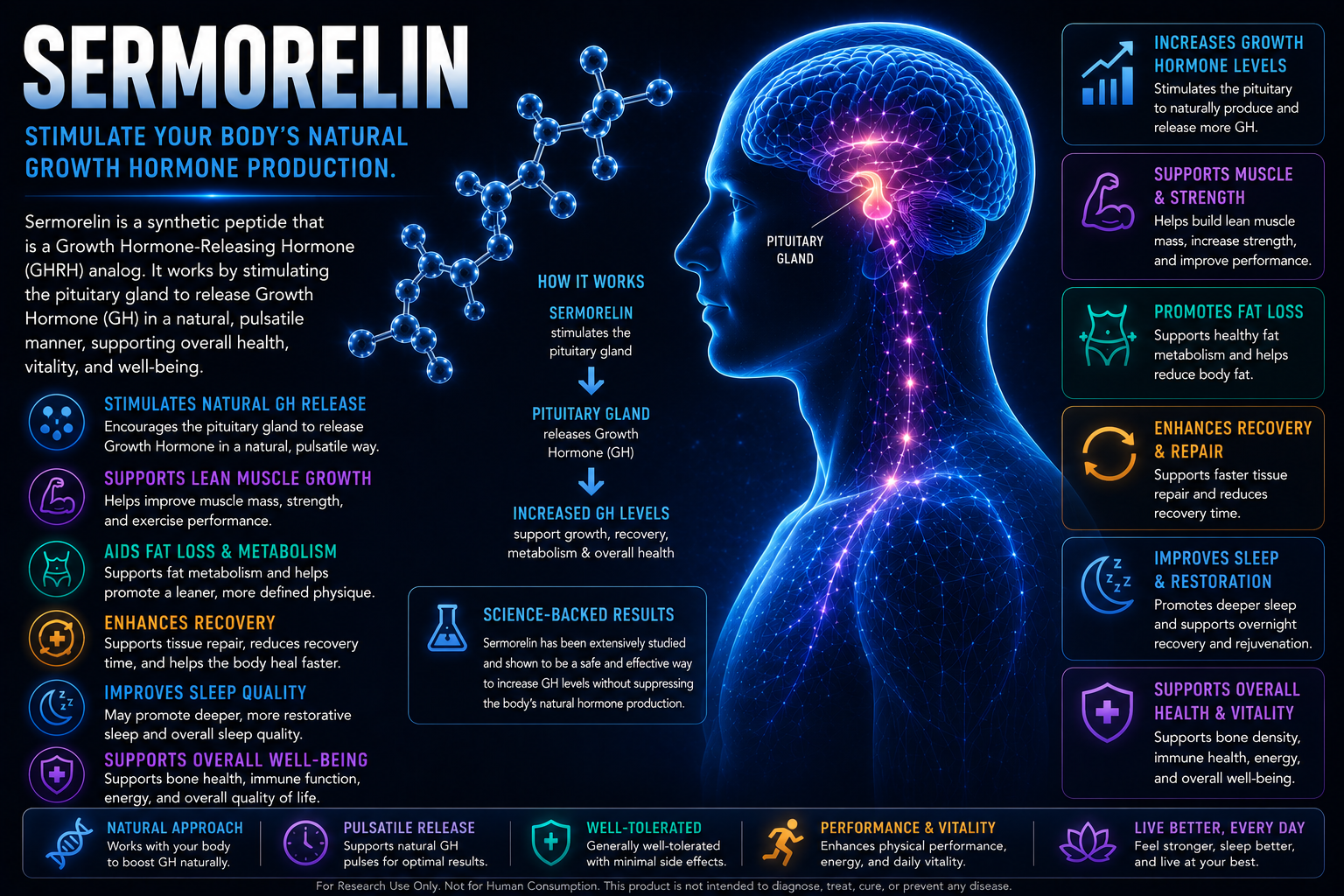
A comprehensive, evidence-graded review of sermorelin, a synthetic amidated 29-amino-acid fragment of human growth hormone-releasing hormone that activates pituitary GHRH receptors and stimulates endogenous growth-hormone secretion.
What Is Sermorelin?
Sermorelin is a synthetic peptide corresponding to the first 29 amino acids of human growth hormone-releasing hormone, abbreviated GHRH. It is also called:
- GHRH(1-29)-NH₂
- Growth hormone-releasing factor 1-29
- GRF(1-29)-NH₂
- Sermorelin acetate
29 amino acids
GHRH receptor
Endogenous GH release
IGF-1
Approximately 3,357.9 Da
No marketed approved product
Major research and historical clinical uses
- Testing pituitary growth-hormone reserve
- Diagnosing selected forms of growth-hormone deficiency
- Stimulating growth in some children with preserved pituitary function
- Studying GH pulsatility
- Evaluating age-related changes in the somatotropic axis
- Research involving sleep, body composition, muscle, and metabolism
🧬 Structure, Sequence, and Molecular Properties
🧪 Amino-acid sequence
H-Tyr-Ala-Asp-Ala-Ile-Phe-Thr-Asn-Ser-Tyr-Arg-Lys-Val-Leu-Gly-Gln-Leu-Ser-Ala-Arg-Lys-Leu-Leu-Gln-Asp-Ile-Met-Ser-Arg-NH₂
YADAIFTNSYRKVLGQLSARKLLQDIMSR-NH₂
| Length | 29 amino acids |
|---|---|
| Molecular formula | C149H246N44O42S |
| Average molecular weight | Approximately 3,357.9 g/mol |
| Exact mass | Approximately 3,355.82 Da |
| N terminus | Free tyrosine amino group |
| C terminus | Amidated arginine |
| Disulfide bonds | None |
| Sulfur-containing residue | Met27 |
| Common salt form | Sermorelin acetate |
C-terminal amidation
The peptide ends in Arg-NH₂ rather than a free carboxyl group. Amidation is essential to the defined sermorelin identity and affects mass, charge, stability, and receptor activity.
Methionine oxidation
Met27 is susceptible to oxidation, producing a +16 Da impurity that may change chromatographic behavior and biological potency.
Acetate-salt correction
Commercial material is frequently supplied as an acetate salt. Net peptide content must be corrected for acetate, water, and residual solvents rather than inferred from total powder weight.
Relationship to Native Human GHRH
Shortest fully active region
The first 29 amino acids of human GHRH contain the principal receptor-activating sequence. Sermorelin retains this active N-terminal region while omitting residues 30–44.
Native GHRH sequence
Human GHRH is a 44-amino-acid hypothalamic peptide. Tesamorelin uses the full 44-residue sequence with an added N-terminal modification, whereas sermorelin uses the shorter 1–29 fragment with a C-terminal amide.
Rapid enzymatic degradation
The unmodified N terminus is vulnerable to dipeptidyl peptidase-IV and other proteases. Sermorelin is therefore relatively short acting compared with stabilized analogues.
Dependence on pituitary function
Sermorelin can stimulate GH only when functioning pituitary somatotrophs remain. Severe pituitary destruction or complete GH deficiency may produce little or no response.
📅 Discovery and Regulatory Timeline
- 1982: Human pancreatic-tumor GHRH was isolated and characterized, advancing understanding of hypothalamic GH control.
- Mid-1980s: GHRH(1-29)-NH₂ was shown to stimulate GH release through intravenous, subcutaneous, and intranasal routes.
- Early 1990s: Geref Diagnostic was FDA approved to evaluate pituitary GH-secretory capacity.
- 1997: Geref Pediatric received FDA approval for short stature associated with pediatric growth-hormone deficiency.
- 1990s: Trials evaluated growth velocity, pituitary priming, immune markers, body composition, and aging-related GH decline.
- 2008: The manufacturer discontinued production for commercial reasons.
- June 2009: FDA withdrew approvals of the two sermorelin NDAs after discontinuation.
- 2010s–2020s: Sermorelin continued to be offered through compounding and wellness settings, commonly for unapproved adult uses.
- 2026: No currently marketed FDA-approved sermorelin drug exists, and WADA continues to prohibit sermorelin as a GHRH analogue.
🧠 How Does Sermorelin Work?
1. GHRH receptor activation
Sermorelin binds GHRH receptors on anterior-pituitary somatotroph cells.
2. Cyclic-AMP signaling
Receptor activation increases intracellular cyclic AMP and protein kinase A activity.
3. Calcium-dependent secretion
Downstream ion-channel and calcium changes support exocytosis of stored GH.
4. GH gene transcription
Repeated GHRH receptor stimulation can increase GH synthesis and pituitary reserve.
5. IGF-1 production
Released GH stimulates hepatic and tissue production of IGF-1, which mediates many growth and anabolic effects.
🎯 Receptor Profile
| Target | Relationship | Primary downstream effect |
|---|---|---|
| GHRH receptor | Direct primary target | Gs → cAMP → PKA → GH synthesis and release |
| Growth-hormone receptor | Indirectly activated by released GH | JAK2/STAT5 and metabolic signaling |
| IGF-1 receptor | Indirectly activated by increased IGF-1 | PI3K/AKT/mTOR and MAPK pathways |
| Somatostatin receptors | Physiologic inhibitory counterbalance | Limits pituitary GH release |
Selective endocrine effect
Classic human studies generally found GH release without major direct changes in prolactin, thyroid hormones, gonadotropins, ACTH, cortisol, insulin, or glucagon after single diagnostic exposures.
Growth Hormone and IGF-1 Axis
Physiologic pulsatility
Growth hormone is released episodically, with the largest pulses often occurring during slow-wave sleep.
Hypothalamic control
GHRH stimulates GH secretion, while somatostatin inhibits it. Ghrelin-receptor signaling can amplify release.
Feedback regulation
GH and IGF-1 feed back to the hypothalamus and pituitary to limit further secretion.
Age-related decline
GH pulse amplitude and IGF-1 concentrations generally decline with aging, but this physiologic change is not automatically a disease requiring treatment.
Incomplete pituitary function
Sermorelin may be most effective when hypothalamic GHRH signaling is impaired but pituitary somatotrophs remain capable of releasing GH.
Diagnostic Research and Historical Use
Provocative GH testing
Geref Diagnostic was historically used as an intravenous challenge to evaluate whether the pituitary could release GH.
Interpretive limitation
A response to GHRH does not perfectly distinguish hypothalamic from pituitary disease and may produce false-normal results in some patients with GH deficiency.
Factors affecting response
- Age
- Obesity
- Hyperglycemia
- Elevated free fatty acids
- Hypothyroidism
- Somatostatin-active drugs
- Glucocorticoids
- Insulin and hypoglycemia
- Clonidine and levodopa
Current diagnostic alternatives
Modern evaluation may use insulin tolerance, glucagon stimulation, macimorelin, arginine-based testing, or other endocrinology-directed methods depending on the patient and region.
Pediatric Growth Research
Short stature and GH deficiency
Clinical studies evaluated daily or multiple-daily sermorelin in children with idiopathic or hypothalamic GH deficiency.
Growth velocity
Some children showed increased height velocity, particularly those with mild deficiency and preserved pituitary responsiveness.
Comparison with recombinant GH
In several studies, recombinant GH produced more consistent or stronger growth outcomes, especially in severe deficiency.
Response variability
Children with complete pituitary GH failure are less likely to respond because sermorelin requires endogenous GH production.
Antibody formation
Anti-GHRH antibodies developed in some historical studies, although major clinical consequences were not consistently observed.
Adult and Healthy-Aging Research
Older-adult studies
Small randomized studies of GHRH analogues in adults aged roughly 55–71 years reported activation of the GH–IGF-1 axis.
Sex-specific findings
Some studies found increases in lean mass, insulin sensitivity, well-being, libido, or skin thickness, with inconsistent effects between men and women.
Immune markers
Exploratory work reported changes in selected immune measures after prolonged GHRH analogue administration.
Evidence limitations
These studies were small, short, and often involved analogues such as [Nle27]GHRH(1-29)-NH₂ rather than standard sermorelin itself.
No anti-aging approval
No FDA-approved indication exists for age-related GH decline, vitality, sleep, body composition, or longevity.
Body Composition, Muscle, and Metabolic Research
Lean body mass
Small studies of GHRH analogues have reported modest increases in lean mass in selected older adults.
Muscle strength and bioenergetics
Research has explored whether nightly GHRH can influence muscle strength and energy metabolism, but findings are preliminary.
Fat mass
Growth-hormone signaling can promote lipolysis, but sermorelin has not been established as an obesity or weight-loss treatment.
Glucose metabolism
GH can reduce insulin sensitivity, while improved body composition may produce competing effects. Human responses vary.
Not equivalent to tesamorelin
Tesamorelin has randomized evidence for visceral-fat reduction in HIV lipodystrophy. Sermorelin does not have an equivalent approved body-composition indication.
Sleep and GH Pulsatility Research
Nocturnal GH secretion
GH pulses are closely linked to slow-wave sleep, especially in younger individuals.
Nightly administration rationale
Some research used evening dosing to align GHRH stimulation with normal nocturnal physiology.
Sleep claims remain uncertain
Evidence does not establish sermorelin as an approved treatment for insomnia, sleep quality, or sleep disorders.
Sleep-disordered breathing
Excessive GH and IGF-1 signaling can contribute to soft-tissue changes and may worsen obstructive sleep apnea in susceptible individuals.
Major Evidence Limitations
- No currently marketed FDA-approved sermorelin product
- Historical approvals do not automatically validate modern compounded formulations
- Adult anti-aging evidence is small and inconsistent
- Some frequently cited studies used modified GHRH analogues rather than exact sermorelin
- No established obesity or weight-loss indication
- No validated athletic-recovery or muscle-building indication
- Requires preserved pituitary function
- Short plasma half-life and rapid degradation
- Human long-term safety data for chronic wellness use are limited
- Commercial compounded products may vary in sequence, salt, potency, sterility, and content
- No FDA-reviewed current finished-product specification exists
Current FDA and Anti-Doping Status
Historical FDA approval
Sermorelin acetate was previously approved for GH diagnostic testing and pediatric short stature associated with GH deficiency.
Withdrawal
The manufacturer discontinued production for commercial reasons, and FDA withdrew the approvals in June 2009.
Current compounded products
Compounded sermorelin is not an FDA-approved product and has not undergone the same premarket review for safety, effectiveness, manufacturing consistency, or labeling.
WADA prohibition
The 2026 World Anti-Doping Agency Prohibited List specifically includes sermorelin among prohibited GHRH analogues.
Potential Side Effects, Contraindications, and Safety Considerations
Historically reported adverse effects
- Injection-site pain, redness, or swelling
- Facial flushing
- Headache
- Nausea or vomiting
- Metallic taste or dysgeusia
- Pallor
- Chest tightness
Growth-axis effects
- Elevated IGF-1
- Fluid retention and edema
- Arthralgia and myalgia
- Carpal-tunnel-type symptoms
- Glucose intolerance
- Soft-tissue growth
Malignancy concern
GH and IGF-1 support cell growth and survival. Chronic stimulation may be inappropriate in active malignancy or in people at elevated oncologic risk without specialist evaluation.
Pituitary or intracranial disease
Patients with pituitary tumors, prior cranial irradiation, intracranial lesions, or disrupted hypothalamic-pituitary anatomy require specialist assessment.
Pregnancy and pediatric use
Current compounded use should not be inferred from the former product’s historical indications. Pregnancy, pediatric use, and endocrine disorders require formal medical oversight.
Product-quality risk
Potential hazards include incorrect sequence, oxidation, deamidation, nonamidated peptide, endotoxin, microbial contamination, particulates, inaccurate net content, or poor sterile technique.
🧪 Laboratory Testing Methods
| Method | Purpose | Important limitation |
|---|---|---|
| RP-HPLC / UPLC | Separates intact sermorelin from deletion peptides, oxidation products, deamidation, and synthesis impurities | Area purity does not prove sequence or potency |
| LC-HRMS | Confirms intact mass near 3,357.9 Da | Does not alone prove complete sequence or amidation |
| LC-MS/MS peptide mapping | Confirms the full 29-residue sequence | Requires high sequence coverage |
| C-terminal amidation assay | Confirms Arg-NH₂ rather than free-acid sermorelin | Requires validated resolution of closely related species |
| N-terminal identity assay | Confirms free Tyr1 and detects N-terminal clipping | Only evaluates the N terminus |
| Amino-acid analysis | Confirms composition and supports content assignment | Does not prove sequence order |
| Chiral amino-acid analysis | Detects epimers and D-amino-acid contamination | Hydrolysis can introduce racemization artifacts |
| Methionine-oxidation assay | Measures Met27 oxidation | Oxidation can occur during sample preparation |
| Deamidation assay | Measures Asn/Gln-related degradation | Multiple sites may require peptide mapping |
| Deletion and truncation panel | Measures synthesis failures and enzymatic clipping | Reference standards may be required |
| Net peptide-content assay | Measures actual sermorelin free-base content | Must correct for acetate, water, and excipients |
| Acetate assay | Measures counterion content | Acetate stoichiometry may vary |
| Residual-solvent testing | Measures synthesis and purification solvents | Does not establish biological activity |
| SEC-HPLC / DLS | Measures aggregates and particles | Small soluble aggregates may require orthogonal methods |
| GHRH-receptor binding assay | Measures receptor affinity | Binding alone does not prove signaling potency |
| cAMP potency assay | Measures functional GHRHR activation | Cell line and receptor density affect results |
| Pituitary GH-release assay | Measures physiologic downstream activity | Animal or cell results may not predict human pulses |
| Protease-stability assay | Measures DPP-IV and plasma degradation | In-vitro half-life may not predict clinical exposure |
| Anti-drug-antibody assay | Evaluates immunogenicity potential | Clinical relevance requires human exposure data |
| Sterility, endotoxin, and particles | Required for finished injectable evaluation | Raw peptide purity does not establish injectable safety |
| Stability-indicating assay | Tracks oxidation, deamidation, clipping, aggregation, adsorption, and potency loss | Requires validated forced-degradation and real-time studies |
📄 How to Interpret a Sermorelin COA
- Confirm the exact 29-residue sequence: YADAIFTNSYRKVLGQLSARKLLQDIMSR.
- Confirm C-terminal amidation: Arg-NH₂.
- Verify the free N-terminal Tyr1.
- Confirm molecular formula C₁₄₉H₂₄₆N₄₄O₄₂S.
- Verify average molecular weight near 3,357.9 Da.
- Use LC-MS/MS mapping rather than intact mass alone.
- Confirm all residues are in the intended L configuration.
- Measure Met27 oxidation separately.
- Measure deamidation, clipping, deletion peptides, and nonamidated material.
- State acetate-salt form and counterion content.
- Report net sermorelin free-base content after correcting for water and acetate.
- Measure monomer, aggregates, and particles.
- Use GHRH-receptor binding and cAMP potency assays.
- Include protease-stability testing when pharmacology is relevant.
- For finished injectables, require sterility, endotoxin, particles, pH, osmolality, fill accuracy, container closure, and post-reconstitution stability.
- Do not assume compounded sermorelin is equivalent to former Geref products.
- A COA does not establish FDA approval, human efficacy, or suitability for administration.
📊 Comparison Tables
Sermorelin vs Tesamorelin vs CJC-1295 vs Ipamorelin
| Feature | Sermorelin | Tesamorelin | CJC-1295 | Ipamorelin |
|---|---|---|---|---|
| Type | GHRH(1-29)-NH₂ | Modified GHRH(1-44) | Stabilized GHRH analogue | Ghrelin-receptor agonist |
| Primary receptor | GHRHR | GHRHR | GHRHR | GHSR-1a |
| Length | 29 aa | 44 aa | Varies by form | 5 residues |
| Current FDA status | No marketed approved product | Approved for HIV lipodystrophy | Not approved | Not approved |
Sermorelin vs Recombinant Growth Hormone
| Feature | Sermorelin | Recombinant GH |
|---|---|---|
| Action | Stimulates endogenous pituitary GH | Supplies GH directly |
| Pituitary function required | Yes | No |
| Release pattern | More dependent on physiologic pulse regulation | Injection-driven pharmacologic profile |
| Current approval | No marketed product | Multiple specific approved indications |
Sermorelin vs Macimorelin for GH Testing
| Feature | Sermorelin | Macimorelin |
|---|---|---|
| Mechanism | GHRH receptor agonist | GHSR agonist |
| Route | Historically intravenous diagnostic test | Oral diagnostic test |
| Current U.S. approval | No | Approved for adult GH-deficiency diagnosis |
| Dependence on pituitary reserve | Yes | Yes |
Compounded Sermorelin vs Former Geref
| Attribute | Current compounded sermorelin | Former Geref product |
|---|---|---|
| FDA approval | No | Previously approved; withdrawn after discontinuation |
| Manufacturing | Pharmacy and supplier dependent | FDA-reviewed product manufacturing |
| Formulation | Variable | Validated approved formulation |
| Clinical equivalence | Not established | |
🖼️ Original Diagram Specifications
- Sequence map: Native GHRH(1-44) with the sermorelin 1-29 region highlighted and C-terminal amidation labeled.
- GHRH-receptor pathway: Pituitary receptor, cAMP, GH pulse, liver IGF-1, and peripheral tissues.
- Pituitary-dependence graphic: Preserved somatotroph function versus complete pituitary GH deficiency.
- Historical-use timeline: Diagnostic approval, pediatric approval, discontinuation, and withdrawal.
- Evidence pyramid: Historical pediatric and diagnostic data, small aging studies, limited modern wellness evidence.
- Risk map: IGF-1 elevation, glucose changes, edema, joint symptoms, malignancy, and product-quality risks.
- COA workflow: Sequence, amidation, Met oxidation, acetate correction, receptor potency, sterility, and stability.
❓ Frequently Asked Questions
Is sermorelin a peptide?
Yes. It is a synthetic 29-amino-acid fragment of human GHRH.
What is the exact sequence?
YADAIFTNSYRKVLGQLSARKLLQDIMSR-NH₂.
What is its molecular formula?
C₁₄₉H₂₄₆N₄₄O₄₂S.
What is its molecular weight?
Approximately 3,357.9 Da.
What receptor does sermorelin activate?
The pituitary growth hormone-releasing hormone receptor.
Is sermorelin FDA approved?
It was previously approved under the Geref name, but the products were discontinued and the approvals were withdrawn in 2009. No currently marketed FDA-approved sermorelin product exists.
Why was Geref withdrawn?
The manufacturer discontinued production for commercial reasons; available FDA records do not indicate withdrawal for safety or effectiveness concerns.
What was sermorelin approved for?
Historically, GH diagnostic testing and treatment of short stature associated with pediatric GH deficiency.
Is sermorelin approved for anti-aging?
No.
Does sermorelin increase growth hormone?
Yes, when functioning pituitary somatotroph cells are present.
Does it increase IGF-1?
It may increase IGF-1 through endogenous GH release.
Is sermorelin the same as tesamorelin?
No. Sermorelin is amidated GHRH(1-29); tesamorelin is a modified full-length GHRH(1-44) analogue.
Is sermorelin the same as growth hormone?
No. Sermorelin stimulates endogenous GH release; recombinant GH supplies the hormone directly.
Can sermorelin help if the pituitary cannot produce GH?
Response may be poor or absent when pituitary somatotroph function is severely impaired.
Is sermorelin prohibited in sports?
Yes. WADA specifically prohibits sermorelin as a GHRH analogue.
Does 99% HPLC purity prove high quality?
No. Sequence, amidation, oxidation, net content, acetate, potency, endotoxin, sterility, and stability must also be assessed.
Final Thoughts
Sermorelin is the amidated 1–29 fragment of human GHRH and represents the shortest sequence retaining full GHRH receptor activity. It stimulates endogenous pituitary GH secretion through GHRH-receptor, cyclic-AMP, and protein-kinase-A signaling.
Its historical medical role is well documented. Sermorelin acetate was previously approved for provocative GH testing and for selected children with short stature associated with GH deficiency. The products were later discontinued commercially, and FDA withdrew the approvals in 2009.
Modern claims involving anti-aging, fat loss, bodybuilding, recovery, sleep, or adult GH optimization extend beyond the former approved uses. Small studies of GHRH analogues in older adults reported mixed body-composition, metabolic, muscle, skin, and immune findings, but they do not establish a broad wellness indication.
Quality evaluation requires confirmation of the complete YADAIFTNSYRKVLGQLSARKLLQDIMSR-NH₂ sequence, C-terminal amidation, correct stereochemistry, Met27 oxidation, deamidation and truncation impurities, acetate-corrected net content, GHRH-receptor potency, sterility, and stability. Current compounded material is not automatically equivalent to the former FDA-approved Geref product.
📚 References
- U.S. Food and Drug Administration. Geref Approval and Supplemental Approval Documents.
- U.S. Food and Drug Administration. Tesamorelin Medical Review: Prior Geref Diagnostic and Geref Pediatric Approval History. 2010.
- U.S. Food and Drug Administration. Macimorelin Medical Review: Sermorelin Discontinuation and Withdrawal History. 2017.
- U.S. Food and Drug Administration. Pharmacy Compounding Advisory Committee Briefing Materials. October 2024.
- FDA Orphan Drug Designations and Approvals Database. Sermorelin Acetate / Geref.
- KEGG Drug. Sermorelin, D08509.
- NCATS GSRS. Sermorelin Acetate Substance Record.
- Prakash A, Goa KL. Sermorelin: A Review of Its Use in the Diagnosis and Treatment of Children With Idiopathic Growth Hormone Deficiency. BioDrugs. 1999.
- Esposito P, et al. PEGylation of Growth Hormone-Releasing Hormone (GRF) Analogue. Advanced Drug Delivery Reviews. 2003.
- Vance ML, et al. Effects of GHRH(1-29)-NH₂ on Growth Hormone Secretion in Normal Men. 1986.
- Barron JL, et al. Growth Hormone-Releasing Hormone(1-29)-NH₂ and Stimulation of GH Secretion in Normal Men. 1985.
- Wilton P, et al. Pharmacology of GHRH(1-29)-NH₂ in Healthy Men. 1993.
- Neyzi O, et al. GHRH(1-29)-NH₂ Compared With Growth Hormone in Children With GH Deficiency. 1993.
- Kirk JM, et al. Treatment With GHRH(1-29)-NH₂ in Children With Idiopathic Short Stature. 1994.
- Ross RJ, et al. Treatment of Growth-Hormone Deficiency With GHRH(1-29)-NH₂. Lancet. 1987.
- Khorram O, et al. Endocrine and Metabolic Effects of Long-Term GHRH Analogue Administration in Older Adults. Journal of Clinical Endocrinology & Metabolism. 1997.
- Vittone J, et al. Effects of Nightly GHRH Injections on Muscle Strength and Bioenergetics in Older Adults. 1997.
- Khorram O, et al. Effects of GHRH Analogue Administration on the Immune System of Aging Adults. 1997.
- World Anti-Doping Agency. 2026 Prohibited List.
- USADA. What Athletes Should Know About Sermorelin. 2025.
- International Council for Harmonisation. ICH Q1A(R2), Q2(R2), Q3A, Q3B, Q3C, Q5C, and Q6B.
- United States Pharmacopeia General Chapters <621>, <71>, <85>, and <788>.
Sequence, chemistry, historical FDA status, research evidence, safety, anti-doping status, and analytical recommendations reviewed in July 2026.