SS-31 (Elamipretide): What It Is, How It Works, Benefits, and Research Overview
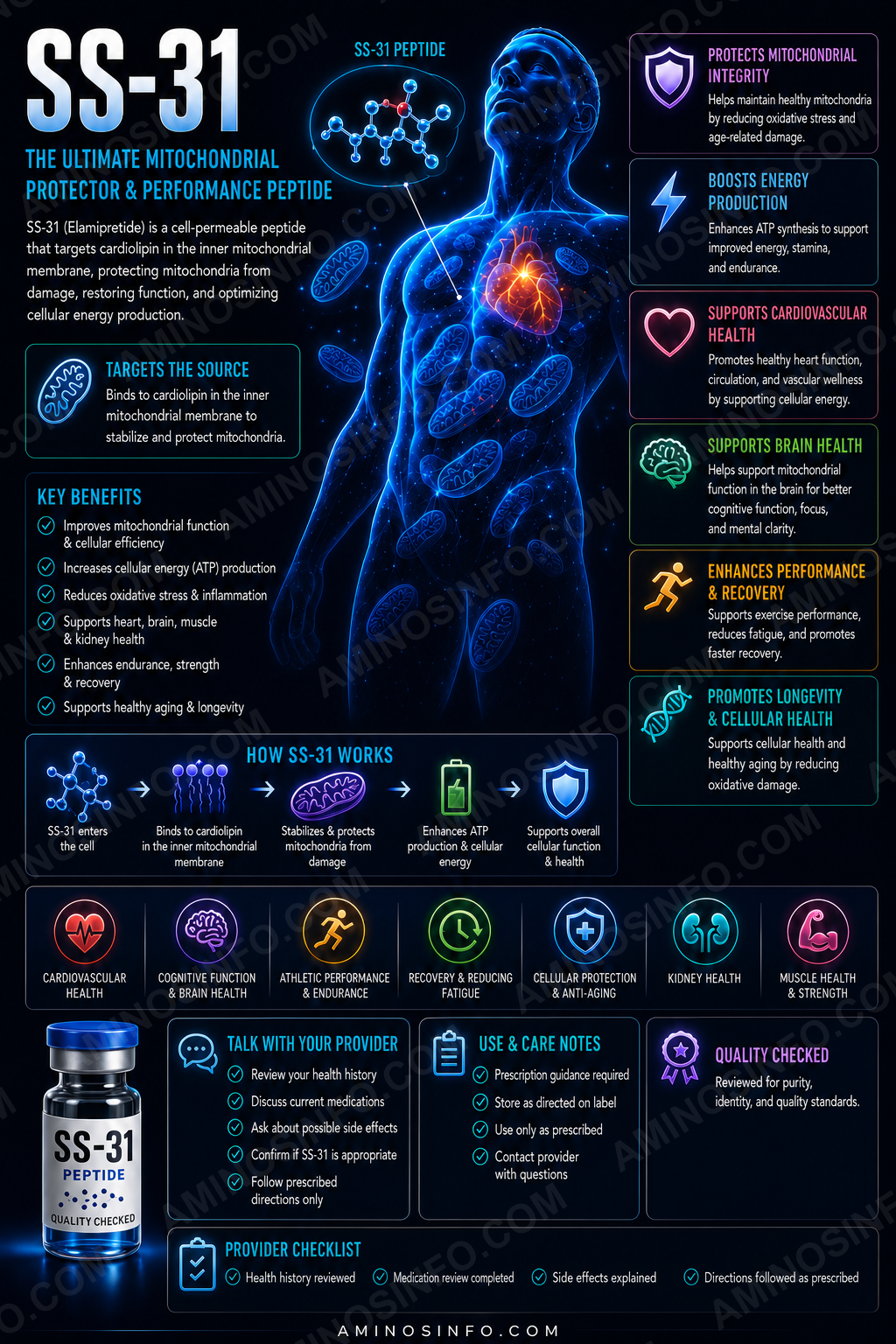
A comprehensive, evidence-graded review of SS-31—also known as elamipretide, MTP-131, Bendavia, and the active ingredient in Forzinity—a mitochondria-targeting aromatic-cationic tetrapeptide that binds cardiolipin, stabilizes the inner mitochondrial membrane, supports respiratory-chain organization, reduces electron leak, and improves mitochondrial energy production.
What Is SS-31?
SS-31 is a synthetic mitochondria-targeting tetrapeptide from the Szeto–Schiller family. Its generic drug name is elamipretide. The peptide reaches the inner mitochondrial membrane and binds the phospholipid cardiolipin.
4 residues
D-Arg-Dmt-Lys-Phe-NH₂
Cardiolipin
639.8 Da
11764719
Approved for a narrow Barth syndrome indication
Main research themes
- Inner mitochondrial membrane stabilization
- Cardiolipin protection
- Respiratory-chain efficiency
- Reduced electron leak and reactive oxygen species
- ATP production
- Cristae architecture
- Muscle, cardiac, kidney, neurological, and ocular mitochondrial injury
🧬 Structure, Sequence, and Molecular Properties
D-Arg-2′,6′-dimethyl-Tyr-Lys-Phe-NH₂
D-Arg-Dmt-Lys-Phe-NH₂
| Length | 4 residues |
|---|---|
| Free-base molecular formula | C32H49N9O5 |
| Free-base molecular weight | 639.8 g/mol |
| CAS number | 736992-21-5 |
| PubChem CID | 11764719 |
| Nonstandard residue | 2′,6′-dimethyltyrosine (Dmt) |
| C terminus | Amidated |
| Disulfide bonds | None |
Stereochemistry and salts
The N-terminal arginine is in the D configuration. Exact stereochemistry is essential. Elamipretide may appear as hydrochloride, acetate, triacetate, or TFA-containing forms. PubChem lists the triacetate near 819.9 Da and a 1:1 TFA form near 753.8 Da, so gross powder mass must not be confused with free-base content.
SS-31, Elamipretide, MTP-131, Bendavia, and Forzinity
| Name | Meaning |
|---|---|
| SS-31 | Original Szeto–Schiller research designation |
| MTP-131 | Development code |
| Bendavia | Earlier development name |
| Elamipretide | Generic drug name |
| Forzinity | FDA-approved brand name |
📅 Discovery and Development Timeline
- Early 2000s: SS peptides were developed as aromatic-cationic mitochondrial-protective peptides.
- 2004–2010: SS-31 showed protection in ischemia-reperfusion, cardiac, kidney, neural, and metabolic models.
- 2014: Cardiolipin interaction became established as a central mechanism.
- 2010s: Elamipretide entered clinical trials across mitochondrial, cardiovascular, kidney, and eye disorders.
- 2020: Biophysical and proteomic work expanded understanding of membrane and mitochondrial-protein interactions.
- September 19, 2025: FDA granted accelerated approval to Forzinity for Barth syndrome patients weighing at least 30 kg.
- 2026: Confirmatory and additional mitochondrial-disease research continued.
🧠 How Does SS-31 Work?
Mitochondrial targeting
The alternating aromatic and cationic structure supports rapid cell entry and affinity for negatively charged cardiolipin.
Respiratory-chain support
SS-31 supports electron-transfer efficiency, respiratory-supercomplex organization, and membrane architecture.
Reduced oxidative injury
Improved electron flow lowers electron leakage and reactive oxygen species generation in many models.
Cardiolipin Binding
Cardiolipin is concentrated in the inner mitochondrial membrane and helps organize respiratory complexes, cristae curvature, mitochondrial dynamics, and apoptotic signaling. SS-31 binds through electrostatic and hydrophobic interactions. It is therefore better described as a cardiolipin-directed membrane modulator than as a simple free-radical scavenger.
Electron-Transport Chain and ATP Production
Cardiolipin supports the close organization of respiratory complexes. SS-31 may stabilize this architecture, improve electron transfer, reduce superoxide formation, preserve the proton gradient, and support ATP synthase activity.
Oxidative Stress, Cytochrome c, and Apoptosis
Oxidized cardiolipin can shift cytochrome c from an electron carrier toward peroxidase activity, further damaging the membrane and promoting apoptosis. SS-31 helps preserve electron-carrier function and reduces cardiolipin peroxidation, mitochondrial swelling, cytochrome-c release, and caspase activation in experimental models.
Barth Syndrome and FDA Approval
Barth syndrome is a rare X-linked mitochondrial disorder caused by pathogenic TAFAZZIN variants that disrupt cardiolipin remodeling. Forzinity is approved to improve muscle strength in adult and pediatric patients weighing at least 30 kg. The accelerated approval was based on improvement in knee-extensor strength measured by handheld dynamometry, and confirmatory evidence is required.
Other Research Areas
Skeletal muscle and mitochondrial myopathy
Trials in primary mitochondrial myopathy produced mixed results. Some studies did not meet primary walk-distance or fatigue endpoints, while longer open-label extensions reported selected sustained benefits.
Cardiac research
Preclinical studies include ischemia-reperfusion, heart failure, aging, and diabetic cardiomyopathy. Human cardiovascular outcomes have been mixed or neutral for major endpoints.
Kidney research
Animal studies include acute kidney injury, renal ischemia, fibrosis, and diabetic nephropathy. Small human studies explored renal artery stenosis and revascularization.
Neurological and aging research
Models include Alzheimer’s disease, Parkinson’s disease, stroke, traumatic injury, synaptic dysfunction, and age-related muscle decline. No approved neurological or anti-aging indication exists.
Ophthalmic research
Studies include retinal ischemia, glaucoma, optic neuropathy, inherited retinal disease, and geographic atrophy. No eye indication is approved.
Human Clinical Evidence
Elamipretide is one of the rare research peptides to become an approved medicine. However, benefit is indication-specific. Barth syndrome data supported accelerated approval, whereas trials in primary mitochondrial myopathy and other diseases produced mixed results. Research-grade SS-31 is not clinically interchangeable with Forzinity.
Safety and Adverse Effects
Common adverse effects
Injection-site reactions are the most prominent reported effects and may include redness, pain, swelling, itching, induration, bruising, or irritation.
Other concerns
- Hypersensitivity or immune reactions
- Long-term uncertainty under accelerated approval
- Incorrect sequence or stereochemistry in unapproved products
- Wrong salt form or concentration
- Residual TFA or synthesis reagents
- Endotoxin, contamination, or particles
- Unknown effects outside studied populations
🧪 Laboratory Testing Methods
| Method | Purpose | Important limitation |
|---|---|---|
| RP-HPLC / UPLC | Separates intact peptide from deletions, epimers, and degradants | Area purity does not prove stereochemistry |
| LC-HRMS | Confirms free-base mass near 639.8 Da | Does not alone prove D-Arg or Dmt identity |
| MS/MS sequencing | Confirms residue order and amidation | Dmt requires validated standards |
| Chiral analysis | Confirms D-arginine and intended stereochemistry | Hydrolysis can create artifacts |
| Dmt identity assay | Distinguishes Dmt from tyrosine or related analogues | Requires authentic standards |
| C-terminal amidation assay | Confirms Phe-NH₂ | Requires validated resolution |
| Net-content assay | Measures free-base elamipretide content | Must correct for salts and water |
| Counterion assay | Measures acetate, TFA, or chloride | Gross mass may overstate active content |
| SEC-HPLC / DLS | Measures aggregates and particles | Small aggregates may need orthogonal methods |
| Cardiolipin-binding assay | Measures primary target interaction | Membrane composition affects results |
| Cytochrome-c peroxidase assay | Measures cardiolipin-related functional activity | Biochemical potency may not predict clinical response |
| Mitochondrial respiration assay | Measures oxygen consumption and coupling | Cell type and substrates matter |
| ATP-production assay | Measures energy output | ATP has many determinants |
| ROS assay | Measures electron leak and oxidative stress | Some probes lack specificity |
| Cristae imaging | Assesses inner-membrane ultrastructure | Requires advanced imaging |
| Sterility, endotoxin, particles | Required for injectable evaluation | Raw purity is insufficient |
| Stability-indicating assay | Tracks hydrolysis, epimerization, deamidation, aggregation, and adsorption | Requires validated stress studies |
📄 How to Interpret an SS-31 / Elamipretide COA
- Verify D-Arg-Dmt-Lys-Phe-NH₂.
- Confirm D-arginine stereochemistry.
- Confirm Dmt as 2′,6′-dimethyltyrosine.
- Confirm C-terminal amidation.
- Verify free-base formula C₃₂H₄₉N₉O₅ and mass near 639.8 Da.
- State the exact salt form.
- Report net free-base content after correcting for counterions and water.
- Use MS/MS rather than intact mass alone.
- Measure epimers, deletion peptides, nonamidated species, and Dmt-related impurities.
- Include cardiolipin-binding and mitochondrial-respiration potency assays.
- For finished injection, require sterility, endotoxin, particles, pH, osmolality, container closure, and in-use stability.
- Do not assume research-grade SS-31 is equivalent to Forzinity.
📊 Comparison Tables
SS-31 vs MOTS-c vs Humanin vs HNG
| Feature | SS-31 | MOTS-c | Humanin | HNG |
|---|---|---|---|---|
| Main target | Cardiolipin | AMPK, CK2, nuclear signaling | Anti-apoptotic pathways | Enhanced Humanin signaling |
| Main focus | Membrane structure and oxidative phosphorylation | Metabolism and exercise | Cell survival | Neuroprotection and metabolism |
| FDA status | Approved for a narrow Barth indication | Not approved | Not approved | Not approved |
Research-Grade SS-31 vs Forzinity
| Attribute | Research-grade SS-31 | Forzinity |
|---|---|---|
| Manufacturing | Variable | FDA-reviewed |
| Sterility | Not guaranteed | Approved sterile injection |
| Clinical use | Research only | Specific Barth syndrome indication |
| Interchangeable? | No | |
🖼️ Original Diagram Specifications
- Peptide architecture with D-Arg, Dmt, charge, and amidation labeled.
- Cell entry and targeting of the inner mitochondrial membrane.
- Cardiolipin binding and stabilization of cristae curvature.
- Respiratory-supercomplex organization, reduced electron leak, and increased ATP.
- Cytochrome-c electron-carrier versus peroxidase pathway.
- Evidence map showing Barth approval and broader investigational programs.
- COA workflow covering sequence, stereochemistry, Dmt, amidation, potency, sterility, and stability.
❓ Frequently Asked Questions
Is SS-31 a peptide?
Yes, a synthetic aromatic-cationic tetrapeptide.
What is its sequence?
D-Arg-2′,6′-dimethyl-Tyr-Lys-Phe-NH₂.
What is its molecular weight?
Approximately 639.8 Da for free-base elamipretide.
Is SS-31 the same as elamipretide?
Yes. SS-31 is the research designation; elamipretide is the generic name.
Is it FDA approved?
Yes, under accelerated approval for improving muscle strength in Barth syndrome patients weighing at least 30 kg.
What does it bind?
Cardiolipin in the inner mitochondrial membrane.
Is it approved for anti-aging or exercise?
No.
What are the common side effects?
Injection-site reactions are the most common.
Can research-grade SS-31 substitute for Forzinity?
No.
What is the most important potency testing?
Cardiolipin-binding plus mitochondrial-respiration testing.
Final Thoughts
SS-31 is a cardiolipin-directed mitochondrial peptide rather than a conventional receptor agonist. By stabilizing the inner mitochondrial membrane, respiratory supercomplexes, cytochrome-c electron transfer, and cristae architecture, elamipretide can improve oxidative phosphorylation and reduce electron leak.
In September 2025, elamipretide became the first FDA-approved treatment for Barth syndrome under the brand name Forzinity for patients weighing at least 30 kg. The approval is accelerated and indication specific.
This approval does not extend to fatigue, anti-aging, exercise enhancement, heart failure, kidney disease, neurodegeneration, or general mitochondrial support. Research-grade SS-31 is not interchangeable with the approved medicine.
A credible evaluation must confirm sequence, D stereochemistry, Dmt identity, amidation, salt form, free-base content, impurities, cardiolipin binding, mitochondrial potency, sterility, particles, formulation quality, and stability.
📚 References
- U.S. Food and Drug Administration. FDA Grants Accelerated Approval to First Treatment for Barth Syndrome. 2025.
- U.S. Food and Drug Administration. Forzinity Prescribing Information. 2025.
- U.S. Food and Drug Administration. Drug Trials Snapshot: Forzinity. 2026.
- PubChem. Elamipretide, CID 11764719.
- Tung C, et al. Elamipretide: A Review of Its Structure, Mechanism of Action, and Therapeutic Potential. 2025.
- Szeto HH. First-in-Class Cardiolipin-Protective Compound as a Therapeutic Agent to Restore Mitochondrial Bioenergetics. British Journal of Pharmacology. 2014.
- Mitchell W, et al. The Mitochondria-Targeted Peptide SS-31 Binds Lipid Bilayers and Modulates Surface Electrostatics. Journal of Biological Chemistry. 2020.
- Chavez JD, et al. Mitochondrial Protein Interaction Landscape of SS-31. PNAS. 2020.
- Zhao C, et al. Elamipretide: The First Cardiolipin-Directed Mitochondrial Therapy. 2026.
- Jacob N, et al. Elamipretide in the Management of Barth Syndrome. 2025.
- Birk AV, et al. SS-31 Re-Energizes Ischemic Mitochondria by Interacting with Cardiolipin. JASN. 2013.
- ClinicalTrials.gov. Elamipretide Studies in Barth Syndrome, Primary Mitochondrial Myopathy, Heart Failure, Kidney Disease, and Ophthalmic Disorders.
- International Council for Harmonisation. ICH Q1A(R2), Q2(R2), Q3A, Q3B, Q3C, and Q6B.
- United States Pharmacopeia General Chapters <621>, <71>, <85>, and <788>.
Sequence, chemistry, cardiolipin mechanism, FDA approval, clinical evidence, safety, and analytical information reviewed in July 2026.