Tesamorelin: What It Is, How It Works, Benefits, and Research Overview
A comprehensive, evidence-graded review of tesamorelin, a 44-amino-acid, N-terminally modified growth hormone-releasing hormone analogue that stimulates endogenous pulsatile growth-hormone secretion and is FDA approved for reducing excess abdominal fat in adults with HIV-associated lipodystrophy.
What Is Tesamorelin?
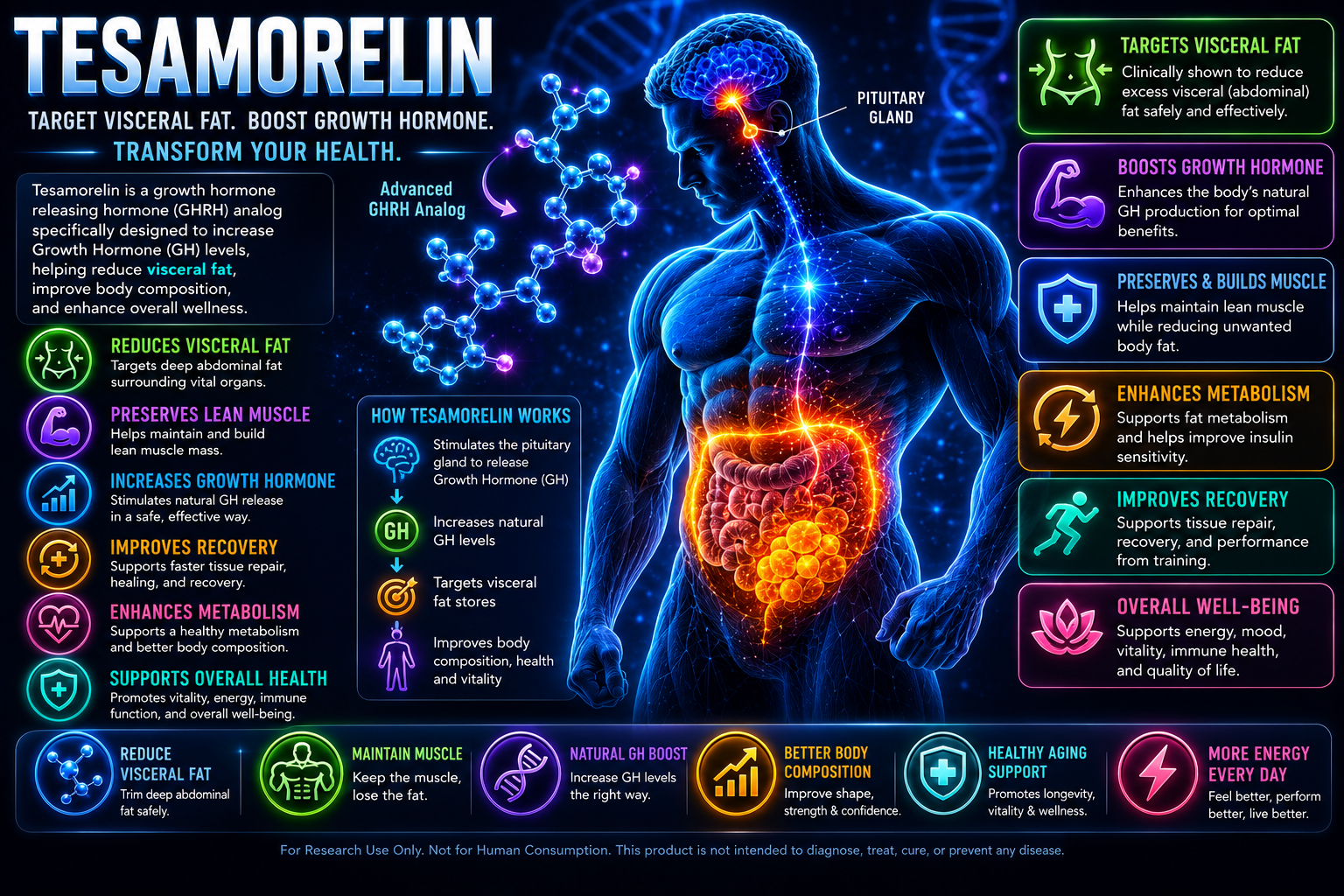
Tesamorelin is a synthetic analogue of human growth hormone-releasing hormone, abbreviated GHRH. It contains the complete 44-amino-acid human GHRH sequence plus an N-terminal trans-3-hexenoyl group that improves resistance to enzymatic degradation.
44 amino acids
GHRH receptor
Endogenous GH release
IGF-1
Approximately 5,136 Da
Approved for one specific HIV indication
Major research and clinical themes
- Reduction of visceral adipose tissue
- HIV-associated lipodystrophy
- Growth-hormone pulsatility
- IGF-1 production
- Liver-fat and ectopic-fat research
- Lean body mass
- Lipid metabolism
- Glucose and insulin-sensitivity monitoring
🧬 Structure, Sequence, and Molecular Properties
🧪 Amino-acid sequence
trans-3-hexenoyl-YADAIFTNSYRKVLGQLSARKLLQDIMSRQQGESNQERGARARL-OH
| Length | 44 amino acids |
|---|---|
| N-terminal modification | trans-3-hexenoyl group attached to Tyr1 |
| Free-base molecular formula | C221H366N72O67S |
| Free-base molecular weight | Approximately 5,136 g/mol |
| Common drug form | Tesamorelin acetate |
| Disulfide bonds | None |
| C terminus | Free carboxyl group |
| Primary receptor | Growth hormone-releasing hormone receptor |
Acetate-salt considerations
Pharmaceutical tesamorelin is supplied as tesamorelin acetate. The acetate counterions and water increase gross material mass, so vial weight is not identical to tesamorelin free-base content.
Structural relationship to native GHRH
The 44-residue peptide backbone matches human GHRH(1-44). The N-terminal lipid-like modification protects the biologically critical N terminus from rapid enzymatic cleavage.
Why Was Tesamorelin Modified?
Native GHRH is short lived
Natural GHRH is rapidly degraded in plasma, including cleavage by dipeptidyl peptidase-IV and other enzymes.
N-terminal protection
The trans-3-hexenoyl modification increases stability while preserving receptor agonism.
Endogenous rather than exogenous GH
Tesamorelin stimulates the pituitary to release the body’s own GH instead of supplying recombinant GH directly.
Preserved feedback
Endogenous somatostatin and IGF-1 feedback remain partly active, although pharmacologic stimulation can still produce excessive IGF-1 or adverse metabolic effects.
📅 Discovery and Development Timeline
- 1980s: Human GHRH was isolated, sequenced, and synthesized.
- 1990s: Modified GHRH analogues were developed to improve stability and biologic activity.
- 2005: Dose-ranging research with TH9507, later called tesamorelin, reported reduced truncal fat and improved lipid measures in people with HIV.
- 2007: A large randomized trial showed decreased visceral fat and improved lipid profiles after 26 weeks.
- 2010: FDA approved tesamorelin for reducing excess abdominal fat in adults with HIV-associated lipodystrophy.
- 2010: Extension studies reported maintenance of visceral-fat reduction during continued treatment and reaccumulation after withdrawal.
- 2014: A randomized study reported modest reductions in liver fat in adults with HIV and abdominal fat accumulation.
- 2019: EGRIFTA SV labeling and formulation updates were approved.
- March 25, 2025: FDA approved EGRIFTA WR, an 11.6 mg multidose-vial formulation.
- 2026: Tesamorelin remained the only FDA-approved treatment specifically targeting excess abdominal fat in people with HIV.
🧠 How Does Tesamorelin Work?
1. Pituitary stimulation
Tesamorelin acts primarily on somatotroph cells in the anterior pituitary.
2. Cyclic-AMP signaling
GHRH receptor activation increases cyclic AMP and intracellular signaling that supports GH synthesis and secretion.
3. Pulsatile GH release
The drug increases endogenous GH pulses rather than maintaining continuously high recombinant-GH concentrations.
4. IGF-1 production
GH stimulates the liver and peripheral tissues to produce IGF-1, which mediates many anabolic, growth, and metabolic effects.
5. Visceral-fat sensitivity
Visceral adipose tissue is particularly responsive to GH-mediated lipolysis, helping explain the selective reduction in abdominal visceral fat.
🎯 Receptor Profile
| Target | Role | Downstream effect |
|---|---|---|
| GHRH receptor | Primary direct target | Gs → cAMP → PKA → GH synthesis and release |
| Growth-hormone receptor | Activated indirectly by released GH | JAK2/STAT5 and metabolic signaling |
| IGF-1 receptor | Activated indirectly by increased IGF-1 | PI3K/AKT/mTOR and MAPK pathways |
| Somatostatin system | Physiologic inhibitory counter-regulation | Limits GH pulse amplitude |
Growth Hormone and IGF-1 Axis
Normal physiology
GH is released in pulses influenced by sleep, exercise, fasting, age, sex, GHRH, ghrelin, and somatostatin.
IGF-1 feedback
IGF-1 feeds back to the hypothalamus and pituitary to reduce GH output.
Monitoring
FDA labeling recommends monitoring IGF-1 during therapy and considering discontinuation when elevation remains persistent.
Not equivalent to physiologic restoration
Pharmacologic stimulation can increase GH and IGF-1 beyond normal age-adjusted ranges despite intact feedback.
Visceral Adipose Tissue Research
Randomized clinical trials
Large placebo-controlled studies in adults with HIV-associated abdominal fat accumulation showed meaningful reductions in visceral adipose tissue.
Magnitude of reduction
Long-term studies reported visceral-fat reductions around 17–18% during continued therapy.
Subcutaneous fat preservation
Tesamorelin generally reduced visceral fat without a comparable loss of abdominal subcutaneous fat.
Reaccumulation after discontinuation
Benefits were lost relatively quickly when treatment was stopped, indicating that the effect depends on continued therapy.
Not general obesity evidence
These trials enrolled people with HIV-associated lipodystrophy. They do not establish tesamorelin as a general obesity medication.
Liver-Fat and Ectopic-Fat Research
Randomized liver-fat study
A six-month trial in adults with HIV and abdominal fat accumulation reported modest reductions in liver fat alongside visceral-fat reduction.
Clinical interpretation
The study was preliminary, and the long-term clinical importance of the liver-fat change remains uncertain.
Not an approved fatty-liver drug
Tesamorelin is not FDA approved for metabolic dysfunction-associated steatotic liver disease, nonalcoholic steatohepatitis, or general liver-fat reduction.
Fibrosis research
Later HIV studies explored inflammatory and fibrosis markers, but broader liver-disease treatment claims remain investigational.
Body Composition, Lean Mass, and Lipid Effects
Lean body mass
Clinical trials and meta-analyses report modest increases in lean body mass.
Muscle quality
Secondary analyses have explored trunk-muscle area and density, particularly among people who responded with significant visceral-fat loss.
Triglycerides
Responders often showed improved triglycerides and adiponectin.
Body weight
Tesamorelin is generally weight neutral because changes in visceral fat may be partly offset by lean-mass changes.
No proof of athletic enhancement
Lean-mass change does not establish improved strength, recovery, endurance, or athletic performance.
Glucose, Insulin Sensitivity, and Metabolic Effects
GH can oppose insulin
Growth hormone increases lipolysis but can reduce insulin sensitivity and raise glucose in susceptible patients.
Clinical trial findings
Average glucose changes were often modest, but some participants developed glucose intolerance or diabetes.
Responder differences
People achieving substantial visceral-fat reduction sometimes showed better preservation of glucose homeostasis than nonresponders.
Monitoring
FDA labeling recommends assessing glucose status before and during therapy, especially in patients with diabetes or elevated metabolic risk.
Retinopathy concern
Patients with diabetes should be monitored for potential worsening of diabetic retinopathy.
Muscle, Recovery, and Healthy-Aging Research
Growth-axis biology
GH and IGF-1 influence protein turnover, connective tissue, bone, and muscle physiology.
Clinical evidence boundary
Tesamorelin trials were designed primarily to evaluate visceral fat in people with HIV, not injury recovery or muscle hypertrophy in healthy adults.
Age-related GH decline
GH secretion declines with age, but raising GH in healthy older adults can produce edema, arthralgia, glucose intolerance, and carpal-tunnel symptoms.
No anti-aging approval
Tesamorelin is not approved for healthy aging, frailty, muscle loss, or age-related GH decline.
FDA-Approved Indication and Formulations
Approved indication
Reduction of excess abdominal fat in HIV-infected adult patients with lipodystrophy.
Limitations of use
- Not indicated for weight-loss management
- Weight-neutral therapy
- Long-term cardiovascular safety has not been established
- Continued benefit depends on continued treatment
EGRIFTA WR
EGRIFTA WR is an 11.6 mg multidose-vial formulation approved in 2025.
EGRIFTA SV
EGRIFTA SV is a separate formulation with different strength, preparation, dosing, and storage instructions.
Not substitutable
FDA labeling states that EGRIFTA WR and EGRIFTA SV are not substitutable. Product-specific instructions must be followed.
Major Evidence Limitations
- The strongest evidence applies to HIV-associated lipodystrophy
- No approval for general obesity or weight loss
- No established anti-aging benefit
- No controlled evidence for bodybuilding or athletic recovery
- Visceral fat tends to return after discontinuation
- Long-term cardiovascular benefit remains unproven
- Liver-fat findings are preliminary and population specific
- Effects depend on an intact hypothalamic-pituitary axis
- IGF-1 responses vary substantially between patients
- Glucose intolerance can occur
- Research-grade material is not equivalent to approved formulations
Potential Side Effects, Contraindications, and Safety Considerations
Contraindications
- Active malignancy
- Pregnancy
- Disruption of the hypothalamic-pituitary axis
- Known hypersensitivity to tesamorelin or product excipients
Common adverse reactions
- Arthralgia
- Injection-site erythema, itching, pain, or swelling
- Pain in extremities
- Peripheral edema
- Myalgia
- Paresthesia
Elevated IGF-1
Persistent supraphysiologic IGF-1 may increase growth-related and mitogenic concerns.
Glucose intolerance and diabetes
Tesamorelin can worsen glucose control in susceptible individuals.
Fluid retention
Edema, joint discomfort, and carpal-tunnel-type symptoms can occur.
Malignancy
Because GH and IGF-1 support cell proliferation and survival, active malignancy is a contraindication, and prior cancer requires careful risk assessment.
Critical illness
Pharmacologic GH increased mortality in certain critically ill patients. Labeling recommends considering discontinuation if a patient becomes critically ill.
Immunogenicity
Antibodies may develop against tesamorelin or related proteins, although their clinical significance varies.
🧪 Laboratory Testing Methods
| Method | Purpose | Important limitation |
|---|---|---|
| RP-HPLC / UPLC | Separates intact tesamorelin from clipping, oxidation, deamidation, and synthesis impurities | Area purity does not prove sequence or potency |
| LC-HRMS | Confirms intact free-base mass near 5,136 Da | Does not alone prove sequence or modification location |
| LC-MS/MS peptide mapping | Confirms complete 44-residue sequence | Requires high sequence coverage |
| N-terminal modification assay | Confirms trans-3-hexenoylation at Tyr1 | Must distinguish geometric and positional isomers |
| Geometric-isomer analysis | Confirms the trans rather than cis hexenoyl form | Requires validated chromatographic resolution |
| Amino-acid analysis | Confirms composition and supports content | Does not prove sequence order |
| Chiral amino-acid analysis | Detects epimers | Hydrolysis may cause racemization artifacts |
| Net peptide-content assay | Measures tesamorelin free-base equivalent | Must correct for acetate, water, and excipients |
| Acetate assay | Measures counterion content and stoichiometry | Acetate content may vary by batch |
| Residual-solvent testing | Measures synthesis and purification solvents | Does not establish biological activity |
| SEC-HPLC / DLS | Measures aggregates and particles | Small soluble aggregates may require orthogonal methods |
| Oxidation assay | Measures sulfur- and aromatic-residue oxidation products | Oxidation can occur during sample preparation |
| Deamidation assay | Measures Asn/Gln-related degradation | Multiple sites may require mapping |
| Clipping and truncation panel | Measures N- and C-terminal degradation products | Reference standards may be needed |
| GHRH-receptor binding assay | Measures receptor affinity | Binding alone does not prove signaling |
| cAMP potency assay | Measures functional GHRHR activation | Cell line and receptor density affect potency |
| Pituitary GH-release assay | Measures physiologic downstream activity | Animal or cell systems may not predict human pulses |
| Anti-drug-antibody assay | Evaluates immunogenicity | Clinical relevance requires exposure data |
| Sterility, endotoxin, and particles | Required for finished injectable evaluation | Raw purity cannot establish injectable safety |
| Stability-indicating assay | Tracks oxidation, deamidation, clipping, aggregation, adsorption, and potency loss | Requires validated forced-degradation and real-time studies |
📄 How to Interpret a Tesamorelin COA
- Confirm the complete 44-amino-acid GHRH sequence.
- Confirm the trans-3-hexenoyl group at Tyr1.
- Distinguish trans from cis or positional isomers.
- Verify free-base molecular weight near 5,136 Da.
- Use LC-MS/MS mapping rather than intact mass alone.
- Confirm all residues are in the intended L configuration.
- State acetate-salt form and counterion stoichiometry.
- Report net tesamorelin free-base content after correcting for water and acetate.
- Measure oxidation, deamidation, clipping, deletion peptides, and epimers.
- Measure monomer and aggregate content.
- Use GHRH-receptor binding and cAMP potency assays.
- For finished injectables, require sterility, endotoxin, particles, pH, osmolality, fill accuracy, container closure, and reconstituted stability.
- Do not assume research-grade tesamorelin is equivalent to EGRIFTA WR or EGRIFTA SV.
- A COA does not establish clinical equivalence, FDA approval, or suitability for human administration.
📊 Comparison Tables
Tesamorelin vs Sermorelin vs CJC-1295 vs Ipamorelin
| Feature | Tesamorelin | Sermorelin | CJC-1295 | Ipamorelin |
|---|---|---|---|---|
| Type | Modified GHRH(1-44) | GHRH(1-29) analogue | Longer-acting GHRH analogue | GHSR-1a agonist |
| Primary receptor | GHRHR | GHRHR | GHRHR | GHSR-1a |
| FDA status | Approved for HIV lipodystrophy | Prior approved product history; not currently broadly marketed | Not approved | Not approved |
| Strongest evidence | Visceral-fat reduction | GH diagnostic and pediatric history | GH-release pharmacology | Early GH-release studies |
Tesamorelin vs Recombinant Growth Hormone
| Feature | Tesamorelin | Recombinant GH |
|---|---|---|
| Mechanism | Stimulates endogenous pituitary GH | Supplies GH directly |
| Pituitary required | Yes | No |
| Release pattern | More pulse dependent | Injection-driven profile |
| Approved use discussed here | HIV-associated excess abdominal fat | Multiple specific GH-related indications |
Tesamorelin vs GLP-1 Weight-Loss Drugs
| Feature | Tesamorelin | GLP-1/GIP-based obesity drugs |
|---|---|---|
| Main target | GHRH receptor | Incretin receptors |
| Main approved purpose | HIV-associated visceral adiposity | Obesity or diabetes, product dependent |
| Total body weight | Generally weight neutral | Usually reduced |
| Visceral fat | Selective reduction in approved population | Reduced along with overall weight |
Research-Grade Tesamorelin vs EGRIFTA
| Attribute | Research-grade tesamorelin | EGRIFTA WR / SV |
|---|---|---|
| Manufacturing | Variable, unapproved specifications | FDA-reviewed manufacturing |
| Formulation | Variable | Validated product-specific excipients |
| Sterility | Not guaranteed | Approved sterile product |
| Clinical indication | None | HIV-associated excess abdominal fat |
| Interchangeable? | No | |
🖼️ Original Diagram Specifications
- Peptide architecture: Full 44-residue sequence with trans-3-hexenoyl-Tyr1 highlighted.
- GHRH-receptor mechanism: Pituitary receptor, cAMP, GH pulse, liver IGF-1, and peripheral tissues.
- Visceral-fat pathway: GH-mediated lipolysis in visceral versus subcutaneous fat.
- Clinical-evidence graphic: HIV lipodystrophy approval, liver-fat research, and unsupported general weight-loss claims.
- Feedback loop: Hypothalamus, pituitary, GH, IGF-1, and somatostatin.
- Risk map: IGF-1 elevation, glucose intolerance, edema, malignancy, injection-site reactions, and critical illness.
- COA workflow: Sequence, hexenoylation, acetate correction, degradants, receptor potency, sterility, and stability.
❓ Frequently Asked Questions
Is tesamorelin a peptide?
Yes. It is a modified 44-amino-acid GHRH analogue.
What is its exact sequence?
trans-3-hexenoyl-YADAIFTNSYRKVLGQLSARKLLQDIMSRQQGESNQERGARARL-OH.
What is its molecular formula?
C₂₂₁H₃₆₆N₇₂O₆₇S for free-base tesamorelin.
What is its molecular weight?
Approximately 5,136 Da for the free-base peptide.
What receptor does tesamorelin activate?
The growth hormone-releasing hormone receptor.
Is tesamorelin FDA approved?
Yes, for reducing excess abdominal fat in adults with HIV-associated lipodystrophy.
Is tesamorelin approved for weight loss?
No. FDA labeling states that it is not indicated for weight-loss management and is weight neutral.
Does tesamorelin reduce visceral fat?
Yes, in its studied and approved HIV-lipodystrophy population.
Does visceral fat return after stopping?
Clinical studies show that much of the reduction can be lost after treatment discontinuation.
Can tesamorelin reduce liver fat?
A preliminary HIV study found a modest reduction, but tesamorelin is not approved for general fatty-liver disease.
Does it raise IGF-1?
Yes. Monitoring is recommended during treatment.
Can it raise blood glucose?
Yes. Glucose intolerance or diabetes may develop in susceptible patients.
Can it be used with active cancer?
No. Active malignancy is a contraindication.
Is tesamorelin prohibited in sports?
Yes. GHRH analogues are prohibited under anti-doping rules.
Is research tesamorelin equivalent to EGRIFTA?
No.
Does 99% HPLC purity prove pharmaceutical quality?
No. Sequence, N-terminal modification, acetate correction, degradants, potency, sterility, formulation, and stability are also required.
Final Thoughts
Tesamorelin is a scientifically and clinically distinctive GHRH analogue. Its 44-amino-acid sequence reproduces human GHRH, while the trans-3-hexenoyl group protects the N terminus and increases functional stability.
The strongest evidence is clear and narrow: tesamorelin reduces excess visceral abdominal fat in adults with HIV-associated lipodystrophy. Randomized trials also report selected improvements in triglycerides, body image, lean mass, and modest liver-fat reduction. Visceral fat tends to return when treatment stops.
Tesamorelin is not a general weight-loss drug and is usually weight neutral. It is not approved for bodybuilding, anti-aging, routine obesity, athletic recovery, or general fatty-liver disease. Treatment can raise IGF-1, impair glucose regulation, cause fluid-retention symptoms, and create concern in malignancy.
Analytical authentication requires the full 44-residue sequence, trans-3-hexenoylation at Tyr1, correct free-base molecular mass, acetate correction, degradation and aggregation profiling, receptor-binding and cAMP potency, sterility, and formulation-specific stability. Research-grade tesamorelin is not interchangeable with EGRIFTA WR or EGRIFTA SV.
📚 References
- U.S. Food and Drug Administration. EGRIFTA WR Prescribing Information. Revised March 2025.
- U.S. Food and Drug Administration. EGRIFTA WR Supplement Approval Letter. March 25, 2025.
- U.S. Food and Drug Administration. Purple Book: EGRIFTA and EGRIFTA WR.
- PubChem. Tesamorelin, CID 16137828.
- Falutz J, et al. A Placebo-Controlled, Dose-Ranging Study of a Growth Hormone-Releasing Factor in HIV-Infected Patients With Abdominal Fat Accumulation. AIDS. 2005.
- Falutz J, et al. Metabolic Effects of a Growth Hormone-Releasing Factor in Patients With HIV. New England Journal of Medicine. 2007.
- Falutz J, et al. Effects of Tesamorelin, a Growth Hormone-Releasing Factor, in HIV-Infected Patients With Abdominal Fat Accumulation. Journal of Acquired Immune Deficiency Syndromes. 2010.
- Falutz J, et al. Long-Term Safety and Effects of Tesamorelin on Visceral Fat. Journal of Clinical Endocrinology & Metabolism. 2010.
- Stanley TL, et al. Reduction in Visceral Adiposity Is Associated With Improved Metabolic Outcomes in Tesamorelin Responders. Clinical Infectious Diseases. 2012.
- Stanley TL, et al. Effect of Tesamorelin on Visceral Fat and Liver Fat in HIV-Infected Patients With Abdominal Fat Accumulation. JAMA. 2014.
- Stanley TL, et al. Effects of Tesamorelin on Inflammatory and Fibrinolytic Markers. 2011.
- Adrian S, et al. The GHRH Analogue Tesamorelin and Skeletal Muscle Area and Density. 2019.
- Russo SC, et al. Efficacy and Safety of Tesamorelin in People With HIV on Contemporary Antiretroviral Therapy. 2024.
- Badran AS, et al. Tesamorelin in HIV-Associated Lipodystrophy: Meta-Analysis of Randomized Controlled Trials. 2026.
- Ferdinandi ES, et al. Nonclinical Pharmacology and Safety Evaluation of TH9507, a Human GHRH Analogue. Basic & Clinical Pharmacology & Toxicology. 2007.
- Frohman LA, et al. Enzymatic Degradation of Human Growth Hormone-Releasing Hormone in Plasma. Journal of Clinical Investigation. 1989.
- World Anti-Doping Agency. 2026 Prohibited List.
- International Council for Harmonisation. ICH Q1A(R2), Q2(R2), Q3A, Q3B, Q3C, Q5C, and Q6B.
- United States Pharmacopeia General Chapters <621>, <71>, <85>, and <788>.
Sequence, chemistry, current FDA status, clinical evidence, safety, and analytical recommendations reviewed in July 2026.