Testagen Scientific Overview: Identity, Mechanism, Evidence, and Testing
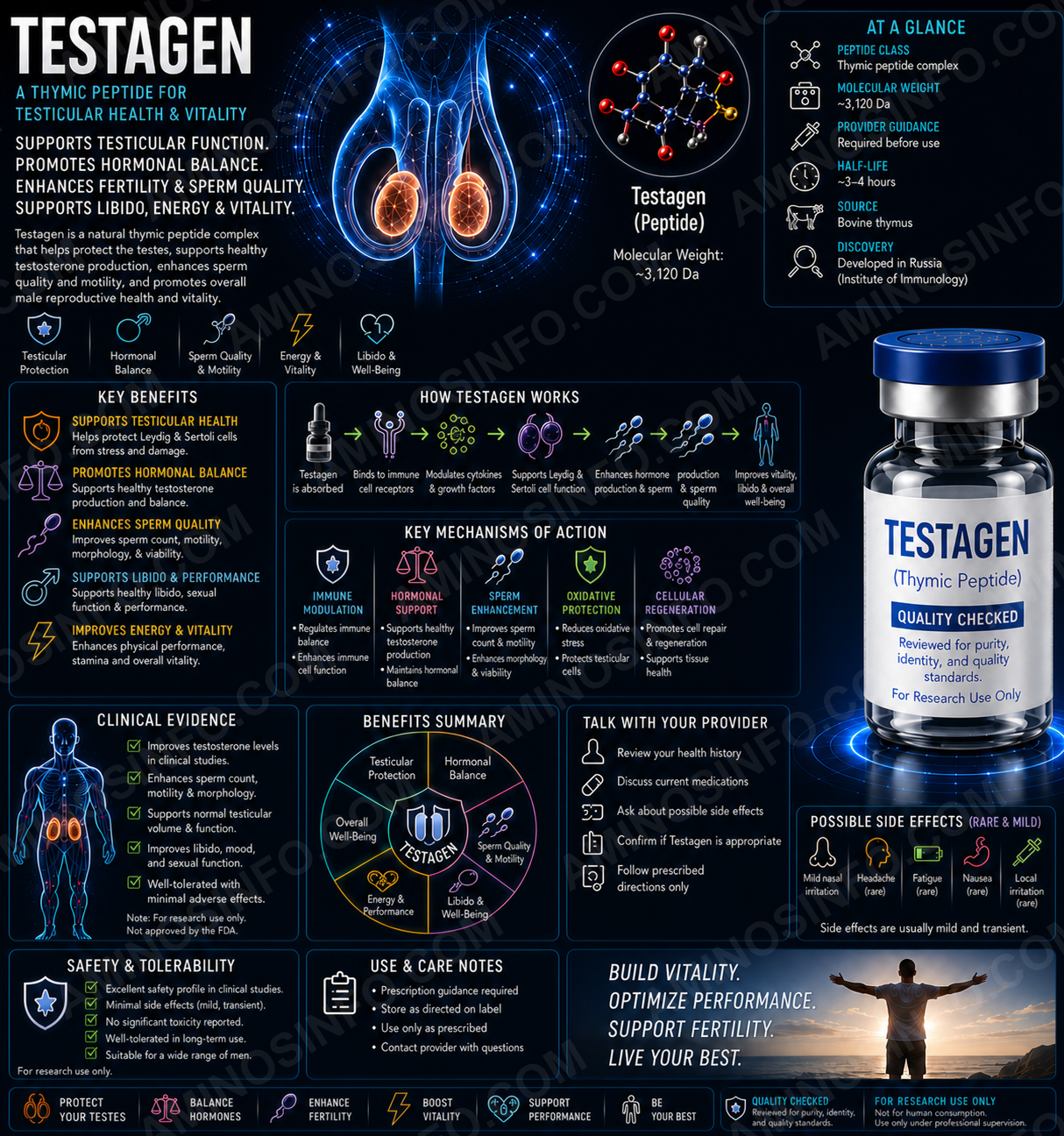
For example, Testagen scientific overview content should separate the verified Lys–Glu–Asp–Gly tetrapeptide identity from testosterone, fertility, pituitary, and thyroid claims that lack strong human evidence. This tetrapeptide remains an unapproved research compound.
What Is Testagen?
First, Testagen is a commercial and research name for the tetrapeptide Lys–Glu–Asp–Gly, abbreviated KEDG. It is commonly placed within the Khavinson-school category of ultrashort peptide bioregulators.
However, online sources often describe Testagen as an anterior-pituitary, testicular, or male-endocrine peptide. However, the peer-reviewed KEDG literature located for this review focuses more clearly on cell differentiation, immune-cell phenotypes, peptide–DNA or peptide–histone hypotheses, and general bioregulator theory than on validated testosterone or fertility outcomes.
Testagen
Lys–Glu–Asp–Gly
KEDG
Linear tetrapeptide
Differentiation and gene regulation
No
🧬 Molecular Structure
First, Testagen is a linear tetrapeptide composed of L-lysine, L-glutamic acid, L-aspartic acid, and glycine. The commonly represented research form has a free N-terminus and free C-terminal carboxyl group.
🧪 Amino-Acid Sequence
H-Lys-Glu-Asp-Gly-OH
One-letter notation: KEDG
⚛️ Molecular Weight and 🧫 Formula
| Neutral molecular formula | Meanwhile, C17H29N5O9 |
|---|---|
| Average molecular weight | Approximately 447.44 g/mol |
| Peptide length | 4 amino acids |
| Expected terminal form | Likewise, Free N-terminus and free C-terminal carboxyl group |
Importantly, the 24 possible sequence permutations of Lys, Glu, Asp, and Gly share the same elemental composition and nominal mass. Exact sequence-order confirmation is therefore essential.
📅 Research Timeline and History
1970s–1990s: Tissue peptide-bioregulator programs develop
First, Russian gerontology and peptide-regulation programs investigated low-molecular-weight peptide fractions from endocrine, immune, neural, and other tissues.
1990s–2000s: Defined ultrashort peptides synthesized
Next, researchers began studying defined two- to four-residue sequences as candidate active motifs from more complex tissue extracts.
2010s: Differentiation and gene-regulation studies expand
Moreover, KEDG appeared in studies and reviews involving immune-cell differentiation and peptide-dependent regulation of gene expression.
2020–2021: Reviews summarize peptide regulation
In addition, reviews described KEDG as one of several short peptides associated with immunogenic differentiation in stem-cell systems and discussed possible peptide interactions with DNA, histones, and transcriptional machinery.
2025: Materials-science research
Likewise, a study examined KEDG adsorption and corrosion-inhibition behavior on copper surfaces. This confirms the chemical identity and physicochemical interest of KEDG but is unrelated to testosterone or endocrine efficacy.
Current status
Finally, Testagen remains an unapproved research peptide without a modern, independently replicated human endocrine-development program.
Endocrine and HPG-Axis Biology
Hypothalamic control
First, the hypothalamus releases gonadotropin-releasing hormone in pulses, which stimulate pituitary gonadotroph cells.
Pituitary gonadotropins
Next, the anterior pituitary releases LH and FSH. LH stimulates Leydig-cell testosterone production, while FSH supports Sertoli-cell function and spermatogenesis.
Testicular function
Moreover, Leydig cells produce testosterone. Sertoli cells support germ-cell development, blood–testis-barrier function, inhibin B production, and the local environment required for spermatogenesis.
Negative feedback
In addition, testosterone, estradiol, and inhibin B regulate hypothalamic and pituitary signaling through feedback loops.
Clinical hypogonadism
Finally, diagnosis requires compatible symptoms plus consistently low morning testosterone, often with LH, FSH, prolactin, and other testing to determine the cause. No peptide label can replace this evaluation.
🧠 Proposed Mechanisms of Action
Importantly, researchers have not established a validated receptor or endocrine signaling mechanism for Testagen.
Testosterone and HPG-axis effects remain unproven
1. Peptide transport
First, as a tetrapeptide, intact oral absorption may be limited compared with di- and tripeptides. KEDG may be hydrolyzed into smaller peptides or free amino acids before or after absorption.
2. Nuclear-entry hypothesis
Next, some short-peptide literature proposes entry into nuclei and nucleoli. KEDG-specific pharmacokinetic and live-cell evidence remains limited.
3. DNA and histone interaction
Moreover, reviews propose that selected short peptides bind DNA or histones and alter transcriptional accessibility. Computational or biophysical interaction does not establish selective endocrine gene regulation in vivo.
4. Cell-differentiation signaling
In addition, researchers have reported KEDG among peptides associated with differentiation toward immune-cell phenotypes in stem-cell systems.
5. Tissue-selectivity hypothesis
However, there is no established transporter, receptor, or targeting sequence proving preferential delivery of KEDG to the pituitary, testes, Leydig cells, or Sertoli cells.
🎯 Target and Pathway Profile
| Target or pathway | Evidence status |
|---|---|
| In addition, DNA or histone interactions | Moreover, Proposed in broad short-peptide literature; KEDG endocrine relevance uncertain. |
| Immune-cell differentiation genes | By contrast, Reported in stem-cell differentiation reviews. |
| GnRH receptor | Also, No established direct agonist or antagonist activity. |
| Consequently, LH or FSH receptors | However, No established direct activity. |
| Androgen receptor | Therefore, No evidence that KEDG is an androgen-receptor agonist. |
| Steroidogenic enzymes | For example, No validated direct effect on STAR, CYP11A1, CYP17A1, HSD3B, or HSD17B. |
| Meanwhile, TSH receptor or thyroid enzymes | Likewise, No established direct activity. |
Cell Differentiation and Gene-Regulation Research
First, systematic reviews from the Khavinson research group list KEDG among peptides associated with expression of genes involved in immune-cell differentiation in stem-cell systems.
Moreover, the proposed model is that short peptides interact with DNA or chromatin and favor transcription of lineage-associated genes. Independent confirmation across laboratories and clinically relevant exposure levels remains limited.
However, claims that Testagen specifically binds histones and opens testosterone-related genes are stronger than the available evidence supports.
Male Reproductive Claims and Evidence Limits
Testosterone claims
First, this review found no high-quality human trial demonstrating a reliable increase in total testosterone, free testosterone, LH, FSH, or intratesticular testosterone after KEDG.
Leydig-cell claims
Moreover, this review identified no direct peer-reviewed evidence showing that KEDG increases Leydig-cell steroidogenesis or key testosterone-synthesis enzymes.
Sertoli-cell and fertility claims
In addition, no robust evidence establishes improved sperm count, motility, morphology, inhibin B, pregnancy rates, or live birth outcomes.
HPG-axis restoration
Likewise, a genuine HPG-axis effect would require controlled measurement of LH, FSH, testosterone, estradiol, inhibin B, semen parameters, symptoms, and feedback responses.
Comparison with TRT
However, testosterone replacement supplies an active hormone with known androgen-receptor pharmacology. Testagen is an unapproved peptide with no established ability to replace or restore androgen action.
Pituitary and Thyroid Claims
First, calling KEDG an “anterior pituitary peptide” does not establish selective access to gonadotrophs, thyrotrophs, corticotrophs, somatotrophs, or lactotrophs.
Moreover, commercial articles sometimes claim stimulation of TSH and thyroid hormones. Reliable primary human evidence for this effect was not identified.
Finally, suspected pituitary or thyroid disease may require TSH, free T4, prolactin, LH, FSH, cortisol, IGF-1, imaging, and specialist evaluation.
Safety and Regulatory Considerations
- First, No FDA-approved label defines dose, route, pharmacokinetics, contraindications, interactions, fertility effects, pregnancy safety, or long-term risk.
- Next, If KEDG truly altered pituitary or gonadal signaling, abnormal hormone levels, fertility changes, gynecomastia, acne, mood changes, or altered prostate biology could theoretically occur.
- Also, Reported immune-differentiation effects raise theoretical concerns in autoimmune disease, transplant recipients, inflammatory disorders, and malignancy.
- Moreover, Unapproved material may contain incorrect sequence, sequence isomers, deletion peptides, residual solvents, microbial contamination, endotoxin, or inaccurate content.
- In addition, Testagen should not replace testosterone therapy, fertility treatment, thyroid medication, pituitary treatment, or evidence-based evaluation.
🧪 Laboratory Testing Methods
Identity, Purity, and Sequence Testing
| Method | Purpose | Important limitation |
|---|---|---|
| In addition, RP-HPLC, ion-pair HPLC, or UPLC | Moreover, Separates KEDG from deletion peptides, amino acids, and degradants. | By contrast, Small polar peptides require validated methods. |
| LC-MS / HRMS | Also, Confirms exact intact mass. | Consequently, Cannot distinguish all sequence permutations by mass alone. |
| MS/MS sequencing | Confirms Lys–Glu–Asp–Gly order. | However, Requires authentic standards and validated fragmentation. |
| Chiral amino-acid analysis | Therefore, Confirms L-Lys, L-Glu, and L-Asp. | For example, Hydrolysis can introduce artifacts. |
| Net peptide-content assay | Meanwhile, Measures actual KEDG concentration. | Likewise, analysts must not infer net peptide content from HPLC area purity. |
| Sequence-isomer analysis | In addition, Detects other permutations of K, E, D, and G. | Moreover, Many isomers are analytically challenging. |
| By contrast, Pyroglutamate and isoaspartate analysis | Also, Evaluates cyclization and isomerization. | Consequently, analysts may need specialized LC-MS. |
| Gene-expression assay | However, Measures proposed transcriptional effects. | Therefore, Requires prespecified targets and independent replication. |
| Hormone-cell assay | For example, Could test LH, FSH, TSH, or steroidogenesis in validated models. | Meanwhile, No single in vitro result proves HPG-axis restoration. |
| Likewise, Microbial limits, sterility, and endotoxin | In addition, Evaluates route-specific microbiological quality. | Moreover, Requirements differ by intended use. |
| Stability testing | By contrast, Tracks hydrolysis, isomerization, assay, moisture, and appearance. | Also, Must reflect the final formulation and storage conditions. |
📄 How to Interpret a Testagen COA
COA Review and Route-Specific Quality
- Consequently, Verify the exact sequence: H-Lys-Glu-Asp-Gly-OH or KEDG.
- However, Confirm sequence order: Amino-acid composition and mass alone are insufficient.
- Therefore, Verify terminal chemistry: Acetylated, amidated, cyclic, or salt-modified variants are different materials.
- For example, Separate identity, purity, and net content: These are different analytical measurements.
- Meanwhile, analysts should review deletion sequences, free amino acids, sequence isomers, pyroglutamate, isoaspartate, and hydrolysis products.
- Likewise, Match testing to the intended route: A raw-powder certificate does not establish injectable or oral suitability.
- In addition, Do not infer hormone effects: A COA cannot demonstrate higher testosterone, improved sperm production, pituitary targeting, thyroid effects, fertility, or anti-aging benefit.
📊 Testagen vs Kisspeptin vs hCG vs TRT
Experimental Peptide Versus Established Endocrine Agents
| Feature | Testagen | Kisspeptin | hCG | Testosterone therapy |
|---|---|---|---|---|
| Compound type | Experimental KEDG tetrapeptide | Endogenous reproductive neuropeptide | Glycoprotein hormone | Active androgen hormone |
| Established target | None | KISS1R | LH/CG receptor | Androgen receptor |
| Moreover, Effect on HPG axis | Unproven | By contrast, Stimulates GnRH and gonadotropins | Also, Mimics LH at gonads | Consequently, Suppresses endogenous LH/FSH through feedback |
| Human endocrine evidence | Very limited | However, Substantial experimental human research | Established clinical use | Extensive clinical evidence |
| FDA approved? | For example, No FDA approval applies. | No routine approval | Therefore, Yes, for specific indications | For example, Yes, for approved products and indications |
Testagen vs Thymogen vs Epitalon vs Livagen
Sequence and Research-Association Differences
| Feature | Testagen | Thymogen | Epitalon | Livagen |
|---|---|---|---|---|
| Sequence | KEDG | EW | AEDG | KEDA |
| Length | 4 amino acids | 2 amino acids | 4 amino acids | 4 amino acids |
| Common research association | Meanwhile, Endocrine and differentiation claims | Likewise, Thymic or immune research | In addition, Pineal and aging research | Liver-related research |
| FDA approved? | Moreover, Regulators have not approved this compound. | In addition, No approved indication exists. | This remains unapproved. | However, No FDA approval applies. |
🔗 Related Hormones, Peptides, and Pathways
- GnRH: First, Hypothalamic hormone controlling pituitary LH and FSH release.
- LH: Next, Pituitary hormone stimulating Leydig-cell testosterone production.
- FSH: Also, Pituitary hormone supporting Sertoli-cell function.
- Kisspeptin: Moreover, KISS1R agonist upstream of GnRH.
- hCG: In addition, LH-receptor agonist used clinically in selected reproductive settings.
- Testosterone: Likewise, Active androgen hormone, not a peptide.
- Testoluten: Finally, Tissue-derived testicular peptide complex distinct from KEDG.
🖼️ Original Diagram Specifications
Diagram 1: Testagen molecular structure
Moreover, Show H-Lys-Glu-Asp-Gly-OH with the lysine side-chain amine, two acidic side chains, glycine, peptide bonds, and free termini.
Diagram 2: KEDG sequence-isomer chart
By contrast, Show several permutations of K, E, D, and G to explain why mass alone cannot confirm identity.
Diagram 3: HPG-axis physiology
Also, Show hypothalamic GnRH, pituitary LH/FSH, Leydig cells, Sertoli cells, testosterone, inhibin B, spermatogenesis, and feedback loops. Mark Testagen’s target as unknown.
Diagram 4: Proposed peptide-gene pathway
Consequently, Show possible transport, cellular uptake, proposed nuclear entry, DNA or histone interaction, altered transcription, and the unresolved link to endocrine outcomes.
Diagram 5: Evidence correction
However, Contrast published KEDG immune-differentiation research with unsupported testosterone, fertility, and thyroid marketing claims.
Diagram 6: Testagen vs TRT
Therefore, Show KEDG with no validated receptor on one side and testosterone binding the androgen receptor and suppressing LH/FSH feedback on the other.
Diagram 7: COA workflow
For example, Show exact mass, MS/MS sequence, stereochemistry, sequence isomers, free amino acids, degradation, assay, microbiology, stability, and functional testing.
❓ Frequently Asked Questions
Is Testagen a peptide?
Meanwhile, Yes. It is a synthetic tetrapeptide composed of Lys–Glu–Asp–Gly.
What is its sequence?
H-Lys-Glu-Asp-Gly-OH, abbreviated KEDG.
What is its molecular weight?
Likewise, Approximately 447.44 g/mol for neutral KEDG.
Is Testagen FDA approved?
No.
Does Testagen increase testosterone?
In addition, No reliable human clinical evidence establishes a consistent testosterone increase.
Does Testagen stimulate Leydig cells?
Moreover, researchers have not identified a validated direct Leydig-cell mechanism.
Does it improve sperm count or fertility?
In addition, no robust evidence establishes improved semen parameters, pregnancy, or live birth outcomes.
Is Testagen the same as TRT?
By contrast, No. TRT supplies active testosterone; Testagen is an unapproved tetrapeptide.
Does Testagen stimulate the pituitary?
Also, That claim is not supported by strong primary human evidence.
Does it affect thyroid hormones?
Consequently, No reliable evidence establishes predictable changes in TSH, T3, or T4.
Is Testagen the same as Testoluten?
However, No. Testagen is defined KEDG, while Testoluten is a complex derived from testicular tissue.
Does 99% HPLC purity prove endocrine activity?
Therefore, No. Sequence, stereochemistry, content, functional activity, pharmacokinetics, safety, and clinical outcomes must be established separately.
Testagen Scientific Overview: Final Thoughts
In conclusion, Testagen is a clearly defined ultrashort tetrapeptide with the sequence Lys–Glu–Asp–Gly. Its strongest identifiable published research relates to cell differentiation and the broader short-peptide gene-regulation framework—not to proven testosterone enhancement or male-fertility treatment.
However, claims involving pituitary stimulation, Leydig-cell activation, HPG-axis restoration, increased testosterone, improved sperm production, and thyroid support remain speculative or commercially amplified. Importantly, no validated receptor, human pharmacokinetic profile, large endocrine trial, or approved indication has been established.
Therefore, analysts should verify legitimate material for exact KEDG sequence order, L-amino-acid stereochemistry, terminal chemistry, sequence isomers, degradation products, net peptide content, route-specific microbiological quality, and stability.
📚 References
- For example, Dobriţescu A, et al. The inhibitory effect and adsorption properties of Testagen KEDG on copper surfaces. 2025.
- Meanwhile, Dobriţescu A, et al. Testagen KEDG adsorption and corrosion-inhibition research. 2025.
- Likewise, Khavinson V, et al. Peptide regulation of gene expression: a systematic review. Molecules. 2021.
- In addition, Khavinson V, et al. Peptide regulation of gene expression. 2021.
- Moreover, Khavinson V, et al. Peptide regulation of cell differentiation. 2020.
- By contrast, Anisimov VN, Khavinson VK. Peptide bioregulation of aging: results and prospects. Biogerontology. 2010.
- Also, Solovyev AY, et al. Interaction of amino acids, peptides, and proteins with DNA. 2015.
- Consequently, Daniel H. Molecular and integrative physiology of intestinal peptide transport. Annual Review of Physiology.
- However, Brandsch M. Drug transport via the intestinal peptide transporter PepT1. Current Opinion in Pharmacology.
- Therefore, Smith DE, Clémençon B, Hediger MA. Proton-coupled oligopeptide transporter family SLC15. Molecular Aspects of Medicine.
- For example, Plant TM. The hypothalamo-pituitary-gonadal axis. Journal of Endocrinology.
- Meanwhile, Clarke IJ, Cummins JT. GnRH pulse generation and gonadotropin secretion. Endocrine Reviews.
- Likewise, Zirkin BR, Papadopoulos V. Leydig cells: formation, function, and regulation. Biology of Reproduction.
- In addition, Smith LB, Walker WH. The regulation of spermatogenesis by androgens. Seminars in Cell & Developmental Biology.
- Moreover, Griswold MD. The central role of Sertoli cells in spermatogenesis. Seminars in Cell & Developmental Biology.
- By contrast, Adamczewska D, et al. The fate of Leydig cells in men with spermatogenic failure. Life. 2022.
- Also, Sharma A, et al. Kisspeptin and testicular function. 2020.
- Consequently, Evans JJ. Modulation of gonadotropin levels by peptides acting at the anterior pituitary. 1999.
- However, Crawford M, Kennedy L. Testosterone replacement therapy: role of pituitary and thyroid in diagnosis and treatment. 2016.
- Therefore, Bhasin S, et al. Testosterone therapy in men with hypogonadism: Endocrine Society clinical practice guideline.
- For example, Mulhall JP, et al. Evaluation and management of testosterone deficiency: AUA guideline.
- Meanwhile, World Health Organization. WHO Laboratory Manual for the Examination and Processing of Human Semen. 6th edition.
- Likewise, Schlegel PN, et al. Diagnosis and treatment of infertility in men: AUA/ASRM guideline.
- In addition, International Council for Harmonisation. ICH Q2(R2): Validation of Analytical Procedures.
- Moreover, United States Pharmacopeia. General Chapter <621>, Chromatography.
- By contrast, United States Pharmacopeia. General Chapters <61> and <62>, Microbiological Examination of Nonsterile Products.
- Also, United States Pharmacopeia. General Chapter <71>, Sterility Tests.
- Consequently, United States Pharmacopeia. General Chapter <85>, Bacterial Endotoxins Test.
- However, International Council for Harmonisation. ICH Q3C: Impurities—Guideline for Residual Solvents.
- Therefore, International Council for Harmonisation. ICH Q1A(R2): Stability Testing of New Drug Substances and Products.
Testagen, Differentiation, and Gene-Regulation Sources
Endocrine, Fertility, and Analytical Sources
Identity, molecular properties, differentiation research, endocrine claims, evidence limitations, safety, and regulatory status were reviewed in July 2026. Finally, Testagen remains an unapproved research peptide.