Thymalfasin Scientific Overview: Identity, Mechanism, Evidence, and Testing
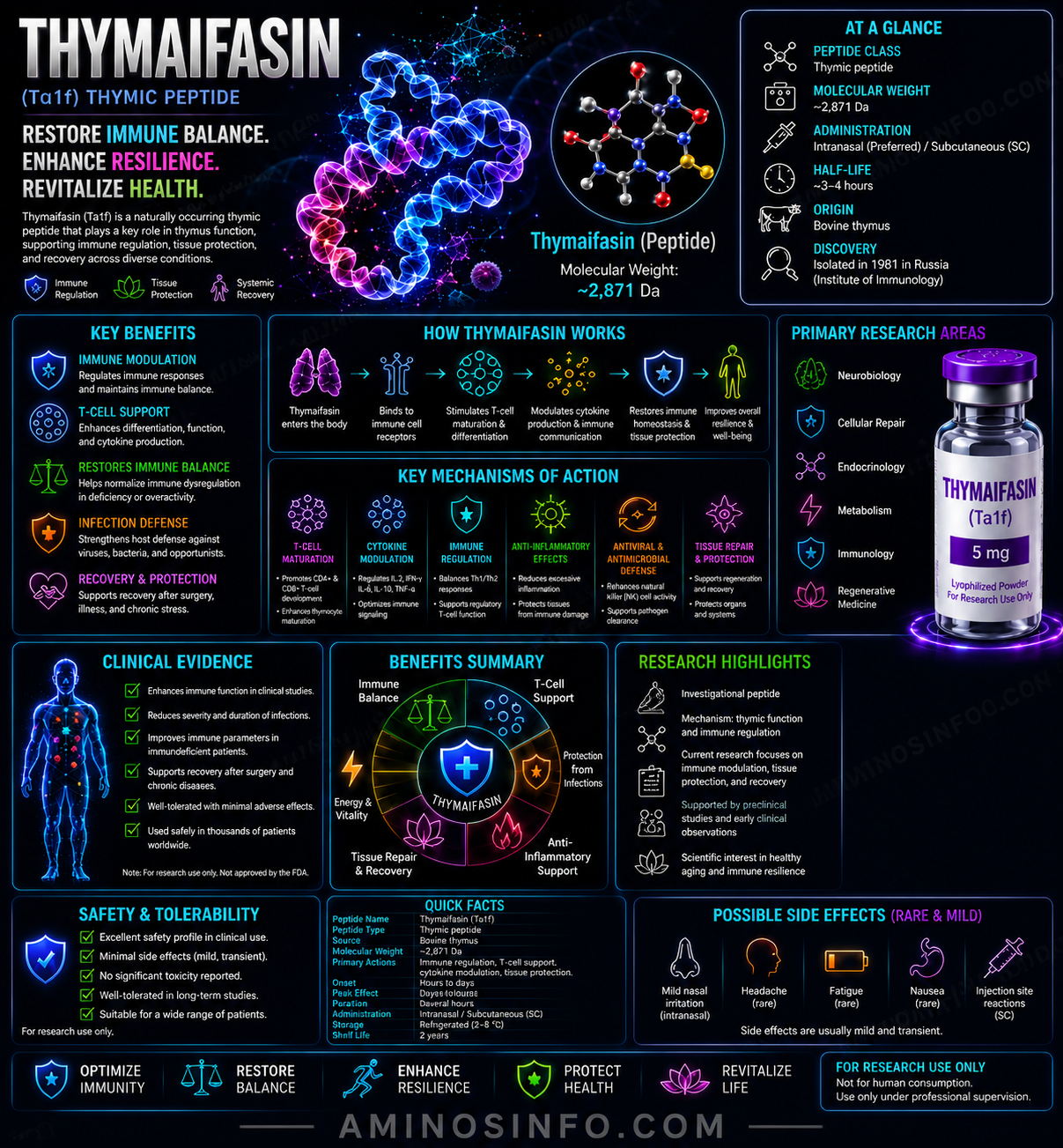
Thymalfasin scientific overview content should distinguish the recognized synthetic form of thymosin alpha-1 from the misspelled term “Thymaifasin” and from ultrashort Khavinson peptides. The article also separates international use and clinical research from the absence of U.S. FDA marketing approval.
Important Identity Correction
| Original description | Evidence-based correction |
|---|---|
| “Thymaifasin” | For example, The recognized name is thymalfasin. |
| Meanwhile, Unknown proprietary short peptide | Likewise, Thymalfasin is a fully defined 28-amino-acid peptide. |
| Khavinson ultrashort bioregulator | In addition, Thymalfasin is synthetic thymosin alpha-1 and is not a Khavinson dipeptide, tripeptide, or tetrapeptide. |
| Exact sequence unavailable | Moreover, researchers have known the complete sequence since 1977. |
| Evidence mainly preclinical | By contrast, Thymalfasin has extensive clinical research and international pharmaceutical use, although evidence quality varies by indication. |
What Is Thymalfasin?
First, Thymalfasin is the chemically synthesized form of thymosin alpha-1, a naturally occurring 28-amino-acid peptide derived from the N-terminal region of prothymosin alpha.
Next, thymosin alpha-1 was first isolated from thymosin fraction 5, a thymus-derived peptide preparation. The synthetic drug form is marketed internationally under names including Zadaxin.
However, unlike short organ-specific peptide bioregulators such as Vilon or Thymogen, thymalfasin is a comparatively large, completely characterized immunoregulatory peptide with decades of experimental and clinical research.
Thymalfasin
Thymosin alpha-1
28 amino acids
N-terminal acetylation
Immune modulation
No
🧬 Molecular Structure
First, thymalfasin is an acidic, N-terminally acetylated linear peptide containing 28 amino-acid residues. It is chemically identical in sequence to human thymosin alpha-1.
🧪 Complete Amino-Acid Sequence
Ac-Ser-Asp-Ala-Ala-Val-Asp-Thr-Ser-Ser-Glu-Ile-Thr-Thr-Lys-Asp-Leu-Lys-Glu-Lys-Lys-Glu-Val-Val-Glu-Glu-Ala-Glu-Asn-OH
One-letter notation:
Ac-SDAAVDTSSEITTKDLKEKKEVEEEAEN-OH
| Structural feature | Importance |
|---|---|
| N-terminal acetyl group | Also, Part of the native thymosin alpha-1 structure and essential for correct identity. |
| 28-amino-acid length | Consequently, Distinguishes thymalfasin from ultrashort thymic peptides. |
| High acidic-residue content | However, Contributes to low isoelectric point and solution behavior. |
| No disulfide bonds | Therefore, The peptide is linear and contains no cysteine residues. |
| For example, Free C-terminal carboxyl group | Meanwhile, Distinguishes the native form from amidated analogs. |
⚛️ Molecular Weight and 🧫 Formula
| Neutral molecular formula | Likewise, C129H215N33O55 |
|---|---|
| Average molecular weight | Approximately 3108.3 g/mol |
| Peptide length | 28 amino acids |
| N-terminal form | Acetylated |
| C-terminal form | Free carboxyl group |
| Common CAS number | 62304-98-7 |
📅 Discovery Timeline and Research History
1960s–1970s: Thymosin fraction 5 developed
First, researchers extracted and fractionated peptides from calf thymus to identify factors involved in immune development.
1977: Thymosin alpha-1 isolated and sequenced
Next, researchers determined the complete 28-amino-acid sequence and established thymosin alpha-1 as one of the first fully characterized thymic peptides.
1980s–1990s: Synthetic thymalfasin developed
Moreover, researchers produced chemically synthesized thymosin alpha-1 for standardized experimental and pharmaceutical use.
1990s–2000s: International clinical development
In addition, researchers evaluated thymalfasin in chronic hepatitis B and C, immunodeficiency, cancer, vaccine-response studies, and infection-related immune dysfunction.
2000: FDA orphan designation
However, the FDA granted orphan-drug designation for thymalfasin in hepatocellular carcinoma, but this did not constitute FDA approval.
2010s: Sepsis, oncology, and vaccine-response research expands
Meanwhile, investigators studied thymalfasin as an immune adjunct in critical illness, malignancy, and immunocompromised populations.
2020–2025: COVID-19 and immune-reconstitution research
Moreover, clinical trials and reviews explored thymalfasin in severe viral illness, lymphocyte recovery, immune homeostasis, and vaccine response.
Current status
Finally, multiple countries use or approve thymalfasin, but the FDA has not approved it in the United States.
Thymus and Immune-System Biology
Thymic T-cell development
First, the thymus supports T-cell lineage commitment, positive selection, negative selection, and development of immune tolerance.
CD4 and CD8 cells
Next, CD4 T cells coordinate immune responses, while CD8 T cells kill infected or malignant cells. Their function depends on antigen presentation, cytokines, costimulation, and tissue context.
Dendritic cells
Moreover, dendritic cells detect pathogens, process antigens, and activate naïve T cells. They bridge innate and adaptive immunity.
Innate immunity
In addition, macrophages, natural killer cells, neutrophils, and pattern-recognition receptors provide early defense and shape later adaptive responses.
Immune homeostasis
Finally, effective immunity requires balance. Excessive activation can cause tissue injury, while insufficient activation can permit infection or malignancy.
🧠 Mechanism of Action
Importantly, thymalfasin appears to modulate both innate and adaptive immunity. Its action is pleiotropic rather than limited to one receptor.
1. Toll-like receptor signaling
First, research has linked thymosin alpha-1 with Toll-like receptor pathways, particularly Next, TLR2 and TLR9 in dendritic and myeloid cells.
2. Dendritic-cell maturation
Next, thymalfasin can enhance antigen presentation, expression of costimulatory molecules, and dendritic-cell functional maturation.
3. T-cell differentiation and survival
Moreover, studies report effects on T-cell maturation, CD4 and CD8 responses, cytokine production, and protection of thymocytes from steroid-induced apoptosis.
4. Natural killer-cell activity
In addition, researchers have associated thymosin alpha-1 with enhanced NK-cell cytotoxicity in selected models.
5. Cytokine modulation
However, reported effects include changes in interferons, interleukins, chemokines, and Th1-associated signaling. However, responses depend on disease state and immune context.
🎯 Receptor and Pathway Profile
| Target or pathway | Evidence status |
|---|---|
| TLR2 | In addition, Supported in myeloid and dendritic-cell research. |
| TLR9 | Moreover, Supported in dendritic-cell and innate immune research. |
| Dendritic-cell maturation | By contrast, Well represented in experimental literature. |
| Also, CD4 and CD8 T-cell responses | Consequently, Supported across experimental and clinical immune studies. |
| Natural killer cells | However, Enhanced activity reported in selected studies. |
| Th1 cytokine signaling | Therefore, Frequently reported, but context dependent. |
| Single exclusive receptor | None established. |
T-Cell and Adaptive Immune Research
T-cell maturation
First, thymosin alpha-1 was initially identified because of its ability to support thymus-dependent lymphocyte differentiation and function.
CD4 and CD8 populations
Next, clinical and preclinical studies report changes in CD4 counts, CD8 activity, CD4:CD8 ratios, or functional T-cell responses in selected immunocompromised populations.
Vaccine responses
Moreover, researchers have investigated thymalfasin as an adjunct to improve vaccine immunogenicity in older adults or immunocompromised individuals.
Antiviral immunity
In addition, research has evaluated thymalfasin in chronic hepatitis, severe viral infection, and other conditions where T-cell dysfunction may impair viral clearance.
Not a universal immune stimulant
However, responses depend on baseline immune status, pathogen, timing, concurrent therapy, age, and disease severity.
Dendritic-Cell and Innate Immune Research
Dendritic cells
First, thymalfasin may increase dendritic-cell maturation, antigen presentation, and cytokine production.
Pattern-recognition receptors
Next, TLR2 and TLR9 signaling may help explain effects on pathogen recognition and adaptive immune activation.
Natural killer cells
Moreover, researchers have reported increased NK-cell activity in infection and cancer-related studies.
Macrophage signaling
In addition, thymalfasin can alter inflammatory cytokine responses, but whether this is stimulatory or regulatory depends on the immune environment.
Immune homeostasis
However, researchers often describe the peptide as an immune modulator rather than a simple stimulant because it may restore weak responses while limiting dysregulated inflammation in some models.
Clinical Research and International Use
Chronic hepatitis B and C
First, thymalfasin has been approved or used in some countries as an adjunct in chronic viral hepatitis. Results vary by antiviral regimen and study era.
Cancer adjunct research
Next, studies have evaluated thymalfasin with chemotherapy, immunotherapy, or other cancer treatments. It is not an established standalone anticancer drug.
Sepsis and critical illness
Moreover, trials and meta-analyses have examined mortality, infection, lymphocyte recovery, and ICU outcomes. Findings are mixed and study quality varies.
Vaccine response
In addition, research has explored improved influenza, hepatitis, and other vaccine responses in populations with reduced immune responsiveness.
COVID-19
However, trials investigated immune recovery, lymphocyte counts, severity, and mortality. Evidence remains insufficient for routine universal use.
Regulatory distinction
Finally, approval in another country does not mean FDA approval in the United States. FDA orphan designation also does not equal marketing approval.
Immunosenescence and Healthy-Aging Research
Age-related thymic involution
First, the thymus shrinks with age, reducing naïve T-cell output and narrowing immune repertoire diversity.
Older-adult immune responses
Next, researchers have studied thymalfasin for vaccine-response enhancement and immune restoration in older or immunocompromised adults.
No proven thymic regrowth
However, no robust evidence shows that thymalfasin physically regrows the aged human thymus or restores it to a youthful state.
No established longevity effect
Moreover, researchers have not proven that thymalfasin extends human lifespan or broadly reverses biological aging.
Immune aging is multifactorial
Finally, nutrition, chronic infection, inflammation, frailty, medications, cancer, metabolic disease, and bone-marrow function all contribute to immune decline.
Evidence Limitations and Clinical Interpretation
Heterogeneous trials
First, studies vary in population, dose, duration, disease severity, concurrent therapy, and endpoints.
Regional availability
Next, some clinical experience comes from countries with regulatory systems and treatment practices different from those in the United States.
Adjunctive use complicates interpretation
Moreover, many studies combine thymalfasin with antiviral drugs, chemotherapy, vaccines, antibiotics, or supportive care.
Biomarkers are not always clinical outcomes
However, higher lymphocyte counts or cytokine changes do not automatically translate into fewer infections, longer survival, or better quality of life.
No universal immune indication
Finally, marketers should not present thymalfasin as appropriate for every infection, cancer, or low-immunity state.
Safety and Regulatory Considerations
General tolerability
First, international studies generally describe thymalfasin as well tolerated, with injection-site reactions and mild systemic symptoms among the more commonly reported adverse effects.
Potential adverse effects
- First, Injection-site pain, redness, or swelling
- Next, Fatigue or transient flu-like symptoms
- Also, Headache
- Moreover, Nausea
- In addition, Possible changes in inflammatory or autoimmune activity
Autoimmune disease
Moreover, immune modulation could theoretically worsen some autoimmune conditions or interact with immunosuppressive therapy.
Transplantation
In addition, immune-enhancing effects may be inappropriate in transplant recipients without specialist oversight.
Cancer treatment
However, use alongside chemotherapy, checkpoint inhibitors, cellular therapy, or immunosuppressive regimens requires oncology supervision.
United States regulatory status
Finally, thymalfasin is not FDA approved. It received orphan designation for selected indications, but orphan designation is not approval.
🧪 Laboratory Testing Methods
Identity, Sequence, Acetylation, and Potency Testing
| Method | Purpose | Important limitation |
|---|---|---|
| RP-HPLC or UPLC | For example, Measures purity and separates deletion, truncation, and oxidation products. | Meanwhile, Area purity does not establish sequence or net content. |
| LC-MS / HRMS | Likewise, Confirms intact molecular mass and major impurities. | In addition, Does not by itself prove complete sequence order. |
| MS/MS sequencing | Moreover, Confirms the 28-residue amino-acid sequence. | By contrast, Requires validated coverage across the full peptide. |
| Peptide mapping | Also, Uses enzymatic or chemical fragments to confirm identity. | Consequently, Method development is more complex than for ultrashort peptides. |
| N-terminal acetylation assay | However, Confirms the required acetyl modification. | Therefore, Unacetylated material is not authentic thymalfasin. |
| Amino-acid analysis | For example, Confirms composition and supports content determination. | Meanwhile, Does not establish sequence order. |
| Chiral amino-acid analysis | Likewise, Confirms expected L-amino-acid stereochemistry. | In addition, Hydrolysis can introduce artifacts. |
| Net peptide-content assay | Moreover, Measures actual thymalfasin mass after correcting for water and counterions. | By contrast, analysts must not infer net peptide content from HPLC purity. |
| Also, Residual solvent and elemental impurity testing | Evaluates manufacturing-process contaminants. | Consequently, Does not prove biological activity. |
| Cell-based potency assay | However, May evaluate dendritic-cell, cytokine, or T-cell responses. | Therefore, Requires a validated, reproducible biological endpoint. |
| For example, Microbial limits, sterility, and endotoxin | Meanwhile, Evaluates route-specific microbiological quality. | Likewise, Requirements depend on final dosage form. |
| Stability-indicating assay | In addition, Tracks deamidation, oxidation, hydrolysis, aggregation, and potency. | Moreover, Must reflect final formulation and storage conditions. |
📄 How to Interpret a Thymalfasin COA
COA Review and Route-Specific Quality
- By contrast, Verify the exact identity: The COA should state thymalfasin or thymosin alpha-1.
- Also, Confirm the full 28-amino-acid sequence: A generic “thymic peptide” label is inadequate.
- Consequently, Verify N-terminal acetylation: The sequence must begin with acetylated serine.
- However, Confirm molecular mass: Approximately 3108.3 g/mol.
- Therefore, Separate purity from net content: A 99% HPLC area result does not prove the labeled peptide amount.
- For example, Review truncations, deletion peptides, oxidation, deamidation, and aggregation.
- Meanwhile, Check water, counterions, residual solvents, and elemental impurities.
- Likewise, Match microbiological testing to the route: Injectable material requires validated sterility and endotoxin testing.
- In addition, Do not infer clinical efficacy: A COA cannot prove improved immunity, infection prevention, vaccine response, cancer benefit, or thymic rejuvenation.
📊 Thymalfasin vs Thymogen vs Vilon vs Thymalin
Large Defined Peptide Versus Ultrashort Thymic Peptides
| Feature | Thymalfasin | Thymogen | Vilon | Thymalin |
|---|---|---|---|---|
| Structure | 28-AA acetylated peptide | EW dipeptide | KE dipeptide | Complex peptide mixture |
| Main research focus | Moreover, Innate and adaptive immune modulation | Thymic immune signaling | By contrast, Gene and immune regulation | Also, Broad thymic peptide effects |
| Human clinical evidence | Substantial international research | Limited regional research | Limited regional research | Regional clinical literature |
| US FDA approved? | For example, Regulators have not approved this compound. | Moreover, No approved indication exists. | This remains unapproved. | In addition, No FDA authorization applies. |
Thymalfasin vs Thymosin Beta-4
| Feature | Thymalfasin | Thymosin Beta-4 |
|---|---|---|
| Peptide length | 28 amino acids | 43 amino acids |
| Main biology | Immune modulation | Consequently, Actin binding, migration, wound repair |
| Same thymosin family? | However, No; alpha and beta thymosins are chemically and genetically distinct | Therefore, No; distinct beta-thymosin family |
Thymalfasin vs Approved Immune Therapies
International Immune Modulator Versus Approved U.S. Therapies
| Therapy type | Established role | Difference from thymalfasin |
|---|---|---|
| Vaccines | For example, Induce antigen-specific immune memory | Preventive antigen-directed therapy |
| Interferons | Meanwhile, Approved for selected viral, malignant, and immune conditions | Defined cytokine-receptor signaling |
| Colony-stimulating factors | Likewise, Increase selected blood-cell populations | In addition, Defined hematopoietic receptor targets |
| Checkpoint inhibitors | Moreover, Release specific antitumor T-cell brakes | Targeted oncology immunotherapy |
| Thymalfasin | International immune-modulating adjunct | By contrast, Pleiotropic peptide with no US approval |
🔗 Related Peptides and Immune Pathways
- Prothymosin alpha: First, the precursor protein from which thymosin alpha-1 derives.
- Next, TLR2 and TLR9: Pattern-recognition pathways associated with thymosin alpha-1 activity.
- Dendritic cells: Also, Antigen-presenting cells central to thymalfasin research.
- CD4 and CD8 T cells: Moreover, Adaptive immune populations influenced in selected studies.
- Natural killer cells: In addition, Innate lymphocytes reported to respond to thymosin alpha-1.
- Thymogen and Vilon: Likewise, Distinct ultrashort thymic peptides.
- Thymalin: Finally, Complex thymus-derived peptide mixture.
🖼️ Original Diagram Specifications
Diagram 1: Thymalfasin primary structure
Also, Show the full 28-amino-acid chain with the N-terminal acetyl group, acidic residues, lysine clusters, and free C-terminal carboxyl group.
Diagram 2: Identity correction
Consequently, Contrast the unrecognized term “Thymaifasin” with thymalfasin, thymosin alpha-1, and the Zadaxin trade name.
Diagram 3: Innate-to-adaptive immune bridge
However, Show TLR2/TLR9 signaling in dendritic cells, antigen presentation, T-cell activation, NK-cell support, and antibody responses.
Diagram 4: Thymic T-cell development
Therefore, Show bone-marrow progenitors entering the thymus, positive and negative selection, and mature CD4/CD8 T-cell release.
Diagram 5: Clinical evidence map
For example, Show chronic viral hepatitis, cancer adjunct research, sepsis, vaccine response, COVID-19, and immunocompromised states, with evidence strength graded separately.
Diagram 6: Regulatory-status map
Meanwhile, Show international approvals or marketing versus lack of FDA approval and the distinction between orphan designation and approval.
Diagram 7: COA workflow
Likewise, Show intact mass, full MS/MS sequence, N-terminal acetylation, peptide mapping, amino-acid analysis, net content, impurities, sterility, endotoxin, and stability.
❓ Frequently Asked Questions
Is “Thymaifasin” a recognized peptide?
In addition, No reliable primary source was found for that spelling. The intended compound is almost certainly thymalfasin.
Is thymalfasin a peptide?
Moreover, Yes. It is a synthetic, N-terminally acetylated 28-amino-acid peptide.
Is thymalfasin the same as thymosin alpha-1?
By contrast, Yes. Thymalfasin is the chemically synthesized drug form of thymosin alpha-1.
What is its sequence?
Ac-SDAAVDTSSEITTKDLKEKKEVEEEAEN-OH.
What is its molecular weight?
Approximately 3108.3 g/mol.
Is thymalfasin FDA approved?
Also, No. It has FDA orphan designations but no FDA marketing approval.
Is it approved elsewhere?
Consequently, multiple countries have approved or marketed it for selected indications.
Does thymalfasin increase T cells?
Moreover, studies report effects on T-cell maturation, function, and counts in selected populations, but results vary.
Does it improve immunity?
However, It may improve selected immune responses in some immunocompromised or infected populations, but it is not a universal immune booster.
Does thymalfasin regrow the thymus?
However, no robust evidence shows physical regrowth of an aged human thymus.
Is it used for cancer?
Therefore, researchers have studied it as an adjunct rather than as a proven standalone cancer treatment.
Is thymalfasin the same as TB-500?
For example, No. TB-500 is associated with thymosin beta-4 and is chemically unrelated.
Does 99% HPLC purity prove immune activity?
Meanwhile, No. Full sequence, acetylation, net content, potency, safety, pharmacokinetics, and clinical outcomes must be established separately.
Thymalfasin Scientific Overview: Final Thoughts
In conclusion, the original article appears to be based on a misspelling. The recognized compound is thymalfasin, the synthetic form of thymosin alpha-1—not a proprietary ultrashort Khavinson peptide.
However, thymalfasin is a fully characterized, N-terminally acetylated 28-amino-acid peptide with decades of research involving dendritic cells, Next, TLR2 and TLR9 pathways, T-cell responses, natural killer cells, chronic viral hepatitis, cancer adjunct therapy, sepsis, vaccine responses, and immune reconstitution.
Therefore, its international use and clinical literature make it more established than most research peptides, but the FDA has not approved it, and marketers should not present it as a universal immune enhancer, anti-aging treatment, or substitute for standard care.
📚 References
- Likewise, Goldstein AL, et al. Thymosin alpha1: isolation and sequence analysis of an immunologically active thymic polypeptide. 1977.
- In addition, PubChem. Thymalfasin compound record.
- Moreover, Dominari A, et al. Thymosin alpha-1: A comprehensive review of the literature. 2020.
- By contrast, Li J, et al. Thymosin alpha 1: biological activities, applications and genetic engineering production. 2010.
- Also, Sjögren MH. Thymalfasin: an immune system enhancer for chronic hepatitis and related diseases. 2004.
- Consequently, FDA. Orphan-drug designation record for thymalfasin.
- However, FDA. Thymosin Alpha-1 related bulk drug substances review. 2024.
- Therefore, ClinicalTrials.gov. Thymalfasin for COVID-19 infection.
- For example, ClinicalTrials.gov. Thymalfasin vaccine-response and immune-reconstitution studies.
- Meanwhile, Garaci E. Thymosin alpha1: a historical overview. Annals of the New York Academy of Sciences.
- Likewise, Romani L, et al. Thymosin alpha1 activates dendritic cells through Toll-like receptor signaling. Blood and related immunology literature.
- In addition, Romani L, et al. Thymosin alpha1 represents a potential potent single-molecule-based therapy for cystic fibrosis. Nature Medicine.
- Moreover, Serafino A, et al. Thymosin alpha1 activates dendritic cells and protects against fungal infection. Immunology literature.
- By contrast, Naylor PH, et al. Thymosin alpha1 and T-cell differentiation. International Journal of Immunopharmacology.
- Also, Low TLK, et al. Thymosin alpha1 effects on lymphocyte maturation and function. Journal of Biological Response Modifiers.
- Consequently, Schulof RS. Thymic hormones and immune restoration. Cancer Treatment Reports.
- However, Goldstein AL, et al. Thymosins and immune regulation. Annals of the New York Academy of Sciences.
- Therefore, Tuthill C, et al. Thymalfasin and chronic hepatitis B. Journal of Viral Hepatitis.
- For example, Sherman KE, et al. Thymosin alpha1 and chronic hepatitis C combination therapy.
- Meanwhile, Andreone P, et al. Thymosin alpha1 plus interferon in chronic hepatitis C.
- Likewise, Rasi G, et al. Thymosin alpha1 in hepatocellular carcinoma and cancer immunotherapy.
- In addition, Maio M, et al. Thymosin alpha1 in melanoma and oncology adjunct research.
- Moreover, Schulof RS, et al. Thymosin alpha1 in lung cancer immunotherapy. Journal of Biological Response Modifiers.
- By contrast, King R, Tuthill C. Immune-modulating properties of thymosin alpha1. Expert Opinion on Biological Therapy.
- Also, Matteucci C, et al. Thymosin alpha1 and immune homeostasis. Annals of the New York Academy of Sciences.
- Consequently, Garaci E, et al. Thymosin alpha1 in sepsis and severe infection. Expert Opinion on Biological Therapy.
- However, Liu F, et al. Thymosin alpha1 for sepsis: systematic review and meta-analysis.
- Therefore, Wu J, et al. Thymosin alpha1 in severe sepsis and lymphocyte recovery.
- For example, Pei F, et al. Thymosin alpha1 treatment in critical illness and infection.
- Meanwhile, Matteucci C, et al. Thymosin alpha1 and dendritic-cell function.
- Likewise, Bistoni F, et al. Thymosin alpha1 and antifungal immunity.
- In addition, Wolf E, et al. Thymosin alpha1 as an adjuvant to vaccination in immunocompromised hosts.
- Moreover, Ershler WB, et al. Thymosin alpha1 and influenza vaccine response in older adults.
- However, Rinaldi M, et al. Thymosin alpha1 and vaccine immunogenicity.
- Therefore, Peppas S, et al. Thymosin alpha1 in chronic viral infection.
- Likewise, Matteucci C, et al. Thymosin alpha1 and innate immunity.
- For example, Pica F, et al. Thymosin alpha1 in infectious diseases. Expert Opinion on Biological Therapy.
- Moreover, Riva A, et al. Thymosin alpha1 in COVID-19: mechanistic and clinical review.
- In addition, Yu K, et al. Thymosin alpha1 in COVID-19 patients with severe lymphocytopenia.
- However, Liu Y, et al. Thymosin alpha1 and outcomes in severe COVID-19.
- Therefore, Blood Neoplasia. Thymic peptides in immune reconstitution and clinical practice. 2025.
- Likewise, Besman M, et al. Review of thymic peptides and hormones. 2024.
- For example, ICH Q2(R2). Validation of Analytical Procedures.
- Moreover, USP General Chapter <621>. Chromatography.
- In addition, USP General Chapter <71>. Sterility Tests.
- USP General Chapter <85>. Bacterial Endotoxins Test.
- USP General Chapters <232> and <233>. Elemental Impurities.
- ICH Q3C. Residual Solvents.
- ICH Q1A(R2). Stability Testing of New Drug Substances and Products.
Thymalfasin Identity, Mechanism, and Clinical Sources
Immune, Regulatory, and Analytical Sources
Identity, molecular properties, immune mechanisms, international clinical research, regulatory status, safety, and analytical requirements were reviewed in July 2026. Thymalfasin remains unapproved by the FDA in the United States.