Thymogen Scientific Overview: Identity, Mechanism, Evidence, and Testing
Thymogen scientific overview content should distinguish L-α-glutamyl-L-tryptophan from γ-glutamyl and D-amino-acid analogs. The article also separates Russian medicinal registration and regional evidence from FDA or EMA approval and from claims of universal immune or anti-aging benefit.
What Is Thymogen?
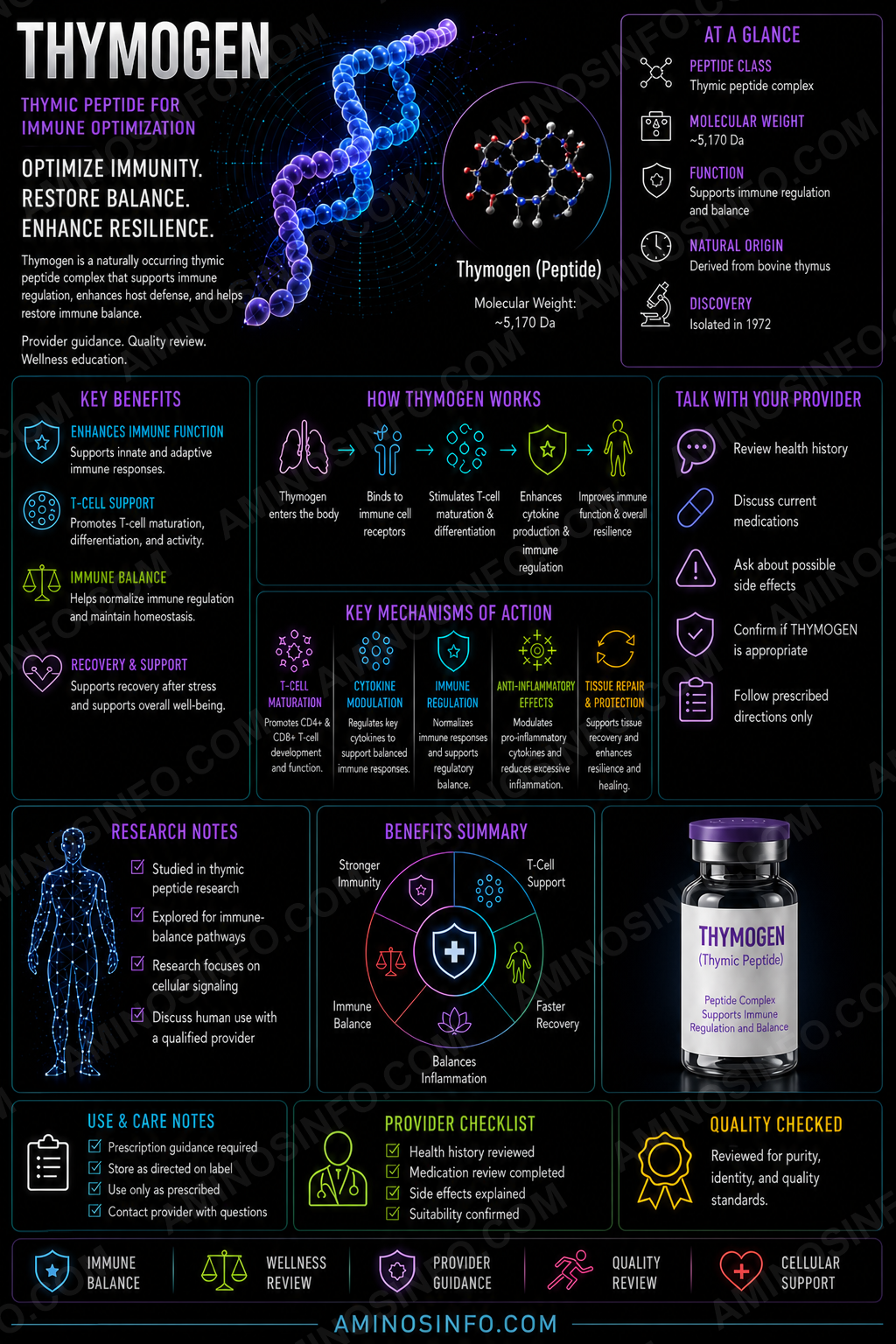
First, Thymogen is the dipeptide α-L-glutamyl-L-tryptophan, commonly abbreviated Glu–Trp or EW. It is also known by the generic chemical name oglufanide.
Next, researchers isolated the peptide as a biologically active component associated with the thymus-derived peptide complex Thymalin and was later produced synthetically as a standardized immunomodulatory compound.
However, Thymogen is unusual among many peptides discussed in research markets because it is not merely a vendor-defined compound. It has been developed and registered as a medicine in Russia, although it remains unapproved by the FDA, EMA, and other major Western regulators.
Thymogen
Oglufanide
α-L-Glu–L-Trp
EW
2 amino acids
No
🧬 Molecular Structure
First, Thymogen consists of L-glutamic acid linked through its α-carboxyl group to the amino group of L-tryptophan. The conventional structure has a free N-terminal amino group and a free C-terminal carboxyl group.
🧪 Amino-Acid Sequence
H-L-Glu-L-Trp-OH
One-letter notation: EW
For example, Systematic description: L-α-glutamyl-L-tryptophan.
| Residue | Chemical feature | Analytical relevance |
|---|---|---|
| L-glutamic acid | However, Acidic amino acid with α- and γ-carboxyl groups | Finally, analysts must confirm an α-glutamyl peptide bond rather than a γ-glutamyl linkage. |
| L-tryptophan | Moreover, Aromatic indole-containing amino acid | First, Provides UV absorbance near 280 nm and can undergo oxidation. |
⚛️ Molecular Weight and 🧫 Formula
| Neutral molecular formula | Next, C16H19N3O5 |
|---|---|
| Average molecular weight | Approximately 333.34 g/mol |
| Peptide length | Dipeptide; two residues |
| Stereochemistry | L-Glu and L-Trp |
| Peptide linkage | α-glutamyl linkage |
| CAS number | 38101-59-6 |
📅 Discovery Timeline and Research History
1970s–1980s: Thymalin and thymic peptide research
First, researchers investigated peptide fractions isolated from calf thymus for effects on immune development, hematopoiesis, regeneration, and aging.
1980s: Glu–Trp identified as an active component
Next, researchers isolated L-Glu-L-Trp from the thymic peptide complex Thymalin by chromatographic methods and synthesized as a defined immunomodulatory peptide.
Late 1980s–1990s: Experimental infection and immune-recovery studies
Moreover, animal studies evaluated secondary immunodeficiency, candidiasis, toxic injury, radiation exposure, and post-stress immune recovery.
1990s–2000s: Regional clinical development
In addition, researchers developed Thymogen in injectable, intranasal, and topical formulations in Russia.
2000: Lifespan and tumor study
However, a mouse study reported that chronic L-Glu-L-Trp treatment slowed aspects of aging and altered tumor incidence, but such findings remain model specific.
2010s: Inflammation and stress-signaling research
Meanwhile, researchers examined thymic hormones as anti-inflammatory agents and studied precursor peptides as possible cellular stress signals.
2022–2024: Modern structural and mechanistic reviews
Moreover, recent reviews clarified the peptide’s α-glutamyl structure, pharmaceutical development, chiral analogs, and possible bidirectional immune regulation.
Current status
Finally, Thymogen remains a registered regional medicine but is not FDA approved and lacks broad modern multicenter validation across many marketed uses.
Relationship to Thymalin
Thymalin is a mixture
Likewise, Thymalin is a complex of low-molecular-weight thymus-derived peptides rather than one defined chemical entity.
Thymogen is one defined dipeptide
First, Thymogen is the specific synthetic sequence L-Glu-L-Trp.
Biological Effects Do Not Transfer Automatically
Next, Findings from Thymalin may reflect multiple components, while Thymogen research isolates the activity of one dipeptide.
Other Thymalin-associated peptides
Khavinson-school literature also discusses Lys–Glu (KE/Vilon) and Glu–Asp–Pro (EDP/Crystagen) as components or functional analogs associated with Thymalin.
Thymus, T-Cell, and Hematopoietic Biology
Thymic maturation
In addition, The thymus supports development and selection of T lymphocytes, helping establish a functional and self-tolerant adaptive immune repertoire.
CD4 and CD8 T cells
However, CD4 T cells coordinate immune responses, while CD8 T cells kill infected or malignant cells.
Hematopoietic stem cells
Finally, All blood and immune cells arise from hematopoietic stem and progenitor cells in bone marrow.
Immune recovery
Importantly, After radiation, chemotherapy, severe infection, toxic exposure, or physiologic stress, recovery requires coordinated bone-marrow production, thymic maturation, tissue trafficking, and cytokine signaling.
Immune balance
Likewise, Increasing immune activity is not always beneficial. Autoimmunity, chronic inflammation, transplant rejection, and cytokine-mediated injury can result from poorly controlled activation.
🧠 Proposed Mechanisms of Action
Importantly, no single high-affinity receptor has been established as the exclusive target of Thymogen. Reported effects involve immune-cell differentiation, cytokine signaling, gene expression, stress-response pathways, and hematopoietic regulation.
1. T-cell differentiation and function
First, researchers have studied Thymogen for effects on thymocyte maturation, mature T-cell markers, and adaptive immune responses.
2. Hematopoietic regulation
Next, experimental studies suggest effects on bone-marrow recovery and differentiation after immunosuppressive or toxic stress.
3. Cytokine modulation
Moreover, researchers have reported that α-Glu–Trp to alter IL-1α, IL-8, TNF-related responses, and endothelial adhesion-molecule expression.
4. Gene-expression regulation
However, broader short-peptide research proposes interactions with promoter regions, chromatin, or transcription-related proteins. Direct physiological genomic targets remain incompletely established.
5. Stress-sensor hypothesis
Finally, recent reviews propose that thymic and intracellular peptide precursors may release short peptides during cellular stress, providing signals between tissues and the immune system.
🎯 Target and Pathway Profile
| Target or pathway | Evidence status |
|---|---|
| T-cell differentiation | Likewise, Supported in regional experimental and thymic-peptide literature. |
| Hematopoietic recovery | Next, Reported in animal and regional clinical contexts. |
| IL-1α | In addition, Reduced after TNF stimulation in an endothelial-cell study. |
| IL-8 | Finally, Reduced after TNF stimulation in tested cell systems. |
| ICAM-1 | Likewise, Increased under selected spontaneous or TNF-stimulated conditions. |
| In addition, Heat-shock and stress-response pathways | Next, Proposed in short-peptide research; Thymogen-specific evidence varies. |
| Single exclusive receptor | None established. |
Immune and T-Cell Research
Adaptive immune signaling
However, researchers have investigated Thymogen for restoring T-cell responses under conditions of secondary immunodeficiency.
Mature T-cell markers
Finally, Related thymic-peptide research reports increased expression of markers associated with mature T lymphocytes, although not every result is specific to isolated EW.
Immune coordination
Importantly, The peptide may influence communication between thymic tissue, circulating lymphocytes, endothelial cells, and inflammatory mediators.
Context-dependent effects
Likewise, Recent chiral-peptide research contrasts immunostimulatory L-Glu-L-Trp with immunosuppressive D-amino-acid analogs, emphasizing that stereochemistry strongly influences activity.
No proof of universal immune enhancement
First, No large modern trial establishes that Thymogen improves immunity in all healthy individuals or prevents routine infections.
Hematopoietic and Recovery Research
Radiation and chemotherapy models
Next, researchers have investigated thymic peptides for recovery of blood-cell production and immune function after radiation or cytotoxic exposure.
Bone-marrow signaling
Moreover, Proposed effects include support of hematopoietic progenitor differentiation and restoration of immune-cell populations.
Toxic-exposure models
In addition, Animal studies have evaluated post-intoxication immunodeficiency after chemicals such as acetonitrile.
Recovery is multifactorial
However, Changes in white-cell counts may reflect bone marrow, thymus, spleen, infection status, inflammatory signaling, and drug effects.
No replacement for growth factors
Finally, Thymogen is not an FDA-approved alternative to granulocyte colony-stimulating factors, erythropoietin, transfusion, antibiotics, or oncology-directed supportive care.
Inflammation and Endothelial-Cell Research
2023 α-Glu–Trp cell study
Importantly, A study of α-glutamyl-tryptophan-containing preparations evaluated TNF-stimulated endothelial cells and peripheral blood mononuclear cells.
IL-1α and IL-8
Likewise, α-Glu–Trp reduced TNF-induced IL-1α and IL-8 production under the tested conditions.
ICAM-1
First, The peptide increased selected ICAM-1 responses, suggesting that it may not act as a simple anti-inflammatory suppressor.
Endothelial–immune communication
Next, ICAM-1 supports leukocyte adhesion and trafficking. Increasing or decreasing it can have different implications depending on infection, vascular inflammation, or tissue injury.
No established inflammatory-disease treatment
Moreover, Cell findings do not prove benefit in rheumatoid arthritis, inflammatory bowel disease, vasculitis, asthma, or sepsis.
Infection and Host-Defense Research
Experimental candidiasis
In addition, A 1990 study reported less severe candidiasis in an animal model of secondary immunodeficiency after Thymogen treatment.
Bacterial and viral defense
However, Regional literature has explored Thymogen in recurrent respiratory infection, viral illness, and impaired host defense.
Adjunctive, not antimicrobial
Finally, Thymogen does not directly replace antifungal, antiviral, or antibacterial drugs.
Immune activation may carry risk
Importantly, During severe infection, excessive immune activation can contribute to tissue injury, while insufficient activation can impair pathogen clearance.
Human evidence remains heterogeneous
Likewise, Many studies are older, regional, small, or use combination therapy, limiting certainty about Thymogen-specific effects.
Immunosenescence and Aging Research
Age-related thymic decline
First, The thymus involutes with age, reducing naïve T-cell production and changing immune repertoire diversity.
Mouse lifespan study
Next, A chronic L-Glu-L-Trp study in mice reported slower aspects of aging and altered spontaneous-tumor incidence.
Interpretation limits
Moreover, Animal longevity and tumor findings depend on strain, sex, dose, timing, husbandry, and statistical endpoints.
No proven thymic rejuvenation
In addition, No robust evidence shows physical regrowth of the aged human thymus or restoration of a youthful T-cell repertoire.
No proven human lifespan extension
However, researchers have not shown that Thymogen extends human life or broadly reverses biological aging.
Regional Clinical Use and Evidence
Russian formulations
Finally, companies have marketed Thymogen in Russia as intramuscular solution, dosed nasal spray, and topical cream formulations.
Indications vary by jurisdiction
Importantly, Regional labeling includes immune-deficiency and infection-related uses. These indications are not recognized FDA approvals.
Pediatric use
Likewise, Russian product information includes pediatric use for selected formulations, but clinicians should not transfer that use to unapproved products in other countries.
Formulation matters
First, Injection, nasal spray, and topical products have different absorption, exposure, excipients, and quality requirements.
Modern trial gap
Next, Large contemporary multicenter trials with standardized product characterization remain limited.
Evidence Limitations and Clinical Interpretation
Regional literature concentration
Moreover, Much of the evidence comes from Russian and Eastern European research traditions.
Older study designs
In addition, Many reports predate current standards for trial registration, CONSORT reporting, pharmacokinetics, and independent replication.
Thymalin findings are not automatically Thymogen findings
However, Thymalin is a mixture, while Thymogen is one defined dipeptide.
Biomarkers are not outcomes
Finally, Cytokine shifts, lymphocyte markers, or blood counts do not automatically prove fewer infections, better survival, or improved quality of life.
No broad Western regulatory approval
Importantly, writers should not describe regional medicinal registration as FDA or EMA approval.
Safety and Regulatory Considerations
Regional tolerability
Likewise, Russian product information and published experience generally describe low toxicity and acceptable short-term tolerability.
Potential adverse effects
- However, Injection-site discomfort or redness
- Next, Nasal irritation with intranasal products
- Therefore, Allergic or hypersensitivity reactions
- In addition, Headache or transient systemic symptoms
- However, Potential changes in autoimmune or inflammatory activity
Autoimmune disease
Finally, Immune stimulation could theoretically worsen some autoimmune conditions.
Transplantation and immunosuppression
Importantly, Thymogen may be inappropriate without specialist supervision in transplant recipients or people receiving immunosuppressive drugs.
Cancer and proliferation
Likewise, Because immune and gene-regulatory effects may vary by tissue, oncology use requires careful evidence and supervision.
United States status
First, Thymogen/oglufanide is not FDA approved.
🧪 Laboratory Testing Methods
Identity, Linkage, Stereochemistry, and Stability Testing
| Method | Purpose | Important limitation |
|---|---|---|
| Next, RP-HPLC, ion-pair HPLC, or UPLC | Moreover, Separates Thymogen from amino acids, analogs, and degradants. | In addition, Small polar peptides require validated retention and detection. |
| LC-MS / HRMS | Likewise, Confirms intact molecular mass. | Importantly, Cannot distinguish α- from γ-glutamyl linkage by mass alone. |
| MS/MS sequencing | First, Confirms Glu–Trp order and supports linkage assignment. | Next, May require comparison with authentic α- and γ-linked standards. |
| NMR spectroscopy | In addition, Can confirm α-glutamyl versus γ-glutamyl connectivity. | However, Requires sufficient purity and material. |
| Chiral amino-acid analysis | Importantly, Confirms L-Glu and L-Trp stereochemistry. | Likewise, Hydrolysis and derivatization can introduce artifacts. |
| Net peptide-content assay | For example, Measures actual Thymogen concentration. | Moreover, analysts must not infer net peptide content from HPLC area purity. |
| Tryptophan-oxidation analysis | Moreover, Detects oxidized indole-related impurities. | Finally, Requires light- and oxygen-controlled sample handling. |
| Free amino-acid analysis | Likewise, Detects hydrolysis or incomplete synthesis. | Requires adequate separation. |
| Cell-based immune assay | Moreover, Measures cytokines, lymphocyte markers, or endothelial responses. | In addition, No universally accepted Thymogen potency assay exists. |
| However, Microbial limits, sterility, and endotoxin | In addition, Evaluates route-specific microbiological quality. | Importantly, Requirements differ for nasal, injectable, and topical products. |
| Stability-indicating assay | First, Tracks hydrolysis, oxidation, assay, pH, and appearance. | Next, Must reflect the final dosage form and container. |
📄 How to Interpret a Thymogen COA
COA Review and Route-Specific Quality
- Moreover, Verify exact identity: L-α-glutamyl-L-tryptophan or oglufanide.
- Confirm sequence: H-L-Glu-L-Trp-OH.
- However, Confirm linkage: α-glutamyl Thymogen is not the same as a γ-glutamyl analog.
- Finally, Verify stereochemistry: Both residues should be in the L configuration.
- Importantly, Confirm molecular formula and mass: C₁₆H₁₉N₃O₅ and approximately 333.34 g/mol.
- Likewise, Separate identity, purity, and net content: These are distinct tests.
- First, Review tryptophan oxidation, free amino acids, water, counterions, and residual solvents.
- Next, Match testing to the route: Injectable, nasal, and topical products require different microbiological and formulation controls.
- Moreover, Do not infer clinical efficacy: A COA cannot prove immune restoration, fewer infections, anti-aging effects, or hematopoietic recovery.
📊 Thymogen vs Thymalin vs Vilon vs Crystagen
Defined Dipeptide Versus Thymic Peptide Mixtures
| Feature | Thymogen | Thymalin | Vilon | Crystagen |
|---|---|---|---|---|
| Sequence or composition | EW | However, Complex thymic peptide mixture | KE | EDP |
| Length | Dipeptide; two residues | Mixture | Dipeptide; two residues | 3 amino acids |
| Main research association | Therefore, Immune restoration and hematopoiesis | Likewise, Broad thymic immune regulation | For example, Gene and immune signaling | Immune-cell differentiation |
| FDA approved? | Moreover, Regulators have not approved this compound. | In addition, No approved indication exists. | This remains unapproved. | However, No FDA authorization applies. |
Thymogen vs Thymalfasin vs Thymulin
| Feature | Thymogen | Thymalfasin | Thymulin |
|---|---|---|---|
| Structure | EW dipeptide | 28-AA acetylated peptide | Zinc-dependent nonapeptide hormone |
| Main biology | Regional immune bioregulator | Finally, Innate and adaptive immune modulation | Thymic and neuroendocrine regulation |
| Human evidence | Regional and limited | Substantial international research | Mainly physiological and experimental |
| US FDA approved? | Regulators have not approved this compound. | No approved indication exists. | This remains unapproved. |
Thymogen vs Bestim vs Thymodepressin
Linkage, Chirality, and Opposing Immune Effects
| Compound | Key structural distinction | Reported immune direction |
|---|---|---|
| Thymogen | α-L-Glu-L-Trp | Immunostimulatory or restorative |
| Bestim | Modified γ-glutamyl tryptophan analog | Immunostimulatory |
| Thymodepressin | D-amino-acid analog | Immunosuppressive |
Thymogen vs Evidence-Based Immune Recovery
| Approach | Established role | Difference from Thymogen |
|---|---|---|
| Vaccination | Antigen-specific immune memory | Defined preventive mechanism |
| G-CSF | Accelerates neutrophil recovery | Approved receptor-targeted growth factor |
| Antimicrobials | Directly treat selected pathogens | Pathogen-directed therapy |
| Thymogen | Regional immune-modulating medicine | In addition, No FDA approval and less definitive evidence |
🔗 Related Peptides and Immune Pathways
- However, Thymalin is the thymus-derived peptide complex from which researchers identified EW.
- Finally, Vilon: KE dipeptide associated with immune and gene-regulation research.
- Importantly, Crystagen: EDP tripeptide associated with immune-cell differentiation.
- Likewise, Thymalfasin: 28-amino-acid thymosin alpha-1 peptide.
- First, Thymulin: Natural zinc-dependent thymic hormone.
- Next, ICAM-1: Endothelial adhesion molecule influenced in α-Glu–Trp cell studies.
- Moreover, IL-1α and IL-8: Inflammatory mediators altered under selected experimental conditions.
🖼️ Original Diagram Specifications
Diagram 1: Thymogen molecular structure
In addition, Show α-L-glutamyl-L-tryptophan with the glutamate α-peptide bond, free γ-carboxyl group, tryptophan indole ring, and free termini.
Diagram 2: α- versus γ-glutamyl linkage
However, Compare Thymogen’s α-linkage with a γ-glutamyl analog and explain why identical amino-acid composition does not mean identical compound.
Diagram 3: Thymalin-to-Thymogen relationship
Finally, Show Thymalin as a peptide mixture and EW as one defined synthetic component.
Diagram 4: Immune and hematopoietic pathway
Importantly, Show bone marrow, thymus, T-cell maturation, circulating lymphocytes, cytokines, and recovery after immune stress.
Diagram 5: Endothelial inflammation experiment
Likewise, Show TNF stimulation, IL-1α, IL-8, ICAM-1, and the mixed regulatory effects of α-Glu–Trp.
Diagram 6: Chiral analog comparison
First, Contrast L-Glu-L-Trp with D-amino-acid immunosuppressive analogs.
Diagram 7: COA workflow
Next, Show intact mass, MS/MS, NMR linkage confirmation, stereochemistry, tryptophan oxidation, net content, microbiology, and stability.
❓ Frequently Asked Questions
Is Thymogen a peptide?
Moreover, Yes. It is a synthetic dipeptide.
What is its exact chemical identity?
L-α-glutamyl-L-tryptophan, also called oglufanide.
What is its sequence?
H-L-Glu-L-Trp-OH, abbreviated EW.
What is its molecular weight?
Approximately 333.34 g/mol.
Is Thymogen FDA approved?
No.
Is it a registered medicine elsewhere?
Likewise, Yes. It has registered medicinal formulations in Russia.
Is Thymogen the same as Thymalin?
First, No. Thymalin is a mixture; Thymogen is one defined dipeptide.
Does Thymogen stimulate T cells?
Next, regional research suggests effects on T-cell differentiation and immune restoration, but modern large-scale validation remains limited.
Does it improve blood-cell recovery?
Moreover, Animal and regional research suggests possible hematopoietic effects, but it is not an FDA-approved growth factor.
Does it prevent infection?
In addition, No robust evidence establishes routine prevention of infection in healthy people.
Does it reverse immune aging?
However, No. It has not been shown to restore a youthful thymus or extend human lifespan.
Is Thymogen the same as thymosin alpha-1?
Finally, No. Thymogen is a two-amino-acid peptide; thymosin alpha-1/thymalfasin contains 28 amino acids.
Does 99% HPLC purity prove activity?
Importantly, No. Exact linkage, stereochemistry, net content, potency, pharmacokinetics, safety, and clinical outcomes must be established separately.
Thymogen Scientific Overview: Final Thoughts
In conclusion, Thymogen is a chemically defined thymic dipeptide composed of α-L-glutamyl-L-tryptophan. It is also known as oglufanide and has been developed as a registered medicinal product in Russia.
However, its research spans T-cell regulation, immune recovery, hematopoietic signaling, infection models, inflammatory cytokines, endothelial-cell communication, and aging. The evidence is more substantial than for many vendor-defined ultrashort peptides, but much of it remains regional, older, or mechanistic.
Therefore, analysts should verify legitimate material for the correct α-glutamyl linkage, L/L stereochemistry, exact EW sequence, molecular mass, tryptophan oxidation, free amino acids, net peptide content, route-specific microbiological quality, and stability.
📚 References
- Moreover, PubChem. Thymogen / Oglufanide compound record.
- In addition, Khavinson VK, et al. The Use of Thymalin for Immunocorrection and Molecular Aspects of Thymic Peptides. 2021.
- However, Deigin VI, et al. Advancement from Small Peptide Pharmaceuticals to Orally Active Peptidomimetics. 2023.
- Deigin V, et al. The First Reciprocal Activities of Chiral Peptide Pharmaceuticals. 2024.
- Importantly, Deigin VI, et al. Development of Peptide Biopharmaceuticals in Russia. 2022.
- Likewise, Golovacheva EG, et al. The Effect of Drugs with α-Glutamyl–Tryptophan on Cytokine Production and Endothelial Activation. 2023.
- First, Linkova N, et al. Influence of KE and EW Dipeptides on Gene Expression and Protein Synthesis. 2023.
- Next, Anisimov VN, et al. Immunomodulatory synthetic dipeptide L-Glu-L-Trp slows aging and inhibits spontaneous carcinogenesis in mice. 2000.
- Moreover, Khmel'nitskiĭ OK, et al. Effect of synthetic thymus peptide Thymogen on experimental candidiasis. 1990.
- In addition, Lunin SM, et al. Thymus hormones as prospective anti-inflammatory agents. 2010.
- However, Lunin SM, et al. Precursors of thymic peptides as stress sensors. 2020.
- Finally, Khavinson VK, et al. Thymic peptides and immune regulation. Regional immunology literature.
- Importantly, Morozov VG, Khavinson VK. Thymalin and Thymogen in immune correction. Clinical and experimental gerontology literature.
- Likewise, Khavinson VK. Peptides and ageing. Neuro Endocrinology Letters. 2002.
- First, Anisimov VN, Khavinson VK. Peptide bioregulation of aging: results and prospects. Biogerontology. 2010.
- Next, Khavinson VK, Kuznik BI. Peptide Bioregulators: The New Class of Geroprotectors. 2014.
- Moreover, Solovyev AY, et al. Interaction of amino acids, peptides, and proteins with DNA. 2015.
- In addition, Cytomed. Thymogen medicinal product information.
- However, Kashirin DM, et al. Identification of synthetic peptide preparations Thymogen, Thymodepressin, and Neogen by IR spectroscopy. Pharmaceutical Chemistry Journal. 2000.
- Finally, Zabrodskii PF. Thymogen in post-intoxication immunodeficiency after acetonitrile poisoning. Experimental and Clinical Pharmacology. 1999.
- Importantly, Rushkovskii SR, et al. Effect of Thymogen on chromosome aberrations in human peripheral blood lymphocytes. Cytology and Genetics. 1996.
- Likewise, Nevidimova TI, Suslov NI. Psychotropic effects of Thymogen. Bulletin of Experimental Biology and Medicine. 1995.
- First, Deigin VI, et al. Structure-function relationship of Glu-Trp peptide analogs. Peptide pharmaceutical literature.
- Next, Khavinson VK, et al. Thymalin: Activation of Differentiation of Human Hematopoietic Stem Cells. 2020.
- Moreover, Gokhale AS, et al. Peptides and peptidomimetics as immunomodulators. 2014.
- In addition, Thapa P, Farber DL. The role of the thymus in the immune response. Thoracic Surgery Clinics.
- However, Palmer DB. The effect of age on thymic function. Frontiers in Immunology.
- Finally, Thomas R, Wang W, Su DM. Age-related thymic involution and immunosenescence. Immunity & Ageing.
- Importantly, Goronzy JJ, Weyand CM. Immune aging and vaccine responses. Nature Immunology.
- Likewise, Nikolich-Žugich J. The twilight of immunity. Nature Immunology.
- First, Murray PJ. Macrophage activation and polarization. Annual Review of Physiology.
- Next, Turner MD, et al. Cytokines and inflammatory regulation. Biochimica et Biophysica Acta.
- Moreover, Lawrence T. The nuclear factor NF-κB pathway in inflammation. Cold Spring Harbor Perspectives in Biology.
- In addition, Vestweber D. How leukocytes cross the vascular endothelium. Nature Reviews Immunology.
- However, Springer TA. Adhesion receptors of the immune system. Nature.
- Finally, Kaech SM, Wherry EJ, Ahmed R. Effector and memory T-cell differentiation. Nature Reviews Immunology.
- Importantly, Murphy K, Weaver C. Janeway's Immunobiology. Garland Science.
- Likewise, International Council for Harmonisation. ICH Q2(R2): Validation of Analytical Procedures.
- First, United States Pharmacopeia. General Chapter <621>, Chromatography.
- Next, United States Pharmacopeia. General Chapters <61> and <62>, Microbiological Examination of Nonsterile Products.
- Moreover, United States Pharmacopeia. General Chapter <71>, Sterility Tests.
- In addition, United States Pharmacopeia. General Chapter <85>, Bacterial Endotoxins Test.
- However, United States Pharmacopeia. General Chapters <232> and <233>, Elemental Impurities.
- Finally, International Council for Harmonisation. ICH Q3C: Residual Solvents.
- Importantly, International Council for Harmonisation. ICH Q1A(R2): Stability Testing of New Drug Substances and Products.
Thymogen Identity, Immune, and Clinical Sources
Thymic Biology, Inflammation, and Analytical Sources
Identity, molecular properties, immune, hematopoietic, inflammatory, aging, safety, and regulatory findings were reviewed in July 2026. Finally, Thymogen remains unapproved by the FDA in the United States.