Tirzepatide (Mounjaro / Zepbound): What It Is, How It Works, Benefits, and Research Overview
A comprehensive review of tirzepatide, the once-weekly dual GIP and GLP-1 receptor agonist approved as Mounjaro for type 2 diabetes and as Zepbound for chronic weight management and moderate-to-severe obstructive sleep apnea in eligible adults.
What Is Tirzepatide?
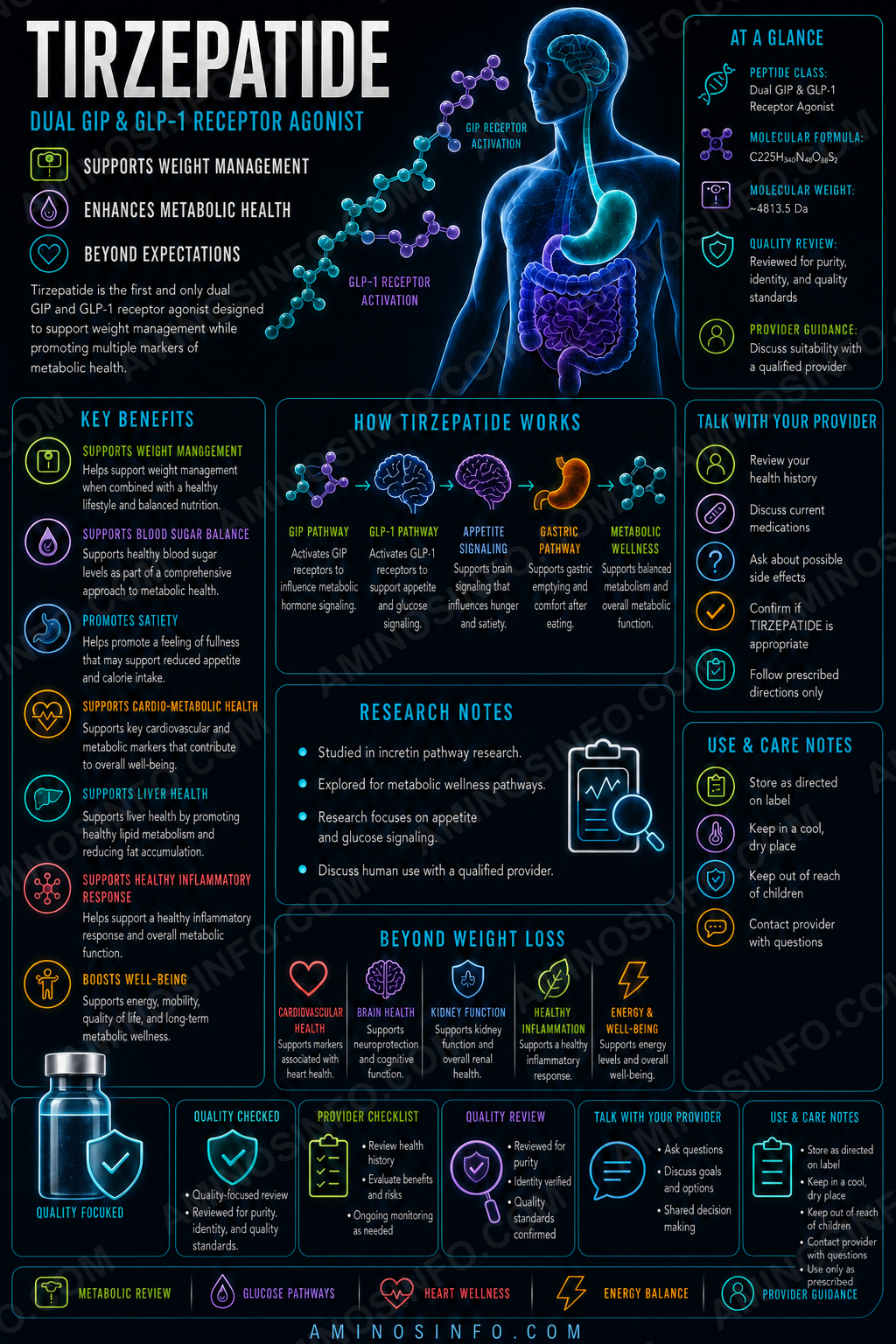
Tirzepatide, development code LY3298176, is a once-weekly synthetic peptide that activates both the glucose-dependent insulinotropic polypeptide receptor and the glucagon-like peptide-1 receptor.
Mounjaro and Zepbound
Long-acting dual-incretin peptide
GIPR + GLP-1R
39 amino acids
C₂₂₅H₃₄₈N₄₈O₆₈
4813.53 Da
Current U.S. indications
- Mounjaro: Adjunct to diet and exercise to improve glycemic control in adults and pediatric patients 10 years of age and older with type 2 diabetes.
- Zepbound: Chronic weight reduction and long-term weight maintenance in adults with obesity or overweight plus at least one weight-related comorbidity.
- Zepbound: Treatment of moderate-to-severe obstructive sleep apnea in adults with obesity.
🧬 Structure, Sequence, and Molecular Properties
🧪 Amino-acid sequence
YXEGTFTSDYSIXLDKIAQKAFVQWLIAGGPSSGAPPPS-NH₂
The sequence contains 39 residues. The “X” positions represent aminoisobutyric acid, or Aib, at positions 2 and 13.
Structural modifications
- GIP-sequence-derived peptide backbone
- Aib at positions 2 and 13 for protease resistance
- C-terminal amide
- Lysine at position 20 attached to 1,20-eicosanedioic acid through a linker
- Fatty-acid side chain that promotes albumin association
- No required disulfide bridge
⚛️ Molecular properties
| Molecular formula | C225H348N48O68 |
|---|---|
| Molecular weight | 4813.53 Da |
| CAS number | 2023788-19-2 |
| Development code | LY3298176 |
| Peptide type | Modified linear 39-amino-acid peptide |
| Half-life | Approximately 5 days |
Why the fatty-acid side chain matters
The 1,20-eicosanedioic-acid modification binds reversibly to albumin, reducing renal clearance and proteolytic degradation and enabling once-weekly administration.
📅 Discovery and Approval Timeline
2016–2020: Dual-incretin development
Lilly optimized tirzepatide to combine GIP and GLP-1 receptor activity in a single long-acting molecule.
2021: SURPASS phase 3 results
Major diabetes trials showed large A1C reductions and substantial weight loss compared with placebo, insulin, dulaglutide, and semaglutide 1 mg.
May 13, 2022: Mounjaro approval
The FDA approved Mounjaro for adults with type 2 diabetes.
November 8, 2023: Zepbound approval
The FDA approved Zepbound for chronic weight management in eligible adults.
December 20, 2024: OSA approval
Zepbound became the first FDA-approved medication for moderate-to-severe obstructive sleep apnea in adults with obesity.
2024: SUMMIT heart-failure findings
Tirzepatide reduced worsening heart-failure events and improved symptoms in adults with obesity-related HFpEF.
2025: SURPASS-CVOT results
Tirzepatide demonstrated cardiovascular safety and noninferiority to dulaglutide for major adverse cardiovascular events.
December 2025: Pediatric type 2 diabetes expansion
Mounjaro labeling expanded to include patients 10 years of age and older with type 2 diabetes.
2026: New delivery presentations
FDA-approved multi-dose vial and KwikPen presentations expanded available delivery formats.
🧠 How Does Tirzepatide Work?
1. GIP receptor activation
GIP receptor signaling supports glucose-dependent insulin secretion and may influence adipose-tissue function, nutrient handling, and the tolerability or efficacy profile of dual-incretin treatment.
2. GLP-1 receptor activation
GLP-1 receptor signaling reduces appetite, increases satiety, enhances glucose-dependent insulin secretion, suppresses inappropriate glucagon release, and delays gastric emptying.
3. Appetite and calorie intake
Tirzepatide reduces energy intake through central appetite pathways and changes in food reward and meal size.
4. Insulin sensitivity
Weight loss and direct metabolic signaling improve insulin sensitivity and reduce fasting and postprandial glucose.
5. Gastric emptying
Gastric emptying is delayed most strongly after initial doses, with attenuation over time.
🎯 Dual-Receptor Profile
| Target | Action | Major contribution |
|---|---|---|
| GIP receptor | Direct agonist | Glucose-dependent insulin secretion, adipose and metabolic signaling |
| GLP-1 receptor | Direct agonist | Appetite suppression, insulin secretion, glucagon regulation, gastric effects |
| Glucagon receptor | No direct agonism | Distinguishes tirzepatide from retatrutide, mazdutide, and survodutide |
| cAMP signaling | Primary downstream pathway | Functional receptor potency |
| Albumin | Reversible association through lipidation | Supports once-weekly exposure |
Type 2 Diabetes Evidence
SURPASS-1
Tirzepatide monotherapy produced major A1C reductions compared with placebo.
SURPASS-2
Tirzepatide 5 mg, 10 mg, and 15 mg produced greater A1C and weight reductions than semaglutide 1 mg over 40 weeks.
SURPASS-3
Tirzepatide outperformed insulin degludec for A1C reduction and produced weight loss rather than weight gain.
SURPASS-4
In adults with increased cardiovascular risk, tirzepatide produced strong glycemic and weight effects compared with insulin glargine.
SURPASS-5
Tirzepatide added to basal insulin improved A1C and weight compared with placebo.
Pediatric type 2 diabetes
The current Mounjaro label includes patients 10 years and older, with a maximum pediatric dose of 10 mg once weekly.
Weight-Management Evidence
SURMOUNT-1
In adults with obesity or overweight without diabetes, mean weight loss at 72 weeks reached approximately 15.0%, 19.5%, and 20.9% with 5 mg, 10 mg, and 15 mg, compared with approximately 3.1% with placebo.
SURMOUNT-2
Adults with obesity or overweight and type 2 diabetes achieved clinically meaningful weight reduction, though average loss was lower than in participants without diabetes.
SURMOUNT-3
After intensive lifestyle intervention, tirzepatide produced additional substantial weight reduction.
SURMOUNT-4
Participants who continued tirzepatide maintained and deepened weight loss, while those switched to placebo regained a meaningful amount of weight.
Diabetes prevention
Long-term SURMOUNT-1 follow-up in participants with prediabetes showed sustained weight loss and marked reduction in progression to type 2 diabetes during treatment.
Obstructive Sleep Apnea Evidence
SURMOUNT-OSA
Two phase 3 trials evaluated adults with moderate-to-severe OSA and obesity, including participants using positive-airway-pressure therapy and those unable or unwilling to use it.
Apnea-hypopnea index
Tirzepatide reduced breathing interruptions by up to approximately 63%, corresponding to about 25 to 30 fewer events per hour in major analyses.
Additional effects
- Reduced body weight
- Improved hypoxic burden
- Reduced inflammation
- Improved sleep-related patient-reported outcomes
- Improved cardiometabolic risk markers
Approved OSA use
Zepbound is FDA approved to treat moderate-to-severe OSA in adults with obesity, together with a reduced-calorie diet and increased physical activity.
Cardiovascular and Heart-Failure Evidence
SURPASS-CVOT
Tirzepatide was noninferior to dulaglutide for major adverse cardiovascular events in adults with type 2 diabetes and established cardiovascular disease or high risk.
SUMMIT
In adults with obesity and heart failure with preserved ejection fraction, tirzepatide reduced the risk of worsening heart-failure events and improved symptoms, physical limitations, exercise capacity, weight, and inflammation.
Current labeling limitation
Tirzepatide does not currently carry a broad Zepbound indication for cardiovascular-event reduction or an approved heart-failure indication.
Ongoing morbidity and mortality research
SURMOUNT-MMO is evaluating whether tirzepatide reduces major clinical outcomes in adults with obesity.
Liver Fat and Metabolic Research
Liver-fat reduction
Tirzepatide substantially reduces liver fat in many participants with type 2 diabetes or obesity.
MASH research
Clinical studies have evaluated tirzepatide in metabolic dysfunction-associated steatohepatitis, but tirzepatide does not currently have an FDA-approved MASH indication.
Lipid and blood-pressure effects
Trials consistently report improvements in triglycerides, non-HDL cholesterol, waist circumference, and systolic blood pressure.
Kidney-related effects
Albuminuria and estimated kidney-function trajectories have improved in exploratory and cardiovascular-outcome analyses, but exact kidney indications depend on future regulatory review.
FDA-Approved Dosing
Starting and escalation schedule
| Stage | Dose |
|---|---|
| Starting dose | 2.5 mg once weekly for 4 weeks |
| First increase | 5 mg once weekly |
| Further increases | Increase in 2.5 mg increments after at least 4 weeks at the current dose |
| Maximum adult dose | 15 mg once weekly |
| Maximum pediatric Mounjaro dose | 10 mg once weekly for patients 10 years and older |
Zepbound maintenance doses
Maintenance dose selection depends on indication, response, and tolerability. The 2.5 mg dose is for initiation and is not an approved maintenance dose.
Administration
- Once weekly, any time of day
- With or without meals
- Subcutaneous injection in the abdomen, thigh, or upper arm
- Rotate injection sites
- Do not combine with another tirzepatide product or GLP-1 receptor agonist
Warnings, Contraindications, and Side Effects
Boxed warning
Tirzepatide causes thyroid C-cell tumors in rats. Human relevance is unknown. It is contraindicated in patients with a personal or family history of medullary thyroid carcinoma or Multiple Endocrine Neoplasia syndrome type 2.
Common adverse effects
- Nausea
- Diarrhea
- Vomiting
- Constipation
- Abdominal pain
- Dyspepsia
- Reduced appetite
- Injection-site reactions
- Fatigue
- Eructation and reflux
- Hair loss in weight-management trials
Important warnings
- Acute pancreatitis
- Severe gastrointestinal adverse reactions
- Not recommended in severe gastroparesis
- Acute kidney injury due to volume depletion
- Hypoglycemia with insulin or insulin secretagogues
- Serious hypersensitivity reactions
- Diabetic retinopathy complications in susceptible patients
- Acute gallbladder disease
- Pulmonary aspiration during anesthesia or deep sedation
- Intestinal obstruction and severe constipation reported postmarketing
Suicidal-ideation labeling update
In 2026, FDA requested removal of suicidal-ideation language from GLP-1 receptor agonist labeling after its evaluation did not support a causal association.
Drug Interactions
Insulin and insulin secretagogues
Hypoglycemia risk increases when tirzepatide is used with insulin or sulfonylureas, and dose reduction of the background medicine may be necessary.
Oral medications
Delayed gastric emptying can affect the absorption of oral medications, especially medicines with narrow therapeutic windows or time-sensitive absorption.
Oral contraceptives
Patients using oral hormonal contraceptives should switch to a non-oral method or add a barrier method for 4 weeks after starting tirzepatide and for 4 weeks after each dose increase.
Use in Special Populations
Pregnancy
Tirzepatide may cause fetal harm and should be discontinued when pregnancy is recognized. Weight loss offers no benefit during pregnancy.
Lactation
Clinical decisions should consider the benefits of breastfeeding, maternal treatment needs, and available exposure data.
Renal impairment
No routine dose adjustment is required solely for renal impairment, but dehydration from gastrointestinal effects can worsen kidney function.
Hepatic impairment
No routine dose adjustment is required solely for hepatic impairment based on current pharmacokinetic data.
Pediatric use
Mounjaro is approved for type 2 diabetes in patients 10 years and older. Zepbound is not established as safe and effective in children.
🧪 Laboratory Testing Methods
| Method | Purpose | Important limitation |
|---|---|---|
| RP-HPLC / UPLC | Separates intact tirzepatide from deletion peptides, oxidized species, deacylated material, and process impurities. | Area purity does not prove complete identity or net peptide content. |
| LC-HRMS | Confirms intact mass and formula. | Does not alone prove sequence, stereochemistry, or attachment site. |
| MS/MS peptide mapping | Confirms the 39-residue sequence, Aib residues, linker, and lipidation site. | Requires validated fragmentation and a qualified standard. |
| Amino-acid analysis | Confirms composition and supports net-content assignment. | Does not prove residue order or modification location. |
| Chiral amino-acid analysis | Detects epimerization and incorrect stereochemistry. | Hydrolysis can create artifacts. |
| C-terminal amidation assay | Confirms the amidated terminal serine. | Requires targeted mass-spectrometric confirmation. |
| Lipid-chain characterization | Confirms 1,20-eicosanedioic acid, linker composition, and Lys20 attachment. | Incorrect lipidation may preserve approximate intact mass. |
| Deacylated-peptide assay | Measures peptide lacking the long-acting side chain. | Deacylated peptide may retain partial receptor activity. |
| Oxidation and deamidation assays | Measure stability-related degradants. | Some variants require high-resolution separation. |
| SEC-HPLC | Measures aggregates and high-molecular-weight species. | Small reversible oligomers may require orthogonal testing. |
| Net peptide-content assay | Measures actual active peptide mass. | Must correct for water, counterions, and excipients. |
| GIPR cAMP assay | Measures GIP-receptor potency. | Does not establish GLP-1R potency. |
| GLP-1R cAMP assay | Measures GLP-1-receptor potency. | Receptor density affects EC50. |
| Dual-receptor potency ratio | Confirms intended GIPR-to-GLP-1R balance. | No universal cross-laboratory ratio exists. |
| Albumin-binding assay | Confirms the long-acting lipidated design. | Does not fully predict clinical half-life. |
| Plasma stability | Measures proteolysis and deacylation. | Species differences matter. |
| Residual-solvent and counterion testing | Measures TFA, acetate, acetonitrile, and synthesis residues. | Does not establish receptor potency. |
| Sterility and endotoxin | Required for finished injectable products. | Raw-peptide purity cannot establish injectable safety. |
| Particulate matter | Measures visible and subvisible particles. | Requires finished-product testing. |
| Fill-volume and dose-delivery testing | Confirms pen, vial, or KwikPen dose accuracy. | Raw API testing cannot establish device performance. |
| Stability-indicating assay | Tracks oxidation, deamidation, hydrolysis, aggregation, deacylation, and potency loss. | Requires validated forced-degradation studies. |
📄 How to Interpret a Tirzepatide COA
- Verify the complete 39-residue sequence.
- Confirm Aib at positions 2 and 13.
- Confirm C-terminal amidation.
- Verify the linker, 1,20-eicosanedioic-acid side chain, and Lys20 attachment.
- Confirm intact mass of approximately 4813.53 Da.
- Use LC-HRMS plus MS/MS peptide mapping.
- Confirm stereochemistry: Epimers may have the same nominal mass.
- Measure deletion peptides, deacylated material, oxidation, deamidation, hydrolysis, and aggregates.
- Report net peptide content: “99% HPLC purity” is not equivalent to the actual milligram dose.
- Test GIPR and GLP-1R potency separately.
- Confirm the dual-receptor potency ratio.
- For finished injections, require sterility, endotoxin, particles, fill accuracy, device delivery, container closure, and stability.
- Do not infer FDA equivalence: A raw-material COA cannot establish equivalence to Mounjaro or Zepbound.
📊 Tirzepatide vs Semaglutide vs Retatrutide vs Mazdutide
| Feature | Tirzepatide | Semaglutide | Retatrutide | Mazdutide |
|---|---|---|---|---|
| Receptors | GIPR + GLP-1R | GLP-1R | GIPR + GLP-1R + GCGR | GLP-1R + GCGR |
| FDA approved? | Yes | Yes | No | No |
| Weight-management approval | Yes, Zepbound | Yes, Wegovy | No | China only |
| OSA approval | Yes | No | No | No |
Mounjaro vs Zepbound
| Feature | Mounjaro | Zepbound |
|---|---|---|
| Active ingredient | Tirzepatide | Tirzepatide |
| Primary indication | Type 2 diabetes | Weight management and OSA |
| Adult maximum dose | 15 mg weekly | 15 mg weekly |
| Pediatric indication | Type 2 diabetes age 10+ | Not established |
Tirzepatide vs Bariatric Surgery
| Feature | Tirzepatide | Bariatric surgery |
|---|---|---|
| Intervention | Ongoing weekly medication | Surgical anatomical and hormonal change |
| Average weight loss | Up to about 21% in pivotal obesity trials | Procedure-dependent and often higher |
| Reversibility | Can be stopped, with risk of regain | Anatomical effects may be permanent |
| Main limitations | GI effects, long-term use, cost, access | Surgical risk and nutritional monitoring |
Raw Tirzepatide vs FDA-Approved Finished Product
| Quality attribute | Raw peptide | Mounjaro / Zepbound |
|---|---|---|
| Identity | Sequence and chemistry claim | FDA-reviewed sponsor-controlled identity |
| Potency | Requires dual-receptor assays | Validated release specifications |
| Microbiology | May lack final testing | Sterility, endotoxin, and particle controls |
| Delivery | Unknown | Validated vial, pen, or KwikPen performance |
| Clinical equivalence | Not established by COA | Supported by approved manufacturing and trials |
🖼️ Original Diagram Specifications
Diagram 1: Tirzepatide peptide architecture
Show the 39-residue sequence, Aib at positions 2 and 13, Lys20 linker, and C20 fatty diacid.
Diagram 2: Dual-incretin mechanism
Show GIPR and GLP-1R activation converging on insulin secretion, appetite, glucagon regulation, and gastric emptying.
Diagram 3: Approval timeline
Show Mounjaro approval in 2022, Zepbound weight approval in 2023, OSA approval in 2024, and pediatric diabetes expansion in 2025.
Diagram 4: SURMOUNT-1 results
Show approximately 15.0%, 19.5%, and 20.9% mean weight loss at 5 mg, 10 mg, and 15 mg.
Diagram 5: OSA improvement
Show reduced apnea-hypopnea index, hypoxic burden, weight, and inflammation.
Diagram 6: Benefit–risk balance
Show A1C, weight, OSA, blood-pressure, lipid, and heart-failure benefits opposite GI effects, gallbladder disease, pancreatitis, dehydration, and aspiration risk.
Diagram 7: COA workflow
Show sequence, Aib confirmation, amidation, lipidation, HRMS, peptide mapping, receptor potency, sterility, device delivery, and stability.
❓ Frequently Asked Questions
Is tirzepatide a peptide?
Yes. It is a 39-amino-acid modified peptide.
What are the brand names?
Mounjaro and Zepbound.
What is the molecular formula?
C₂₂₅H₃₄₈N₄₈O₆₈.
What is the molecular weight?
4813.53 Da.
What is the sequence?
YXEGTFTSDYSIXLDKIAQKAFVQWLIAGGPSSGAPPPS-NH₂, with Aib at the two X positions.
Is tirzepatide FDA approved?
Yes.
What is Mounjaro approved for?
Type 2 diabetes in adults and patients 10 years and older.
What is Zepbound approved for?
Chronic weight management in eligible adults and moderate-to-severe OSA in adults with obesity.
What is the starting dose?
2.5 mg once weekly for 4 weeks.
What is the maximum adult dose?
15 mg once weekly.
Does tirzepatide activate glucagon receptors?
No.
How is it different from semaglutide?
Tirzepatide activates both GIP and GLP-1 receptors; semaglutide activates GLP-1 receptors only.
How is it different from retatrutide?
Retatrutide also activates the glucagon receptor and remains investigational.
What are the most common side effects?
Nausea, diarrhea, vomiting, constipation, abdominal symptoms, and reduced appetite.
Can Mounjaro and Zepbound be used together?
No. They contain the same active ingredient.
Does 99% HPLC purity prove equivalence to Mounjaro or Zepbound?
No. Complete identity, net content, dual-receptor potency, sterility, formulation, device performance, and FDA-reviewed manufacturing are also required.
Final Thoughts
Tirzepatide is the first FDA-approved dual GIP and GLP-1 receptor agonist. It combines powerful glucose lowering with clinically substantial weight reduction and is marketed as Mounjaro for type 2 diabetes and Zepbound for chronic weight management and obesity-related obstructive sleep apnea.
Its benefits extend beyond A1C and body weight. Clinical programs have demonstrated meaningful improvements in waist circumference, blood pressure, lipids, sleep apnea, heart-failure symptoms, inflammation, liver fat, and kidney-related markers. However, exact approved indications remain narrower than the full research program.
Tirzepatide also carries important risks, including a boxed thyroid C-cell tumor warning, gastrointestinal intolerance, pancreatitis, gallbladder disease, dehydration-related kidney injury, diabetic retinopathy complications, hypoglycemia with certain diabetes medicines, and aspiration risk during anesthesia or deep sedation.
Analytical authentication requires much more than a purity percentage. A credible evaluation must confirm the exact 39-residue sequence, Aib residues, C-terminal amidation, Lys20-linked C20 fatty diacid, stereochemistry, intact mass, impurity profile, net peptide content, GIPR potency, GLP-1R potency, sterility, particles, dose delivery, and long-term stability.
📚 References
- U.S. Food and Drug Administration. Mounjaro Prescribing Information. 2026.
- U.S. Food and Drug Administration. Zepbound Prescribing Information. 2026.
- U.S. Food and Drug Administration. FDA Approves New Medication for Chronic Weight Management. November 8, 2023.
- U.S. Food and Drug Administration. FDA Approves First Medication for Obstructive Sleep Apnea. December 20, 2024.
- Frías JP, et al. Tirzepatide versus Semaglutide Once Weekly in Patients with Type 2 Diabetes. New England Journal of Medicine. 2021.
- Rosenstock J, et al. Efficacy and safety of tirzepatide monotherapy versus placebo in type 2 diabetes. Lancet. 2021.
- Ludvik B, et al. Tirzepatide versus insulin degludec in type 2 diabetes. Lancet. 2021.
- Del Prato S, et al. Tirzepatide versus insulin glargine in type 2 diabetes and increased cardiovascular risk. Lancet. 2021.
- Dahl D, et al. Tirzepatide added to insulin glargine in type 2 diabetes. JAMA. 2022.
- Jastreboff AM, et al. Tirzepatide Once Weekly for the Treatment of Obesity. New England Journal of Medicine. 2022.
- Garvey WT, et al. Tirzepatide once weekly for obesity in people with type 2 diabetes. Lancet. 2023.
- Wadden TA, et al. Tirzepatide after intensive lifestyle intervention. Nature Medicine. 2023.
- Aronne LJ, et al. Continued treatment with tirzepatide for maintenance of weight reduction. JAMA. 2024.
- Malhotra A, et al. Tirzepatide for the Treatment of Obstructive Sleep Apnea and Obesity. New England Journal of Medicine. 2024.
- Packer M, et al. Tirzepatide for Heart Failure with Preserved Ejection Fraction and Obesity. New England Journal of Medicine. 2024.
- Nicholls SJ, et al. Cardiovascular Outcomes with Tirzepatide versus Dulaglutide in Type 2 Diabetes. New England Journal of Medicine. 2025.
- ClinicalTrials.gov. SURPASS-CVOT, NCT04255433.
- ClinicalTrials.gov. SURMOUNT-1, NCT04184622.
- ClinicalTrials.gov. SURMOUNT-OSA, NCT05412004 and NCT05412017.
- ClinicalTrials.gov. SUMMIT, NCT04847557.
- ClinicalTrials.gov. SURMOUNT-MMO, NCT05556512.
- Coskun T, et al. LY3298176, a novel dual GIP and GLP-1 receptor agonist. Molecular Metabolism. 2018.
- Willard FS, et al. Tirzepatide is an imbalanced and biased dual GIP and GLP-1 receptor agonist. JCI Insight. 2020.
- Sun B, et al. Structural determinants of dual incretin receptor recognition by tirzepatide. Nature. 2022.
- Knerr PJ, et al. Selection and optimization of tirzepatide. Molecular Metabolism. 2022.
- PubChem. Tirzepatide compound record.
- KEGG Drug. Tirzepatide, D11360.
- Müller TD, et al. Glucagon-like peptide 1 molecular physiology and therapeutic applications. Nature Reviews Drug Discovery.
- Holst JJ. The physiology of GLP-1. Physiological Reviews.
- Baggio LL, Drucker DJ. Biology of incretins. Gastroenterology.
- Nauck MA, Meier JJ. Incretin hormones and GLP-1 receptor agonists. Lancet Diabetes & Endocrinology.
- Campbell JE. Targeting the GIP receptor for metabolic disease. Trends in Endocrinology and Metabolism.
- Samms RJ, et al. GIP receptor agonism and metabolic control. Trends in Endocrinology and Metabolism.
- Drucker DJ. Mechanisms of action and therapeutic application of GLP-1. Cell Metabolism.
- Gastaldelli A, et al. Effect of tirzepatide on liver fat content and abdominal adipose tissue. Lancet Diabetes & Endocrinology.
- Loomba R, et al. Tirzepatide for MASH with liver fibrosis. New England Journal of Medicine. 2024.
- Heerspink HJL, et al. Kidney effects of tirzepatide in SURPASS-4. Lancet Diabetes & Endocrinology.
- Rubino D, et al. Weight regain after withdrawal of incretin therapy. Diabetes, Obesity and Metabolism.
- Heymsfield SB, Wadden TA. Mechanisms and management of obesity. New England Journal of Medicine.
- Morton GJ, et al. Neurobiology of food intake. Nature Reviews Neuroscience.
- International Council for Harmonisation. ICH Q1A(R2): Stability Testing.
- International Council for Harmonisation. ICH Q2(R2): Validation of Analytical Procedures.
- International Council for Harmonisation. ICH Q3A and Q3B: Impurities.
- International Council for Harmonisation. ICH Q3C: Residual Solvents.
- International Council for Harmonisation. ICH Q6B: Specifications for Biotechnological Products.
- International Council for Harmonisation. ICH M10: Bioanalytical Method Validation.
- United States Pharmacopeia General Chapter <621>: Chromatography.
- United States Pharmacopeia General Chapter <71>: Sterility Tests.
- United States Pharmacopeia General Chapter <85>: Bacterial Endotoxins Test.
- United States Pharmacopeia General Chapter <788>: Particulate Matter in Injections.
Chemistry, FDA indications, pediatric labeling, diabetes and obesity trials, OSA, cardiovascular and heart-failure evidence, safety, and analytical recommendations were reviewed in July 2026.