Vesilute Scientific Overview: Identity, Chemistry, Evidence, and Testing
Vesilute scientific overview content should separate the verified Glu–Asp dipeptide identity from bladder, prostate, chromatin, and urinary-function claims that lack strong controlled human evidence. This peptide, also called Vesilut, remains an unapproved research-market peptide.
What Is Vesilute?
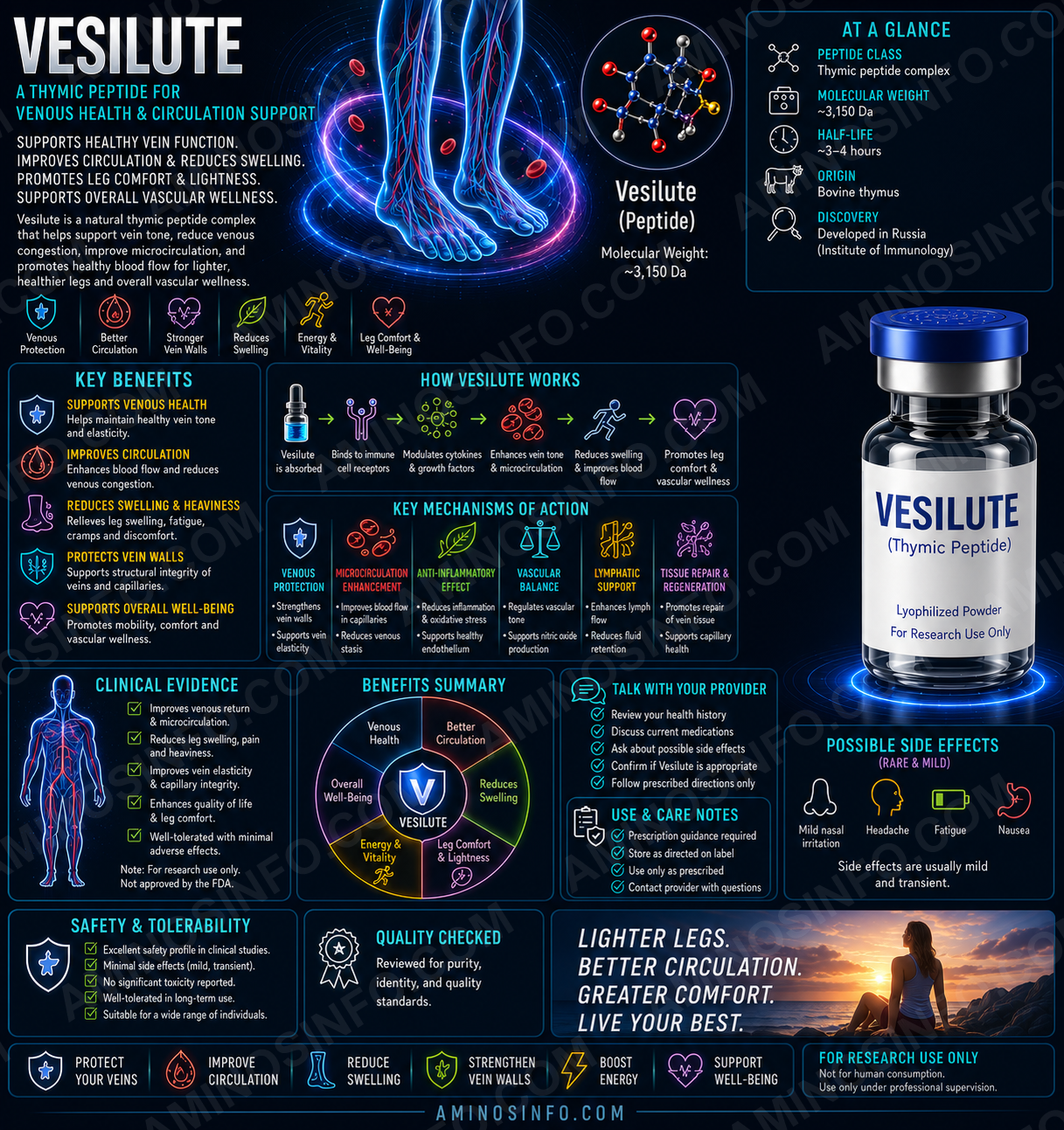
First, Vesilute, also marketed as Vesilut, is a commercial and research name applied to the dipeptide glutamyl-aspartate, usually written Glu–Asp or ED.
Next, it is commonly placed within the Khavinson-school category of ultrashort peptide bioregulators. Vendors and secondary sources associate it with the urinary bladder, lower urinary tract, and sometimes prostate tissue. However, no widely recognized international nonproprietary name, FDA-approved drug monograph, or extensive modern clinical-development record exists for Vesilute.
Vesilute, Vesilut
Glu–Asp
ED
Linear dipeptide
Bladder and urogenital tissue
No
🧬 Molecular Structure
First, Vesilute is a linear dipeptide formed by joining the α-carboxyl group of L-glutamic acid to the amino group of L-aspartic acid. Unless specified otherwise, the expected material has a free N-terminus and free C-terminal carboxyl group.
🧪 Amino-Acid Sequence
H-Glu-Asp-OH
One-letter notation: ED
| Residue | Chemical feature | Analytical relevance |
|---|---|---|
| Glutamic acid | For example, Acidic amino acid with a side-chain carboxyl group | Meanwhile, Creates possible pyroglutamate, isomerization, and hydrolysis-related impurities. |
| Aspartic acid | Likewise, Acidic amino acid with a shorter side-chain carboxyl group | In addition, Can form isoaspartyl-related degradation products under some conditions. |
| Peptide bond | Moreover, Joins Glu to Asp in a defined sequence | By contrast, analysts must distinguish ED from Asp–Glu and from a mixture of free amino acids. |
⚛️ Molecular Weight and 🧫 Formula
| Neutral molecular formula | Also, C9H14N2O7 |
|---|---|
| Average molecular weight | Approximately 262.22 g/mol |
| Peptide length | 2 amino acids |
| Common CAS listing | 3918-84-1 |
| Expected terminal form | Consequently, Free N-terminus and free C-terminal carboxyl group |
Importantly, Next, Glu–Asp and Asp–Glu have the same elemental formula and nominal mass but are different peptides. Sequence-order confirmation requires tandem mass spectrometry or another orthogonal method.
📅 Research Timeline and Nomenclature
1970s–1990s: Tissue peptide-extract programs develop
First, Russian and Eastern European research programs studied low-molecular-weight peptide fractions isolated from organs and tissues. These programs produced products and research names associated with particular organs.
1990s–2000s: Defined ultrashort peptides emphasized
Next, researchers increasingly synthesized dipeptides, tripeptides, and tetrapeptides thought to reproduce selected activities of more complex tissue extracts.
2000s–2010s: Gene-regulation hypotheses expand
Moreover, Khavinson-related publications proposed that ultrashort peptides could influence chromatin state, transcription, protein synthesis, and age-associated cellular function.
2022: Transport review covers ultrashort peptide uptake
In addition, a peer-reviewed review examined potential interactions of ultrashort peptides with proton-coupled oligopeptide and amino-acid transporters. This supports a plausible route of cellular uptake for some short peptides but does not establish urinary-organ targeting or clinical efficacy of Vesilute.
Current status
Finally, Vesilute remains predominantly a vendor and research-market product name. Direct indexed literature using “Vesilute” or “Vesilut” is sparse, and much online content extrapolates from the wider peptide-bioregulator field.
Bladder, Prostate, and Urinary Physiology
Bladder urothelium
First, the urothelium forms a specialized barrier between urine and underlying tissue. It also senses stretch and chemical signals and communicates with nerves, smooth muscle, immune cells, and blood vessels.
Detrusor smooth muscle
Next, bladder emptying depends on coordinated parasympathetic signaling, acetylcholine release, muscarinic receptors, calcium handling, and detrusor contraction.
Bladder storage
Moreover, storage requires sympathetic and somatic coordination, urethral sphincter function, compliant bladder wall mechanics, intact sensory pathways, and central nervous-system control.
Prostate and lower urinary tract
In addition, benign prostatic enlargement can narrow the urethra, but urinary symptoms also arise from bladder dysfunction, infection, stones, neurological disease, pelvic-floor dysfunction, medication effects, cancer, and other causes.
Microcirculation
However, blood supply influences tissue oxygenation and repair, but no validated evidence shows that ED selectively improves prostate or bladder microcirculation in humans.
🧠 Proposed Mechanisms of Action
Importantly, no validated receptor-level mechanism has been established for Vesilute. Proposed mechanisms are mostly extrapolated from general ultrashort-peptide research.
Bladder and prostate selectivity remain unproven
1. Peptide-transporter interaction
First, dipeptides may interact with proton-coupled oligopeptide transporters or be hydrolyzed and absorbed as free amino acids. Transport depends on tissue, pH, route, concentration, and transporter expression.
2. Rapid enzymatic hydrolysis
Next, ED can be cleaved by peptidases into glutamate and aspartate. Any observed effect must distinguish intact-peptide signaling from amino-acid effects.
3. Gene-expression hypothesis
Moreover, some ultrashort-peptide publications propose direct or indirect interactions with DNA, histones, or transcriptional systems. Specific, independently replicated evidence connecting ED to bladder- or prostate-selective genes is limited.
4. Cytoprotection and stress-response hypothesis
However, vendors describe tissue resilience, but rigorous studies would need to demonstrate effects on oxidative stress, mitochondrial function, inflammatory signaling, apoptosis, barrier integrity, or smooth-muscle physiology.
5. Tissue-specificity hypothesis
Finally, the biological basis for assigning ED specifically to bladder and urogenital tissue is not well established in accessible primary literature. Small size alone does not confer organ targeting.
🎯 Proposed Target Profile
| Target or pathway | Evidence status |
|---|---|
| However, PEPT1/PEPT2 and related transport systems | Therefore, general dipeptide transport remains plausible, but Vesilute-specific tissue delivery remains unproven. |
| Bladder muscarinic receptors | For example, No established direct agonist or antagonist activity. |
| Adrenergic receptors | Meanwhile, No established direct activity. |
| Androgen receptor | Likewise, No validated direct effect. |
| 5α-reductase | In addition, No established inhibitory effect. |
| Moreover, Chromatin and gene expression | By contrast, General ultrashort-peptide hypothesis; ED-specific urogenital evidence remains limited. |
Potential Research Areas
Urothelial-barrier research
First, cell models could test whether ED changes transepithelial resistance, tight-junction proteins, ATP release, inflammatory signaling, or recovery after chemical injury.
Bladder smooth-muscle research
Next, organ-bath and cell studies could evaluate calcium handling, contractility, cholinergic responses, adrenergic responses, fibrosis markers, and stretch-induced signaling.
Prostate-cell research
Moreover, relevant experiments could measure epithelial and stromal proliferation, androgen-responsive genes, inflammatory cytokines, apoptosis, extracellular matrix, and angiogenic pathways.
Age-related lower urinary tract research
In addition, aging affects nerves, smooth muscle, collagen, blood vessels, sex hormones, immune tone, kidney function, and central control. Any geroprotective claim would require defined models and functional outcomes.
Gene-expression and epigenetic research
Likewise, RNA sequencing, chromatin-accessibility assays, DNA-binding studies, and proteomics could determine whether ED has reproducible molecular effects beyond nonspecific amino-acid exposure.
Pharmacokinetic research
Finally, essential unanswered questions include oral stability, plasma half-life, renal filtration, urinary excretion, bladder-lumen exposure, tissue distribution, and intact-peptide concentration.
Evidence Quality and Clinical Interpretation
Direct Vesilute literature is sparse
First, searches identify commercial descriptions and broad Khavinson reviews more readily than controlled, indexed studies specifically testing purified ED as Vesilute in bladder or prostate disease.
Evidence from related peptides is not interchangeable
Moreover, researchers cannot automatically assign findings involving Vesugen, Prostamax, Prostatilen, Thymogen, or tissue-derived extracts to ED.
No validated urinary outcomes
In addition, there is no established evidence that Vesilute improves urinary frequency, urgency, nocturia, weak stream, residual urine, bladder capacity, prostate volume, pain, infection recurrence, incontinence, or quality of life.
No established prostate-cancer effect
However, Vesilute should not be represented as preventing or treating prostate cancer. Prostate-specific antigen changes require medical evaluation and cannot be interpreted through peptide marketing claims.
No substitute for diagnosis
Finally, blood in urine, urinary retention, fever, flank pain, recurrent infection, pelvic pain, abnormal PSA, or new urinary symptoms may indicate urgent or serious disease.
Safety and Regulatory Considerations
No standardized human safety profile
First, no FDA-approved prescribing information defines dose, route, contraindications, pregnancy safety, interactions, pharmacokinetics, or long-term risk.
Possible local or systemic reactions
Moreover, depending on route and formulation, possible concerns include irritation, nausea, allergic reaction, infection, endotoxin exposure, contamination, or effects from excipients rather than ED itself.
Neurological relevance of glutamate and aspartate
In addition, Glu and Asp are normal amino acids and neurotransmitter-related metabolites. This does not mean a small amount of ED acts as an excitotoxin, but it also does not prove neurological or systemic safety at untested exposures.
Kidney and urinary excretion
Likewise, a small peptide may be rapidly filtered or metabolized. Kidney disease could alter handling, but Vesilute pharmacokinetics have not been adequately characterized.
Product identity risk
However, online materials may use the names Vesilute, Vesilut, ED, or “bladder peptide” while differing in stereochemistry, sequence order, salt form, concentration, contaminants, and route suitability.
Regulatory status
Finally, Vesilute is not FDA approved as a drug or biologic. Research-use labeling does not establish safety for human administration.
🧪 Laboratory Testing Methods
| Method | Purpose | Important limitation |
|---|---|---|
| Also, RP-HPLC, ion-pair HPLC, or UPLC | Consequently, Separates ED from free amino acids and related impurities. | However, Very polar acidic peptides can require specialized methods. |
| LC-MS / HRMS | Therefore, Confirms exact molecular mass. | For example, ED and DE share the same formula and mass. |
| MS/MS sequencing | Meanwhile, Confirms Glu followed by Asp. | Likewise, Requires validated fragmentation and authentic standards. |
| Chiral amino-acid analysis | In addition, Confirms L-Glu and L-Asp and detects racemization. | Moreover, Hydrolysis conditions may create artifacts. |
| Net peptide-content assay | By contrast, Measures actual ED concentration. | Also, analysts must not infer net peptide content from HPLC area purity. |
| Free amino-acid analysis | Consequently, Detects glutamate and aspartate from hydrolysis or incomplete synthesis. | However, Requires separation from peptide-associated peaks. |
| Pyroglutamate testing | Therefore, Detects N-terminal cyclization of glutamate. | For example, May require LC-MS confirmation. |
| Meanwhile, Isoaspartate or sequence-isomer testing | Likewise, Detects degradation and isomerization. | In addition, Can be challenging for a very small peptide. |
| Moreover, Water and residual solvents | By contrast, Measures nonpeptide mass and synthesis residues. | Also, Does not establish biological activity. |
| Elemental impurities | Consequently, Evaluates metals and process contamination. | However, Does not prove route-specific safety. |
| Therefore, Microbial limits or sterility | For example, Assesses microbiological quality according to intended route. | Meanwhile, Oral, topical, intravesical, and injectable materials require different controls. |
| Endotoxin testing | Likewise, Evaluates pyrogenic bacterial endotoxin for parenteral or high-risk applications. | In addition, A passing result does not prove sterility. |
| Stability testing | Moreover, Tracks hydrolysis, cyclization, isomerization, assay, and appearance. | By contrast, Must reflect the finished formulation and packaging. |
📄 How to Interpret a Vesilute COA
1. Confirm the exact identity
First, the report should state H-Glu-Asp-OH or ED.
2. Confirm sequence order
Importantly, Next, Glu–Asp and Asp–Glu have identical molecular formulas and nominal masses. Tandem mass spectrometry or another sequence-specific method is required.
3. Verify stereochemistry
Moreover, the expected research material is typically L-Glu–L-Asp. D-amino-acid substitutions create different compounds.
4. Separate identity, purity, and content
- Identity First, confirms ED.
- Purity Next, estimates chromatographic composition.
- Also, net peptide content measures actual ED after analysts account for water, salts, and residuals.
5. Review degradation
In addition, analysts should control free glutamate, free aspartate, pyroglutamate formation, sequence isomers, and hydrolysis.
6. Match testing to the route
Likewise, a raw-powder COA does not prove suitability for injection, oral use, topical use, or intravesical administration. Route-specific formulation and microbiological controls are essential.
7. Do not infer urogenital efficacy
However, a passing COA cannot demonstrate bladder targeting, prostate effects, urinary improvement, anti-aging activity, or human safety.
📊 Vesilute vs Vesugen vs Cardiogen vs Livagen
Sequence and Research-Association Differences
| Feature | Vesilute | Vesugen | Cardiogen | Livagen |
|---|---|---|---|---|
| Reported sequence | ED | KED | AEDR | KEDA |
| Peptide length | 2 residues | 3 residues | 4 residues | 4 residues |
| Common research association | Bladder/urogenital tissue | Vascular tissue | Cardiac tissue | Liver-related bioregulator research |
| Also, Direct modern clinical evidence | Very limited | Limited regional literature | Primarily preclinical/regional | Primarily preclinical/regional |
| FDA approved? | For example, No FDA approval applies. | Moreover, Regulators have not approved this compound. | In addition, No approved indication exists. | This remains unapproved. |
Vesilute vs Prostamax vs Prostatilen
Defined Dipeptide Versus Prostate-Focused Products
| Feature | Vesilute | Prostamax | Prostatilen |
|---|---|---|---|
| Composition | Defined dipeptide ED | Consequently, Commonly listed as KEDP | However, Complex of prostate-derived peptides |
| Main claimed focus | Therefore, Bladder and urinary tract | Prostate bioregulation | Regional prostate-treatment product |
| Same compound? | However, No validated equivalence exists. | Therefore, No FDA approval applies. | Likewise, Regulators have not approved this compound. |
| Evidence transferable? | For example, No approved indication exists. | This remains unapproved. | Moreover, No validated equivalence exists. |
Vesilute vs Approved Lower-Urinary-Tract Therapies
| Therapy class | Established role | Difference from Vesilute |
|---|---|---|
| Alpha blockers | For example, Improve urinary flow and lower-urinary-tract symptoms in selected patients | Meanwhile, Defined receptor pharmacology and clinical evidence |
| 5α-reductase inhibitors | Likewise, Reduce prostate volume and progression risk in selected men | In addition, Defined hormonal enzyme target |
| Antimuscarinics | Moreover, Treat selected overactive-bladder symptoms | Defined muscarinic-receptor mechanism |
| Beta-3 agonists | By contrast, Improve bladder storage symptoms | Also, Defined beta-3 receptor mechanism |
| Vesilute | No approved indication | Consequently, Unproven target and clinical benefit |
🔗 Related Peptides and Urogenital Pathways
- Vesugen: First, KED tripeptide associated with vascular research.
- Prostamax: Next, KEDP tetrapeptide associated with prostate-focused bioregulator research.
- Prostatilen: Also, Prostate-derived peptide complex used regionally.
- Muscarinic M3 receptor: Moreover, Major receptor driving detrusor contraction.
- Beta-3 adrenergic receptor: In addition, Important in bladder relaxation during storage.
- Androgen receptor and 5α-reductase: Likewise, Central to prostate growth biology.
- Uroplakins: Finally, Structural proteins maintaining the urothelial barrier.
🖼️ Original Diagram Specifications
Diagram 1: Vesilute molecular structure
However, Show H-Glu-Asp-OH with the peptide bond, both acidic side chains, free N-terminus, and free C-terminal carboxyl group.
Diagram 2: ED vs DE identity
Show Importantly, Glu–Asp and Asp–Glu side by side, noting identical formula and mass but different sequence order.
Diagram 3: Lower urinary tract anatomy
Therefore, Show kidneys, ureters, bladder urothelium, detrusor, bladder neck, prostate, urethra, and pelvic-floor structures.
Diagram 4: Bladder storage and voiding pathways
For example, Illustrate parasympathetic muscarinic signaling, sympathetic beta-3 and alpha signaling, somatic sphincter control, and central coordination. Mark Vesilute’s target as unknown.
Diagram 5: Proposed ultrashort-peptide pathway
Meanwhile, Show oral or experimental ED exposure, possible transporter uptake, hydrolysis, circulation, renal filtration, and unresolved bladder/prostate delivery.
Diagram 6: Evidence ladder
Likewise, Show chemical identity, transporter plausibility, cell studies, animal urinary models, controlled human trials, and regulatory approval. Place Vesilute near the early evidence stages.
Diagram 7: COA workflow
In addition, Show exact mass, MS/MS order, stereochemistry, free amino acids, pyroglutamate, assay, water, solvents, microbiology, stability, and batch verification.
❓ Frequently Asked Questions
Is Vesilute a peptide?
Moreover, Yes. It is commonly identified as the dipeptide Glu–Asp, abbreviated ED.
Is Vesilute the same as Vesilut?
By contrast, These names are generally used for the same commercial research peptide.
What is the molecular weight?
Also, The average molecular weight of neutral Glu–Asp is approximately 262.22 g/mol.
Is Vesilute FDA approved?
No.
Does Vesilute improve bladder function?
Consequently, No high-quality clinical evidence establishes improvement in frequency, urgency, incontinence, bladder pain, or emptying.
Does it shrink the prostate?
However, No validated evidence shows that ED reduces prostate volume or acts like finasteride or dutasteride.
Does it improve prostate microcirculation?
Therefore, That is a commercial or mechanistic claim without strong direct human evidence.
Can it treat prostatitis?
For example, No. Prostatitis has infectious, inflammatory, pelvic-floor, and pain-related causes requiring proper diagnosis.
Is Vesilute the same as Vesugen?
Meanwhile, No. Vesilute is ED, while Vesugen is KED and is associated with vascular research.
Is Vesilute the same as Prostamax?
Likewise, No. Prostamax is commonly listed as KEDP.
Does a 99% HPLC result prove effectiveness?
In addition, No. It does not prove sequence order, net content, organ targeting, clinical benefit, sterility, or safety.
Vesilute Scientific Overview: Final Thoughts
In conclusion, Vesilute or Vesilut is most consistently identified as the ultrashort dipeptide Glu–Asp, abbreviated ED. Its chemistry is straightforward, but its biological and clinical claims are not.
However, the available evidence does not establish a validated bladder receptor, prostate target, chromatin mechanism, urinary benefit, or anti-aging effect in humans. Much of the published discussion relies on the broader peptide-bioregulator framework, related compounds, regional literature, or commercial extrapolation.
Therefore, any legitimate research material should be verified for Glu–Asp sequence order, L-amino-acid stereochemistry, molecular mass, free amino acids, pyroglutamate or isomer impurities, net peptide content, route-specific microbiological quality, and stability. Clinical claims require controlled studies using objective urinary, urodynamic, prostate, symptom, and safety endpoints.
📚 References
- In addition, Khavinson V, et al. Transport of biologically active ultrashort peptides using POT and LAT carriers. International Journal of Molecular Sciences. 2022.
- However, Anisimov VN, Khavinson VK. Peptide bioregulation of aging: results and prospects. Biogerontology. 2010.
- Therefore, Khavinson VK, et al. Peptide bioregulators: the new class of geroprotectors. Advances in Gerontology. 2013.
- Likewise, Khavinson VK, Linkova NS, et al. Short peptides and regulation of gene expression. Advances in Gerontology and related literature.
- For example, Khavinson VK. Peptides, Genome, and Aging. Research monograph.
- Moreover, Khavinson VK, Kuznik BI. Peptide Bioregulators: The New Class of Geroprotectors. 2014.
- In addition, Wang J, et al. Exogenous bioactive peptides have potential therapeutic effects on aging-related diseases. Frontiers in Pharmacology. 2022.
- However, Avolio F, et al. Peptides regulating proliferative activity and inflammatory pathways. International Journal of Molecular Sciences. 2022.
- Therefore, Daniel H. Molecular and integrative physiology of intestinal peptide transport. Annual Review of Physiology.
- Likewise, Brandsch M. Drug transport via the intestinal peptide transporter PepT1. Current Opinion in Pharmacology.
- For example, Smith DE, Clémençon B, Hediger MA. Proton-coupled oligopeptide transporter family SLC15. Molecular Aspects of Medicine.
- Moreover, Newstead S. Molecular insights into proton-coupled peptide transport. Trends in Pharmacological Sciences.
- In addition, Rubio-Aliaga I, Daniel H. Peptide transporters and their roles in physiological processes and drug disposition. Xenobiotica.
- However, Hediger MA, et al. The ABCs of solute carriers: physiological, therapeutic and genetic perspectives. Molecular Aspects of Medicine.
- Therefore, Birder L, Andersson KE. Urothelial signaling. Physiological Reviews.
- Likewise, Birder LA, de Groat WC. Mechanisms of disease: involvement of the urothelium in bladder dysfunction. Nature Clinical Practice Urology.
- For example, Andersson KE, Arner A. Urinary bladder contraction and relaxation: physiology and pathophysiology. Physiological Reviews.
- Moreover, de Groat WC, Griffiths D, Yoshimura N. Neural control of the lower urinary tract. Comprehensive Physiology.
- In addition, Fowler CJ, Griffiths D, de Groat WC. The neural control of micturition. Nature Reviews Neuroscience.
- However, Michel MC, Vrydag W. Alpha-1, alpha-2 and beta-adrenoceptors in the urinary bladder, urethra and prostate. British Journal of Pharmacology.
- Therefore, Andersson KE. Antimuscarinics for treatment of overactive bladder. Lancet Neurology and urology reviews.
- Likewise, Chapple CR, et al. Mirabegron in overactive bladder. European Urology.
- For example, McVary KT, et al. American Urological Association guideline on management of lower urinary tract symptoms attributed to benign prostatic hyperplasia.
- Moreover, Gravas S, et al. European Association of Urology guidelines on non-neurogenic male lower urinary tract symptoms.
- In addition, Nickel JC. Prostatitis. Canadian Urological Association Journal and clinical reviews.
- However, Hanno PM, Erickson D, Moldwin R, Faraday MM. Diagnosis and treatment of interstitial cystitis/bladder pain syndrome. Journal of Urology.
- Therefore, Wyndaele JJ, et al. Bladder aging and lower urinary tract function. Neurourology and Urodynamics.
- Likewise, Michel MC, Oelke M. Medical therapy of male lower urinary tract symptoms. European Urology.
- For example, Roehrborn CG. Benign prostatic hyperplasia: etiology, pathophysiology, epidemiology and natural history. Campbell-Walsh Urology.
- Moreover, McConnell JD, et al. The long-term effect of doxazosin, finasteride, and combination therapy on BPH progression. New England Journal of Medicine.
- In addition, Roehrborn CG, et al. Dutasteride and tamsulosin combination therapy in BPH. European Urology.
- However, International Council for Harmonisation. ICH Q2(R2): Validation of Analytical Procedures.
- United States Pharmacopeia. General Chapter <621>, Chromatography.
- United States Pharmacopeia. General Chapters <61> and <62>, Microbiological Examination of Nonsterile Products.
- United States Pharmacopeia. General Chapter <71>, Sterility Tests.
- United States Pharmacopeia. General Chapter <85>, Bacterial Endotoxins Test.
- United States Pharmacopeia. General Chapters <232> and <233>, Elemental Impurities.
- International Council for Harmonisation. ICH Q3C: Impurities—Guideline for Residual Solvents.
- International Council for Harmonisation. ICH Q1A(R2): Stability Testing of New Drug Substances and Products.
- Conscientia Industrial. Vesilute H-Glu-Asp-OH chemical identity and CAS listing.
- Commercial Vesilute supplier technical pages reviewed only for nomenclature cross-checking; efficacy claims were not treated as clinical evidence.
Vesilute, Ultrashort-Peptide, and Urogenital Sources
Clinical, Analytical, and Quality-Control Sources
Chemical identity, molecular properties, ultrashort-peptide literature, urogenital physiology, evidence limitations, and regulatory status were reviewed in July 2026. Finally, Vesilute remains an unapproved research peptide.