Vesugen Scientific Overview: Identity, Mechanism, Evidence, and Testing
Vesugen scientific overview content should separate the verified Lys–Glu–Asp tripeptide identity from vascular-rejuvenation, epigenetic, neuroprotective, and longevity claims that lack large independent clinical trials. Finally, This peptide remains an unapproved research peptide.
What Is Vesugen?
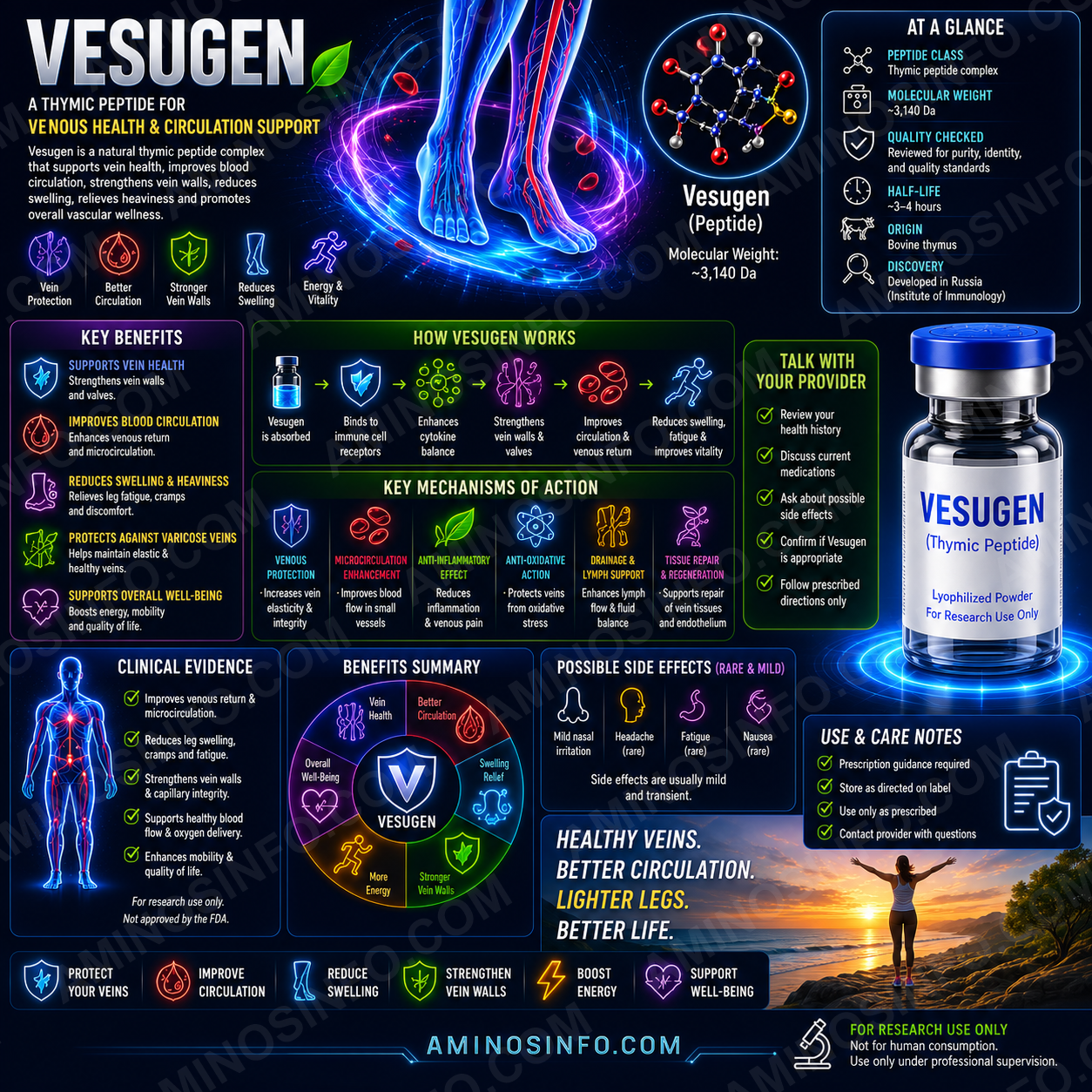
First, Vesugen is a commercial and research name for the ultrashort tripeptide Lys–Glu–Asp, abbreviated KED. It is commonly described in Khavinson-school peptide literature as a vasoprotective or vascular bioregulator peptide.
Next, researchers have studied KED in endothelial-cell cultures, aging models, neuronal differentiation systems, gene-expression experiments, and small regional human studies. Its proposed biological focus is the vascular wall, especially endothelial function and age-related cellular changes.
Vesugen
Lys–Glu–Asp
KED
Linear tripeptide
Vasoprotective peptide
No
🧬 Molecular Structure
First, Vesugen is a linear tripeptide composed of L-lysine, L-glutamic acid, and L-aspartic acid. The commonly reported research form has a free N-terminus and free C-terminal carboxyl group.
🧪 Amino-Acid Sequence
H-Lys-Glu-Asp-OH
One-letter notation: KED
| Residue | Chemical feature | Analytical relevance |
|---|---|---|
| Lysine | For example, Basic side-chain amino group | Meanwhile, Contributes positive charge and can retain counterions. |
| Glutamic acid | Likewise, Acidic side-chain carboxyl group | In addition, Can undergo N-terminal cyclization or sequence-related degradation under some conditions. |
| Aspartic acid | Moreover, Acidic side-chain carboxyl group | By contrast, Can isomerize or hydrolyze under unfavorable storage conditions. |
| Net charge | Also, Strongly dependent on pH | Consequently, Affects chromatography, solubility, transport, and formulation behavior. |
⚛️ Molecular Weight and 🧫 Formula
| Neutral molecular formula | However, C15H26N4O8 |
|---|---|
| Average molecular weight | Approximately 390.39 g/mol |
| Peptide length | 3 amino acids |
| Expected terminal form | Therefore, Free N-terminus and free C-terminal carboxyl group |
| Common synonym | KED peptide |
Importantly, KED, KDE, EKD, EDK, DKE, and DEK contain the same amino-acid composition and molecular formula but are distinct sequences. Sequence-order testing is therefore essential.
📅 Discovery Timeline
1970s–1990s: Vascular peptide extracts investigated
First, Russian gerontology programs studied low-molecular-weight peptide complexes isolated from blood-vessel tissue and proposed that selected short sequences contributed to organ-associated regulatory effects.
1990s–2000s: KED synthesized as a defined tripeptide
Next, researchers developed Lys–Glu–Asp as a simplified synthetic peptide associated with vascular tissue research.
2011–2014: Cell-proliferation and epigenetic studies
Moreover, research reported that Vesugen increased Ki-67 expression or proliferative potential in selected cell cultures and used molecular-docking methods to propose interaction with gene-promoter regions.
2014–2016: Regional vascular studies and mechanism papers
In addition, small studies and reviews described KED in relation to atherosclerosis-associated vascular dysfunction, erectile blood-flow measures, endothelial markers, and gene regulation.
2021: Neuroprotective review
Likewise, a review described KED as a vasoprotective peptide with effects in neuronal differentiation, cognitive observations, and experimental neuroplasticity systems.
2022–2024: Senescence and induced-neuron research
Meanwhile, later work investigated KED in cardiovascular inflammaging reviews and in fibroblast-derived induced-neuron models exposed to oxidative DNA damage.
Current status
Finally, Vesugen remains an unapproved research peptide. There is no established international drug label, modern large-scale cardiovascular-outcome trial, or recognized standard-of-care use.
📖 Research History
Importantly, the Vesugen literature combines several lines of inquiry: tissue-derived peptide extracts, synthetic KED, endothelial-cell proliferation, DNA or promoter docking, aging biomarkers, neuronal differentiation, and small clinical observations.
However, these strands should not be treated as equivalent. A docking model does not prove gene regulation, a cell-culture change does not prove vascular repair, and a small uncontrolled clinical observation does not establish prevention of cardiovascular events.
Vascular and Endothelial Biology
What endothelial cells do
First, endothelial cells line blood vessels and regulate vascular tone, permeability, coagulation, leukocyte trafficking, angiogenesis, nutrient exchange, and tissue perfusion.
Endothelial dysfunction
Next, aging, smoking, diabetes, hypertension, dyslipidemia, chronic kidney disease, inflammation, and oxidative stress can reduce nitric-oxide availability and promote a proinflammatory, prothrombotic endothelial state.
Microcirculation
Moreover, the microcirculation includes arterioles, capillaries, and venules. Function depends on endothelial signaling, smooth-muscle tone, red-cell properties, autonomic control, local metabolites, and structural integrity.
Vascular remodeling
In addition, blood vessels respond to injury and hemodynamic stress through changes in endothelial cells, smooth-muscle cells, extracellular matrix, inflammatory cells, and adventitial tissue.
Where Researchers Propose KED May Act
However, KED is proposed to influence endothelial-cell proliferation and expression of proteins associated with vascular function. No validated high-affinity receptor or selective endothelial uptake mechanism has been established.
🧠 Proposed Mechanisms of Action
Importantly, the mechanism of KED is not established at the level expected for an approved pharmacological agent. Published hypotheses include peptide transport, gene regulation, histone or DNA interaction, modulation of proliferation markers, and effects on cellular stress responses.
Clinical vascular benefit remains unproven
1. Peptide transport
First, as a tripeptide, KED may interact with proton-coupled oligopeptide transporters or be broken down into amino acids before or after absorption. Tissue exposure and intact-peptide pharmacokinetics remain poorly characterized.
2. Ki-67-associated proliferation
Next, studies reported that KED increased Ki-67 in selected endothelial or tissue-specific cultures in which age-related proliferation was reduced. Ki-67 is a proliferation marker, not a direct measure of healthy vessel repair or clinical benefit.
3. Promoter and DNA-interaction hypothesis
Moreover, molecular-docking and peptide-gene-regulation publications propose that KED may interact with specific DNA sequences or promoter regions. Physical binding, cellular nuclear access, sequence specificity, and physiological relevance require stronger independent validation.
4. Histone and chromatin hypothesis
In addition, broader short-peptide literature proposes interactions with histones and chromatin that influence gene accessibility. This is not the same as demonstrating predictable epigenetic treatment in humans.
5. Oxidative-stress and DNA-damage responses
Finally, recent induced-neuron studies examined KED under oxidative DNA-damage conditions. Such models may identify cellular effects but do not prove prevention of stroke, dementia, or vascular aging.
🎯 Target and Pathway Profile
| Target or pathway | Evidence status |
|---|---|
| For example, Ki-67 / MKI67-associated proliferation | Meanwhile, Reported in selected cell studies; not a validated therapeutic target for KED. |
| DNA promoter interactions | Likewise, Proposed by docking and gene-regulation research; physiological relevance uncertain. |
| Histone interactions | In addition, General short-peptide hypothesis; KED-specific effects require replication. |
| Nitric-oxide pathway | Moreover, No clearly validated direct eNOS agonist mechanism. |
| VEGF receptors | By contrast, No established direct receptor agonism or antagonism. |
| Also, Angiotensin, adrenergic, or endothelin receptors | Consequently, No established direct activity. |
| However, Platelet and coagulation pathways | Therefore, No validated antiplatelet or anticoagulant mechanism. |
Vascular Aging and Cellular-Senescence Research
Endothelial senescence
First, senescent endothelial cells can show reduced proliferation, impaired nitric-oxide signaling, inflammatory secretory activity, mitochondrial dysfunction, and altered barrier function.
Senescence-associated secretory phenotype
Moreover, SASP factors can promote inflammation, thrombosis, fibrosis, and dysfunction in neighboring cells. Reviews have proposed vasoprotective peptides as possible modulators, but direct clinical evidence is lacking.
Proliferation is not always beneficial
However, restoring appropriate repair capacity may be helpful, while excessive proliferation can contribute to neointimal hyperplasia, tumor growth, or abnormal vascular remodeling. Increasing Ki-67 cannot automatically be labeled rejuvenation.
Biological-age claims
In addition, a small regional study reported changes in biological-age indicators after Vesugen or Pinealon. The design, sample size, mixed interventions, and reported prooxidant and hematopoietic findings prevent firm conclusions.
Longevity
Finally, no high-quality evidence shows that Vesugen extends human lifespan or prevents cardiovascular mortality.
Neurovascular and Neuroprotective Research
Neuronal differentiation
First, researchers have reported that KED to stimulate neuronal differentiation in human dental-pulp stem-cell systems. This is an in vitro developmental model, not evidence of brain regeneration in patients.
Neuronal spine density
Moreover, reviews describe increased dendritic-spine density in selected experimental neurodegeneration models. Translation to cognition or neurological disease is unknown.
Induced-neuron stress models
In addition, recent work investigated KED in fibroblast-derived induced neurons subjected to oxidative DNA damage. Such systems can reveal molecular responses but cannot establish treatment of dementia, stroke, or Parkinson disease.
Neurovascular coupling
Likewise, brain function depends on coordinated neuronal activity, astrocytes, pericytes, endothelial cells, and blood flow. No evidence establishes KED as a direct neurovascular-coupling therapy.
Cognitive observations
However, regional reports involving workers exposed to hazardous conditions have described cognitive improvements with peptide combinations. These findings require independent controlled replication.
Human and Regional Clinical Observations
Vasculogenic erectile dysfunction
In addition, a small regional study evaluated Vezugen in men with vasculogenic erectile dysfunction associated with atherosclerosis and reported improvement in objective blood-flow measurements. Publicly accessible information is limited, and the study does not establish efficacy comparable to approved erectile-dysfunction or cardiovascular treatments.
Chronic arterial insufficiency
Moreover, regional literature has discussed vascular peptide bioregulators in older adults with lower-limb arterial insufficiency. Study quality, treatment combinations, endpoint selection, and independent replication are limited.
Cognitive and occupational studies
In addition, KED has appeared in peptide regimens for older adults or workers under hazardous conditions. Combination treatment and heterogeneous outcomes make Vesugen-specific attribution difficult.
No cardiovascular-outcome evidence
However, there is no evidence from large randomized trials that Vesugen reduces heart attack, stroke, hospitalization, limb loss, cardiovascular death, or progression of atherosclerosis.
No replacement for established care
Finally, statins, antihypertensive medicines, smoking cessation, diabetes control, exercise, antiplatelet therapy in appropriate patients, and revascularization have evidence-based roles that Vesugen does not replace.
Safety and Regulatory Considerations
No standardized human safety profile
First, no FDA-approved prescribing information defines dose, pharmacokinetics, contraindications, interactions, pregnancy safety, or long-term adverse effects.
Proliferation-related uncertainty
Moreover, any compound that increases proliferation markers raises theoretical concerns involving cancer, restenosis, pathological angiogenesis, and abnormal tissue growth. These risks have not been adequately characterized for KED.
Potential vascular effects
In addition, if KED meaningfully altered vascular tone or endothelial function, possible effects could include headache, flushing, dizziness, blood-pressure changes, or interactions with cardiovascular medicines. These are theoretical because pharmacology is not established.
Kidney handling
Likewise, a small peptide may be rapidly filtered or metabolized. Renal impairment could change exposure, but formal pharmacokinetic data are lacking.
Product-quality risk
However, unapproved products may contain incorrect sequence, free amino acids, residual solvents, microbial contamination, endotoxin, inaccurate concentration, or unsuitable formulation.
Regulatory status
Finally, Vesugen is not FDA approved as a drug or biologic. Research-use labeling does not establish suitability for human administration.
🧪 Laboratory Testing Methods
| Method | Purpose | Important limitation |
|---|---|---|
| For example, RP-HPLC, ion-pair HPLC, or UPLC | Meanwhile, Separates KED from free amino acids and sequence-related impurities. | Likewise, Small, highly polar peptides require carefully validated methods. |
| LC-MS / HRMS | In addition, Confirms exact molecular mass. | Moreover, All six sequence permutations share the same elemental formula and mass. |
| MS/MS sequencing | By contrast, Confirms Lys followed by Glu followed by Asp. | Also, Requires authentic standards and validated fragment interpretation. |
| Chiral amino-acid analysis | Consequently, Confirms L-Lys, L-Glu, and L-Asp and detects racemization. | However, Hydrolysis conditions can introduce artifacts. |
| Net peptide-content assay | Therefore, Measures actual KED concentration. | For example, analysts must not infer net peptide content from chromatographic purity. |
| Free amino-acid analysis | Meanwhile, Detects hydrolysis or incomplete synthesis. | Likewise, Requires resolution from intact peptide. |
| Sequence-isomer testing | In addition, Detects KDE, EKD, EDK, DKE, and DEK. | Moreover, These isomers may be difficult to separate chromatographically. |
| By contrast, Pyroglutamate and isoaspartate analysis | Also, Evaluates cyclization and isomerization products. | Consequently, analysts may need specialized LC-MS methods. |
| However, Water, counterion, and residual-solvent testing | Therefore, Measures nonpeptide mass and synthesis residues. | For example, Does not prove biological potency. |
| Cell-proliferation assay | Meanwhile, Measures Ki-67, cell count, or endothelial growth responses. | Likewise, Proliferation alone is not a validated vasoprotective endpoint. |
| Gene-expression assay | In addition, Evaluates candidate endothelial, aging, or neuronal genes. | Moreover, Requires prespecified targets, replication, and appropriate controls. |
| By contrast, Microbial limits or sterility | Also, Evaluates microbiological quality according to route. | Consequently, Oral and injectable products require different standards. |
| Endotoxin testing | However, Required for injectable or high-risk research material. | Therefore, A passing endotoxin result does not prove sterility. |
| Stability testing | For example, Tracks hydrolysis, isomerization, assay, moisture, and appearance. | Meanwhile, Must reflect final formulation and storage conditions. |
📄 How to Interpret a Vesugen COA
1. Verify the exact sequence
First, the expected identity is H-Lys-Glu-Asp-OH or KED.
2. Confirm sequence order
Next, mass alone cannot distinguish KED from the five other permutations of lysine, glutamate, and aspartate. Tandem mass spectrometry or another sequence-specific method is essential.
3. Verify terminal chemistry
Moreover, acetylated, amidated, cyclic, or salt-modified versions are different materials and may behave differently.
4. Separate identity, purity, and content
- Identity First, confirms KED.
- Purity Next, estimates chromatographic composition.
- Net peptide content Also, measures actual KED after accounting for water, counterions, and residuals.
5. Review sequence and degradation impurities
In addition, analysts should evaluate free amino acids, deletion sequences, sequence isomers, pyroglutamate, isoaspartate, and hydrolysis products.
6. Match testing to intended route
Likewise, a raw-powder certificate does not establish injectable, oral, nasal, or topical suitability. Finished-product testing must reflect the actual formulation and route.
7. Do not infer vascular efficacy
However, a passing COA cannot demonstrate endothelial targeting, improved circulation, lower cardiovascular risk, cognitive benefit, or healthy aging.
📊 Vesugen vs Cardiogen vs Livagen vs Epitalon
Sequence and Research-Association Differences
| Feature | Vesugen | Cardiogen | Livagen | Epitalon |
|---|---|---|---|---|
| Sequence | KED | AEDR | KEDA | AEDG |
| Length | 3 amino acids | Four-residue tetrapeptide | Length: four amino acids | Tetrapeptide containing four residues |
| Common research association | Vascular/endothelial | Cardiac tissue | Liver-related research | Likewise, Pineal and aging research |
| Mechanism certainty | Mechanistic certainty remains low | Evidence certainty is limited | Low confidence in the proposed mechanism | In addition, Low to moderate preclinical literature |
| FDA approved? | For example, No FDA approval applies. | Moreover, No FDA approval applies. | In addition, No FDA approval applies. | However, No FDA approval applies. |
Vesugen vs Ventfort
Defined Tripeptide Versus Tissue-Derived Complex
| Feature | Vesugen | Ventfort |
|---|---|---|
| Composition | Moreover, Defined synthetic KED tripeptide | By contrast, Complex of low-molecular-weight peptides derived from vascular tissue |
| Single sequence? | Yes | Therefore, No FDA approval applies. |
| Evidence transferable? | Likewise, No FDA approval applies. | For example, No FDA approval applies. |
| FDA approved? | Moreover, No FDA approval applies. | In addition, No FDA approval applies. |
Vesugen vs Approved Vascular Therapies
| Therapy | Established role | Difference from Vesugen |
|---|---|---|
| Statins | Also, Reduce LDL cholesterol and cardiovascular events in appropriate patients | Consequently, Large outcome-trial evidence and defined enzyme target |
| However, ACE inhibitors / ARBs | Therefore, Treat hypertension, heart failure, kidney disease, and selected vascular conditions | Defined renin–angiotensin targets |
| Antiplatelet therapy | For example, Reduces thrombotic events in selected high-risk patients | Meanwhile, Defined platelet targets and risk-benefit guidance |
| PDE5 inhibitors | Likewise, Treat erectile dysfunction and selected pulmonary vascular disease | In addition, Defined cGMP mechanism and controlled clinical evidence |
| Vesugen | No approved indication | Moreover, Unproven receptor, pharmacokinetics, and outcome benefit |
🔗 Related Peptides and Vascular Pathways
- Ventfort: First, Vascular tissue-derived peptide complex distinct from KED.
- Cardiogen: Next, AEDR tetrapeptide associated with cardiac research.
- Pinealon: Also, EDR tripeptide studied in neurobiology and aging models.
- Endothelial nitric-oxide synthase: Moreover, Central regulator of vascular tone and endothelial health.
- VEGF: In addition, Major angiogenic signaling protein.
- Endothelin-1: Likewise, Potent endothelial-derived vasoconstrictor.
- Angiotensin II: Finally, Vascular and blood-pressure regulatory peptide hormone.
- Ki-67: First, Proliferation marker used in some KED cell studies.
🖼️ Original Diagram Specifications
Diagram 1: Vesugen molecular structure
By contrast, Show H-Lys-Glu-Asp-OH with the lysine amino side chain, two acidic side chains, peptide bonds, and free termini.
Diagram 2: Sequence-isomer comparison
Also, Show KED beside KDE, EKD, EDK, DKE, and DEK, explaining that all share the same formula and mass but differ in sequence.
Diagram 3: Endothelial-cell functions
Consequently, Illustrate nitric oxide, vascular tone, barrier function, coagulation balance, leukocyte adhesion, angiogenesis, and nutrient exchange.
Diagram 4: Proposed KED pathway
However, Show peptide uptake, possible nuclear access, proposed promoter or histone interaction, Ki-67-associated changes, and unresolved clinical significance.
Diagram 5: Vascular aging
Therefore, Compare young and senescent endothelium, including nitric oxide, ROS, SASP, inflammation, permeability, and repair capacity. Mark Vesugen effects as experimental.
Diagram 6: Evidence ladder
For example, Show chemical identity, docking, cell culture, animal models, small regional human studies, large randomized outcome trials, and approval. Place Vesugen below confirmatory clinical evidence.
Diagram 7: COA workflow
Meanwhile, Show exact mass, MS/MS sequence, stereochemistry, sequence isomers, free amino acids, net content, solvents, microbiology, stability, and functional cell assays.
❓ Frequently Asked Questions
Is Vesugen a peptide?
Likewise, Yes. It is a synthetic tripeptide composed of Lys–Glu–Asp.
What is its sequence?
H-Lys-Glu-Asp-OH, abbreviated KED.
What is the molecular weight?
In addition, The average molecular weight of neutral KED is approximately 390.39 g/mol.
Is Vesugen FDA approved?
No.
Does Vesugen improve circulation?
Moreover, Limited regional studies and cell research suggest possible vascular effects, but robust clinical evidence is lacking.
Does it treat atherosclerosis?
Finally, no high-quality evidence establishes Vesugen as a treatment that reduces plaque or cardiovascular events.
Does Vesugen improve erectile dysfunction?
In addition, a small regional study reported improved vascular measurements in men with vasculogenic erectile dysfunction, but the evidence is insufficient for routine treatment.
Does it lower blood pressure?
By contrast, researchers have not established a validated antihypertensive effect or dosing protocol.
Is Vesugen a nootropic?
Also, Some experimental studies involve neuronal differentiation and neuroprotection, but it is not an approved cognitive drug.
Does Vesugen reverse vascular aging?
Consequently, No. Cell-marker and biological-age studies do not prove reversal of human vascular aging.
Is Vesugen the same as Ventfort?
However, No. Vesugen is the defined KED tripeptide, while Ventfort is a vascular tissue-derived peptide complex.
Does 99% HPLC purity prove clinical activity?
Therefore, No. Sequence order, stereochemistry, net content, impurities, functional effects, pharmacokinetics, and clinical outcomes must be established separately.
Vesugen Scientific Overview: Final Thoughts
In conclusion, Vesugen is a clearly defined ultrashort tripeptide with the sequence Lys–Glu–Asp. It has been studied primarily within a Russian and Eastern European peptide-bioregulator tradition for endothelial proliferation, gene regulation, vascular aging, neurobiology, and selected regional clinical observations.
However, the evidence is scientifically interesting but limited. No well-defined receptor, human pharmacokinetic profile, large independent cardiovascular trial, or approved indication has been established. Findings involving Ki-67, DNA docking, neuronal differentiation, or small blood-flow studies should not be translated into claims of proven vascular rejuvenation or cardiovascular protection.
Therefore, legitimate product characterization requires KED sequence-order confirmation, L-amino-acid stereochemistry, molecular mass, sequence-isomer control, free amino-acid and degradation testing, net peptide content, route-specific microbiological quality, and stability. Clinical claims require modern randomized studies with objective vascular and patient-centered outcomes.
📚 References
- However, Khavinson VK, et al. Epigenetic aspects of peptidergic regulation of vascular endothelial cell proliferation during aging. 2014.
- Therefore, Kozlov KL, et al. Molecular aspects of vasoprotective peptide KED activity. 2016.
- Likewise, Kitachev KV, et al. Efficacy of vascular peptide bioregulators in vasculogenic erectile dysfunction associated with atherosclerosis. 2014.
- For example, Khavinson V, et al. Neuroprotective effects of tripeptides—epigenetic regulators in experimental models. International Journal of Molecular Sciences. 2021.
- Moreover, Khavinson V, et al. Peptide regulation of gene expression: a systematic review. Molecules. 2021.
- In addition, Khavinson V, et al. Senescence-associated secretory phenotype of cardiovascular-system cells and vasoprotective peptides. Cells. 2023.
- However, Kraskovskaya N, et al. Short peptides protect fibroblast-derived induced neurons from oxidative DNA damage. 2024.
- Therefore, Linkova NS, et al. Peptidergic stimulation of differentiation of pineal immune cells. 2011.
- Likewise, Meshchaninov VN, et al. Effect of synthetic peptides on aging indicators in polymorbid patients. 2015.
- For example, Anisimov VN, Khavinson VK. Peptide bioregulation of aging: results and prospects. Biogerontology. 2010.
- Moreover, Khavinson V, et al. Transport of biologically active ultrashort peptides using POT and LAT carriers. International Journal of Molecular Sciences. 2022.
- In addition, Khavinson VK, Kuznik BI. Peptide Bioregulators: The New Class of Geroprotectors. 2014.
- However, Khavinson VK. Peptides, Genome, and Aging. Research monograph.
- Therefore, Wang J, et al. Exogenous bioactive peptides and aging-related disease research. Frontiers in Pharmacology. 2022.
- Likewise, Avolio F, et al. Peptides regulating proliferative activity and inflammatory pathways. International Journal of Molecular Sciences. 2022.
- For example, Daniel H. Molecular and integrative physiology of intestinal peptide transport. Annual Review of Physiology.
- Moreover, Brandsch M. Drug transport via the intestinal peptide transporter PepT1. Current Opinion in Pharmacology.
- In addition, Smith DE, Clémençon B, Hediger MA. Proton-coupled oligopeptide transporter family SLC15. Molecular Aspects of Medicine.
- However, Newstead S. Molecular insights into proton-coupled peptide transport. Trends in Pharmacological Sciences.
- Therefore, Gimbrone MA Jr, García-Cardeña G. Endothelial cell dysfunction and the pathobiology of atherosclerosis. Circulation Research.
- Likewise, Deanfield JE, Halcox JP, Rabelink TJ. Endothelial function and dysfunction. Circulation. 2007.
- For example, Rajendran P, et al. The vascular endothelium and human diseases. International Journal of Biological Sciences. 2013.
- Moreover, Vita JA. Endothelial function. Circulation.
- In addition, Förstermann U, Sessa WC. Nitric oxide synthases: regulation and function. European Heart Journal.
- However, Donato AJ, Morgan RG, Walker AE, Lesniewski LA. Cellular and molecular biology of aging endothelial cells. Journal of Molecular and Cellular Cardiology.
- Therefore, Ungvari Z, Tarantini S, Donato AJ, Galvan V, Csiszar A. Mechanisms of vascular aging. Circulation Research.
- Likewise, Childs BG, Durik M, Baker DJ, van Deursen JM. Cellular senescence in aging and age-related disease. Nature Medicine.
- For example, He S, Sharpless NE. Senescence in health and disease. Cell. 2017.
- Moreover, Campisi J. Cellular senescence and aging. Annual Review of Physiology.
- In addition, Libby P, Buring JE, Badimon L, et al. Atherosclerosis. Nature Reviews Disease Primers. 2019.
- However, Davignon J, Ganz P. Role of endothelial dysfunction in atherosclerosis. Circulation.
- Therefore, Vlachopoulos C, Aznaouridis K, Stefanadis C. Prediction of cardiovascular events and all-cause mortality with arterial stiffness. Journal of the American College of Cardiology.
- Likewise, Miner M, Parish SJ, Billups KL, et al. Erectile dysfunction and cardiovascular disease. Journal of Sexual Medicine.
- For example, Jackson G, et al. Erectile dysfunction and coronary artery disease prediction. European Heart Journal.
- Moreover, Burnett AL, et al. Erectile dysfunction: AUA guideline. Journal of Urology.
- In addition, Mach F, et al. ESC/EAS guidelines for dyslipidaemias. European Heart Journal.
- Visseren FLJ, et al. ESC guidelines on cardiovascular disease prevention. European Heart Journal.
- International Council for Harmonisation. ICH Q2(R2): Validation of Analytical Procedures.
- United States Pharmacopeia. General Chapter <621>, Chromatography.
- United States Pharmacopeia. General Chapters <61> and <62>, Microbiological Examination of Nonsterile Products.
- United States Pharmacopeia. General Chapter <71>, Sterility Tests.
- United States Pharmacopeia. General Chapter <85>, Bacterial Endotoxins Test.
- United States Pharmacopeia. General Chapters <232> and <233>, Elemental Impurities.
- International Council for Harmonisation. ICH Q3C: Impurities—Guideline for Residual Solvents.
- International Council for Harmonisation. ICH Q1A(R2): Stability Testing of New Drug Substances and Products.
Vesugen, Endothelial, and Neurobiology Sources
Vascular Aging, Clinical, and Analytical Sources
Identity, molecular properties, endothelial and neurobiology research, human observations, safety limitations, and regulatory status were reviewed in July 2026. Finally, Vesugen remains an unapproved research peptide.