Multi-Vial Conformity Testing: Why One Vial Is Not Enough
In the peptide industry, one of the biggest problems hiding in plain sight is something most researchers never think to question:
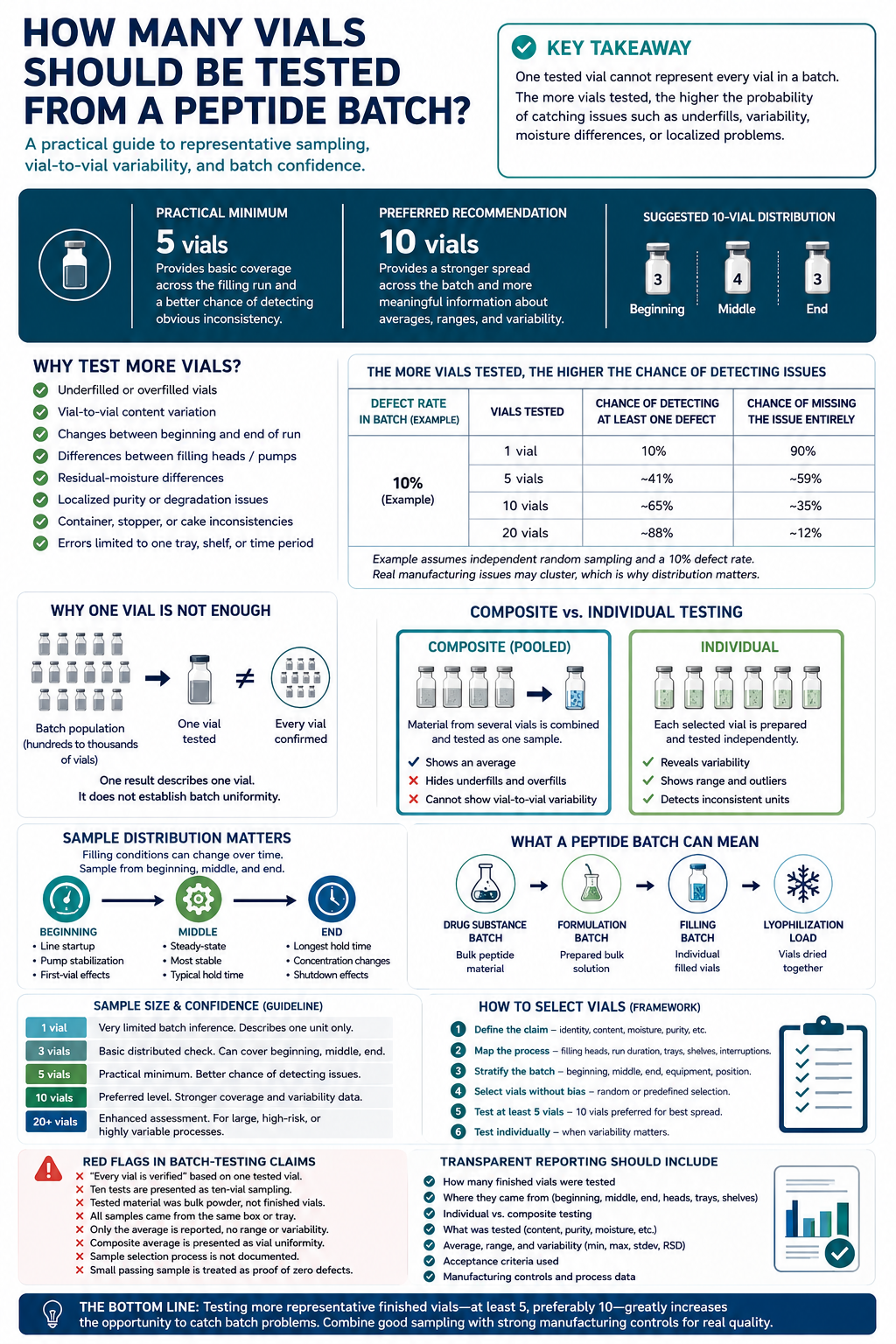
How many vials were actually tested?
For many companies, the answer is simple — one.
One vial is selected from a batch, tested, and a Certificate of Analysis (COA) is issued as though that single result represents every vial produced.
But here is the uncomfortable reality:
One vial passing does not mean the entire batch passes.
That assumption creates a serious quality problem across the industry and introduces avoidable risks for consistency, reproducibility, and research confidence.
The Industry Problem: One Vial, One Assumption
Many peptide companies rely on a minimal testing model that prioritizes cost savings over batch-wide verification.
Common shortcuts include:
- Testing only one vial per batch
- Skipping important testing categories
- Reusing old COAs across multiple production lots
- Avoiding re-testing to reduce expenses
The result?
- Inconsistent dosing
- Hidden impurities
- Weak or inconsistent vial fills
- Unreliable and non-repeatable research results
A single “passing” vial may tell part of the story — but it does not tell the whole story.
If only one vial is tested, there is no meaningful proof that the remaining vials in the batch match it.
That means variability can go undetected.
Why Multi-Vial Conformity Matters
Imagine a batch containing hundreds or thousands of vials.
If only one vial is analyzed, companies are effectively assuming:
“If this one looks good, the rest probably are.”
That is not verification.
That is assumption.
True quality assurance means demonstrating consistency across the batch — not hoping for it.
This is where multi-vial conformity testing becomes essential.
The 7 Testing Categories That Matter
Quality peptide testing should go far beyond purity alone.
Many suppliers advertise “99% purity” while skipping nearly everything else.
A truly verified batch requires broader testing coverage.
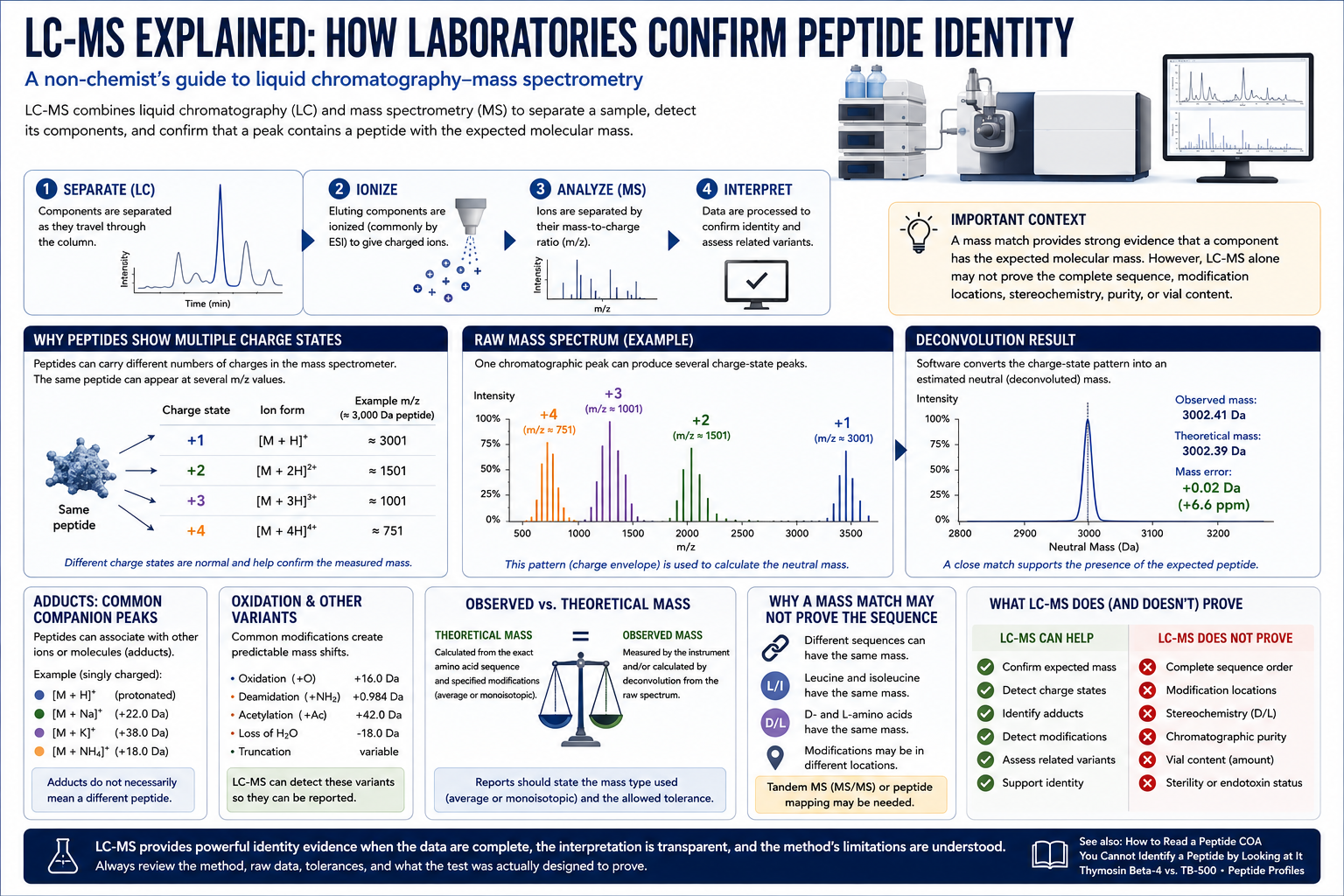
1. Identification Testing
Before anything else, the material must be confirmed as the correct compound.
Identification testing verifies:
- Correct peptide sequence
- Molecular identity
- Synthesis accuracy
If identification fails, every other result becomes meaningless.
Simply put:
If the peptide is not what it claims to be, nothing else matters.
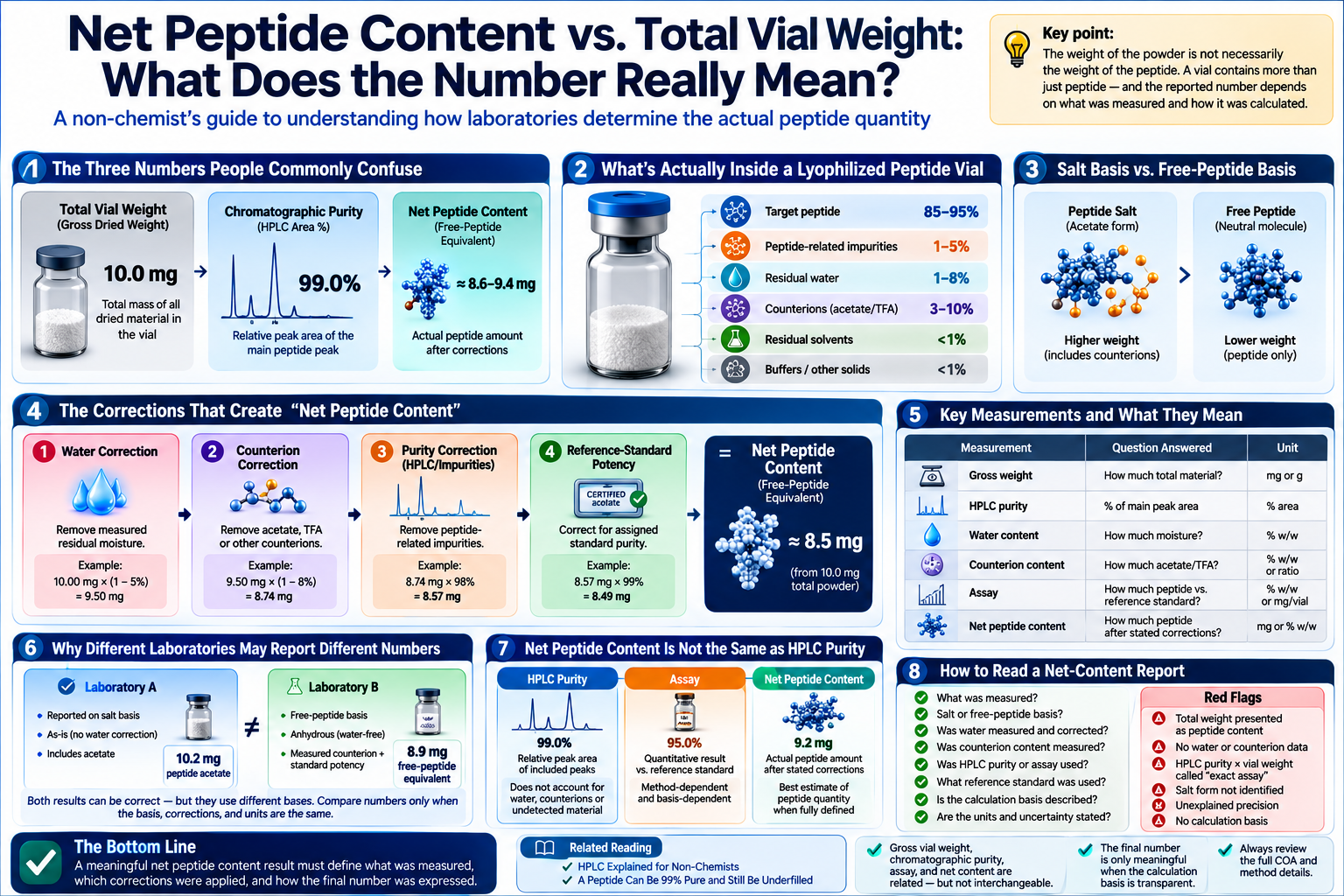
2. Net Peptide Content
A vial label may say 10 mg, but does it actually contain 10 mg of peptide?
Net peptide content testing determines how much material is genuine peptide versus residual substances or non-active material.
This testing confirms:
- Accurate dosing claims
- Real peptide content
- No inflated milligram labeling
A vial labeled 10 mg should not be assumed to contain 10 mg of actual peptide unless verified.
3. Purity Testing (HPLC Analysis)
Purity testing evaluates how clean a peptide preparation truly is.
Using analytical techniques such as HPLC, testing can identify:
- Byproducts
- Impurities
- Incomplete synthesis fragments
A dominant, clean peak generally indicates a cleaner product and stronger manufacturing consistency.
Purity testing matters because:
High purity reduces unknown variables in research.
4. Endotoxin Testing
Endotoxins are bacterial toxins that can interfere with experiments and compromise research reliability.
Even trace contamination can distort outcomes.
Endotoxin screening helps confirm:
- Clean production environments
- Reduced contamination risks
- Improved experimental reliability
For cell-based or sensitive research environments, this testing becomes especially important.
5. Sterility Testing
Sterility testing confirms the absence of microbial growth, including:
- Bacteria
- Mold
- Yeast
This helps demonstrate:
- Proper laboratory handling
- Clean processing practices
- Contamination-free production
While often overlooked in the industry, sterility testing provides another layer of confidence in manufacturing standards.
6. Heavy Metals Testing
Manufacturing contamination can occur from equipment, solvents, or raw material handling.
Heavy metals screening evaluates contaminants such as:
- Lead
- Mercury
- Arsenic
- Cadmium
Testing helps verify:
- Cleaner synthesis environments
- Better manufacturing controls
- Reduced contamination concerns
Skipping heavy metal testing leaves an unnecessary blind spot in quality control.
7. Batch Conformity Testing
This may be the single most overlooked category in the peptide market.
Batch conformity testing examines whether multiple vials from the same batch actually match one another.
It helps detect:
- Weak fills
- Potency inconsistencies
- Outlier vials
- Uneven peptide distribution
Most companies assume consistency.
Multi-vial conformity testing attempts to prove it.
Warning Signs of Low-Quality Suppliers
Researchers should pay close attention to quality indicators.
Potential red flags include:
- Identical COAs reused across batches
- No batch-specific testing documentation
- Claims of “research grade” without evidence
- Purity listed as the only metric
- No endotoxin, sterility, heavy metals, or conformity testing
Transparency matters.
Testing should be documented, current, and batch specific.
What This Means for Researchers
Better testing practices can help support:
- Greater consistency between vials
- More repeatable research outcomes
- Higher confidence in batch reliability
- Fewer unknown variables
Research quality begins with material quality.
And material quality starts with testing.
Final Takeaway
Testing should never be treated as a marketing feature.
It is the foundation of confidence, consistency, and reliability.
One vial passing a test does not automatically mean an entire batch deserves the same trust.
Multi-vial conformity testing helps close that gap.
The real question every researcher should ask is simple:
Was one vial tested — or was the batch actually verified?