Lyophilized Peptides and Shipping Conditions
Understanding Stability During Transit
Introduction
Questions often arise regarding whether shipping delays, warm temperatures, or standard transit conditions may negatively impact peptide stability.
It is understandable to be concerned when a shipment spends extra time in transit or arrives after exposure to varying environmental conditions. However, there is an important distinction that must be understood:
Lyophilized (freeze-dried) peptides behave very differently than reconstituted peptides in solution.
In research settings, peptides are commonly supplied in a lyophilized dry powder form specifically because this preparation offers improved stability during storage and transportation.
While no material is completely immune to environmental stress, current literature and standard handling practices suggest that short-term shipping exposure alone is not generally considered the sole determining factor of peptide integrity when peptides remain dry and properly sealed.
What Does “Lyophilized” Mean?
Lyophilization—commonly called freeze-drying—is a manufacturing process that removes the majority of water from a peptide preparation.
This creates a dry, stable powder commonly referred to as a lyophilized cake inside the vial.
Why does this matter?
Many degradation pathways require moisture to occur. By removing water, the freeze-drying process significantly slows many chemical reactions that can negatively affect stability.
This is one of the primary reasons peptides are commonly stored and shipped in dry powder form prior to reconstitution.
Why Dry Peptides Are More Stable Than Reconstituted Peptides
A common misconception is that all peptides react the same way to temperature changes.
They do not.
Once a peptide has been reconstituted into liquid form, environmental sensitivity generally increases. In contrast, lyophilized peptides in dry form are typically more stable because moisture-dependent degradation pathways are greatly reduced.
Simply put:
Dry peptides and liquid peptides are not equivalent when discussing stability.
What Actually Influences Peptide Stability?
Several variables contribute to peptide stability during storage and transport.
1. Moisture Exposure
Moisture is widely recognized as one of the largest risks to peptide stability.
Exposure to humidity or compromised vial integrity may increase degradation risk over time.
This is why maintaining a dry, sealed environment is important.
2. Time and Environmental Exposure
Transit periods of several days are common within standard shipping systems.
Short-term temperature fluctuations alone are not typically viewed in isolation when evaluating stability.
Instead, outcomes depend on multiple factors, including:
- Duration of exposure
- Environmental conditions
- Packaging integrity
- Storage after delivery
- Product handling practices
3. Solution vs. Dry Form
This distinction is critical.
Reconstituted peptides (liquid form) generally require stricter temperature management and are more sensitive to environmental exposure.
Lyophilized peptides (dry powder) are commonly transported under normal logistics workflows because their dry state offers greater short-term stability.
4. Storage Conditions After Delivery
Shipping is only one part of the equation.
Improper handling after delivery can also influence long-term stability.
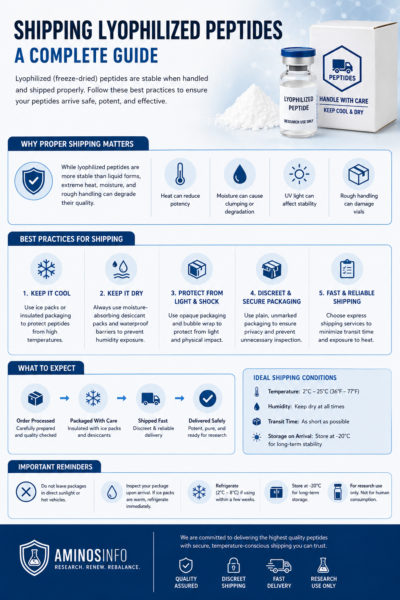
General best practices commonly include:
- Keeping peptides dry until reconstitution
- Avoiding unnecessary moisture exposure
- Following supplier storage recommendations
- Using controlled storage environments for extended preservation
Why Peptides Are Commonly Shipped Without Refrigeration
A question frequently asked is:
“If peptides are sensitive, why aren’t they always shipped cold?”
The answer lies in lyophilization itself.
Freeze-drying is widely used because it improves stability and allows many compounds to tolerate short-term ambient transportation conditions when maintained in dry form.
This is a common practice across research and supply environments depending on the specific compound and supplier handling protocols.
A Practical Perspective on Shipping Delays
It is understandable to feel concerned if a package experiences delays, sits on a delivery vehicle, or arrives after warmer weather.
However, a delayed shipment does not automatically mean a peptide has been compromised.
When peptides remain:
- Lyophilized
- Properly sealed
- Dry
- Handled appropriately after receipt
Short-term shipping exposure alone is not generally considered the only factor determining product integrity.
The Simple Takeaway
Here is the easiest way to think about it:
Lyophilized peptides are designed to be more stable than reconstituted peptides.
Because freeze-drying removes water, many degradation processes slow significantly.
That does not mean environmental conditions never matter—but it does mean that short-term shipping exposure by itself is not automatically evidence of product degradation.
As with all research materials:
Proper handling, storage, and adherence to supplier guidance remain essential for maintaining integrity.
Important Notice
All materials are intended for laboratory research use only and are not for human consumption.