Sterility Testing vs. Endotoxin Testing Explained
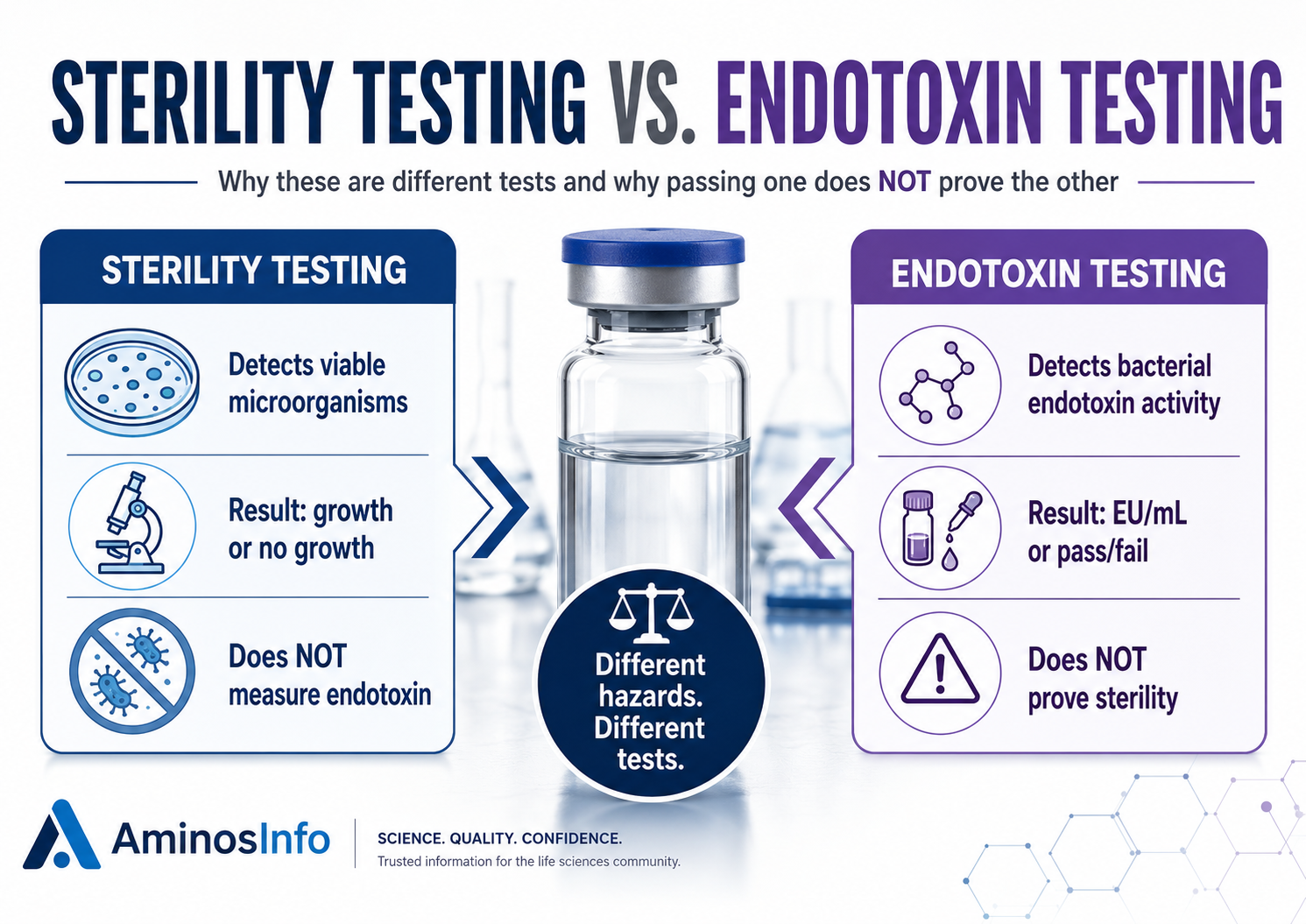
In addition, Sterility testing vs. endotoxin testing compares two separate quality checks. Sterility testing looks for viable microbes, while endotoxin testing measures bacterial endotoxin activity.
Therefore, Important context: This article is for scientific and lab education. A laboratory result does not establish regulatory approval or suitability for human use. Only trained professionals should handle research-use-only materials in properly controlled research environments under relevant laws, workplace rules, and proven procedures.
Likewise, Sterility testing vs. endotoxin testing begins with one essential distinction. First, sterility testing checks whether viable microbes grow under the test conditions. Next, endotoxin testing measures activity linked to Gram-negative bacterial material. Finally, reviewers must interpret both results with sampling and method limits in mind.
However, passing one test does not guarantee passing the other. Therefore, a complete microbe-related quality review must keep sterility, endotoxin, microbial load, and pyrogen claims separate.
Sterility Testing vs. Endotoxin Testing: The Central Difference
Sterility testing asks:
For example, were viable contaminating microbes detected in the tested sample under the specified culture conditions and observation period?
Endotoxin testing asks:
Therefore, was bacterial endotoxin activity detected or measured above a defined limit using a suitable bacterial endotoxins test?
Moreover, the distinction matters because microbes and endotoxins behave differently. As a result, viable organisms can reproduce when conditions support growth. Likewise, endotoxins are nonliving molecular components associated with the outer membrane of Gram-negative bacteria. By contrast, endotoxins can remain after the bacteria die or a process removes them.
In addition, a sterilization process may kill viable microbes without reliably removing or destroying endotoxin. However, conversely, a material can have a low endotoxin result while still containing viable bacteria, yeast, or mold that are not Gram-negative endotoxin sources.
For example, Most common misconception: “Sterile” and “endotoxin-free” are not synonyms. They represent different quality attributes that require different controls and different lab tests.
What Sterility Testing Evaluates
Moreover, Sterility testing checks for viable contaminating microbes in a defined portion of a product. In addition, official-standard procedures use growth media and incubation conditions that support a broad range of bacteria, yeast, and mold. See the USP information on sterility testing standards.
By contrast, the lab holds the sample under specified growth conditions and watches for evidence of microbe growth. A test result may be reported as “no growth,” “complies,” “passes,” or similar language when no evidence of growth the test detects under the method conditions.
What sterility testing can detect
- However, viable bacteria capable of growing under the selected conditions
- For example, viable yeast and mold capable of growing in the selected media
- Therefore, contamination present in the sampled units at a detectable level
- Moreover, a sterility failure when growth the investigation confirms and linked to the product sample
What a sterility test does not directly measure
- Bacterial endotoxin concentration
- Non-bacterial pyrogens
- Dead microbes
- As a result, microbe fragments that cannot reproduce
- Likewise, viruses, unless a separate suitable test serves
- By contrast, every microorganism that may require specialized growth conditions
- In addition, sterility of every vial in a batch
- However, quality of the entire manufacturing process by itself
“No growth” is not proof that zero organisms existed anywhere
For example, sterility testing is destructive and therefore performed on a sample rather than every finished unit. Therefore, a negative result means no viable microbes the test detected in the tested sample under the specified conditions. Moreover, it does not with complete certainty prove that every unit in the batch is sterile.
As a result, this is why modern sterility confidence depends on much more than the final test. Likewise, facility design, facility monitoring, proven sterilization or aseptic processing, personnel practices, filtration controls, container-closure integrity, process simulations, raw-material controls, and investigations all contribute to confidence in a sterile product.
What Bacterial Endotoxin Testing Evaluates
By contrast, bacterial endotoxins are LPS-containing materials associated with the outer membrane of Gram-negative bacteria. In addition, they can produce strong biological responses and are an important quality concern for injectable drug products, biological products, medical devices, and other materials where endotoxin exposure is relevant.
However, The Bacterial Endotoxins Test detects or measures endotoxin activity with a test reagent system that responds to endotoxin. Moreover, USP provides both traditional lysate methods and recombinant-test reagent techniques. See the USP bacterial endotoxins test information.
What endotoxin testing can evaluate
- Moreover, whether endotoxin activity the test detects above the method threshold
- As a result, the approximate endotoxin concentration under a quantitative method
- Likewise, whether a sample meets a defined endotoxin limit
- By contrast, whether the sample sample mixture interferes with the assay when suitability controls the report includes
What endotoxin testing does not directly measure
- In addition, viable bacteria, yeast, or mold
- Sterility
- Every possible microbe toxin
- Every non-endotoxin pyrogen
- However, identity or purity of a peptide
- For example, peptide quantity or labeled milligrams
- Therefore, regulatory approval or suitability for human use
Why dead bacteria can still matter
Moreover, a process that kills Gram-negative bacteria may stop them from reproducing but leave endotoxin behind. As a result, endotoxin can be comparatively resistant to ordinary sterilization conditions, and pyrogen reduction generally requires separate proven controls. Therefore, a material can produce no microbe growth during sterility testing yet still contain unacceptable endotoxin activity.
By contrast, Key distinction: Sterilization is intended to control viable microbes. Pyrogen reduction aims to lower or remove fever-causing contamination, including bacterial endotoxins, to a defined level. Readers should not use the terms interchangeably.
Why a Sample Can Pass One Test and Fail the Other
Scenario 1: Sterility passes, endotoxin fails
For example, a Gram-negative bacterial contamination event occurs during manufacturing. Therefore, a later treatment kills the viable bacteria, so the sterility test shows no growth. Moreover, endotoxin released from the bacterial cells remains, producing a result above the specified endotoxin limit.
Scenario 2: Endotoxin passes, sterility fails
As a result, the sample contains a viable yeast, mold, or Gram-positive bacterium. Likewise, these organisms are not measured by a bacterial endotoxins test in the same way as Gram-negative endotoxin, so the endotoxin result can remain low while a sterility culture shows growth.
Scenario 3: Both tests pass
By contrast, no viable microbes the test detects in the sampled units, and endotoxin activity is below the defined limit. In addition, this is the desired outcome, but it remains limited to the methods, sample plan, detection capability, and validity of the testing process.
Scenario 4: Both tests fail
However, viable Gram-negative bacteria are present in the tested sample and produce sufficient endotoxin activity to exceed the limit. For example, the lab may observe both microbe growth and an elevated endotoxin result.
Common Sterility-Test Methods
Therefore, official-standard sterility testing commonly uses either membrane filtration or direct inoculation. The appropriate method depends on the sample’s physical properties, volume, antimicrobial activity, filterability, and compatibility with the test system.
Membrane filtration
As a result, the sample is passed through a sterile membrane that retains microbes. Likewise, the analyst rinses the membrane when appropriate and transfers it to growth media. By contrast, this approach can help remove product components that interfere with microbe detection.
Direct inoculation
In addition, a defined quantity of sample the analyst adds directly to suitable culture media. However, the sample volume must not prevent microbe growth or overwhelm the medium.
Method suitability
For example, the method must demonstrate that the product does not inhibit the detection of microbes under the chosen conditions. Therefore, the method may require neutralization, dilution, or rinsing.
Culture media and incubation
Moreover, sterility methods use growth media and incubation conditions intended to recover different categories of microbes. As a result, media must pass growth-promotion testing, and the test environment must minimize the risk that laboratory handling introduces false-positive contamination.
Likewise, the incubation period is intentionally long enough to allow low numbers of stressed or slow-growing organisms to become detectable. By contrast, reviewers should wait for the full observation period unless the lab uses a proven rapid microbe-related method under an appropriate framework.
Why a positive result requires investigation
In addition, microbe growth can originate from the tested product, the manufacturing process, or an accidental contamination event during laboratory testing. However, a valid investigation examines the organism identity, test controls, facility monitoring, analyst practices, equipment, media, sample handling, and manufacturing history.
For example, simply repeating a failed sterility test until a passing result appears is not scientifically sound. Therefore, a confirmed initial failure can indicate a serious process problem, and the lab must investigate it rather than dismiss it.
Common Bacterial Endotoxin Test Methods
Moreover, Traditional endotoxin methods use Limulus amebocyte lysate or related lysate reagents. In addition, USP Chapter <86> provides techniques that use recombinant reagents and became official in May 2025. See the USP Chapter <86> announcement.
| Method | Basic principle | Typical output | Important considerations |
|---|---|---|---|
| Gel-clot | By contrast, a clot forms when endotoxin activity reaches or exceeds the test reagent sensitivity. | In addition, pass/fail or range-based pass/fail result | However, visual endpoint, test reagent sensitivity, signal blocking or signal boosting controls |
| Kinetic cloudiness-based | For example, the assay measures increasing turbidity over time as the reaction proceeds. | Quantitative endotoxin concentration | Therefore, standard curve, timing, optical test interference, reaction kinetics |
| color-based | Moreover, the activated cascade releases a colored compound measured by light measurement. | As a result, endpoint or kinetic quantitative result | Likewise, product color, optical test interference, standard curve, dilution |
| By contrast, Recombinant Factor C or cascade reagents | In addition, recombinant proteins reproduce all or part of the endotoxin-responsive pathway. | However, usually quantitative light-signal or color response | For example, method qualification, product suitability, official-standard or regulatory framework |
Endotoxin units
Therefore, Endotoxin results reports commonly express in endotoxin units (EU), such as EU/mL, EU/mg, or EU per device. The acceptable limit depends on the product, route, maximum exposure, and relevant standards. A bare number without units or an acceptance limit is not enough to determine whether a result is acceptable.
Product test interference must be evaluated
Likewise, some sample matrices can inhibit the endotoxin reaction and create falsely low results. By contrast, others can enhance the response and create falsely high results. In addition, method-suitability or signal blocking/signal boosting studies are therefore critical. However, positive product controls demonstrate whether a known amount of endotoxin the method can recover in the presence of the sample.
For example, diluting a sample can reduce test interference, but dilution cannot exceed the maximum valid dilution established for the test. Therefore, excessive dilution could reduce endotoxin below the method’s ability to detect a meaningful failure.
“Below detection” is not the same as zero
Moreover, A result such as <0.05 EU/mL means endotoxin activity was not measured above the stated threshold under the method conditions. It does not mean absolute absence of every endotoxin molecule.
How to Read Sterility and Endotoxin Results on a COA
| COA entry | What it may mean | What to verify |
|---|---|---|
| “Sterility: Pass” | Likewise, no growth the test detected in the tested sample under the stated method. | By contrast, method, sample quantity, media, incubation period, method suitability, and lot number |
| “No growth” | In addition, no visible or instrument-detected microbe growth the analyst observed. | However, whether the full required incubation period the lab completed and controls were valid |
| “Endotoxin: <0.10 EU/mg” | For example, endotoxin activity was below the method’s reporting threshold or stated value. | Therefore, limit, units, method, sample dilution, test interference controls, and calculation basis |
| “BET: Complies” | Moreover, the test result met the stated bacterial endotoxin criterion. | As a result, the actual limit and result, not only the word “complies” |
| “Pyrogen-free” | Likewise, often used imprecisely in marketing. | By contrast, which pyrogen test the lab performed and whether only bacterial endotoxin the reviewer evaluated |
| “Sterile and endotoxin-free” | In addition, a broad claim requiring separate supporting tests and process controls. | However, lot-specific sterility and endotoxin reports, methods, limits, sampling, and manufacturing controls |
limits and results must both be visible
For example, a COA should ideally show the method, predefined acceptance criterion, actual result, units, and conclusion. Therefore, “Pass” without a disclosed limit provides less information than a number-based result compared against a defined limit.
| Test | Example limit | Example result | Interpretation |
|---|---|---|---|
| Sterility | Moreover, no evidence of microbe growth | No growth detected | As a result, meets the stated sterility-test criterion for the tested sample. |
| Bacterial endotoxins | Likewise, not more than 0.50 EU/mg | 0.08 EU/mg | By contrast, meets the stated endotoxin limit under the proven test conditions. |
Major Limitations of Final-Product Testing
Sterility testing is a sampling test
In addition, because the test consumes the product, only selected units labs can analyze. However, contamination may be uneven or occasional. For example, a contaminated vial can exist even when the sampled vials show no growth. Therefore, increasing the number of tested units improves sampling confidence but does not transform the test into proof of every unit.
Low-level contamination the test may miss
Moreover, a very small number of organisms may not be included in the sampled volume. As a result, organisms may grow slowly, remain unevenly distributed, suffer damage, or fail to grow under the selected conditions. Likewise, product-related antimicrobial activity can suppress detection if method suitability is inadequate.
Endotoxin assays are sample mixture-sensitive
By contrast, proteins, peptides, surfactants, salts, chelating agents, extreme pH, color, turbidity, and other sample characteristics can interfere with endotoxin detection. In addition, a result without suitable test interference controls may be unreliable.
Endotoxin testing is not a universal pyrogen test
However, the bacterial endotoxins test the method aims for bacterial endotoxins. For example, other substances can cause fever responses even when a BET does not detect them. Therefore, “low endotoxin” should not automatically be translated into “free of all pyrogens.”
Final testing cannot replace process control
Moreover, a manufacturer cannot reliably test quality into a poorly controlled process. As a result, sterility confidence and endotoxin control depend on facility hygiene, water systems, raw-material control, proven cleaning, equipment design, hold times, aseptic practices, sterilization, pyrogen reduction, facility monitoring, packaging integrity, and trend analysis.
microbial load Testing Is a Third, Separate Concept
Likewise, microbial load generally refers to the number and types of viable microbes present in or on a material before a sterilization step or as part of microbe-control monitoring. It is not the same as a sterility test and not the same as an endotoxin test.
| Test | Main question | Typical type of result |
|---|---|---|
| Sterility | In addition, were viable organisms detected in the tested sample? | Growth or no growth |
| Endotoxin | However, how much bacterial endotoxin activity is present? | For example, eU/mL, EU/mg, EU/device, or pass/fail |
| microbial load | Therefore, how many viable microbes are recoverable before sterilization or during monitoring? | Moreover, colony-forming units per defined amount |
As a result, microbial load testing helps evaluate process hygiene and the microbe challenge presented to a sterilization or filtration process. Likewise, a low microbial load does not prove sterility. By contrast, a high microbial load may increase the risk of endotoxin accumulation, but microbial load counts do not directly quantify endotoxin.
Why organism identification can matter
In addition, the same colony count can carry different process meaning depending on the organism. However, repeated detection of water-associated Gram-negative bacteria may point toward a water-system or wet-processing problem. For example, spore-forming organisms may challenge certain control strategies. Therefore, mold may suggest an facility or facility issue. Moreover, trending the identity and location of recovered organisms provides information that a total count alone cannot.
Endotoxin Testing vs. Pyrogen Testing
As a result, A pyrogen is a substance capable of producing a fever response. Bacterial endotoxins are an important category of pyrogens, but the terms are not identical. Non-endotoxin pyrogens can include components from Gram-positive bacteria, fungi, viruses, and other biological or chemical sources.
Bacterial endotoxin test
In addition, targets endotoxin activity associated with Gram-negative bacterial LPS using lysate or recombinant test reagent methods.
Broader pyrogen assessment
However, may be needed when non-endotoxin pyrogens are a plausible risk and the product or process cannot be adequately controlled using BET alone.
For example, reviewers should examine “pyrogen-free” claims carefully. Therefore, a low BET result supports control of bacterial endotoxin under that method. Moreover, it does not always demonstrate absence of every fever-causing substance.
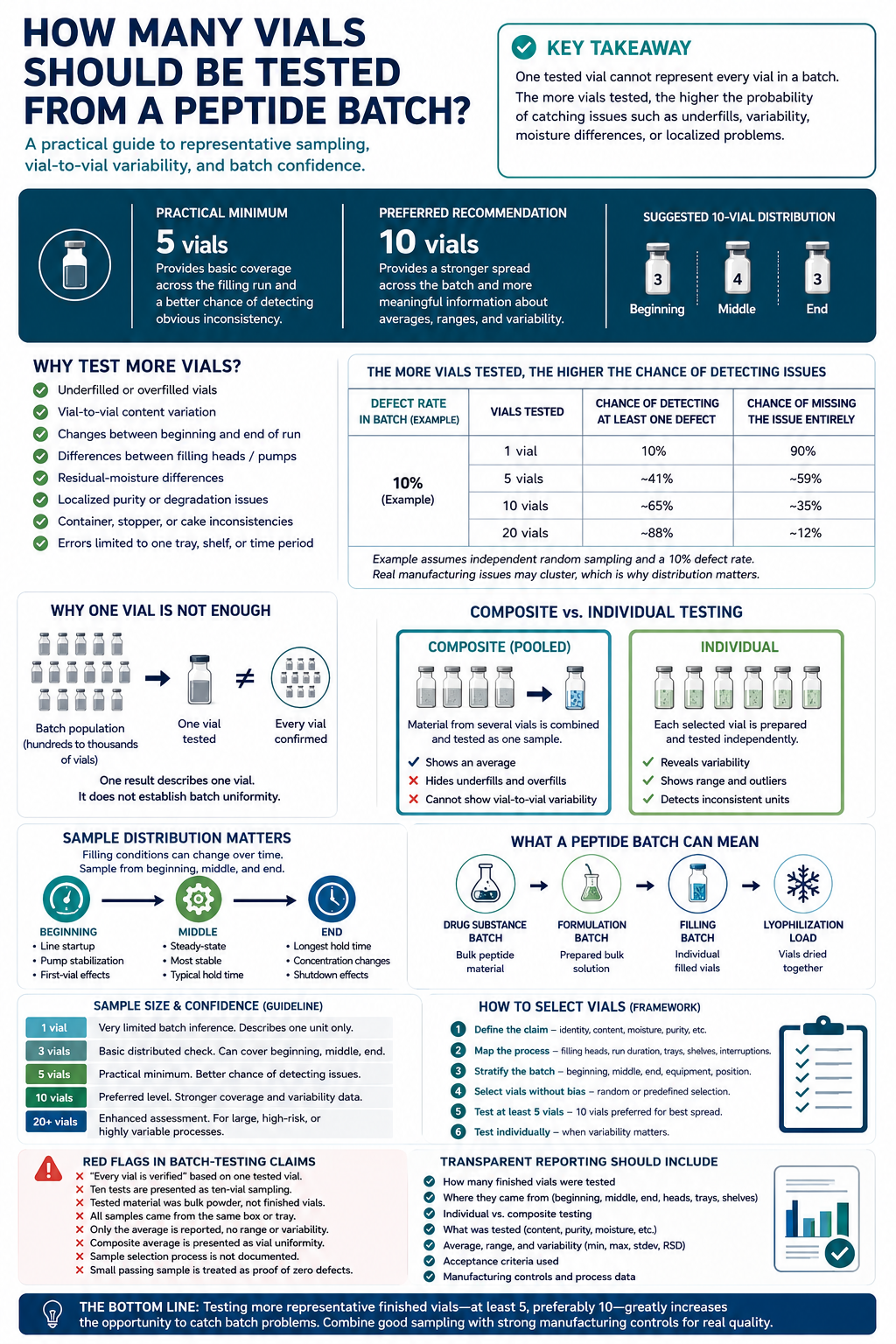
Sampling, Batch Relevance, and sample-handling record
As a result, even technically valid results can be misleading when the sample is not connected to the distributed batch. Likewise, a strong testing record identifies the exact lot, sample source, number of units, sample condition, collection date, receipt date, storage, and test date.
Questions to ask about sterility-test sampling
- By contrast, were finished vials or only bulk material tested?
- In addition, how many units the lab sampled?
- However, were units selected across the filling or lyophilization run?
- For example, were different container sizes or sub-batches represented?
- Therefore, was the sample quantity sufficient for the official-standard or proven method?
- Moreover, were the test units handled and transported under controlled conditions?
Questions to ask about endotoxin sampling
- As a result, was the finished product tested, or only the bulk solution or raw powder?
- Likewise, did the test account for the product’s maximum valid dilution?
- By contrast, were test interference and positive product controls acceptable?
- In addition, were endotoxin-free sampling materials and containers used?
- However, was the result reported in units appropriate to the limit?
- For example, did the lot number match the product being reviewed?
Finished-product results answer different questions from raw-material results
Therefore, a raw peptide-powder endotoxin test may provide information about the starting material, but it does not establish the endotoxin status of finished vials after formulation, filling, lyophilization, capping, storage, and distribution. Moreover, similarly, a sterility result for a bulk solution does not automatically establish sterility of the final container.
How to Evaluate Sterility and Endotoxin Claims on a COA
- As a result, Match the lot. Confirm that the report’s lot or batch number matches the vial or product being evaluated.
- By contrast, Identify the sample type. Determine whether the laboratory tested raw material, bulk solution, a finished vial, pooled vials, or multiple individual units.
- However, Find the exact method. Look for a official-standard chapter, proven method number, or clear test description—not merely “microbe testing.”
- Therefore, Review method suitability. Confirm that antimicrobial effects and endotoxin-assay test interference the reviewer evaluated for the product sample mixture.
- As a result, Check limits. A sterility result should have a clear no-growth criterion. An endotoxin result should have a number-based limit with units.
- In addition, Review actual results. Prefer the measured value and test conclusion over a single unexplained “pass” statement.
- For example, Confirm controls were valid. Growth-promotion, negative controls, positive controls, standard curves, and product-control detection must support test validity.
- Moreover, Check dates. Sample receipt, testing, incubation completion, and report dates should follow a logical sequence.
- Likewise, Verify the laboratory. Confirm the laboratory identity and report number independently when validity is uncertain.
- In addition, Keep claims separate. Do not allow a sterility result to substitute for endotoxin testing or an endotoxin result to substitute for sterility testing.
What a stronger microbe-related testing packet includes
How to Review the Supporting Evidence
- Lot-specific finished-product testing
- For example, clear sample quantity and number of units
- Therefore, sterility method and complete incubation conditions
- Moreover, method-suitability or bacterial growth blocking/fungal growth blocking information
- As a result, endotoxin method, sensitivity, standard curve, and units
- Likewise, maximum valid dilution and test interference-control results
- By contrast, actual limits and measured results
- In addition, authorized laboratory review and report identifier
- However, separate microbial load or facility-control data when relevant
- For example, evidence of broader sterility confidence rather than reliance on end-product testing alone
Misleading Claims and Red Flags
- Therefore, “Sterile” based only on a sealed vial. Container appearance does not establish sterility.
- As a result, “Endotoxin-free” without a test result. The claim evidence should support by a lot-specific method, limit, units, and actual result.
- By contrast, A sterility result used to imply low endotoxin. No-growth testing does not measure endotoxin.
- However, An endotoxin result used to imply sterility. A BET does not detect viable yeast, mold, Gram-positive bacteria, or all Gram-negative bacteria as living organisms.
- Therefore, “Pyrogen-free” based only on BET. BET targets bacterial endotoxins, not always all possible pyrogens.
- As a result, No method-suitability information. Product signal blocking can hide microbe growth or endotoxin activity.
- By contrast, No number-based endotoxin limit. “Pass” is difficult to evaluate without units and acceptance criteria.
- However, No lot match. A valid report for another batch is not evidence for the batch in hand.
- Therefore, Raw-material testing presented as finished-vial testing. Later processing steps can introduce contamination.
- As a result, One sample described as proof of every vial. Sampling limits sterility testing.
- By contrast, Testing performed immediately after inoculation. Sterility results require the complete specified incubation period unless a proven rapid method serves.
- However, Repeat testing used to erase a failure. An initial positive result requires a scientifically justified investigation.
- Therefore, HPLC purity presented as microbe-related testing. Chemical purity does not establish sterility or endotoxin status.
- As a result, “No bacteria” presented as “no endotoxin.” Dead or removed Gram-negative organisms can leave endotoxin behind.
Quick Comparison
| Question | Sterility test | Bacterial endotoxin test |
|---|---|---|
| Primary target | Viable microbes | Gram-negative bacterial endotoxin activity |
| Common result format | Growth / no growth | Likewise, eU/mL, EU/mg, EU/device, or pass/fail |
| Can detect dead bacteria? | By contrast, no, not as viable growth | In addition, can detect remaining endotoxin activity from Gram-negative bacterial material |
| However, can detect yeast or mold? | For example, yes, when recoverable under the test conditions | No |
| Can detect Gram-positive bacteria? | Therefore, yes, when viable and recoverable | Moreover, not through Gram-negative endotoxin detection |
| As a result, can prove every vial is acceptable? | Likewise, no; testing depends on sampled units | By contrast, no; the result applies to the tested sample and method |
| Does passing prove safety? | No | No |
| In addition, does passing prove identity or purity? | No | No |
Frequently Asked Questions About Sterility and Endotoxin Testing
Sterility and Endotoxin Basics
Can a sterile product contain endotoxin?
However, yes. For example, sterility refers to viable microbes under the test and process context. Therefore, endotoxin can remain after Gram-negative bacteria die or a process removes them. Moreover, a separate bacterial endotoxins test the method requires to evaluate endotoxin activity.
Can a low-endotoxin product fail sterility testing?
As a result, yes. Likewise, viable yeast, mold, Gram-positive bacteria, or even low-endotoxin Gram-negative contamination can produce a sterility failure while the BET remains below its specified limit.
Does autoclaving remove endotoxin?
By contrast, autoclaving the method aims primarily to kill viable microbes. In addition, users should not assume that it provides adequate pyrogen reduction. However, endotoxin reduction requires a separately proven process appropriate to the material and equipment.
Is “no growth” the same as sterile?
For example, “No growth” means no viable microbes the test detected in the tested sample under the stated conditions. Therefore, a sterile-product claim also depends on proven manufacturing controls, sampling, container integrity, facility control, and the overall sterility-confidence system.
Methods, Units, and Test Limits
What does EU mean?
Moreover, eU means endotoxin unit, a standardized measure of endotoxin activity. As a result, reports should always include the basis, such as EU/mL or EU/mg, and reviewers should compare it with a defined product-specific limit.
Is LAL the only endotoxin method?
Likewise, traditional official-standard methods use amebocyte lysate reagents, including gel-clot, cloudiness-based, and color-based approaches. By contrast, uSP Chapter <86> also provides techniques using recombinant reagents. In addition, method suitability and the relevant regulatory framework remain essential.
What is recombinant Factor C?
However, recombinant Factor C is a non-animal-derived test reagent based on the endotoxin-sensitive initiating protein in the horseshoe-crab clotting cascade. For example, when activated by endotoxin, it generates a measurable signal. Therefore, the lab must establish suitability for the specific product and method.
Is endotoxin the same as all bacterial toxins?
Moreover, no. As a result, endotoxin refers specifically to LPS-associated material from Gram-negative bacteria. Likewise, bacteria can produce many other toxins that are not measured by a standard bacterial endotoxins test.
HPLC, Appearance, and Batch Assurance
Does HPLC purity say anything about sterility?
By contrast, no. In addition, hPLC evaluates chemical components detectable under a chromatographic method. However, it does not establish absence of viable microbes or bacterial endotoxin.
Why is the endotoxin limit different for different products?
For example, limits can depend on the route of exposure, maximum dose or contact, product concentration, patient population, and relevant official-standard or regulatory rules. Therefore, reviewers cannot judge a number without its units and product-specific limit.
Can a clear solution still fail either test?
Moreover, yes. As a result, microbes and endotoxin may be present without visible cloudiness, particles, color, or odor. Likewise, visual appearance cannot replace microbe-related testing.
Does one sterile test prove the entire batch is sterile?
By contrast, no. In addition, the result directly applies to the sampled units. However, batch confidence depends on properly selected sampling and a proven, consistently controlled manufacturing and packaging process.
Final Takeaway
For example, sterility testing and bacterial endotoxin testing are complementary, not interchangeable. Therefore, sterility testing the method aims to detect viable microbes in a sample under defined growth conditions. Moreover, endotoxin testing detects or measures a specific type of fever-causing bacterial material associated with Gram-negative bacteria.
As a result, a sample can pass sterility and fail endotoxin because dead bacteria can leave endotoxin behind. Likewise, it can pass endotoxin and fail sterility because viable yeast, mold, or other bacteria may be present without producing a high BET result. By contrast, both tests also have sampling, test interference, detection, and method-suitability limitations.
In addition, Remember: “No growth” answers a viable-microorganism question. “Below the endotoxin limit” answers a bacterial-endotoxin question. Neither result can substitute for the other, and neither result alone proves overall product quality or suitability for human use.
Technical References and Further Reading
- Therefore, U.S. Food and Drug Administration. Pyrogen and Endotoxins Testing: Questions and Answers. Updated March 18, 2026. https://www.fda.gov/regulatory-information/search-fda-guidance-documents/pyrogen-and-endotoxins-testing-questions-and-answers
- In addition, U.S. Food and Drug Administration. Pharmaceutical Microbiology Manual. https://www.fda.gov/media/88801/download
- Moreover, United States Pharmacopeia. USP General Chapter <71> Sterility Tests. Listed among USP injectables-related documentary standards. https://www.usp.org/biologics/injectables
- In addition, United States Pharmacopeia. USP General Chapter <85> Bacterial Endotoxins Test. https://www.usp.org/harmonization-standards/pdg/general-methods/bacterial-endotoxins
- Therefore, United States Pharmacopeia. USP General Chapter <86> Bacterial Endotoxins Test Using Recombinant Reagents. Official May 2025. https://www.usp.org/news/chapter-for-endotoxin-testing-using-non-animal-derived-reagents-published-for-early-adoption
- By contrast, U.S. Food and Drug Administration. Bacterial Endotoxins/Pyrogens Inspection Technical Guide. https://www.fda.gov/inspections-compliance-enforcement-and-criminal-investigations/inspection-technical-guides/bacterial-endotoxinspyrogens
- Therefore, U.S. Food and Drug Administration. Container and Closure System Integrity Testing in Lieu of Sterility Testing as a Component of the Stability Protocol. https://www.fda.gov/regulatory-information/search-fda-guidance-documents/container-and-closure-system-integrity-testing-lieu-sterility-testing-component-stability-protocol
- By contrast, European Medicines Agency. ICH Q4B Annex 14: Bacterial Endotoxins Tests. https://www.ema.europa.eu/en/ich-q4b-annex-14-bacterial-endotoxins-tests-scientific-guideline
- For example, European Medicines Agency. Guideline on the Sterilisation of the Medicinal Product, Active Substance, Excipient and Primary Container. https://www.ema.europa.eu/en/documents/scientific-guideline/guideline-sterilisation-medicinal-product-active-substance-excipient-and-primary-container_en.pdf
- As a result, European Medicines Agency. Quality of Medicines Questions and Answers—Endotoxin and Sterility Testing at End of Shelf Life. https://www.ema.europa.eu/en/human-regulatory-overview/research-development/scientific-guidelines/quality-medicines-questions-answers-introduction/quality-medicines-questions-answers-part-2