Warm Shipping Conditions and Freeze-dried Peptides
However, Warm shipping conditions are a common concern when freeze-dried peptides travel through hot vehicles, sorting facilities, or outdoor delivery locations. Therefore, this guide explains why a warm package does not automatically establish peptide damage and how temporary temperature excursions should be evaluated using specific to the product stability evidence.
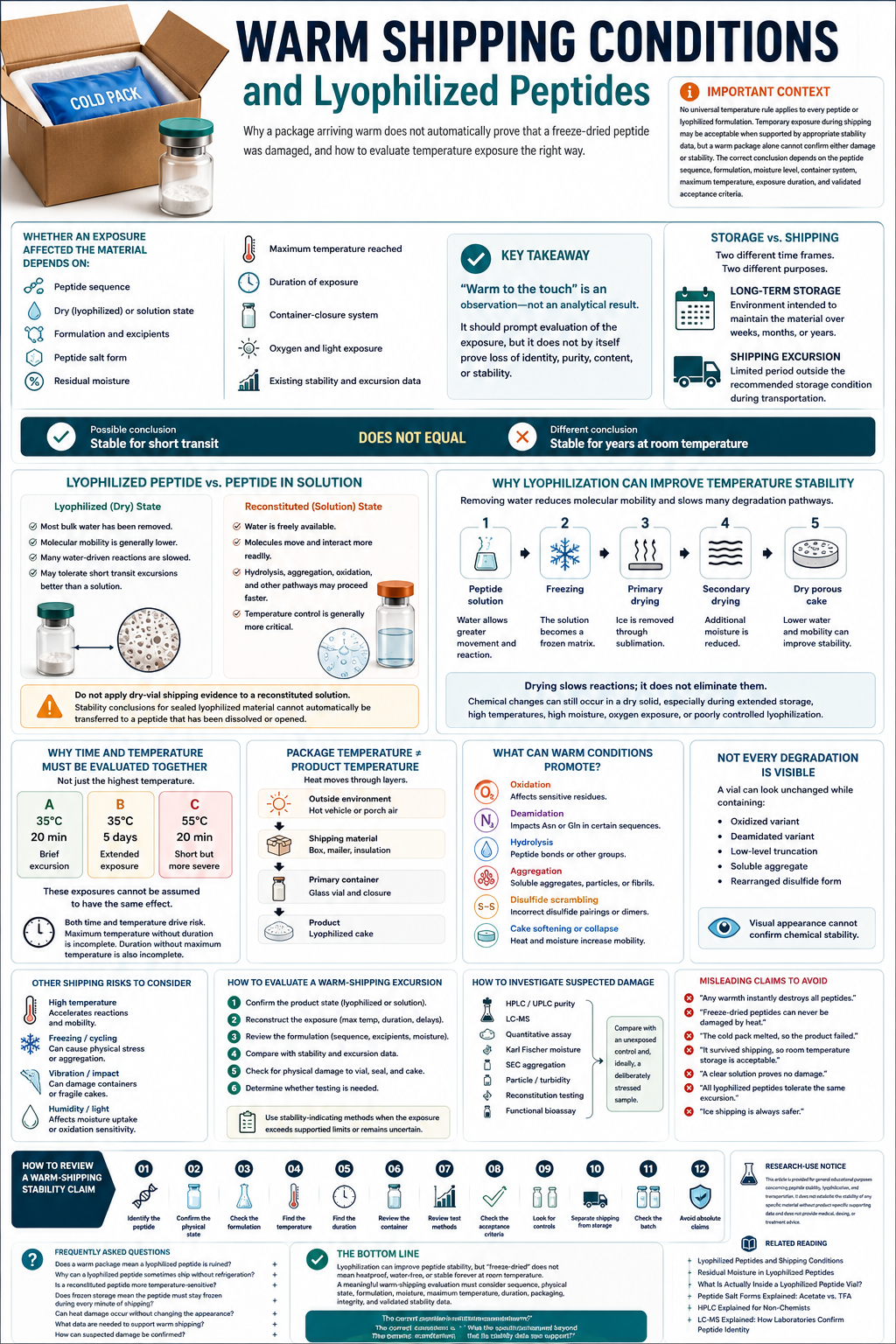
Why a package arriving warm does not automatically prove that a freeze-dried peptide was damaged, how short shipping excursions differ from long-term storage, and why stability must be evaluated using time, temperature, formulation, and analytical data.
Do Warm Shipping Conditions Damage Freeze-dried Peptides?
Not automatically.
First, a shipping box, mailer, or vial that feels warm confirms only that the package was exposed to a warm environment. However, it does not establish that the peptide crossed a scientifically meaningful damage threshold.
Instead, whether an exposure affected the material depends on:
- The exact peptide sequence
- Whether the material was dry or already in solution
- The formulation and excipients
- The peptide’s salt form
- Residual moisture
- The highest temperature reached
- The duration of exposure
- The vial and closure system
- Oxygen and light exposure
- Existing stability and excursion data
For example, FDA stability guidance recognizes that temporary temperature excursions during handling, transport, and storage may be acceptable when justified by scientific evidence and supported by stability data.
Therefore, Warm to the touch is an observation—not an lab result.
Therefore, it should prompt a review of the exposure, but it does not by itself prove loss of identity, purity, content, or stability.
Long-Term Storage Conditions Are Not the Same as Shipping Conditions
First, storage instructions are designed to protect a material over its complete proposed storage or retest period. By contrast, shipping conditions describe a much shorter period during which the material moves through a distribution network.
Recommended storage
The environment intended to maintain the material over weeks, months, or years.
Shipping excursion
In addition, A limited period outside the recommended storage condition during transportation or handling.
Therefore, a recommendation to store a peptide refrigerated or frozen does not automatically mean that every hour above that condition causes immediate destruction.
Likewise, evidence that a peptide tolerates several days of transit at ambient temperature does not mean that ambient temperature is appropriate for long-term storage.
For example, FDA stability guidance discusses short-term excursions outside the labeled storage condition during shipping or handling and expects those excursions to be supported by suitable testing.
In addition, USP guidance on reference standards distinguishes shipping conditions from long-term storage. Its reference standards are not automatically shipped on ice merely because their labeled storage condition is refrigerated or frozen; cold shipment is used when scientific evidence shows that it is necessary.
Freeze-dried Peptide vs. Peptide in Solution
First, the most important distinction in warm-shipping discussions is often whether the peptide remains dry or has already been dissolved.
Dry peptide material
- Most bulk water has been removed.
- Molecule movement is generally lower.
- Many water-driven reactions are slowed.
- The material may tolerate short transit excursions better than a solution.
Peptide in solution
- Water is freely available.
- Molecules can move and interact more readily.
- Water-driven breakdown, clumping, oxygen-related change, and other pathways may proceed faster.
- Temperature control is generally more critical.
Similarly, reviews of peptide stability distinguish solution stability from solid or freeze-dried stability. Peptide solutions commonly have shorter stability windows, while freeze-drying is used to improve storage characteristics by reducing water and molecule movement.
However, this does not mean that every dry peptide is heatproof. It means the physical state substantially changes the degradation environment.
Do not apply dry-vial shipping evidence to a mixed into solution solution
For example, Stability conclusions for sealed freeze-dried material cannot automatically be transferred to a peptide that has been dissolved, repeatedly opened, mixed with another substance, or stored in a different container.
Why Freeze-drying Can Improve Temperature Stability
First, freeze-drying removes water by freezing the formulation and then removing ice through sublimation, followed by additional drying that reduces more strongly associated moisture.
As a result, in the dried state:
- Molecular movement is reduced.
- Peptide molecules collide less frequently.
- Many water-driven reactions slow substantially.
- Clumping pathways may be reduced.
- Excipients can hold the peptide in a protective glass-like matrix.
Water allows greater molecular movement and reaction opportunity.
The solution becomes a frozen matrix.
Ice is removed through sublimation.
Additional associated moisture is reduced.
Lower water and mobility can improve storage stability.
Drying slows reactions; it does not eliminate them
Even so, chemical changes can still occur in a dry solid, especially during extended storage, high temperatures, high moisture, oxygen exposure, or poorly controlled freeze-drying.
For example, studies have found solid-state peptide reactions and disulfide rearrangement during freeze-drying and subsequent room-temperature storage, demonstrating that a dry state is not chemically inactive.
Why Time and Temperature Must Be Evaluated Together
As a result, Importantly, temperature exposure is not fully described by stating only the highest temperature.
Therefore, an excursion review should consider:
- How hot the product became
- How long it remained at that temperature
- Whether temperature rose gradually or suddenly
- Whether several excursions occurred
- The product’s starting temperature
- Whether the material cooled between exposures
Brief moderate excursion
Extended moderate exposure
Short but more severe exposure
Consequently, these exposures cannot be assumed to have the same effect.
Heat can accelerate reaction rates
By contrast, In general, many chemical breakdown reactions occur faster at higher temperatures. However, the rate increase is specific to the peptide, formulation, moisture level, and degradation pathway.
Therefore, it is misleading to use a universal rule such as:
Every ten-degree increase destroys a fixed percentage of every peptide.
In addition, mean kinetic temperature can be useful in some pharmaceutical distribution assessments because it converts a changing temperature history into a single calculated value reflecting total heat stress. It is not automatically appropriate for every excursion or every breakdown process.
Maximum temperature without exposure duration is incomplete.
Exposure duration without maximum temperature is also incomplete.
Package Temperature Is Not Necessarily Product Temperature
First, a cardboard box, padded envelope, gel pack, vial cap, and vial contents can all be at different temperatures at the same moment.
For example, when a parcel is placed in a hot vehicle or direct sunlight:
- The outside packaging heats first.
- Insulation slows heat transfer toward the center.
- The vial warms gradually.
- A cold pack may continue absorbing heat after it no longer feels frozen.
- The internal product temperature may lag behind the surrounding air temperature.
Touch is not a calibrated measurement
However, human touch cannot accurately determine:
- The highest temperature reached
- How long the product was warm
- The internal cake temperature
- Whether the temperature crossed a tested excursion limit
- Whether chemical change occurred
Instead, temperature-monitoring devices and tested shipping studies provide stronger evidence than subjective descriptions such as “warm,” “hot,” or “room temperature.”
What Types of Degradation Can Warm Conditions Promote?
Likewise, heat does not cause one universal form of peptide damage. It can accelerate several sequence- and formulation-dependent pathways.
Oxygen-related change
Can affect residues such as methionine, tryptophan, cysteine, or other oxygen-related change-sensitive groups.
Amino-group change
Meanwhile, Can affect certain asparagine- or glutamine-containing sequences under suitable conditions.
Water-driven breakdown
Can involve peptide bonds or other hydrolytically sensitive chemical groups.
Clumping
More importantly, Peptide molecules may associate into soluble aggregates, particles, or fibrillar structures.
Disulfide bond changes
Cysteine-containing peptides may form incorrect disulfide arrangements or dimers.
Cake softening or collapse
In practice, Heat and moisture can increase mobility within an amorphous dried matrix.
Moreover, peptide physical stability is affected by intrinsic properties such as sequence, charge, hydrophobicity, concentration, and conformation, as well as external conditions such as temperature, pH, agitation, and interfaces.
Not every degradation product is visible
For example, a vial can look unchanged while containing:
- An oxidized variant
- A deamidated variant
- A low-level truncation or cleavage product
- A soluble aggregate
- A rearranged disulfide form
By contrast, a cake can appear slightly shrunken or cracked without proving loss of peptide identity or purity.
Visual appearance cannot confirm chemical stability
For this reason, Appearance is one quality observation. Chemical identity, purity, content, and degradation require appropriate lab methods.
Why Peptide Sequence Matters
First, each peptide has a different arrangement of amino acids and chemical modifications. Those structural differences create different stability risks.
Important sequence-related factors include:
- Oxygen-related change-sensitive amino acids
- Amino-group change-prone sequence motifs
- Cysteine residues and disulfide bonds
- Hydrophobic regions that promote clumping
- Terminal modifications
- Lipid or fatty-acid attachments
- Nonstandard amino acids
- Peptide length and conformation
Therefore, scientific reviews stress that peptide stability is molecule-specific rather than uniform across the entire class.
Relatively simple sequence
May show limited degradation during a short dry-state excursion.
Oxygen-related change-sensitive sequence
However, May require greater protection from oxygen, light, and prolonged warmth.
Disulfide-containing structure
May face dimerization or disulfide-rearrangement risks.
As a result, data from one peptide should not be used as proof of stability for an unrelated peptide.
Why Formulation and Salt Form Matter
Likewise, a peptide vial is not defined by sequence alone. Its formulation can strongly influence how it responds to temperature.
Relevant components may include:
- Acetate, trifluoroacetate, or chloride counterions
- Buffers
- Sugars such as sucrose or trehalose
- Polyols such as mannitol
- Bulking agents
- Antioxidants
- Surfactants
- Other stabilizers
For example, excipients may protect the peptide by:
- Replacing stabilizing interactions normally provided by water
- Creating a glassy matrix
- Reducing clumping
- Improving cake structure
- Controlling pH after reconstitution
However, they can also add stability concerns, including crystallization, hygroscopicity, phase separation, or altered glass-transition behavior. The physical properties of excipients and the formulation’s collapse temperature are important parts of freeze-dried-product development.
Salt form can change physical behavior
Acetate, TFA, and hydrochloride forms can differ in:
- Moisture uptake
- Solubility
- Powder mass
- Glass-transition behavior
- Interaction with excipients
See Peptide Salt Forms Explained: Acetate vs. TFA for more detail.
Residual Moisture Can Change the Effect of Warm Exposure
Therefore, Importantly, freeze-dried material is not completely water-free. A controlled amount of residual moisture generally remains after primary and secondary drying.
As a result, moisture can soften an amorphous matrix in an amorphous matrix, increasing molecule movement and lowering the temperature at which the material becomes more rubber-like or prone to collapse.
Reduced mobility
The cake may remain glassy and physically stable at a higher temperature.
Greater mobility
In addition, The same temperature may create more movement, stickiness, collapse, or degradation risk.
However, the relationship is specific to the formulation. Extremely low moisture is not automatically optimal, but uncontrolled moisture can make warm exposure more consequential.
See Residual Moisture in Freeze-dried Peptides for a full explanation of primary drying, secondary drying, Karl Fischer testing, and moisture-related cake changes.
What Shipping Packaging Can and Cannot Do
First, packaging is used to reduce, delay, or control outside exposure during transit.
Cardboard box or mailer
For example, Provides basic physical protection but limited thermal control by itself.
Insulation
Slows heat transfer between the outside environment and the product.
Gel or cold pack
Absorbs heat and can delay internal warming.
Temperature logger
As a result, Records the temperature history at or near a selected package location.
A melted cold pack does not automatically mean protection failed
For example, a gel pack absorbs heat as it warms and changes state. It can continue slowing heat transfer after it is no longer solid.
However, its condition on arrival does not reveal:
- When it melted
- The product’s highest temperature
- How long the product remained warm
- Whether a stability limit was exceeded
Qualified shipping systems are lane-specific
Therefore, a well-designed shipping study considers:
- Package dimensions
- Insulation type
- Coolant quantity and placement
- Summer and winter profiles
- Transit duration
- Carrier delays
- Product load
- Geographic shipping lanes
In addition, USP transport guidance emphasizes risk assessment, temperature mapping, monitoring, and qualification of transportation conditions rather than assuming one package design works equally in every environment.
Warm Exposure Is Not the Only Shipping Risk
Meanwhile, too much focus on warmth can overlook other transportation stresses.
High temperature
Can accelerate chemical reactions and increase physical mobility.
Freezing or repeated cycling
Can create physical stress, condensation, or solution-phase clumping.
Vibration and impact
Can damage containers, stoppers, or fragile cake structures.
Humidity and light
Can affect moisture uptake or oxygen-related change-sensitive materials.
For dry freeze-dried material, however, a brief warm excursion may sometimes be less concerning than moisture entry or container damage.
By contrast, for a mixed into solution solution, repeated freezing and thawing can be a major concern because ice formation concentrates solutes and creates interfaces that may promote clumping.
By contrast, The safest shipping condition is the condition supported for the specific formulation—not automatically the coldest condition possible.
How Should a Warm-Shipping Excursion Be Evaluated?
A useful excursion review follows a structured process.
Confirm the product state
Was the material sealed and freeze-dried, or was it already mixed into solution?
Reconstruct the exposure
Meanwhile, Determine maximum temperature, duration, delays, delivery location, and package condition.
Review the formulation
Consider sequence, salt form, excipients, moisture, and vial seal.
Compare with stability data
More importantly, Use actual accelerated, excursion, and long-term studies for that product or formulation.
Check for physical damage
Inspect the vial, closure, cake, seal, and evidence of moisture entry.
Determine whether testing is needed
In practice, Use stability-focused methods when the exposure exceeds supported limits or remains uncertain.
Information useful for an excursion review
- Carrier tracking timeline
- Weather and transit conditions
- Temperature-logger data, when available
- Package configuration
- Whether the vial remained sealed
- Observed cake condition
- Supported excursion limits
- Specific to the product stability data
Therefore, regulatory and distribution guidance treats excursions as scientific risk assessments rather than automatic pass-or-fail events based only on a package feeling warm.
How Can Suspected Heat Damage Be Investigated?
When an excursion falls outside supported conditions, however, stability-focused laboratory testing can evaluate whether meaningful changes occurred.
| Test | What it can investigate | Important limitation |
|---|---|---|
| HPLC or UPLC purity | Changes in main-peak area and detectable degradation products | Does not automatically identify every impurity or establish vial content. |
| LC-MS | Oxygen-related change, cleavage, adducts, or other detectable mass changes | Some structural changes may share the same mass or require MS/MS. |
| Amount test | Whether measurable target-peptide content changed | Requires a validated method and suitable reference standard. |
| Karl Fischer testing | Whether residual moisture increased | Does not independently establish chemical change. |
| Size-exclusion chromatography | Soluble clumping or higher-molecular-weight species | Method suitability depends on peptide size and behavior. |
| Particle or turbidity testing | Visible or subvisible clumping after reconstitution | Does not identify the chemical structure of particles. |
| Reconstitution testing | Changes in dissolution time, clarity, or cake behavior | Normal reconstitution does not prove complete chemical stability. |
| Functional bioassay | Whether relevant biological activity changed | May be more variable and less chemically specific than analytical assays. |
Comparison samples strengthen the investigation
For example, a useful study may compare:
- An unexposed control vial
- A vial exposed to the suspected shipping profile
- A deliberately stressed positive-control sample
- Multiple vials from the same batch
As a result, stability-focused methods are designed to detect meaningful changes over time and under environmental stress.
Warm Shipping vs. Long-Term Improper Storage
| Scenario | General interpretation |
|---|---|
| Sealed freeze-dried vial warm for a few hours | May represent a limited excursion. Specific to the product stability data are needed before concluding damage. |
| Sealed freeze-dried vial warm for several transit days | More thermal exposure has accumulated. The result still depends on the actual temperature and supported excursion data. |
| Freeze-dried vial stored warm for months | Cannot be justified by short-transit evidence. Long-term storage conditions and stability data control. |
| Mixed into solution solution warm during shipment | Generally more concerning because solution-phase degradation can proceed faster. |
| Vial seal broken or moisture entered | Temperature is no longer the only concern. Contamination, humidity, oxygen-related change, and closure integrity must be evaluated. |
| Package warm but no measured temperature history | Insufficient evidence to prove either damage or stability. Review available excursion support and package information. |
Misleading Claims About Warm Peptide Packages
- “Any warmth instantly destroys all peptides.” Peptide stability is sequence-, formulation-, time-, and temperature-dependent.
- “Freeze-dried peptides can never be damaged by heat.” Freeze-drying improves stability but does not make a peptide indestructible.
- “The cold pack melted, so the product failed.” A melted pack does not establish the product’s maximum temperature or exposure duration.
- “The vial felt hot, so it must have degraded.” Touch is not a calibrated temperature measurement or chemical assay.
- “It survived shipping, so room-temperature storage is acceptable.” Short-term excursion support cannot automatically justify long-term room-temperature storage.
- “All freeze-dried peptides tolerate the same excursion.” Sequence, salt form, moisture, excipients, and container systems differ.
- “A clear solution after reconstitution proves no damage.” Low-level chemical change can remain invisible.
- “A cracked or shrunken cake proves the peptide is degraded.” Physical appearance and chemical integrity are related but separate quality attributes.
- “Ice shipping is always safer.” Unqualified cold packaging can introduce freezing, condensation, or temperature-cycling risks.
- “No temperature logger means the package stayed within specification.” The absence of data cannot prove the temperature history.
How to Review a Warm-Shipping Stability Claim
Identify the peptide
For this reason, Stability evidence should apply to the actual sequence and modification.
Confirm the physical state
Determine whether the evidence covers sealed freeze-dried material or a solution.
Check the formulation
However, Salt form, buffer, excipients, and moisture can alter thermal behavior.
Find the temperature
A claim should identify the studied temperature rather than using only the word warm.
Find the duration
Therefore, Several hours, several days, and several months are not equivalent.
Review the container
Evidence should use the same or a representative vial and closure system.
Review test methods
In addition, Look for stability-focused HPLC, LC-MS, assay, moisture, or other appropriate testing.
Check the pass limits
The study should define what amount of change was considered acceptable.
Look for controls
Unexposed and deliberately stressed samples strengthen interpretation.
Separate shipping from storage
For example, Do not use short excursion data to justify long-term improper storage.
Check the batch
Confirm that testing represents the batch or formulation being discussed.
Avoid absolute claims
Scientifically credible conclusions state conditions, limits, and uncertainty.
Frequently Asked Questions
Warm Shipping Conditions and Product Temperature
Does a warm package mean a freeze-dried peptide is ruined?
No. However, It confirms that the package was warm but does not establish the internal product temperature, duration of exposure, or chemical effect.
Why can a freeze-dried peptide sometimes ship without refrigeration?
As a result, Removing most water can reduce molecule movement and slow many breakdown pathways. Whether ambient shipping is appropriate must still be supported for the specific peptide and formulation.
Is a mixed into solution peptide more temperature-sensitive?
In addition, Frequently, yes. Water allows greater molecular movement and can accelerate water-driven breakdown, clumping, oxygen-related change, and other pathways.
Does frozen storage mean the peptide must stay frozen during every minute of shipping?
Not necessarily. Instead, Long-term storage and temporary shipping excursions are separate conditions. Excursion acceptability must be supported by data.
Does a melted cold pack mean the peptide became hot?
No. However, The pack may have continued absorbing heat after melting, and the internal product temperature may have remained lower than the outside package.
Can touching the vial determine whether it exceeded a temperature limit?
No. However, Human touch cannot provide a reliable maximum temperature or exposure history.
Stability, Storage, and Testing Questions
Can heat damage occur without changing the appearance?
Yes. In addition, Oxygen-related change, amino-group change, cleavage, or soluble clumping may not be visually apparent.
Does a cracked cake prove heat damage?
No. However, Cracking, shrinkage, or separation from the vial wall can result from freeze-drying and handling conditions and does not independently prove chemical change.
Are all freeze-dried peptides stable at room temperature?
No. However, Stability is specific to the sequence, formulation, salt form, residual moisture, container, and duration.
What data are needed to support warm shipping?
By contrast, Specific to the product accelerated or excursion testing using stability-focused methods, representative packaging, defined time and temperature conditions, and predefined pass limits.
Can warm-shipping evidence justify room-temperature storage?
Not automatically. Instead, A short transit study cannot establish stability over months or years.
How can suspected damage be confirmed?
Therefore, Through comparison with an appropriate control using tests such as HPLC, LC-MS, amount test, moisture analysis, clumping testing, and other specific to the formulation methods.
A Warm Package Does Not Automatically Mean a Freeze-dried Peptide Was Damaged
Meanwhile, Freeze-drying can improve peptide stability by removing most water and reducing molecule movement. This is one reason sealed freeze-dried materials may tolerate temporary transportation conditions differently from mixed into solution solutions.
However, freeze-dried does not mean:
- Completely water-free
- Unaffected by all temperatures
- Stable indefinitely at room temperature
- Identical in stability to every other peptide
A meaningful warm-shipping evaluation must consider:
- The peptide sequence
- The dry or mixed into solution state
- The formulation and salt form
- Residual moisture
- Maximum product temperature
- Exposure duration
- Packaging and container integrity
- Tested stability and excursion data
The correct question is not simply:
Did the package feel warm?
The correct question is:
Was the specific product exposed beyond conditions that its stability data support?
Warmth alone is not proof of damage. At the same time, unsupported claims that all freeze-dried peptides are unaffected by heat are also scientifically unjustified.
More importantly, Transparent stability claims should always identify the tested peptide, physical state, formulation, temperature, duration, packaging, test methods, and pass limits.