
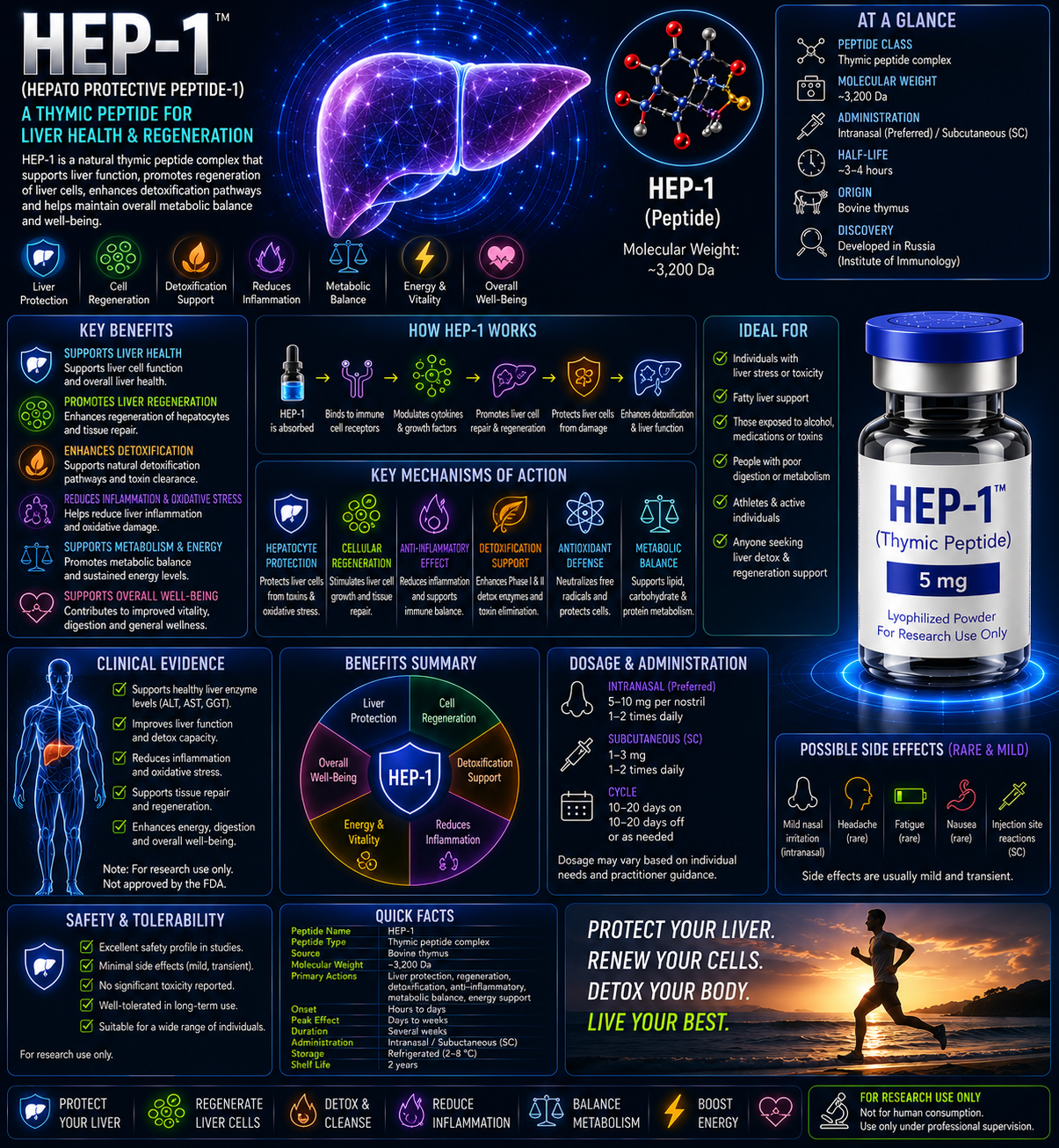
HEP-1: What It Is, How It Works, Benefits, and Research Overview What Is HEP-1? HEP-1 is an investigational peptide bioregulator studied for its pot
HEP-1: What It Is, How It Works, Benefits, and Research Overview
What Is HEP-1?
HEP-1 is an investigational peptide bioregulator studied for its potential role in liver tissue signaling, hepatocyte resilience, detoxification pathways, and healthy hepatic aging research. It is commonly discussed within the broader family of organ-specific peptide bioregulators, particularly in Eastern European and Russian peptide literature, where tissue-specific peptides are investigated for possible effects on cellular signaling, tissue repair, and gene regulation.
Researchers investigate HEP-1 in relation to:
- Liver tissue resilience and hepatocyte signaling
- Cellular recovery following metabolic or oxidative stress
- Hepatic regeneration and tissue remodeling
- Detoxification-related cellular pathways
- Inflammatory signaling and oxidative balance in liver tissue
Important: HEP-1 is not FDA approved and remains investigational, with evidence coming largely from preclinical models, peptide literature, and mechanistic research, rather than large human clinical trials.
What Is HEP-1 Made Of?
HEP-1 is described as a short synthetic peptide associated with hepatic (liver) tissue signaling. Depending on the manufacturer or peptide literature referenced, HEP-1 is discussed as a liver bioregulator peptide fragment designed to model signaling effects within hepatocytes and surrounding hepatic tissue.
Researchers classify HEP-1 as:
A liver-focused signaling peptide
studied for possible tissue-specific activity in metabolic and detoxification systems.
Key features:
- Small peptide structure designed for signaling research
- Tissue-focused in liver biology models
- Investigated for cellular adaptation and hepatic resilience pathways
Because nomenclature surrounding HEP-1 varies, some literature refers to it more broadly as a hepatic peptide bioregulator rather than emphasizing a specific amino-acid sequence.
How Does HEP-1 Work?
The exact mechanism remains under investigation, but researchers theorize HEP-1 may influence:
- Hepatocyte signaling pathways
- Cellular stress adaptation and oxidative balance
- Liver repair and regenerative signaling
- Gene expression and protein synthesis pathways in hepatic tissue
1. Hepatocyte (Liver Cell) Signaling
One of the largest areas of interest involves:
Hepatocytes
These cells are responsible for:
- Metabolism
- Detoxification
- Protein synthesis
- Bile production
Researchers investigate whether HEP-1 may support:
- Cellular communication in liver tissue
- Hepatic tissue resilience under metabolic stress
- Adaptive signaling after oxidative or inflammatory injury
In simple terms:
HEP-1 says:
“Help support healthy liver-cell signaling and tissue resilience.”
2. Oxidative Stress and Cellular Recovery Research
The liver experiences constant exposure to:
- Metabolic byproducts
- Reactive oxygen species (oxidative stress)
- Inflammatory signaling
Researchers investigate whether HEP-1 may influence:
- Cellular antioxidant signaling
- Stress-response pathways
- Mitochondrial resilience in hepatocytes
- Tissue adaptation following metabolic stress
Experimental work explores whether small peptides may help coordinate organized recovery signaling after physiologic strain.
3. Regeneration and Tissue Remodeling
Researchers are interested in HEP-1 for:
Liver regeneration biology
Experimental literature explores whether HEP-1 may influence:
- Cellular turnover and repair signaling
- Tissue remodeling pathways
- Hepatocyte survival and regeneration mechanisms
Because the liver possesses strong regenerative capacity, researchers are interested in whether peptides can influence:
How efficiently repair signaling occurs.
4. Gene Expression and Cellular Regulation
Like many peptide bioregulators, HEP-1 is studied for possible influence on:
- Gene transcription pathways
- Protein synthesis signaling
- Cellular adaptation and stress responses
- Tissue-specific regulation in liver systems
Researchers hypothesize that short peptides may influence:
Cellular communication at the transcriptional level, though this remains mechanistic and experimental.
Why Is HEP-1 Getting Attention?
HEP-1 attracts attention because it combines several important research themes:
- Liver resilience and hepatic signaling
- Cellular stress adaptation
- Oxidative balance and inflammation biology
- Regenerative and tissue-repair research
- Healthy aging and metabolic resilience
Researchers are especially interested in whether short peptides can influence hepatic cellular signaling without functioning as hormones or replacement therapies.
Potential Research Areas of Interest
1. Liver and Hepatic Tissue Research
Researchers investigate whether HEP-1 may support:
- Hepatocyte signaling pathways
- Cellular resilience during metabolic stress
- Hepatic tissue maintenance and adaptation
2. Oxidative Stress Research
Experimental work explores HEP-1 in relation to:
- Oxidative stress signaling
- Mitochondrial resilience
- Inflammatory adaptation pathways
3. Regeneration and Repair Research
Researchers study HEP-1 for:
- Hepatic tissue remodeling
- Cellular repair signaling
- Recovery biology following tissue stress
4. Healthy Aging and Metabolic Research
Researchers investigate whether HEP-1 influences:
- Metabolic resilience during aging
- Liver cellular communication
- Tissue adaptation in age-related decline
HEP-1 vs Livagen vs Pancragen vs Vesugen
| Feature | HEP-1 | Livagen | Pancragen | Vesugen |
|---|---|---|---|---|
| Main Focus | Liver resilience & repair signaling | Liver signaling & chromatin biology | Pancreatic/metabolic signaling | Vascular/endothelial signaling |
| Tissue Focus | Liver/hepatocytes | Liver/immune system | Pancreas/metabolism | Blood vessels |
| Major Research Area | Hepatic resilience | Chromatin & liver signaling | Metabolic adaptation | Vascular aging |
| FDA Approved? | No | No | No | No |
Researchers generally view:
- HEP-1 → hepatic repair and resilience peptide
- Livagen → liver/chromatin bioregulator peptide
- Pancragen → pancreatic signaling peptide
- Vesugen → vascular/endothelial peptide
Potential Side Effects and Safety Considerations
Because HEP-1 remains investigational:
- Human therapeutic evidence is limited
- Long-term pharmacology remains uncertain
- Most evidence comes from mechanistic and preclinical research, rather than large clinical trials
Researchers emphasize that findings should be interpreted as:
Experimental and hypothesis-generating, not established therapeutic evidence.
Frequently Asked Questions
Is HEP-1 a peptide?
Yes. HEP-1 is described as an investigational hepatic peptide bioregulator studied for liver signaling and resilience research.
Is HEP-1 FDA approved?
No. HEP-1 is not FDA approved and remains investigational.
What is HEP-1 studied for?
Researchers study HEP-1 for liver tissue signaling, oxidative stress adaptation, regeneration pathways, metabolic resilience, and hepatic cellular communication.
Does HEP-1 repair the liver?
There is no validated clinical evidence proving HEP-1 repairs liver tissue in humans. Research focuses on cellular signaling and regenerative pathways in experimental models.
What makes HEP-1 different from Livagen?
HEP-1 is generally discussed as a hepatic repair/resilience peptide, while Livagen is more associated with chromatin remodeling, gene accessibility, and hepatocyte signaling in aging models.
Final Thoughts
HEP-1 is an investigational liver-focused peptide bioregulator studied for its potential role in hepatic signaling, oxidative stress adaptation, tissue resilience, and regenerative biology. Researchers are interested in whether short peptides may help coordinate cellular communication and recovery pathways in liver tissue. While intriguing, HEP-1 remains experimental, human evidence is limited, and broader clinical relevance continues to be explored.
