
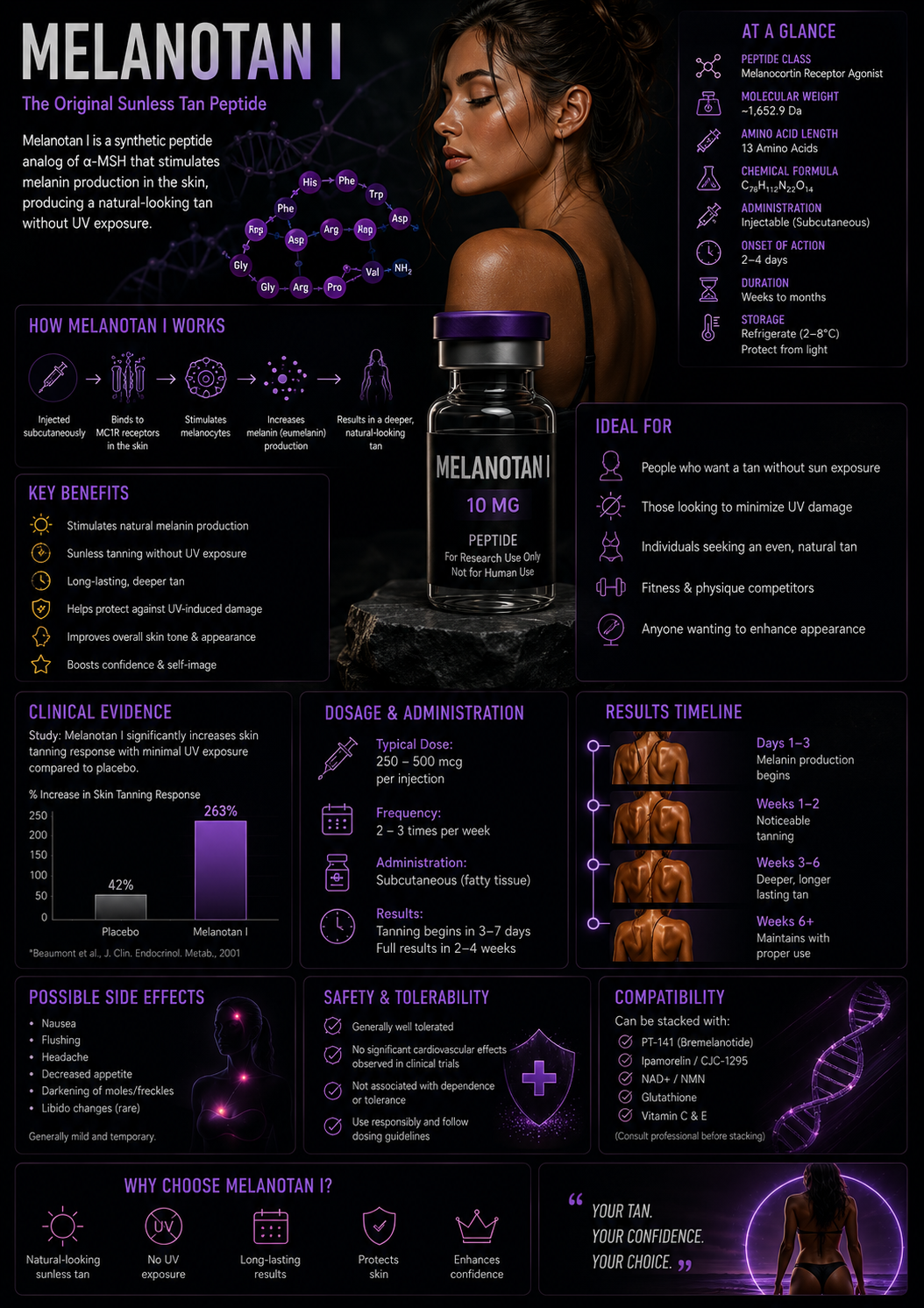
Melanotan I (Afamelanotide): What It Is, How It Works, Benefits, and Research Overview What Is Melanotan I? Melanotan I, also known
Melanotan I (Afamelanotide): What It Is, How It Works, Benefits, and Research Overview
What Is Melanotan I?
Melanotan I, also known as Afamelanotide, is a synthetic analog of α-melanocyte-stimulating hormone (α-MSH), a naturally occurring peptide that regulates melanin production in the skin. It is primarily studied for its photoprotective properties, skin pigmentation enhancement, and potential skin cancer prevention.
Melanotan I is closely related to Melanotan II, but differs in that it is more selective for melanocortin 1 receptors (MC1R), with fewer effects on sexual arousal and appetite compared to Melanotan II. (nih.gov)
Afamelanotide has regulatory approval in some contexts:
- Approved in the EU and US for photoprotection in patients with erythropoietic protoporphyria (EPP), a rare genetic photosensitivity disorder. Scenesse
Researchers investigate Melanotan I for:
- Skin pigmentation enhancement
- Photoprotection and UV resistance
- Skin cancer prevention research
- Melanocyte biology
- Sunburn and UV-induced DNA damage mitigation
What Is Melanotan I Made Of?
Melanotan I is a synthetic linear peptide consisting of 13 amino acids derived from α-MSH:
- Sequence: Ac-Ser-Tyr-Ser-Nle-Glu-His-D-Phe-Arg-Trp-Gly-Lys-Pro-Val-NH₂
Key characteristics:
- Synthetic analog of α-MSH
- Selective for MC1R (melanocortin 1 receptor)
- Primarily increases melanin production without strong systemic effects on libido or appetite (pubmed.ncbi.nlm.nih.gov)
How Does Melanotan I Work?
Melanotan I works by activating melanocortin receptors on melanocytes:
1. MC1R Activation
- MC1R (melanocortin 1 receptor) is expressed on skin melanocytes
- Activation triggers melanin synthesis (eumelanin production)
- Leads to darker, more UV-resistant skin pigmentation
2. Photoprotection
- Increased eumelanin absorbs ultraviolet (UV) radiation, protecting skin cells
- Reduces UV-induced DNA damage, sunburn, and oxidative stress
3. Minimal Central Nervous System Effects
- Unlike Melanotan II, Melanotan I is less likely to stimulate sexual arousal, appetite, or cardiovascular effects
- Focused primarily on skin pigmentation and photoprotection
Benefits and Potential Applications
- Skin Pigmentation Enhancement
- Induces gradual tanning without excessive UV exposure
- Photoprotection
- Reduces risk of sunburn in photosensitive individuals
- Useful for patients with disorders like erythropoietic protoporphyria (EPP)
- Potential Skin Cancer Prevention
- Eumelanin reduces UV-induced DNA damage
- May lower risk of UV-related skin cancers
- Research in Melanocyte Biology
- Investigates pigment cell signaling and melanin production
- Cosmetic Applications (Experimental)
- Topical or subcutaneous use to enhance skin pigmentation
Administration
- Medical (approved): Implantable slow-release devices (Scenesse) for EPP
- Investigational / Cosmetic: Subcutaneous injection or IV in research or experimental use
- Dosing: Controlled slow-release implants for chronic photoprotection; experimental doses vary in research
Side Effects
Common side effects include:
- Nausea
- Flushing
- Headache
- Injection-site reactions (if using experimental subcutaneous forms)
Rare or theoretical risks:
- Hyperpigmentation or uneven tanning
- Potential long-term effects on melanocyte biology not fully known
Overall, Melanotan I is considered well-tolerated under controlled dosing in clinical studies (pubmed.ncbi.nlm.nih.gov)
Melanotan I vs Melanotan II vs Afamelanotide Implant
| Feature | Melanotan I (Afamelanotide) | Melanotan II | Scenesse (Implant) |
|---|---|---|---|
| Type | Synthetic α-MSH analog | Synthetic α-MSH analog | Implantable slow-release Melanotan I |
| Primary Action | Skin pigmentation / photoprotection | Skin pigmentation + libido stimulation | Skin pigmentation / photoprotection |
| Receptor Selectivity | MC1R (melanocytes) | MC1R, MC3R, MC4R (broader CNS effects) | MC1R |
| FDA / Regulatory Approval | Yes (for EPP) | No | Yes (EU, US) |
| Common Use | Photoprotection, tanning | Experimental / cosmetic | Photoprotection in EPP |
| CNS Effects | Minimal | Increased libido, appetite | Minimal |
Frequently Asked Questions
Is Melanotan I a peptide?
- Yes. Melanotan I is a synthetic 13-amino-acid peptide analog of α-MSH.
Does Melanotan I make you tan?
- Yes. It stimulates melanin production in melanocytes, leading to darker skin.
Is it safe?
- Generally safe in approved medical contexts; experimental or cosmetic use is less controlled and may carry unknown risks.
Does Melanotan I affect libido like Melanotan II?
- Minimal CNS effects; primarily skin pigmentation with little impact on sexual desire.
How is it administered?
- Clinically via implantable slow-release device (Scenesse) or in research via subcutaneous injection.
Final Thoughts
Melanotan I (Afamelanotide) is a synthetic α-MSH peptide analog primarily designed to stimulate skin pigmentation and provide photoprotection. It is clinically approved for patients with erythropoietic protoporphyria (EPP) to reduce UV sensitivity and sunburn risk. Unlike Melanotan II, it has minimal CNS effects and does not significantly alter libido or appetite. Beyond approved medical uses, Melanotan I continues to be studied for cosmetic tanning, skin protection, and melanocyte biology, making it a prominent peptide in both therapeutic and research contexts.
