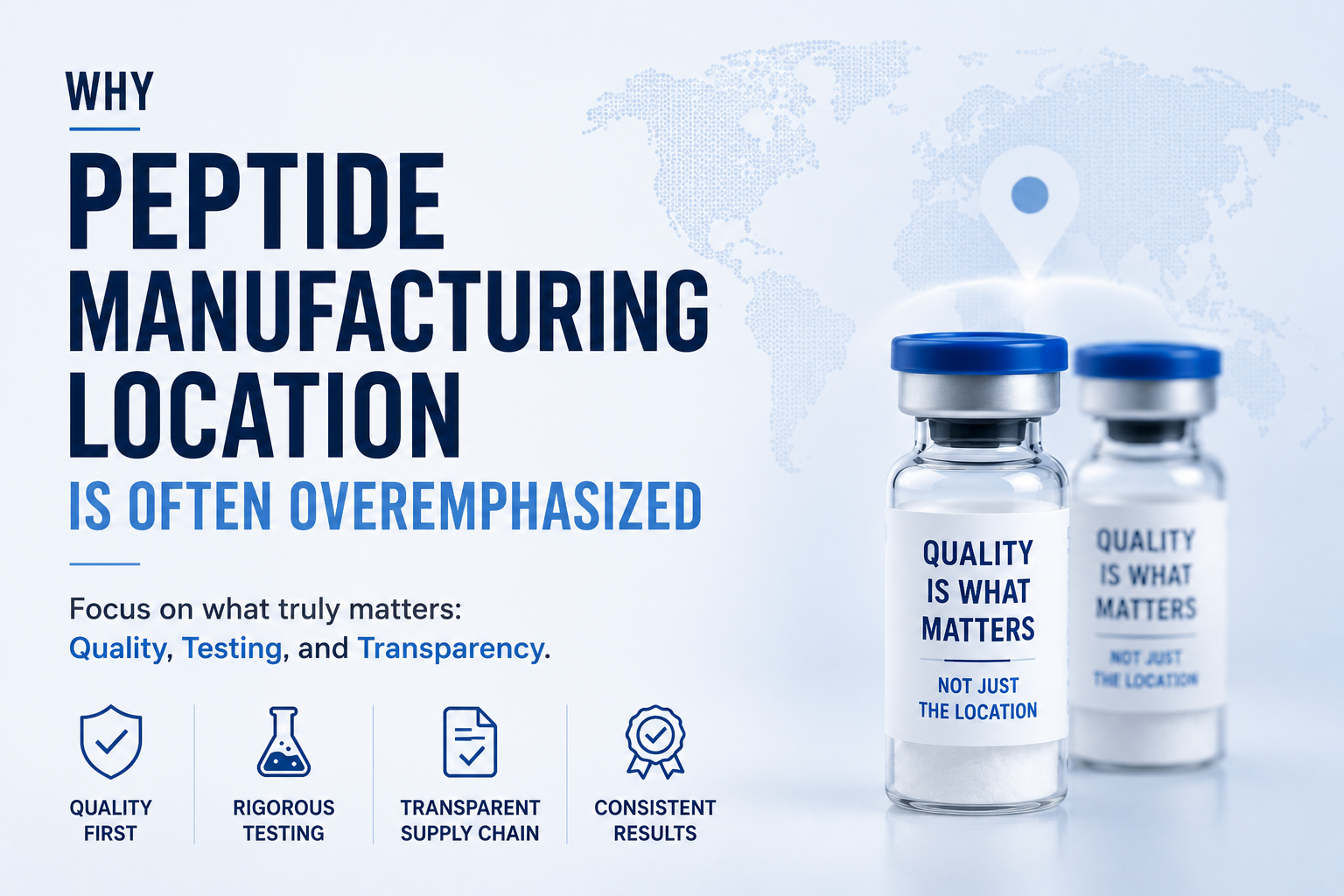
Why Peptide Manufacturing Location Is Often Overemphasized
What Actually Matters: Testing, Quality Systems, and Passing Certificates of Analysis
Introduction
One of the most common misconceptions in the peptide industry is the belief that a peptide’s quality can be judged primarily by where it was manufactured.
Many people assume:
“Made in the USA automatically means better.”
“Manufactured in China automatically means lower quality.”
While geographic location may influence regulatory environments, logistics, or manufacturing standards, location alone is not a scientific measure of peptide quality.
What ultimately determines peptide quality is far more objective:
Testing, manufacturing controls, and verifiable analytical results.
At the end of the day, peptides are chemical compounds. Chemistry does not care about geography.
If two peptide batches manufactured in different regions undergo the same rigorous testing and both pass established specifications, there is no scientific basis for assuming one is inherently superior simply because of where it was produced.
The Misconception: “Country of Origin Equals Quality”
Consumers often treat peptide manufacturing like consumer goods.
People may assume:
- U.S.-manufactured = premium
- Overseas-manufactured = inferior
- Certain regions automatically guarantee higher quality
This assumption sounds intuitive—but scientifically, it falls apart.
Quality is not determined by nationality.
It is determined by:
- Manufacturing controls
- Purification standards
- Batch consistency
- Analytical verification
- Contamination screening
- Final product testing
A peptide does not somehow become chemically superior because it crossed a border.
Chemistry Does Not Change by Geography
A peptide molecule synthesized correctly is still the same peptide molecule regardless of where it was produced.
For example:
If one laboratory manufactures a peptide in the United States and another manufactures the same peptide in China, Europe, or elsewhere, the end product can be analytically indistinguishable if both batches meet the same specifications.
A peptide either:
- Matches the expected molecular identity
- Meets purity specifications
- Passes contaminant screening
- Demonstrates batch consistency
Or it does not.
The molecule itself does not know where it was manufactured.
What Actually Determines Peptide Quality?
Rather than focusing primarily on geography, researchers and consumers should focus on objective quality indicators.
1. Certificate of Analysis (COA)
A high-quality peptide supplier should provide a Certificate of Analysis (COA) demonstrating that a batch has undergone testing.
A meaningful COA may include:
- Identity verification
- Purity results (HPLC)
- Mass confirmation
- Batch information
- Analytical methods
- Contaminant screening when applicable
A COA should reflect actual testing—not marketing language.
2. Purity Testing
Purity matters.
Analytical techniques such as High-Performance Liquid Chromatography (HPLC) help determine whether unwanted impurities remain in a peptide batch.
A peptide with poor purification may contain residual contaminants regardless of where it was manufactured.
Conversely, a properly manufactured and purified peptide can demonstrate excellent quality independent of geography.
3. Identity Confirmation
Mass spectrometry and related analytical methods help confirm:
Is this actually the peptide it claims to be?
This is fundamental.
A beautifully branded product manufactured domestically still fails if the compound identity is wrong.
4. Endotoxin and Contaminant Testing
One of the most overlooked quality considerations is contamination screening.
Responsible quality systems may include:
- Endotoxin testing
- Residual solvent analysis
- Microbial testing
- Heavy metal screening
- Environmental quality controls
A peptide manufactured anywhere in the world should be evaluated by objective testing standards—not assumptions.
5. Batch-to-Batch Consistency
Quality is about repeatability.
Reliable manufacturers produce peptide batches that remain consistent over time.
That consistency comes from:
- Standardized procedures
- Process controls
- Validated testing
- Quality assurance systems
Not from geographic location alone.
A Simple Thought Experiment
Imagine two peptide batches:
Peptide A
Manufactured in the United States
Tests show:
- Passes HPLC purity requirements
- Verified identity
- Passing endotoxin testing
- Acceptable residual solvent profile
- Batch consistency confirmed
Peptide B
Manufactured in China
Tests show:
- Passes HPLC purity requirements
- Verified identity
- Passing endotoxin testing
- Acceptable residual solvent profile
- Batch consistency confirmed
Now ask an important question:
What objective scientific evidence proves Peptide A is automatically superior?
If both batches meet the same specifications and pass the same testing regime, there is no analytical basis to conclude one is inherently “better” because of location.
Chemically and analytically, they may be indistinguishable.
The Reality of Global Pharmaceutical Manufacturing
Another overlooked fact:
Modern pharmaceutical and peptide manufacturing is already global.
Raw materials, intermediates, active ingredients, excipients, and finished compounds frequently move across international supply chains.
Many companies source materials from multiple countries while relying on independent testing and quality systems to validate final products.
This is why regulatory frameworks focus on:
Testing and compliance—not assumptions based on geography.
Why People Focus Too Much on Geography
The emphasis on manufacturing location is often driven by:
- Fear of counterfeits
- Prior bad experiences
- Internet anecdotes
- Marketing narratives
- Misunderstanding of chemistry and manufacturing
While skepticism is understandable, skepticism should be directed toward quality evidence, not stereotypes about manufacturing regions.
The better question is not:
“Where was it made?”
The better question is:
“How was it tested?”
Red Flags That Matter More Than Country of Origin
Rather than obsessing over geography, pay attention to warning signs such as:
- Missing or vague COAs
- No independent testing information
- No endotoxin or contaminant data when applicable
- Inconsistent batches
- Lack of transparency
- Unusually low pricing paired with poor documentation
These indicators tell you far more about quality than a country label.
The Simple Takeaway
Peptide quality is determined by science, testing, and consistency—not passports.
If two peptides manufactured in different regions both:
- Pass the same analytical testing
- Meet the same purity standards
- Demonstrate the same identity confirmation
- Show acceptable contaminant profiles
- Are supported by valid COAs
Then there is no scientific reason to assume one is inherently superior because of geography alone.
At the molecular level:
A peptide is judged by what it is—not where it came from.
Important Notice
All materials are intended for laboratory research use only and are not for human consumption.