TP508 Scientific Overview: Chrysalin, Rusalatide, Mechanism, Evidence, and Testing
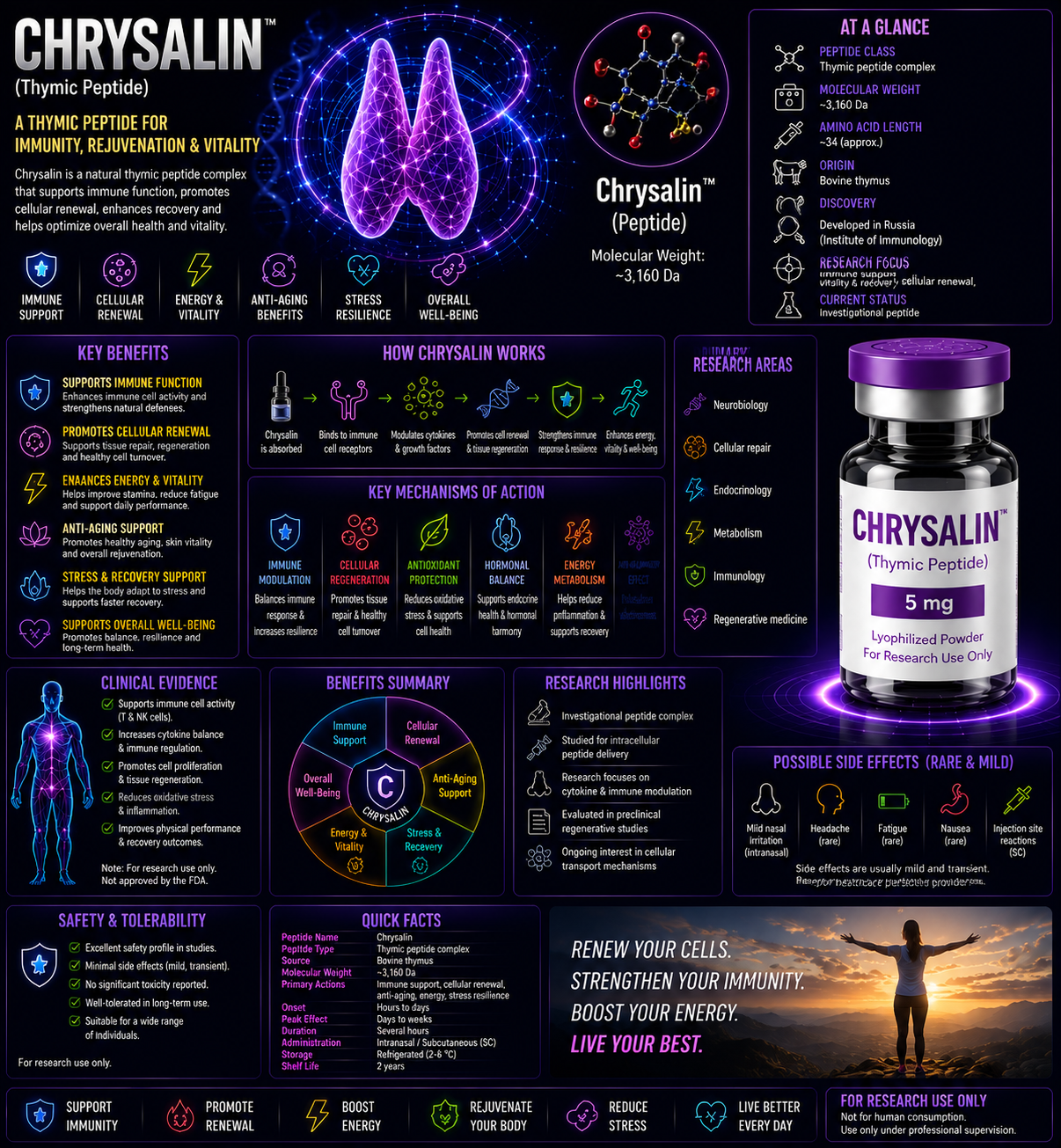
TP508 scientific overview content should distinguish strong preclinical repair findings from mixed human clinical evidence. This peptide, also called Chrysalin or rusalatide acetate, is a 23-amino-acid prothrombin-derived peptide investigated for nonclotting repair signaling, angiogenesis, wound healing, fracture repair, ischemia, and radiation injury.
What Is Chrysalin?
First, Chrysalin is a former development name for TP508, also known by the nonproprietary name rusalatide or rusalatide acetate. It is a synthetic 23-amino-acid peptide corresponding to residues 508–530 of human prothrombin.
Next, after prothrombin is cleaved to form thrombin, this region is exposed within thrombin’s B-chain and participates in high-affinity, nonproteolytic interactions with cells. For example, tP508 was designed to mimic repair-associated thrombin signaling without retaining thrombin’s serine-protease activity or directly converting fibrinogen into fibrin.
Linear thrombin-derived peptide
23 amino acids
Human prothrombin
Residues 508–530
Repair, angiogenesis, bone, ischemia, radiation
No
🧬 Molecular Structure
First, TP508 is a linear peptide with one cysteine residue and no intended disulfide bridge. Meanwhile, the sequence is derived from the receptor-binding region of human thrombin but lacks the full enzyme’s catalytic triad and three-dimensional protease structure.
🧪 Amino-Acid Sequence
H-Ala-Gly-Tyr-Lys-Pro-Asp-Glu-Gly-Lys-Arg-Gly-Asp-Ala-Cys-Glu-Gly-Asp-Ser-Gly-Gly-Pro-Phe-Val-OH
One-letter notation:
AGYKPDEGKRGDACEGDSGGPFV
| Region or residue | Potential structural relevance |
|---|---|
| AGYKPDEG | For example, N-terminal segment containing mixed polar and charged residues. |
| KRGD | Meanwhile, Contains an RGD-like motif that may contribute to cell-surface interactions, although TP508 is not simply an integrin ligand. |
| Cys14 | Likewise, Single cysteine susceptible to oxidation or intermolecular dimer formation. |
| EGDSGGPFV | In addition, C-terminal segment contributing to the native thrombin-derived binding sequence. |
| Terminal form | Moreover, Commonly represented with free N- and C-termini. |
⚛️ Molecular Weight and 🧫 Formula
| Neutral peptide formula | By contrast, C97H146N28O36S |
|---|---|
| Average molecular weight | Approximately 2,312.4 g/mol |
| Peptide length | 23 amino acids |
| Acetate form | Also, May include acetate counterion and associated water |
| Common alternative salt | Consequently, TFA-containing research material has a higher total formula mass |
Therefore, rusalatide acetate may be represented differently across databases depending on counterion stoichiometry and protonation state. Likewise, cOAs should state whether content is reported as salt-free TP508, acetate-associated peptide, TFA salt, hydrate, or “as is” powder.
📅 Discovery Timeline
1980s–1990s: Nonproteolytic thrombin signaling characterized
First, researchers found that thrombin could stimulate fibroblast proliferation and repair-related cellular responses through binding interactions distinct from fibrin formation and catalytic protease activity.
1990s: TP508 sequence identified
Next, researchers identified the 23-residue region corresponding to human prothrombin residues 508–530 as a high-affinity thrombin-binding sequence with tissue-repair activity.
Late 1990s–2000s: Wound and fracture models expand
Moreover, TP508 accelerated revascularization, dermal repair, bone formation, and fracture healing in multiple animal models.
2000s: Human wound and orthopedic studies
In addition, Phase I/II studies evaluated topical Chrysalin in diabetic foot ulcers and local TP508 in distal-radius fractures.
Late 2000s–2010: Fracture program fails to confirm benefit
However, a later controlled wrist-fracture study showed no benefit compared with placebo, so investigators terminated it and limited further orthopedic development.
2010s: Systemic vascular and radiation research
Meanwhile, preclinical studies investigated myocardial ischemia, chronic hypoxia, endothelial dysfunction, gastrointestinal radiation injury, and nuclear-radiation countermeasures.
2020s: Renewed systemic-development interest
Finally, the sponsor has described injectable TP508 development for acute respiratory distress syndrome, radiation injury, vascular damage, hemorrhage, and inflammation. In addition, these programs remain investigational and do not establish approval or efficacy.
📖 Research History
Importantly, TP508 originated from the concept that clotting and tissue repair are coordinated but separable functions of thrombin. Moreover, a nonproteolytic fragment could, in theory, retain signals that recruit inflammatory cells, restore endothelium, and initiate repair without causing fibrin formation.
However, the compound’s development illustrates the difference between robust animal efficacy and uncertain clinical translation. By contrast, preclinical effects have been reported across many tissues, while human studies have been small, mixed, or unsuccessful in confirmatory testing.
Thrombin Biology and Nonclotting Repair Signaling
Thrombin’s classical role
First, thrombin is a serine protease that converts fibrinogen to fibrin, activates platelets, and amplifies coagulation. It also activates protease-activated receptors and coordinates inflammation, vascular responses, and tissue repair.
Nonproteolytic interactions
Next, thrombin contains cell-binding regions that can influence fibroblasts, endothelial cells, monocytes, and other repair-associated cells without requiring catalytic cleavage.
TP508 lacks clotting activity
Importantly, a 23-residue linear peptide cannot reproduce thrombin’s enzyme pocket, exosite architecture, or fibrinogen-cleaving function. It is therefore described as nonproteolytic and nonclotting.
Not fully receptor defined
However, researchers have described TP508 as binding high-affinity thrombin receptors, but the exact receptor complex is not completely established. Also, some responses intersect with PAR-1, integrins, MAP kinases, nitric oxide, and growth-factor signaling, but TP508 is not a conventional direct PAR-1-cleaving agonist.
🧠 Proposed Mechanism of Action
1. Early inflammatory-cell recruitment
First, TP508 can increase monocyte and macrophage recruitment and alter cytokine release during the early injury response.
2. MAP-kinase signaling
Next, studies in immune and vascular cells report activation of ERK1/2 and p38 pathways associated with migration, cytokine production, survival, and proliferation.
3. Nitric-oxide signaling
Moreover, TP508 can activate endothelial nitric-oxide pathways, improve endothelial responsiveness, and support vasodilation and perfusion in experimental models.
4. Growth-factor induction
In addition, preclinical fracture studies reported increased expression of VEGF, FGF-related signals, and other mediators involved in angiogenesis and osteogenesis.
5. Angiogenesis and revascularization
Likewise, TP508 promotes endothelial-cell migration and vessel formation in cell, chick membrane, wound, bone, and ischemia models.
6. Apoptosis and cell survival
Finally, experimental work suggests reduced apoptosis and preservation of endothelial, intestinal crypt, and other vulnerable cells after ischemic or radiation injury.
🎯 Target and Pathway Profile
| Target or pathway | Evidence status |
|---|---|
| High-affinity thrombin-binding sites | However, Foundational basis for TP508 discovery; molecular identity remains incompletely defined. |
| PAR-1-related signaling | Therefore, May contribute to some responses, but TP508 does not proteolytically activate PAR-1 like thrombin. |
| For example, ERK1/2 and p38 MAPK | Meanwhile, Activated in immune and repair-associated cell studies. |
| Endothelial nitric oxide | Likewise, Associated with vascular protection and angiogenic responses. |
| In addition, VEGF and angiogenic pathways | Moreover, Increased in several wound, ischemia, and bone models. |
| Integrin-associated signaling | By contrast, Possible because of the sequence and cellular adhesion effects, but not established as the sole mechanism. |
Wound-Healing Research
Incisional and excisional wounds
First, early animal studies reported faster closure, increased inflammatory-cell recruitment, enhanced granulation tissue, stronger repair, and earlier revascularization.
Diabetic wounds
Next, TP508 improved healing in diabetic and ischemic wound models. Consequently, proposed mechanisms include improved perfusion, endothelial function, fibroblast activity, and matrix organization.
Diabetic foot-ulcer clinical trial
Moreover, a 60-subject randomized Phase I/II trial evaluated topical Chrysalin with standardized care and offloading. However, overall interpretation was exploratory. A small heel-ulcer subgroup showed a higher mean closure rate and more complete healing than placebo, but the subgroup involved very few patients and requires caution.
Collagen and matrix remodeling
In addition, researchers have associated TP508 with collagen deposition and organization, but “more collagen” does not automatically mean better scar quality or function.
Clinical limitation
However, no approved wound-care product, validated routine regimen, or large confirmatory trial has established TP508 as standard treatment for diabetic ulcers or other chronic wounds.
Bone and Fracture-Repair Research
Fracture models
First, animal studies reported increased callus formation, vascularization, mechanical strength, and growth-factor expression after local TP508 treatment.
Critical-size bone defects
Next, TP508 promoted bone formation in models with limited spontaneous healing, especially when researchers incorporated it into carriers or scaffolds.
Osteoblast and progenitor effects
Moreover, the peptide may influence osteoblast recruitment, progenitor-cell differentiation, endothelial–bone coupling, and matrix deposition indirectly through vascular and inflammatory pathways.
Distal-radius clinical development
However, early studies generated interest in faster radiographic and functional recovery. However, the later controlled wrist-fracture trial did not demonstrate benefit over placebo and was terminated.
What the evidence does not establish
- First, Routine acceleration of fracture healing in humans
- Next, Treatment of nonunion or delayed union
- Also, Replacement of fixation, bone grafting, infection control, or osteoporosis treatment
- Moreover, Established benefit from systemic or local self-administration
Angiogenesis, Ischemia, Radiation, and Organ-Protection Research
Endothelial dysfunction
Next, First, TP508 improved nitric-oxide-dependent vascular responses and endothelial survival in chronic hypoxia and injury models.
Myocardial ischemia
First, animal studies reported reduced infarct injury, improved perfusion, increased vascular density, or improved cardiac function after treatment.
Peripheral ischemia
Moreover, systemic administration enhanced VEGF-associated angiogenesis and revascularization in experimental ischemia.
Radiation injury
In addition, in mice, TP508 administered after high-dose radiation preserved intestinal crypt architecture, increased stem-cell markers, reduced apoptosis, and improved survival in gastrointestinal radiation models.
Acute lung injury and ARDS
However, recent development materials propose TP508 for endothelial damage, hemorrhage, inflammation, and ARDS. Therefore, these claims remain investigational; public proof of clinical efficacy is not established.
Broad-regeneration caution
Finally, activity in one injury model cannot be generalized to all organs. For example, dose, timing, route, vascular state, inflammatory phase, and species strongly affect outcome.
Human Clinical Evidence
| Program | Findings | Interpretation |
|---|---|---|
| Also, Diabetic foot ulcers, Phase I/II | Consequently, Generally acceptable tolerability; promising results in a small heel-ulcer subgroup. | However, Exploratory and insufficient for approval. |
| Therefore, Distal-radius fractures, early study | For example, Some early radiographic or functional measures suggested possible accelerated repair. | Meanwhile, Generated interest but required confirmation. |
| Later wrist-fracture study | Likewise, the study showed no benefit versus placebo, so investigators terminated it. | In addition, Failed to confirm clinical efficacy. |
| Current systemic programs | Moreover, Sponsor reports readiness for trials in vascular, radiation, inflammatory, and pulmonary injury. | By contrast, Development status, not proof of benefit. |
Importantly, clinical-trial registry entries and investigational-new-drug authorization permit research; they do not imply FDA approval or confirmed effectiveness.
Safety and Translational Limitations
Limited exposure database
First, earlier local studies reported no clear drug-related serious adverse-event pattern, but sample sizes were small and do not define rare, systemic, or long-term risks.
Angiogenesis risk
Moreover, promoting vascular growth can support repair but could theoretically worsen malignancy, proliferative retinopathy, vascular malformations, or pathologic inflammation. Meanwhile, these risks have not been fully characterized.
Inflammatory effects
First, In addition, TP508 can increase selected cytokines and inflammatory-cell recruitment. Likewise, the same response may be beneficial early in repair but harmful in uncontrolled inflammation.
Single cysteine and aggregation
Likewise, Cys14 can oxidize and form dimers or higher-order species, potentially changing potency, distribution, or immunogenicity.
Route-specific risk
Meanwhile, topical, local injection, systemic injection, scaffold delivery, and inhalational or pulmonary-development concepts have different pharmacokinetics and safety requirements.
Product-quality risk
However, unapproved material may contain incorrect sequence, TFA, deletion peptides, oxidized cysteine, endotoxin, microbial contamination, incorrect content, or unstable formulation.
Regulatory status
Finally, TP508/rusalatide acetate is not FDA approved. In addition, chrysalin is a historical development name, not evidence of an available approved prescription medicine.
🧪 Laboratory Testing Methods
| Method | Purpose | Important limitation |
|---|---|---|
| RP-HPLC or UPLC | Also, Measures chromatographic purity and deletion, truncation, or oxidation impurities. | Consequently, Does not prove sequence, potency, or sterility alone. |
| LC-MS / HRMS | However, Confirms intact molecular mass and major related species. | Therefore, Does not establish biological repair activity. |
| MS/MS peptide mapping | Confirms AGYKPDEGKRGDACEGDSGGPFV sequence. | For example, Short acidic and glycine-rich regions may require optimized fragmentation. |
| Amino-acid analysis | Meanwhile, Supports composition and net-content determination. | Likewise, Does not independently prove sequence order. |
| In addition, Free-thiol and disulfide analysis | Moreover, Measures reduced Cys14 and unintended dimerization. | By contrast, Sample preparation can itself alter oxidation state. |
| Also, SEC or orthogonal aggregation analysis | Consequently, Detects dimers, oligomers, and high-molecular-weight species. | However, Small peptide aggregates may evade one method. |
| Counterion analysis | Therefore, Measures acetate, trifluoroacetate, or other salts. | For example, Counterion burden affects gross mass and tolerability. |
| Meanwhile, Assay / net peptide content | Likewise, Measures actual TP508 quantity. | In addition, analysts must not infer net peptide content from HPLC area percentage. |
| Moreover, Cell-migration or angiogenesis assay | By contrast, Evaluates endothelial or fibroblast responses. | Also, In vitro activity does not prove wound or fracture benefit. |
| Consequently, NO or MAPK signaling assay | However, Measures endothelial nitric oxide or ERK/p38 activation. | Therefore, Pathway activation can be context dependent and nonspecific. |
| Endotoxin and sterility | For example, Required for injectable clinical material. | Meanwhile, Each answers a different safety question. |
| Likewise, Particulate, pH, and osmolality testing | In addition, Evaluates finished parenteral formulation quality. | Moreover, Does not establish identity or potency. |
| Stability testing | By contrast, Tracks oxidation, hydrolysis, aggregation, adsorption, assay, and appearance. | Also, Must reflect final formulation, packaging, light, and temperature. |
📄 How to Interpret a TP508 COA
1. Verify the exact 23-residue sequence
First, the expected sequence is AGYKPDEGKRGDACEGDSGGPFV.
2. Confirm the terminal chemistry
Next, the research sequence is generally represented with free N- and C-termini. Moreover, acetylation, amidation, lipidation, or other changes create a different molecule.
3. Identify the salt form
Moreover, the report should distinguish rusalatide acetate, TFA salt, salt-free peptide, and hydrate forms.
4. Separate identity, purity, content, and activity
- Identity First, confirms the sequence and mass.
- Purity Next, estimates chromatographic composition.
- Also, net peptide content measures actual TP508 after analysts account for salts and water.
- Functional activity Moreover, evaluates a validated repair-signaling endpoint.
5. Review cysteine oxidation
In addition, the single cysteine should be characterized as reduced or oxidized. By contrast, intermolecular disulfide dimers are not equivalent to monomeric TP508.
6. Check route-specific quality
Likewise, injectable material requires sterility, endotoxin, particulates, pH, osmolality, container compatibility, and dose accuracy. Also, topical wound material requires validated microbiological and preservation controls.
7. Do not infer clinical effectiveness from purity
However, a 99% HPLC result cannot prove angiogenesis, fracture healing, ulcer closure, radiation protection, or safety in humans.
📊 TP508 vs BPC-157 vs Thymosin Beta-4 vs Wolverine Blend
Research Focus and Evidence Differences
| Feature | TP508 / Chrysalin | BPC-157 | Thymosin Beta-4 / TB-500 | Wolverine Blend |
|---|---|---|---|---|
| Compound type | 23-residue prothrombin fragment | 15-residue synthetic peptide | Consequently, 43-residue endogenous peptide; TB-500 products may differ | However, Nonstandard commercial blend name |
| Main research focus | Therefore, Repair initiation, vasculature, bone, ischemia | For example, Preclinical GI and soft-tissue injury | Meanwhile, Actin dynamics, migration, angiogenesis, repair | Likewise, Depends on exact ingredients |
| Primary proposed mechanism | In addition, Nonproteolytic thrombin-related repair signaling | Moreover, No single validated receptor mechanism | By contrast, G-actin binding and cellular migration | Also, Multiple and formulation dependent |
| Formal human trials | Consequently, Yes, with mixed outcomes | However, No established major efficacy program | Limited, indication-specific studies | Therefore, No standardized clinical program |
| FDA approved? | No | No | For example, No FDA-approved TB-500 product | No |
TP508 vs Thrombin vs PAR-1 Agonist Peptides
Protease, Fragment, and Receptor-Agonist Differences
| Property | TP508 | Thrombin | PAR-1 agonist peptide |
|---|---|---|---|
| Type | Linear 23-residue fragment | Large serine protease | Short tethered-ligand mimic |
| Clotting activity | Meanwhile, No direct fibrinogen-cleaving activity | Strong | Likewise, No direct clotting enzyme activity |
| Primary concept | Nonproteolytic repair signaling | In addition, Coagulation and protease signaling | Direct PAR-1 activation |
| Same receptor mechanism? | Not fully defined | Moreover, Multiple proteolytic and nonproteolytic pathways | PAR-1-specific signaling |
TP508 vs Approved Wound and Bone Strategies
| Strategy | Evidence or regulatory position |
|---|---|
| By contrast, Standard diabetic-foot wound care | Also, Debridement, offloading, infection control, perfusion assessment, glucose management, and selected advanced therapies have established roles. |
| Consequently, Bone fixation and grafting | However, Standard orthopedic management based on fracture type and biology. |
| Approved bone-growth products | Therefore, Selected recombinant growth-factor products have narrow approved uses and significant risk controls. |
| TP508 | For example, Investigational, with mixed human evidence and no approval. |
🔗 Related Proteins and Compounds
- Prothrombin: First, the circulating zymogen from which researchers derived the TP508 region.
- Thrombin: Next, Active clotting protease with coagulation and repair functions.
- PAR-1: Also, Protease-activated receptor involved in thrombin signaling.
- VEGF: Moreover, Major angiogenic growth factor influenced in several TP508 models.
- Endothelial nitric oxide synthase: In addition, Vascular signaling enzyme associated with TP508 effects.
- ERK and p38 MAPK: Likewise, Intracellular pathways activated in selected cell studies.
🖼️ Original Diagram Specifications
Diagram 1: TP508 sequence map
Meanwhile, Show all 23 residues, highlighting the KRGD region, Cys14, free termini, and acetate counterion as a separate formulation component.
Diagram 2: Thrombin vs TP508
Likewise, Show full thrombin with catalytic protease activity and fibrin formation on one side, and the small nonproteolytic TP508 fragment producing repair signaling on the other.
Diagram 3: Wound-repair cascade
In addition, Show TP508 leading to inflammatory-cell recruitment, endothelial activation, nitric oxide, angiogenesis, fibroblast migration, matrix deposition, and remodeling.
Diagram 4: Fracture-healing pathway
Moreover, Show hematoma, inflammatory phase, vascular invasion, soft callus, hard callus, and remodeling. Consequently, mark TP508 effects as preclinical or mixed clinical evidence.
Diagram 5: Radiation intestinal protection
By contrast, Show radiation-damaged crypts, apoptosis and barrier loss, followed by experimental TP508-associated stem-cell marker preservation, proliferation, and crypt recovery in mice.
Diagram 6: Clinical evidence timeline
Also, Show promising preclinical studies, diabetic-foot Phase I/II, early radius-fracture studies, later failed wrist-fracture study, and renewed systemic-development proposals.
Diagram 7: COA workflow
Consequently, Show sequence confirmation, LC-MS, HPLC purity, Cys oxidation, aggregation, counterion, assay, functional signaling, endotoxin, sterility, particulates, and stability.
❓ Frequently Asked Questions
Is Chrysalin a peptide?
However, Yes. However, tP508 is a synthetic 23-amino-acid peptide derived from human prothrombin residues 508–530.
What is its sequence?
AGYKPDEGKRGDACEGDSGGPFV.
Is Chrysalin the same as rusalatide acetate?
Therefore, They refer to the same investigational active peptide development program, with rusalatide acetate describing the acetate-associated drug substance.
Does TP508 cause blood clotting?
For example, It lacks thrombin’s protease structure and does not directly convert fibrinogen to fibrin. Therefore, it may still affect vascular and inflammatory signaling.
Is TP508 FDA approved?
No.
Does TP508 heal diabetic foot ulcers?
Meanwhile, An early small study found promising results in a heel-ulcer subgroup, but this did not establish approved or broadly confirmed efficacy.
Does TP508 accelerate fracture healing?
Likewise, Animal studies were encouraging, but a later controlled wrist-fracture trial failed to demonstrate benefit over placebo.
Is TP508 an angiogenic peptide?
In addition, It promotes angiogenesis and revascularization in several experimental models, but the extent and safety of this effect in humans are not established.
Is it being studied for radiation injury?
Moreover, Yes. Mouse studies and development programs have examined gastrointestinal and vascular radiation injury. It is not an approved radiation countermeasure.
What is the difference between TP508 and TB-500?
By contrast, TP508 is a prothrombin-derived repair-signaling peptide. TB-500 is a nonstandard name generally associated with thymosin beta-4-related products and actin/migration biology.
Does 99% HPLC purity prove biological activity?
Also, No. Identity, cysteine state, net content, aggregation, functional signaling, formulation quality, and clinical performance must be assessed separately.
TP508 Scientific Overview: Final Thoughts
In conclusion, Chrysalin, TP508, and rusalatide acetate refer to a 23-amino-acid prothrombin-derived peptide designed to preserve nonclotting tissue-repair signals associated with thrombin. Preclinical studies have reported effects on inflammatory-cell recruitment, nitric oxide, angiogenesis, vascular protection, wound healing, bone repair, ischemia, and radiation injury.
However, the clinical record is more cautious. An early diabetic-foot-ulcer trial produced an encouraging but very small heel-ulcer subgroup, while the later wrist-fracture program failed to demonstrate benefit over placebo. TP508 therefore remains investigational and should not be represented as a proven wound- or bone-healing therapy.
Therefore, accurate characterization requires the complete 23-residue sequence, terminal chemistry, acetate or TFA basis, cysteine oxidation state, aggregation, net peptide content, and a validated functional assay. Raw purity alone cannot establish regenerative benefit or human safety.
📚 References
- For example, Ryaby JT, et al. Thrombin peptide TP508 stimulates cellular events leading to angiogenesis, revascularization, and repair of dermal and musculoskeletal tissues. Journal of Bone and Joint Surgery. 2006.
- Wang H, et al. Thrombin peptide Likewise, TP508 promotes fracture repair by up-regulating inflammatory mediators, early growth factors, and increasing angiogenesis. Journal of Orthopaedic Research. 2005.
- Moreover, Carney DH. Could rusalatide acetate be the future drug of choice for diabetic foot ulcers and fracture repair? Expert Opinion on Investigational Drugs. 2008.
- In addition, Fife C, et al. Thrombin peptide Chrysalin stimulates healing of diabetic foot ulcers in a placebo-controlled Phase I/II study. Wound Repair and Regeneration. 2007.
- However, ClinicalTrials.gov. Study of Chrysalin/TP508 in adults with distal-radius fractures.
- Therefore, NCATS Inxight Drugs. Rusalatide.
- Likewise, NCATS Inxight Drugs. Rusalatide acetate.
- For example, GenScript. TP508 sequence and molecular properties.
- Moreover, Naldini A, et al. The thrombin peptide TP508 enhances cytokine release and activates MAP kinase pathways in human mononuclear cells. Peptides. 2004.
- In addition, Stiernberg J, et al. Acceleration of full-thickness wound healing in normal rats by thrombin-derived peptide TP508. Wound Repair and Regeneration.
- However, Carney DH, et al. Promotion of incisional wound repair by thrombin-derived peptide TP508. Journal of Surgical Research.
- Therefore, Glenn KC, et al. Thrombin peptides and fibroblast proliferation. Journal of Cellular Physiology.
- Likewise, Bar-Shavit R, et al. Thrombin receptor binding and nonproteolytic cellular effects. Journal of Biological Chemistry.
- For example, Li G, et al. TP508 accelerates wound healing in diabetic mice. Wound Repair and Regeneration.
- Moreover, Norfleet AM, et al. Thrombin peptide TP508 accelerates closure of diabetic wounds and enhances vascularization. Experimental wound-healing literature.
- In addition, Hanratty BM, et al. Thrombin-related peptide TP508 promoted fracture repair in a rabbit model. 2009.
- However, Sheller MR, et al. TP508 enhances healing of segmental bone defects. Journal of Orthopaedic Research.
- Therefore, Ryaby JT, et al. TP508 and bone repair in critical-size defect models. Orthopedic research literature.
- Li Y, et al. Thrombin peptide Likewise, TP508 promotes distraction osteogenesis through angiogenic and osteogenic signaling. Experimental bone research.
- Likewise, Olszewska-Pazdrak B, et al. Systemic administration of thrombin peptide TP508 enhances VEGF-stimulated angiogenesis and attenuates effects of chronic hypoxia. 2013.
- For example, Olszewska-Pazdrak B, et al. TP508 improves endothelial function and nitric-oxide signaling. Vascular biology literature.
- Moreover, Osipov RM, et al. TP508 improves myocardial function and limits ischemic injury in animal models. Annals of Thoracic Surgery-related literature.
- In addition, Chu LM, et al. TP508 enhances myocardial angiogenesis and perfusion in chronic ischemia. Journal of Thoracic and Cardiovascular Surgery.
- However, Kantara C, et al. Novel regenerative peptide TP508 mitigates radiation-induced gastrointestinal damage by activating stem cells and preserving crypt integrity. 2015.
- Therefore, Olszewska-Pazdrak B, et al. Nuclear countermeasure activity of TP508 linked to restoration of endothelial function and acceleration of DNA repair. 2016.
- Likewise, Chrysalis BioTherapeutics. TP508 peptide technology and investigational development status.
- For example, Chrysalis BioTherapeutics. Tissue-repair clinical-trial history.
- Moreover, Business Wire. Chrysalis receives authorization to initiate clinical trials with TP508. 2023.
- In addition, Coughlin SR. Thrombin signalling and protease-activated receptors. Nature. 2000.
- However, Di Cera E. Thrombin. Molecular Aspects of Medicine.
- Therefore, Davie EW, Fujikawa K, Kisiel W. The coagulation cascade: initiation, maintenance, and regulation. Biochemistry.
- Likewise, Furie B, Furie BC. Mechanisms of thrombus formation. New England Journal of Medicine.
- Carmeliet P. Angiogenesis in health and disease. Nature Medicine.
- Potente M, Gerhardt H, Carmeliet P. Basic and therapeutic aspects of angiogenesis. Cell. 2011.
- Eming SA, Martin P, Tomic-Canic M. Wound repair and regeneration: mechanisms, signaling, and translation. Science Translational Medicine. 2014.
- Gurtner GC, Werner S, Barrandon Y, Longaker MT. Wound repair and regeneration. Nature. 2008.
- Claes L, Recknagel S, Ignatius A. Fracture healing under healthy and inflammatory conditions. Nature Reviews Rheumatology.
- Bahney CS, et al. Cellular biology of fracture healing. Journal of Orthopaedic Research.
- International Council for Harmonisation. ICH Q2(R2): Validation of Analytical Procedures.
- United States Pharmacopeia. General Chapter <621>, Chromatography.
- United States Pharmacopeia. General Chapter <71>, Sterility Tests.
- United States Pharmacopeia. General Chapter <85>, Bacterial Endotoxins Test.
- United States Pharmacopeia. General Chapters <788> and <790>, Particulate Matter and Visible Particulates in Injections.
- International Council for Harmonisation. ICH Q3C: Impurities—Guideline for Residual Solvents.
- International Council for Harmonisation. ICH Q6B: Specifications for Biotechnological/Biological Products.
- International Council for Harmonisation. ICH Q1A(R2): Stability Testing of New Drug Substances and Products.
TP508 Repair, Wound, and Clinical Sources
Vascular, Radiation, Mechanistic, and Analytical Sources
Consequently, Sequence, molecular properties, clinical-trial history, wound and fracture findings, and current investigational status were reviewed in July 2026. TP508 remains unapproved.