BPC-157: What It Is, How It Works, Benefits, and Research Overview
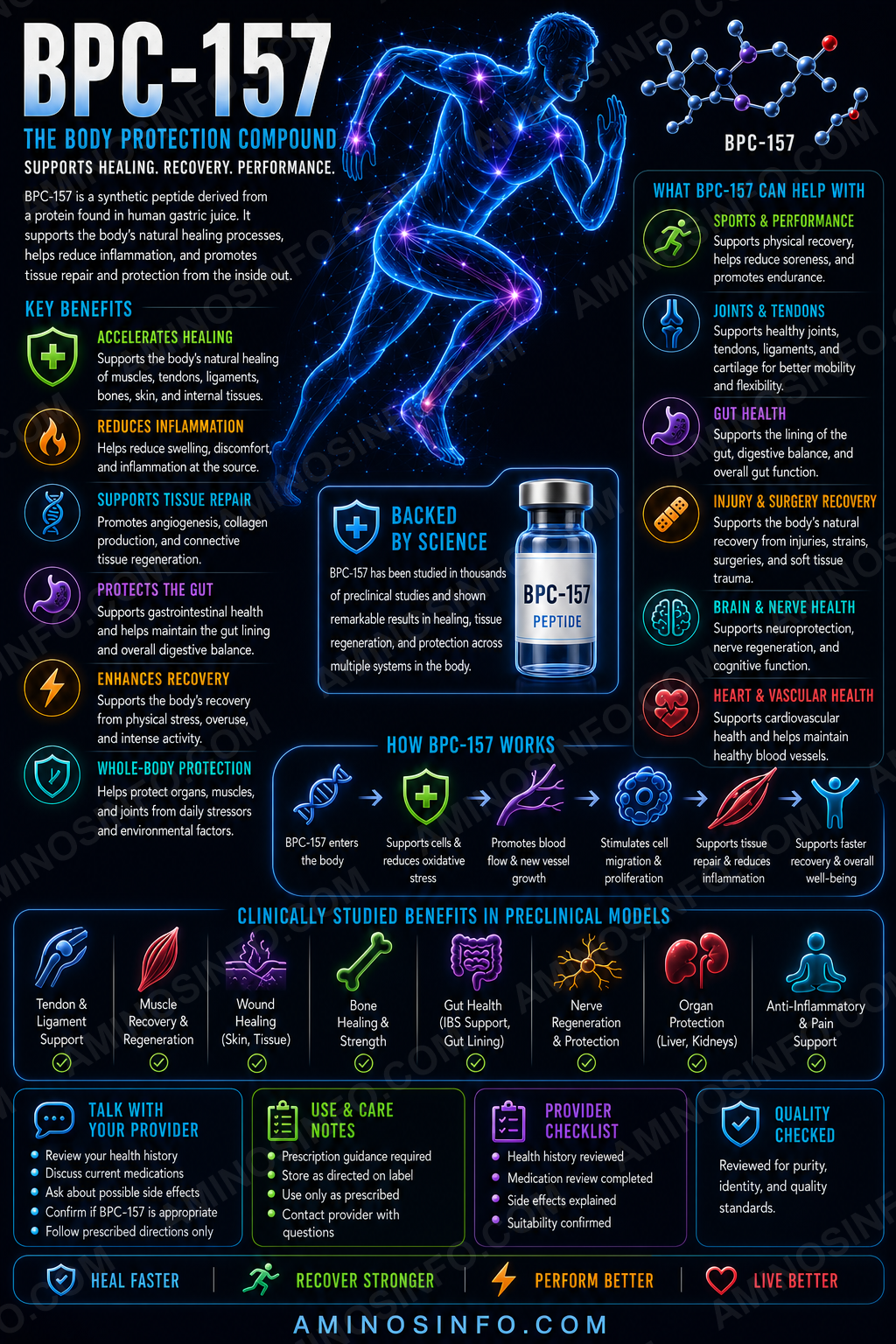
A comprehensive, evidence-graded review of BPC-157, a synthetic 15-amino-acid peptide investigated primarily in animal models for gastrointestinal cytoprotection, vascular signaling, tendon and muscle repair, nerve recovery, inflammation regulation, nitric-oxide biology, and tissue-healing pathways.
What Is BPC-157?
BPC-157, commonly expanded as “Body Protection Compound-157,” is a synthetic pentadecapeptide composed of 15 amino acids. It was developed from research involving a protective protein fraction found in human gastric juice.
15 amino acids
GEPPPGKPADDAGLV
Approximately 1419.5 Da
Linear peptide
None
No
Major research themes
- Gastric and intestinal cytoprotection
- Tendon, ligament, muscle, and bone healing
- Fibroblast migration and collagen organization
- Angiogenesis and endothelial signaling
- Nitric-oxide pathway modulation
- Nerve and neuromuscular recovery
🧬 Structure, Sequence, and Molecular Properties
🧪 Amino-acid sequence
H-Gly-Glu-Pro-Pro-Pro-Gly-Lys-Pro-Ala-Asp-Asp-Ala-Gly-Leu-Val-OH
GEPPPGKPADDAGLV
| Length | 15 amino acids |
|---|---|
| Representative formula | C62H98N16O22 |
| Average molecular weight | Approximately 1419.54 g/mol |
| Monoisotopic mass | Approximately 1418.70 Da |
| N terminus | Free amino group |
| C terminus | Free carboxyl group |
| Proline content | Four residues |
BPC-157 may be supplied as free peptide, acetate salt, or TFA salt. Counterions and water can materially increase gross powder weight, so net peptide content is not the same as total vial weight.
Origin and Naming
BPC-157 was described as a stable 15-residue fragment related to a larger protective gastric protein fraction. The commercial research peptide is synthetically manufactured. The exact endogenous precursor, physiological concentration, receptor, and natural processing pathway remain incompletely established.
📅 Research Timeline
- 1990s: Early animal studies described gastric and systemic cytoprotection.
- 2000s: Research expanded into ulcers, fistulas, vascular effects, tendons, and organ injury.
- 2011: Tendon-fibroblast work reported enhanced migration and FAK-paxillin signaling.
- 2021: A small uncontrolled knee-pain report described intra-articular use.
- 2022: WADA added BPC-157 to its Prohibited List.
- 2023–2024: FDA highlighted significant safety concerns for compounded BPC-157.
- 2025: A two-person intravenous pilot reported no adverse effects at the tested exposures.
- 2026: Orthopaedic reviews continued to classify the evidence as predominantly preclinical.
🧠 How Might BPC-157 Work?
Nitric-oxide signaling
Animal studies report interactions with nitric-oxide synthase pathways and effects during both nitric-oxide excess and blockade.
Angiogenesis and endothelium
Reported mechanisms include VEGF-related signaling, endothelial migration, vascular repair, and collateral-vessel recruitment.
FAK-paxillin signaling
Tendon fibroblast research reported activation of focal adhesion kinase and paxillin pathways associated with migration and adhesion.
Growth-factor and cytoprotective signaling
Experimental work has examined VEGF, Egr-1, growth-hormone receptor, epithelial preservation, and broader cytoprotective responses.
Gastrointestinal Research
Animal studies report reduced injury and improved healing in models involving gastric ulcers, NSAID damage, alcohol injury, colitis, intestinal anastomoses, fistulas, obstruction, and short-bowel injury. Proposed effects include epithelial preservation, improved blood flow, reduced inflammation, and restored mucosal integrity. No large randomized human trial has established efficacy for ulcers, inflammatory bowel disease, or fistulas.
Tendon, Ligament, Muscle, and Bone Research
Preclinical studies report enhanced tendon fibroblast migration, FAK-paxillin signaling, collagen organization, vascularization, tendon continuity, and biomechanical recovery. Animal work also includes ligament injury, muscle trauma, neuromuscular-junction preservation, fractures, bone defects, and tendon-to-bone healing. Controlled human trials are lacking.
Vascular and Nitric-Oxide Research
BPC-157 has been associated with endothelial protection, vascular adaptation, collateral circulation, and reduced ischemic injury in animal occlusion models. Research groups have also reported effects in thrombosis, bleeding, and blood-pressure models. These findings require independent replication and careful translation because angiogenesis and vascular modulation are not universally beneficial.
Nerve and Neurological Research
Animal studies include peripheral nerve injury, muscle reinnervation, spinal cord injury, traumatic brain injury, stroke, dopamine and serotonin disruption, and neuromuscular damage. No controlled human trial has established efficacy for neuropathy, spinal injury, stroke, or neurodegenerative disease.
Human Evidence
Two-person intravenous pilot
A 2025 pilot administered intravenous BPC-157 to two healthy adults and reported no adverse effects at the studied exposures. This sample is too small to establish safety, detect uncommon events, or support efficacy.
Small knee-pain report
A 2021 uncontrolled retrospective report described improvement in a small group receiving intra-articular BPC-157, with some receiving thymosin beta-4 as well. It lacked randomization, placebo control, standardized imaging outcomes, and rigorous follow-up.
Major unknowns
- Human pharmacokinetics and half-life
- Bioavailability by route
- Therapeutic window
- Long-term organ safety
- Immunogenicity
- Drug interactions
- Reproductive safety
- Clinical efficacy for any condition
FDA, Compounding, and Anti-Doping Status
BPC-157 is not FDA approved. FDA has stated that compounded BPC-157 may pose immunogenicity and impurity-characterization risks and that available information is insufficient to determine whether administration would harm humans. BPC-157 is prohibited at all times under WADA rules.
Potential Side Effects and Safety Considerations
There is no established human safety profile. Potential risks include injection-site reactions, infection, hypersensitivity, anti-peptide antibodies, endotoxin, particles, incorrect sequence or strength, unknown liver and kidney effects, unknown coagulation and blood-pressure effects, and unknown reproductive risk.
Potential interactions with anticoagulants, antiplatelet agents, nitric-oxide drugs, NSAIDs, psychiatric medicines, blood-pressure drugs, and chemotherapy have not been adequately studied.
🧪 Laboratory Testing Methods
| Method | Purpose | Important limitation |
|---|---|---|
| RP-HPLC / UPLC | Separates intact peptide from deletions and degradants | Area purity does not prove identity |
| LC-HRMS | Confirms mass near 1419.5 Da | Does not prove complete sequence |
| MS/MS mapping | Confirms GEPPPGKPADDAGLV | Proline-rich sequences need optimized fragmentation |
| Amino-acid analysis | Confirms composition and supports content | Does not prove order |
| Chiral analysis | Detects epimerization | Hydrolysis may create artifacts |
| Cis-trans proline profiling | Characterizes conformers | Conformers can interconvert |
| Net peptide-content assay | Measures actual intact peptide | Must correct for water and counterions |
| Counterion assay | Measures acetate or TFA | Gross mass may overstate peptide |
| SEC-HPLC / DLS | Measures aggregates and particles | Small aggregates may require orthogonal testing |
| Protease-stability assay | Measures degradation in gastric, plasma, and tissue matrices | Does not predict human exposure alone |
| Fibroblast migration assay | Measures repair-related signaling | Does not prove clinical healing |
| Endothelial/angiogenesis assay | Measures vascular activity | Angiogenesis is context dependent |
| NO-pathway assay | Measures eNOS and nitric-oxide effects | Responses differ by model |
| Immunogenicity assessment | Evaluates antibody and T-cell responses | Requires relevant models |
| Sterility, endotoxin, particles | Finished injectable quality | Research purity cannot establish safety |
| Stability-indicating assay | Tracks hydrolysis, oxidation, epimerization, adsorption, and potency loss | Requires validated stress studies |
📄 How to Interpret a BPC-157 COA
- Verify the complete GEPPPGKPADDAGLV sequence.
- Confirm intact mass near 1419.5 Da.
- Use MS/MS rather than intact mass alone.
- Confirm L stereochemistry.
- State free N terminus and C-terminal acid unless modified.
- State acetate, TFA, or other salt form.
- Report net peptide content after correcting for water and counterions.
- Measure deletion peptides, epimers, oxidized products, and synthesis impurities.
- Assess proline-related conformers.
- Include protease stability.
- Use a qualified migration, endothelial, matrix, or nitric-oxide potency assay.
- For finished injectables, require sterility, endotoxin, particles, fill accuracy, container closure, and post-reconstitution stability.
- A COA does not prove human safety, efficacy, or FDA approval.
📊 Comparison Tables
BPC-157 vs TB-500 vs GHK-Cu vs KPV
| Feature | BPC-157 | TB-500 | GHK-Cu | KPV |
|---|---|---|---|---|
| Main focus | Cytoprotection and tissue repair | Actin and migration | Matrix and copper signaling | Inflammatory signaling |
| Structure | 15 aa | Often Ac-LKKTETQ or undefined | 3-aa copper complex | 3 aa |
| Human evidence | Extremely limited | Extremely limited | Some topical data | Extremely limited |
| FDA approved | No | No | No systemic drug | No |
BPC-157 vs Larazotide vs KPV for Gut Research
| Feature | BPC-157 | Larazotide | KPV |
|---|---|---|---|
| Main mechanism | Cytoprotection and vascular signaling | Tight-junction regulation | PepT1 and inflammatory signaling |
| Human trials | Minimal | Multiple | Very limited |
| FDA approved | No | No | No |
Raw BPC-157 vs Research-Qualified Material
| Attribute | Basic raw peptide | Research-qualified material |
|---|---|---|
| Identity | HPLC and mass claim | MS/MS, chirality, termini, salt |
| Content | Gross powder weight | Net peptide content |
| Potency | Often untested | Qualified functional assay |
| Microbiology | May be absent | Study-appropriate controls |
| Human equivalence | Neither establishes an FDA-approved therapeutic product | |
🖼️ Original Diagram Specifications
- Full sequence with proline-rich region highlighted.
- Mechanism map showing endothelium, nitric oxide, FAK-paxillin, VEGF, fibroblasts, and collagen.
- Gastrointestinal injury and epithelial-restoration diagram.
- Tendon-repair cascade with fibroblast migration and collagen organization.
- Evidence pyramid from animal studies to sparse human reports.
- Risk map covering immunogenicity, impurities, angiogenesis, contamination, interactions, and WADA status.
- COA workflow with sequence, chirality, mass, salt correction, conformers, potency, sterility, and stability.
❓ Frequently Asked Questions
Is BPC-157 a peptide?
Yes. It is a synthetic linear 15-amino-acid peptide.
What is the sequence?
GEPPPGKPADDAGLV.
What is the molecular formula?
C₆₂H₉₈N₁₆O₂₂.
What is the molecular weight?
Approximately 1419.5 Da.
Is it FDA approved?
No.
What is it studied for?
Gastrointestinal protection, tendon and muscle repair, vascular signaling, nitric oxide, nerves, and organ-injury models.
Does it heal tendons?
Animal and cell studies are promising, but controlled human evidence is lacking.
Has it been tested in humans?
Only very limited reports exist, including a two-person intravenous pilot and a small uncontrolled knee-pain report.
Is it safe?
There is not enough human evidence to establish general safety.
Is it prohibited in sports?
Yes.
Does 99% HPLC prove quality?
No. Sequence, stereochemistry, salt, net content, impurities, potency, sterility, and stability also matter.
Is there an established injectable dose?
No.
Final Thoughts
BPC-157 is a 15-residue synthetic peptide with a remarkably broad preclinical claim profile. Animal studies report effects across gastrointestinal injury, tendons, ligaments, muscle, bone, vessels, nerves, brain, and multiple organs.
The recurring themes include cytoprotection, endothelial stabilization, nitric-oxide regulation, angiogenesis, fibroblast migration, FAK-paxillin signaling, and collagen organization. However, no accepted primary receptor has been established.
The central problem is translation. Human evidence remains extraordinarily limited, while FDA continues to highlight immunogenicity, impurity-characterization, and insufficient human-safety concerns. WADA prohibits the peptide.
Analytical authentication requires the complete sequence, L stereochemistry, correct termini, intact mass, salt form, net content, conformer and impurity profiling, potency, protease stability, and route-specific microbiological quality. A polished COA cannot replace missing clinical evidence.
📚 References
- Józwiak M, et al. Multifunctionality and Possible Medical Application of the BPC 157 Peptide—Literature and Patent Review. Pharmaceuticals. 2025.
- Vasireddi N, et al. Emerging Use of BPC-157 in Orthopaedic Sports Medicine. 2025.
- McGuire FP, et al. Regeneration or Risk? A Narrative Review of BPC-157 for Musculoskeletal Healing. 2025.
- Lee E, et al. Safety of Intravenous Infusion of BPC157 in Humans. 2025.
- Lee E, et al. Intra-Articular Injection of BPC 157 for Multiple Types of Knee Pain. 2021.
- Chang CH, et al. The Promoting Effect of Pentadecapeptide BPC 157 on Tendon Healing. Journal of Applied Physiology. 2011.
- Seiwerth S, et al. Stable Gastric Pentadecapeptide BPC 157 and Wound Healing. Frontiers in Pharmacology. 2021.
- Xu C, et al. Preclinical Safety Evaluation of BPC-157. Regulatory Toxicology and Pharmacology. 2020.
- Mayfield CK, et al. Injectable Peptide Therapy: A Primer for Orthopaedic and Sports Medicine Physicians. 2026.
- Rahman OF, et al. Therapeutic Peptides in Orthopaedics. 2026.
- U.S. Food and Drug Administration. Certain Bulk Drug Substances for Use in Compounding That May Present Significant Safety Risks: BPC-157.
- World Anti-Doping Agency. 2026 Prohibited List.
- International Council for Harmonisation. ICH Q1A(R2), Q2(R2), Q3A, Q3B, Q3C, and Q6B.
- United States Pharmacopeia General Chapters <621>, <71>, <85>, and <788>.
Sequence, chemistry, preclinical and human evidence, FDA and WADA status, safety, and analytical information reviewed in July 2026.