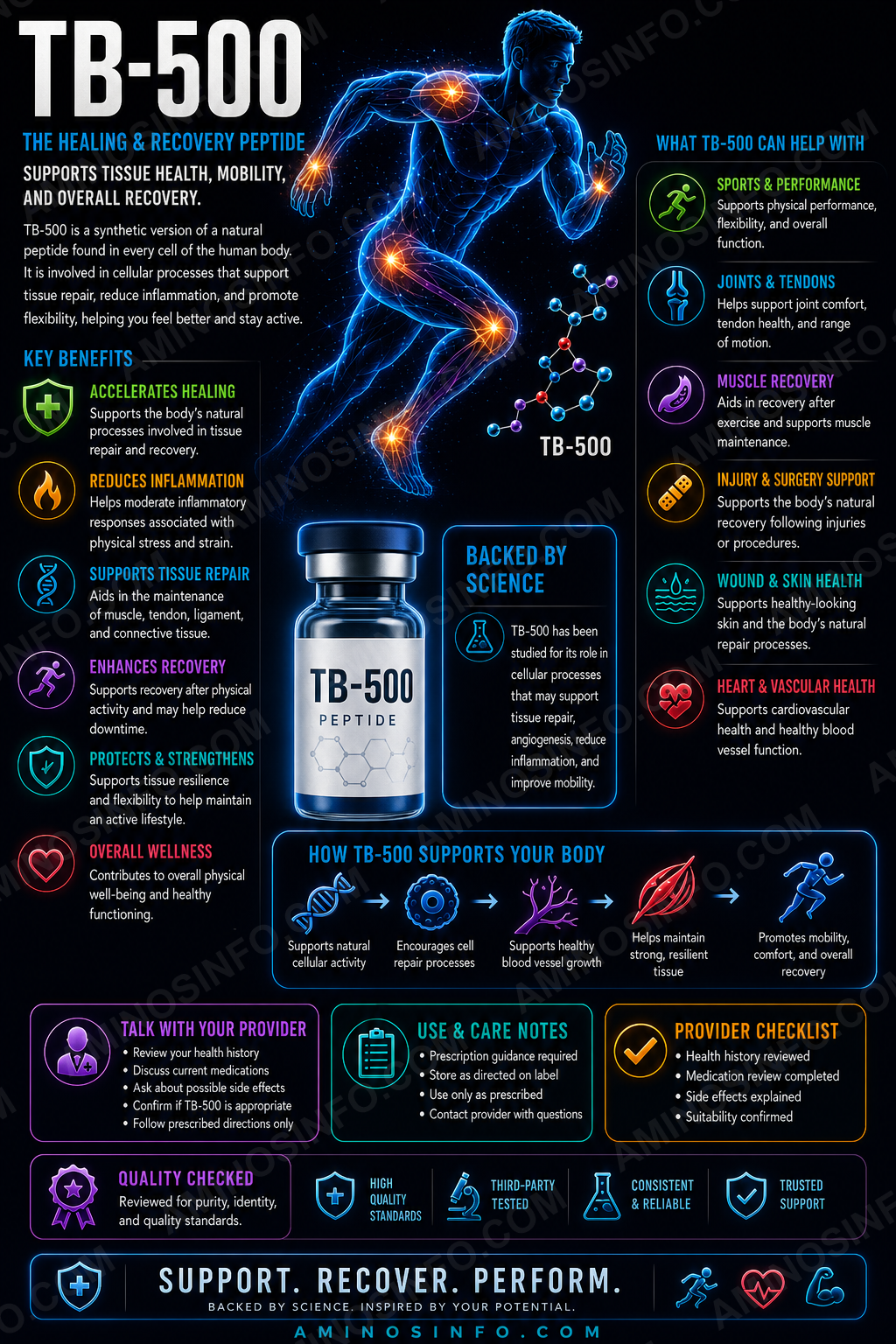
TB-500: What It Is, How It Works, Benefits, and Research Overview
A comprehensive, evidence-graded review of TB-500, a commercial research peptide name most rigorously associated in analytical and anti-doping literature with the N-terminally acetylated thymosin beta-4 actin-binding fragment Ac-LKKTETQ, while also being used inconsistently by some suppliers for full-length thymosin beta-4 or other thymosin-related products.
What Is TB-500?
TB-500 is a commercial and anti-doping term used for a synthetic peptide derived from the actin-binding region of thymosin beta-4. The best-characterized form is the N-terminally acetylated heptapeptide:
Ac-LKKTETQ-OH
This corresponds to residues 17–23 of full-length human thymosin beta-4. The sequence contains the central actin-binding motif associated with cytoskeletal regulation, cellular migration, and selected wound-related effects.
Ac-LKKTETQ
7 amino acids
Thymosin beta-4
889.0 Da
Actin and cell migration
No
The TB-500 Identity Controversy
Analytically identified TB-500
Peer-reviewed anti-doping studies published in 2012 identified the principal active peptide in a veterinary TB-500 preparation as the N-terminally acetylated thymosin beta-4 fragment Ac-LKKTETQ.
Vendor use of the name
Some peptide suppliers use “TB-500” for full-length, N-acetylated thymosin beta-4. Others describe a 7-amino-acid fragment, a longer fragment, or a proprietary analogue without publishing the sequence.
Why this matters
Full-length thymosin beta-4 contains 43 residues and multiple functional regions. Ac-LKKTETQ contains only the central actin-binding motif. It may not reproduce the parent peptide’s anti-inflammatory, anti-apoptotic, antimicrobial, extracellular, or organ-specific effects.
🧬 Structure, Sequence, and Molecular Properties
🧪 Best-characterized TB-500 sequence
Ac-LKKTETQ-OH
| Peptide length | 7 amino acids |
|---|---|
| Residue origin | Thymosin beta-4 residues 17–23 |
| Representative molecular formula | C38H68N10O14 |
| Approximate average molecular weight | 889.0 g/mol |
| N terminus | Acetylated |
| C terminus | Free carboxyl group in the characterized material |
| Disulfide bonds | None |
| Parent motif | LKKTETQ actin-binding region |
Non-acetylated fragment
The unacetylated LKKTETQ peptide is a related but distinct molecule with a molecular weight approximately 42 Da lower than Ac-LKKTETQ.
Full-length Tβ4 is different
Ac-SDKPDMAEIEKFDKSKLKKTETQEKNPLPSKETIEQEKQAGES-OH
Full-length mature thymosin beta-4 contains 43 residues and has a molecular weight near 4963.5 Da.
Relationship to Full-Length Thymosin Beta-4
Shared actin-binding motif
Ac-LKKTETQ preserves the central region implicated in binding actin and supporting cell migration.
Missing full-length domains
The fragment lacks the N-terminal Ac-SDKP region and the majority of the parent sequence. These omitted regions may contribute to anti-inflammatory, anti-apoptotic, antifibrotic, and extracellular signaling.
Evidence transfer problem
Human wound and ophthalmic studies using full-length Tβ4 cannot automatically prove the fragment works the same way.
Potential advantage of a shorter fragment
A small peptide may be easier to synthesize, characterize, and deliver, but it may also be cleared rapidly and possess a narrower biological profile.
📅 Discovery and Research Timeline
- 1980s: Thymosin beta-4 was identified as a major G-actin-sequestering peptide.
- 1990s: The LKKTETQ region was recognized as central to actin binding and cellular migration.
- 1999: Full-length thymosin beta-4 accelerated wound healing in animal models.
- 2000s: Defined full-length Tβ4 advanced into wound and ophthalmic human studies.
- 2012: Two anti-doping studies characterized TB-500 products and identified Ac-LKKTETQ as the active material.
- 2010s: TB-500 became increasingly marketed in veterinary, bodybuilding, and research-peptide channels.
- 2024: Analytical research developed simultaneous measurement of TB-500 and metabolites and emphasized the lack of documented biological effects for the commercial fragment itself.
- 2026: A scoping review continued to distinguish evidence for full-length Tβ4 from sparse direct evidence for TB-500.
🧠 How Might TB-500 Work?
1. Actin interaction
The LKKTETQ sequence is a key region involved in the interaction between thymosin beta-4 and monomeric actin.
2. Cytoskeletal remodeling
Actin availability influences cell shape, migration, adhesion, wound closure, vascular growth, and tissue repair.
3. Cell migration
Research on thymosin-related fragments suggests the motif may promote migration of keratinocytes, endothelial cells, and other repair-relevant cells.
4. Narrower activity than full Tβ4
Because TB-500 lacks most of the parent peptide, effects unrelated to the actin-binding motif should not be assumed.
5. Uncertain in-vivo potency
Direct biological characterization of the commercial Ac-LKKTETQ fragment remains much less extensive than research on full-length thymosin beta-4.
Actin Binding and Cellular Migration
G-actin
Globular actin is the monomeric building block of actin filaments. Tβ4 helps regulate the balance between monomeric and polymerized actin.
Migration biology
Cells must rapidly reorganize actin to migrate into damaged tissue. The LKKTETQ motif is therefore of interest in epithelial, endothelial, fibroblast, and immune-cell movement.
Fragment versus whole peptide
The isolated motif may preserve selected actin-associated activity but may not achieve the same binding affinity, conformation, intracellular distribution, or extracellular signaling as full-length Tβ4.
Required potency testing
A credible TB-500 preparation should demonstrate actin binding or modulation rather than relying only on HPLC purity.
Wound and Skin-Repair Research
Parent-peptide evidence
Full-length Tβ4 accelerates re-epithelialization, wound contraction, angiogenesis, collagen deposition, and repair-cell migration in animal models.
Human wound studies
Defined full-length Tβ4 formulations have been evaluated in venous-stasis ulcers and pressure ulcers.
Fragment evidence
Short Tβ4-derived actin-binding peptides have shown repair-related activity in selected experimental systems, but direct evidence for Ac-LKKTETQ remains limited.
Clinical inference limitation
Human outcomes from full-length Tβ4 gels cannot be assigned to TB-500 without head-to-head characterization.
Muscle, Tendon, and Ligament Research
Commercial claims
TB-500 is widely marketed for muscle, tendon, ligament, and joint recovery.
Published evidence
Most supporting studies concern full-length Tβ4, general actin biology, or animal wound models—not controlled human tendon or muscle trials using Ac-LKKTETQ.
Biological rationale
Cell migration, angiogenesis, and cytoskeletal remodeling are relevant to soft-tissue repair.
Evidence gap
No established randomized human evidence demonstrates that TB-500 accelerates tendon, ligament, or muscle healing.
Angiogenesis and Vascular Research
Thymosin beta-4 evidence
Full-length Tβ4 promotes endothelial migration and vessel formation in experimental systems.
Fragment rationale
The LKKTETQ motif may preserve some cell-migration signals associated with vascular repair.
Potential benefit
New-vessel formation can improve oxygen and nutrient delivery to healing tissue.
Potential risk
Angiogenesis may be undesirable in tumors, proliferative retinopathy, vascular malformations, or other conditions.
Cardiac and Neurological Research
Full-length parent research
Tβ4 has demonstrated cardioprotective and neurorestorative effects in animal models involving myocardial infarction, stroke, traumatic brain injury, and peripheral nerve damage.
Why the fragment may differ
These organ effects may require regions outside LKKTETQ, including anti-apoptotic and pro-resolving sequences absent from TB-500.
No direct clinical role
TB-500 is not an approved cardiac, stroke, nerve, or neuroregenerative therapy.
Human Clinical Evidence
Direct TB-500 evidence
Published controlled human efficacy and safety studies of the characterized Ac-LKKTETQ fragment are essentially absent.
Full-length Tβ4 evidence
Defined full-length Tβ4 formulations have been evaluated in chronic wounds, dry eye, neurotrophic keratopathy, and related local applications.
What cannot be concluded
- That TB-500 has the same efficacy as full-length Tβ4
- That injectable TB-500 improves athletic injury recovery
- That it safely accelerates muscle or tendon healing
- That a commercial vial contains the characterized fragment
- That animal or topical data establish systemic dosing
Anti-Doping and Sports Status
WADA prohibition
The 2026 World Anti-Doping Agency Prohibited List includes thymosin beta-4 and its derivatives, including TB-500, in the growth-factor and growth-factor-modulator category.
Detection research
Anti-doping laboratories have developed LC-HRMS methods to identify Ac-LKKTETQ and its metabolites in products and biological samples.
Athlete responsibility
Use may result in an anti-doping rule violation regardless of whether the product is marketed as “research use only.”
Product contamination
Unregulated peptide products may contain undeclared substances, wrong sequences, or inconsistent amounts.
Major Evidence Limitations
- TB-500 is not a standardized trade name
- Direct biological studies of Ac-LKKTETQ are limited
- Most efficacy claims are extrapolated from full-length Tβ4
- Human systemic studies are lacking
- No established injectable dose or schedule
- Unknown pharmacokinetics and tissue distribution
- Potential rapid proteolytic degradation
- Unknown long-term immunogenicity and toxicology
- Pro-angiogenic effects may be undesirable
- Commercial products may contain the wrong molecule
- Anti-doping prohibition applies
Potential Side Effects and Safety Considerations
No validated systemic safety profile
The absence of obvious short-term toxicity reports does not establish safety. Controlled human pharmacology and long-term follow-up are lacking.
Potential direct risks
- Injection-site pain, redness, swelling, or infection
- Hypersensitivity and anti-peptide antibodies
- Unexpected inflammatory or immune effects
- Unknown liver and kidney handling
- Unknown reproductive and developmental toxicity
- Microbial contamination, endotoxin, or particulate exposure
Angiogenesis concern
A peptide intended to promote migration or vascularization may have undesirable effects in cancer, retinal vascular disease, or proliferative disorders.
Wrong-product risk
The greatest practical safety issue may be chemical uncertainty: a vial labeled TB-500 may contain full-length Tβ4, Ac-LKKTETQ, another fragment, a mixture, or an unrelated peptide.
🧪 Laboratory Testing Methods
| Method | Purpose | Important limitation |
|---|---|---|
| RP-HPLC / UPLC | Separates intact Ac-LKKTETQ from deacetylated, truncated, and synthesis-related impurities | Area purity does not establish sequence or identity |
| LC-HRMS | Confirms intact mass near 889.0 Da | Does not alone distinguish all positional isomers |
| MS/MS sequencing | Confirms L-K-K-T-E-T-Q order | Short basic peptides require optimized fragmentation |
| N-terminal acetylation assay | Confirms and quantifies the acetyl group | Must distinguish acetylation from other +42 Da modifications |
| Amino-acid analysis | Confirms composition | Does not prove residue order |
| Chiral amino-acid analysis | Confirms L stereochemistry and detects epimers | Hydrolysis can introduce artifacts |
| Net peptide-content assay | Measures actual Ac-LKKTETQ mass | Must correct for water, TFA, acetate, and salts |
| Counterion assay | Measures TFA, acetate, or other counterions | Gross powder mass may overstate peptide content |
| Full-length Tβ4 exclusion assay | Detects undeclared 43-residue parent peptide | Requires wide mass and chromatographic range |
| Fragment impurity panel | Measures LKKTETQ, Ac-LKKTET, Ac-LKKTETQ fragments, and synthesis failures | Reference standards are needed |
| G-actin binding assay | Measures interaction with actin | Fragment affinity may differ greatly from full-length Tβ4 |
| Actin-polymerization assay | Measures functional effects on actin dynamics | Assay conditions strongly influence results |
| Cell-migration assay | Measures keratinocyte, endothelial, or fibroblast migration | Does not prove clinical tissue healing |
| Angiogenesis assay | Measures endothelial tube formation | Pro-angiogenic activity is not universally beneficial |
| Protease-stability assay | Measures degradation in plasma or tissue fluids | In-vitro half-life may not predict humans |
| Metabolite mapping | Identifies in-vitro and ex-vivo degradation products | Metabolite profiles vary by species and matrix |
| Sterility, endotoxin, and particles | Required for any finished injectable evaluation | Raw peptide purity does not establish injectable safety |
| Residual-solvent testing | Measures acetonitrile, DMF, and synthesis solvents | Does not establish biological potency |
| Stability-indicating assay | Tracks deacetylation, hydrolysis, aggregation, adsorption, and potency loss | Requires validated forced-degradation studies |
📄 How to Interpret a TB-500 COA
- Require the exact sequence. The name TB-500 alone is insufficient.
- Determine whether the product is Ac-LKKTETQ or full-length Tβ4.
- For fragment TB-500, confirm Ac-LKKTETQ-OH.
- Confirm the N-terminal acetyl group.
- Verify molecular weight near 889.0 Da for Ac-LKKTETQ.
- Use MS/MS to confirm the exact seven-residue order.
- Confirm all residues are L amino acids.
- Measure deacetylated and truncated fragments separately.
- Screen for undeclared full-length thymosin beta-4.
- Report net peptide content after correcting for water and counterions.
- Use actin-binding or actin-polymerization testing for potency.
- Include protease-stability and metabolite studies for research interpretation.
- For finished injectables, require sterility, endotoxin, particles, fill accuracy, container closure, and reconstituted stability.
- A COA does not establish human efficacy, safety, or FDA approval.
📊 Comparison Tables
TB-500 vs Full-Length Thymosin Beta-4
| Feature | TB-500 fragment | Full-length Tβ4 |
|---|---|---|
| Sequence | Ac-LKKTETQ | 43-residue N-acetylated peptide |
| Length | 7 aa | 43 aa |
| Molecular weight | ~889 Da | ~4963.5 Da |
| Main retained region | Actin-binding motif | Multiple functional regions |
| Human clinical evidence | Essentially absent | Some wound and ophthalmic trials |
| Interchangeable? | No | |
TB-500 vs BPC-157 vs GHK-Cu vs KPV
| Feature | TB-500 | BPC-157 | GHK-Cu | KPV |
|---|---|---|---|---|
| Main research focus | Actin and migration | Cytoprotection and vascular repair models | Matrix and copper signaling | Inflammatory signaling |
| Size | 7 aa | 15 aa | 3-aa copper complex | 3 aa |
| Human evidence | Very limited | Very limited | Some topical data | Very limited |
| FDA approved | No | No | No systemic drug | No |
TB-500 Fragment vs Ac-SDKP
| Feature | Ac-LKKTETQ | Ac-SDKP |
|---|---|---|
| Origin | Tβ4 residues 17–23 | Tβ4 residues 1–4 |
| Main research concept | Actin and migration | Anti-inflammatory and antifibrotic signaling |
| Length | 7 aa | 4 aa |
| Same molecule? | No | |
Raw TB-500 vs Research-Qualified TB-500
| Attribute | Basic product claim | Research-qualified material |
|---|---|---|
| Identity | “TB-500” label | Exact Ac-LKKTETQ sequence and acetylation |
| Purity | Single HPLC percentage | Sequence-specific impurities and degradants |
| Content | Gross vial weight | Net peptide corrected for salt and water |
| Potency | Often untested | Actin binding and migration assay |
| Human equivalence | Neither establishes an FDA-approved medicine | |
🖼️ Original Diagram Specifications
- Sequence map: Full thymosin beta-4 with residues 17–23 highlighted and extracted as Ac-LKKTETQ.
- Identity comparison: TB-500 fragment, non-acetylated LKKTETQ, and full-length Tβ4.
- Actin mechanism: Fragment binding to G-actin and influencing cytoskeletal remodeling.
- Cell-migration pathway: Actin reorganization, endothelial migration, epithelial movement, and wound closure.
- Evidence pyramid: Extensive full-length Tβ4 preclinical data, selected human local trials, sparse direct TB-500 evidence.
- Risk map: Angiogenesis, unapproved injection, product substitution, contamination, and anti-doping risk.
- COA workflow: Exact sequence, acetylation, intact mass, fragment impurities, actin potency, sterility, and stability.
❓ Frequently Asked Questions
What is TB-500?
The best-characterized TB-500 material is Ac-LKKTETQ, an acetylated seven-amino-acid fragment of thymosin beta-4.
What is the exact sequence?
Ac-Leu-Lys-Lys-Thr-Glu-Thr-Gln-OH.
What is the molecular formula?
A representative formula is C₃₈H₆₈N₁₀O₁₄.
What is the molecular weight?
Approximately 889.0 Da.
Is TB-500 the same as thymosin beta-4?
Not when TB-500 refers to Ac-LKKTETQ. Full-length Tβ4 is a 43-residue peptide.
Why do some vendors sell full-length Tβ4 as TB-500?
The trade name is used inconsistently and has no universal chemical standard.
Is TB-500 FDA approved?
No.
Has TB-500 been studied in humans?
Controlled human studies of the Ac-LKKTETQ fragment are essentially absent.
Does TB-500 heal tendons or muscles?
There is no established randomized human evidence proving this.
Does TB-500 bind actin?
It contains the parent peptide’s central actin-binding motif, but product-specific binding potency should be demonstrated.
Is TB-500 prohibited in sports?
Yes. WADA prohibits thymosin beta-4 and its derivatives, including TB-500.
Does 99% HPLC purity prove authentic TB-500?
No. Exact sequence, N-terminal acetylation, molecular mass, stereochemistry, impurity profile, and actin-binding potency are also required.
Can a COA prove it is full-length Tβ4?
Only if it includes the complete 43-residue sequence, N-terminal acetylation, correct mass, and full-length potency testing.
Is there an established injectable dose?
No approved or validated human dose exists.
What is the most important quality-control step?
Determine the exact molecule before interpreting any purity or research claim.
Final Thoughts
TB-500 is one of the most frequently misunderstood names in peptide research. The best analytical evidence identifies it as Ac-LKKTETQ, a seven-residue, N-acetylated fragment corresponding to the central actin-binding region of thymosin beta-4.
This fragment has a plausible role in actin regulation and cellular migration, but the direct evidence base is limited. Most wound, corneal, cardiac, neurological, anti-inflammatory, and human clinical research cited in connection with TB-500 actually studied full-length thymosin beta-4.
The distinction is not merely semantic. Full-length Tβ4 contains 43 residues and multiple functional domains, while Ac-LKKTETQ contains only the actin-related motif. They differ in molecular weight, pharmacology, stability, tissue distribution, and likely biological breadth.
A credible TB-500 evaluation must begin by identifying the exact sequence. For Ac-LKKTETQ, testing should confirm N-terminal acetylation, intact mass near 889 Da, residue order, L stereochemistry, fragment impurities, net peptide content, actin-related potency, protease stability, and route-appropriate microbiological quality. No COA can substitute for missing human safety and efficacy data.
📚 References
- Esposito S, et al. Synthesis and Characterization of the N-terminal Acetylated 17–23 Fragment of Thymosin Beta-4 Identified in TB-500. Drug Testing and Analysis. 2012.
- Ho ENM, et al. Doping Control Analysis of TB-500, a Synthetic Version of an Active Region of Thymosin Beta-4. Drug Testing and Analysis. 2012.
- Rahaman KA, et al. Simultaneous Quantification of TB-500 and Its Metabolites in In-Vitro and Ex-Vivo Models. Journal of Chromatography B. 2024.
- World Anti-Doping Agency. Investigation of In-Vitro/Ex-Vivo TB-500 Metabolism and Synthesis of Relevant Metabolites.
- World Anti-Doping Agency. 2026 Prohibited List.
- Goldstein AL, Hannappel E, Kleinman HK. Thymosin Beta-4: A Multifunctional Regenerative Peptide. Basic Properties and Clinical Applications. Expert Opinion on Biological Therapy. 2012.
- Malinda KM, et al. Thymosin Beta-4 Accelerates Wound Healing. Journal of Investigative Dermatology. 1999.
- Treadwell T, et al. The Regenerative Peptide Thymosin Beta-4 Accelerates the Rate of Dermal Healing. 2012.
- Goldstein AL, Kleinman HK. Advances in the Basic and Clinical Applications of Thymosin Beta-4. Expert Opinion on Biological Therapy. 2015.
- Bock-Marquette I, et al. Thymosin Beta-4 Activates Integrin-Linked Kinase and Promotes Cardiac Cell Migration, Survival and Repair. Nature. 2004.
- Smart N, et al. Thymosin Beta-4 Induces Adult Epicardial Progenitor Mobilization and Neovascularization. Nature. 2007.
- Xing Y, et al. Progress on the Function and Application of Thymosin Beta-4. Frontiers in Endocrinology. 2021.
- McGuire F, et al. Thymosin Beta-4 and TB-500 in Tissue Healing and Regeneration: Evidence, Mechanisms, and Clinical Translation. Applied Sciences. 2026.
- ClinicalTrials.gov. Phase 2 Study of Thymosin Beta-4 in Venous Stasis Ulcers. NCT00598871.
- ClinicalTrials.gov. Study of Thymosin Beta-4 in Pressure Ulcers. NCT00382174.
- ClinicalTrials.gov. Thymosin Beta-4 Ophthalmic and RGN-259 Studies.
- International Council for Harmonisation. ICH Q1A(R2), Q2(R2), Q3A, Q3B, Q3C, and Q6B.
- United States Pharmacopeia General Chapters <621>, <71>, <85>, and <788>.
Identity, chemistry, parent-peptide distinctions, anti-doping status, mechanism, safety, and analytical information reviewed in July 2026.