
:root{--ink:#16202a;--muted:#5c6975;--line:#dce3e8;--panel:#f6f8fa;--warning:#fff8e8;--danger:#fff0f0}*{box-sizing:border-box}body{margin:
TB-4 / Thymosin Beta-4: What It Is, How It Works, Benefits, and Research Overview
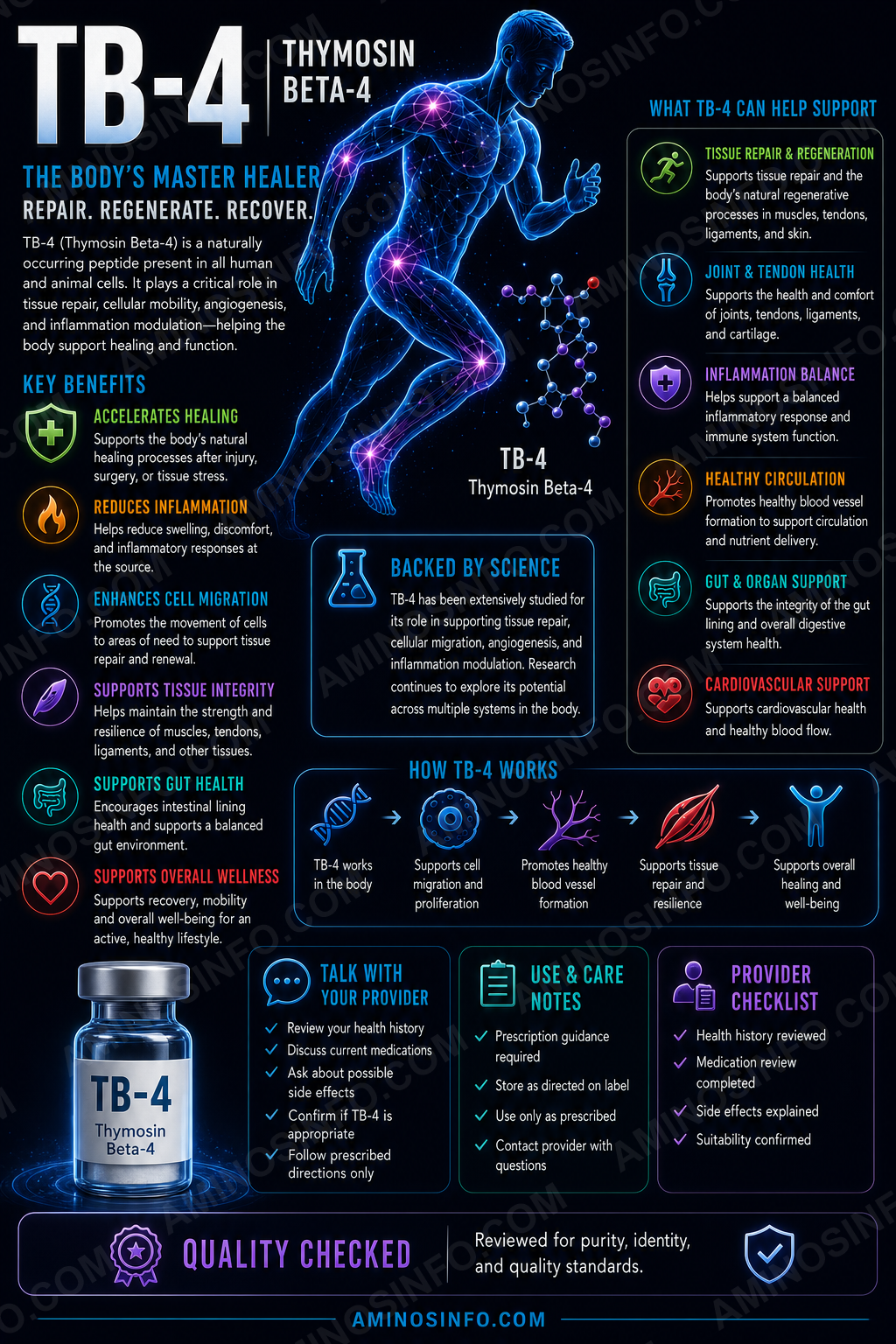
A comprehensive, evidence-graded review of thymosin beta-4, the endogenous 43-residue N-acetylated peptide encoded by TMSB4X and studied for actin sequestration, cellular migration, wound repair, angiogenesis, corneal healing, inflammation resolution, cardiac repair, neuroprotection, and tissue regeneration.
What Is Thymosin Beta-4?
Thymosin beta-4, abbreviated Tβ4 or TB-4, is a naturally occurring peptide found in nearly all mammalian cells. It is the most abundant member of the beta-thymosin family and is encoded by the X-linked TMSB4X gene.
43 amino acids
TMSB4X
G-actin
Approximately 4963.5 Da
N-terminal acetylation
No marketing approval
Primary biological roles
- Sequestration of monomeric G-actin
- Regulation of cytoskeletal organization
- Cell migration and tissue repair
- Angiogenesis
- Inflammation resolution
- Protection from apoptosis and oxidative injury
- Corneal and epithelial healing
- Cardiac and neural repair signaling
🧬 Structure, Sequence, and Molecular Properties
🧪 Mature human thymosin beta-4 sequence
Ac-SDKPDMAEIEKFDKSKLKKTETQEKNPLPSKETIEQEKQAGES-OH
The mature peptide contains 43 amino-acid residues and is acetylated at the N-terminal serine. UniProt lists a 44-residue translation product because the initiating methionine is removed during maturation.
| Mature length | 43 amino acids |
|---|---|
| Precursor translation length | 44 amino acids including initiator methionine |
| Representative molecular formula | C212H350N56O78S |
| Average molecular weight | Approximately 4963.5 Da |
| Post-translational modification | N-terminal acetylation |
| Disulfide bonds | None |
| Characteristic motif | LKKTETQ, actin-binding region |
| Protein accession | UniProt P62328 |
Natural Production and Tissue Distribution
Wide cellular expression
Tβ4 is expressed in many tissues and cell types, including platelets, leukocytes, endothelial cells, fibroblasts, epithelial cells, cardiac tissue, and nervous tissue.
High abundance in platelets and wound fluid
Platelets release Tβ4 after tissue injury, placing the peptide at sites where cell migration, inflammation, angiogenesis, and matrix remodeling occur.
Intracellular and extracellular roles
Inside cells, Tβ4 regulates actin dynamics. Outside cells, it acts as a signaling molecule involved in repair, survival, and inflammation.
Proteolytic fragments
Enzymatic cleavage can generate fragments with distinct biological activity, including the N-terminal tetrapeptide Ac-SDKP.
📅 Discovery and Clinical Research Timeline
- 1960s–1970s: Thymosin fractions were isolated from thymic tissue.
- 1981: Thymosin beta-4 was characterized as a 43-amino-acid peptide.
- 1980s: Tβ4 was identified as a major G-actin-sequestering peptide.
- 1990s: Research established roles in angiogenesis, cellular migration, and wound healing.
- 1999: A landmark study reported accelerated dermal wound healing in animal models.
- 2000s: Human and animal research expanded into venous ulcers, pressure ulcers, corneal injury, dry eye, cardiac repair, and neuroprotection.
- 2010s: Topical Tβ4 products entered phase 2 and phase 3 research for ophthalmic and wound indications.
- 2022: A phase 3 neurotrophic keratopathy study reported healing signals with RGN-259.
- 2023–2026: Ophthalmic, inflammatory-resolution, engineered-peptide, and tissue-regeneration research continued; FDA marketing approval remained pending.
🧠 How Does Thymosin Beta-4 Work?
1. G-actin sequestration
Tβ4 binds monomeric actin in a 1:1 complex and helps maintain a large intracellular pool of unpolymerized actin.
2. Cytoskeletal remodeling
By regulating the availability of actin monomers, Tβ4 influences cell shape, motility, adhesion, and directional migration.
3. Extracellular signaling
Outside the cell, Tβ4 affects endothelial cells, keratinocytes, fibroblasts, immune cells, and progenitor cells through mechanisms that extend beyond actin sequestration.
4. Anti-apoptotic signaling
Selected fragments and full-length Tβ4 have reduced apoptosis in ischemic, inflammatory, and toxic-injury models.
5. Inflammation resolution
Tβ4 can lower selected inflammatory pathways while promoting pro-resolving mediators and tissue-restoration responses.
Actin Binding and Cellular Migration
LKKTETQ motif
The central LKKTETQ region is essential to actin binding and is commonly used to distinguish functional thymosin-related sequences.
Keratinocytes
Tβ4 promotes keratinocyte migration during re-epithelialization.
Endothelial cells
It increases endothelial migration and vessel formation in experimental models.
Fibroblasts
Tβ4 influences fibroblast movement, matrix deposition, and wound contraction.
Stem and progenitor cells
Research suggests recruitment and activation of selected progenitor-cell populations after injury.
Skin and Wound-Healing Research
Dermal wounds
Preclinical studies report faster wound closure, increased keratinocyte migration, improved collagen deposition, and enhanced angiogenesis.
Pressure ulcers and venous ulcers
Topical Tβ4 formulations have been investigated in human chronic-wound studies, including pressure and venous-stasis ulcers.
Epidermolysis bullosa
Clinical research has examined topical Tβ4 in patients with inherited skin fragility and chronic wounds.
Diabetic wounds
Animal studies support improved healing in diabetic and ischemic wound environments, but broad human efficacy remains unestablished.
Scar and remodeling effects
Tβ4 may influence collagen organization, myofibroblast activity, and fibrosis, with effects depending on tissue and injury stage.
Corneal and Ophthalmic Research
Corneal epithelial repair
Tβ4 promotes epithelial-cell migration and closure after scrape, burn, and persistent epithelial injuries.
Anti-inflammatory activity
It reduces inflammatory-cell infiltration and selected cytokine pathways in corneal models.
Neurotrophic keratopathy
RGN-259, a preservative-free ophthalmic Tβ4 formulation, has been studied in phase 3 trials for neurotrophic keratopathy.
Dry eye disease
Clinical studies have evaluated Tβ4 eye drops for signs and symptoms of dry eye.
Regulatory status
Despite clinical development and orphan-drug activity, no FDA marketing approval has been granted.
Angiogenesis and Vascular Research
New-vessel formation
Tβ4 promotes endothelial migration, tube formation, and vascular growth in ischemic and wound models.
VEGF-related effects
Experimental studies associate Tβ4 with vascular endothelial growth factor and other pro-angiogenic pathways.
Improved tissue perfusion
Angiogenesis may improve oxygen and nutrient delivery during repair.
Potential risk
Pro-angiogenic signaling is not universally desirable and may be relevant to tumors, proliferative disorders, or abnormal vascular growth.
Cardiac and Ischemic-Tissue Research
Myocardial protection
Tβ4 reduced cardiomyocyte apoptosis and improved selected functional outcomes in animal models of myocardial infarction.
Epicardial activation
Research suggests Tβ4 may activate epicardial progenitor pathways and support vascular and tissue responses after cardiac injury.
Cardiac development
Tβ4 is involved in embryonic cardiac development and coronary-vessel formation.
Human limitation
No approved cardiac indication exists, and preclinical cardiac-regeneration claims remain difficult to translate.
Neurological and Nerve Research
Stroke models
Tβ4 improved neurovascular remodeling, oligodendrocyte activity, axonal growth, and functional recovery in animal stroke models.
Traumatic brain injury
Research reports reduced inflammation and improved neurorestorative signaling after experimental brain injury.
Peripheral nerves
Tβ4 has been studied for nerve growth, Schwann-cell responses, and peripheral nerve regeneration.
Multiple sclerosis and demyelination
Preclinical work includes oligodendrocyte differentiation and remyelination-related pathways.
Human evidence
Human neurological efficacy has not been established.
Inflammation, Resolution, and Fibrosis
Inflammation control
Tβ4 reduces selected cytokines, neutrophil infiltration, and inflammatory signaling in multiple tissue models.
Pro-resolving mediator pathways
Recent research suggests Tβ4 may activate specialized pro-resolving pathways that support host defense while limiting prolonged inflammation.
Ac-SDKP fragment
The N-terminal Ac-SDKP fragment has anti-inflammatory and antifibrotic properties distinct from full-length Tβ4.
Fibrosis
Tβ4 and its fragments have shown antifibrotic effects in heart, lung, liver, kidney, and skin models, but effects vary with timing and disease context.
Dual-role caution
The same migration and angiogenesis pathways that support repair may have different consequences in established fibrosis or cancer.
Hair-Follicle Research
Follicular stem cells
Tβ4 has been associated with follicular stem-cell migration and differentiation.
Hair growth in animal models
Selected thymosin-β4 fragments and full-length peptide research report stimulation of hair growth in experimental systems.
Human evidence
Robust randomized human studies for androgenetic alopecia are lacking.
Not equivalent to approved therapies
Tβ4 or TB-500 should not be treated as equivalent to minoxidil, finasteride, or other established treatments.
TB-500 Versus Full-Length Thymosin Beta-4
| Feature | Full-length thymosin beta-4 | Commercial TB-500 |
|---|---|---|
| Chemical identity | Defined 43-residue N-acetylated peptide | May vary by supplier |
| Sequence | Ac-SDKPDMAEIEKFDKSKLKKTETQEKNPLPSKETIEQEKQAGES | Must be disclosed and tested |
| Molecular weight | Approximately 4963.5 Da | Depends on actual molecule |
| Clinical evidence | Defined wound and ophthalmic formulations studied | Usually little or no direct human evidence |
| Interchangeable? | No, unless identity is analytically demonstrated | |
Vendors often cite full-length Tβ4 research to promote TB-500. That transfer is only scientifically justified when the commercial material is proven to be the same N-acetylated 43-residue molecule with comparable purity, potency, formulation, and exposure.
Human Clinical Evidence
Venous-stasis ulcers
Topical Tβ4 gel has been evaluated for wound closure in patients with venous-stasis ulcers.
Pressure ulcers and chronic wounds
Early trials and reports suggest acceptable topical tolerability and possible healing signals in selected wound populations.
Neurotrophic keratopathy
Phase 3 research with RGN-259 reported complete corneal-healing signals in a small population with persistent epithelial defects.
Dry eye disease
Ophthalmic studies have evaluated symptom and corneal-staining outcomes.
What is not established
- Systemic injury-recovery efficacy
- Muscle or tendon healing in athletes
- Approved injectable dosing
- Performance enhancement
- General anti-aging effects
- Long-term repeated systemic safety
Major Evidence Limitations
- Much of the regenerative evidence is preclinical
- Human evidence is concentrated in topical wound and ophthalmic applications
- Systemic pharmacokinetics and long-term safety remain limited
- Commercial TB-500 identity is inconsistent
- Fragments may have different activity from full-length Tβ4
- N-terminal acetylation is essential to authentic mature identity
- Formulation and route greatly affect exposure and efficacy
- Pro-angiogenic effects may be undesirable in some conditions
- Cancer and fibrosis effects are context dependent
- No FDA-approved systemic or sports-recovery indication exists
Potential Side Effects and Safety Considerations
Clinical topical and ophthalmic studies
Defined topical and ophthalmic Tβ4 formulations have generally shown acceptable tolerability in small studies, but this does not establish systemic safety.
Potential risks
- Injection-site reactions
- Hypersensitivity or anti-drug antibodies
- Unwanted angiogenesis
- Altered fibrosis or scar remodeling
- Unknown effects on tumor biology
- Unknown reproductive and developmental effects
- Unknown liver and kidney handling with repeated systemic exposure
- Microbial contamination or endotoxin in unapproved preparations
Sports regulation
Thymosin beta-4 and TB-500-related substances are prohibited under anti-doping rules.
Cancer concern
Tβ4 expression has been associated with migration and angiogenesis in certain tumor models. This does not prove that therapeutic Tβ4 causes cancer, but it supports caution and the need for disease-specific safety research.
🧪 Laboratory Testing Methods
| Method | Purpose | Important limitation |
|---|---|---|
| RP-HPLC / UPLC | Separates intact Tβ4 from truncations, oxidation products, deacetylated material, and synthesis impurities | Area purity does not prove sequence or N-terminal acetylation |
| LC-HRMS | Confirms intact mass near 4963.5 Da | Does not alone prove full sequence or biological potency |
| MS/MS peptide mapping | Confirms the complete 43-residue sequence | Requires high sequence coverage and validated digestion |
| N-terminal analysis | Confirms removal of initiator methionine and N-acetylated serine | Standard Edman degradation may be blocked by acetylation |
| Acetylation assay | Quantifies correctly N-acetylated mature peptide | Mass shift must be distinguished from other modifications |
| Amino-acid analysis | Confirms composition and supports content assignment | Does not prove sequence order |
| Chiral amino-acid analysis | Detects epimerization | Hydrolysis can introduce artifacts |
| Methionine-oxidation assay | Measures oxidation at Met6 | Oxidation may occur during handling and analysis |
| Net peptide-content assay | Measures actual intact Tβ4 mass | Must correct for water, salts, and counterions |
| SEC-HPLC / DLS | Measures aggregates and particles | Small soluble aggregates may require orthogonal methods |
| G-actin binding assay | Confirms primary biochemical function | Binding does not establish all extracellular effects |
| Actin-polymerization assay | Measures functional sequestration of G-actin | Assay conditions strongly influence apparent potency |
| Cell-migration assay | Measures keratinocyte, fibroblast, or endothelial migration | Cell type and concentration matter |
| Angiogenesis assay | Measures endothelial tube formation and vessel signaling | Pro-angiogenic activity is not universally beneficial |
| Wound-closure assay | Measures epithelial or fibroblast repair signaling | In-vitro closure may reflect proliferation and migration |
| Anti-inflammatory assay | Measures cytokines, neutrophil activity, and pro-resolving pathways | Response varies by injury model |
| Protease-stability assay | Measures degradation in plasma, wound fluid, tears, or tissue proteases | In-vitro stability may not predict human half-life |
| Sterility, endotoxin, and particles | Required for finished parenteral or ophthalmic evaluation | Raw purity cannot establish product safety |
| Preservative and ocular-quality testing | Evaluates finished ophthalmic formulation | Peptide identity alone does not establish eye-drop safety |
| Stability-indicating assay | Tracks oxidation, hydrolysis, deacetylation, aggregation, and adsorption | Requires validated forced-degradation studies |
📄 How to Interpret a Thymosin Beta-4 COA
- Confirm the exact mature 43-residue sequence.
- Confirm N-terminal acetylation.
- Confirm absence of the initiator methionine.
- Verify intact molecular weight near 4963.5 Da.
- Use MS/MS mapping with high sequence coverage.
- Measure non-acetylated, truncated, and precursor-related species.
- Measure methionine oxidation and other oxidative degradants.
- Confirm the LKKTETQ actin-binding region.
- Report net peptide content after correcting for water and counterions.
- Use a G-actin binding or actin-polymerization potency assay.
- For TB-500, require the exact sequence rather than accepting the product name.
- For ophthalmic products, require sterility, endotoxin, particles, pH, osmolality, container closure, and ocular-quality testing.
- For injectable finished products, require sterility, endotoxin, particles, fill accuracy, and post-reconstitution stability.
- A COA does not establish human efficacy, FDA approval, or systemic safety.
📊 Comparison Tables
Thymosin Beta-4 vs TB-500 vs Ac-SDKP
| Feature | Thymosin beta-4 | TB-500 | Ac-SDKP |
|---|---|---|---|
| Structure | Defined 43-aa N-acetylated peptide | Commercial name with variable identity | N-terminal 4-aa fragment |
| Main focus | Actin, migration, wound repair | Marketed recovery research | Anti-inflammatory and antifibrotic research |
| Human evidence | Wound and ophthalmic studies | Very limited direct evidence | Biomarker and experimental research |
| Interchangeable? | No | ||
Tβ4 vs BPC-157 vs GHK-Cu vs KPV
| Feature | Tβ4 | BPC-157 | GHK-Cu | KPV |
|---|---|---|---|---|
| Main pathway | Actin and migration | Cytoprotective and vascular signaling | Matrix and copper signaling | Inflammatory signaling |
| Size | 43 aa | 15 aa | 3-aa copper complex | 3 aa |
| Human evidence | Some wound/eye trials | Very limited | Some topical cosmetic data | Very limited |
| FDA-approved drug? | No | No | No systemic drug | No |
Tβ4 vs Thymosin Alpha-1
| Feature | Thymosin beta-4 | Thymosin alpha-1 |
|---|---|---|
| Length | 43 aa | 28 aa |
| Main focus | Actin, migration, repair, angiogenesis | Immune modulation |
| Natural source | Widely expressed cellular peptide | Prothymosin-alpha-derived peptide |
| International approvals | No broad approval | Approved in some countries |
Raw Tβ4 vs Finished Ophthalmic Product
| Attribute | Raw peptide | Finished ophthalmic formulation |
|---|---|---|
| Identity | Sequence and modification testing | Active plus sterile product system |
| Microbiology | Raw-material limits | Sterility and container integrity |
| Ocular compatibility | Not established | pH, osmolality, particles, irritation |
| Stability | Raw-material stability | Formula-specific shelf life |
| Clinical performance | Cannot be inferred | Requires product-specific trials |
🖼️ Original Diagram Specifications
- Peptide architecture: Full 43-residue sequence with N-acetylation, Met6, and LKKTETQ motif highlighted.
- Actin mechanism: Tβ4 binding G-actin and regulating filament assembly and cellular migration.
- Wound-repair cascade: Keratinocyte migration, angiogenesis, fibroblasts, collagen, and epithelial closure.
- Corneal mechanism: Epithelial defect, inflammation reduction, nerve support, and surface restoration.
- Fragment map: Full Tβ4, Ac-SDKP, actin-binding region, and angiogenic fragments.
- TB-500 identity problem: Defined Tβ4 versus undisclosed fragment or analogue.
- COA workflow: Sequence, N-acetylation, intact mass, oxidation, actin potency, sterility, and stability.
❓ Frequently Asked Questions
Is thymosin beta-4 a peptide?
Yes. The mature human molecule is a 43-amino-acid N-acetylated peptide.
What is its exact sequence?
Ac-SDKPDMAEIEKFDKSKLKKTETQEKNPLPSKETIEQEKQAGES-OH.
Why does UniProt list 44 amino acids?
The translated precursor includes an initiating methionine that is removed during maturation.
What is its molecular weight?
Approximately 4963.5 Da for mature N-acetylated Tβ4.
What does thymosin beta-4 do?
It binds G-actin, regulates cell migration, and participates in wound repair, angiogenesis, inflammation resolution, and tissue protection.
Is TB-500 the same as thymosin beta-4?
Not necessarily. The exact commercial sequence must be disclosed and analytically confirmed.
Is thymosin beta-4 FDA approved?
No FDA marketing approval has been granted.
Has it been studied in humans?
Yes, mainly in topical wound and ophthalmic formulations.
Does it heal tendons or muscles in humans?
Human evidence for systemic tendon or muscle healing is not established.
Does it promote blood-vessel growth?
Yes, angiogenic activity has been demonstrated in experimental models.
Could angiogenesis be harmful?
Potentially, particularly in some tumors or proliferative conditions.
Is the N-terminal acetyl group important?
Yes. Authentic mature human Tβ4 is N-acetylated.
Can HPLC purity prove authentic Tβ4?
No. Sequence, N-acetylation, intact mass, oxidation, truncations, net content, and actin-binding potency are also needed.
Is there an established injectable dose?
No approved systemic injectable dose exists.
What is the key potency test?
A G-actin binding or actin-polymerization assay.
Final Thoughts
Thymosin beta-4 is a defined endogenous 43-residue N-acetylated peptide with a central role in actin sequestration and cytoskeletal regulation. Its biology extends into cellular migration, wound repair, angiogenesis, inflammation resolution, corneal healing, cardiac protection, and neurorestoration.
Unlike many experimental peptides, defined Tβ4 formulations have reached human wound and phase 3 ophthalmic research. The strongest clinical evidence is therefore local and product specific—not systemic injury recovery, athletic performance, or generalized anti-aging use.
The term TB-500 creates a major scientific problem because it does not guarantee full-length thymosin beta-4. A short fragment, non-acetylated sequence, modified analogue, and authentic mature Tβ4 are not interchangeable.
Analytical authentication requires the complete 43-residue sequence, N-terminal acetylation, absence of the initiator methionine, intact mass near 4963.5 Da, methionine-oxidation control, impurity profiling, net content, and actin-binding potency. Finished ophthalmic or injectable products also require route-specific sterility, particles, pH, osmolality, container, and stability controls.
📚 References
- UniProt. Thymosin beta-4, TMSB4X, P62328.
- Xing Y, et al. Progress on the Function and Application of Thymosin β4. Frontiers in Endocrinology. 2021.
- Goldstein AL, Hannappel E, Kleinman HK. Thymosin β4: Actin-Sequestering Protein Moonlights to Repair Injured Tissues. Trends in Molecular Medicine. 2005.
- Huff T, Müller CSG, Otto AM, Netzker R, Hannappel E. β-Thymosins, Small Acidic Peptides with Multiple Functions. International Journal of Biochemistry & Cell Biology. 2001.
- Malinda KM, et al. Thymosin β4 Accelerates Wound Healing. Journal of Investigative Dermatology. 1999.
- Sosne G, et al. Thymosin Beta 4: A Novel Corneal Wound Healing and Anti-inflammatory Agent. Clinical Ophthalmology. 2007.
- Sosne G, et al. Thymosin Beta-4: A Potential Novel Adjunct Treatment for Neurotrophic Keratopathy. 2023.
- Nguyen J, et al. Engineered Tandem Thymosin Peptide Promotes Corneal Wound Healing. 2025.
- Wang Y, et al. Activation of Pro-resolving Pathways Mediates the Therapeutic Effect of Thymosin β4 in Bacterial Keratitis. Frontiers in Immunology. 2024.
- ClinicalTrials.gov. Study of Thymosin Beta 4 in Patients With Venous Stasis Ulcers. NCT00832091.
- Smart N, et al. Thymosin β4 Induces Adult Epicardial Progenitor Mobilization and Neovascularization. Nature. 2007.
- Bock-Marquette I, et al. Thymosin β4 Activates Integrin-Linked Kinase and Promotes Cardiac Cell Migration, Survival and Repair. Nature. 2004.
- Morris DC, et al. Thymosin Beta 4 Improves Functional Neurological Outcome in Experimental Stroke. Neuroscience.
- Zhang J, et al. Thymosin β4 Promotes Neurorestorative Effects after Traumatic Brain Injury. Journal of Neurosurgery.
- Philp D, et al. Thymosin β4 Promotes Wound Healing and Angiogenesis. Annals of the New York Academy of Sciences.
- Goldstein AL, Kleinman HK. Advances in the Basic and Clinical Applications of Thymosin β4. Expert Opinion on Biological Therapy. 2015.
- Treadwell T, et al. The Regenerative Peptide Thymosin β4 Accelerates Dermal Healing. 2012.
- Guarnera G, et al. Thymosin β4 and Venous Ulcers: Clinical Remarks on a European Prospective Study. 2007.
- Maar K, et al. Utilizing Developmentally Essential Secreted Peptides Such as Thymosin Beta-4 to Remind the Adult Organs of Their Embryonic State. 2021.
- McGuire F, et al. Thymosin Beta-4 and TB-500 in Tissue Healing and Regeneration: Evidence, Mechanisms, and Clinical Translation. Applied Sciences. 2026.
- International Council for Harmonisation. ICH Q1A(R2), Q2(R2), Q3A, Q3B, Q3C, and Q6B.
- United States Pharmacopeia General Chapters <621>, <71>, <85>, <771>, and <788>.
Sequence, actin biology, wound, corneal, vascular, cardiac, neurological, clinical, safety, and analytical information reviewed in July 2026.