P021 (P21 / Peptide 021): What It Is, How It Works, Benefits, and Research Overview
A corrected, evidence-graded review of P021, including its CNTF-derived DGGL core, adamantylated glycine modification, oral and brain-exposure research, LIF/BDNF/GSK3β signaling, neurogenesis, synaptic plasticity, tau and amyloid pathology, developmental-disorder models, safety, analytical testing, and COA interpretation.
What Is P021?
P021, also written P21, Peptide 021, or Compound 021, is a synthetic neurotrophic peptide mimetic derived from a short biologically active region of human ciliary neurotrophic factor (CNTF).
Researchers developed P021 to retain selected neurogenic and neurotrophic actions of CNTF while reducing the poor pharmacokinetics, limited blood–brain barrier penetration, and systemic adverse effects associated with the full-length protein.
P021, P21, Peptide 021
Ciliary neurotrophic factor
Asp-Gly-Gly-Leu
Adamantylated glycine
Approximately 578.3 g/mol
No
🧬 Molecular Structure
🧪 Published sequence notation
Ac-Asp-Gly-Gly-Leu-AG-NH₂
Common shorthand:
Ac-DGGLAG-NH₂
What the superscript A means
The notation AG denotes a single adamantylated glycine-like noncanonical residue. It should not be interpreted as two standard residues, alanine followed by glycine.
Core CNTF-derived region
The standard amino-acid core is Asp-Gly-Gly-Leu, generally described as corresponding to CNTF residues 148–151, although some papers use slightly shifted residue numbering.
| Structural feature | Purpose or significance |
|---|---|
| N-terminal acetylation | Reduces aminopeptidase susceptibility and changes charge. |
| DGGL core | Derived from the biologically active region of CNTF. |
| Adamantylated glycine residue | Designed to improve lipophilicity, stability, oral availability, and brain exposure. |
| C-terminal amidation | Reduces carboxypeptidase susceptibility and changes terminal charge. |
⚛️ Molecular Weight and 🧫 Formula
| Published molecular weight | Approximately 578.3 g/mol |
|---|---|
| Common CAS number | 1246751-68-7 |
| Published notation | Ac-DGGLAG-NH₂ |
| Single universally reported formula | Public databases and suppliers are inconsistent; formula should be confirmed from the exact reference structure |
| Parent nonadamantylated core | Ac-DGGL-NH₂, often called peptide 6c |
Because noncanonical-residue notation varies, the molecular formula should be taken from a qualified structural reference and independently confirmed by high-resolution mass spectrometry and NMR rather than copied from a vendor page.
📅 Discovery Timeline and Research History
1990s–2000s: CNTF-derived peptide mapping
Researchers mapped biologically active regions of CNTF and developed shorter peptide mimetics intended to preserve neurotrophic activity.
Peptide 6 developed
An 11-amino-acid CNTF-derived peptide, commonly called peptide 6, was investigated for neurogenesis and cognition.
Peptide 6c identified
The active sequence was reduced to the four-amino-acid DGGL core.
2010: P021 introduced
Researchers added an adamantylated glycine residue to the DGGL peptide to improve stability, lipophilicity, oral bioavailability, and brain penetration. Mouse studies reported improved learning, neurogenesis, and synaptic plasticity.
2014: Aging and Alzheimer’s-model studies
Chronic oral treatment was reported to improve cognition and reduce abnormal tau phosphorylation in aged and transgenic mice.
2016: Mechanistic review
P021 was summarized as a CNTF-derived neurogenic compound acting through LIF inhibition, BDNF enhancement, and reduced GSK3β activity.
2017: Down syndrome and early Alzheimer’s-model studies
Prenatal and early-postnatal treatment improved selected developmental, synaptic, and cognitive outcomes in Ts65Dn and 3×Tg-AD mice.
2019: Retinal disease model
P021 reduced selected AMD-like retinal pathology in mice.
2020–2021: Prenatal and postnatal prevention studies
Early treatment in 3×Tg-AD mice reduced later synaptic deficits, cognitive impairment, tau pathology, and amyloid burden.
2024: CDKL5 deficiency research
P021 improved neuronal proliferation and maturation deficits in vitro but produced limited benefit in Cdkl5-knockout mice.
2026: MRI microstructure research
Preclinical imaging work continued to examine brain changes associated with early P021 treatment in Alzheimer’s models.
Relationship to CNTF and Peptide 6
What CNTF does
Ciliary neurotrophic factor supports survival and differentiation of selected neurons and glial cells. It signals through a receptor complex involving CNTFRα, LIFRβ, and gp130, activating JAK/STAT and other pathways.
Limitations of full-length CNTF
- Poor blood–brain barrier penetration
- Short systemic half-life
- Large protein size
- Potential systemic inflammatory or metabolic effects
- Immunogenicity concerns
Peptide 6
Peptide 6 is an 11-amino-acid CNTF-derived peptide that demonstrated neurogenic effects but retained less favorable pharmacokinetic properties.
Peptide 6c
Peptide 6c is the acetylated and amidated DGGL tetrapeptide core.
P021 optimization
The adamantylated residue was added to the C-terminus to create a smaller, more lipophilic, orally active experimental compound.
🧠 Proposed Mechanism of Action
1. LIF pathway inhibition
P021 has been described as reducing leukemia inhibitory factor signaling. LIF can suppress adult hippocampal neurogenesis under selected conditions.
2. BDNF enhancement
Multiple animal studies report increased BDNF expression after P021 treatment, although this effect was not reproduced in every disease model.
3. GSK3β regulation
Increased inhibitory phosphorylation of GSK3β is proposed to reduce tau phosphorylation and support neuronal survival.
4. CREB signaling
Studies report improved phosphorylated CREB, a transcription factor involved in memory, neuronal survival, and synaptic plasticity.
5. Synaptic-protein restoration
P021 has been associated with restoration of synaptophysin, synapsin, PSD-95, GluR1, NR1, and MAP2 in selected mouse models.
🎯 Receptor and Pathway Profile
| Target or pathway | Evidence status |
|---|---|
| LIF signaling | Proposed inhibitory mechanism in neurogenesis research. |
| BDNF | Increased in several models but not universally. |
| TrkB-related signaling | Downstream hypothesis based on BDNF effects; direct high-affinity P021 binding is not established. |
| GSK3β | Reduced activity through increased inhibitory phosphorylation in several models. |
| CREB | Improved phosphorylation or activity reported. |
| Tau phosphorylation | Reduced in Alzheimer’s and tau-related mouse models. |
| Single direct molecular receptor | Not established. |
Neurogenesis and Brain-Plasticity Research
Adult dentate gyrus
P021 has been studied extensively in the hippocampal dentate gyrus, a region associated with adult neurogenesis and memory.
Proliferation and neuronal maturation
Animal studies report increases in Ki-67-positive proliferating cells and doublecortin-positive immature neurons.
Survival of newborn neurons
BDNF-related signaling may improve survival and integration of newly generated cells.
Not universal across models
The 2024 CDKL5-deficiency study found strong in-vitro effects but limited in-vivo benefit, demonstrating that disease context matters.
No proof of human neurogenesis
No human imaging, histological, cerebrospinal-fluid, or clinical study has established increased neurogenesis after P021.
Memory and Cognitive Research
Normal adult mice
Early P021 studies reported better learning and memory performance in normal mice.
Aged rats and mice
Treatment improved selected cognitive tasks and reduced age-related neurogenic deficits.
3×Tg-AD mice
Long-term dietary treatment improved or prevented deficits in Morris water maze and related memory tests.
Ts65Dn Down syndrome model
Prenatal and early-postnatal treatment improved developmental milestones and later hippocampal memory performance.
Human evidence
No controlled human cognition trial has been published.
Tau, GSK3β, and Tauopathy Research
Tau hyperphosphorylation
Excessive tau phosphorylation contributes to microtubule dysfunction, aggregation, neurofibrillary pathology, and neuronal injury.
GSK3β as a tau kinase
GSK3β phosphorylates tau at multiple sites associated with Alzheimer’s pathology.
P021 findings
Studies report increased inhibitory phosphorylation of GSK3β and reduced tau hyperphosphorylation in transgenic mouse models.
Timing of treatment
Several of the strongest studies began treatment before extensive pathology, which is more consistent with prevention than reversal of established human disease.
No proven human tau therapy
P021 has not been shown to reduce tau PET signal, cerebrospinal-fluid tau, dementia progression, or clinical disability in humans.
Amyloid and Alzheimer’s-Model Research
3×Tg-AD model
This mouse model develops amyloid and tau abnormalities along with synaptic and cognitive deficits.
Long-term prevention studies
P021 treatment beginning before overt pathology reduced later amyloid burden, tau pathology, synaptic loss, and cognitive impairment.
Chronic oral treatment
Dietary delivery over many months was used in several studies, supporting oral activity in rodents.
Model limitations
Mouse amyloid and tau models reproduce only parts of sporadic human Alzheimer’s disease.
No human disease-modifying evidence
No phase 1, 2, or 3 trial has established safety or efficacy in Alzheimer’s disease.
Dendritic and Synaptic Research
Dendritic markers
P021 increased or preserved MAP2 expression and dendritic architecture in selected models.
Presynaptic markers
Synaptophysin and synapsin-1 deficits were improved in several studies.
Postsynaptic markers
PSD-95, GluR1, and NMDA-receptor subunit NR1 were restored or preserved.
CREB and plasticity
Improved CREB activity provides a plausible link between neurotrophic signaling and memory-associated gene expression.
Synaptic markers are not functional proof alone
Protein-expression changes require correlation with electrophysiology, behavior, and durable clinical outcomes.
Down Syndrome and Developmental Research
Ts65Dn mouse model
Ts65Dn mice model selected features of Down syndrome, including developmental delay, hippocampal dysfunction, and Alzheimer-like changes.
Prenatal and early-postnatal treatment
P021 improved selected developmental milestones, synaptic proteins, recognition memory, and spatial learning.
Translational limitations
Prenatal neurotrophic manipulation raises major safety questions involving fetal development, cell proliferation, circuit formation, and long-term effects.
No human prenatal use
P021 has not been established as safe or effective during human pregnancy, infancy, or childhood.
CDKL5 Deficiency Research
Human neuronal-cell model
In 2024, P021 improved neuronal proliferation, survival, maturation, and GSK3β-related abnormalities in CDKL5-deficient SH-SY5Y cells.
Mouse findings
Chronic treatment in young and adult Cdkl5-knockout mice failed to increase BDNF or correct major neuroanatomical abnormalities and produced only limited behavioral benefit.
Why this matters
The study demonstrates that successful cell-culture findings may not translate to whole-animal efficacy.
No clinical evidence
P021 has not been tested as an established treatment for CDKL5 deficiency disorder in humans.
Retinal and AMD-Like Research
AMD-like mouse model
A 2019 study examined P021 in an amyloid-associated retinal-degeneration model.
Reported effects
P021 reduced selected AMD-like pathology, retinal inflammation, and degeneration-related changes.
Possible shared mechanisms
BDNF signaling, GSK3β regulation, amyloid biology, inflammation, and neuronal survival may be relevant to both brain and retinal tissue.
No human ophthalmic indication
P021 is not approved for age-related macular degeneration, diabetic retinopathy, glaucoma, or inherited retinal disease.
Oral Availability and Brain Exposure
Purpose of adamantane modification
The adamantylated glycine residue was added to increase lipophilicity and resistance to degradation.
Rodent oral administration
Multiple studies delivered P021 in food and reported central nervous system effects, supporting oral activity in animals.
Blood–brain barrier claims
Published reviews describe P021 as blood–brain barrier permeable and possessing pharmacokinetics suitable for oral treatment.
Missing human data
Human oral bioavailability, plasma half-life, metabolite profile, brain concentration, food effects, and dose proportionality are unknown.
Small molecular weight is not sufficient
Brain entry depends on polarity, hydrogen bonding, efflux transport, protein binding, metabolism, and formulation—not mass alone.
Evidence Limitations and Clinical Interpretation
Preclinical evidence only
P021 has a stronger animal evidence base than many commercial research peptides, but it still lacks established human trials.
Research-group concentration
Many studies come from a connected group of investigators and related Alzheimer’s-model programs.
Preventive treatment designs
Some studies began during prenatal life, early postnatal development, or before overt pathology.
Model-specific failures
The CDKL5 study found limited in-vivo efficacy despite positive cell results.
Potential publication bias
Positive animal studies may be more likely to be published than neutral results.
No established therapeutic window
The dose range that separates benefit from abnormal proliferation or other adverse effects is unknown in humans.
Safety and Regulatory Considerations
Animal tolerability
Published studies generally did not report severe toxicity, major weight loss, or obvious behavioral impairment at tested doses.
Insufficient toxicology
Comprehensive genotoxicity, carcinogenicity, reproductive, developmental, immunotoxic, cardiac, and chronic-organ toxicity packages are not publicly established.
Developmental exposure risk
Prenatal or neonatal promotion of neurogenesis and growth-factor signaling could produce unintended changes in circuit formation or tumor biology.
BDNF and proliferation concerns
Increasing neurotrophic signaling is not universally beneficial and may have disease-, region-, and dose-dependent consequences.
Adamantane-related pharmacology
The hydrophobic residue may alter tissue retention, solubility, off-target binding, and metabolite formation.
Regulatory status
P021 is not FDA approved and has no recognized approved indication.
🧪 Laboratory Testing Methods
| Method | Purpose | Important limitation |
|---|---|---|
| Complete structural drawing | Defines the noncanonical adamantylated glycine residue and atom connectivity. | Shorthand sequence alone can be misread. |
| RP-HPLC / UPLC | Measures chromatographic purity and separates deletion, truncation, and hydrophobic impurities. | Does not prove identity or potency. |
| LC-HRMS | Confirms exact intact mass and elemental composition. | Structural isomers may share exact mass. |
| MS/MS sequencing | Confirms DGGL core, terminal acetylation, amidation, and noncanonical residue placement. | Adamantane fragmentation may require custom interpretation. |
| NMR spectroscopy | Confirms atom connectivity and adamantane-residue structure. | Requires sufficient high-purity material. |
| Chiral amino-acid analysis | Confirms expected stereochemistry. | Noncanonical residue may require a dedicated standard. |
| Net peptide-content assay | Measures actual P021 amount. | Must not be inferred from HPLC area purity. |
| Parent peptide and free modifier assay | Detects Ac-DGGL-NH₂, incomplete conjugation, or residual adamantane reagent. | Requires authentic standards. |
| Solubility and aggregation testing | Evaluates hydrophobicity-related formulation behavior. | Must reflect actual concentration and excipients. |
| Plasma and microsomal stability | Measures degradation and metabolite formation. | In-vitro stability does not prove oral bioavailability. |
| Brain/plasma pharmacokinetics | Measures oral exposure, half-life, metabolism, and CNS penetration. | Human data are unavailable. |
| BDNF, LIF, GSK3β, and CREB assays | Evaluate proposed biological pathways. | No universally validated release-potency assay exists. |
| Neurogenesis assay | Measures Ki-67, BrdU, DCX, or neuronal maturation. | Proliferation alone does not prove functional neurons. |
| Microbial limits, sterility, and endotoxin | Evaluate route-specific microbiological quality. | Requirements depend on final dosage form. |
| Stability-indicating assay | Tracks hydrolysis, oxidation, deamidation, aggregation, and modifier loss. | Requires a qualified reference standard. |
📄 How to Interpret a P021 COA
- Verify the exact notation: Ac-DGGLAG-NH₂.
- Confirm that AG is one noncanonical adamantylated glycine residue: It is not ordinary Ala-Gly.
- Require a complete structural drawing: Shorthand alone is insufficient.
- Confirm N-terminal acetylation and C-terminal amidation.
- Confirm intact molecular weight: Approximately 578.3 g/mol for the published reference compound.
- Use MS/MS and NMR: HPLC purity alone cannot verify the adamantane linkage.
- Measure net peptide content: Area purity is not the labeled milligram amount.
- Review parent DGGL peptide, deletion sequences, free modifier, water, counterions, and residual solvents.
- Match microbiological testing to route: Oral, injectable, and nasal products require different controls.
- Do not infer efficacy: A COA cannot prove neurogenesis, memory improvement, tau reduction, Alzheimer’s prevention, or brain penetration.
📊 P021 vs Peptide 6 vs Peptide 6c vs CNTF
| Feature | P021 | Peptide 6 | Peptide 6c | CNTF |
|---|---|---|---|---|
| Structure | Ac-DGGLAG-NH₂ | Longer CNTF-derived peptide | Ac-DGGL-NH₂ | Full-length protein |
| Adamantane modification | Yes | No | No | No |
| Oral activity in rodents | Reported | More limited | Less optimized | Poor |
| Main purpose | Neurogenic small-molecule mimetic | CNTF active-region mimetic | Minimal DGGL core | Natural neurotrophic cytokine |
P021 vs Dihexa vs FGL vs DNSP-11
| Compound | Main proposed mechanism | Primary research theme |
|---|---|---|
| P021 | LIF inhibition, BDNF enhancement, GSK3β regulation | Neurogenesis, tau, cognition |
| Dihexa | HGF/c-Met-related signaling | Synaptogenesis and connectivity |
| FGL | NCAM/FGFR signaling | Memory and synaptic plasticity |
| DNSP-11 | GDNF-derived signaling | Dopaminergic-neuron support |
P021 vs Approved Alzheimer’s Treatments
| Approach | Established role | Difference from P021 |
|---|---|---|
| Cholinesterase inhibitors | Symptomatic cognitive treatment | Approved human medicines with known safety profiles |
| Memantine | Moderate-to-severe Alzheimer’s symptoms | Approved NMDA-receptor modulator |
| Anti-amyloid antibodies | Selected early Alzheimer’s disease | Human biomarker and clinical trial evidence with substantial risks |
| P021 | Preclinical neurotrophic and disease-modifying research | No human approval or established safety |
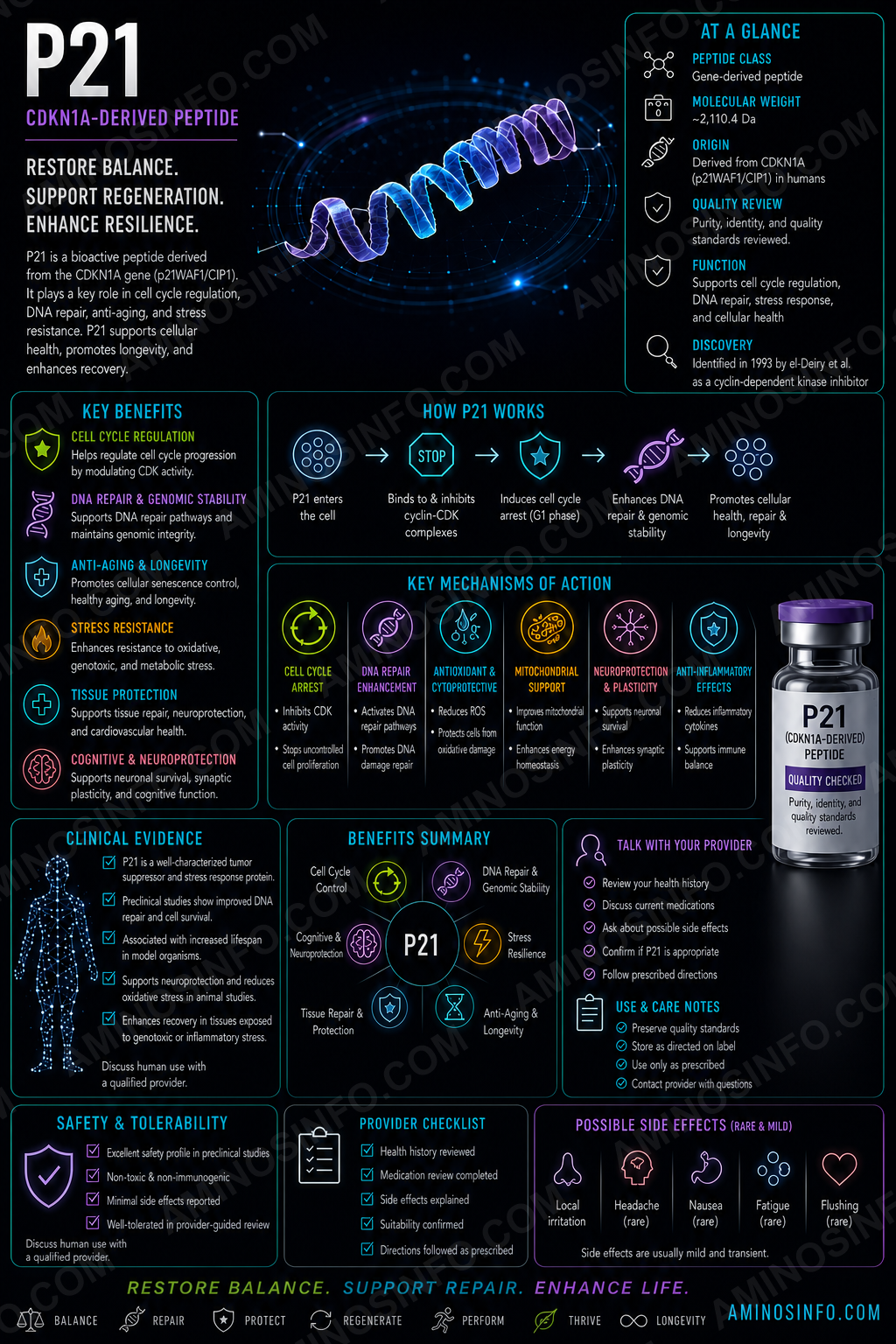
P021 vs p21/CDKN1A
| Feature | P021 peptide | p21/CDKN1A |
|---|---|---|
| Type | Synthetic CNTF-derived compound | Human cell-cycle regulatory protein |
| Main role | Experimental neurotrophic signaling | Cyclin-dependent kinase inhibition |
| Same compound? | No | No |
| Common confusion | Written P21 | Often called p21 |
🔗 Related Peptides and Pathways
- CNTF: Parent neurotrophic protein.
- Peptide 6: Longer CNTF-derived neurogenic peptide.
- Peptide 6c: Ac-DGGL-NH₂ parent tetrapeptide.
- BDNF: Neurotrophic factor increased in several P021 studies.
- LIF: Cytokine pathway proposed to be inhibited by P021.
- GSK3β: Tau kinase whose activity is reduced in several models.
- CREB: Memory- and plasticity-related transcription factor.
- Adamantylated glycine: Noncanonical residue used to improve pharmacokinetic properties.
🖼️ Original Diagram Specifications
Diagram 1: P021 molecular structure
Show N-acetyl-DGGL linked to one adamantylated glycine residue with a C-terminal amide. Clearly label the noncanonical residue.
Diagram 2: CNTF-to-P021 development
Show full-length CNTF → peptide 6 → DGGL peptide 6c → adamantane-modified P021.
Diagram 3: LIF–BDNF–GSK3β pathway
Show P021 reducing LIF signaling, increasing BDNF, activating downstream neurotrophic pathways, inhibiting GSK3β, and reducing tau phosphorylation.
Diagram 4: Neurogenesis pathway
Show dentate-gyrus progenitor proliferation, doublecortin-positive immature neurons, maturation, survival, and synaptic integration.
Diagram 5: Alzheimer’s-model outcomes
Show tau, amyloid, synaptic proteins, CREB, neurogenesis, inflammation, and cognition as separate preclinical endpoints.
Diagram 6: Evidence ladder
Show chemical identity, cell studies, rodent PK, mouse disease models, formal toxicology, phase 1 trials, phase 2/3 trials, and regulatory approval.
Diagram 7: COA workflow
Show structural drawing, HRMS, MS/MS, NMR, chiral analysis, parent peptide, adamantane impurities, net content, microbiology, and stability.
❓ Frequently Asked Questions
Is P021 a peptide?
It is a synthetic peptidergic compound containing a CNTF-derived tetrapeptide core and a noncanonical adamantylated glycine residue.
What is the correct sequence?
Ac-DGGLAG-NH₂.
Does AG mean alanine-glycine?
No. The superscript notation represents one adamantylated glycine residue.
What is its molecular weight?
Published studies report approximately 578.3 g/mol.
Is P021 the same as p21?
No. p21/CDKN1A is a cell-cycle protein.
Is P021 FDA approved?
No.
Does P021 cross the blood–brain barrier?
Rodent research and reviews describe it as BBB permeable, but human brain exposure is unknown.
Is P021 orally active?
Yes in multiple rodent studies, including long-term dietary administration.
Does it increase BDNF?
Several models show increased BDNF, but the effect was absent in one recent CDKL5 mouse study.
Does P021 improve memory?
It improved cognition in multiple animal models. No human trial has established memory benefit.
Does it reduce tau?
Animal studies report reduced abnormal tau phosphorylation and accumulation.
Does it treat Alzheimer’s disease?
No human efficacy has been established.
Is P021 safe?
Animal studies generally report good tolerability, but complete human safety and chronic toxicology are unknown.
Does 99% HPLC purity prove authentic P021?
No. The adamantylated residue, linkage, sequence, termini, exact mass, and net content require orthogonal confirmation.
Final Thoughts
P021 is a legitimate published experimental compound with a clearer identity and stronger preclinical evidence base than many designer peptides. It is derived from the DGGL active region of CNTF and modified with N-terminal acetylation, C-terminal amidation, and one adamantylated glycine residue.
Animal studies report neurogenesis, synaptic preservation, improved cognition, increased BDNF and CREB signaling, reduced GSK3β activity, and lower tau and amyloid pathology in selected models. However, the evidence remains preclinical, treatment often began before advanced disease, and the 2024 CDKL5 study showed limited in-vivo benefit despite positive cell findings.
Legitimate P021 material should be verified for the complete noncanonical structure, exact mass, DGGL sequence, acetylation, amidation, adamantane linkage, stereochemistry, parent-peptide and modifier impurities, net content, route-specific microbiological quality, and stability.
📚 References
- Blanchard J, et al. Neurotrophic peptides incorporating adamantane improve learning and memory, promote neurogenesis and synaptic plasticity in mice. FEBS Letters. 2010.
- Li B, et al. Neurotrophic peptide P021 and neurogenesis in adult animals. FEBS Letters. 2010.
- Bolognin S, et al. Rescue of cognitive aging by administration of a neurogenic and/or neurotrophic compound. Neurobiology of Aging. 2014.
- Kazim SF, et al. Disease-modifying effect of chronic oral treatment with a CNTF-derived peptidergic compound in a triple-transgenic mouse model of Alzheimer’s disease. Neurobiology of Disease. 2014.
- Kazim SF, et al. Neurotrophic factor small-molecule mimetics mediated neuroregeneration and synaptic repair. Molecular Neurodegeneration. 2016.
- Kazim SF, et al. Early neurotrophic pharmacotherapy rescues developmental delay and Alzheimer-like memory deficits in the Ts65Dn mouse model of Down syndrome. Scientific Reports. 2017.
- Baazaoui N, et al. Prevention of dendritic and synaptic deficits and cognitive impairment with a neurotrophic compound. Alzheimer’s Research & Therapy. 2017.
- Liu Y, et al. Inhibition of AMD-like pathology with a neurotrophic compound. 2019.
- Wei W, et al. Prenatal to early postnatal neurotrophic treatment prevents Alzheimer-like behavior and pathology. 2020.
- Wei W, et al. Neurotrophic treatment initiated during early postnatal development prevents Alzheimer-like behavior and synaptic dysfunction. 2021.
- Gascon S, et al. Peptides derived from growth factors to treat Alzheimer’s disease. 2021.
- Mottolese N, et al. Effects of a CNTF small-molecule mimetic in CDKL5 deficiency models. 2024.
- Falangola MF, et al. Diffusion MRI measures detect brain microstructure changes due to early P021 treatment. 2026.
- US Patent. Neurotrophic peptides for treatment of tauopathies.
- Pasquin S, Sharma M, Gauchat JF. Ciliary neurotrophic factor (CNTF): new facets of an old molecule for treating neurodegenerative and metabolic syndrome pathologies. Cytokine & Growth Factor Reviews.
- Ip NY, et al. The alpha component of the CNTF receptor is required for signaling. Cell.
- Davis S, et al. Released form of CNTF receptor potentiates CNTF signaling. Science.
- Stahl N, et al. Association and activation of Jak-Tyk kinases by CNTF receptor components. Science.
- Bonni A, et al. Cell survival promoted by the Ras-MAPK signaling pathway. Science.
- Park H, Poo MM. Neurotrophin regulation of neural circuit development and function. Nature Reviews Neuroscience.
- Lu B, Nagappan G, Lu Y. BDNF and synaptic plasticity, cognitive function, and dysfunction. Handbook of Experimental Pharmacology.
- Waterhouse EG, Xu B. New insights into the role of BDNF in synaptic plasticity. Molecular and Cellular Neuroscience.
- Doble BW, Woodgett JR. GSK-3: tricks of the trade for a multi-tasking kinase. Journal of Cell Science.
- Hooper C, Killick R, Lovestone S. The GSK3 hypothesis of Alzheimer’s disease. Journal of Neurochemistry.
- Hanger DP, Anderton BH, Noble W. Tau phosphorylation: the therapeutic challenge for neurodegenerative disease. Trends in Molecular Medicine.
- Wang Y, Mandelkow E. Tau in physiology and pathology. Nature Reviews Neuroscience.
- Hardy J, Selkoe DJ. The amyloid hypothesis of Alzheimer’s disease. Science.
- Long JM, Holtzman DM. Alzheimer disease: an update on pathobiology and treatment strategies. Cell.
- Oakley H, et al. Intraneuronal beta-amyloid aggregates and cognitive deficits in transgenic mice. Journal of Neuroscience.
- Oddo S, et al. Triple-transgenic model of Alzheimer’s disease. Neuron.
- Deng W, Aimone JB, Gage FH. New neurons and new memories: how does adult hippocampal neurogenesis affect learning and memory? Nature Reviews Neuroscience.
- Gonçalves JT, Schafer ST, Gage FH. Adult neurogenesis in the hippocampus. Cell.
- Kempermann G, et al. Human adult neurogenesis: evidence and remaining questions. Cell Stem Cell.
- Ben-Ari Y. Excitatory actions of GABA during development. Nature Reviews Neuroscience.
- Herault Y, et al. Rodent models in Down syndrome research. Disease Models & Mechanisms.
- Dierssen M. Down syndrome: the brain in trisomic mode. Nature Reviews Neuroscience.
- Fehr S, et al. The CDKL5 disorder is an independent clinical entity. European Journal of Human Genetics.
- Olson HE, et al. Cyclin-dependent kinase-like 5 deficiency disorder. Pediatric Neurology.
- Wanka L, Iqbal K, Schreiner PR. The lipophilic bullet hits the targets: medicinal chemistry of adamantane derivatives. Chemical Reviews.
- Liu J, et al. The many faces of the adamantyl group in drug design. European Journal of Medicinal Chemistry.
- Lau JL, Dunn MK. Therapeutic peptides: historical perspectives and current development trends. Bioorganic & Medicinal Chemistry.
- Fosgerau K, Hoffmann T. Peptide therapeutics: current status and future directions. Drug Discovery Today.
- Craik DJ, Fairlie DP, Liras S, Price D. The future of peptide-based drugs. Chemical Biology & Drug Design.
- International Council for Harmonisation. ICH Q2(R2): Validation of Analytical Procedures.
- International Council for Harmonisation. ICH Q3A and Q3B: Impurities in New Drug Substances and Products.
- International Council for Harmonisation. ICH Q3C: Residual Solvents.
- International Council for Harmonisation. ICH Q1A(R2): Stability Testing of New Drug Substances and Products.
- International Council for Harmonisation. ICH M10: Bioanalytical Method Validation.
- United States Pharmacopeia General Chapter <621>: Chromatography.
- United States Pharmacopeia General Chapter <71>: Sterility Tests.
- United States Pharmacopeia General Chapter <85>: Bacterial Endotoxins Test.
- United States Pharmacopeia General Chapters <232> and <233>: Elemental Impurities.
Identity, molecular structure, CNTF relationship, neurogenesis, cognition, tau, amyloid, developmental, retinal, pharmacokinetic, safety, and analytical evidence were reviewed in July 2026. P021 remains an unapproved investigational compound.