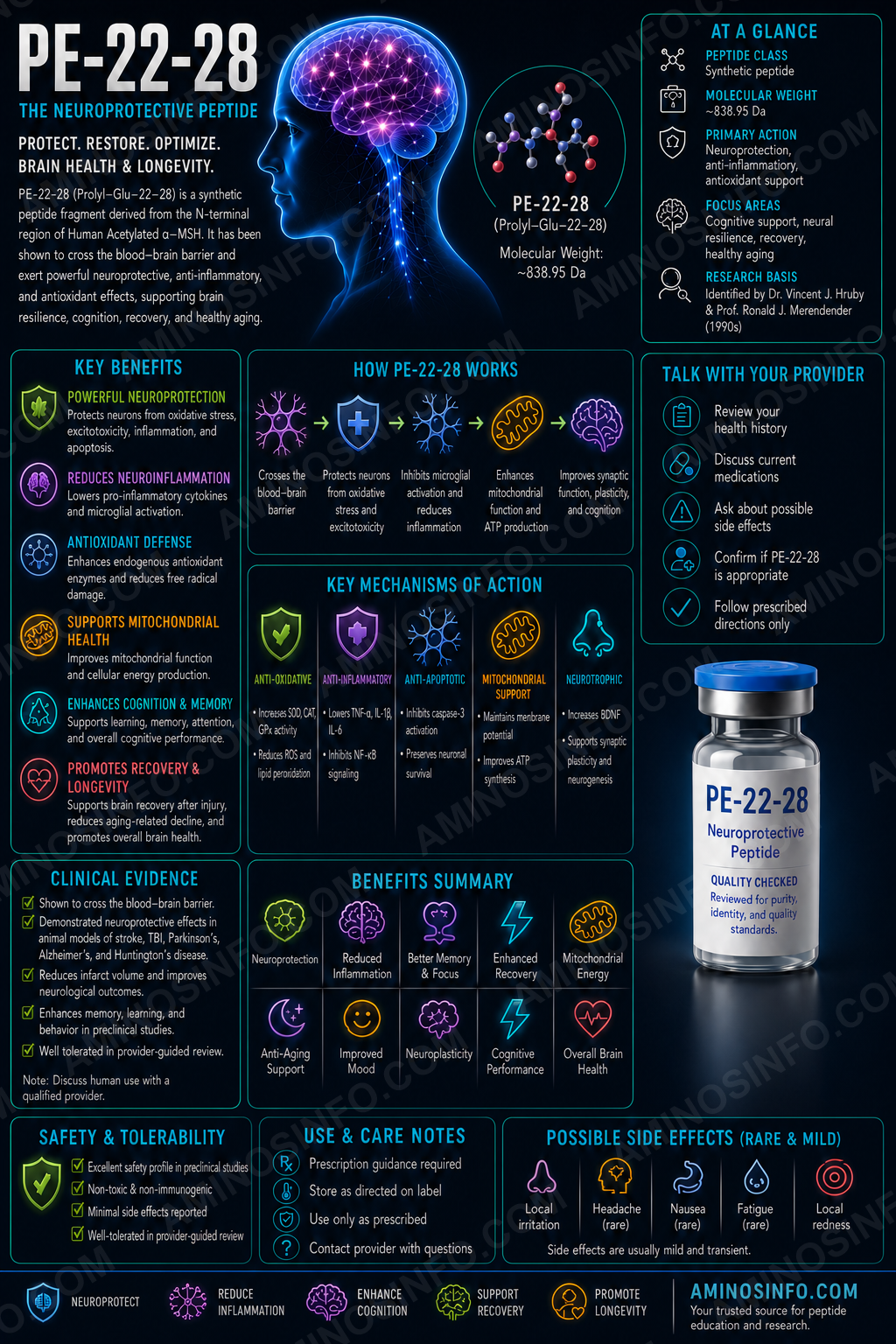
PE 22-28: What It Is, How It Works, Benefits, and Research Overview
A corrected, evidence-graded review of PE 22-28, including its seven-amino-acid GVSWGLR sequence, molecular properties, derivation from spadin and sortilin, high-potency TREK-1 inhibition, antidepressant-like behavior, neurogenesis, synaptogenesis, ischemia-related research, evidence limitations, safety, analytical testing, and COA interpretation.
What Is PE 22-28?
PE 22-28, also written PE-22-28 or PE22-28, is a synthetic seven-amino-acid peptide derived from the C-terminal portion of spadin, a longer sortilin-derived peptide studied as an inhibitor of the two-pore-domain potassium channel TREK-1.
Researchers created shortened spadin analogues to identify the minimum sequence that retained TREK-1 inhibition while improving potency and biological persistence. Among the tested fragments, PE 22-28 was reported as the shortest and most potent core sequence.
GVSWGLR
7 amino acids
TREK-1 / K2P2.1
Approximately 0.12 nM
Antidepressant-like signaling
No
🧬 Molecular Structure
🧪 Amino-acid sequence
Gly-Val-Ser-Trp-Gly-Leu-Arg-OH
One-letter notation:
GVSWGLR
Terminal chemistry
The published reference sequence is generally represented with a free N-terminal glycine and a free C-terminal arginine carboxyl group. Acetylated, amidated, biotinylated, lipidated, or substituted forms are distinct analogues and should not be labeled simply as native PE 22-28 without qualification.
Structural characteristics
- Seven standard L-amino acids
- Linear peptide
- No cysteine or disulfide bonds
- One tryptophan residue
- Basic C-terminal arginine
- Hydrophobic valine, tryptophan, and leucine residues
⚛️ Molecular Weight and 🧫 Formula
| Molecular formula | C35H55N11O9 |
|---|---|
| Average molecular weight | Approximately 773.89 g/mol |
| Peptide length | 7 amino acids |
| Sequence | GVSWGLR |
| Common CAS number | 1801959-12-5 |
| Disulfide bonds | None |
Acetate salt
Commercial research material is sometimes sold as an acetate salt. The reported formula weight then depends on the amount of associated acetate and water. The peptide’s net content must therefore be distinguished from total vial mass.
📅 Discovery Timeline and Research History
1996–1997: Sortilin and neurotensin receptor-3 characterized
Sortilin was identified as a receptor and trafficking protein involved in neurotensin biology, protein sorting, neuronal signaling, and later proneurotrophin pathways.
2010: Spadin described
Spadin, corresponding to residues PE 12-28 of the sortilin propeptide, was reported to inhibit TREK-1 and produce rapid antidepressant-like effects in mice.
2010–2014: Neurogenesis and synaptic research expands
Spadin was reported to increase hippocampal neurogenesis, synaptogenesis, and selected plasticity markers.
2015: TREK-1 blockade and serotonergic signaling
Independent pharmacological work strengthened the relationship between TREK-1 inhibition, antidepressant-like behavior, and CREB–BDNF signaling.
2017: Shortened spadin analogues published
A library of 22 shortened and modified peptides was screened. PE 22-28 emerged as a seven-residue core with an IC₅₀ near 0.12 nM, compared with approximately 40 nM for spadin in the reported assay.
2017: Antidepressant-like and plasticity findings
PE 22-28 and selected analogues reduced depressive-like behavior and increased hippocampal neurogenesis and PSD-95 expression in mice.
2018–2019: TREK-1 reviews and analog development
Reviews positioned shortened spadin analogues as high-affinity research tools and possible leads for novel antidepressant development.
Current status
No recognized phase 1–3 human clinical-development program or FDA-approved PE 22-28 product has been established.
Sortilin, Propeptide, and Spadin Origins
Sortilin
Sortilin, also called neurotensin receptor-3, is a type-I membrane protein involved in intracellular trafficking, neurotrophin signaling, lipoprotein metabolism, and neuronal function.
Sortilin propeptide
Newly synthesized sortilin contains an N-terminal propeptide that is cleaved during maturation. A portion of this propeptide can regulate TREK-1.
Spadin
Spadin is a 17-amino-acid peptide corresponding to residues 12–28 of the sortilin propeptide. Its name was derived from “sortilin-derived peptide with antidepressant effect.”
PE 22-28
PE 22-28 is the seven-amino-acid C-terminal fragment of spadin:
GVSWGLR
Why shortening mattered
Removing nonessential N-terminal residues increased apparent TREK-1-blocking potency and produced a smaller synthesis target. However, shorter sequence does not automatically guarantee better human absorption, brain delivery, or safety.
TREK-1 Biology
What TREK-1 is
TREK-1, encoded by KCNK2, is a two-pore-domain potassium channel also called K2P2.1. It contributes to background potassium currents that stabilize the resting membrane potential.
Channel activation
TREK-1 responds to membrane stretch, temperature, intracellular acidosis, polyunsaturated fatty acids, lysophospholipids, anesthetics, and cellular signaling pathways.
Brain distribution
TREK-1 is expressed in hippocampal, cortical, serotonergic, sensory, and other neuronal populations.
Physiological roles
- Neuronal excitability
- Mood-related circuitry
- Pain and mechanosensation
- Temperature responses
- Ischemic tolerance
- Anesthetic actions
- Neuroprotection
Therapeutic tension
Blocking TREK-1 may enhance antidepressant-like signaling and neurogenesis, while TREK-1 activation can protect neurons during ischemia and excessive excitation. Effects may therefore differ by disease, timing, and tissue.
🧠 Mechanism of Action
1. TREK-1 channel inhibition
PE 22-28 was reported to inhibit human TREK-1 expressed in HEK293 cells with an IC₅₀ of approximately 0.12 nM.
2. Increased membrane excitability
Reducing a background potassium conductance can depolarize neurons and increase responsiveness to synaptic input.
3. Channel internalization
Spadin has been reported to promote TREK-1 internalization. Whether PE 22-28 reproduces the same trafficking mechanism to the same extent requires careful direct testing.
4. Serotonergic and hippocampal signaling
TREK-1 deficiency or blockade can increase firing of dorsal-raphe serotonin neurons and alter downstream hippocampal plasticity.
5. CREB and BDNF-related pathways
Antidepressant-like effects of TREK-1 blockade have been associated with CREB phosphorylation, BDNF expression, and neuroplasticity.
🎯 Target and Pathway Profile
| Target or pathway | PE 22-28 relationship |
|---|---|
| TREK-1 / K2P2.1 / KCNK2 | Primary reported target; high-potency inhibition. |
| TREK-2 / K2P10.1 | Lower reported sensitivity than TREK-1 in selectivity studies. |
| TRAAK / K2P4.1 | Lower reported sensitivity than TREK-1. |
| Serotonergic firing | Indirectly increased by TREK-1 loss or blockade in preclinical systems. |
| CREB | Downstream plasticity-associated transcription factor. |
| BDNF | Downstream neurotrophic pathway linked to TREK-1 blockade. |
| PSD-95 | Postsynaptic density marker increased in mouse hippocampal research. |
| Direct serotonin receptor binding | Not established. |
Antidepressant-Like Research
Rodent behavioral assays
PE 22-28 was evaluated in commonly used preclinical tests, including the forced-swim test, novelty-suppressed feeding, and learned-helplessness paradigms.
Reported findings
Repeated low-dose administration reduced immobility, shortened latency to feed, and improved escape behavior in mice.
Rapid-onset concept
Spadin-family compounds produced effects after several days in animal experiments, faster than the several-week delay historically associated with many conventional antidepressants.
Behavioral tests are not depression diagnoses
Forced-swim immobility and feeding latency measure stress-coping or motivational behavior, not the full human syndrome of major depressive disorder.
No human antidepressant evidence
No randomized controlled human trial has established efficacy for depression, anxiety, bipolar depression, treatment-resistant depression, or suicidality.
Neurogenesis and Synaptogenesis Research
Hippocampal neurogenesis
PE 22-28 and selected analogues increased markers of cell proliferation and immature neurons in the dentate gyrus.
PSD-95
Mouse hippocampal studies reported increased PSD-95, a postsynaptic scaffold protein commonly used as a synaptogenesis-related marker.
Spadin precedent
Earlier spadin research reported increased neurogenesis, dendritic spine maturation, and synaptic proteins.
Potential relationship to mood
Hippocampal neurogenesis is associated with stress adaptation and some antidepressant responses, but it is not the sole mechanism of depression treatment.
No proof of human neuron growth
No human imaging, cerebrospinal-fluid, histological, or clinical evidence demonstrates that PE 22-28 increases neurogenesis or synapse formation in people.
Serotonin, CREB, and BDNF Pathways
TREK-1 and serotonin neurons
TREK-1 is expressed in dorsal-raphe serotonergic neurons. Genetic deletion increases their firing and produces antidepressant-like behavior in mice.
Indirect serotonergic action
PE 22-28 is not an SSRI and has not been shown to block the serotonin transporter directly.
5-HT1A interaction research
Pharmacological TREK-1 blockade may interact synergistically with 5-HT1A receptor activation through shared CREB–BDNF pathways.
CREB
CREB regulates genes involved in neuronal survival, learning, stress adaptation, and synaptic plasticity.
BDNF
BDNF supports neuronal plasticity and is often altered by antidepressant treatment, but increases in BDNF are neither unique to effective antidepressants nor sufficient to prove clinical efficacy.
Ischemia and Neuronal-Injury Research
TREK-1 can be neuroprotective
TREK-1 activation hyperpolarizes neurons and can reduce excitotoxicity during ischemia, seizures, or metabolic stress.
Apparent conflicting claims
Some commercial databases attribute reduced stroke deficits or cell death to PE 22-28 or related spadin analogues. These findings must be distinguished from the established protective role of TREK-1 activation in acute ischemia.
Timing may determine outcome
Chronic TREK-1 blockade may promote plasticity and mood-related signaling, while acute blockade during energy failure could theoretically increase excitability.
No stroke treatment evidence
PE 22-28 is not an approved neuroprotective therapy and must not replace emergency stroke evaluation, reperfusion, antiplatelet therapy, or rehabilitation.
Pancreatic Beta-Cell and Peripheral Research
TREK-1 outside the brain
TREK-1 is expressed in sensory, smooth-muscle, vascular, pancreatic, and other tissues.
Beta-cell survival claims
Some research summaries report reduced apoptotic death of pancreatic beta cells with PE 22-28 in ischemia-related models. The exact direct evidence base is much smaller than the depression literature and should not be generalized.
Insulin secretion
Background potassium channels influence membrane excitability and secretion, but PE 22-28 has not been established as a diabetes therapy.
Muscle and bladder claims
Commercial articles sometimes extrapolate to smooth-muscle or bladder function. Direct PE 22-28 evidence is sparse and does not establish clinical utility.
Channel Selectivity and Physiological Tradeoffs
TREK-1 selectivity
The 2017 analogue study reported substantially higher potency for TREK-1 than spadin and lower effects at related TREK-2 and TRAAK channels.
Absolute selectivity is not proven
A peptide may interact with unrelated channels, receptors, membranes, transporters, or proteins not included in the original screen.
Pain and sensory effects
TREK-1 contributes to pain processing and mechanosensation. Long-term blockade could alter sensory thresholds.
Anesthesia and temperature
TREK-1 participates in volatile-anesthetic actions and thermosensation. The significance of sustained inhibition is unknown.
Seizure and excitability concern
Reducing background potassium current can increase neuronal excitability, creating a theoretical seizure or excitotoxicity concern that requires formal testing.
Stability and Pharmacokinetic Limitations
Spadin duration
Spadin’s in-vivo activity was reported to decline within hours, motivating the development of shorter and modified analogues.
PE 22-28 persistence
The 2017 study reported improved in-vivo stability and behavioral activity relative to spadin, with effects observed well beyond the parent peptide’s shorter window.
Exact half-life
Commercial claims of a greater-than-24-hour half-life should not be treated as established human pharmacokinetics. Behavioral persistence is not identical to plasma half-life.
Brain delivery
Rodent behavioral effects imply that active peptide or downstream signaling reaches relevant circuits, but the precise route, transport mechanism, brain concentration, and metabolite activity remain incompletely characterized.
Human pharmacokinetics
Absorption, bioavailability, half-life, clearance, tissue distribution, and blood–brain barrier exposure are unknown in humans.
Evidence Limitations and Clinical Interpretation
Single primary analogue paper
The most direct PE 22-28 evidence is concentrated in the 2017 shortened-spadin analogue study.
Parent-peptide extrapolation
Many claims are inherited from spadin, genetic TREK-1 knockout models, or unrelated TREK-1 blockers.
Behavioral-model limitations
Rodent stress tests do not fully reproduce human depression, trauma, bipolar disorder, or treatment resistance.
Limited toxicology
Comprehensive safety pharmacology, reproductive, developmental, genotoxic, carcinogenic, seizure-liability, cardiovascular, and chronic-organ studies are not established.
No human trials
No controlled human efficacy, dose-ranging, pharmacokinetic, or safety study has been established.
Publication concentration
Much of the spadin and PE 22-28 literature comes from a connected group of investigators, increasing the importance of independent replication.
Safety and Regulatory Considerations
No established human safety profile
No approved label defines dose, route, contraindications, interactions, pregnancy safety, psychiatric monitoring, or chronic adverse effects.
Potential neurological risks
- Agitation or anxiety
- Sleep disruption
- Headache
- Altered pain or temperature sensation
- Excess neuronal excitability
- Seizure liability
- Mood switching in susceptible individuals
Psychiatric risk
Any experimental compound promoted for mood must be evaluated for suicidality, mania, mixed states, psychosis, withdrawal effects, and interactions with antidepressants or stimulants.
Drug interactions
Interactions with SSRIs, SNRIs, MAO inhibitors, lithium, antipsychotics, anticonvulsants, sedatives, stimulants, or anesthetics are unknown.
Product-quality risk
Unapproved material may contain deletion sequences, D-amino-acid epimers, oxidized tryptophan, incorrect salt content, endotoxin, residual solvents, or inaccurate peptide quantity.
Regulatory status
PE 22-28 is not FDA approved.
🧪 Laboratory Testing Methods
| Method | Purpose | Important limitation |
|---|---|---|
| RP-HPLC / UPLC | Separates PE 22-28 from truncations, deletion sequences, oxidation products, and synthesis impurities. | Area purity does not prove identity or content. |
| LC-HRMS | Confirms intact mass and elemental composition. | Sequence isomers and epimers may share mass. |
| MS/MS sequencing | Confirms the GVSWGLR residue order. | Leucine and isoleucine require careful differentiation. |
| Amino-acid analysis | Confirms overall composition and supports content assignment. | Does not establish residue order. |
| Chiral amino-acid analysis | Detects D-amino-acid epimers from synthesis or degradation. | Hydrolysis can complicate quantification. |
| Net peptide-content assay | Measures actual PE 22-28 amount. | Must correct for acetate, water, and residual solvents. |
| Tryptophan-oxidation assay | Detects oxidized or degraded tryptophan species. | Light and handling can create artifacts. |
| TREK-1 electrophysiology | Measures direct channel inhibition and IC₅₀. | Expression system and membrane conditions affect potency. |
| TREK-2 and TRAAK counter-screens | Evaluate related-channel selectivity. | Does not exclude unrelated off-targets. |
| Broad ion-channel panel | Assesses hERG, sodium, calcium, and other potassium-channel liabilities. | Requires clinically relevant concentrations. |
| Receptor and transporter panel | Identifies unexpected serotonergic, adrenergic, dopaminergic, or other binding. | Binding does not always equal functional activity. |
| Plasma and protease stability | Measures degradation and metabolite formation. | Animal plasma does not predict human stability fully. |
| Brain/plasma pharmacokinetics | Measures systemic exposure and CNS distribution. | Human data are unavailable. |
| Neurogenesis and synaptic assays | Measures Ki-67, BrdU, DCX, PSD-95, and related markers. | Markers do not prove functional antidepressant efficacy. |
| Microbial limits, sterility, and endotoxin | Evaluate route-specific microbiological quality. | Requirements depend on final dosage form. |
| Stability-indicating assay | Tracks hydrolysis, oxidation, epimerization, aggregation, and potency loss. | Requires defined formulation and storage conditions. |
📄 How to Interpret a PE 22-28 COA
- Verify the complete seven-amino-acid sequence: GVSWGLR.
- Confirm terminal chemistry: Free N-terminus and C-terminal carboxyl group unless a specific analogue is intended.
- Confirm formula and molecular weight: C₃₅H₅₅N₁₁O₉ and approximately 773.89 g/mol for the free peptide.
- Account for acetate and water: Salt and moisture increase total vial weight without increasing peptide content.
- Use MS/MS sequencing: HPLC and intact mass alone cannot prove residue order.
- Review truncations and deletion sequences: Seven-residue synthesis can still produce closely related impurities.
- Review tryptophan oxidation and amino-acid epimerization.
- Measure net peptide content: A “99% purity” result is not the labeled number of milligrams.
- Require functional TREK-1 testing: Ideally include TREK-2, TRAAK, and broader ion-channel counter-screens.
- Do not infer efficacy: A COA cannot prove antidepressant effects, neurogenesis, brain penetration, rapid onset, or human safety.
📊 PE 22-28 vs Spadin vs Sortilin Propeptide
| Feature | PE 22-28 | Spadin / PE 12-28 | Sortilin propeptide |
|---|---|---|---|
| Length | 7 amino acids | 17 amino acids | Larger precursor segment |
| Sequence region | Residues 22–28 | Residues 12–28 | Full propeptide |
| TREK-1 potency | Approximately 0.12 nM in published assay | Approximately 40 nM in published comparison | Lower and less optimized |
| Main use | Experimental high-potency TREK-1 probe | Parent antidepressant-like peptide | Endogenous sortilin maturation biology |
PE 22-28 vs SSRI vs Ketamine vs Psilocybin
| Compound | Main mechanism | Evidence stage |
|---|---|---|
| PE 22-28 | TREK-1 inhibition | Preclinical only |
| SSRI | Serotonin-transporter inhibition | Approved human antidepressant class |
| Ketamine / esketamine | NMDA-receptor-related rapid plasticity signaling | Approved in selected settings |
| Psilocybin | 5-HT2A agonism | Investigational or regulated research depending on jurisdiction |
PE 22-28 vs Other Potassium-Channel Targets
| Target | Function | PE 22-28 relevance |
|---|---|---|
| TREK-1 / K2P2.1 | Background K⁺ current, mood, pain, ischemia | Primary reported target |
| TREK-2 / K2P10.1 | Sensory and background K⁺ current | Lower reported sensitivity |
| TRAAK / K2P4.1 | Mechanosensitive neuronal K⁺ current | Lower reported sensitivity |
| hERG / KCNH2 | Cardiac repolarization | Must be excluded in formal safety panels |
PE 22-28 vs Approved Depression Care
| Approach | Established role | Difference from PE 22-28 |
|---|---|---|
| Psychotherapy | First-line or adjunctive treatment | Human outcome evidence and no peptide-quality risk |
| Approved antidepressants | Multiple depressive and anxiety disorders | Defined dosing, monitoring, and adverse-effect data |
| Esketamine | Selected treatment-resistant depression | Controlled clinical use and safety monitoring |
| Electroconvulsive therapy | Severe or urgent depression | Strong evidence for selected patients |
| PE 22-28 | Experimental TREK-1 research peptide | No established human safety or efficacy |
🔗 Related Peptides, Channels, and Pathways
- Spadin: 17-amino-acid parent peptide.
- Sortilin / NTSR3: Protein from whose propeptide spadin was derived.
- TREK-1 / KCNK2: Primary potassium-channel target.
- TREK-2 and TRAAK: Related K2P channels used in selectivity testing.
- CREB and BDNF: Plasticity-associated downstream pathways.
- 5-HT1A: Serotonin receptor linked to TREK-1-blockade synergy.
- PSD-95: Postsynaptic marker increased in preclinical research.
- G/A-PE 22-28: Analogue in which a glycine is replaced with alanine.
🖼️ Original Diagram Specifications
Diagram 1: PE 22-28 molecular sequence
Show the linear GVSWGLR peptide with free N- and C-termini and hydrophobic, polar, aromatic, and basic residues labeled.
Diagram 2: Sortilin-to-PE 22-28 development
Show sortilin precursor → propeptide → spadin/PE 12-28 → PE 22-28/GVSWGLR.
Diagram 3: TREK-1 channel blockade
Show background potassium efflux through TREK-1, membrane stabilization, PE 22-28 binding, reduced K⁺ current, and increased neuronal excitability.
Diagram 4: Antidepressant-like pathway
Show TREK-1 inhibition → dorsal-raphe firing → serotonin-network activity → CREB/BDNF → hippocampal plasticity.
Diagram 5: Neurogenesis and synaptogenesis
Show dentate-gyrus progenitors, DCX-positive neurons, dendritic maturation, PSD-95, and synapse formation.
Diagram 6: Benefit–risk tradeoff
Show mood and plasticity signaling on one side and possible hyperexcitability, seizure, pain, temperature, and ischemia-related risks on the other.
Diagram 7: COA workflow
Show sequence, intact mass, MS/MS, chiral analysis, tryptophan oxidation, acetate correction, net content, TREK-1 potency, related-channel selectivity, microbiology, and stability.
❓ Frequently Asked Questions
Is PE 22-28 a peptide?
Yes. It is a synthetic linear heptapeptide.
What is its exact sequence?
Gly-Val-Ser-Trp-Gly-Leu-Arg, or GVSWGLR.
Is it 22 to 28 amino acids long?
No. It contains seven amino acids. The name identifies its location within the longer spadin sequence.
What is its molecular formula?
C₃₅H₅₅N₁₁O₉ for the free peptide.
What is its molecular weight?
Approximately 773.89 g/mol.
What does PE 22-28 target?
Its primary reported target is the TREK-1 two-pore-domain potassium channel.
How potent is it?
The published cell assay reported an IC₅₀ near 0.12 nM.
Is PE 22-28 an SSRI?
No. It does not primarily inhibit the serotonin transporter.
Does it work rapidly?
Rodent antidepressant-like effects appeared after a short treatment period, but rapid human efficacy has not been established.
Does it increase neurogenesis?
Mouse studies reported increased hippocampal neurogenesis markers. Human evidence is unavailable.
Is PE 22-28 FDA approved?
No.
Has it been tested in humans?
No established controlled human clinical trial was identified.
Could it increase seizure risk?
That remains unknown, but increasing neuronal excitability creates a theoretical concern requiring formal safety testing.
Is PE 22-28 the same as spadin?
No. It is a shorter seven-residue fragment of the 17-residue spadin peptide.
Does 99% HPLC purity prove identity?
No. Sequence, stereochemistry, mass, net content, oxidation, and functional channel activity require separate confirmation.
Final Thoughts
PE 22-28 is a well-defined seven-amino-acid experimental peptide derived from the C-terminal region of spadin. Its principal scientific significance is exceptionally potent inhibition of the TREK-1 background potassium channel in a published cell assay.
Preclinical studies report antidepressant-like behavioral effects, increased hippocampal neurogenesis, and higher PSD-95 expression. However, the evidence remains concentrated in rodent and cellular research, and many broader claims are extrapolated from spadin, TREK-1 knockout animals, or other channel blockers.
Legitimate PE 22-28 material should be verified for its GVSWGLR sequence, free terminal chemistry, exact mass, tryptophan oxidation, amino-acid stereochemistry, deletion peptides, acetate and water content, net peptide quantity, TREK-1 potency, related-channel selectivity, broader ion-channel liabilities, route-specific microbiological quality, and stability.
📚 References
- Djillani A, et al. Shortened Spadin Analogs Display Better TREK-1 Inhibition, In Vivo Stability and Antidepressant Activity. Frontiers in Pharmacology. 2017.
- Djillani A, et al. PubMed record: Shortened Spadin Analogs Display Better TREK-1 Inhibition. 2017.
- Mazella J, et al. Spadin, a Sortilin-Derived Peptide, Targeting Rodent TREK-1 Channels: A New Concept in the Antidepressant Drug Design. PLoS Biology. 2010.
- Djillani A, et al. Fighting against depression with TREK-1 blockers. Current Opinion in Pharmacology. 2019.
- Djillani A, et al. Role of TREK-1 in Health and Disease, Focus on the Central Nervous System. Frontiers in Pharmacology. 2019.
- Mazella J, et al. The Involvement of Sortilin/NTSR3 in Depression as the Progenitor of Spadin and Its Role in the Membrane Expression of TREK-1. Frontiers in Pharmacology. 2019.
- Ye D, et al. TREK1 channel blockade induces an antidepressant-like response and synergistic interaction with 5-HT1A receptor activation. 2015.
- Okada M, et al. Antidepressive effect of an inward rectifier potassium-channel blocker. 2020.
- Cayman Chemical. PE 22-28 acetate technical record.
- Tocris Bioscience. PE 22-28 technical data.
- Biomol/Cayman. PE 22-28 sequence and acetate specification.
- MedChemExpress. PE 22-28 TREK-1 inhibitor reference.
- TargetMol. PE 22-28 compound record.
- Patel AJ, et al. A mammalian two-pore domain mechano-gated S-like K+ channel. EMBO Journal. 1998.
- Fink M, et al. Cloning, functional expression and brain localization of a novel unconventional outward rectifier K+ channel. EMBO Journal. 1996.
- Lesage F, Lazdunski M. Molecular and functional properties of two-pore-domain potassium channels. American Journal of Physiology.
- Enyedi P, Czirják G. Molecular background of leak K+ currents: two-pore-domain potassium channels. Physiological Reviews.
- Honore E. The neuronal background K2P channels: focus on TREK1. Nature Reviews Neuroscience.
- Noël J, et al. The mechano-activated K+ channels TRAAK and TREK-1 control both warm and cold perception. EMBO Journal.
- Heurteaux C, et al. TREK-1, a K+ channel involved in neuroprotection and general anesthesia. EMBO Journal.
- Heurteaux C, et al. Deletion of the background potassium channel TREK-1 results in a depression-resistant phenotype. Nature Neuroscience.
- Alloui A, et al. TREK-1, a K+ channel involved in polymodal pain perception. EMBO Journal.
- Mazella J, et al. TREK-1 channel internalization by spadin and antidepressant signaling. Neuroscience literature.
- Devader C, et al. Spadin and hippocampal neurogenesis. Journal of Neurochemistry.
- Devader C, et al. Spadin increases synaptogenesis and dendritic spine maturation. Neuropharmacology.
- Moha Ou Maati H, et al. Spadin as a new antidepressant with a rapid onset of action. Neuropharmacology.
- Vivier D, et al. Perspectives on TREK-1 channel blockers as antidepressants. Expert Opinion on Therapeutic Targets.
- Fink M, et al. TREK-1 activation by arachidonic acid and membrane stretch. EMBO Journal.
- Maingret F, et al. TREK-1 is a heat-activated background K+ channel. EMBO Journal.
- Patel AJ, et al. Inhalational anesthetics activate two-pore-domain background K+ channels. Nature Neuroscience.
- Chemin J, et al. Molecular mechanisms underlying the differential sensitivity of TREK-1 and TRAAK to membrane stretch. Journal of Biological Chemistry.
- Lauritzen I, et al. Polyunsaturated fatty acids are potent neuroprotectors through TREK-1. EMBO Journal.
- Franks NP, Honoré E. The TREK K2P channels and their role in general anaesthesia and neuroprotection. Trends in Pharmacological Sciences.
- Bagot RC, Nestler EJ. Epigenetic mechanisms in depression and neuroplasticity. Neuropsychopharmacology.
- Duman RS, Aghajanian GK. Synaptic dysfunction in depression: potential therapeutic targets. Science.
- Castrén E, Kojima M. Brain-derived neurotrophic factor in mood disorders and antidepressant treatments. Neurobiology of Disease.
- Björkholm C, Monteggia LM. BDNF: a key transducer of antidepressant effects. Neuropharmacology.
- Carlezon WA, et al. The many faces of CREB. Trends in Neurosciences.
- Santarelli L, et al. Requirement of hippocampal neurogenesis for the behavioral effects of antidepressants. Science.
- Surget A, et al. Drug-dependent requirement of hippocampal neurogenesis in a model of depression and antidepressant reversal. Biological Psychiatry.
- Gould E, et al. Neurogenesis in adulthood and stress-related biology. Nature Neuroscience.
- Willner P. The chronic mild stress model of depression. Psychopharmacology.
- Cryan JF, Mombereau C, Vassout A. The tail suspension test as a model for assessing antidepressant activity. Neuroscience & Biobehavioral Reviews.
- Slattery DA, Cryan JF. Using the rat forced swim test to assess antidepressant-like activity. Nature Protocols.
- Samuels BA, Hen R. Novelty-suppressed feeding in the mouse. Nature Protocols.
- Nestler EJ, Hyman SE. Animal models of neuropsychiatric disorders. Nature Neuroscience.
- Fosgerau K, Hoffmann T. Peptide therapeutics: current status and future directions. Drug Discovery Today.
- Lau JL, Dunn MK. Therapeutic peptides: historical perspectives and current development trends. Bioorganic & Medicinal Chemistry.
- Craik DJ, Fairlie DP, Liras S, Price D. The future of peptide-based drugs. Chemical Biology & Drug Design.
- International Council for Harmonisation. ICH Q2(R2): Validation of Analytical Procedures.
- International Council for Harmonisation. ICH Q3A and Q3B: Impurities in New Drug Substances and Products.
- International Council for Harmonisation. ICH Q3C: Residual Solvents.
- International Council for Harmonisation. ICH Q1A(R2): Stability Testing of New Drug Substances and Products.
- International Council for Harmonisation. ICH M10: Bioanalytical Method Validation.
- United States Pharmacopeia General Chapter <621>: Chromatography.
- United States Pharmacopeia General Chapter <71>: Sterility Tests.
- United States Pharmacopeia General Chapter <85>: Bacterial Endotoxins Test.
- United States Pharmacopeia General Chapters <232> and <233>: Elemental Impurities.
Identity, sequence, spadin origin, TREK-1 pharmacology, antidepressant-like behavior, neurogenesis, synaptogenesis, serotonergic signaling, safety, and analytical evidence were reviewed in July 2026. PE 22-28 remains an unapproved investigational peptide.