FGL Peptide: What It Is, How It Works, Benefits, and Research Overview
A corrected, evidence-graded review of FGL, including its 15-amino-acid NCAM-derived sequence, monomeric and multimeric forms, FGFR1 activation, MAPK and PI3K signaling, cognition, memory, synaptic plasticity, neuroprotection, inflammation, stroke, seizure research, human phase I safety, analytical testing, and COA interpretation.
What Is FGL?
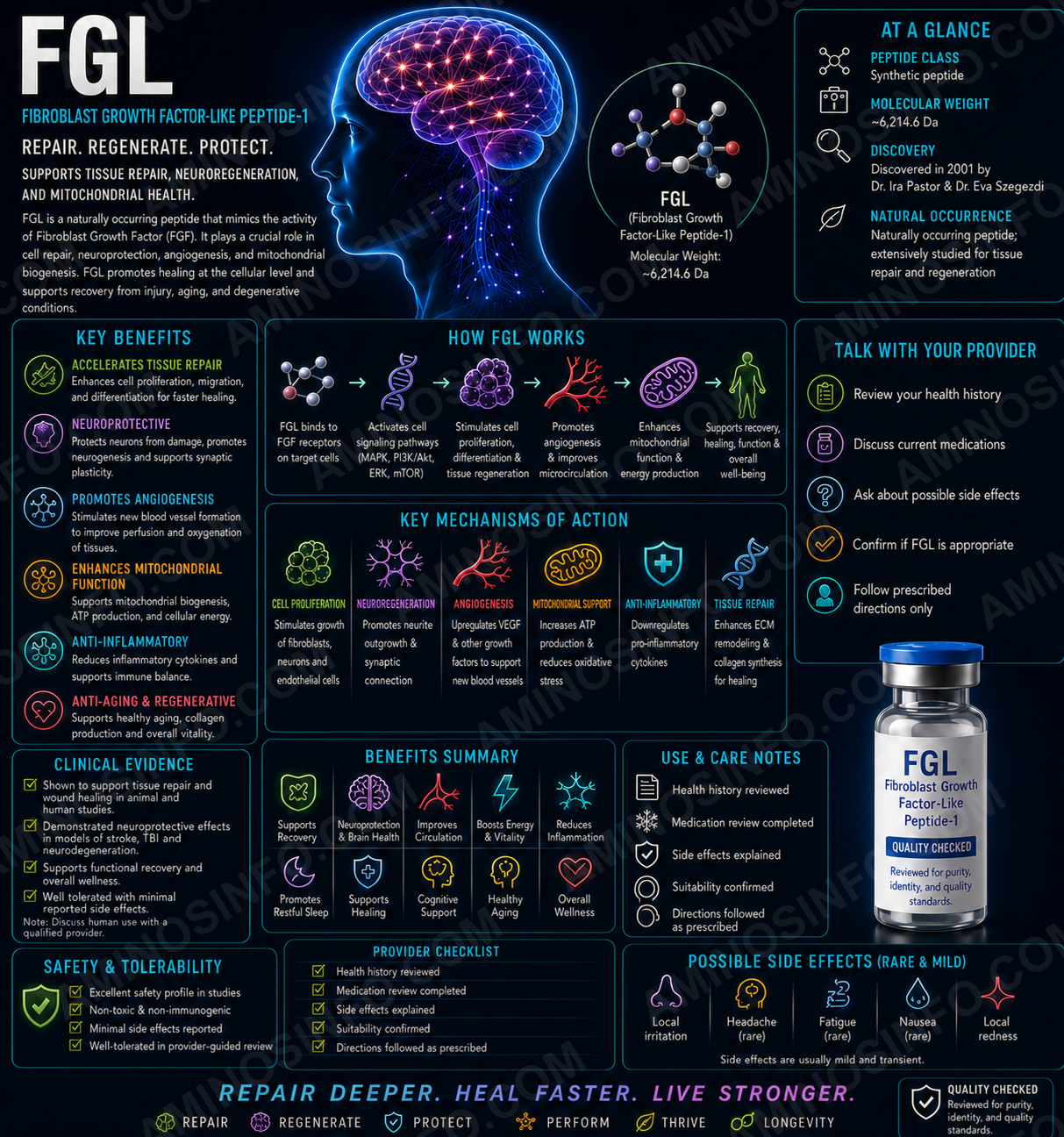
FGL, short for fibroblast growth loop, is a synthetic peptide mimetic derived from the second fibronectin type III domain of neural cell adhesion molecule 1 (NCAM1). The peptide reproduces part of NCAM’s interaction with fibroblast growth factor receptors, especially FGFR1.
Researchers developed FGL to stimulate selected NCAM–FGFR signaling pathways without administering full-length NCAM or fibroblast growth factors. Preclinical work has focused on neurite outgrowth, neuronal survival, synaptic plasticity, memory, inflammation, neurogenesis, and tissue repair.
EVYVVAENQQGKSKA
15 amino acids
NCAM1
FGFR1
MAPK and PI3K/AKT
No
🧬 Structure, Sequence, Formula, and Molecular Weight
🧪 Monomer sequence
Glu-Val-Tyr-Val-Val-Ala-Glu-Asn-Gln-Gln-Gly-Lys-Ser-Lys-Ala
EVYVVAENQQGKSKA
NCAM location
The sequence corresponds to residues approximately Glu681–Ala695 within the FG loop of the second fibronectin type III module of human NCAM1.
⚛️ Monomer molecular properties
| Molecular formula | C71H116N20O25 |
|---|---|
| Average molecular weight | Approximately 1,649.8 g/mol |
| Length | 15 amino acids |
| Disulfide bonds | None |
| Native termini in the monomer | Free N-terminus and free C-terminal carboxyl group unless otherwise specified |
| Common monomer CAS | 499993-62-3 is commonly listed by research suppliers |
Dimeric and tetrameric constructs
Many key studies used multimerized FGL to improve receptor clustering and biological activity. A commonly studied cis dimer called FGLL consists of two FGL monomers attached to a lysine-based scaffold. Some earlier studies used a tetrameric dendrimer composed of four FGL monomers on a lysine backbone.
| Construct | Approximate description | Reported molecular weight |
|---|---|---|
| FGL monomer | One EVYVVAENQQGKSKA chain | ~1,649.8 g/mol |
| FGLL / cis dimer | Two FGL chains attached through a lysine scaffold | ~3,396.7 g/mol in published screening literature |
| FGLd tetramer | Four monomers attached to a lysine dendrimer | Construct-specific; must be defined by full structural drawing |
📅 Discovery Timeline and Research History
1990s: NCAM–FGFR interaction established
Researchers showed that NCAM can promote neurite outgrowth through direct interaction with fibroblast growth factor receptors.
2003: Structural basis identified
The FG-loop region of NCAM’s second fibronectin type III domain was mapped as an FGFR-binding site.
2004: FGL neuritogenic and memory studies
FGL activated FGFR1, promoted neurite outgrowth and neuronal survival, and improved long-term memory in rodents.
2006–2009: Disease-model research expands
Studies investigated amyloid-related cognitive impairment, age-related hippocampal inflammation, schizophrenia-like cognitive deficits, and antidepressant-like behavior.
2007: First-in-human study
Intranasal FGLL was administered to healthy volunteers in a phase I study evaluating safety, tolerability, plasma exposure, and cerebrospinal-fluid penetration.
2010–2012: Anti-inflammatory and synaptic mechanisms
Research linked FGL to reduced microglial activation, altered cytokines, AMPA-receptor delivery, and enhanced synaptic plasticity.
2014: Seizure-model safety signal
In a mouse kindling model, FGL did not clearly prevent epileptogenesis and lower-dose treatment reduced the number of stimulations needed to reach generalized seizures.
2016: Stroke-repair research
FGL mobilized endogenous neural stem-cell and repair-related populations after experimental cerebral ischemia.
2019 onward: Delivery engineering
Hyaluronate conjugation and other delivery systems were explored to improve nasal residence time, enzymatic stability, and brain exposure.
Current status
FGL has not achieved FDA approval, and no large phase II or phase III efficacy program has established clinical benefit.
NCAM and FG-Loop Origins
What NCAM does
Neural cell adhesion molecule is involved in neuronal migration, axonal guidance, synaptic remodeling, learning, and development. Its extracellular region contains immunoglobulin-like and fibronectin type III domains.
NCAM–FGFR interaction
NCAM can bind FGFR independently of fibroblast growth factor ligands. This interaction triggers a signaling pattern that overlaps with, but is not identical to, FGF2 signaling.
The FG loop
FGL reproduces a 15-residue loop implicated in the NCAM–FGFR contact surface.
Critical glutamines
The two glutamine residues within the sequence are important for neuritogenic activity. Replacing them with alanine markedly reduces or abolishes activity in experimental studies.
Why multimerization is used
FGFR activation often depends on receptor clustering. Dimeric and tetrameric FGL constructs may produce stronger and more consistent receptor activation than the free monomer.
🧠 Mechanism of Action
1. FGFR1 activation
FGL binds FGFR1 and stimulates receptor phosphorylation. FGFR blockade suppresses FGL-induced neurite outgrowth and neuronal survival.
2. MAPK/ERK signaling
ERK activation contributes to neurite extension, transcriptional responses, and synaptic plasticity.
3. PI3K/AKT signaling
PI3K and AKT support neuronal survival, metabolism, growth, and anti-apoptotic signaling.
4. AMPA-receptor trafficking
FGL facilitates delivery of GluA1-containing AMPA receptors to synapses, strengthening excitatory transmission and long-term potentiation.
5. Neuroimmune effects
FGL can alter microglial activation, cytokine profiles, IGF-1, and inflammatory signaling in aging and injury models.
🎯 Receptor and Pathway Profile
| Target or pathway | Evidence status |
|---|---|
| FGFR1 | Primary directly supported receptor target. |
| FGFR2 | Interaction has been proposed or reported in selected systems, but FGFR1 is the best-supported target. |
| MAPK/ERK | Required for neurite outgrowth and survival effects. |
| PI3K/AKT | Required for major neurotrophic and survival effects. |
| AMPA receptor GluA1 | Enhanced synaptic delivery in hippocampal studies. |
| IGF-1 | Restored in aged hippocampus in animal research. |
| Microglial activation | Reduced or modified in several inflammatory and aging models. |
| Direct BDNF receptor agonism | Not established. |
Synaptic Plasticity and AMPA-Receptor Research
Long-term potentiation
FGL enhances selected forms of hippocampal long-term potentiation, a cellular model of learning-related synaptic strengthening.
AMPA-receptor delivery
Research showed increased synaptic insertion of GluA1-containing AMPA receptors after FGL treatment.
Dendritic and spine effects
FGL and NCAM–FGFR signaling influence neurite extension, dendritic development, and synapse formation.
State dependence
Excessive excitatory strengthening may be undesirable in epilepsy, excitotoxicity, or maladaptive plasticity.
Plasticity is not guaranteed cognitive benefit
Increased LTP or receptor trafficking does not automatically improve complex human memory, judgment, or executive function.
Learning and Memory Research
Normal rodents
FGL improved performance in hippocampus-dependent memory tasks in rats and mice.
Long-lasting effects
Some studies reported memory facilitation that persisted after treatment ended, suggesting durable changes in synaptic organization.
Age-related cognitive decline
FGL improved selected hippocampal and inflammatory markers in aged animals.
Working and spatial memory
Benefits were reported in spatial navigation, object recognition, and working-memory paradigms.
No proven human cognitive enhancement
The phase I study assessed safety and pharmacokinetics, not treatment of dementia or enhancement of healthy cognition.
Amyloid and Alzheimer’s-Model Research
Amyloid-beta injury
FGL reduced amyloid-beta-associated neuronal damage and rescued selected cognitive deficits in rodent models.
Synaptic resilience
Potential mechanisms include FGFR1 signaling, neuronal survival, AMPA-receptor trafficking, and anti-inflammatory effects.
Model limitations
Acute amyloid-peptide injection models do not reproduce the full chronic pathology of sporadic Alzheimer’s disease.
No amyloid-clearing evidence in humans
FGL has not been shown to reduce amyloid PET, tau biomarkers, dementia progression, or functional decline in people.
Not an approved Alzheimer’s treatment
FGL should not be represented as equivalent to approved symptomatic therapies or anti-amyloid antibodies.
Microglia, Inflammation, and Aging Research
Aged hippocampus
FGL reversed age-related reductions in hippocampal IGF-1 and reduced elevated interferon-gamma in aged rats.
Microglial activation
Studies reported altered microglial morphology and reduced pro-inflammatory activation.
Astrocytes
FGL can influence astrocytic signaling and glial support functions.
Context dependence
Microglia can be protective or harmful depending on disease stage. Broad suppression is not always beneficial.
No established anti-inflammatory indication
FGL is not approved for neuroinflammation, multiple sclerosis, traumatic brain injury, or inflammatory dementia.
Stroke, Neurogenesis, and Repair Research
Experimental cerebral ischemia
FGL has been studied after middle cerebral artery occlusion in rodents.
Endogenous neural stem cells
Subcutaneous FGL mobilized neural stem-cell populations and influenced regenerative compartments after stroke.
Oligodendrocytes and myelin-related repair
Research assessed effects on oligodendrocyte precursor cells and post-stroke tissue remodeling.
Microglial responses
FGL altered post-ischemic inflammatory and repair-related cell populations.
No emergency stroke role
FGL does not replace reperfusion therapy, antiplatelet treatment, blood-pressure management, or rehabilitation.
Depression and Schizophrenia-Model Research
Antidepressant-like effects
FGL produced antidepressant-like behavioral effects in selected rodent models, including NCAM-deficient animals.
FGF2-related signaling
FGFR activation has been linked to stress adaptation and mood-related behavior.
Neonatal PCP model
FGL improved selected cognitive deficits induced by neonatal phencyclidine exposure, a model used to study schizophrenia-related neurodevelopmental impairment.
No clinical psychiatric evidence
FGL has not been proven to treat depression, schizophrenia, bipolar disorder, psychosis, or anxiety in humans.
Seizure and Hyperexcitability Research
Kindling model
A 2014 study evaluated whether FGL altered seizure progression and neurogenesis in amygdala-kindled mice.
Mixed findings
FGL did not consistently prevent kindling. Mice receiving the lower dose required fewer stimulations to reach generalized seizures, while later high-dose treatment showed a trend toward reduced seizure severity.
Neurogenesis effects differed by context
High-dose FGL attenuated one kindling-associated DCX response but did not normalize all proliferation and newborn-neuron measures.
Safety implication
Because FGL strengthens excitatory synaptic transmission and growth-factor signaling, seizure liability and network hyperexcitability require direct assessment.
Human Phase I and Pharmacokinetic Evidence
First-in-human intranasal study
A small healthy-volunteer study evaluated intranasal FGLL, a dimeric FGL construct.
Reported tolerability
Short-term administration was generally well tolerated, with no major systemic toxicity signal reported in the small study.
Exposure
Dose-related plasma exposure was measured, and peptide was detected in cerebrospinal fluid after intranasal administration.
What the study did not prove
- No Alzheimer’s efficacy
- No durable cognitive enhancement
- No long-term neurological safety
- No seizure-safety conclusion
- No chronic intranasal safety framework
- No validated therapeutic dose
Human construct matters
The human study used FGLL rather than an undefined commercial monomer. Results should not be transferred automatically to other FGL forms.
Evidence Limitations and Clinical Interpretation
Construct inconsistency
Monomeric, dimeric, and tetrameric FGL are frequently discussed under one name even though they differ chemically and pharmacologically.
Preclinical concentration
Most efficacy evidence comes from cells and rodents.
Small human study
The phase I study was designed for safety and pharmacokinetics rather than efficacy.
Model limitations
Acute amyloid injection, neonatal PCP exposure, kindling, and rodent stroke models do not fully reproduce human disease.
Growth-factor complexity
FGFR signaling can support repair, but excessive or mistimed activation may affect proliferation, angiogenesis, fibrosis, cancer biology, or excitability.
Independent replication
Many foundational studies came from closely connected NCAM and peptide-mimetic research groups.
Safety and Regulatory Considerations
Short-term human tolerability
FGLL showed acceptable short-term tolerability in a small phase I study, but this is not equivalent to established safety.
Potential neurological risks
- Headache or nasal irritation
- Sleep or arousal changes
- Excess excitatory plasticity
- Seizure susceptibility
- Abnormal circuit remodeling
- Mood or behavioral changes
Potential proliferative risks
FGFR signaling participates in cell proliferation, angiogenesis, wound repair, and tumor biology. Long-term carcinogenicity has not been established.
Immunogenicity and aggregation
Multimeric branched peptides may carry different aggregation and immune risks from monomers.
Product-quality risk
Unapproved material may contain incorrect branch architecture, incomplete conjugation, deletion sequences, glutamine deamidation, oxidation, endotoxin, residual solvents, or inaccurate content.
Regulatory status
FGL is not FDA approved.
🧪 Laboratory Testing Methods
| Method | Purpose | Important limitation |
|---|---|---|
| Complete structural drawing | Defines monomer, dimer, or tetramer architecture. | Sequence alone cannot specify branch topology. |
| RP-HPLC / UPLC | Separates full-length peptide, deletion products, deamidated species, and aggregates. | Closely related branched species may co-elute. |
| LC-HRMS | Confirms intact mass of monomer or multimer. | Branch connectivity may remain ambiguous. |
| MS/MS sequencing | Confirms EVYVVAENQQGKSKA sequence. | Branched constructs require specialized fragmentation analysis. |
| Peptide mapping | Confirms sequence coverage and multimer composition. | Requires a validated cleavage strategy. |
| NMR spectroscopy | Evaluates structure, branch architecture, and aggregation. | Requires high-purity material. |
| SEC-MALS | Measures aggregation and apparent molecular size. | Small peptides require optimized methods. |
| Glutamine deamidation assay | Detects conversion of Gln residues to Glu or isoGlu-related products. | Deamidation can occur during storage and analysis. |
| Net peptide-content assay | Measures actual active peptide amount. | Must correct for water, counterions, and scaffold mass. |
| FGFR1 binding or phosphorylation assay | Confirms target engagement. | Binding does not prove correct downstream signaling. |
| ERK and AKT activation assay | Measures functional pathway activity. | Cell type and receptor density affect results. |
| Neurite-outgrowth assay | Evaluates expected neurotrophic activity. | No universally validated release-potency assay exists. |
| Broad FGFR counter-screen | Assesses FGFR2–4 and off-target growth-factor receptors. | Does not cover unrelated targets. |
| Plasma and nasal-fluid stability | Measures enzymatic degradation. | In-vitro stability does not prove brain delivery. |
| Microbial limits, sterility, and endotoxin | Evaluate route-specific microbiological quality. | Requirements depend on final dosage form. |
| Stability-indicating assay | Tracks deamidation, hydrolysis, aggregation, oxidation, and potency loss. | Requires construct-specific reference standards. |
📄 How to Interpret an FGL COA
- Identify the exact construct: monomer, FGLL dimer, or FGLd tetramer.
- Verify the full monomer sequence: EVYVVAENQQGKSKA.
- Require a complete structural drawing for multimeric material: the lysine scaffold and branch positions must be shown.
- Confirm molecular weight: approximately 1,649.8 g/mol for the free monomer; dimer and tetramer masses are construct specific.
- Use MS/MS or peptide mapping: intact mass and HPLC alone cannot prove sequence or branch topology.
- Review glutamine deamidation: the two glutamines are functionally important.
- Review incomplete conjugation, free monomer, wrong-arm number, aggregates, water, salts, and residual solvents.
- Measure net active content: HPLC purity is not the labeled number of milligrams.
- Require FGFR1 functional testing: ideally include receptor phosphorylation and ERK/AKT assays.
- Do not infer efficacy: a COA cannot prove memory improvement, Alzheimer’s treatment, brain penetration, neurogenesis, or long-term safety.
📊 FGL Monomer vs FGLL Dimer vs FGLd Tetramer
| Feature | Monomer | FGLL dimer | FGLd tetramer |
|---|---|---|---|
| Peptide arms | 1 | 2 | 4 |
| Scaffold | None | Lysine-based | Lysine dendrimer |
| Molecular weight | ~1,649.8 g/mol | ~3,396.7 g/mol | Construct specific |
| Clinical evidence | No established human study | Small intranasal phase I study | Primarily preclinical |
| COA complexity | Moderate | High | Very high |
FGL vs FGF2 vs NCAM
| Feature | FGL | FGF2 | NCAM |
|---|---|---|---|
| Type | 15-residue mimetic | Full growth factor protein | Cell-adhesion protein |
| FGFR activation | Yes, NCAM-like | Yes, canonical ligand | Via direct receptor interaction |
| Main research focus | Plasticity and neuroprotection | Growth, repair, angiogenesis | Adhesion, development, plasticity |
| FDA approved? | No | No general CNS indication | Not a drug |
FGL vs P021 vs Dihexa vs Semax
| Compound | Main proposed pathway | Main research theme |
|---|---|---|
| FGL | NCAM–FGFR1 | Plasticity, memory, neuroprotection |
| P021 | LIF/BDNF/GSK3β | Neurogenesis, tau, cognition |
| Dihexa | HGF/c-Met | Synaptogenesis |
| Semax | Melanocortin-derived neurotrophic signaling | Neuroprotection and cognition |
FGL vs Evidence-Based Cognitive Care
| Approach | Established role | Difference from FGL |
|---|---|---|
| Sleep, exercise, hearing correction, vascular control | Supports cognitive health | Human evidence and broad safety understanding |
| Cholinesterase inhibitors | Symptomatic treatment in selected dementias | Approved medicines with known risks |
| Anti-amyloid antibodies | Selected early Alzheimer’s disease | Human biomarker and clinical-outcome evidence |
| FGL | Experimental NCAM mimetic | No established therapeutic efficacy |
🔗 Related Peptides and Pathways
- NCAM1: Parent cell-adhesion molecule.
- FGFR1: Primary receptor target.
- FGF2: Canonical FGFR ligand with overlapping but distinct signaling.
- MAPK/ERK: Neurite and plasticity pathway.
- PI3K/AKT: Survival and growth pathway.
- GluA1: AMPA-receptor subunit increased at synapses.
- IGF-1: Age-related hippocampal factor altered in FGL studies.
- BCL peptide: Another NCAM-derived mimetic with a different binding region.
🖼️ Original Diagram Specifications
Diagram 1: FGL sequence and NCAM origin
Show NCAM’s extracellular domains and highlight the 15-residue EVYVVAENQQGKSKA FG loop within the second fibronectin type III domain.
Diagram 2: Monomer, dimer, and tetramer
Show one free FGL chain, two chains on a lysine scaffold, and four chains on a lysine dendrimer.
Diagram 3: FGFR1 signaling
Show FGL binding and clustering FGFR1, receptor phosphorylation, ERK and PI3K/AKT activation, and neuronal outcomes.
Diagram 4: Synaptic plasticity
Show GluA1 trafficking to the postsynaptic membrane, stronger AMPA transmission, LTP, and memory-related signaling.
Diagram 5: Neuroinflammation
Show microglia, astrocytes, IGF-1, interferon-gamma, and context-dependent inflammatory modulation.
Diagram 6: Evidence ladder
Show structural studies, cell assays, rodent cognition, disease models, phase I safety, phase II efficacy, phase III outcomes, and approval.
Diagram 7: COA workflow
Show construct identity, structural drawing, intact mass, MS/MS, branch mapping, deamidation, aggregation, net content, FGFR1 potency, microbiology, and stability.
❓ Frequently Asked Questions
Is FGL a peptide?
Yes. The core FGL monomer is a 15-amino-acid NCAM-derived peptide.
What is its exact sequence?
EVYVVAENQQGKSKA.
What is its molecular formula?
C₇₁H₁₁₆N₂₀O₂₅ for the free monomer.
What is its molecular weight?
Approximately 1,649.8 g/mol for the monomer.
What is FGLL?
A dimeric FGL construct attached to a lysine-based scaffold.
What receptor does FGL activate?
FGFR1 is the best-supported direct target.
Does FGL activate BDNF receptors?
No direct TrkB agonism has been established.
Does FGL improve memory?
It improved memory in multiple rodent studies. Human efficacy is unproven.
Was FGL tested in humans?
A small intranasal phase I study of FGLL evaluated short-term safety and pharmacokinetics in healthy volunteers.
Is FGL FDA approved?
No.
Does FGL treat Alzheimer’s disease?
No human therapeutic efficacy has been established.
Does it cross into cerebrospinal fluid?
FGLL was detected in CSF after intranasal administration in a small human study.
Could it affect seizures?
Possibly. A mouse kindling study produced mixed findings, so seizure liability remains unresolved.
Is monomeric FGL the same as the clinical-study material?
No. The phase I study used a dimeric FGLL construct.
Does 99% HPLC purity prove authentic FGL?
No. Construct identity, sequence, branch architecture, mass, deamidation, aggregation, net content, and FGFR1 potency require separate confirmation.
Final Thoughts
FGL is a legitimate NCAM-derived peptide mimetic with a substantial preclinical literature and limited first-in-human safety data. Its best-supported mechanism is activation of FGFR1 followed by MAPK/ERK and PI3K/AKT signaling.
Research reports neurite outgrowth, neuronal survival, synaptic AMPA-receptor delivery, memory enhancement, anti-inflammatory effects, stroke-related repair responses, and protection in selected disease models. However, no robust human efficacy evidence establishes FGL as a treatment for dementia, cognitive decline, depression, schizophrenia, or brain injury.
Legitimate material must be identified as monomeric, dimeric, or tetrameric FGL and tested for exact sequence, scaffold architecture, molecular mass, branch completeness, glutamine deamidation, aggregation, net content, FGFR1 activation, route-specific microbiological quality, and stability.
📚 References
- Kiselyov VV, et al. Structural basis for a direct interaction between FGFR1 and NCAM. Structure. 2003.
- Neiiendam JL, et al. An NCAM-derived FGF-receptor agonist, the FGL-peptide, induces neurite outgrowth and neuronal survival in primary rat neurons. Journal of Neurochemistry. 2004.
- Cambon K, et al. A synthetic neural cell adhesion molecule mimetic peptide promotes synaptic plasticity and memory. Journal of Neuroscience. 2004.
- Secher T, et al. A neural cell adhesion molecule-derived fibroblast growth factor receptor agonist peptide promotes learning and memory. Neuroscience. 2006.
- Klementiev B, et al. A neural cell adhesion molecule-derived peptide reduces amyloid-beta-induced cognitive impairment. Journal of Neuroscience. 2007.
- Anand R, et al. Tolerability, safety and pharmacokinetics of the FGLL peptide following intranasal administration in healthy volunteers. Clinical Pharmacokinetics. 2007.
- Downer EJ, et al. A novel anti-inflammatory role of the NCAM-derived mimetic peptide FGL. Neurobiology of Aging. 2010.
- Downer EJ, et al. FGL modulates age-related hippocampal IGF-1, interferon-gamma, and glial activation. Journal of Neurochemistry. 2009.
- Knafo S, et al. Facilitation of AMPA receptor synaptic delivery as a molecular mechanism for memory enhancement by FGL. Journal of Neuroscience. 2012.
- Zellinger C, et al. Impact of FGL on seizure progression and cellular alterations in the mouse kindling model. ACS Chemical Neuroscience. 2014.
- Klein R, et al. Peptide FG loop mobilizes endogenous neural stem cells after stroke. Journal of Cerebral Blood Flow and Metabolism. 2016.
- Secher T, et al. Effect of an NCAM mimetic peptide FGL on cognitive impairment induced by neonatal PCP treatment. Behavioural Brain Research. 2009.
- Turner CA, et al. Antidepressant-like effects of FGF2 and FGL signaling. Biological Psychiatry research literature.
- Li S, et al. Neuritogenic and neuroprotective properties of peptide mimetics derived from NCAM. 2010.
- Francavilla C, et al. The binding of NCAM to FGFR1 induces a specific cellular response distinct from FGF2. Journal of Cell Biology. 2009.
- Kiryushko D, et al. Pharmacology of cell adhesion molecules of the nervous system. Pharmacological Reviews. 2007.
- Rasmussen KK, et al. NCAM2 fibronectin type III domains and conservation of the FGL region. Scientific Reports. 2018.
- Turner CA, et al. Neural cell adhesion molecule peptide mimetics modulate neuronal signaling. 2018.
- Kim YS, et al. Nose-to-brain delivery of hyaluronate–FG loop peptide conjugates. Journal of Controlled Release. 2019.
- Xu R, et al. Screening of bioactive peptides using an embryonic stem-cell model. PLoS One. 2014.
- Dallerac G, et al. NCAM-derived peptide and hippocampal synaptic plasticity. Neuroscience literature.
- Cox FF, et al. FGL and hippocampal function in aging and disease models. Neuroscience. 2013.
- Ronn LCB, et al. NCAM and neurite outgrowth through FGFR. Nature Neuroscience.
- Williams EJ, et al. Activation of FGFR underlies neurite outgrowth stimulated by NCAM. Neuron.
- Hansen SM, et al. NCAM mimetic peptides and FGFR signaling. Journal of Neurochemistry.
- Schlessinger J. Cell signaling by receptor tyrosine kinases. Cell.
- Eswarakumar VP, Lax I, Schlessinger J. Cellular signaling by fibroblast growth factor receptors. Cytokine & Growth Factor Reviews.
- Turner N, Grose R. Fibroblast growth factor signalling: from development to cancer. Nature Reviews Cancer.
- Ornitz DM, Itoh N. The fibroblast growth factor signaling pathway. Wiley Interdisciplinary Reviews.
- Doherty P, Walsh FS. CAM-FGF receptor interactions in axonal growth. Molecular and Cellular Neuroscience.
- Hansen SM, Berezin V, Bock E. Signaling mechanisms of NCAM-derived peptides. Current Pharmaceutical Design.
- Citri A, Malenka RC. Synaptic plasticity: multiple forms, functions, and mechanisms. Neuropsychopharmacology.
- Huganir RL, Nicoll RA. AMPARs and synaptic plasticity. Neuron.
- Malinow R, Malenka RC. AMPA receptor trafficking and synaptic plasticity. Annual Review of Neuroscience.
- Paolicelli RC, et al. Microglia and synaptic remodeling. Science.
- Salter MW, Stevens B. Microglia emerge as central players in brain disease. Nature Medicine.
- Gage FH. Adult neurogenesis in mammals. Journal of Neuroscience.
- Gonçalves JT, Schafer ST, Gage FH. Adult neurogenesis in the hippocampus. Cell.
- Dirnagl U, Iadecola C, Moskowitz MA. Pathobiology of ischemic stroke. Trends in Neurosciences.
- Lo EH. A new penumbra: transitioning from injury into repair after stroke. Nature Medicine.
- Oddo S, et al. Triple-transgenic model of Alzheimer’s disease. Neuron.
- Long JM, Holtzman DM. Alzheimer disease: an update on pathobiology and treatment strategies. Cell.
- Nestler EJ, Hyman SE. Animal models of neuropsychiatric disorders. Nature Neuroscience.
- Lewis DA, Sweet RA. Schizophrenia from a neural circuitry perspective. Journal of Clinical Investigation.
- Stafstrom CE, Carmant L. Seizures and epilepsy: an overview. Cold Spring Harbor Perspectives in Medicine.
- Löscher W, Schmidt D. Modern antiepileptic drug development. Epilepsy Research.
- Fosgerau K, Hoffmann T. Peptide therapeutics: current status and future directions. Drug Discovery Today.
- Lau JL, Dunn MK. Therapeutic peptides: historical perspectives and current development trends. Bioorganic & Medicinal Chemistry.
- Craik DJ, Fairlie DP, Liras S, Price D. The future of peptide-based drugs. Chemical Biology & Drug Design.
- International Council for Harmonisation. ICH Q2(R2): Validation of Analytical Procedures.
- International Council for Harmonisation. ICH Q3A and Q3B: Impurities in New Drug Substances and Products.
- International Council for Harmonisation. ICH Q3C: Residual Solvents.
- International Council for Harmonisation. ICH Q1A(R2): Stability Testing of New Drug Substances and Products.
- International Council for Harmonisation. ICH M10: Bioanalytical Method Validation.
- United States Pharmacopeia General Chapter <621>: Chromatography.
- United States Pharmacopeia General Chapter <71>: Sterility Tests.
- United States Pharmacopeia General Chapter <85>: Bacterial Endotoxins Test.
- United States Pharmacopeia General Chapters <232> and <233>: Elemental Impurities.
Identity, sequence, construct architecture, FGFR1 signaling, cognition, plasticity, inflammation, stroke, seizure, human phase I, safety, and analytical evidence were reviewed in July 2026. FGL remains an unapproved investigational peptide mimetic.