Orexin-A (Hypocretin-1): What It Is, How It Works, Benefits, and Research Overview
A corrected, evidence-graded review of Orexin-A, including its 33-amino-acid structure, N-terminal pyroglutamate, two disulfide bonds, C-terminal amidation, OX1R and OX2R pharmacology, sleep–wake regulation, narcolepsy, reward and motivation, cognition, feeding, metabolism, stress, autonomic signaling, therapeutic development, safety, analytical testing, and COA interpretation.
What Is Orexin-A?
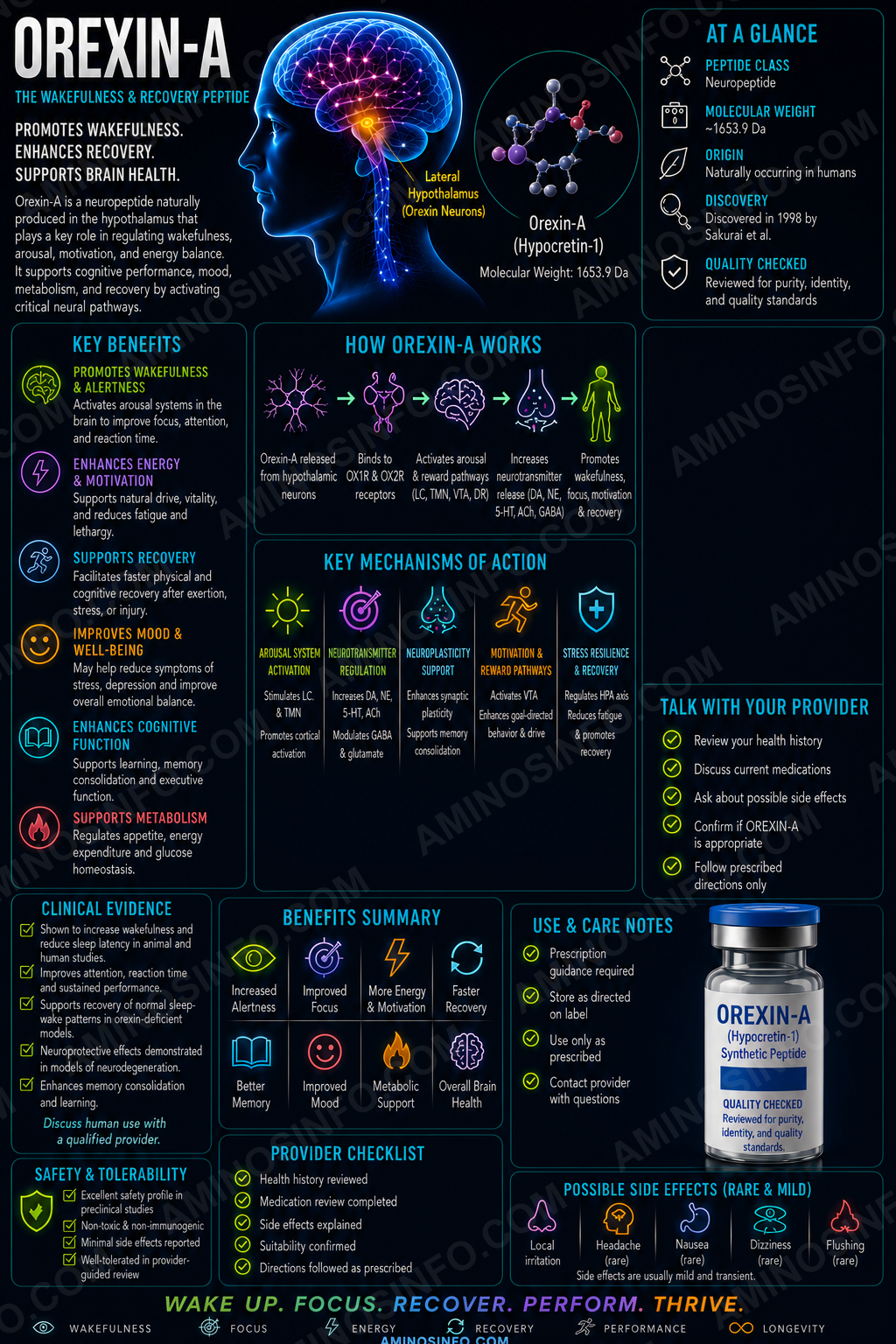
Orexin-A, also called Hypocretin-1, is a naturally occurring 33-amino-acid neuropeptide produced by hypothalamic orexin neurons. It is generated from the same prepro-orexin precursor as Orexin-B.
Orexin-A is structurally more constrained and protease-resistant than Orexin-B because it contains an N-terminal pyroglutamate, two intramolecular disulfide bonds, and a C-terminal amide. It activates both orexin receptors and participates in wakefulness, motivation, reward seeking, stress responses, feeding, autonomic regulation, and state-dependent cognition.
Orexin-A, Hypocretin-1
33 amino acids
Disulfide-stabilized and amidated
OX1R and OX2R
Arousal and behavioral-state integration
No
🧬 Molecular Structure
🧪 Human Orexin-A sequence
pGlu-Pro-Leu-Pro-Asp-Cys-Cys-Arg-Gln-Lys-Thr-Cys-Ser-Cys-Arg-Leu-Tyr-Glu-Leu-Leu-His-Gly-Ala-Gly-Asn-His-Ala-Ala-Gly-Ile-Leu-Thr-Leu-NH₂
Condensed notation:
pEPLPDCCRQKTCSCRLYELLHGAGNHAAGILTL-NH₂
Post-translational modifications
- N-terminal pyroglutamate derived from glutamine
- C-terminal leucinamide
- Disulfide bond between Cys6 and Cys12
- Disulfide bond between Cys7 and Cys14
Structural characteristics
- 33 amino acids
- Two alpha-helical regions
- Compact disulfide-stabilized fold
- Conserved hydrophobic C-terminal receptor-binding region
- Greater resistance to some proteases than linear Orexin-B
⚛️ Molecular Weight and 🧫 Formula
| Molecular formula | C152H243N47O44S4 |
|---|---|
| Average molecular weight | Approximately 3,561.1 g/mol |
| Peptide length | 33 amino acids |
| N-terminal modification | Pyroglutamate |
| C-terminal modification | Amidated |
| Disulfide bonds | Cys6–Cys12 and Cys7–Cys14 |
| Common CAS number | 205640-90-0 |
The formula and mass apply to correctly cyclized, amidated, disulfide-paired native Orexin-A. Reduced, incorrectly bridged, nonamidated, or non-pyroglutamyl material is chemically different.
📅 Discovery Timeline and Research History
1998: Independent discovery
Two groups independently discovered the orexin/hypocretin system. One named the peptides orexins after their feeding effects; the other named them hypocretins based on hypothalamic expression and sequence similarity to secretin-family peptides.
1998: Orexin receptors identified
OX1R and OX2R were characterized as G-protein-coupled receptors activated by Orexin-A and Orexin-B.
1999: Human HCRT gene and precursor described
The human prepro-orexin gene was cloned and shown to encode a 131-residue precursor.
1999–2000: Narcolepsy link established
Canine OX2R mutations, orexin-knockout mice, and severe loss of orexin neurons in human narcolepsy type 1 established the system’s role in state stability.
2002–2004: Human cerebrospinal-fluid biomarker work
Low CSF Orexin-A became a major diagnostic biomarker for narcolepsy type 1.
2000s: Reward, stress, cognition, and autonomic research expands
Orexin-A was linked to locus coeruleus activity, dopamine signaling, conditioned reward, stress responses, feeding, thermogenesis, blood pressure, pain, and memory.
2014 onward: Orexin antagonists approved for insomnia
Dual orexin receptor antagonists provided clinical validation that reducing orexin signaling promotes sleep.
2020s: OX2R agonist era
Clinical programs shifted toward synthetic OX2R-selective agonists for narcolepsy and central hypersomnolence.
Current status
Native Orexin-A remains a research peptide. No native Orexin-A product is FDA approved for narcolepsy, cognition, fatigue, obesity, depression, addiction, or any other indication.
Prepro-Orexin Processing and Neuron Distribution
Prepro-orexin
The human HCRT gene encodes a precursor of approximately 131 amino acids that is processed into Orexin-A and Orexin-B.
Peptide maturation
Orexin-A requires proteolytic cleavage, N-terminal glutamine cyclization to pyroglutamate, C-terminal amidation, and correct formation of two disulfide bonds.
Neuron location
Orexin neurons are concentrated in the lateral hypothalamic, perifornical, and posterior hypothalamic regions.
Projection targets
- Locus coeruleus
- Tuberomammillary nucleus
- Dorsal raphe
- Ventral tegmental area
- Basal forebrain
- Paraventricular hypothalamus
- Brainstem autonomic nuclei
- Spinal cord
Activity pattern
Orexin neurons are relatively quiet during sleep and most active during motivated, emotionally salient, or physically active wakefulness.
🧠 Mechanism of Action
OX1R
OX1R strongly prefers Orexin-A over Orexin-B. It is prominent in reward, stress, emotional arousal, locus coeruleus, ventral tegmental, and selected cortical or limbic circuits.
OX2R
OX2R responds with high affinity to both Orexin-A and Orexin-B and is especially important for sustained wakefulness and prevention of cataplexy.
Neuronal excitation
Orexin receptors increase intracellular calcium, inhibit potassium conductances, activate nonselective cation currents, and enhance NMDA-receptor trafficking or excitability in selected neurons.
Signal diversity
Coupling varies by receptor, cell type, receptor density, tissue, and duration of exposure. Orexin receptors can engage Gq/11, Gi/o, and sometimes Gs-related pathways.
🎯 Receptor and Pathway Profile
| Target or pathway | Orexin-A relationship |
|---|---|
| OX1R / HCRTR1 | High-affinity preferred endogenous agonist. |
| OX2R / HCRTR2 | High-affinity agonist, similar to Orexin-B. |
| Gq/11–PLC–Ca²⁺ | Major excitatory second-messenger pathway. |
| Gi/o | Context-dependent signaling, especially at OX2R. |
| ERK/MAPK | Plasticity, transcription, metabolism, and cellular responses. |
| PI3K/AKT | Survival and metabolic signaling in selected tissues. |
| NMDA-receptor trafficking | Can increase excitatory synaptic responsiveness. |
| Monoamine and histamine systems | Indirect activation of wake and motivational networks. |
Wakefulness and Sleep-State Stability
Active wakefulness
Orexin-A excites histaminergic, noradrenergic, serotonergic, dopaminergic, and cholinergic systems that promote cortical activation and sustained wakefulness.
State stabilization
The orexin system prevents inappropriate switching between wake, non-REM sleep, and REM sleep.
OX1R and OX2R cooperation
OX2R has the stronger role in baseline wake stability, while OX1R contributes to motivated arousal and can reinforce wakefulness through locus coeruleus and reward circuits.
Sleep deprivation and circadian context
Orexin-A effects depend on circadian phase, sleep pressure, nutritional state, emotional salience, and environmental demands.
Not equivalent to restorative sleep
Artificially increasing arousal does not replace sleep and may worsen impairment if it delays needed recovery.
Narcolepsy and Cerebrospinal-Fluid Research
Narcolepsy type 1
Narcolepsy type 1 is usually caused by severe loss of orexin-producing neurons. Symptoms include excessive daytime sleepiness, cataplexy, REM intrusions, sleep paralysis, hallucinations, and fragmented nighttime sleep.
CSF Orexin-A measurement
Orexin-A is measured in cerebrospinal fluid because validated assays and clinical thresholds were developed for Hypocretin-1. Low concentrations strongly support narcolepsy type 1.
Why Orexin-A is the biomarker
Orexin-A is more structurally stable than Orexin-B and became the established CSF analyte, even though both peptides are lost when orexin neurons degenerate.
Intranasal Orexin-A research
Small experimental human and animal studies have explored intranasal Orexin-A for narcolepsy, olfactory transfer, attention, and sleep-related outcomes, but delivery, dosing, reproducibility, and clinical benefit remain uncertain.
Modern therapeutic strategy
Because receptors remain available in most patients, small-molecule OX2R agonists are designed to replace missing orexin tone more reliably than native peptide delivery.
Attention, Cognition, and Memory Research
Attention and vigilance
Orexin-A activates locus coeruleus and basal-forebrain pathways that support vigilance and attention.
Hippocampal signaling
OX1R and OX2R are expressed in hippocampal regions, where orexin signaling can influence long-term potentiation, synaptic excitability, spatial learning, and memory retrieval.
State-dependent cognitive effects
Improved performance may reflect reversal of sleepiness or increased motivational salience rather than direct enhancement of memory capacity.
Stress and cognition
Moderate orexin activation may improve attention during challenge, while excessive activation may impair cognition through anxiety, hyperarousal, or sleep loss.
No proven healthy-person nootropic
No robust clinical evidence establishes native Orexin-A as a safe cognitive enhancer in rested healthy adults.
Motivation, Reward, and Addiction Biology
Lateral hypothalamus and reward
Orexin neurons respond strongly to cues predicting food, drugs, social opportunity, and other rewards.
Ventral tegmental area
Orexin-A enhances dopamine-neuron excitability and synaptic plasticity in the VTA.
OX1R emphasis
OX1R is frequently implicated in cue-driven drug seeking, conditioned reward, stress-induced reinstatement, and effortful motivation.
Addiction models
OX1R antagonists reduce seeking of cocaine, opioids, alcohol, nicotine, and palatable food in selected animal models.
Potential risk of agonism
Increasing Orexin-A signaling could theoretically intensify compulsive reward seeking or stress-associated relapse in susceptible individuals.
Feeding, Energy Balance, and Metabolism
Orexigenic effect
Central Orexin-A administration increases food intake in rodents, which inspired the name “orexin.”
Energy expenditure
Orexin-A also increases movement, sympathetic activity, thermogenesis, and energy expenditure.
Metabolic sensing
Orexin neurons respond to glucose, amino acids, leptin, ghrelin, carbon dioxide, and other internal signals.
Brown adipose tissue
Orexin signaling supports sympathetic thermogenesis and brown-adipose development or activity in experimental models.
Peripheral metabolic receptors
OX1R and OX2R have been reported in adipose tissue, pancreas, gastrointestinal tissue, adrenal tissue, and other peripheral sites, although expression and function vary by method and species.
No weight-loss indication
Orexin-A cannot be simplistically described as a fat-loss peptide. It can increase appetite and arousal while also increasing activity and energy expenditure.
Stress, Cardiovascular, and Autonomic Signaling
Stress activation
Orexin neurons help shift the organism from a resting state into active coping during threat or challenge.
Sympathetic effects
Central Orexin-A can increase blood pressure, heart rate, respiration, thermogenesis, and sympathetic nerve activity.
HPA-axis interaction
Orexin-A interacts with corticotropin-releasing hormone and stress-hormone systems.
Anxiety-related effects
OX1R signaling is frequently associated with panic, stress reactivity, and anxiety-like behavior in animal models.
Context dependency
Orexin signaling can support adaptive resilience during challenge but may contribute to pathological hyperarousal when excessive or mistimed.
Pain and Sensory Modulation
Descending pain pathways
Orexin-A acts in periaqueductal, spinal, thalamic, and limbic circuits that influence nociception and stress-induced analgesia.
Receptor-specific effects
Both OX1R and OX2R can contribute to pain modulation, depending on brain region and injury model.
Peripheral effects
Orexin receptors have been studied in inflammatory and visceral pain pathways.
No approved analgesic role
Native Orexin-A is not an approved treatment for acute pain, neuropathy, migraine, inflammatory pain, or opioid withdrawal.
Peripheral, Inflammatory, and Cellular Research
Peripheral receptor expression
Orexin receptors have been reported in gastrointestinal, endocrine, adipose, cardiovascular, reproductive, immune, and cancer tissues.
Inflammatory signaling
Orexin-A has demonstrated anti-inflammatory or tissue-protective effects in selected models of sepsis, inflammatory bowel disease, multiple sclerosis, and neuroinflammation.
Apoptosis in cancer-cell models
Unlike many survival peptides, orexin-receptor activation can induce mitochondrial apoptosis in selected OX1R- or OX2R-expressing cancer cells through immunoreceptor tyrosine-based inhibitory motifs and SHP2-related signaling.
Translation remains uncertain
Receptor expression in tumors is heterogeneous, and anticancer effects in cell models do not establish a safe systemic cancer therapy.
Endocrine effects
Orexin-A has been studied in adrenal, pituitary, pancreatic, and reproductive signaling, but results vary by species and hormonal context.
Orexin Agonists and Antagonists
Dual antagonists for insomnia
Suvorexant, lemborexant, and daridorexant block OX1R and OX2R to reduce wake drive and promote sleep.
OX2R agonists for narcolepsy
Danavorexton, oveporexton, ALKS 2680, cleminorexton, E2086, and related compounds aim to restore wake signaling.
Why not simply use Orexin-A?
- Poor oral bioavailability
- Limited blood–brain barrier penetration
- Complex synthesis and folding
- Short systemic duration
- Broad OX1R and OX2R activation
- Potential cardiovascular and reward-related effects
OX1R antagonists
Selective OX1R antagonists have been explored for panic, stress, addiction, binge eating, and reward-driven behavior.
Target validation versus peptide validation
Clinical success of an orexin agonist or antagonist validates receptor biology, not the safety or efficacy of unapproved native Orexin-A products.
Evidence Limitations and Clinical Interpretation
Central administration dominates
Many Orexin-A studies use intracerebroventricular or direct brain-region injection, bypassing normal pharmacokinetic barriers.
System-wide findings are often overassigned
Studies may evaluate “orexin” signaling without isolating Orexin-A from Orexin-B or OX1R from OX2R.
Receptor pharmacology is not binary
Orexin-A activates both receptors. Effects attributed to OX1R may still include OX2R contributions unless selective tools are used.
Human CSF data are diagnostic, not therapeutic
Low endogenous Orexin-A supports narcolepsy diagnosis but does not establish that peripheral peptide supplementation is effective.
Intranasal delivery remains uncertain
Some studies suggest central effects, but actual delivered dose, nasal absorption, degradation, brain distribution, and reproducibility remain unresolved.
Wakefulness is not wellness
Increasing arousal may worsen sleep debt, anxiety, cardiovascular strain, or compulsive behavior.
Safety and Regulatory Considerations
No standardized human safety profile
No approved label defines dosing, route, contraindications, interactions, pregnancy safety, or chronic adverse effects for native Orexin-A.
Expected pharmacological risks
- Insomnia and sleep fragmentation
- Anxiety, panic, agitation, or hypervigilance
- Increased heart rate or blood pressure
- Sympathetic overactivation
- Altered appetite and energy expenditure
- Increased reward seeking or compulsive behavior
- Thermoregulatory disturbance
Structural quality risks
Incorrect disulfide pairing, incomplete pyroglutamate formation, nonamidated peptide, reduced cysteines, aggregation, or oxidation can change potency and immunogenicity.
Drug-development safety lessons
Adverse effects of individual orexin agonists or antagonists may arise from off-target chemistry, receptor pharmacology, dose, tissue exposure, or metabolites and cannot be generalized automatically to every orexin ligand.
Regulatory status
Native Orexin-A is not FDA approved.
🧪 Laboratory Testing Methods
| Method | Purpose | Important limitation |
|---|---|---|
| RP-HPLC / UPLC | Separates correctly folded Orexin-A from truncations, reduced peptide, oxidation products, and aggregates. | Correct and incorrect disulfide isomers may have similar retention. |
| LC-HRMS | Confirms intact mass and overall oxidation state. | Cannot establish disulfide connectivity alone. |
| MS/MS sequencing | Confirms the 33-residue sequence and terminal modifications. | Disulfide bonds complicate fragmentation unless reduced or mapped specifically. |
| Disulfide mapping | Confirms Cys6–Cys12 and Cys7–Cys14 pairing. | Requires carefully controlled digestion and MS interpretation. |
| Pyroglutamate assay | Confirms N-terminal cyclization. | Requires targeted MS or enzymatic treatment. |
| C-terminal amidation assay | Distinguishes native amidated peptide from free acid. | Requires high-resolution or targeted analysis. |
| NMR spectroscopy | Confirms native fold, helices, and disulfide-stabilized conformation. | Requires sufficient high-purity material. |
| Free-thiol assay | Detects reduced or incompletely oxidized cysteines. | Does not by itself identify incorrect disulfide pairing. |
| Net peptide-content assay | Measures actual Orexin-A amount. | Must correct for water, salts, and residual solvents. |
| OX1R functional assay | Measures calcium flux, β-arrestin, or second-messenger potency. | Cell background and receptor density affect results. |
| OX2R functional assay | Confirms dual receptor activity. | Does not establish in-vivo CNS exposure. |
| Protease and plasma stability | Measures degradation and metabolite formation. | In-vitro stability does not predict brain delivery fully. |
| Brain/plasma pharmacokinetics | Measures systemic exposure and CNS penetration. | Native peptide human data are limited. |
| Microbial limits, sterility, and endotoxin | Evaluate route-specific microbiological quality. | Requirements depend on final dosage form. |
| Stability-indicating assay | Tracks disulfide scrambling, oxidation, hydrolysis, deamidation, and aggregation. | Requires a qualified reference standard and defined formulation. |
📄 How to Interpret an Orexin-A COA
- Verify the full 33-amino-acid sequence: pEPLPDCCRQKTCSCRLYELLHGAGNHAAGILTL.
- Confirm N-terminal pyroglutamate: Uncyclized glutamine is not native Orexin-A.
- Confirm C-terminal amidation: Native Orexin-A ends in Leu-NH₂.
- Confirm both disulfide bonds: Cys6–Cys12 and Cys7–Cys14.
- Confirm formula and molecular weight: C₁₅₂H₂₄₃N₄₇O₄₄S₄ and approximately 3,561.1 g/mol.
- Use disulfide mapping and orthogonal structural analysis: HPLC and intact mass cannot prove correct folding.
- Review reduced peptide, scrambled disulfides, pyroglutamate variants, nonamidated peptide, oxidation, truncations, and aggregates.
- Measure net peptide content: Purity percentage is not the labeled milligram amount.
- Confirm activity at both OX1R and OX2R: A single receptor assay is incomplete.
- Do not infer efficacy: A COA cannot prove wakefulness, narcolepsy treatment, cognition, metabolism, intranasal brain delivery, or safety.
📊 Orexin-A vs Orexin-B
| Feature | Orexin-A | Orexin-B |
|---|---|---|
| Length | 33 amino acids | 28 amino acids |
| N-terminus | Pyroglutamate | Free arginine |
| Disulfide bonds | Two | None |
| C-terminus | Amidated | Amidated |
| OX1R | High affinity | Lower potency |
| OX2R | High affinity | High affinity |
| Main research emphasis | Broad arousal, motivation, reward, stress | OX2R-linked wake stability |
Orexin-A vs Synthetic OX2R Agonists
| Feature | Native Orexin-A | Modern OX2R agonists |
|---|---|---|
| Receptor profile | OX1R and OX2R | Designed for OX2R selectivity |
| Oral bioavailability | Poor | Optimized in newer compounds |
| Brain penetration | Limited after peripheral delivery | Designed for CNS exposure |
| Structural complexity | 33-residue disulfide peptide | Usually small molecules |
| Clinical development | No approved program | Multiple active programs |
Orexin Agonists vs Antagonists
| Class | Main effect | Therapeutic direction |
|---|---|---|
| OX2R agonist | Restores wake drive | Narcolepsy and hypersomnolence |
| Dual orexin receptor antagonist | Reduces wake signaling | Insomnia |
| Selective OX1R antagonist | Reduces selected reward and stress signaling | Addiction, panic, binge-eating research |
| Native Orexin-A | Broad OX1R/OX2R activation | Laboratory research |
Orexin-A vs Wake-Promoting Medications
| Compound | Main mechanism | Status |
|---|---|---|
| Orexin-A | Native OX1R/OX2R agonist | Research peptide |
| Modafinil | Wake-promoting dopamine-transporter and network effects | FDA approved for selected disorders |
| Solriamfetol | Dopamine/norepinephrine reuptake inhibition | FDA approved |
| Pitolisant | Histamine H3 inverse agonist/antagonist | FDA approved for narcolepsy |
🔗 Related Peptides, Receptors, and Drugs
- Orexin-B: Companion peptide derived from the same precursor.
- OX1R/HCRTR1: Orexin-A-preferring receptor linked to reward, stress, and motivated arousal.
- OX2R/HCRTR2: Receptor important for wake stability and cataplexy prevention.
- Danavorexton: Intravenous OX2R-selective agonist.
- Oveporexton: Oral OX2R agonist in advanced development.
- ALKS 2680: Oral OX2R agonist in narcolepsy and hypersomnolence research.
- Suvorexant, lemborexant, daridorexant: Approved dual orexin receptor antagonists.
- SB-334867: Common experimental OX1R-selective antagonist.
🖼️ Original Diagram Specifications
Diagram 1: Orexin-A molecular structure
Show all 33 residues, N-terminal pyroglutamate, C-terminal Leu-NH₂, and disulfide bridges Cys6–Cys12 and Cys7–Cys14.
Diagram 2: Prepro-orexin processing
Show the HCRT gene, precursor peptide, cleavage, pyroglutamate formation, amidation, disulfide formation, Orexin-A, and Orexin-B.
Diagram 3: Receptor pharmacology
Show Orexin-A strongly activating OX1R and OX2R, while Orexin-B strongly activates OX2R and more weakly activates OX1R.
Diagram 4: Arousal circuit
Show orexin neurons projecting to locus coeruleus, tuberomammillary nucleus, dorsal raphe, basal forebrain, and ventral tegmental area.
Diagram 5: Reward and stress map
Show OX1R-linked cue salience, dopamine plasticity, stress response, conditioned reward, and relapse pathways.
Diagram 6: Narcolepsy treatment map
Show orexin-neuron loss, low CSF Orexin-A, unstable wake/REM boundaries, and synthetic OX2R agonist replacement.
Diagram 7: COA workflow
Show sequence confirmation, pyroglutamate, amidation, disulfide mapping, HRMS, reduced/scrambled forms, OX1R and OX2R assays, net content, microbiology, and stability.
❓ Frequently Asked Questions
Is Orexin-A a peptide?
Yes. It is a naturally occurring 33-amino-acid neuropeptide.
What is its exact sequence?
pEPLPDCCRQKTCSCRLYELLHGAGNHAAGILTL-NH₂.
What is its molecular formula?
C₁₅₂H₂₄₃N₄₇O₄₄S₄.
What is its molecular weight?
Approximately 3,561.1 g/mol.
Does Orexin-A contain disulfide bonds?
Yes. Cys6–Cys12 and Cys7–Cys14.
Is the N-terminus modified?
Yes. It begins with pyroglutamate.
Is the C-terminus amidated?
Yes. It ends in Leu-NH₂.
Does Orexin-A activate both receptors?
Yes. It is a high-affinity agonist at OX1R and OX2R.
Is Orexin-A FDA approved?
No.
Does it promote wakefulness?
Yes in experimental systems, but native peptide delivery is not an approved wake treatment.
Why is CSF Orexin-A measured in narcolepsy?
Low CSF Hypocretin-1 is a validated biomarker of orexin-neuron loss in narcolepsy type 1.
Does intranasal Orexin-A work?
Small studies exist, but dosing, brain delivery, reproducibility, and clinical benefit remain uncertain.
Does Orexin-A improve cognition?
It affects vigilance and hippocampal signaling, but no robust evidence establishes it as a healthy-person nootropic.
Can Orexin-A increase anxiety or heart rate?
Excess central signaling could increase hyperarousal, sympathetic activity, anxiety, blood pressure, or heart rate.
Does 99% HPLC purity prove authentic Orexin-A?
No. Correct pyroglutamate, amidation, disulfide connectivity, folding, sequence, mass, potency, and net content require separate verification.
Final Thoughts
Orexin-A is a structurally complex endogenous 33-amino-acid peptide that activates both OX1R and OX2R. Its pyroglutamate, two disulfide bonds, and C-terminal amide distinguish it sharply from the linear 28-residue Orexin-B peptide.
Research links Orexin-A to wakefulness, reward, motivated behavior, attention, feeding, thermogenesis, stress, autonomic activation, pain modulation, and peripheral inflammatory signaling. However, native Orexin-A is difficult to develop as a conventional drug because it is complex to manufacture, poorly orally available, broadly active at both receptors, and has limited peripheral access to the brain.
Legitimate Orexin-A material should be verified for its complete sequence, N-terminal pyroglutamate, C-terminal amidation, both native disulfide bonds, exact mass, free thiols, scrambled disulfides, oxidation, truncation impurities, net peptide content, dual-receptor potency, route-specific microbiological quality, and stability.
📚 References
- Sakurai T, et al. Orexins and orexin receptors: a family of hypothalamic neuropeptides and G protein-coupled receptors that regulate feeding behavior. Cell. 1998.
- de Lecea L, et al. The hypocretins: hypothalamus-specific peptides with neuroexcitatory activity. Proceedings of the National Academy of Sciences. 1998.
- Sakurai T, et al. Structure and function of human prepro-orexin gene. Journal of Biological Chemistry. 1999.
- UniProt. Human hypocretin neuropeptide precursor, O43612.
- PubChem. Orexin-A compound record, C152H243N47O44S4.
- RCSB Protein Data Bank. Solution structure of human Orexin-A, PDB 1R02.
- Takai T, et al. Orexin-A structure, disulfide connectivity, and receptor activation. Biochemical and Biophysical Research Communications.
- Scammell TE, Winrow CJ. Orexin receptors: pharmacology and therapeutic opportunities. Annual Review of Pharmacology and Toxicology. 2011.
- Gotter AL, et al. International Union of Basic and Clinical Pharmacology: Orexin receptor function, nomenclature, and pharmacology. Pharmacological Reviews. 2012.
- Soya S, Sakurai T. Evolution of the orexin neuropeptide system: structure and function. Frontiers in Neuroscience. 2020.
- Tsujino N, Sakurai T. Role of orexin in modulating arousal, feeding, and motivation. Frontiers in Behavioral Neuroscience. 2013.
- Wang C, et al. The orexin/receptor system: molecular mechanism and therapeutic potential. Medicinal Research Reviews. 2018.
- Chatterjee O, et al. A molecular network map of orexin–orexin receptor signaling. 2022.
- Lin L, et al. The sleep disorder canine narcolepsy is caused by a mutation in the hypocretin receptor 2 gene. Cell. 1999.
- Chemelli RM, et al. Narcolepsy in orexin knockout mice. Cell. 1999.
- Peyron C, et al. A mutation in a case of early-onset narcolepsy and generalized absence of hypocretin peptides in human narcoleptic brains. Nature Medicine. 2000.
- Thannickal TC, et al. Reduced number of hypocretin neurons in human narcolepsy. Neuron. 2000.
- Mignot E, et al. The role of cerebrospinal-fluid hypocretin measurement in narcolepsy. Archives of Neurology.
- Dauvilliers Y, et al. Narcolepsy type 1 and hypocretin deficiency. Lancet Neurology.
- Scammell TE. Narcolepsy. New England Journal of Medicine.
- Sakurai T. The neural circuit of orexin/hypocretin: maintaining sleep and wakefulness. Nature Reviews Neuroscience.
- Saper CB, Fuller PM. Wake–sleep circuitry. Current Opinion in Neurobiology.
- Yamanaka A, et al. Hypothalamic orexin neurons regulate arousal according to energy balance in mice. Neuron.
- Adamantidis AR, et al. Neural substrates of awakening probed with optogenetic control of hypocretin neurons. Nature.
- Hagan JJ, et al. Orexin-A activates locus coeruleus firing and increases arousal in the rat. Proceedings of the National Academy of Sciences.
- Bourgin P, et al. Hypocretin-1 modulates rapid eye movement sleep through GABAergic mechanisms. Journal of Neuroscience.
- Willie JT, et al. Distinct narcolepsy syndromes in orexin receptor-2 and orexin-null mice. Neuron.
- Mieda M, et al. Differential roles of orexin receptors in sleep/wake regulation. Frontiers in Endocrinology.
- Mochizuki T, et al. Behavioral-state instability in orexin knockout mice. Journal of Neuroscience.
- España RA, Scammell TE. Sleep neurobiology from a clinical perspective. Sleep.
- Deadwyler SA, et al. Systemic and intranasal Orexin-A effects on cognition during sleep deprivation. Journal of Neuroscience.
- Baier PC, et al. Effects of intranasal Orexin-A in patients with narcolepsy. Sleep Medicine.
- Weinhold SL, et al. Intranasal orexin delivery and olfactory pathways. Sleep research literature.
- Wayner MJ, et al. Orexin-A and hippocampal synaptic plasticity. Peptides.
- Akbari E, et al. Orexin receptors and spatial learning and memory. Peptides.
- Salmani ME, et al. Hippocampal orexin receptors: localization and function. Peptides. 2022.
- Mahler SV, et al. Motivational activation: a unifying hypothesis of orexin/hypocretin function. Nature Neuroscience.
- Harris GC, Wimmer M, Aston-Jones G. A role for lateral hypothalamic orexin neurons in reward seeking. Nature.
- Aston-Jones G, et al. Lateral hypothalamic orexin neurons: a role in reward seeking and addiction. Brain Research.
- Borgland SL, et al. Orexin-A in the ventral tegmental area is critical for synaptic plasticity and cocaine sensitization. Neuron.
- James MH, et al. Orexin/hypocretin regulation of addiction. British Journal of Pharmacology.
- Plaza-Zabala A, et al. Orexin-A and nicotine reward. Neuropsychopharmacology.
- Lawrence AJ, et al. The orexin system regulates alcohol seeking in rats. British Journal of Pharmacology.
- Grafe LA, Bhatnagar S. Orexins and stress. Frontiers in Neuroendocrinology. 2018.
- Johnson PL, et al. Orexin-1 receptors and panic vulnerability. Nature Medicine.
- Berridge CW, España RA. Synergistic sedative effects of noradrenergic and orexin antagonism. Neuroscience.
- Samson WK, et al. Orexin actions on cardiovascular and autonomic function. Regulatory Peptides.
- Shirasaka T, et al. Orexin-A increases blood pressure and heart rate in conscious rats. American Journal of Physiology.
- Ferguson AV, Samson WK. The orexin/hypocretin system: a critical regulator of neuroendocrine and autonomic function. Frontiers in Neuroendocrinology.
- Lubkin M, Stricker-Krongrad A. Independent feeding and metabolic actions of Orexin-A. Biochemical and Biophysical Research Communications.
- Sellayah D, et al. Orexin is required for brown adipose tissue development, differentiation, and function. Cell Metabolism.
- Digby JE, et al. Orexin receptor expression in human adipose tissue. Journal of Endocrinology. 2006.
- Laburthe M, et al. Orexins/hypocretins and orexin receptors in apoptosis. Acta Physiologica. 2010.
- Voisin T, et al. Orexin receptor signaling induces apoptosis in colon cancer cells. Journal of Biological Chemistry.
- Messal N, et al. Orexin-A and OX1R in gastrointestinal cancer models. Cancer Research.
- Becquet L, et al. Orexins as therapeutic targets in inflammatory and neurodegenerative diseases. Frontiers in Endocrinology. 2019.
- Evans R, et al. Danavorexton, an OX2R-selective agonist, improves narcolepsy symptoms. 2022.
- Dauvilliers Y, et al. Oral Orexin Receptor 2 Agonist in Narcolepsy Type 1. New England Journal of Medicine. 2023.
- Saitoh T, et al. The present and future of synthetic orexin receptor agonists. 2023.
- ClinicalTrials.gov. TAK-861 / oveporexton in narcolepsy type 1, NCT05687903.
- ClinicalTrials.gov. ALKS 2680 phase 3 study in narcolepsy type 1, NCT07540897.
- ClinicalTrials.gov. ALKS 2680 in narcolepsy type 2, NCT06555783.
- Coleman PJ, et al. The discovery of suvorexant. Journal of Medicinal Chemistry.
- Rosenberg R, et al. Daridorexant in insomnia disorder. Lancet Neurology.
- International Council for Harmonisation. ICH Q2(R2): Validation of Analytical Procedures.
- International Council for Harmonisation. ICH Q3A and Q3B: Impurities in New Drug Substances and Products.
- International Council for Harmonisation. ICH Q3C: Residual Solvents.
- International Council for Harmonisation. ICH Q1A(R2): Stability Testing of New Drug Substances and Products.
- International Council for Harmonisation. ICH M10: Bioanalytical Method Validation.
- United States Pharmacopeia General Chapter <621>: Chromatography.
- United States Pharmacopeia General Chapter <71>: Sterility Tests.
- United States Pharmacopeia General Chapter <85>: Bacterial Endotoxins Test.
- United States Pharmacopeia General Chapters <232> and <233>: Elemental Impurities.
Identity, structure, receptor pharmacology, wakefulness, narcolepsy, cognition, reward, feeding, autonomic, inflammatory, therapeutic-development, safety, and analytical evidence were reviewed in July 2026. Native Orexin-A remains an unapproved research peptide.