Liraglutide (Victoza / Saxenda): What It Is, How It Works, Benefits, and Research Overview
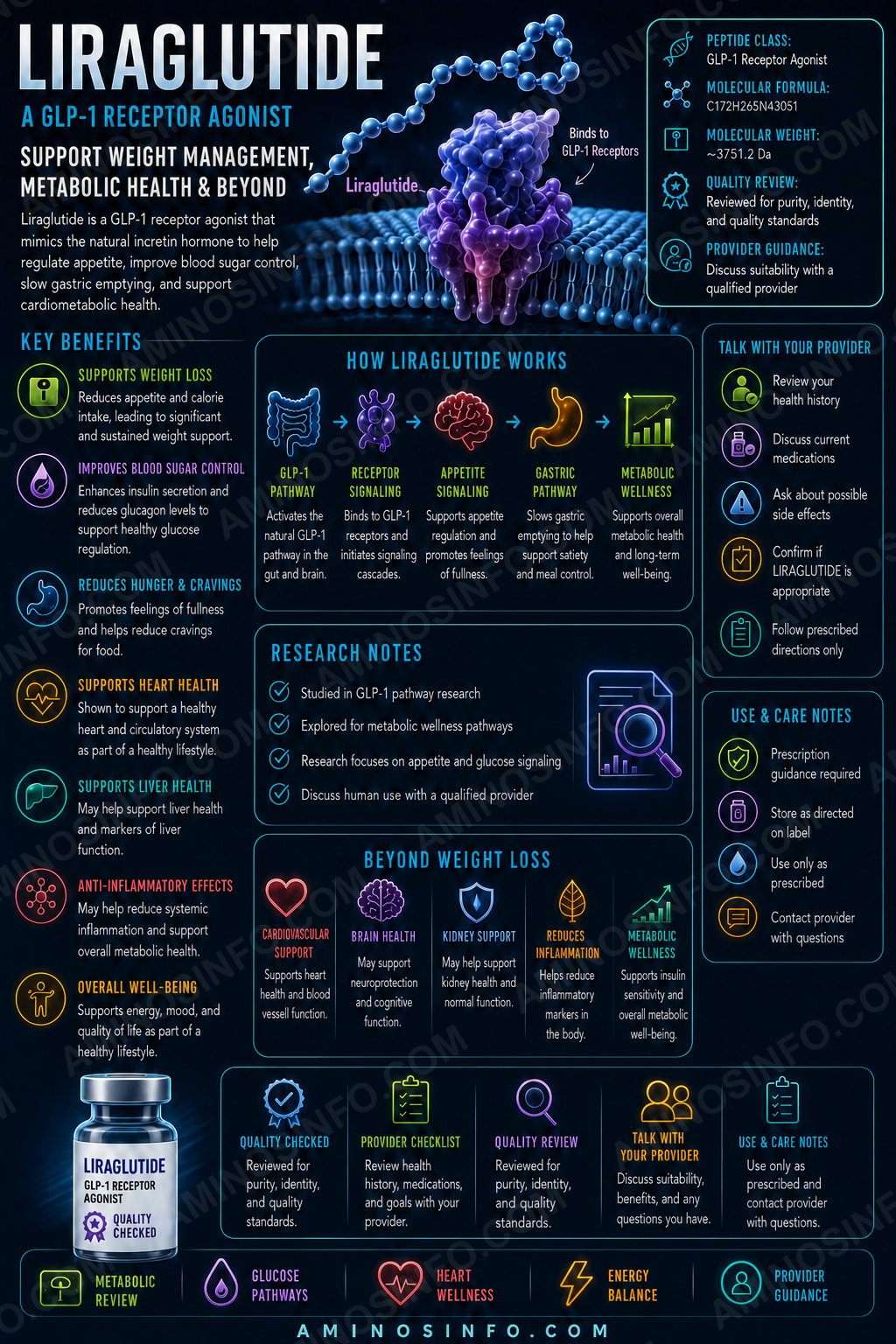
A comprehensive review of liraglutide, the once-daily long-acting GLP-1 receptor agonist approved as Victoza for type 2 diabetes and cardiovascular-risk reduction and as Saxenda for chronic weight management.
What Is Liraglutide?
Liraglutide, development code NN2211, is a long-acting analogue of human glucagon-like peptide-1. It shares approximately 97% sequence identity with human GLP-1 and is engineered for once-daily subcutaneous administration.
Victoza and Saxenda
Acylated GLP-1 analogue
GLP-1R
31-amino-acid GLP-1 analogue
C₁₇₂H₂₆₅N₄₃O₅₁
Approximately 3751.2 Da
Current U.S. uses
- Victoza: Improve glycemic control in adults and children 10 years and older with type 2 diabetes.
- Victoza: Reduce major adverse cardiovascular events in adults with type 2 diabetes and established cardiovascular disease.
- Saxenda: Chronic weight management in eligible adults.
- Saxenda: Chronic weight management in adolescents 12 years and older with obesity and body weight above 60 kg.
🧬 Structure, Sequence, and Molecular Properties
🧪 Amino-acid sequence
HAEGTFTSDVSSYLEGQAAKEFIAWLVRGRG
Liraglutide is based on human GLP-1(7–37), with lysine at position 34 replaced by arginine to permit selective acylation at Lys26.
Structural modifications
- Arginine substitution at position 34
- γ-glutamyl spacer attached to Lys26
- C16 palmitic-acid side chain
- No disulfide bridge
- Free C-terminal glycine rather than amidation
⚛️ Molecular properties
| Molecular formula | C172H265N43O51 |
|---|---|
| Molecular weight | Approximately 3751.2–3751.3 Da |
| CAS number | 204656-20-2 |
| Sequence identity to human GLP-1 | Approximately 97% |
| Fatty-acid modification | C16 palmitic acid through a glutamic-acid spacer at Lys26 |
| Plasma half-life | Approximately 13 hours |
Why acylation matters
The palmitic-acid side chain promotes self-association at the injection site and reversible albumin binding. These effects slow absorption, reduce renal clearance, and protect against enzymatic degradation.
📅 Discovery and Approval Timeline
1990s–2000s: Molecular development
Novo Nordisk optimized human GLP-1 through site-specific acylation to create a daily rather than short-acting injectable agonist.
January 25, 2010: Victoza approval
The FDA approved liraglutide for type 2 diabetes.
December 2014: Saxenda approval
The FDA approved the 3 mg daily formulation for chronic weight management in adults.
2016: LEADER cardiovascular trial
Liraglutide reduced major adverse cardiovascular events and cardiovascular mortality in high-risk adults with type 2 diabetes.
2017: Cardiovascular-risk indication
Victoza labeling expanded to include reduction of major adverse cardiovascular events in adults with type 2 diabetes and established cardiovascular disease.
2019: Pediatric diabetes expansion
Victoza was approved for type 2 diabetes in patients 10 years and older.
December 2020: Adolescent obesity approval
Saxenda labeling expanded to adolescents 12–17 years with obesity and body weight above 60 kg.
2024–2025: Generic approvals
FDA-approved generic liraglutide diabetes products entered the U.S. market, followed in 2025 by the first generic Saxenda-equivalent weight-management product.
🧠 How Does Liraglutide Work?
1. Appetite and satiety
GLP-1 receptors in appetite-regulating brain regions reduce hunger, lower food intake, and promote fullness.
2. Insulin secretion
Liraglutide increases insulin secretion when glucose is elevated.
3. Glucagon regulation
It reduces inappropriate glucagon secretion during hyperglycemia, lowering hepatic glucose output.
4. Gastric emptying
It delays gastric emptying and moderates postprandial glucose exposure.
5. Cardiovascular effects
Benefits in high-risk diabetes populations may reflect improved glycemia, weight, blood pressure, inflammation, vascular biology, and other direct or indirect pathways.
Type 2 Diabetes Evidence
LEAD clinical program
The LEAD trials established liraglutide as monotherapy and in combination with metformin, sulfonylureas, thiazolidinediones, and insulin.
Glycemic effects
Victoza commonly reduces A1C, fasting glucose, postprandial glucose, and body weight while carrying relatively low intrinsic hypoglycemia risk unless combined with insulin or secretagogues.
Maximum diabetes dose
The adult Victoza dose may be increased to 1.8 mg once daily after starting at 0.6 mg and increasing to 1.2 mg.
Pediatric diabetes
Victoza is approved for patients 10 years and older with type 2 diabetes.
Weight-Management Evidence
SCALE Obesity and Prediabetes
In adults without diabetes, liraglutide 3 mg plus lifestyle intervention produced approximately 8.0% mean weight loss at 56 weeks, compared with about 2.6% with placebo.
Responder rates
A larger proportion of liraglutide-treated participants achieved at least 5% and at least 10% body-weight reduction.
SCALE Diabetes
Adults with type 2 diabetes lost less weight on average than adults without diabetes, but 3 mg liraglutide produced greater reduction than 1.8 mg or placebo.
Weight regain
As with other chronic obesity medications, stopping therapy can lead to weight regain, reinforcing the long-term-treatment model.
Early-response rule
Adults should discontinue Saxenda if they have not lost at least 4% of baseline body weight by 16 weeks, because continued clinically meaningful loss is unlikely.
Cardiovascular and Kidney Evidence
LEADER
The LEADER trial enrolled 9,340 adults with type 2 diabetes at high cardiovascular risk and followed them for a median of 3.8 years.
Major adverse cardiovascular events
The primary composite of cardiovascular death, nonfatal myocardial infarction, or nonfatal stroke occurred significantly less often with liraglutide than placebo.
Cardiovascular mortality
Cardiovascular death and all-cause mortality were lower in the liraglutide group.
Kidney outcomes
Renal benefits were driven mainly by reduced development or progression of diabetic kidney disease, particularly new persistent macroalbuminuria.
Labeling scope
The cardiovascular-risk indication applies to adults with type 2 diabetes and established cardiovascular disease, not to every person using Saxenda for obesity.
Pediatric Evidence and Labeling
Type 2 diabetes
Victoza is approved for patients 10 years and older.
Adolescent obesity
Saxenda is approved for adolescents 12 years and older with obesity and body weight above 60 kg.
Adolescent stopping rule
Discontinue if BMI has not decreased by at least 1% after 12 weeks on the maintenance dose.
Children younger than 12
A clinical trial found BMI improvement in children 6 to under 12 years, but Saxenda is not currently FDA approved for this age group.
FDA-Approved Dosing
Victoza
| Stage | Dose |
|---|---|
| Starting dose | 0.6 mg once daily for at least one week |
| Usual maintenance | 1.2 mg once daily |
| Maximum adult dose | 1.8 mg once daily |
Saxenda
| Week | Dose |
|---|---|
| 1 | 0.6 mg once daily |
| 2 | 1.2 mg once daily |
| 3 | 1.8 mg once daily |
| 4 | 2.4 mg once daily |
| 5 and onward | 3.0 mg once daily |
Administration
- Subcutaneous injection once daily
- May be taken at any time of day
- May be taken with or without food
- Inject in abdomen, thigh, or upper arm
- Rotate injection sites
- Do not combine Victoza and Saxenda
- Do not combine with another GLP-1 receptor agonist
Warnings, Contraindications, and Side Effects
Boxed warning
Liraglutide causes thyroid C-cell tumors in rodents. Human relevance is unknown. It is contraindicated in patients with a personal or family history of medullary thyroid carcinoma or Multiple Endocrine Neoplasia syndrome type 2.
Common adverse effects
- Nausea
- Diarrhea
- Vomiting
- Constipation
- Dyspepsia
- Reduced appetite
- Abdominal pain
- Headache
- Injection-site reactions
Important warnings
- Acute pancreatitis
- Acute gallbladder disease
- Hypoglycemia with insulin or insulin secretagogues
- Acute kidney injury from dehydration
- Serious hypersensitivity reactions
- Increased heart rate
- Severe gastrointestinal reactions
- Pulmonary aspiration during anesthesia or deep sedation
Saxenda-specific monitoring
Monitor heart rate, mental-health symptoms, hydration, gallbladder symptoms, and early weight response according to current labeling.
Drug Interactions
Insulin and sulfonylureas
Hypoglycemia risk increases, and adjustment of background therapy may be required.
Oral medications
Delayed gastric emptying may affect oral drug absorption, particularly for medications with narrow therapeutic windows.
Other GLP-1 products
Concurrent use with another liraglutide-containing product or another GLP-1 receptor agonist is not recommended.
🧪 Laboratory Testing Methods
| Method | Purpose | Important limitation |
|---|---|---|
| RP-HPLC / UPLC | Separates intact liraglutide from deletion peptides, oxidized forms, deacylated material, and process impurities. | Area purity does not prove complete identity or net content. |
| LC-HRMS | Confirms intact mass and elemental composition. | Does not alone prove sequence or modification location. |
| MS/MS peptide mapping | Confirms sequence, Arg34 substitution, spacer, and Lys26 palmitoylation. | Requires a qualified reference standard. |
| Amino-acid analysis | Confirms composition and supports net peptide-content assignment. | Does not prove residue order. |
| Chiral amino-acid analysis | Detects epimerization and incorrect stereochemistry. | Hydrolysis can introduce artifacts. |
| Palmitoyl-linker analysis | Confirms C16 fatty acid, glutamic-acid spacer, and Lys26 attachment. | Incorrect acylation may preserve approximate intact mass. |
| Deacylated-peptide assay | Measures liraglutide lacking the fatty-acid side chain. | Deacylated peptide may retain partial GLP-1R activity. |
| Oxidation and deamidation assays | Measure stability-related degradants. | High-resolution methods may be needed. |
| SEC-HPLC | Measures aggregates and high-molecular-weight species. | Small reversible oligomers may require orthogonal testing. |
| Net peptide-content assay | Measures actual active peptide mass. | Must correct for water, counterions, and excipients. |
| GLP-1R cAMP assay | Confirms functional receptor potency. | Receptor expression affects apparent potency. |
| Albumin-binding assay | Confirms the long-acting acylated design. | Does not fully predict clinical half-life. |
| Plasma stability | Measures proteolysis and deacylation. | Species differences matter. |
| Residual-solvent and counterion testing | Measures fermentation or synthesis residues, salts, and solvents. | Does not establish receptor potency. |
| Sterility and endotoxin | Required for finished injection products. | Raw-peptide purity cannot establish injectable safety. |
| Particulate matter | Measures visible and subvisible particles. | Requires finished-product testing. |
| Preservative assay | Confirms phenol content in multidose formulations. | Relevant to finished product, not raw API. |
| Pen dose-delivery testing | Confirms delivered volume and dose accuracy. | API testing cannot establish device performance. |
| Stability-indicating assay | Tracks oxidation, deamidation, hydrolysis, aggregation, deacylation, and potency loss. | Requires validated forced-degradation studies. |
📄 How to Interpret a Liraglutide COA
- Verify the complete GLP-1 analogue sequence.
- Confirm the Lys34-to-Arg34 substitution.
- Confirm Lys26 attachment of the γ-glutamyl-palmitoyl side chain.
- Verify the C16 palmitic-acid chain.
- Confirm intact mass of approximately 3751.2 Da.
- Use LC-HRMS plus MS/MS peptide mapping.
- Confirm stereochemistry: Epimers may retain the same nominal mass.
- Measure deletion peptides, deacylated material, oxidation, deamidation, hydrolysis, and aggregates.
- Report net peptide content: HPLC area purity is not the actual milligram amount.
- Confirm GLP-1 receptor potency and albumin binding.
- For finished products, require sterility, endotoxin, particles, preservative content, fill accuracy, pen performance, and stability.
- Do not infer FDA equivalence: A raw-material COA cannot establish equivalence to Victoza, Saxenda, or an approved generic.
📊 Liraglutide vs Semaglutide vs Tirzepatide
| Feature | Liraglutide | Semaglutide | Tirzepatide |
|---|---|---|---|
| Receptors | GLP-1R | GLP-1R | GIPR + GLP-1R |
| Dosing | Daily | Weekly injection or daily oral product | Weekly |
| Maximum obesity-trial mean loss | About 8% in SCALE | Higher in STEP trials | Higher in SURMOUNT trials |
| FDA approved? | Yes | Yes | Yes |
Victoza vs Saxenda
| Feature | Victoza | Saxenda |
|---|---|---|
| Active ingredient | Liraglutide | Liraglutide |
| Main indication | Type 2 diabetes and CV-risk reduction | Chronic weight management |
| Maximum dose | 1.8 mg daily | 3.0 mg daily |
| Pediatric use | Type 2 diabetes age 10+ | Obesity age 12+ and over 60 kg |
Liraglutide vs Native GLP-1
| Feature | Liraglutide | Native GLP-1 |
|---|---|---|
| Sequence identity | Approximately 97% | Natural hormone |
| Half-life | Approximately 13 hours | Minutes |
| Fatty-acid modification | Yes | No |
| Clinical use | Approved medication | Endogenous hormone |
Raw Liraglutide vs FDA-Approved Product
| Quality attribute | Raw peptide | Approved product |
|---|---|---|
| Identity | Sequence and chemistry claim | FDA-reviewed identity and manufacturing |
| Potency | Requires GLP-1R assay | Validated release specification |
| Microbiology | May lack final controls | Sterility, endotoxin, particles |
| Delivery | Unknown | Validated multidose pen or approved device |
| Clinical equivalence | Not established by COA | Supported by approved NDA or ANDA |
🖼️ Original Diagram Specifications
Diagram 1: Liraglutide peptide architecture
Show the GLP-1(7–37) backbone, Arg34 substitution, Lys26 glutamate spacer, and C16 palmitic acid.
Diagram 2: GLP-1 receptor mechanism
Show pancreas, brain, stomach, and liver effects converging on glucose and appetite regulation.
Diagram 3: Approval timeline
Show Victoza 2010, Saxenda 2014, cardiovascular indication 2017, pediatric diabetes 2019, and adolescent obesity 2020.
Diagram 4: SCALE weight-loss results
Show approximately 8.0% mean weight loss with liraglutide 3 mg versus approximately 2.6% with placebo.
Diagram 5: LEADER cardiovascular outcome
Show reduced cardiovascular death, nonfatal myocardial infarction, and nonfatal stroke composite.
Diagram 6: Victoza versus Saxenda dosing
Show daily titration to 1.8 mg for diabetes and 3.0 mg for obesity.
Diagram 7: COA workflow
Show sequence, Arg34, Lys26 acylation, intact mass, peptide mapping, GLP-1R potency, albumin binding, sterility, pen testing, and stability.
❓ Frequently Asked Questions
Is liraglutide a peptide?
Yes. It is a modified human GLP-1 analogue.
What are the brand names?
Victoza and Saxenda.
What is the molecular formula?
C₁₇₂H₂₆₅N₄₃O₅₁.
What is the molecular weight?
Approximately 3751.2 Da.
What is the CAS number?
204656-20-2.
Is liraglutide FDA approved?
Yes.
How often is liraglutide taken?
Once daily.
What is the maximum Victoza dose?
1.8 mg once daily.
What is the maximum Saxenda dose?
3.0 mg once daily.
Does Saxenda reduce cardiovascular events?
The formal cardiovascular-risk indication belongs to Victoza in adults with type 2 diabetes and established cardiovascular disease.
How much weight loss did SCALE report?
Approximately 8% average body-weight reduction at 56 weeks.
What are the most common side effects?
Nausea, diarrhea, vomiting, constipation, dyspepsia, and reduced appetite.
How is liraglutide different from semaglutide?
Liraglutide is injected daily and generally produces less average weight loss than weekly semaglutide.
Are generic versions available?
Yes. FDA-approved generic diabetes and weight-management liraglutide products are now available in the United States.
Does 99% HPLC purity prove equivalence to Saxenda or Victoza?
No. Complete identity, net content, receptor potency, sterility, formulation, device performance, and approved manufacturing are also required.
Final Thoughts
Liraglutide was one of the most important early long-acting GLP-1 medicines and helped establish the modern incretin era. As Victoza, it improves glycemic control and reduces cardiovascular risk in selected adults with type 2 diabetes. As Saxenda, the higher 3 mg daily dose supports chronic weight management in eligible adults and adolescents.
Its efficacy is more modest than that of newer weekly agents, but it has extensive long-term clinical experience, cardiovascular-outcome evidence, pediatric labeling, and now lower-cost generic competition.
Liraglutide carries important risks, including a boxed thyroid C-cell tumor warning, gastrointestinal intolerance, pancreatitis, gallbladder disease, dehydration-related kidney injury, increased heart rate, hypoglycemia with certain diabetes medicines, and aspiration risk during anesthesia or deep sedation.
Analytical authentication requires confirmation of the GLP-1 analogue sequence, Arg34 substitution, Lys26-linked γ-glutamyl-palmitic-acid side chain, intact mass, stereochemistry, impurities, net peptide content, receptor potency, albumin binding, sterility, preservative content, device delivery, and stability.
📚 References
- U.S. Food and Drug Administration. Victoza Prescribing Information. 2025.
- U.S. Food and Drug Administration. Saxenda Prescribing Information. 2026.
- U.S. Food and Drug Administration. FDA Approves Weight Management Drug for Patients Aged 12 and Older. December 2020.
- Pi-Sunyer X, et al. A Randomized, Controlled Trial of 3.0 mg of Liraglutide in Weight Management. New England Journal of Medicine. 2015.
- Marso SP, et al. Liraglutide and Cardiovascular Outcomes in Type 2 Diabetes. New England Journal of Medicine. 2016.
- Mann JFE, et al. Liraglutide and Renal Outcomes in Type 2 Diabetes. New England Journal of Medicine. 2017.
- Kelly AS, et al. A Randomized, Controlled Trial of Liraglutide for Adolescents with Obesity. New England Journal of Medicine. 2020.
- Fox CK, et al. Liraglutide for Children 6 to Less Than 12 Years of Age with Obesity. New England Journal of Medicine. 2024.
- Knudsen LB, Lau J. The Discovery and Development of Liraglutide and Semaglutide. Frontiers in Endocrinology. 2019.
- Knudsen LB, et al. Potent derivatives of GLP-1 with pharmacokinetic properties suitable for once-daily administration. Journal of Medicinal Chemistry.
- PubChem. Liraglutide compound record, CID 16134956.
- FDA Chemistry Review. Victoza NDA 22-341.
- Davies MJ, et al. Liraglutide for weight management in type 2 diabetes. JAMA. 2015.
- Wadden TA, et al. Weight maintenance and additional weight loss with liraglutide after low-calorie diet. International Journal of Obesity.
- Astrup A, et al. Effects of liraglutide in the treatment of obesity. Lancet. 2009.
- Astrup A, et al. Safety, tolerability and sustained weight loss over 2 years with liraglutide. International Journal of Obesity.
- Zinman B, et al. Liraglutide versus glimepiride monotherapy for type 2 diabetes. Lancet.
- Nauck M, et al. Liraglutide versus glimepiride in combination with metformin. Diabetes Care.
- Russell-Jones D, et al. Liraglutide versus insulin glargine in type 2 diabetes. Diabetologia.
- Garber A, et al. Liraglutide versus glimepiride monotherapy. Lancet.
- Buse JB, et al. Liraglutide treatment in type 2 diabetes. Lancet.
- Pratley RE, et al. Liraglutide versus sitagliptin in patients on metformin. Lancet.
- Tamborlane WV, et al. Liraglutide in children and adolescents with type 2 diabetes. New England Journal of Medicine. 2019.
- Holst JJ. The physiology of glucagon-like peptide 1. Physiological Reviews.
- Drucker DJ. Mechanisms of action and therapeutic application of GLP-1. Cell Metabolism.
- Müller TD, et al. GLP-1 molecular physiology and therapeutic applications. Nature Reviews Drug Discovery.
- Baggio LL, Drucker DJ. Biology of incretins. Gastroenterology.
- Nauck MA, Meier JJ. Incretin hormones and GLP-1 receptor agonists. Lancet Diabetes & Endocrinology.
- Secher A, et al. The arcuate nucleus mediates GLP-1 receptor agonist weight loss. Journal of Clinical Investigation.
- Wilding JPH, et al. Once-weekly semaglutide in adults with obesity. New England Journal of Medicine.
- Jastreboff AM, et al. Tirzepatide once weekly for obesity. New England Journal of Medicine.
- Rubino D, et al. Weight regain after withdrawal of GLP-1 therapy. Diabetes, Obesity and Metabolism.
- International Council for Harmonisation. ICH Q1A(R2): Stability Testing.
- International Council for Harmonisation. ICH Q2(R2): Validation of Analytical Procedures.
- International Council for Harmonisation. ICH Q3A and Q3B: Impurities.
- International Council for Harmonisation. ICH Q3C: Residual Solvents.
- International Council for Harmonisation. ICH Q6B: Specifications for Biotechnological Products.
- International Council for Harmonisation. ICH M10: Bioanalytical Method Validation.
- United States Pharmacopeia General Chapter <621>: Chromatography.
- United States Pharmacopeia General Chapter <71>: Sterility Tests.
- United States Pharmacopeia General Chapter <85>: Bacterial Endotoxins Test.
- United States Pharmacopeia General Chapter <788>: Particulate Matter in Injections.
Chemistry, current FDA indications, generic availability, diabetes and obesity evidence, cardiovascular and kidney outcomes, pediatric labeling, safety, and analytical recommendations were reviewed in July 2026.