
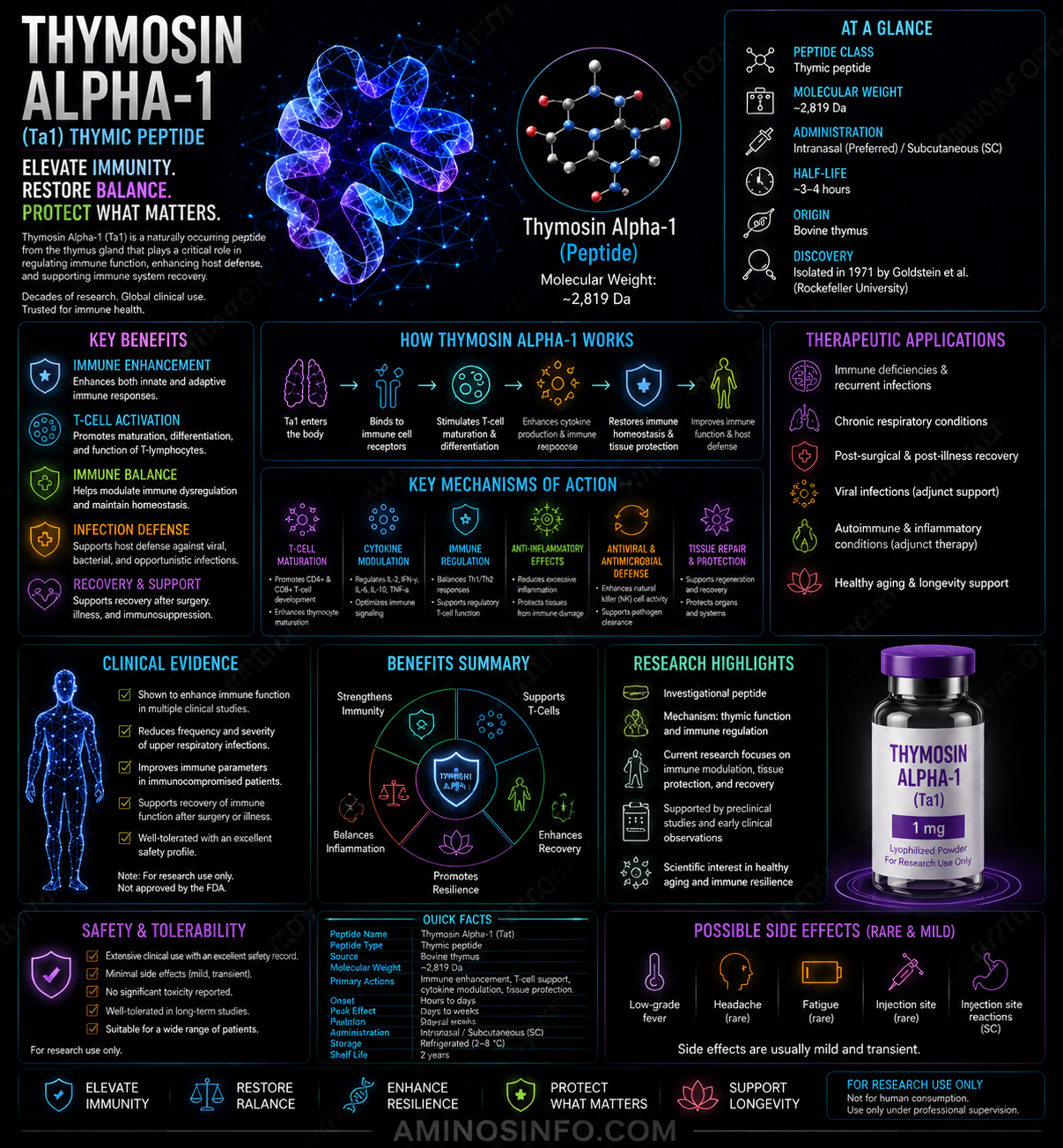
Thymosin Alpha-1 (Tα1 / Thymalfasin): What It Is, How It Works, Benefits, and Research Overview :root{--ink:#16202a;--muted:#5c6975;--line:#dce
Thymosin Alpha-1 (Tα1 / Thymalfasin): What It Is, How It Works, Benefits, and Research Overview
A corrected, evidence-graded review of Thymosin Alpha-1, including its authentic 28-amino-acid sequence, molecular properties, relationship to prothymosin alpha, innate and adaptive immune mechanisms, Toll-like receptor signaling, clinical research, international regulatory status, safety, analytical testing, and COA interpretation.
Important Scientific Corrections
| Original claim | Evidence-based correction |
|---|---|
| Sequence: Ac-SDKPVSLSRLSGIL-KRKG-GC-NH₂ | This is not Tα1. Authentic Tα1 is Ac-SDAAVDTSSEITTKDLKEKKEVEEEAEN-OH. |
| C-terminal amide | Tα1 has a free C-terminal carboxyl group. |
| Contains cysteine and arginine | Authentic Tα1 contains neither cysteine nor arginine. |
| Directly “derived from the thymus gland” as a conventional hormone | Tα1 was originally isolated from thymic extracts and corresponds to the N-terminal 28 residues of prothymosin alpha. |
| FDA approved in some countries | The FDA is a United States regulator. Tα1 is approved or marketed by regulators in some other countries, but it is not FDA approved anywhere. |
| Proven immune enhancement | Tα1 is an immune modulator. Clinical effects vary by indication, immune state, and accompanying treatment. |
What Is Thymosin Alpha-1?
Thymosin Alpha-1, abbreviated Tα1, is a naturally occurring 28-amino-acid peptide associated with immune regulation. The chemically synthesized form used in pharmaceutical and clinical research is called thymalfasin.
Tα1 was first isolated from thymosin fraction 5, a mixture obtained from calf thymus. It is now understood to correspond to the N-terminal 28-amino-acid region of the intracellular protein prothymosin alpha.
Research has examined Tα1 in relation to T-cell function, dendritic-cell maturation, Toll-like receptor signaling, natural killer-cell activity, chronic viral infections, sepsis, vaccination, malignancy, radiation-associated lymphopenia, and immune dysfunction.
Thymosin Alpha-1
Thymalfasin
28 amino acids
Acetylated serine
Immune modulation
No
🧬 Molecular Structure
Tα1 is a linear, highly acidic peptide. It is blocked at the N-terminus by an acetyl group, has no disulfide bonds, and ends in a free asparagine carboxyl group.
🧪 Complete Amino-Acid Sequence
Ac-Ser-Asp-Ala-Ala-Val-Asp-Thr-Ser-Ser-Glu-Ile-Thr-Thr-Lys-Asp-Leu-Lys-Glu-Lys-Lys-Glu-Val-Val-Glu-Glu-Ala-Glu-Asn-OH
One-letter notation:
Ac-SDAAVDTSSEITTKDLKEKKEVEEEAEN-OH
| Structural feature | Importance |
|---|---|
| N-terminal acetylation | Part of the authentic natural structure and required for correct identity. |
| 28 amino-acid residues | Distinguishes Tα1 from Thymogen, Vilon, Crystagen, and other short thymic peptides. |
| High glutamate and aspartate content | Produces a strongly acidic peptide with distinctive chromatographic behavior. |
| No cysteine | No disulfide bonds are present. |
| No tryptophan or tyrosine | Low intrinsic absorbance at 280 nm; peptide-bond or alternative detection is important. |
| Free C-terminal carboxyl group | An amidated product would be a different compound. |
⚛️ Molecular Weight and 🧫 Formula
| Neutral molecular formula | C129H215N33O55 |
|---|---|
| Average molecular weight | Approximately 3108.3 g/mol |
| Peptide length | 28 amino acids |
| Terminal modifications | N-acetylated; free C-terminal carboxyl |
| CAS number | 62304-98-7 |
| Common pharmaceutical name | Thymalfasin |
Three-dimensional structure
NMR research in a membrane-mimicking solvent system found a structured conformation with an alpha-helical region in approximately residues 14–26 and turn-like structures toward the N-terminus. Tα1 may remain more flexible in ordinary aqueous solution.
📅 Discovery Timeline and Research History
1966: Thymosin research begins
Researchers identified lymphocytopoietic activity in calf-thymus extracts and developed thymosin fraction preparations.
1977: Tα1 isolated and sequenced
Goldstein and colleagues reported the complete sequence of the heat-stable, highly acidic 28-amino-acid peptide.
1980s: Prothymosin alpha relationship identified
The first 28 residues of prothymosin alpha were shown to match Tα1.
1980s–1990s: Immune-restoration and cancer studies
Research expanded into lymphocyte differentiation, chronic viral disease, malignancy, vaccination, and immunocompromised states.
1991 and 2000: FDA orphan-drug designations
Thymalfasin received orphan designations for selected conditions including chronic active hepatitis B and hepatocellular carcinoma. These designations did not result in FDA approval.
2000s: International pharmaceutical use expands
Thymalfasin became marketed in multiple countries under trade names including Zadaxin.
2010s: Dendritic-cell, TLR, sepsis, and vaccine research
Mechanistic and clinical studies increasingly focused on immune homeostasis rather than simple stimulation.
2020–2025: COVID-19, aging, oncology, and lymphopenia studies
Recent research has examined severe viral illness, radiation-associated lymphocytopenia, checkpoint-inhibitor combinations, aging, and personalized immune therapy.
Current status
Tα1 remains internationally used but not FDA approved in the United States.
Biological Origin and Prothymosin Alpha
Original thymic isolation
Tα1 was originally purified from calf-thymus thymosin fraction 5.
Prothymosin alpha precursor
Tα1 corresponds to the first 28 residues of prothymosin alpha, a widely expressed intracellular protein rather than an exclusively thymus-specific secreted precursor.
Processing remains complex
The precise physiological generation, release, and extracellular concentrations of endogenous Tα1 remain less straightforward than for classical endocrine hormones.
Natural versus synthetic product
Thymalfasin is chemically synthesized to reproduce the authentic human sequence and N-terminal acetylation, avoiding the heterogeneity of tissue extracts.
🧠 Mechanism of Action
Tα1 has pleiotropic immune effects and no single exclusive receptor has been established.
1. Toll-like receptor signaling
Research associates Tα1 with TLR2, TLR4, and TLR9-related signaling, although the exact role may vary by cell type and disease model.
2. Dendritic-cell maturation
Tα1 can affect antigen presentation, costimulatory molecules, cytokine secretion, and dendritic-cell differentiation.
3. T-cell differentiation and survival
Studies report effects on thymocyte maturation, CD4 and CD8 function, Th1 responses, regulatory T-cell balance, and protection from glucocorticoid-induced apoptosis.
4. Natural killer-cell activity
Enhanced NK-cell activity has been reported in selected infection and cancer models.
5. Cytokine and chemokine modulation
Tα1 can influence interferons, interleukins, chemokines, and inflammatory mediators. The direction of effect depends on immune state and stimulation.
🎯 Receptor and Pathway Profile
| Target or pathway | Evidence status |
|---|---|
| TLR2 | Supported in dendritic and myeloid-cell research. |
| TLR4 | Implicated in selected innate-immune models. |
| TLR9 | Supported in dendritic-cell and antifungal research. |
| MyD88 / NF-κB | Downstream innate-signaling pathways implicated in several models. |
| Dendritic-cell maturation | Well represented in experimental literature. |
| CD4 and CD8 T cells | Supported across experimental and clinical studies. |
| Natural killer cells | Enhanced function reported in selected contexts. |
| Single exclusive receptor | None established. |
T-Cell and Adaptive Immune Research
T-cell maturation
Tα1 was initially characterized for its ability to promote differentiation and function of thymus-dependent lymphocytes.
CD4 and CD8 responses
Research reports changes in T-cell numbers, activation, cytokine production, cytotoxic function, or recovery in selected immunocompromised populations.
Regulatory T cells
Tα1 may alter Treg activity and the balance between protective immunity and excessive inflammation. Effects are disease dependent.
Antibody responses
The peptide has been investigated as an adjunct to improve humoral responses to vaccination in older adults and immunocompromised patients.
Not a universal T-cell enhancer
More T-cell activation is not always beneficial and can worsen autoimmunity, transplant rejection, or immune-mediated tissue damage.
Innate Immunity and Dendritic-Cell Research
Dendritic cells
Tα1 can promote maturation and improve antigen presentation under selected conditions.
Macrophages
Studies report modulation of phagocytosis, cytokines, pathogen recognition, and inflammatory responses.
Natural killer cells
NK-cell cytotoxicity and activity have been reported to increase in selected studies.
Antifungal defense
TLR9-dependent dendritic-cell mechanisms and antifungal responses have been prominent in experimental Tα1 research.
Immune homeostasis
Tα1 is better described as an immune-response modifier than a simple stimulant because it can enhance weak responses while modulating excessive inflammation in some models.
Viral-Infection Research
Chronic hepatitis B
Thymalfasin has been studied and used internationally as an adjunct in chronic hepatitis B. Outcomes vary by regimen and treatment era.
Chronic hepatitis C
Studies evaluated Tα1 with interferon and other antiviral regimens. Many predate modern direct-acting antivirals.
HIV and other viral infections
Research has examined immune restoration and antiviral host responses, but Tα1 is not a substitute for effective antiviral therapy.
COVID-19
Observational studies and trials evaluated lymphocyte recovery, severity, and mortality. Findings are mixed and affected by patient selection, disease stage, and concurrent treatment.
Influenza and respiratory viruses
Research includes vaccine enhancement and host-response modulation rather than direct antiviral activity.
Sepsis and Critical-Illness Research
Sepsis-associated immunosuppression
Some patients transition from early hyperinflammation to profound lymphocyte dysfunction and impaired pathogen clearance.
Clinical trials and meta-analyses
Studies have examined mortality, infection control, HLA-DR expression, lymphocyte recovery, and ICU outcomes.
2025 systematic review
A recent review suggested possible reduction in 28-day mortality in selected sepsis subgroups while emphasizing heterogeneity and the need for personalized immune therapy.
Not standard universal sepsis therapy
Antibiotics, source control, hemodynamic support, and guideline-directed critical care remain essential.
Timing matters
Immune stimulation during uncontrolled hyperinflammation may have different effects than treatment during later immune paralysis.
Cancer and Immunotherapy Research
Adjunct to chemotherapy
Tα1 has been studied for reducing immune suppression, supporting lymphocyte recovery, and potentially improving treatment tolerance.
Checkpoint inhibitors
Recent studies have explored combinations with PD-1 or PD-L1 inhibitors, particularly in lung cancer and other solid tumors.
Tumor microenvironment
Proposed effects include dendritic-cell activation, T-cell recruitment, NK-cell function, and changes in immunosuppressive populations.
Evidence remains indication specific
Results from one cancer type or treatment combination cannot be generalized to all malignancies.
Not a standalone anticancer therapy
Tα1 does not replace surgery, radiation, chemotherapy, targeted therapy, immunotherapy, or oncology-directed care.
Vaccine-Response Research
Older adults
Tα1 has been evaluated as a co-adjuvant to improve influenza vaccine response in older populations.
Immunocompromised populations
Studies have explored hepatitis and other vaccines in people with reduced immune responsiveness.
Mechanistic rationale
Dendritic-cell maturation, T-cell support, and antibody-response enhancement provide a plausible immunological basis.
Not part of routine US vaccination
Tα1 is not an FDA-approved vaccine adjuvant and should not be used as a substitute for recommended vaccine schedules.
Immunosenescence and Aging Research
Thymic involution
Aging reduces thymic output, narrows T-cell diversity, and contributes to weaker vaccine responses and chronic inflammation.
Immune restoration
Tα1 has been studied for improving immune-cell function in older or immunocompromised populations.
Radiation-associated lymphopenia
A 2025 retrospective oncology study reported higher lymphocyte counts in patients receiving Tα1 during radiotherapy and immunotherapy, but prospective confirmation is needed.
No proven thymic regrowth
No robust evidence establishes physical rejuvenation of the human thymus.
No proven lifespan extension
Tα1 has not been shown to extend human lifespan or broadly reverse biological aging.
Evidence Limitations and Clinical Interpretation
Heterogeneous indications
Viral hepatitis, sepsis, cancer, vaccination, and aging involve different immune mechanisms and cannot be treated as one evidence category.
Adjunctive treatment
Many studies combine Tα1 with standard therapy, complicating attribution of benefit.
Regional regulatory history
International approval does not establish FDA approval or uniform evidence standards across jurisdictions.
Biomarkers versus outcomes
Higher lymphocyte counts or altered cytokines do not automatically prove reduced mortality, fewer infections, or improved quality of life.
Potential publication bias
Small positive studies may be more likely to appear in the literature than neutral studies.
No universal immune indication
Tα1 should not be described as appropriate for every infection, cancer, autoimmune disorder, or healthy-aging protocol.
Safety and Regulatory Considerations
General tolerability
Clinical literature generally describes thymalfasin as well tolerated, especially during short-term use.
Reported adverse effects
- Injection-site pain, redness, or swelling
- Fatigue
- Headache
- Nausea
- Transient fever or flu-like symptoms
- Possible hypersensitivity reactions
Autoimmune disease
Immune activation or cytokine changes could theoretically worsen selected autoimmune conditions.
Transplantation
Tα1 may conflict with immunosuppressive treatment or increase rejection risk without specialist oversight.
Cancer immunotherapy
Potential interactions with checkpoint inhibitors, corticosteroids, chemotherapy, cellular therapy, or transplant regimens require oncology supervision.
United States regulatory status
Tα1/thymalfasin is not FDA approved. FDA orphan-drug designation is not approval.
🧪 Laboratory Testing Methods
| Method | Purpose | Important limitation |
|---|---|---|
| RP-HPLC or UPLC | Measures purity and separates truncation, deletion, deamidation, and oxidation products. | Area purity does not prove identity or net content. |
| LC-MS / HRMS | Confirms intact molecular mass. | Does not alone prove the entire 28-residue sequence. |
| MS/MS sequencing | Confirms residue order and sequence coverage. | Complete coverage may require optimized fragmentation. |
| Peptide mapping | Uses controlled cleavage and LC-MS analysis to confirm structure. | Requires validated digestion and reference material. |
| N-terminal acetylation assay | Confirms the essential acetyl modification. | Desacetyl-Tα1 is a different impurity. |
| C-terminal identity assay | Confirms free Asn carboxyl group and excludes amidation or truncation. | Requires appropriate MS or mapping methods. |
| Amino-acid analysis | Confirms composition and supports quantitative content. | Does not establish sequence order. |
| Chiral amino-acid analysis | Checks expected L-amino-acid stereochemistry. | Hydrolysis can introduce racemization artifacts. |
| Net peptide-content assay | Measures actual Tα1 mass after correcting for water and counterions. | Must not be inferred from HPLC purity. |
| Deamidation analysis | Detects Asn and Gln-related degradation products. | Small mass shifts may require high-resolution methods. |
| Aggregation and particle analysis | Evaluates soluble aggregates and visible or subvisible particles. | Final formulation and container matter. |
| Cell-based potency assay | May evaluate dendritic-cell maturation, cytokines, or T-cell responses. | No single universally accepted potency assay captures all actions. |
| Microbial limits, sterility, and endotoxin | Evaluates route-specific microbiological quality. | Injectable products require validated final-product testing. |
| Stability-indicating assay | Tracks deamidation, hydrolysis, oxidation, aggregation, assay, and potency. | Must reflect real storage and formulation conditions. |
📄 How to Interpret a Thymosin Alpha-1 COA
- Verify the name: Thymosin Alpha-1 or thymalfasin.
- Confirm the full sequence: Ac-SDAAVDTSSEITTKDLKEKKEVEEEAEN-OH.
- Confirm N-terminal acetylation: Desacetyl material is not authentic Tα1.
- Confirm the C-terminus: The terminal asparagine must have a free carboxyl group, not an amide.
- Confirm molecular mass: Approximately 3108.3 g/mol.
- Reject products containing cysteine or arginine in the listed sequence: Authentic Tα1 contains neither.
- Separate purity, identity, and net content: These are distinct analytical results.
- Review deletion peptides, truncations, deamidation, oxidation, aggregation, water, and counterions.
- Match microbiological testing to route: Injectable material requires sterility, endotoxin, particle, and container-closure controls.
- Do not infer clinical efficacy: A COA cannot prove immune enhancement, viral clearance, sepsis survival, cancer benefit, or thymic rejuvenation.
📊 Tα1 vs Thymogen vs Thymalin vs Thymulin
| Feature | Thymosin Alpha-1 | Thymogen | Thymalin | Thymulin |
|---|---|---|---|---|
| Structure | 28-AA acetylated peptide | EW dipeptide | Complex thymic peptide mixture | Zinc-dependent nonapeptide |
| Main research focus | Innate and adaptive immune modulation | Regional immune bioregulation | Broad thymic immune effects | Thymic and neuroendocrine regulation |
| Human clinical evidence | Substantial international literature | Regional and limited | Regional | Mainly experimental |
| US FDA approved? | No | No | No | No |
Tα1 vs Thymosin Beta-4
| Feature | Thymosin Alpha-1 | Thymosin Beta-4 |
|---|---|---|
| Length | 28 amino acids | 43 amino acids |
| Primary biology | Immune modulation | Actin binding, cell migration, tissue repair |
| Precursor | Prothymosin alpha-related | TMSB4X gene product |
| Same peptide family? | No | No; historically similar naming but biologically distinct |
Tα1 vs Approved Immune Therapies
| Therapy | Established role | Difference from Tα1 |
|---|---|---|
| Vaccines | Induce antigen-specific immune memory | Preventive and antigen directed |
| Interferons | Approved for selected viral, malignant, and immune conditions | Defined cytokine-receptor pharmacology |
| G-CSF | Stimulates neutrophil production | Defined hematopoietic receptor target |
| Checkpoint inhibitors | Release specific antitumor T-cell brakes | Targeted oncology immunotherapy |
| Tα1 | International immune-modulating adjunct | Pleiotropic peptide without US approval |
Tα1 vs Common Misidentified Sequence
| Feature | Authentic Tα1 | Sequence supplied in original draft |
|---|---|---|
| Length | 28 amino acids | Different length and composition |
| Cysteine | None | Present |
| Arginine | None | Multiple residues |
| C-terminus | Free carboxyl | Amidated |
| Identity | Thymosin Alpha-1 | Not Tα1 |
🔗 Related Peptides and Immune Pathways
- Thymalfasin: Chemically synthesized pharmaceutical Tα1.
- Prothymosin alpha: Intracellular precursor protein containing the Tα1 sequence.
- TLR2, TLR4, and TLR9: Pattern-recognition pathways implicated in Tα1 activity.
- Dendritic cells: Antigen-presenting cells central to Tα1 research.
- CD4 and CD8 T cells: Adaptive immune populations affected in selected studies.
- Natural killer cells: Innate lymphocytes with reported Tα1 responses.
- Thymogen, Thymalin, and Thymulin: Distinct thymic peptides or peptide preparations.
🖼️ Original Diagram Specifications
Diagram 1: Authentic Tα1 primary structure
Show the full 28-amino-acid chain with the N-terminal acetyl group, acidic residues, lysine cluster, and free C-terminal asparagine.
Diagram 2: Sequence correction
Compare authentic Tα1 with the incorrect cysteine- and arginine-containing amidated sequence.
Diagram 3: Prothymosin alpha relationship
Show full-length prothymosin alpha and highlight the N-terminal 28-residue Tα1 segment.
Diagram 4: Innate-to-adaptive immune pathway
Show TLR signaling, dendritic-cell maturation, antigen presentation, CD4/CD8 activation, NK cells, and antibody responses.
Diagram 5: Clinical research map
Show chronic viral hepatitis, sepsis, vaccination, cancer adjunct therapy, COVID-19, and radiation-associated lymphopenia with separate evidence grades.
Diagram 6: Regulatory-status map
Show international marketing or approval, United States orphan designations, and lack of FDA marketing approval.
Diagram 7: COA workflow
Show intact mass, MS/MS sequence, N-terminal acetylation, C-terminal identity, peptide mapping, net content, impurities, sterility, endotoxin, particles, and stability.
❓ Frequently Asked Questions
Is Thymosin Alpha-1 a peptide?
Yes. It is an N-terminally acetylated 28-amino-acid peptide.
What is the correct sequence?
Ac-SDAAVDTSSEITTKDLKEKKEVEEEAEN-OH.
Is the C-terminus amidated?
No. Authentic Tα1 has a free C-terminal carboxyl group.
Does Tα1 contain cysteine or arginine?
No. It contains neither amino acid.
What is thymalfasin?
Thymalfasin is the chemically synthesized pharmaceutical form of Tα1.
What is its molecular weight?
Approximately 3108.3 g/mol.
Is Tα1 FDA approved?
No. It has orphan-drug designations but no FDA marketing approval.
Is it approved outside the United States?
It has been approved or marketed in multiple countries for selected indications.
Does Tα1 improve immunity?
It can modify immune responses in selected populations, but it is not a universal immune booster.
Does it increase T cells?
Studies report improved T-cell function or recovery in some settings, but responses vary.
Does Tα1 treat viral infections?
It has been used as an adjunct in selected countries, but it does not replace direct antiviral therapy.
Does it treat sepsis?
Research suggests possible benefit in selected subgroups, but it is not a universal standard treatment.
Is it a cancer treatment?
It is studied as an adjunct and is not a proven standalone anticancer therapy.
Does it regrow the thymus?
No robust evidence establishes physical thymic regrowth.
Does 99% HPLC purity prove activity?
No. Full sequence, acetylation, C-terminal identity, net content, potency, pharmacokinetics, safety, and clinical outcomes must be established separately.
Final Thoughts
Thymosin Alpha-1 is one of the most extensively studied thymic peptides, but the original draft contained a completely incorrect sequence. Authentic Tα1 is the N-terminally acetylated 28-amino-acid peptide Ac-SDAAVDTSSEITTKDLKEKKEVEEEAEN-OH.
Its research spans dendritic cells, Toll-like receptor pathways, T-cell and natural killer-cell function, viral hepatitis, sepsis, vaccine response, cancer adjunct therapy, severe viral illness, and immune recovery. Its effects are context dependent, and evidence strength varies considerably among indications.
Legitimate material should be verified for the full 28-residue sequence, N-terminal acetylation, free C-terminal carboxyl group, intact mass, deletion and truncation impurities, deamidation, aggregation, net peptide content, route-specific microbiological quality, and stability.
📚 References
- Goldstein AL, et al. Thymosin alpha1: isolation and sequence analysis of an immunologically active thymic polypeptide. Proceedings of the National Academy of Sciences. 1977.
- Goldstein AL, et al. PubMed record for the original Tα1 sequence paper. 1977.
- PubChem. Thymalfasin compound record.
- Dominari A, et al. Thymosin alpha 1: A comprehensive review of the literature. 2020.
- Li J, et al. Thymosin alpha 1: Biological activities, applications and genetic engineering production. 2010.
- Li J, et al. PubMed record: biological activities and applications. 2010.
- Elizondo-Riojas MA, et al. NMR Structure of Human Thymosin Alpha-1. 2011.
- Samara P, et al. Prothymosin Alpha and Immune Responses. 2016.
- Caldarella J, et al. Thymosin alpha11 and related alpha-thymosin peptides. 1983.
- Eschenfeldt WH, Berger SL. Primary structure of rat prothymosin alpha. 1985.
- Xue XC, et al. Construction, expression, and characterization of Thymosin Alpha-1. 2013.
- Mao L, et al. Thymosin alpha 1—Reimagining broader applications. 2023.
- Tao N, et al. Thymosin α1 and its role in viral infectious diseases. 2023.
- Garaci E. Phenotypic drug discovery: a case for thymosin alpha-1. 2024.
- Wei Y, et al. Thymosin α1 in cancer therapy: immunoregulation and potential applications. 2023.
- Liu Y, et al. Mechanism and clinical application of thymosin in lung cancer. 2023.
- Gu B, et al. Efficacy of thymosin α1 for sepsis: systematic review and meta-analysis. 2025.
- Xu M, et al. Thymosin α1 and radiation-associated lymphocytopenia. 2025.
- Wang H, et al. Thymosin α1 combined with PD-1/PD-L1 inhibitor therapy. 2025.
- Simonova MA, et al. Aging and Thymosin Alpha-1. 2025.
- Simonova MA, et al. PubMed record: Aging and Thymosin Alpha-1. 2025.
- FDA. Orphan designation for chronic active hepatitis B.
- FDA. Orphan designation for hepatocellular carcinoma.
- FDA. Pharmacy Compounding Advisory Committee materials concerning Thymosin Alpha-1. 2024.
- Sjögren MH. Thymalfasin: an immune system enhancer for chronic hepatitis and related diseases. 2004.
- Panatto D, et al. Utility of thymosin alpha-1 as a co-adjuvant in influenza vaccination. 2011.
- Bepler G. Thymosin alpha-1 as adjunct for conventional cancer therapy. 1994.
- Garaci E, et al. Thymosin alpha1 in cancer and infectious disease. Annals of the New York Academy of Sciences.
- Romani L, et al. Thymosin alpha1 activates dendritic cells through Toll-like receptor signaling. Blood.
- Romani L, et al. Thymosin alpha1 in cystic fibrosis and innate immune regulation. Nature Medicine.
- Bistoni F, et al. Thymosin alpha1 and antifungal immunity. Immunology literature.
- Serafino A, et al. Thymosin alpha1 and dendritic-cell activation. Experimental immunology literature.
- Naylor PH, et al. Thymosin alpha1 and T-cell differentiation. International Journal of Immunopharmacology.
- Low TLK, et al. Thymosin alpha1 and lymphocyte maturation. Journal of Biological Response Modifiers.
- Goldstein AL, et al. Thymosins and immune regulation. Annals of the New York Academy of Sciences.
- Schulof RS. Thymic hormones and immune restoration. Cancer Treatment Reports.
- Tuthill C, et al. Thymalfasin in chronic hepatitis B. Journal of Viral Hepatitis.
- Andreone P, et al. Thymosin alpha1 plus interferon in chronic hepatitis C.
- Sherman KE, et al. Thymosin alpha1 combination therapy in chronic hepatitis C.
- Rasi G, et al. Thymosin alpha1 in hepatocellular carcinoma.
- Maio M, et al. Thymosin alpha1 in melanoma and oncology adjunct research.
- King R, Tuthill C. Immune-modulating properties of thymosin alpha1. Expert Opinion on Biological Therapy.
- Matteucci C, et al. Thymosin alpha1 and immune homeostasis. Annals of the New York Academy of Sciences.
- Garaci E, et al. Thymosin alpha1 in severe infection and sepsis. Expert Opinion on Biological Therapy.
- Liu F, et al. Thymosin alpha1 in sepsis: systematic review and meta-analysis.
- Wu J, et al. Thymosin alpha1 in severe sepsis and immune recovery.
- Pei F, et al. Thymosin alpha1 in critical illness.
- Ershler WB, et al. Thymosin alpha1 and influenza vaccine response in older adults.
- Rinaldi M, et al. Thymosin alpha1 and vaccine immunogenicity.
- Pica F, et al. Thymosin alpha1 in infectious diseases. Expert Opinion on Biological Therapy.
- Riva A, et al. Thymosin alpha1 in COVID-19: mechanistic and clinical review.
- Yu K, et al. Thymosin alpha1 in severe COVID-19 with lymphocytopenia.
- Liu Y, et al. Thymosin alpha1 and outcomes in severe COVID-19.
- International Council for Harmonisation. ICH Q2(R2): Validation of Analytical Procedures.
- United States Pharmacopeia. General Chapter <621>, Chromatography.
- United States Pharmacopeia. General Chapter <71>, Sterility Tests.
- United States Pharmacopeia. General Chapter <85>, Bacterial Endotoxins Test.
- United States Pharmacopeia. General Chapters <232> and <233>, Elemental Impurities.
- International Council for Harmonisation. ICH Q3C: Residual Solvents.
- International Council for Harmonisation. ICH Q1A(R2): Stability Testing of New Drug Substances and Products.
Identity, molecular properties, immune mechanisms, clinical research, international use, United States regulatory status, safety, and analytical requirements were reviewed in July 2026. Thymosin Alpha-1 remains unapproved by the FDA.