Thymulin (FTS / Zinc-Thymulin): What It Is, How It Works, Benefits, and Research Overview
A detailed, evidence-graded review of thymulin, including its pyroglutamyl nonapeptide structure, zinc-dependent biologically active complex, thymic epithelial origin, T-cell and neuroendocrine signaling, inflammatory and pain research, age-related decline, safety, analytical testing, and COA interpretation.
What Is Thymulin?
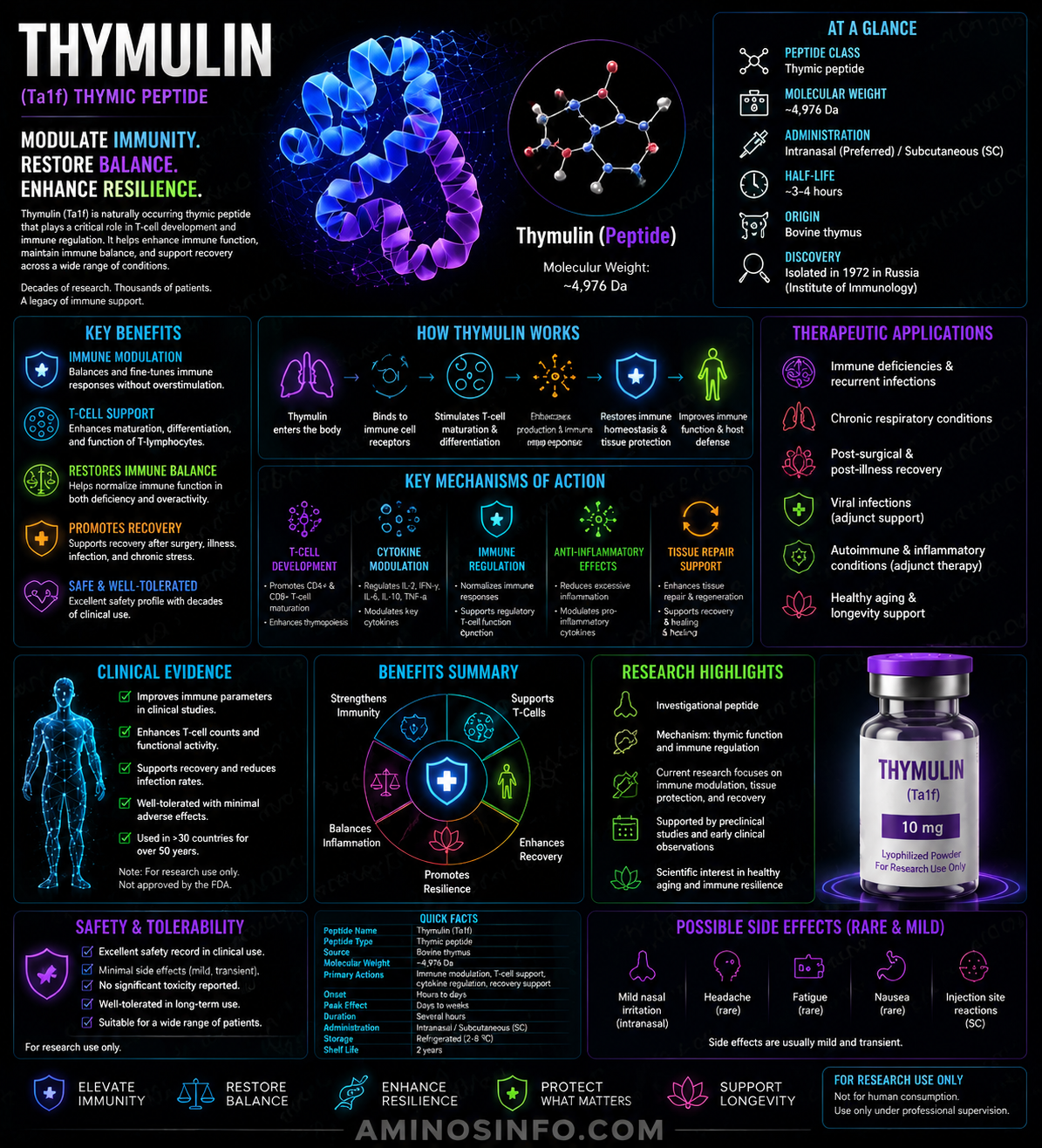
Thymulin is a zinc-dependent thymic hormone produced primarily by thymic epithelial cells. Its peptide component is a nine-amino-acid sequence historically called serum thymic factor, facteur thymique sérique, or FTS.
The peptide becomes biologically active after binding zinc in approximately a 1:1 molar relationship. For this reason, the terms FTS and thymulin should not always be used interchangeably: FTS commonly refers to the apo-peptide, while thymulin refers to the active zinc-associated form.
Thymulin
Serum thymic factor / FTS
9 amino acids
Zinc
Immune–neuroendocrine regulation
No
🧬 Molecular Structure
Thymulin’s peptide component is a linear nonapeptide with an N-terminal pyroglutamic-acid residue and a free C-terminal asparagine carboxyl group.
🧪 Amino-Acid Sequence
H-pGlu-Ala-Lys-Ser-Gln-Gly-Gly-Ser-Asn-OH
Common abbreviated notation:
pEAKSQGGSN
| Residue or feature | Chemical characteristic | Analytical relevance |
|---|---|---|
| Pyroglutamate | Cyclized N-terminal glutamate derivative | Must be distinguished from uncyclized glutamate or glutamine. |
| Lysine | Basic side chain | Contributes positive charge and may participate in zinc-associated conformation. |
| Serine residues | Polar hydroxyl-containing residues | Potentially sensitive to dehydration or chemical modification during synthesis. |
| Glutamine and asparagine | Amide-containing side chains | Can undergo deamidation during storage. |
| Two glycine residues | Small achiral residues | Provide conformational flexibility. |
⚛️ Molecular Weight and 🧫 Formula
| Apo-peptide molecular formula | C33H54N12O15 |
|---|---|
| Apo-peptide average molecular weight | Approximately 858.9 g/mol |
| Peptide length | 9 amino acids |
| N-terminal form | Pyroglutamate |
| C-terminal form | Free asparagine carboxyl group |
| Common CAS number | 78922-62-0 |
The values above describe the peptide component without zinc. A zinc-bound complex has a different elemental composition and mass, depending on the analytical representation and associated counterions.
Why Zinc Is Required for Thymulin Activity
Apo-FTS is largely inactive
The nonapeptide without zinc is generally described as biologically inactive or markedly less active in classical thymulin bioassays.
Approximately equimolar binding
Thymulin is commonly described as FTS associated with zinc in approximately a 1:1 ratio.
Zinc changes conformation
Zinc binding is believed to stabilize a biologically active peptide conformation that can interact with immune targets.
Zinc deficiency lowers active thymulin
Animal and human research shows that zinc deficiency can reduce biologically active circulating thymulin even when total peptide production is not completely absent.
In vitro zinc restoration
In some zinc-deficiency studies, adding zinc to serum samples restored detectable thymulin activity, supporting the concept that inactive apo-FTS was present.
Zinc supplementation is not automatically thymulin therapy
Zinc can restore activity when deficiency is the limiting factor, but excess zinc can cause copper deficiency, gastrointestinal symptoms, and immune dysfunction.
📅 Discovery Timeline and Research History
1970s: Serum thymic factor identified
Researchers described a circulating thymic factor produced by thymic epithelial cells and associated with T-cell differentiation.
1977: Thymulin characterization expands
Work by Bach and colleagues established the nonapeptide nature of FTS and its thymic origin.
Early 1980s: Zinc dependency established
Studies showed that the peptide requires zinc for full biological activity and that zinc deficiency reduces active circulating thymulin.
1980s–1990s: Immune and neuroendocrine research broadens
Investigators studied T-cell differentiation, natural killer cells, pituitary hormones, endocrine feedback, autoimmune disease, and aging.
1992: Immunomodulation review
Researchers summarized thymulin’s role at the intersection of immune and neuroendocrine systems.
2003–2006: Analgesic analogue research
Modified thymulin-related peptides were developed to separate anti-inflammatory and analgesic effects from classical immunological activity.
2011 onward: Gene-therapy models
Experimental vectors were used to produce circulating thymulin in thymectomized or aged animals and to study pituitary, inflammatory, and metabolic effects.
Current status
Thymulin remains a physiologically important research hormone but has no broadly approved therapeutic formulation.
Thymic Epithelial and Immune Biology
Thymic epithelial cells
Cortical and medullary thymic epithelial cells support T-cell development, selection, tolerance, and thymic hormone production.
T-cell maturation
Thymocytes progress through multiple developmental stages before emerging as mature CD4 or CD8 T cells.
Extrathymic immune effects
Thymulin has been reported to influence mature peripheral T cells, natural killer cells, cytokine production, and immune-cell communication outside the thymus.
Neuroendocrine feedback
Growth hormone, prolactin, thyroid hormones, glucocorticoids, and gonadal hormones can affect thymulin production. Thymulin may in turn influence pituitary hormone secretion.
Not a classical one-direction hormone
Thymulin is best understood within a bidirectional immune–endocrine network rather than as a simple T-cell stimulant.
🧠 Proposed Mechanisms of Action
No universally accepted single thymulin receptor has been molecularly cloned and validated.
1. T-cell differentiation
Classical bioassays indicate effects on immature and mature T-lymphocyte phenotypes and function.
2. Cytokine regulation
Thymulin can modify inflammatory cytokines in experimental systems, including TNF, IL-1, and IL-6-related responses.
3. Neuroendocrine signaling
Research suggests effects on ACTH, prolactin, growth hormone, gonadotropins, and hypothalamic–pituitary communication.
4. Glial and neuroimmune signaling
Experimental work suggests thymulin or analogues can influence glial activation and inflammatory pain pathways.
5. Zinc-dependent conformational signaling
The active zinc complex may present a conformation required for biological recognition, though the precise receptor remains uncertain.
🎯 Target and Pathway Profile
| Target or pathway | Evidence status |
|---|---|
| Zinc binding | Essential and well established for classical biological activity. |
| T-cell differentiation | Core historical and experimental evidence. |
| Natural killer-cell activity | Reported in selected immune studies. |
| Pituitary hormone secretion | Supported in neuroendocrine and gene-therapy models. |
| Inflammatory cytokines | Modulated in experimental inflammation and pain studies. |
| Glial activation | Implicated in neuroinflammatory and pain models. |
| Single molecular receptor | Not established. |
T-Cell and Immune Research
Intra-thymic differentiation
Thymulin was originally characterized by its ability to influence markers and functions associated with maturing T cells.
Peripheral T cells
Studies report effects on mature T-cell function and immune responsiveness outside the thymus.
Natural killer cells
Thymulin has been associated with changes in NK-cell activity in selected experimental systems.
Immunodeficiency states
Reduced circulating thymulin has been reported in zinc deficiency, immunodeficiency, autoimmune disease, endocrine disorders, and aging.
Association is not proof of treatment
Low thymulin may be a biomarker or consequence of disease rather than a direct therapeutic target.
Neuroendocrine and Pituitary Research
Bidirectional thymus–pituitary signaling
Pituitary hormones can regulate thymulin production, while thymulin can influence pituitary secretory activity.
ACTH and stress pathways
Experimental studies suggest interactions with hypothalamic–pituitary–adrenal signaling and stress responses.
Growth hormone and prolactin
These hormones have been linked to thymic function and thymulin secretion; thymulin may also influence their release.
Gonadotropins and reproductive aging
Animal studies have examined thymulin’s influence on luteinizing hormone, follicle-stimulating hormone, and age-related reproductive endocrine changes.
No approved endocrine indication
Thymulin has not been established as a treatment for pituitary disease, infertility, adrenal disorders, or hormonal aging.
Inflammation, Neuroinflammation, and Pain Research
Dual dose-dependent effects
Low and high doses of thymulin may have different or even opposing effects in pain and inflammatory models.
Inflammatory pain
Systemic thymulin at selected doses reduced inflammatory pain and cytokine elevations in animal studies.
Peptide analogue of thymulin
A modified analogue—often called PAT—was developed to retain analgesic and anti-inflammatory effects while reducing or eliminating classical hyperalgesic or immune effects.
Neuropathic pain models
PAT reduced mechanical allodynia, heat hyperalgesia, and selected cold-allodynia outcomes in rat peripheral nerve-injury models.
Glial and cytokine pathways
Thymulin-related interventions have been studied for effects on spinal or brain glial activation and inflammatory cytokines.
No proven human analgesic
Animal pain studies do not establish efficacy or safety in human neuropathic pain, arthritis, migraine, or neurodegenerative disease.
Age-Related Decline and Zinc Status
Life-course pattern
Circulating biologically active thymulin is generally higher in childhood and youth and declines with age.
Thymic involution
Loss and remodeling of thymic epithelial tissue reduces naïve T-cell output and may contribute to lower thymulin activity.
Zinc deficiency in aging
Older adults are at increased risk of inadequate zinc status, which can further reduce active thymulin.
In vitro zinc reversibility
Some age-related or deficiency-associated serum samples regain thymulin bioactivity after zinc addition, suggesting apo-FTS remains present.
No proven thymic rejuvenation
Restoring a biomarker does not prove regrowth of the thymus, restoration of a youthful T-cell repertoire, or longer lifespan.
Thymulin Gene-Therapy Research
Experimental vectors
Researchers developed constructs encoding a biologically active thymulin analogue to achieve sustained hormone production in animals.
Thymectomized-animal studies
Gene therapy was evaluated for correction of endocrine and immune changes after removal of the thymus.
Pituitary outcomes
Studies examined prolactin, growth hormone, gonadotropins, and pituitary-cell populations.
Aging models
Some work tested long-term thymulin gene expression in senescent animals.
Not a clinical gene therapy
No approved human thymulin gene-therapy product exists.
Evidence Limitations and Clinical Interpretation
Mostly preclinical evidence
Therapeutic claims rely largely on cell studies, rodent models, physiological observations, and experimental gene therapy.
Historical bioassays
Many classic studies used functional bioassays that may be less specific than modern mass spectrometry or validated immunoassays.
Apo-peptide versus zinc complex
Studies may differ in zinc content, peptide source, assay conditions, and whether active complex formation was confirmed.
Analogue evidence is not native thymulin evidence
PAT and gene-encoded analogues are modified molecules and should not be treated as identical to native zinc-bound thymulin.
No large therapeutic trials
There is no strong modern evidence for treatment of immune aging, chronic pain, neuroinflammation, autoimmune disease, or endocrine dysfunction.
Safety and Regulatory Considerations
No standardized human drug profile
No FDA-approved label defines dose, route, pharmacokinetics, contraindications, interactions, pregnancy safety, or long-term adverse effects.
Immune modulation
Effects on T cells, NK cells, and cytokines could be relevant in autoimmune disease, transplantation, infection, cancer, or immunosuppressive treatment.
Neuroendocrine effects
Potential changes in pituitary or stress-hormone signaling require caution in endocrine disorders.
Zinc toxicity and deficiency
Too little zinc may impair activity; too much zinc can cause nausea, copper deficiency, anemia, neurologic problems, and immune dysfunction.
Product-quality risk
Unapproved products may contain incorrect sequence, absent or excess zinc, uncyclized N-terminal residues, deamidation products, microbial contamination, endotoxin, or inaccurate content.
Regulatory status
Thymulin is not FDA approved as a therapeutic drug or biologic.
🧪 Laboratory Testing Methods
| Method | Purpose | Important limitation |
|---|---|---|
| RP-HPLC or UPLC | Separates thymulin peptide from deletion peptides and degradants. | Area purity does not establish zinc complex formation or net content. |
| LC-MS / HRMS | Confirms apo-peptide molecular mass. | Metal complexes may dissociate under common ionization conditions. |
| MS/MS sequencing | Confirms pGlu-Ala-Lys-Ser-Gln-Gly-Gly-Ser-Asn order. | N-terminal pyroglutamate can affect fragmentation. |
| Pyroglutamate identity assay | Distinguishes correct cyclic pGlu from uncyclized Glu or Gln. | Requires orthogonal standards or enzyme-assisted methods. |
| Chiral amino-acid analysis | Confirms expected L-amino-acid stereochemistry. | Glycine is achiral and hydrolysis can create artifacts. |
| Net peptide-content assay | Measures actual peptide amount. | Must be corrected separately from zinc and counterions. |
| ICP-MS or atomic spectroscopy | Measures zinc concentration and metal impurities. | Total zinc does not prove specific 1:1 complex formation. |
| Native MS, NMR, or spectroscopic binding assay | Evaluates zinc–peptide complex formation and stoichiometry. | Complexes can be condition dependent. |
| Deamidation analysis | Detects Gln- and Asn-related degradation. | Small mass shifts require high-resolution methods. |
| Functional thymulin bioassay | Assesses zinc-dependent biological activity. | Historical assays may lack modern specificity and reproducibility. |
| T-cell and cytokine assays | Evaluate immune activity in cell systems. | No universally accepted potency assay exists. |
| Microbial limits, sterility, and endotoxin | Evaluate route-specific microbiological quality. | Requirements depend on final dosage form. |
| Stability-indicating assay | Tracks deamidation, hydrolysis, zinc loss, aggregation, and potency. | Must reflect formulation pH, chelators, container, and storage. |
📄 How to Interpret a Thymulin COA
- Verify exact sequence: pGlu-Ala-Lys-Ser-Gln-Gly-Gly-Ser-Asn.
- Confirm N-terminal pyroglutamate: Uncyclized glutamate or glutamine is not the authentic structure.
- Confirm apo-peptide mass: Approximately 858.9 g/mol.
- Check zinc separately: Quantify total zinc and evaluate approximately equimolar peptide-to-zinc stoichiometry.
- Demonstrate complex formation: Total zinc content alone does not prove active zinc-thymulin.
- Separate purity, identity, peptide content, and zinc content: These are distinct results.
- Review deamidation, deletion peptides, free amino acids, water, counterions, and residual solvents.
- Match microbiological testing to route: Injectable products require validated sterility, endotoxin, particle, and container controls.
- Do not infer biological efficacy: A COA cannot prove T-cell maturation, immune rejuvenation, pain relief, neuroprotection, or endocrine benefit.
📊 Thymulin vs Thymalin vs Thymogen vs Thymosin Alpha-1
| Feature | Thymulin | Thymalin | Thymogen | Thymosin Alpha-1 |
|---|---|---|---|---|
| Structure | Zinc-dependent nonapeptide | Complex thymic peptide mixture | EW dipeptide | 28-AA acetylated peptide |
| Natural origin | Thymic epithelial hormone | Thymus-derived extract | Synthetic defined peptide | Natural sequence / synthetic thymalfasin |
| Main research focus | Immune–neuroendocrine regulation | Broad thymic immune effects | Immune recovery and hematopoiesis | Innate and adaptive immune modulation |
| Required metal cofactor | Zinc | No single required cofactor | No | No |
| FDA approved? | No | No | No | No |
Thymulin vs Apo-FTS vs PAT
| Feature | Zinc-Thymulin | Apo-FTS | PAT analogue |
|---|---|---|---|
| Composition | FTS nonapeptide + zinc | Nonapeptide without zinc | Modified thymulin-related peptide |
| Classical immune bioactivity | Active | Low or absent | Designed to alter immune/pain profile |
| Pain research | Dose-dependent effects | Limited | Strong preclinical analgesic focus |
| Same compound? | Native active complex | Inactive precursor form | No |
Thymulin vs Zinc Supplementation
| Approach | Research purpose | Key limitation |
|---|---|---|
| Zinc-Thymulin | Direct hormone-complex research | No approved therapeutic formulation |
| Zinc supplementation | Correct zinc deficiency | Does not create thymulin if peptide production is absent |
| Dietary zinc sufficiency | Supports normal immune and thymic physiology | Not a targeted thymulin treatment |
Thymulin vs Established Pain Therapies
| Approach | Established role | Difference from thymulin research |
|---|---|---|
| NSAIDs | Inflammatory pain relief | Defined cyclooxygenase targets |
| Gabapentinoids | Selected neuropathic pain conditions | Defined calcium-channel subunit target |
| Antidepressant analgesics | Selected neuropathic pain conditions | Defined monoamine mechanisms |
| Thymulin/PAT | Preclinical immune–pain modulation | No approved human analgesic indication |
🔗 Related Peptides and Pathways
- Serum thymic factor: Historical name for the thymulin nonapeptide component.
- Zinc: Essential metal cofactor for classical thymulin activity.
- Thymic epithelial cells: Main source of endogenous thymulin.
- Thymalin: Distinct thymus-derived peptide mixture.
- Thymogen: EW dipeptide associated with immune recovery research.
- Thymosin Alpha-1: Distinct 28-amino-acid immunomodulatory peptide.
- PAT: Modified thymulin analogue developed for analgesic research.
- Hypothalamic–pituitary axis: Major neuroendocrine system interacting with thymulin.
🖼️ Original Diagram Specifications
Diagram 1: Thymulin peptide structure
Show pGlu-Ala-Lys-Ser-Gln-Gly-Gly-Ser-Asn with N-terminal pyroglutamate, flexible glycine pair, amide-containing side chains, and free C-terminus.
Diagram 2: Zinc activation
Show inactive apo-FTS binding one zinc ion to form biologically active thymulin, with a note that stoichiometry and conformation require analytical confirmation.
Diagram 3: Thymic epithelial–T-cell signaling
Show thymic epithelial cells, developing thymocytes, mature CD4/CD8 cells, and extrathymic immune effects.
Diagram 4: Neuroendocrine feedback loop
Show hypothalamus, pituitary, adrenal gland, gonads, thyroid, thymus, and bidirectional hormone signaling.
Diagram 5: Pain and neuroinflammation pathway
Show peripheral injury, cytokines, spinal glia, sensitization, allodynia, and experimental thymulin/PAT modulation.
Diagram 6: Aging and zinc pathway
Show thymic involution, lower thymic epithelial output, zinc deficiency, reduced active thymulin, and declining naïve T-cell production.
Diagram 7: COA workflow
Show peptide identity, pyroglutamate confirmation, MS/MS sequence, zinc quantification, complex stoichiometry, deamidation, net peptide content, microbiology, and stability.
❓ Frequently Asked Questions
Is thymulin a peptide?
Yes. Its peptide component is a nine-amino-acid nonapeptide.
What is its exact sequence?
pGlu-Ala-Lys-Ser-Gln-Gly-Gly-Ser-Asn.
What is its molecular weight?
The apo-peptide has an average molecular weight of approximately 858.9 g/mol.
Why does thymulin require zinc?
Zinc stabilizes the biologically active form recognized in classical thymulin assays.
Is serum thymic factor the same as thymulin?
FTS often refers to the peptide alone; thymulin more precisely refers to the active zinc-associated complex.
Is thymulin FDA approved?
No.
Does thymulin mature T cells?
Classical experimental research supports a role in T-cell differentiation and function.
Does thymulin improve immunity?
It participates in immune regulation, but therapeutic immune enhancement in humans has not been established.
Does thymulin regrow the thymus?
No robust evidence demonstrates thymic regrowth.
Does thymulin decline with age?
Biologically active circulating thymulin generally declines with age and can also be reduced by zinc deficiency.
Can zinc raise thymulin?
Zinc can restore active thymulin when zinc deficiency limits complex formation, but it may not overcome loss of peptide production.
Does thymulin treat neuropathic pain?
Native thymulin and modified analogues have shown effects in animal pain models, but there is no approved human indication.
Is thymulin the same as thymosin alpha-1?
No. They have different sequences, structures, mechanisms, and evidence bases.
Does 99% HPLC purity prove active thymulin?
No. HPLC purity does not prove zinc stoichiometry, complex formation, biological potency, safety, or clinical efficacy.
Final Thoughts
Thymulin is a genuine thymic epithelial hormone composed of a pyroglutamyl nonapeptide and zinc. Its defining scientific feature is that the apo-peptide alone is not equivalent to the biologically active zinc-associated complex.
Research supports roles in T-cell differentiation, immune–neuroendocrine communication, zinc biology, inflammatory signaling, pituitary regulation, and experimental pain pathways. However, most therapeutic work remains preclinical, and modified analogues or gene-therapy constructs should not be treated as identical to native thymulin.
Legitimate research material should be verified for exact nonapeptide sequence, N-terminal pyroglutamate, peptide content, zinc content, zinc-to-peptide stoichiometry, actual complex formation, deamidation, route-specific microbiological quality, and stability.
📚 References
- PubChem. Thymulin compound record.
- Dardenne M, et al. In vivo and in vitro studies of thymulin in marginally zinc-deficient mice. 1984.
- Safieh-Garabedian B, et al. Thymulin and its role in immunomodulation. 1992.
- Goya RG, et al. Thymulin and the neuroendocrine system. Peptides. 2004.
- Reggiani PC, et al. Thymulin-based gene therapy and pituitary function. 2011.
- Saadé NE, et al. A thymulin analogue peptide with inhibitory effects in neuropathic pain models. 2003.
- Dardenne M, et al. Role of thymulin or its analogue as a new analgesic molecule. 2006.
- Consolini R, et al. Distribution of age-related thymulin titres in normal subjects. 2000.
- Mocchegiani E, Fabris N. Age-related thymus involution: zinc reverses in vitro the thymulin secretion defect. International Journal of Immunopharmacology. 1995.
- Bach JF, et al. Serum thymic factor and thymulin characterization. Early thymic hormone literature.
- Dardenne M, Bach JF. Thymulin: chemistry, biology, and zinc dependency. Thymus and immunology literature.
- Prasad AS, et al. Zinc and thymulin activity in human zinc deficiency. Clinical nutrition and immunology literature.
- Mocchegiani E, et al. Zinc, thymulin, and immunosenescence. Mechanisms of Ageing and Development.
- Fabris N, et al. Zinc deficiency and thymic endocrine function. International Journal of Immunopharmacology.
- Savino W, Dardenne M. Neuroendocrine control of thymic physiology. Endocrine Reviews.
- Savino W. The thymus is a common target organ in infectious diseases. PLoS Pathogens.
- Savino W, et al. Thymic hormones and the neuroendocrine system. Neuroimmunomodulation.
- Reggiani PC, et al. Thymulin gene therapy in thymectomized animals. Experimental Gerontology.
- Reggiani PC, et al. Long-term thymulin gene therapy in aging models. Neuroimmunomodulation.
- Goya RG, et al. Thymulin and pituitary gonadotropin regulation. Experimental neuroendocrinology literature.
- Goya RG, et al. Thymulin and reproductive endocrine aging. Gerontology literature.
- Hall NR, Goldstein AL. Neuroendocrine regulation of thymic hormones. Immunology Today.
- Hadley AJ, et al. Thymic hormones and pituitary function. Endocrinology literature.
- Nasseri B, et al. Thymulin treatment attenuates inflammatory pain. 2019.
- Safieh-Garabedian B, et al. Thymulin and cytokine modulation in inflammatory pain. Brain, Behavior, and Immunity.
- Saadé NE, et al. Thymulin analogue and neuropathic allodynia. Neuroscience research.
- Haddad JJ, et al. Thymulin, cytokines, and neuroimmune communication. Neuroimmunology literature.
- Lunin SM, et al. Thymic hormones as anti-inflammatory agents. International Immunopharmacology.
- Thomas R, et al. Contributions of age-related thymic involution to immunosenescence and inflammaging. 2020.
- Liang Z, et al. Age-related thymic involution: mechanisms and functional consequences. 2022.
- Palmer DB. The effect of age on thymic function. 2013.
- Santamaria JC, et al. Age-related thymic involution: mechanistic insights and therapeutic perspectives. 2026.
- Elyahu Y, et al. Thymus involution sets the clock of the aging T-cell landscape. Ageing Research Reviews. 2021.
- Ventevogel MS, Sempowski GD. Thymic rejuvenation and aging. Current Opinion in Immunology.
- Thapa P, Farber DL. The role of the thymus in the immune response. Thoracic Surgery Clinics.
- Nikolich-Žugich J. The twilight of immunity: emerging concepts in aging of the immune system. Nature Immunology.
- Goronzy JJ, Weyand CM. Understanding immunosenescence to improve responses to vaccines. Nature Immunology.
- Fraker PJ, King LE. Reprogramming of the immune system during zinc deficiency. Annual Review of Nutrition.
- Wessels I, Maywald M, Rink L. Zinc as a gatekeeper of immune function. Nutrients.
- Prasad AS. Zinc in human health: effect of zinc on immune cells. Molecular Medicine.
- International Council for Harmonisation. ICH Q2(R2): Validation of Analytical Procedures.
- United States Pharmacopeia. General Chapter <621>, Chromatography.
- United States Pharmacopeia. General Chapter <71>, Sterility Tests.
- United States Pharmacopeia. General Chapter <85>, Bacterial Endotoxins Test.
- United States Pharmacopeia. General Chapters <232> and <233>, Elemental Impurities.
- International Council for Harmonisation. ICH Q3C: Residual Solvents.
- International Council for Harmonisation. ICH Q1A(R2): Stability Testing of New Drug Substances and Products.
Identity, molecular properties, zinc dependence, immune, neuroendocrine, pain, aging, safety, and analytical findings were reviewed in July 2026. Thymulin remains an unapproved investigational hormone.