
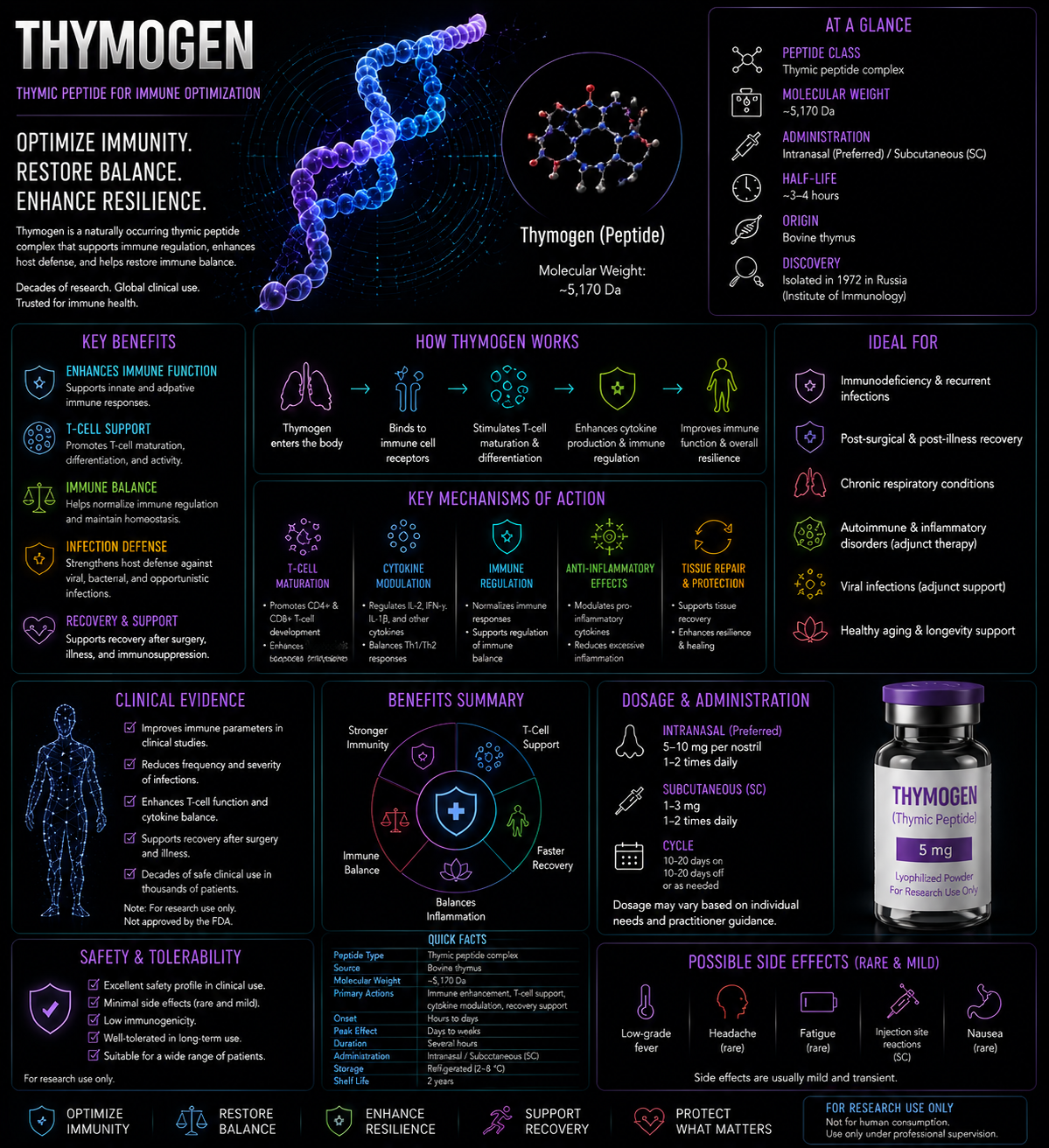
Thymogen: What It Is, How It Works, Benefits, and Research Overview What Is Thymogen? Thymogen (also called Glu-Trp or L-glutamyl-L-tryptophan) is a
Thymogen: What It Is, How It Works, Benefits, and Research Overview
What Is Thymogen?
Thymogen (also called Glu-Trp or L-glutamyl-L-tryptophan) is an investigational thymic bioregulator peptide studied for its potential role in immune signaling, T-cell regulation, inflammation balance, immune recovery, and healthy aging research. It is a very small peptide belonging to the Khavinson bioregulator family, developed from research into thymus-derived immune peptides. Thymogen consists of only two amino acids:
Glutamic acid + Tryptophan (Glu-Trp / EW).
Researchers investigate Thymogen in relation to:
- T-cell signaling and immune coordination
- Immune resilience and recovery pathways
- Healthy aging and immunosenescence (immune aging)
- Inflammation regulation
- Hematopoietic (blood-cell) recovery and immune regeneration research
Important: Thymogen is not FDA approved in the United States and remains investigational, though versions have been used clinically in some countries, particularly in Russian medical literature and immune research.
What Is Thymogen Made Of?
Thymogen is a synthetic dipeptide composed of:
L-Glutamic Acid + L-Tryptophan (Glu-Trp / EW).
Researchers developed Thymogen after identifying biologically active peptide fragments within thymic tissue and immune signaling pathways. Compared with larger thymic peptides, Thymogen is:
- Extremely small and structurally simple
- Stable and experimentally practical
- Designed to influence immune signaling and cellular regulation pathways
Researchers often describe it as a:
Thymic immune bioregulator peptide.
How Does Thymogen Work?
The precise mechanism remains under investigation, but researchers believe Thymogen acts through immune-cell regulation, gene-expression signaling, and thymic restoration pathways.
1. T-Cell Signaling and Immune Regulation
The thymus is responsible for:
- T-cell maturation
- Adaptive immune signaling
- Immune-cell differentiation
Researchers investigate whether Thymogen may:
- Support T-lymphocyte signaling
- Promote immune-cell differentiation pathways
- Improve immune coordination during stress or aging
- Enhance adaptive immune resilience
In simple terms:
Thymogen says:
“Help coordinate immune communication and adaptive immune readiness.”
2. Gene Expression and Cellular Regulation
Like several short thymic peptides, Thymogen is studied for possible effects on:
- Gene transcription signaling
- Cytokine production
- Heat-shock protein regulation
- Cell proliferation and apoptosis pathways
Researchers propose small thymic peptides may influence how immune-related genes are expressed and regulated under stress conditions.
3. Healthy Aging and Immunosenescence Research
Because immune function naturally declines with age, researchers study Thymogen in relation to:
Immunosenescence (age-related immune decline)
Research explores whether Thymogen may help:
- Support immune resilience during aging
- Improve adaptive immune signaling
- Influence inflammatory balance in older organisms
- Support thymic signaling pathways as thymic function declines
4. Immune Recovery and Hematopoietic Research
Researchers also investigate Thymogen in models involving:
- Immune suppression recovery
- Bone marrow and hematopoietic signaling
- Recovery after physiological stress or immune dysfunction
- Infection and immune-defense pathways
Experimental work has explored thymogen-related peptides in irradiated or immune-compromised models to better understand recovery signaling.
Why Is Thymogen Getting Attention?
Thymogen attracts attention because it combines several major research themes:
- Immune signaling and resilience
- Healthy aging biology
- Inflammatory balance
- T-cell regulation
- Recovery signaling under immune stress
Researchers are especially interested in how a peptide consisting of only two amino acids may influence broader immune signaling networks.
Potential Research Areas of Interest
1. Immune Function and T-Cell Research
Researchers investigate whether Thymogen may support:
- T-cell signaling pathways
- Immune-cell maturation
- Adaptive immune communication
- Immune resilience during stress and aging
2. Healthy Aging Research
Thymogen is studied for:
- Immunosenescence models
- Age-related immune decline
- Chronic inflammatory signaling during aging
- Immune resilience and healthy aging pathways
3. Inflammatory and Recovery Research
Researchers investigate whether Thymogen influences:
- Cytokine balance
- Immune recovery signaling
- Stress adaptation pathways
- Inflammatory homeostasis
4. Infection and Host Defense Research
Experimental literature has explored Thymogen in relation to:
- Immune dysfunction models
- Viral and bacterial defense signaling
- Host resilience during immune challenge
Thymogen vs Thymalin vs Thymulin vs Thymosin Alpha-1
| Feature | Thymogen | Thymalin | Thymulin | Thymosin Alpha-1 |
|---|---|---|---|---|
| Structure | Dipeptide (Glu-Trp / EW) | Peptide complex | Single nonapeptide hormone | 28-AA peptide |
| Main Focus | Immune signaling & resilience | Broad thymic immune support | T-cell regulation | Immune modulation & antiviral signaling |
| Major Research Area | T-cell signaling | Immune aging | Neuroimmune/immune biology | Immune enhancement |
| Aging Research | Moderate | High | Moderate | Moderate |
| FDA Approved? | No | No | No | Limited international approvals |
Researchers generally view:
- Thymogen → small thymic immune bioregulator peptide
- Thymalin → broader thymus-derived peptide complex
- Thymulin → natural thymic hormone for immune signaling
- Thymosin Alpha-1 → larger immune-modulating thymic peptide
Potential Side Effects and Safety Considerations
Because Thymogen remains investigational:
- Human therapeutic evidence is limited outside Russian clinical literature
- Long-term pharmacology remains uncertain
- Most evidence comes from mechanistic studies, animal research, and regional clinical experience
Published literature generally reports good tolerability and low toxicity, though large modern Western clinical trials remain lacking.
Frequently Asked Questions
Is Thymogen a peptide?
Yes. Thymogen is a synthetic thymic dipeptide composed of L-glutamic acid and L-tryptophan (Glu-Trp / EW).
Is Thymogen FDA approved?
No. Thymogen is not FDA approved in the United States and remains investigational.
What is Thymogen studied for?
Researchers study Thymogen for immune signaling, T-cell regulation, healthy aging, immune resilience, inflammatory balance, and recovery pathways.
Does Thymogen affect the immune system?
Research suggests Thymogen may influence T-cell signaling, immune-cell communication, cytokine activity, and adaptive immune resilience, though broader clinical validation remains needed.
What makes Thymogen different from Thymalin?
Thymogen is a single defined dipeptide (Glu-Trp), while Thymalin is a broader peptide complex extracted or modeled from thymic peptide fractions.
Final Thoughts
Thymogen is an investigational thymic bioregulator peptide studied for its potential role in immune signaling, T-cell coordination, healthy aging, inflammation balance, and immune resilience research. Despite containing only two amino acids, researchers believe it may influence broader biological signaling pathways related to immune adaptation and recovery. While decades of regional research are intriguing, Thymogen remains investigational and broader clinical significance continues to be explored.
