
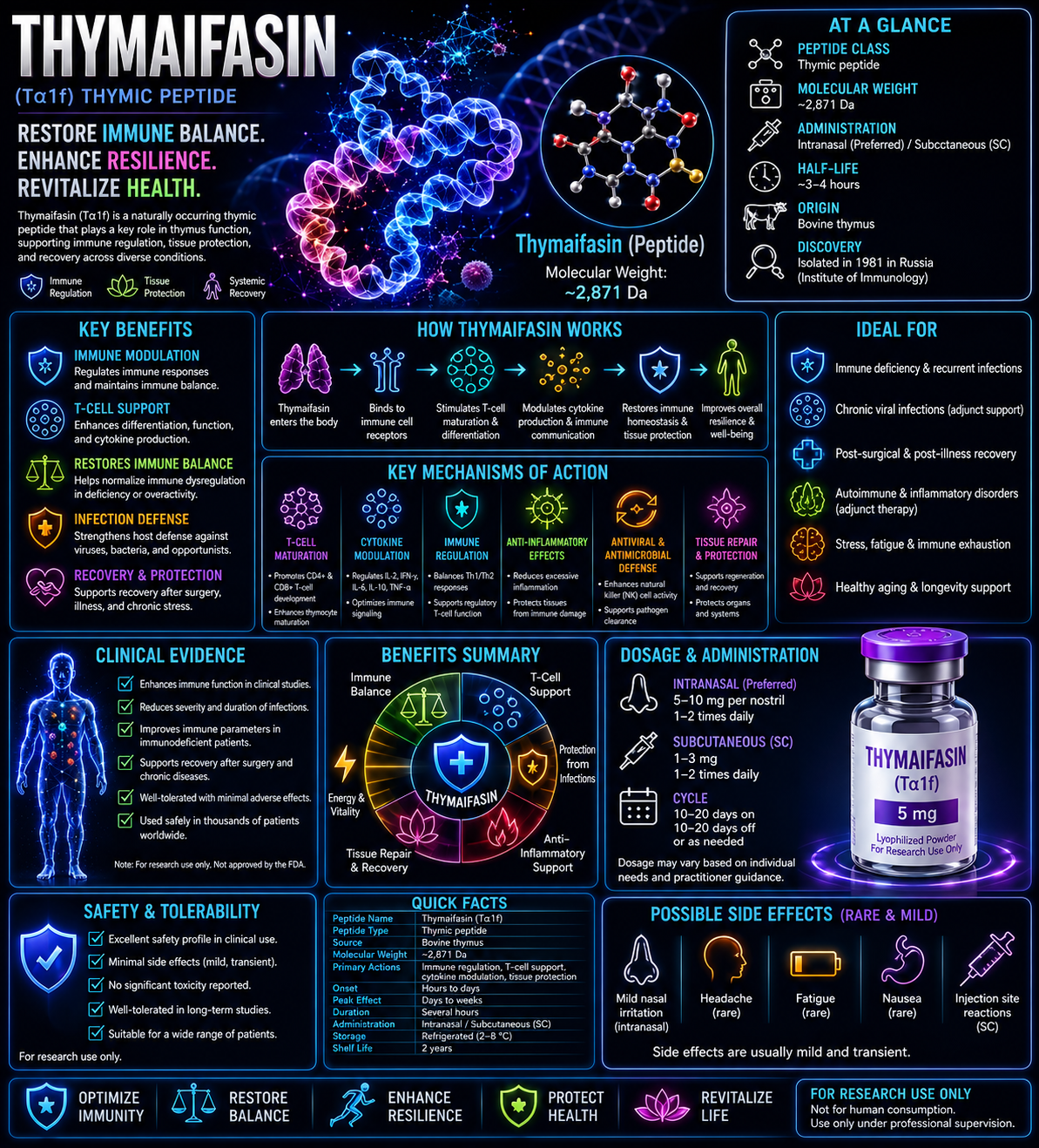
Thymaifasin: Overview, Mechanism, and Research Insights What Is Thymaifasin? Thymaifasin is an investigational thymic peptide studied for its potent
Thymaifasin: Overview, Mechanism, and Research Insights
What Is Thymaifasin?
Thymaifasin is an investigational thymic peptide studied for its potential role in immune modulation, T-cell support, thymic function restoration, and healthy aging. It belongs to a family of thymic bioregulator peptides developed primarily through Russian and Eastern European research on thymus-derived signaling molecules.
Thymaifasin is studied in relation to:
- T-cell maturation and signaling
- Immune system resilience and regulation
- Thymic rejuvenation in aging models
- Inflammation and immune homeostasis
- Recovery after immunosuppression or physiological stress (pmc.ncbi.nlm.nih.gov)
Important: Thymaifasin is not FDA approved and remains investigational, with most evidence coming from animal studies, in vitro experiments, and regional clinical literature.
What Is Thymaifasin Made Of?
Thymaifasin is a small synthetic thymic peptide, derived from naturally occurring thymus signaling molecules. Its key features include:
- Short amino acid sequence optimized for immune signaling
- Modeled after thymus-derived regulatory peptides
- Designed to support T-cell differentiation, immune coordination, and cellular resilience
Exact sequences are typically proprietary, but like other thymic bioregulators (e.g., Thymogen, Vilon, Thymalin), Thymaifasin is very small, stable, and experimentally practical (pmc.ncbi.nlm.nih.gov).
How Does Thymaifasin Work?
While mechanisms are still under study, research suggests Thymaifasin works through immune-cell modulation and thymic signaling pathways:
1. T-Cell Modulation
Thymaifasin supports:
- T-cell maturation in the thymus
- Adaptive immune signaling
- Regulation of CD4⁺ and CD8⁺ lymphocyte activity
- Maintenance of immune balance during aging or stress
2. Immune Recovery and Resilience
Thymaifasin may enhance:
- Recovery after immunosuppression
- Resilience to infections or stress-related immune dysfunction
- Homeostatic balance in adaptive and innate immune responses
3. Healthy Aging and Thymic Function
Because the thymus gradually involutes with age, Thymaifasin is studied for its potential to:
- Support thymic output of T-cells
- Reduce age-related immune decline (immunosenescence)
- Modulate chronic inflammatory pathways associated with aging (pmc.ncbi.nlm.nih.gov)
4. Inflammatory and Cellular Regulation
Thymaifasin may influence:
- Cytokine signaling
- Immune-mediated inflammatory responses
- Cell proliferation and stress response pathways
Researchers suggest these pathways could help maintain immune homeostasis and tissue resilience, particularly in aging organisms.
Potential Research Applications
- Immune support in aging – counteracting immunosenescence
- T-cell signaling modulation – improving adaptive immune responses
- Immune recovery after stress or suppression – chemotherapy, radiation, infection
- Inflammation regulation – balancing pro- and anti-inflammatory signaling (pmc.ncbi.nlm.nih.gov)
Thymaifasin vs Thymogen vs Thymalin vs Vilon
| Peptide | Main Focus | Structure | Major Research Area | FDA Approved? |
|---|---|---|---|---|
| Thymaifasin | T-cell & thymic support | Small thymic peptide | Immune resilience & aging | No |
| Thymogen | T-cell signaling | Dipeptide (EW) | Immune modulation | No |
| Thymalin | Thymic peptide complex | Peptide mixture | Immune aging & regeneration | No |
| Vilon | Gene regulation & thymic resilience | Dipeptide (KE) | Aging & chromatin signaling | No |
Researchers generally view:
- Thymaifasin → thymic T-cell support and immune resilience peptide
- Thymogen → smaller dipeptide T-cell regulator
- Thymalin → broader thymic peptide complex for immune aging
- Vilon → thymic bioregulator influencing gene expression and immune signaling
Potential Side Effects and Safety Considerations
Because Thymaifasin is investigational:
- Human safety data is limited
- Most evidence comes from animal studies, in vitro experiments, and regional clinical literature
- No significant toxicity reported in preclinical studies, but rigorous large-scale clinical validation is lacking
Frequently Asked Questions
Is Thymaifasin a peptide?
Yes. It is a small synthetic thymic peptide designed to support T-cell signaling and immune resilience.
Is Thymaifasin FDA approved?
No. Thymaifasin remains investigational.
What is Thymaifasin studied for?
Researchers study it for immune signaling, thymic support, T-cell regulation, healthy aging, and recovery from immune stress.
Does Thymaifasin improve immunity?
Preclinical studies suggest it may enhance T-cell activity and adaptive immune function, though human data is limited.
How is Thymaifasin administered in research?
Typically via systemic injection in animal models; human protocols are investigational.
Final Thoughts
Thymaifasin is an investigational thymic peptide with potential to support immune signaling, T-cell development, thymic function, inflammation regulation, and healthy aging. Its primary research focus is on immune resilience and adaptive immune coordination, particularly in aging or stress-compromised models. While preclinical data are promising, Thymaifasin remains experimental, and broader human clinical validation is limited. (pubmed.ncbi.nlm.nih.gov)
