
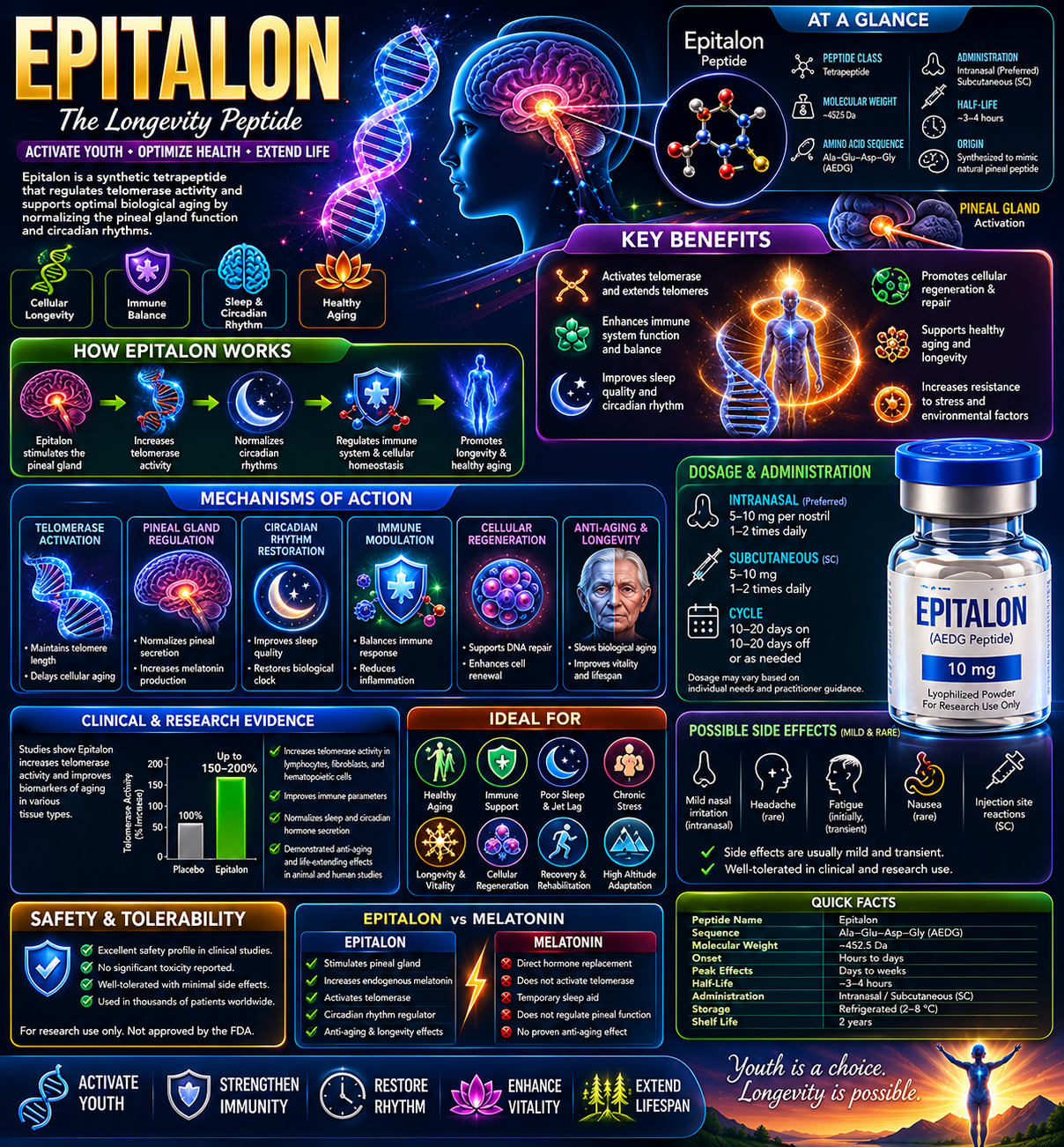
Epitalon (Epithalamin / Epithalon): Overview, Mechanism, Benefits, and Research Insights What Is Epitalon? Epitalon (also called Epithalamin or Epit
Epitalon (Epithalamin / Epithalon): Overview, Mechanism, Benefits, and Research Insights
What Is Epitalon?
Epitalon (also called Epithalamin or Epithalon) is a synthetic tetrapeptide studied extensively for its potential role in healthy aging, circadian rhythm regulation, telomere maintenance, and anti-aging research. It was first developed by Russian scientist Vladimir Khavinson and is derived from peptides naturally found in the pineal gland.
Epitalon is primarily studied in relation to:
- Telomere length maintenance and DNA protection
- Healthy aging and lifespan research
- Circadian rhythm and melatonin regulation
- Cellular repair and antioxidant signaling
- Age-related immune function decline (pmc.ncbi.nlm.nih.gov)
Important: Epitalon is not FDA approved and remains investigational, though it has been used clinically in some countries for experimental anti-aging protocols.
What Is Epitalon Made Of?
Epitalon is a synthetic tetrapeptide with the amino acid sequence:
Ala‑Glu‑Asp‑Gly (AEAG / AEDG)
Key features:
- Very small peptide (4 amino acids)
- Designed to mimic the naturally occurring pineal peptide Epithalamin
- Stable for research or clinical use in preclinical and experimental studies (pmc.ncbi.nlm.nih.gov)
Researchers developed Epitalon to enhance telomerase activity and cellular repair pathways, while remaining simple and bioavailable for experimental administration.
How Does Epitalon Work?
Epitalon is believed to act through multiple anti-aging and cellular signaling pathways.
1. Telomerase Activation and DNA Protection
One of Epitalon’s most studied mechanisms is its ability to:
- Stimulate telomerase activity, particularly in aging cells
- Maintain or lengthen telomeres, which are protective caps on chromosomes
- Reduce age-related DNA damage and cellular senescence
This mechanism is thought to slow cellular aging and support healthy cell replication (pmc.ncbi.nlm.nih.gov).
2. Pineal Gland and Melatonin Regulation
Epitalon may also influence the pineal gland, affecting:
- Melatonin synthesis
- Circadian rhythm regulation
- Sleep-wake cycle balance
- Endocrine and neuroendocrine signaling
These effects contribute to better circadian rhythm stability and antioxidant activity, particularly in aging organisms (pmc.ncbi.nlm.nih.gov).
3. Antioxidant and Cellular Repair Signaling
Research suggests Epitalon may:
- Reduce oxidative stress in cells
- Promote DNA repair mechanisms
- Modulate gene expression related to stress response
- Support healthy mitochondrial function
These effects are thought to improve cellular resilience and longevity potential (pmc.ncbi.nlm.nih.gov).
4. Immune Function and Aging
Epitalon has been investigated for its influence on:
- Age-related immune decline (immunosenescence)
- T-cell signaling and thymic support
- Inflammation modulation
- Recovery from age-related immune dysfunction (pmc.ncbi.nlm.nih.gov)
Potential Research Applications
- Healthy aging and longevity research – supporting telomere maintenance and cellular repair
- Circadian rhythm regulation – improving sleep, melatonin balance, and neuroendocrine function
- Telomere and DNA protection – mitigating age-related cellular senescence
- Immune support – maintaining T-cell and thymic signaling in aging
- Antioxidant and cellular resilience – improving cellular defense against oxidative stress (pmc.ncbi.nlm.nih.gov)
Epitalon vs Other Thymic and Anti-Aging Peptides
| Peptide | Main Focus | Structure | Major Research Area | FDA Approved? |
|---|---|---|---|---|
| Epitalon | Anti-aging, telomere maintenance | Tetrapeptide (Ala‑Glu‑Asp‑Gly) | Healthy aging, circadian rhythm, telomerase | No |
| Vilon | Immune/gene signaling | Dipeptide (KE) | Aging & chromatin regulation | No |
| Thymulin | T-cell regulation | Nonapeptide | Immune-neuroendocrine | No |
| Thymalin | Thymic immune complex | Peptide mixture | Immune aging & regeneration | No |
| Thymogen | T-cell signaling | Dipeptide (EW) | Immune modulation | No |
| Thymosin Alpha‑1 | Immune modulation | 28-AA peptide | T-cell & antiviral therapy | Yes (some countries) |
Potential Side Effects and Safety Considerations
Because Epitalon remains investigational:
- Human safety evidence is limited, though Russian clinical studies report good tolerability
- No major toxicity reported in short-term studies
- Long-term pharmacology, optimal dosing, and broad clinical effects remain under investigation (pmc.ncbi.nlm.nih.gov)
Reported minor effects may include:
- Mild local reactions at injection sites
- Transient fatigue or changes in sleep patterns
Frequently Asked Questions
Is Epitalon a peptide?
Yes. Epitalon is a synthetic tetrapeptide derived from the pineal gland peptide Epithalamin.
Is Epitalon FDA approved?
No. It is investigational in most regions, though some countries use it for experimental anti-aging protocols.
What is Epitalon studied for?
Epitalon is studied for healthy aging, telomere maintenance, circadian rhythm regulation, DNA protection, and immune support.
Does Epitalon affect telomeres?
Yes. Preclinical studies suggest it may stimulate telomerase activity, potentially maintaining or lengthening telomeres in aging cells.
How is Epitalon administered in research?
Typically via subcutaneous or intramuscular injection in research and experimental studies.
Final Thoughts
Epitalon is an investigational anti-aging tetrapeptide that supports telomere maintenance, circadian rhythm regulation, cellular repair, immune resilience, and healthy aging. While preclinical and limited clinical evidence—especially from Russian studies—are promising, Epitalon remains experimental, human data are limited, and regulatory approval is not universal. Its role in longevity research and cellular resilience continues to be an active area of study. (pmc.ncbi.nlm.nih.gov)
