GHK-Cu (Copper Peptide): What It Is, How It Works, Benefits, and Research Overview
A comprehensive, evidence-graded review of GHK-Cu, the naturally occurring copper complex of glycyl-L-histidyl-L-lysine studied for extracellular-matrix remodeling, collagen and elastin signaling, wound repair, skin aging, angiogenesis, nerve growth, antioxidant defense, inflammation, and tissue regeneration.
What Is GHK-Cu?
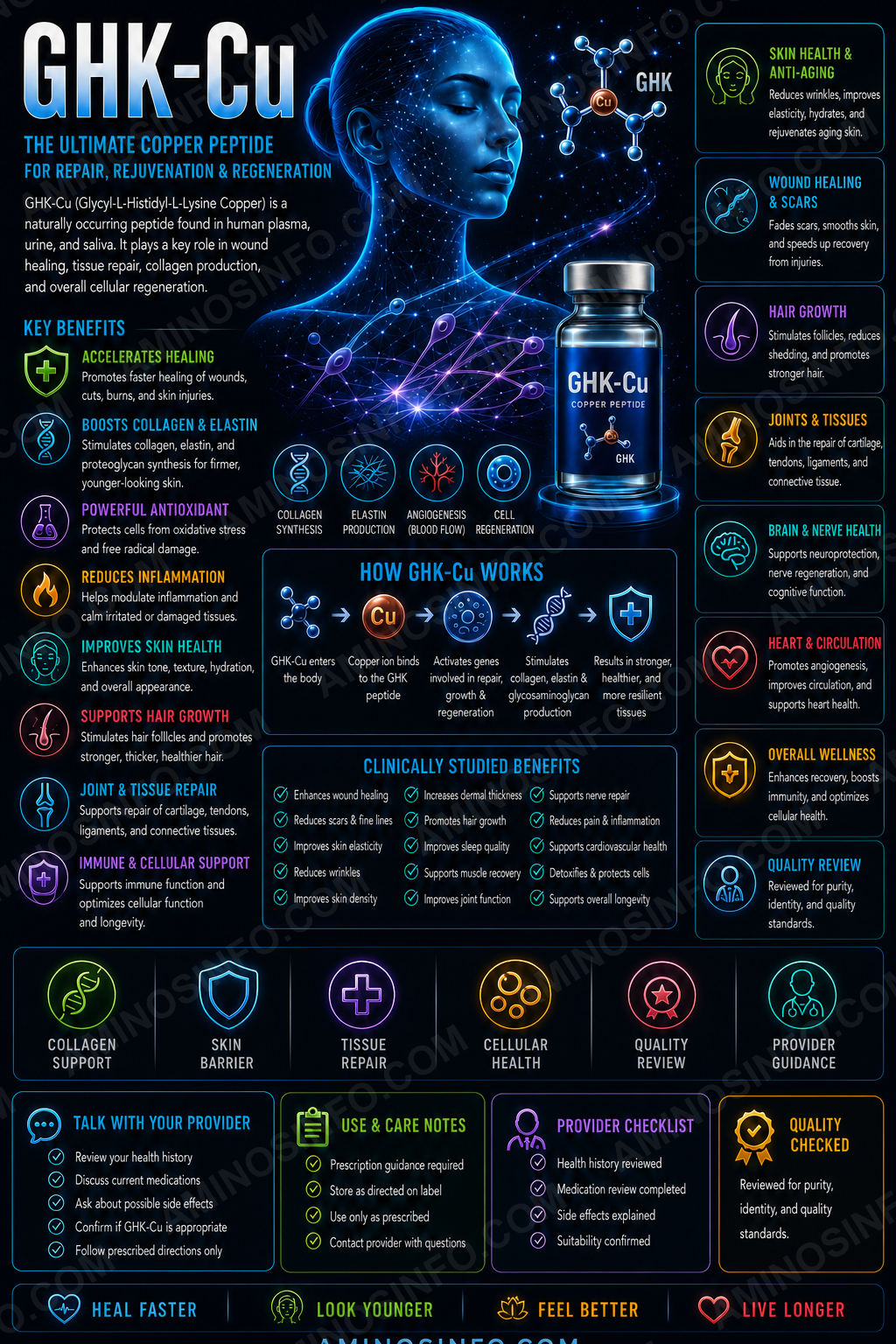
GHK-Cu is a naturally occurring complex formed when the tripeptide GHK—glycine, histidine, and lysine—binds copper in the Cu²⁺ oxidation state. GHK occurs in human plasma, saliva, and urine, and its circulating concentration declines with age.
Gly-His-Lys
3 amino acids
Copper(II)
378611
403.92 Da
No systemic drug approval
Major research themes
- Collagen, elastin, and glycosaminoglycan synthesis
- Extracellular-matrix remodeling
- Wound healing and epithelial repair
- Skin firmness, elasticity, and fine-line appearance
- Angiogenesis and blood-vessel growth
- Nerve outgrowth and regeneration
- Antioxidant and anti-inflammatory signaling
- Gene-expression modulation
- Hair-follicle and scalp research
🧬 Structure, Sequence, and Copper Coordination
🧪 Peptide sequence
H-Gly-His-Lys-OH
Free GHK chemistry
| Molecular formula | C14H24N6O4 |
|---|---|
| Molecular weight | 340.38 g/mol |
| Structure | Linear tripeptide |
| Disulfide bonds | None |
Representative Cu-GHK chemistry
| PubChem formula | C14H24CuN6O4 |
|---|---|
| PubChem molecular weight | 403.92 g/mol |
| Exact mass | Approximately 403.1155 Da |
| Common copper state | Cu²⁺ |
| Typical appearance | Blue to blue-violet complex |
How copper binds
The Cu²⁺ ion is coordinated by donor atoms within the GHK peptide, especially the N-terminal amine, peptide backbone, and histidine imidazole group. Exact coordination geometry depends on pH, concentration, counterions, and solution conditions.
📅 Discovery and Research Timeline
- 1973: Loren Pickart and colleagues identified GHK in human plasma as a factor associated with younger tissue behavior.
- 1970s–1980s: GHK was shown to bind copper strongly and influence wound repair and collagen metabolism.
- 1980s–1990s: Research expanded into fibroblast activity, extracellular matrix, angiogenesis, nerve growth, and wound healing.
- 1990s–2000s: Controlled cosmetic studies explored topical copper-peptide products for photoaged skin, firmness, elasticity, and wrinkles.
- 2000s: Reviews consolidated evidence for tissue remodeling and skin repair.
- 2010s: Gene-expression analyses suggested GHK may influence large networks involving tissue repair, inflammation, oxidative stress, and cellular function.
- 2020s: Research increasingly focused on delivery systems, wound dressings, microneedles, hair and scalp applications, and more stable formulations.
- Current status: GHK-Cu remains widely used topically but has no approved systemic regenerative or anti-aging indication.
🧠 How Does GHK-Cu Work?
1. Copper transport and buffering
GHK binds copper with high affinity and may help transport copper safely to cells and enzymes while limiting uncontrolled free-copper reactions.
2. Matrix signaling
GHK-Cu influences collagen, elastin, glycosaminoglycans, decorin, fibronectin, matrix metalloproteinases, and tissue inhibitors of metalloproteinases.
3. Fibroblast regulation
Dermal fibroblasts respond to GHK-Cu with changes in proliferation, collagen production, matrix organization, and growth-factor signaling.
4. Angiogenesis
GHK-Cu promotes endothelial-cell activity and new blood-vessel formation in several experimental models.
5. Antioxidant systems
Copper is required for enzymes such as copper/zinc superoxide dismutase, while GHK-Cu may also reduce oxidative injury and inflammatory damage through broader pathways.
6. Gene-expression effects
Gene-expression analyses suggest GHK can shift transcriptional patterns toward tissue repair and away from selected inflammatory and destructive states.
Gene-Expression and Cellular Signaling Research
Large-scale transcriptional effects
Connectivity-map analyses have associated GHK with changes across thousands of genes related to tissue remodeling, nervous-system function, inflammation, oxidative stress, and cell survival.
TGF-β and matrix pathways
GHK-Cu can influence TGF-β-related signaling, collagen synthesis, and extracellular-matrix organization.
Metalloproteinase balance
Rather than simply increasing collagen, GHK-Cu appears to support coordinated synthesis and breakdown through regulation of matrix metalloproteinases and their inhibitors.
Cellular context matters
Gene-expression findings are model dependent and do not prove that every pathway changes meaningfully in human skin or after systemic exposure.
Skin-Aging and Cosmetic Research
Firmness and elasticity
Controlled topical studies summarized in reviews reported improvements in skin firmness, elasticity, dermal density, and visible signs of photoaging.
Fine lines and wrinkles
GHK-Cu-containing creams and serums have been associated with gradual improvement in fine-line and wrinkle appearance over repeated use.
Collagen density
Ultrasound and histologic observations in some studies suggested increased collagen density and improved dermal structure.
Barrier and texture
GHK-Cu may improve skin texture, smoothness, and repair by supporting fibroblasts, matrix, and epithelial signaling.
Formulation matters
Concentration, pH, chelators, acids, antioxidants, emulsifiers, packaging, and stability strongly influence whether copper remains correctly complexed and biologically available.
Wound-Healing Research
Animal wound models
GHK-Cu accelerated wound closure, collagen deposition, epithelialization, antioxidant status, and fibroblast activity in multiple animal studies.
Ischemic wounds
Research reported improved healing in ischemic and difficult-to-heal wounds, potentially through angiogenesis, matrix repair, and reduced oxidative injury.
Collagen dressings
GHK incorporated into collagen dressings increased wound collagen and improved repair markers in healthy and diabetic animals.
Human wound evidence
Human evidence is less extensive than the animal literature. Current clinical research continues to investigate topical GHK-Cu gels and wound formulations.
Not a universal wound product
Cosmetic GHK-Cu serums should not be applied to open, infected, surgical, or deep wounds unless specifically formulated and evaluated for that purpose.
Collagen and Extracellular-Matrix Research
Collagen synthesis
GHK-Cu stimulates collagen production in fibroblast and tissue models.
Elastin and glycosaminoglycans
Research reports increases in elastin, dermatan sulfate, chondroitin sulfate, and decorin.
Matrix remodeling
GHK-Cu can stimulate both collagen production and collagen breakdown, supporting replacement of damaged matrix with more organized tissue.
Scar biology
Balanced remodeling may influence scar quality, but strong evidence for established scar treatment remains limited.
Fibrosis caution
More collagen is not always beneficial. Effects may differ between normal repair and pathologic fibrosis.
Hair-Follicle and Scalp Research
Follicular signaling
Copper peptides are studied for dermal-papilla cells, follicle survival, extracellular matrix, angiogenesis, and inflammatory signaling.
AHK-Cu evidence
A frequently cited 2007 study showing stimulation of human hair-follicle growth evaluated AHK-Cu, a related but distinct copper tripeptide—not GHK-Cu itself.
GHK-Cu topical rationale
GHK-Cu may support scalp environment, follicular matrix, vascular signaling, and tissue repair, but robust randomized human hair-growth trials are lacking.
Not equivalent to approved therapies
GHK-Cu is not established as equivalent to minoxidil, finasteride, dutasteride, or other evidence-based treatments for androgenetic alopecia.
Nerve, Blood-Vessel, and Cellular Migration Research
Nerve outgrowth
GHK-Cu has promoted neurite and nerve outgrowth in experimental systems.
Angiogenesis
It stimulates blood-vessel development and may support nutrient delivery during repair.
Cell migration
Fibroblast, endothelial, epithelial, and repair-cell migration may be influenced by GHK-Cu.
Potential tradeoff
Angiogenesis can support healing but may be undesirable in certain cancers, vascular malformations, or proliferative disorders.
Organ and Tissue Research
Lung
Gene-expression studies and preclinical work have explored GHK in chronic obstructive pulmonary disease, lung injury, and connective-tissue remodeling.
Liver
Experimental research suggests possible protective and regenerative signaling in liver injury models.
Bone
GHK-Cu has been studied in bone-cell and repair models involving matrix formation and tissue regeneration.
Stomach and intestinal lining
Research includes gastric and epithelial protection, though clinical evidence remains limited.
Brain and cognition
Preliminary animal and computational work has explored anti-inflammatory and gene-regulatory effects in aging and neurodegeneration. These findings remain early-stage.
Antioxidant and Anti-Inflammatory Research
Oxidative stress
GHK-Cu may reduce lipid peroxidation, protect proteins and membranes, and support antioxidant enzyme systems.
Iron and copper chemistry
By binding transition metals, GHK may limit uncontrolled metal-catalyzed oxidative reactions while delivering copper to appropriate biological targets.
Inflammatory cytokines
Experimental studies report reductions in selected inflammatory mediators and improved inflammatory balance.
Macrophage and immune signaling
GHK-Cu may influence macrophage phenotype, immune-cell recruitment, and tissue-resolution pathways.
Concentration matters
Excess free copper can be pro-oxidant. Correct complexation, concentration, and formulation are essential.
Human Clinical and Cosmetic Evidence
Topical photoaging studies
Reviews describe controlled studies in women with photoaged skin showing improvements in laxity, clarity, fine lines, wrinkles, density, and elasticity after repeated topical use.
Cosmetic evidence quality
Many older studies are small, incompletely reported, industry-associated, or evaluate finished products rather than purified GHK-Cu alone.
Human wound research
Clinical wound evidence is still developing. A current registered study is evaluating topical GHK-Cu gel in standardized acute skin wounds.
Systemic human evidence
No large controlled clinical program has established the safety or benefit of injected GHK-Cu for anti-aging, healing, hair growth, neurological disease, or organ repair.
Major Evidence Limitations
- Many studies are preclinical or laboratory based
- Some human cosmetic studies are small or industry sponsored
- Finished-product results may reflect multiple ingredients
- GHK data cannot always be transferred to GHK-Cu
- AHK-Cu hair data cannot automatically be assigned to GHK-Cu
- Topical findings do not establish injectable safety or efficacy
- Copper coordination changes with pH and formulation
- Commercial products may contain free copper, free GHK, wrong ratios, or degradation products
- Long-term systemic toxicology is not established
- Potential effects on cancer, fibrosis, and angiogenesis are context dependent
Potential Side Effects and Safety Considerations
Topical use
- Redness
- Burning or stinging
- Itching
- Contact irritation
- Rare sensitization
- Discoloration or formulation instability
Copper excess
Excess copper can promote oxidative stress and cellular toxicity. A correctly measured peptide-to-copper ratio is essential.
Systemic and injectable use
There is no approved systemic dose, validated injectable formulation, pharmacokinetic profile, or long-term safety program for GHK-Cu.
Potential theoretical concerns
- Unwanted angiogenesis
- Effects on copper homeostasis
- Liver or kidney accumulation
- Immune reactions
- Interaction with disorders of copper metabolism
- Unknown pregnancy and reproductive safety
- Unknown influence on tumors or fibrosis
Copper-metabolism disorders
Individuals with Wilson disease, copper overload, severe liver disease, or other copper-handling abnormalities require particular caution with copper-containing compounds.
🧪 Laboratory Testing Methods
| Method | Purpose | Important limitation |
|---|---|---|
| RP-HPLC / UPLC | Separates GHK, GHK-Cu-related species, truncations, oxidation products, and synthesis impurities | Standard UV area purity may not distinguish all coordination states |
| LC-HRMS | Confirms free GHK and representative Cu-GHK masses | Metal complexes may dissociate or change during ionization |
| MS/MS peptide mapping | Confirms Gly-His-Lys sequence and termini | Does not by itself prove copper coordination |
| Amino-acid analysis | Confirms glycine, histidine, and lysine composition | Does not prove sequence order |
| Chiral amino-acid analysis | Confirms L stereochemistry and detects epimers | Hydrolysis can introduce racemization artifacts |
| ICP-MS or ICP-OES | Quantifies total copper | Total copper does not prove that copper is correctly bound to GHK |
| Copper-speciation assay | Measures bound copper, free copper, and complex stoichiometry | Speciation can change with dilution, pH, and buffer |
| UV-visible spectroscopy | Assesses characteristic copper-complex absorbance | Color and absorbance are not fully specific |
| EPR spectroscopy | Characterizes Cu²⁺ coordination environment | Requires specialized instrumentation and interpretation |
| NMR spectroscopy | Supports peptide structure and coordination analysis | Paramagnetic Cu²⁺ complicates spectra |
| Free GHK assay | Quantifies uncomplexed peptide | Requires separation from related species |
| Free copper assay | Quantifies unbound or weakly bound copper | Method conditions can disturb the complex |
| Net peptide-content assay | Measures actual GHK-equivalent peptide mass | Must correct for copper, counterions, water, and excipients |
| SEC-HPLC / DLS | Measures aggregates and particles | Small complexes may require orthogonal methods |
| Fibroblast collagen assay | Measures matrix-related biological activity | Does not establish clinical anti-aging benefit |
| Angiogenesis assay | Measures endothelial migration or tube formation | Pro-angiogenic activity is not universally beneficial |
| Antioxidant assay | Measures protection against oxidative injury | Simple chemical assays may not predict cellular function |
| Skin-permeation testing | Measures topical delivery through human or reconstructed skin | Vehicle and donor variability are substantial |
| Preservative-efficacy and microbial testing | Evaluates finished topical formulation safety | Raw ingredient purity does not establish finished-product preservation |
| Sterility, endotoxin, and particles | Required for any finished injectable evaluation | Research-grade purity cannot establish injectable safety |
| Stability-indicating assay | Tracks decomplexation, oxidation, hydrolysis, aggregation, color change, and adsorption | Requires validated forced-degradation and real-time studies |
📄 How to Interpret a GHK-Cu COA
- Confirm the exact peptide sequence: H-Gly-His-Lys-OH.
- Confirm all three amino acids are in the L configuration.
- Verify free GHK molecular weight near 340.38 Da.
- Verify the stated Cu-GHK species and analytical mass.
- Require a measured peptide-to-copper molar ratio.
- Measure total copper and free copper separately.
- Measure free GHK separately from intact GHK-Cu.
- Use MS/MS to confirm sequence identity.
- Use UV-visible, EPR, or another orthogonal method to support copper coordination.
- Do not accept blue color as proof of identity.
- Report net peptide content after correcting for copper, salts, water, and excipients.
- Measure truncations, epimers, oxidation, hydrolysis, and aggregates.
- For topical products, include skin penetration, irritation, preservation, and finished-formula stability.
- For injectable finished products, require sterility, endotoxin, particles, fill accuracy, container closure, and post-reconstitution stability.
- A COA does not establish human efficacy, FDA approval, or systemic safety.
📊 Comparison Tables
GHK-Cu vs GHK vs PAL-GHK vs AHK-Cu
| Feature | GHK-Cu | GHK | PAL-GHK | AHK-Cu |
|---|---|---|---|---|
| Structure | GHK bound to copper | Free GHK | Palmitoylated GHK | AHK bound to copper |
| Copper present | Yes | No | No | Yes |
| Main research focus | Repair, matrix, skin, wound biology | Signal peptide and copper binding | Topical cosmetic delivery | Hair-follicle research |
| Interchangeable? | No | |||
GHK-Cu vs Matrixyl 3000 vs Palmitoyl Tripeptide-5
| Feature | GHK-Cu | Matrixyl 3000 | Palmitoyl Tripeptide-5 |
|---|---|---|---|
| Type | Copper peptide complex | Two-peptide cosmetic blend | Palmitoylated signal peptide |
| Main pathway | Copper, matrix, repair, angiogenesis | Matrix and inflammatory signaling | TGF-β/collagen signaling |
| Metal present | Yes | No inherent copper | No |
| FDA-approved drug? | No | No | No |
GHK-Cu vs Retinol vs Vitamin C
| Feature | GHK-Cu | Retinoid | Vitamin C |
|---|---|---|---|
| Main role | Matrix and repair signaling | Cell turnover and collagen regulation | Antioxidant and collagen cofactor |
| Evidence base | Moderate but less standardized | Strong for photoaging | Strongest with stable effective formulation |
| Irritation potential | Usually low to moderate | Moderate to high | Formulation dependent |
| Can be combined? | Potentially, but formulation pH and stability must be considered | ||
Raw GHK-Cu vs Finished Topical Product
| Attribute | Raw GHK-Cu | Finished topical formulation |
|---|---|---|
| Identity | Requires peptide and copper-speciation testing | Active plus full excipient system |
| Skin delivery | Unknown without vehicle | Depends on formulation and packaging |
| Microbiology | Ingredient-level testing | Preservative efficacy and finished-product limits |
| Stability | Raw-material stability | Formula-specific real-time stability |
| Clinical performance | Cannot be inferred | Requires finished-product evidence |
🖼️ Original Diagram Specifications
- Molecular architecture: Gly-His-Lys coordinating a Cu²⁺ ion through peptide and histidine donor atoms.
- Identity map: GHK, GHK-Cu, PAL-GHK, and AHK-Cu side by side.
- Matrix mechanism: Fibroblast signaling, collagen, elastin, glycosaminoglycans, MMPs, and TIMPs.
- Wound-repair cascade: Inflammation control, angiogenesis, fibroblast migration, collagen deposition, epithelialization, and remodeling.
- Skin-aging pathway: Photoaging damage followed by GHK-Cu-supported matrix renewal and improved elasticity.
- Copper-speciation risk: Correctly bound copper versus free copper, decomplexed peptide, and oxidative degradation.
- COA workflow: Sequence, chirality, copper ratio, free copper, free GHK, coordination, potency, stability, and microbiology.
❓ Frequently Asked Questions
Is GHK-Cu a peptide?
It is a copper complex of the tripeptide GHK.
What is its peptide sequence?
Gly-His-Lys.
What is the formula?
PubChem lists the representative Cu-GHK formula as C₁₄H₂₄CuN₆O₄.
What is the molecular weight?
Approximately 403.92 Da for the representative PubChem Cu-GHK species.
Is GHK-Cu naturally occurring?
Yes. GHK occurs naturally in human fluids and binds copper.
Is GHK-Cu FDA approved?
It is used in cosmetics but is not approved as an injectable systemic regenerative or anti-aging drug.
What is GHK-Cu studied for?
Skin aging, collagen, wounds, angiogenesis, nerves, hair, antioxidant defense, inflammation, and tissue remodeling.
Does GHK-Cu grow hair?
The rationale is plausible, but robust human clinical evidence is limited. A frequently cited hair-follicle study evaluated AHK-Cu, not GHK-Cu.
Does GHK-Cu increase collagen?
Yes, laboratory, animal, and topical cosmetic studies support collagen and matrix-related effects.
Is GHK-Cu the same as PAL-GHK?
No. PAL-GHK is GHK attached to palmitic acid and does not inherently contain copper.
Can blue color confirm GHK-Cu?
No. Color cannot prove peptide identity, copper ratio, purity, or potency.
Can GHK-Cu be injected?
There is no established FDA-approved injectable use, dose, or long-term systemic safety profile.
Does 99% HPLC purity prove high-quality GHK-Cu?
No. Copper speciation, peptide identity, free copper, free GHK, net content, impurities, and biological activity also matter.
Can LC-MS alone prove correct GHK-Cu?
No. Metal complexes may dissociate during ionization, so orthogonal copper-coordination methods are required.
What is the most important COA test?
Separate confirmation of peptide identity, total copper, free copper, intact complex, and peptide-to-copper molar ratio.
Final Thoughts
GHK-Cu is one of the best-studied cosmetic and regenerative copper peptides. Its small GHK sequence binds copper and participates in matrix remodeling, collagen and elastin regulation, angiogenesis, antioxidant defense, inflammatory control, nerve outgrowth, and wound repair.
The strongest practical evidence supports topical skin and cosmetic applications. Controlled studies summarized in the literature suggest gradual improvements in firmness, elasticity, collagen density, fine lines, and photoaged skin. Preclinical evidence for wound, nerve, lung, liver, bone, and other tissue effects is broader but less clinically established.
GHK-Cu should not be treated as interchangeable with free GHK, PAL-GHK, AHK-Cu, or generic “copper peptides.” Hair-growth claims also require caution because a commonly cited human-follicle study involved AHK-Cu.
Analytical authentication is more complex than ordinary peptide testing. A credible evaluation must confirm the Gly-His-Lys sequence, L stereochemistry, copper content, free copper, free peptide, peptide-to-copper ratio, coordination state, oxidation, aggregation, net content, biological potency, and formulation-specific stability. Topical cosmetic safety does not establish injectable or systemic safety.
📚 References
- Pickart L, Margolina A. Regenerative and Protective Actions of the GHK-Cu Peptide in the Light of New Gene Data. International Journal of Molecular Sciences. 2018.
- Pickart L, Vasquez-Soltero JM, Margolina A. GHK Peptide as a Natural Modulator of Multiple Cellular Pathways in Skin Regeneration. BioMed Research International. 2015.
- Pickart L. The Human Tri-Peptide GHK and Tissue Remodeling. Journal of Biomaterials Science, Polymer Edition. 2008.
- Dou Y, et al. The Potential of GHK as an Anti-Aging Peptide. Aging Pathobiology and Therapeutics. 2020.
- PubChem. Cu-GHK, CID 378611.
- Pyo HK, et al. The Effect of Tripeptide-Copper Complex on Human Hair Growth In Vitro. Archives of Pharmacal Research. 2007.
- Maquart FX, et al. Stimulation of Collagen Synthesis in Fibroblast Cultures by the Tripeptide-Copper Complex GHK-Cu. FEBS Letters.
- Maquart FX, et al. In Vivo Stimulation of Connective Tissue Accumulation by the Tripeptide-Copper Complex Glycyl-L-Histidyl-L-Lysine-Cu²⁺ in Rat Experimental Wounds. Journal of Clinical Investigation.
- Pickart L, et al. Copper-Binding Peptide GHK-Cu and Wound Healing. Various early studies.
- Canapp SO, et al. The Use of Copper Peptide GHK-Cu in Tissue Repair Models.
- Mortazavi SM, et al. Topically Applied GHK as an Anti-Wrinkle Peptide. 2025.
- Liu T, et al. Ionic Liquid Microemulsions for Topical Delivery of GHK-Cu. 2023.
- ClinicalTrials.gov. Topical GHK-Cu Gel for Acute Skin Wound Healing. NCT07437586.
- Pickart L, et al. Effects of GHK-Cu on Extracellular Matrix Components and Metalloproteinases.
- Gorouhi F, Maibach HI. Role of Topical Peptides in Preventing or Treating Aged Skin. International Journal of Cosmetic Science.
- Schagen SK. Topical Peptide Treatments with Effective Anti-Aging Results. Cosmetics. 2017.
- Veiga E, et al. Anti-Aging Peptides for Advanced Skincare. Journal of Drug Delivery Science and Technology. 2023.
- Huang PJ, et al. Copper Peptide Complexes in Skin and Wound Research.
- International Council for Harmonisation. ICH Q1A(R2), Q2(R2), Q3A, Q3B, Q3C, and Q6B.
- United States Pharmacopeia General Chapters <621>, <61>, <62>, <71>, <85>, and <788>.
Chemistry, copper coordination, skin, wound, matrix, hair, organ, safety, testing, and regulatory information reviewed in July 2026.