FOXO4-DRI: What It Is, How It Works, Benefits, and Research Overview
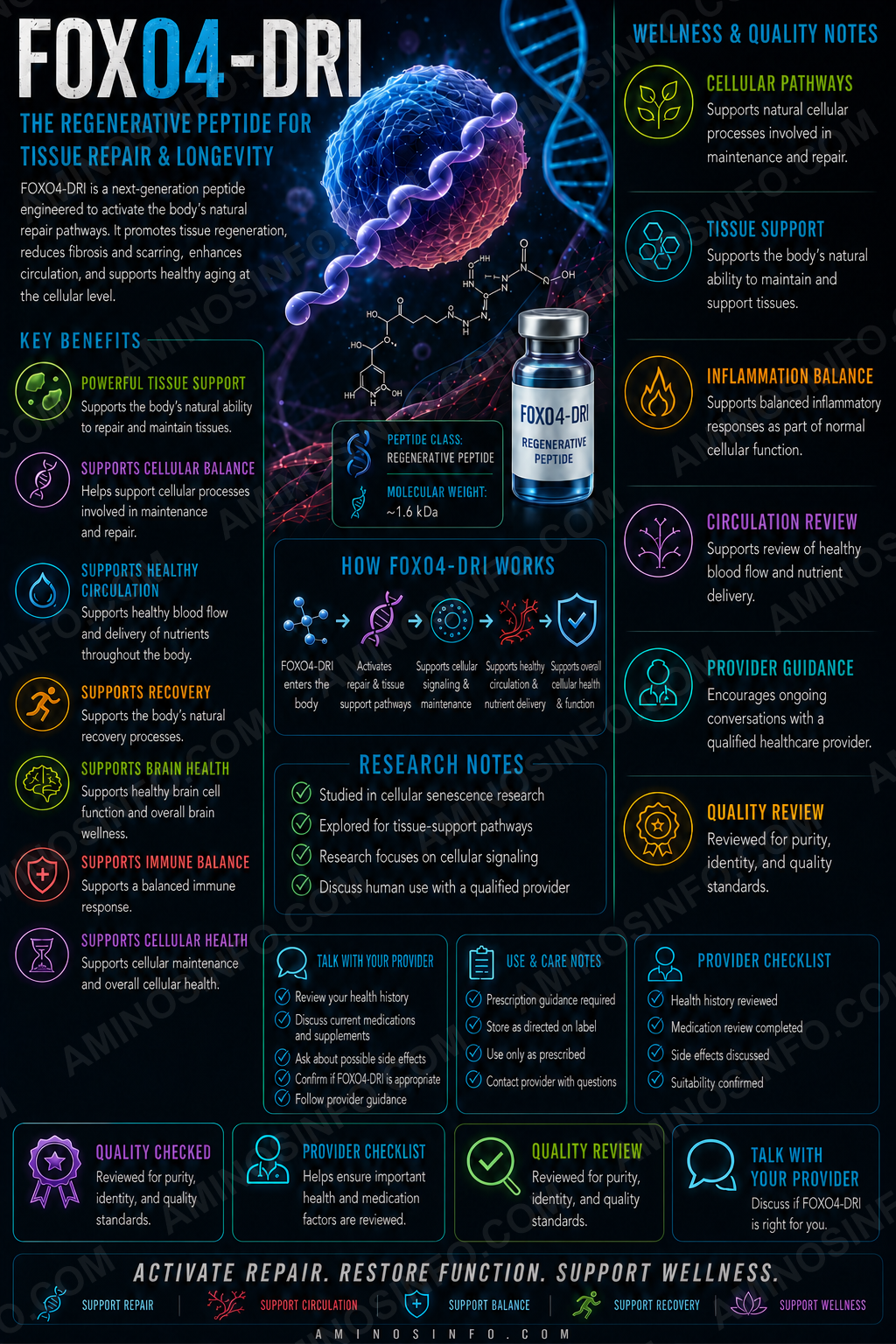
A comprehensive, evidence-graded review of FOXO4-DRI, an experimental D-retro-inverso cell-penetrating peptide designed to disrupt the FOXO4–p53 interaction and selectively trigger apoptosis in certain senescent cells.
What Is FOXO4-DRI?
FOXO4-DRI is an experimental senolytic peptide derived from a p53-binding region of the transcription factor Forkhead box O4, or FOXO4. It was engineered as a D-retro-inverso peptide to imitate the spatial presentation of the original FOXO4 interaction motif while improving resistance to proteolytic degradation.
The research hypothesis is that some senescent cells depend on FOXO4 to retain p53 in the nucleus and avoid apoptosis. FOXO4-DRI competes for p53 binding, disrupts that survival interaction, and promotes p53 movement out of the nucleus, mitochondrial signaling, and apoptosis in susceptible senescent cells.
Experimental senolytic peptide
D-retro-inverso peptide
FOXO4–p53
53 amino-acid residues
Approximately 5358.06 Da
No
🧬 Structure, Sequence, and Molecular Properties
🧪 Public sequence
H-ltlrkepaseiaqsileaysqngwanrrsggkrppprrrqrrkkrg-OH
Lowercase notation is commonly used to indicate that the residues are in the D-configuration. Because FOXO4-DRI is retro-inverso, the sequence order is reversed relative to the corresponding natural L-peptide motif while side-chain topology is intended to resemble the parent interaction surface.
Structural regions
- FOXO4-derived interaction region: Designed to bind the p53 transactivation domain.
- Cell-penetrating region: A highly basic HIV-TAT-like sequence rich in arginine and lysine facilitates cellular uptake.
- D-amino-acid backbone: Improves resistance to common proteases.
- Linear peptide: No required disulfide bridge is present.
- Free termini: Common public representation uses a free N terminus and C-terminal carboxyl group.
⚛️ Molecular properties
| Representative molecular formula | C228H388N86O64 |
|---|---|
| Representative molecular weight | Approximately 5358.06 g/mol |
| CAS number | 2460055-10-9 |
| PubChem CID | 167312269 |
| Peptide length | 53 amino-acid residues |
| Disulfide bridge | None |
| Net character | Highly cationic because of the cell-penetrating tail |
What Does D-Retro-Inverso Mean?
D-amino acids
Natural proteins predominantly use L-amino acids. FOXO4-DRI uses D-amino acids, which are less readily recognized by many proteases.
Reversed sequence
The order of amino acids is reversed relative to the native L-peptide motif.
Side-chain mimicry
Reversing the sequence while switching chirality can recreate a similar side-chain orientation even though the peptide-bond direction is reversed.
Advantages
- Greater proteolytic stability
- Longer persistence in experimental systems
- Potentially improved intracellular exposure
Limitations
- Not every native secondary structure is preserved
- Binding may differ from the parent protein
- D-peptides may have unfamiliar distribution and clearance
- Immunologic and long-term toxicologic behavior remains uncertain
📅 Discovery and Research Timeline
2017: Foundational Cell study
Baar and colleagues reported that FOXO4 supports survival of senescent cells by interacting with p53. FOXO4-DRI disrupted this interaction, induced apoptosis in senescent cells, and improved selected health measures in aged and chemotoxicity-exposed mice.
2018–2020: Organ and reproductive-aging models
Researchers explored kidney injury, aged Leydig cells, testosterone secretion, and other tissue-specific senescence models.
2021: Cartilage and cancer-cell modeling
Studies evaluated senescent chondrocytes and modeled improved peptide designs targeting FOXO4–p53 interactions.
2021–2024: Fibrosis and reproductive research
FOXO4-DRI was studied in pulmonary fibrosis, cancer-treatment-related senescence, spermatogenesis, and extracellular-matrix models.
2025: Structural and keloid research
Mechanistic work characterized binding of FOXO4 and FOXO4-DRI to the disordered p53 transactivation domain. Keloid-fibroblast research reported apoptosis of senescent fibroblasts.
2026: Endothelial-aging research
A preclinical study reported that FOXO4-DRI promoted apoptosis of senescent endothelial cells through p53/BCL-2/caspase-3 signaling and improved vascular function in experimental models.
Current status
No established human therapeutic efficacy, approved dosing, or completed large clinical-trial program has been demonstrated.
🧠 How Does FOXO4-DRI Work?
1. FOXO4 accumulation in senescent cells
FOXO4 expression and FOXO4–p53 nuclear foci are elevated in some senescent-cell models. This interaction appears to help maintain viability despite persistent cellular damage.
2. Competitive p53 binding
FOXO4-DRI mimics the p53-binding region of FOXO4 and competes with endogenous FOXO4.
3. Nuclear exclusion of p53
Disruption of FOXO4–p53 foci promotes redistribution of p53 away from the nucleus.
4. Mitochondrial apoptosis
p53 can influence BAX, BCL-2-family signaling, mitochondrial membrane integrity, cytochrome-c release, and downstream caspases.
5. Reduction of the senescence-associated secretory phenotype
Removing some senescent cells may lower secretion of inflammatory cytokines, proteases, growth factors, and extracellular-matrix signals collectively called the SASP.
Why Might FOXO4-DRI Prefer Senescent Cells?
Dependence on FOXO4 survival signaling
Some senescent cells appear more dependent on FOXO4–p53 interactions than proliferating cells.
Persistent damage signaling
Senescent cells frequently contain activated p53 and DNA-damage signaling but remain apoptosis resistant.
Therapeutic-window hypothesis
Disrupting a senescence-associated survival pathway may preferentially kill stressed senescent cells while sparing healthier cells.
Selectivity is not universal
Senescent cells are heterogeneous. Their survival mechanisms differ by tissue, trigger, disease, duration, and cell type. Some may not rely on FOXO4, while some nonsenescent cells may still be affected at high exposure.
Aging, Frailty, and Functional Research
Premature-aging and naturally aged mice
The 2017 study reported improvements in fur density, physical activity, and selected measures of tissue homeostasis after intermittent FOXO4-DRI treatment.
Healthspan rather than proven lifespan extension
The foundational experiments focused primarily on functional and organ outcomes. They did not establish that FOXO4-DRI extends human lifespan or safely reverses biological aging.
SASP reduction
Reduced senescent-cell burden may lower chronic inflammatory signaling in experimental models.
Translation problem
Mouse senescence biology, dosing, tissue distribution, and immune clearance do not directly predict human outcomes.
Kidney and Chemotoxicity Research
Kidney function in aged mice
Foundational research reported improved markers of kidney function and reduced senescence-related pathology.
Platinum-chemotherapy toxicity
FOXO4-DRI was studied after doxorubicin and other chemotoxic stress, with improvements in selected tissue-damage measures.
Transplant and renal-aging interest
Senolytics are being investigated conceptually for ischemia, transplantation, chronic kidney disease, and age-related renal decline.
Clinical limitation
No approved kidney indication or established human nephroprotective effect exists.
Reproductive Aging Research
Leydig-cell senescence
Mouse studies reported that clearing senescent Leydig cells improved testosterone secretion and testicular microenvironment measures in aged animals.
Spermatogenesis
Later research reported improved spermatogenic measures in aged mice alongside reduced SASP signaling from senescent testicular cells.
Human relevance
These studies do not establish FOXO4-DRI as testosterone therapy, fertility treatment, or a substitute for clinical evaluation of hypogonadism or infertility.
Fibrosis, Cartilage, Vascular, and Keloid Research
Pulmonary fibrosis
Animal and cell studies have evaluated FOXO4-DRI in bleomycin-induced fibrosis and treatment-associated senescent fibroblasts.
Cartilage
FOXO4-DRI selectively removed senescent expanded chondrocytes in vitro and improved cartilage-forming potential in experimental systems.
Keloids
A 2025 study reported apoptosis of senescent keloid fibroblasts through altered p53-serine-15 signaling and nuclear exclusion.
Endothelial aging
A 2026 study reported reduced endothelial-cell senescence, activation of p53/BCL-2/caspase-3 apoptosis pathways, and improved vascular function in preclinical models.
Model-specific evidence
Results from one senescence trigger or tissue cannot automatically be generalized to all fibrotic, vascular, cartilage, or wound-healing disorders.
Cancer-Research Considerations
Potential benefit
Therapy-induced senescent cancer cells and senescent stromal cells can contribute to relapse, resistance, fibrosis, and inflammatory signaling. FOXO4–p53 disruption has therefore been studied as a possible adjunct strategy.
Potential risk
p53 is a central tumor suppressor. Manipulating its localization or availability may have complex and context-dependent consequences.
Senescence can suppress tumors
Cellular senescence prevents damaged cells from proliferating. Removing senescent cells without understanding tumor context could theoretically eliminate a protective barrier or alter immune surveillance.
No established oncology role
FOXO4-DRI is not an approved cancer treatment, radiosensitizer, chemotherapy adjunct, or recurrence-prevention therapy.
Major Evidence Limitations
- No established large randomized human efficacy trials
- No validated human dose or treatment cycle
- No accepted pharmacokinetic or biodistribution profile in humans
- No long-term carcinogenicity or reproductive-toxicity program
- Uncertain organ distribution of a highly cationic cell-penetrating peptide
- Senescent-cell heterogeneity and variable target dependence
- Potential disruption of beneficial senescence
- Limited manufacturing and formulation standardization
- Potential differences between commercial research products and the published peptide
Potential Side Effects and Safety Considerations
No validated human safety profile
Human adverse-event rates, safe exposure, maximum tolerated dose, immunogenicity, and long-term risk are unknown.
Potential on-target risks
- Excessive removal of beneficial senescent cells
- Impaired wound healing or tissue remodeling
- Altered fibrosis control
- Disturbance of tumor-suppressive senescence
- Inflammatory response to abrupt cell death
Potential peptide-related risks
- Injection reactions
- Hypersensitivity or anti-drug antibodies
- Off-target cellular uptake
- Renal or hepatic accumulation
- Membrane toxicity from the highly cationic tail
- Unknown interactions with chemotherapy or radiation
p53 pathway concern
Because p53 coordinates DNA-damage responses, apoptosis, senescence, and tumor suppression, systemic manipulation requires especially strong safety evidence.
🧪 Laboratory Testing Methods
| Method | Purpose | Important limitation |
|---|---|---|
| RP-HPLC / UPLC | Separates intact FOXO4-DRI from deletion sequences, oxidation products, and synthesis impurities | Area purity does not confirm chirality or sequence |
| LC-HRMS | Confirms intact mass near 5358 Da for the parent peptide | L- and D-enantiomers have identical mass |
| MS/MS peptide mapping | Confirms residue order and terminal structure | Standard MS cannot independently prove D chirality |
| Chiral amino-acid analysis | Confirms D-configuration of hydrolyzed residues | Must control for hydrolysis-induced racemization |
| Enzymatic proteolysis comparison | Supports D-peptide and retro-inverso identity through protease resistance | Indirect and not a substitute for chiral analysis |
| NMR / circular dichroism | Assesses conformation and interaction properties | Large flexible peptides can produce complex spectra |
| FOXO4–p53 binding assay | Measures disruption of the target protein interaction | Binding does not prove cell selectivity |
| Cell-penetration assay | Confirms intracellular delivery | Fluorescent labels may alter uptake |
| Senescent-cell viability assay | Measures killing of senescent cells | Must compare with matched nonsenescent cells |
| p53 localization imaging | Measures nuclear exclusion or redistribution | Requires validated imaging and controls |
| Caspase-3/7 and annexin V assays | Confirm apoptosis | Cannot alone establish FOXO4-specific action |
| SASP biomarker panel | Measures IL-6, IL-8, MMPs, and related signals | SASP composition varies by cell type |
| SEC-HPLC / DLS | Measures aggregation and particles | Highly charged peptides may interact with surfaces |
| Net peptide-content assay | Measures actual FOXO4-DRI mass | Must correct for TFA, acetate, water, and salts |
| Residual-solvent and TFA testing | Measures synthesis and purification residues | Does not establish biological activity |
| Endotoxin, sterility, and bioburden | Required for relevant experimental preparations | Research purity does not establish human injectable safety |
| Stability-indicating assay | Tracks oxidation, hydrolysis, aggregation, and adsorption losses | Requires validated forced-degradation conditions |
📄 How to Interpret a FOXO4-DRI COA
- Confirm the exact 53-residue sequence.
- Verify that every amino acid is D-configured. Intact mass cannot distinguish D from L.
- Confirm retro-inverso residue order.
- Verify the cell-penetrating basic tail and junction.
- Confirm parent molecular mass near 5358.06 Da.
- State the salt form: TFA, acetate, or another counterion.
- Report net peptide content after correcting for counterions and water.
- Measure deletion sequences, truncated TAT fragments, oxidation, and aggregation.
- Use a FOXO4–p53 interaction assay and matched senescent-versus-proliferating cell assay.
- Confirm p53 redistribution and caspase-dependent apoptosis.
- Require endotoxin and microbiological controls for cell or animal experiments.
- Do not treat a COA as proof of human safety or efficacy.
📊 Comparison Tables
FOXO4-DRI vs Dasatinib + Quercetin vs Fisetin vs Navitoclax
| Feature | FOXO4-DRI | Dasatinib + Quercetin | Fisetin | Navitoclax |
|---|---|---|---|---|
| Type | Cell-penetrating D-peptide | Small-molecule combination | Flavonoid | BCL-2-family inhibitor |
| Main target concept | FOXO4–p53 interaction | Multiple senescent-cell survival pathways | Multiple stress and survival pathways | BCL-2/BCL-xL |
| Human evidence | Very limited or absent | Early pilot studies | Limited clinical research | Oncology experience; senolytic toxicity concerns |
| Major concern | Unknown systemic p53 effects | Drug-specific toxicity | Bioavailability and uncertain potency | Thrombocytopenia |
FOXO4-DRI vs FOXO4-L Peptide
| Feature | FOXO4-DRI | Natural-orientation L-peptide |
|---|---|---|
| Chirality | D amino acids | L amino acids |
| Sequence direction | Reversed | Native direction |
| Protease stability | Higher | Lower |
| Mass | May be identical for the same composition | May be identical |
| Required identity test | Chiral analysis plus mapping | Sequence mapping |
Senolytic vs Senomorphic Approaches
| Feature | Senolytic | Senomorphic |
|---|---|---|
| Goal | Kill selected senescent cells | Reduce harmful senescent-cell signaling |
| Example | FOXO4-DRI | mTOR, NF-κB, or SASP modulation |
| Potential advantage | Durable cell removal | May preserve useful senescent cells |
| Potential risk | Loss of beneficial senescence | Requires continued pathway suppression |
Raw FOXO4-DRI vs Research-Qualified Material
| Attribute | Basic raw peptide | Research-qualified preparation |
|---|---|---|
| Identity | Mass and HPLC claim | Sequence, D chirality, retro-inverso order, termini |
| Potency | Often untested | FOXO4–p53 disruption and senolytic selectivity |
| Impurities | Area purity only | Truncations, deletion peptides, counterions, aggregation |
| Microbiology | May be absent | Endotoxin and bioburden appropriate to study |
| Human equivalence | Neither establishes an approved human drug product | |
🖼️ Original Diagram Specifications
- Peptide architecture: FOXO4-derived D-retro-inverso motif joined to the arginine-rich cell-penetrating tail.
- Retro-inverso concept: Native L sequence versus reversed D sequence with preserved side-chain orientation.
- Mechanism: FOXO4–p53 foci, peptide competition, p53 nuclear exit, mitochondria, and caspase apoptosis.
- Senescence selectivity: Senescent cell dependent on FOXO4 versus proliferating cell with lower dependence.
- SASP pathway: Senescent-cell removal followed by reduced inflammatory cytokine and matrix signaling.
- Benefit–risk balance: Experimental tissue-function improvements opposite beneficial-senescence and p53-related risks.
- COA workflow: Sequence, D chirality, parent mass, salt correction, binding assay, cellular selectivity, and microbiology.
❓ Frequently Asked Questions
Is FOXO4-DRI a peptide?
Yes. It is a synthetic 53-residue D-retro-inverso cell-penetrating peptide.
What does FOXO4-DRI stand for?
Forkhead box O4 D-retro-inverso.
What is its sequence?
H-ltlrkepaseiaqsileaysqngwanrrsggkrppprrrqrrkkrg-OH, commonly written in lowercase to indicate D residues.
What is its molecular formula?
The parent peptide is commonly represented as C₂₂₈H₃₈₈N₈₆O₆₄.
What is its molecular weight?
Approximately 5358.06 Da for the parent peptide. Acetate or TFA salt records may show higher values.
Is FOXO4-DRI FDA approved?
No.
Has it been proven to reverse aging in humans?
No. Reported rejuvenation findings are preclinical.
How does it kill senescent cells?
It disrupts FOXO4 binding to p53, promoting p53 redistribution and apoptosis in susceptible senescent cells.
Does it kill every senescent cell?
No. Senescent cells are heterogeneous and rely on different survival pathways.
Can it affect healthy cells?
Potentially. Selectivity is incomplete and exposure-dependent, and human safety is unknown.
Why use D amino acids?
They improve resistance to protease degradation.
Can mass spectrometry prove it is D-retro-inverso?
No. L and D peptides can have the same mass. Chiral analysis and residue-order confirmation are required.
What research areas have been studied?
Aging, kidney injury, chemotoxicity, reproductive aging, cartilage, fibrosis, keloids, vascular aging, and cancer-associated senescence.
Is there an established human dose?
No.
Does a 99% HPLC result prove authentic FOXO4-DRI?
No. Chirality, retro-inverso order, sequence, salt correction, target binding, cell penetration, and selective senolytic activity must also be confirmed.
Final Thoughts
FOXO4-DRI is one of the best-known experimental peptide senolytics. Its central concept is unusually precise: disrupt a FOXO4–p53 survival interaction that appears important in certain senescent cells, thereby allowing p53-driven apoptosis.
The foundational 2017 study reported striking functional and tissue improvements in aged and chemotoxicity-exposed mice. Later studies expanded the research into reproductive aging, cartilage, pulmonary fibrosis, keloids, endothelial aging, and treatment-induced senescence. Structural research published in 2025 strengthened understanding of how the peptide engages the disordered p53 transactivation domain.
Despite this scientific interest, FOXO4-DRI remains far from an established anti-aging therapy. Human pharmacokinetics, safe exposure, long-term cancer risk, immunogenicity, organ distribution, treatment timing, and effects on beneficial senescence are unresolved.
Analytical verification is also unusually demanding. Because the molecule is D-retro-inverso, intact mass and ordinary HPLC cannot distinguish it from an incorrectly synthesized L-peptide with the same composition. A credible evaluation requires sequence mapping, chiral amino-acid analysis, confirmation of retro-inverso order, parent-versus-salt mass correction, FOXO4–p53 binding, cell penetration, senescent-cell selectivity, apoptosis assays, impurity profiling, and microbiological controls.
📚 References
- Baar MP, et al. Targeted Apoptosis of Senescent Cells Restores Tissue Homeostasis in Response to Chemotoxicity and Aging. Cell. 2017.
- Krimpenfort P, Berns A. Rejuvenation by Therapeutic Elimination of Senescent Cells. Cell. 2017.
- Bourgeois B, et al. The Disordered p53 Transactivation Domain Is the Target of FOXO4 and FOXO4-DRI. Nature Communications. 2025.
- Huang Y, et al. Senolytic Peptide FOXO4-DRI Selectively Removes Senescent Chondrocytes and Improves Cartilage Formation. 2021.
- Tripathi U, et al. Development of a Novel Senolytic by Precise Disruption of FOXO4–p53 Interaction. EBioMedicine commentary. 2021.
- Le HH, et al. Molecular Modelling of the FOXO4–TP53 Interaction to Design Senolytic Peptides. EBioMedicine. 2021.
- Hu Z, et al. FOXO4-DRI Regulates Endothelial Cell Senescence via the p53/BCL-2/Caspase-3 Pathway. 2026.
- Kong YX, et al. FOXO4-DRI Induces Keloid Senescent Fibroblast Apoptosis. Communications Biology. 2025.
- FOXO4-DRI Alleviates Age-Related Testosterone Secretion Insufficiency by Targeting Senescent Leydig Cells. Aging. 2020.
- FOXO4-DRI Improves Spermatogenesis in Aged Mice through Reducing SASP Secretion from Leydig Cells. Experimental Gerontology. 2024.
- FOXO4-D-Retro-Inverso Targets Extracellular Matrix Production and Ameliorates Experimental Pulmonary Fibrosis. 2023.
- Targeting Senescence-Like Fibroblasts Radiosensitizes NSCLC and Reduces Radiation-Induced Pulmonary Fibrosis. JCI Insight. 2021.
- Gui T, et al. Targeted Perturbation of Signaling-Driven Condensates. Molecular Cell. 2023.
- Gorgoulis V, et al. Cellular Senescence: Defining a Path Forward. Cell. 2019.
- Liu W, et al. Current Perspective on the Regulation of FOXO4 and Its Role in Disease. 2019.
- Valentijn FA, et al. Cellular Senescence in the Aging and Diseased Kidney. 2018.
- Kirkland JL, Tchkonia T. Senolytic Drugs: From Discovery to Translation. Journal of Internal Medicine.
- Kirkland JL, Tchkonia T. Cellular Senescence: A Translational Perspective. EBioMedicine.
- Childs BG, et al. Cellular Senescence in Aging and Age-Related Disease. Nature Medicine.
- Gorgoulis V, et al. Cellular Senescence: Defining a Path Forward. Cell.
- Di Micco R, et al. Cellular Senescence in Ageing: From Mechanisms to Therapeutic Opportunities. Nature Reviews Molecular Cell Biology.
- He S, Sharpless NE. Senescence in Health and Disease. Cell.
- Campisi J. Aging, Cellular Senescence, and Cancer. Annual Review of Physiology.
- Ovadya Y, Krizhanovsky V. Strategies Targeting Cellular Senescence. Journal of Clinical Investigation.
- Xu M, et al. Senolytics Improve Physical Function and Increase Lifespan in Old Age. Nature Medicine.
- Zhu Y, et al. The Achilles’ Heel of Senescent Cells: From Transcriptome to Senolytic Drugs. Aging Cell.
- Justice JN, et al. Senolytics in Idiopathic Pulmonary Fibrosis: First-in-Human Pilot Study. EBioMedicine.
- Hickson LJ, et al. Senolytics Decrease Senescent Cells in Humans. EBioMedicine.
- PubChem. FOXO4-DRI, CID 167312269.
- PubChem. FOXO4-DRI Acetate Record.
- Recent Applications of Retro-Inverso Peptides. International Journal of Molecular Sciences. 2021.
- ICH Q1A(R2): Stability Testing.
- ICH Q2(R2): Validation of Analytical Procedures.
- ICH Q3A and Q3B: Impurities.
- ICH Q3C: Residual Solvents.
- ICH Q6B: Specifications for Biotechnological Products.
- USP <621> Chromatography.
- USP <71> Sterility Tests.
- USP <85> Bacterial Endotoxins Test.
- USP <788> Particulate Matter in Injections.
Chemistry, foundational mechanism, preclinical aging, fibrosis, reproductive, cartilage, keloid, vascular, safety, and analytical information reviewed in July 2026.