
:root{--ink:#16202a;--muted:#5c6975;--line:#dce3e8;--panel:#f6f8fa;--accent:#174f69;--accent2:#665b7c;--warning-bg:#fff8e8;--danger-bg:#ff
Selank: What It Is, How It Works, Benefits, and Research Overview
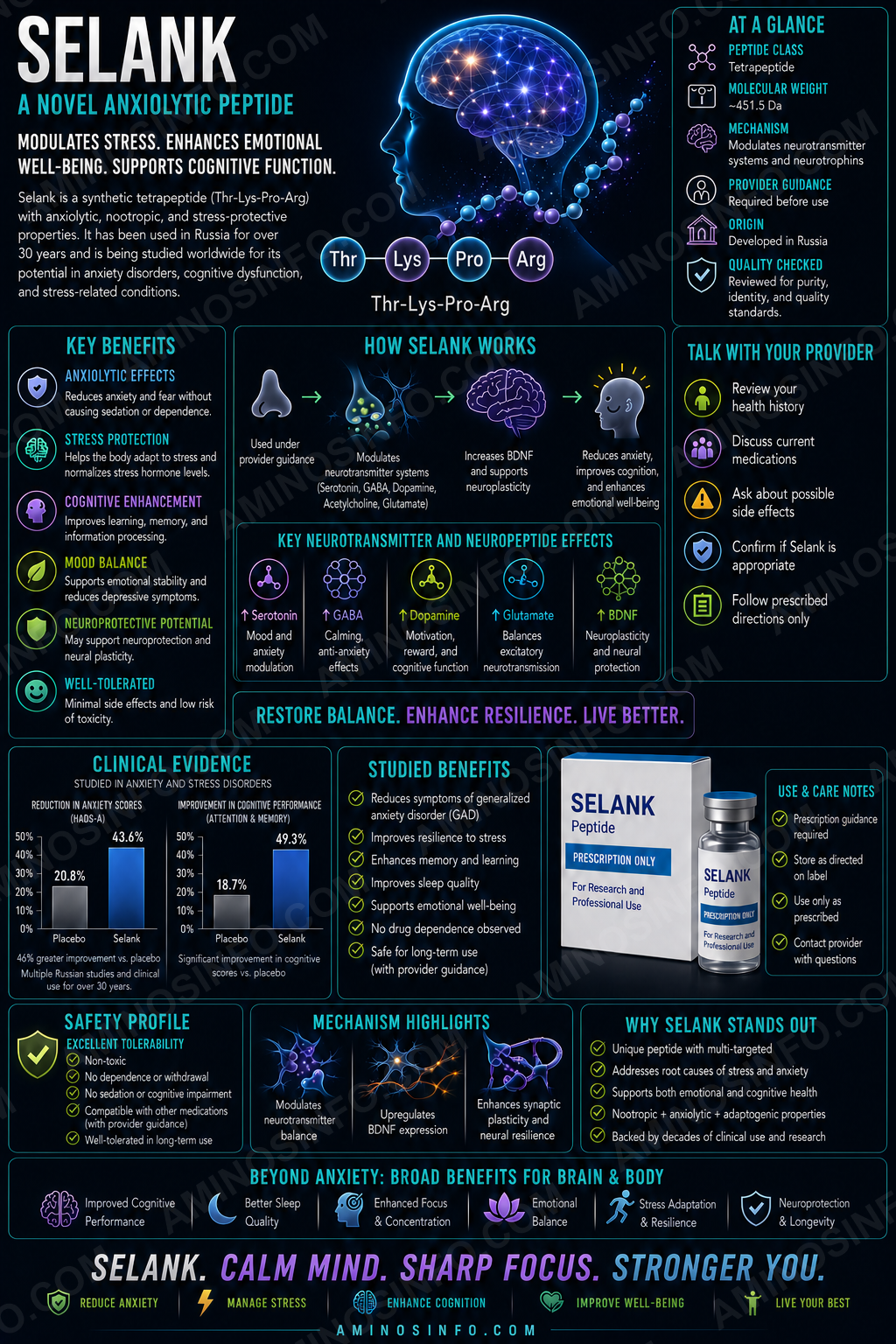
A corrected, evidence-graded review of Selank, including its seven-amino-acid tuftsin-derived sequence, molecular properties, proposed GABAergic, BDNF, enkephalin, gene-expression, and neuroimmune mechanisms, anxiety and cognition research, stress, alcohol-withdrawal models, regional clinical evidence, safety, analytical testing, and COA interpretation.
What Is Selank?
Selank is a synthetic heptapeptide developed from tuftsin, a naturally occurring immunomodulatory tetrapeptide. Selank retains tuftsin’s sequence and adds a Pro-Gly-Pro tail intended to improve stability and prolong biological activity.
Thr-Lys-Pro-Arg-Pro-Gly-Pro
TKPRPGP
7 amino acids
C₃₃H₅₇N₁₁O₉
Approximately 751.9 g/mol
No
Researchers investigate Selank in relation to:
- Anxiety and stress-related behavior
- GABAergic neurotransmission
- Learning, memory, and attention
- BDNF and neuroplasticity
- Enkephalin metabolism
- Immune and inflammatory signaling
- Alcohol-related cognitive impairment
- Gene-expression changes in the brain
🧬 Molecular Structure
🧪 Complete amino-acid sequence
L-Threonyl-L-Lysyl-L-Prolyl-L-Arginyl-L-Prolyl-Glycyl-L-Proline
Thr-Lys-Pro-Arg-Pro-Gly-Pro
TKPRPGP
Terminal chemistry
The standard reference free peptide is represented as:
H-Thr-Lys-Pro-Arg-Pro-Gly-Pro-OH
Structural characteristics
- Seven amino acids
- Linear peptide
- No cysteine residues
- No disulfide bonds
- Three proline residues contributing conformational rigidity and protease resistance
- One lysine and one arginine contributing positive charge
- One C-terminal Pro-Gly-Pro motif
⚛️ Molecular Weight and 🧫 Formula
| Molecular formula | C33H57N11O9 |
|---|---|
| Average molecular weight | Approximately 751.9 g/mol |
| Monoisotopic mass | Approximately 751.433 Da |
| Common CAS number | 129954-34-3 |
| PubChem CID | 11765600 |
| Disulfide bonds | None |
Selank acetate
Selank acetate is a salt form with a different total formula and molecular weight. PubChem lists Selank acetate as C₃₅H₆₁N₁₁O₁₁ with an average molecular weight near 811.9 g/mol. A COA must state whether the reported quantity refers to free Selank or acetate salt.
N-acetyl Selank
N-acetyl Selank is a chemically modified analogue and should not be labeled as standard Selank without clear identification.
📅 Discovery Timeline and Research History
1960s–1970s: Tuftsin identified
Tuftsin, Thr-Lys-Pro-Arg, was identified as an immunomodulatory fragment associated with the Fc region of immunoglobulin G.
1980s–1990s: Tuftsin analogue development
Russian researchers examined tuftsin-family peptides for immune, stress, and behavioral effects.
1990s: Selank developed
The Pro-Gly-Pro sequence was added to tuftsin to create a more stable, longer-acting heptapeptide.
2000s: Regional clinical anxiety studies
Selank was studied in generalized anxiety disorder, neurasthenia, anxiety-phobic states, and stress-related conditions.
2003: Tuftsin-family review
A review summarized Selank and related tuftsin peptides in stress and adaptive behavior.
2008: GAD and neurasthenia study
A clinical-biological study reported anxiolytic effects and changes in leu-enkephalin metabolism.
2008: BDNF study
Intranasal Selank was reported to regulate BDNF expression in rat hippocampus.
2016–2017: Gene-expression studies
Research reported rapid changes in genes involved in neurotransmission and possible GABAergic-system modulation.
2019: Alcohol-withdrawal cognition study
Selank reduced ethanol-withdrawal-related memory and attention deficits in rats.
2020: Functional-connectivity research
Resting-state functional-connectivity changes were explored using animal neuroimaging.
Current status
Selank remains regionally used in Russia but lacks FDA approval and large independently replicated international trials.
Tuftsin Origin and PGP Extension
Tuftsin
Tuftsin is the tetrapeptide Thr-Lys-Pro-Arg. It has been associated with phagocyte activation, immune regulation, and stress-related signaling.
Selank design
Selank extends tuftsin with Pro-Gly-Pro:
Tuftsin: TKPR
Selank: TKPRPGP
Why Pro-Gly-Pro was added
The PGP tail was intended to improve enzymatic stability and may contribute independent biological effects.
Not a simple immune peptide
Despite its tuftsin origin, Selank has been studied more extensively for anxiety, cognition, and neurochemical regulation than for direct immune stimulation.
🧠 Proposed Mechanism of Action
1. GABAergic modulation
Gene-expression and pharmacological studies suggest Selank may influence GABA-A receptor-associated signaling without acting like a conventional benzodiazepine.
2. BDNF regulation
Intranasal Selank altered hippocampal BDNF expression in animal research.
3. Enkephalin metabolism
Clinical and biochemical studies reported changes in leu-enkephalin-related measures and peptide-degrading enzymes.
4. Neuroimmune signaling
Its tuftsin origin supports research into cytokines, phagocyte activity, and immune–brain communication.
5. Gene-expression changes
Rapid changes have been observed in genes involved in neurotransmission, synaptic function, inflammation, and cellular signaling.
6. Stress-system modulation
Behavioral studies suggest normalization of stress-related anxiety without strong sedation.
🎯 Receptor and Signaling Profile
| Target or pathway | Evidence status |
|---|---|
| Specific Selank receptor | Not identified. |
| GABA-A receptor system | Indirect or allosteric modulation proposed; direct binding remains incompletely defined. |
| BDNF | Expression changes reported in rat hippocampus. |
| Leu-enkephalin metabolism | Changes reported in clinical-biological research. |
| Immune and cytokine pathways | Supported by tuftsin-family biology and selected studies. |
| Monoamine systems | Indirect changes proposed; no single direct monoamine receptor profile established. |
| Gene-expression networks | Rapid transcriptional changes reported in neural cells and animal brain. |
| Validated human target-engagement biomarker | None established. |
GABAergic-System Research
Similarity to benzodiazepine effects
Regional clinical studies described anxiolytic effects without the pronounced sedation, muscle relaxation, or cognitive impairment associated with many benzodiazepines.
Gene-expression correlation
One study found overlapping short-term gene-expression changes after Selank and GABA administration.
GABA-A receptor interaction hypothesis
Research suggests Selank may affect the interaction of GABA with GABA-A receptors or alter receptor-associated signaling.
No direct benzodiazepine-site proof
Selank has not been established as a classical benzodiazepine-site positive allosteric modulator.
Combination with diazepam
Animal studies reported altered anxiolytic effects when Selank was combined with diazepam.
Clinical caution
Potential interaction with benzodiazepines, alcohol, gabapentinoids, sedating antihistamines, or other CNS depressants is not well characterized.
BDNF and Neuroplasticity Research
Hippocampal BDNF
Intranasal Selank was reported to regulate BDNF expression in rat hippocampus.
Stress-dependent effects
BDNF changes may differ under baseline conditions, chronic stress, alcohol exposure, or withdrawal.
Alcohol-withdrawal study
Selank prevented ethanol-related cognitive deficits and altered the ethanol-induced increase in BDNF content.
Neuroplasticity interpretation
BDNF regulation may contribute to learning, stress adaptation, and synaptic resilience.
Not BDNF replacement
Selank does not act as BDNF itself, and peripheral or tissue BDNF changes do not prove improved human cognition.
Enkephalin and Peptide-Metabolism Research
Leu-enkephalin
Leu-enkephalin is an endogenous opioid peptide involved in pain, stress, reward, and emotional regulation.
Clinical findings
Patients with generalized anxiety or neurasthenia were reported to have altered leu-enkephalin-related measures that changed during Selank treatment.
Peptidase modulation
Selank may alter enzymes involved in regulatory-peptide degradation.
Not an opioid agonist
Selank has not been established as a direct mu-, delta-, or kappa-opioid receptor agonist.
Clinical relevance uncertain
Changes in peptide metabolism may reflect stress normalization rather than a direct therapeutic target.
Neuroimmune and Immune-Signaling Research
Tuftsin-family biology
Tuftsin influences phagocyte and immune-cell activity, which motivated investigation of Selank’s immunomodulatory properties.
Cytokines and inflammation
Selected studies report effects on cytokine signaling and immune-response genes.
Brain–immune communication
Immune signaling can influence anxiety, mood, cognition, and stress adaptation.
No established immune indication
Selank is not an approved treatment for infection, autoimmune disease, immunodeficiency, inflammatory disorders, or cancer.
Immunogenicity
Any repeated peptide exposure can theoretically produce immune reactions or anti-drug antibodies, especially when impurities or aggregates are present.
Anxiety and Regional Clinical Studies
Generalized anxiety disorder
Regional studies reported reductions in anxiety symptoms, autonomic complaints, and asthenic symptoms.
Neurasthenia
Selank was studied in patients with fatigue, weakness, irritability, and anxiety-related symptoms.
Anxiety-phobic conditions
A long-term observational study of tuftsin analogue TP-7 reported reduced anxiety-phobic states beginning early in treatment.
Comparison with benzodiazepines
Some Russian reports described similar anxiolytic efficacy with less sedation and cognitive impairment.
Evidence limitations
- Regional publication
- Older diagnostic frameworks
- Limited placebo-controlled replication
- Variable blinding and allocation details
- Small samples
- Limited long-term relapse data
- No FDA regulatory review
No established first-line role
Selank should not replace cognitive behavioral therapy, SSRIs, SNRIs, buspirone, or other evidence-based anxiety treatments.
Learning, Memory, and Cognition Research
Animal learning models
Selank improved performance in selected learning, memory, and attention tests.
Stress-impaired cognition
Benefits may be more apparent when cognition is disrupted by anxiety, stress, or alcohol exposure.
Alcohol withdrawal
Selank prevented object-recognition, memory, and attention deficits in rats during ethanol withdrawal.
Functional connectivity
Animal imaging studies examined changes in whole-brain resting-state functional connectivity after Selank administration.
No healthy-user nootropic proof
No large independently replicated human trial establishes improved IQ, academic performance, executive function, or productivity.
Stress and Behavioral Research
Unpredictable chronic mild stress
Animal studies evaluated Selank alone and in combination with diazepam under chronic-stress conditions.
Anxiety normalization
Selank reduced anxiety-like behavior in selected stress models.
Non-sedating profile
The peptide is commonly described as producing anxiolysis without strong sedation, but this claim requires broader clinical validation.
Behavioral context
Responses depend on baseline anxiety, prior drug exposure, stress intensity, and testing method.
Alcohol and Withdrawal Research
Ethanol exposure
Selank was studied in rats exposed to repeated ethanol and subsequent withdrawal.
Cognitive protection
It prevented memory and attention disturbances in object-recognition testing.
BDNF normalization
Selank altered ethanol-related BDNF changes in hippocampus and frontal cortex.
No detoxification role
Selank is not an approved treatment for alcohol withdrawal and does not replace medically supervised care, benzodiazepine protocols, thiamine, seizure prevention, or emergency treatment.
Benzodiazepine-withdrawal claims
Online reports about benzodiazepine tapering are anecdotal and not supported by robust clinical trials.
Gene-Expression Research
Rapid transcriptional effects
Selank changed expression of genes involved in neurotransmission within one hour in animal brain research.
GABA comparison
Some expression changes correlated with those produced by GABA.
Olanzapine interaction
Cell studies examined how Selank altered olanzapine-related changes in GABAergic-system genes.
Complex network effect
The data suggest broad regulatory activity rather than one simple receptor mechanism.
Interpretation caution
Gene-expression changes do not prove direct receptor binding, clinical anxiolysis, or long-term safety.
Intranasal Delivery and Pharmacokinetics
Regional route
Selank has primarily been developed as an intranasal formulation.
Nose-to-brain rationale
Intranasal administration may provide both systemic absorption and access through olfactory or trigeminal pathways.
Proteolytic degradation
Selank can be cleaved into shorter fragments, including tuftsin- and PGP-related metabolites that may retain activity.
Human pharmacokinetic gaps
Modern data on absolute bioavailability, plasma half-life, brain concentrations, active metabolites, and exposure-response relationships remain limited.
Device and formulation matter
Delivered dose, pH, tonicity, preservative, spray pattern, droplet size, and mucociliary clearance substantially affect nasal exposure.
Evidence Limitations and Clinical Interpretation
Regional evidence concentration
Most human studies were conducted in Russia or neighboring countries.
Limited independent replication
Few large international trials have been performed by unaffiliated groups.
No established receptor
Without a validated direct target, potency testing and target engagement remain difficult.
Mechanistic breadth
GABA, BDNF, enkephalin, cytokines, gene expression, and neuroimmune pathways may all contribute, but no single model is definitive.
Healthy-user claims exceed evidence
Commercial claims about calm focus, social confidence, productivity, and memory often go beyond the available clinical data.
No FDA approval
Regional use does not equal FDA approval or broad international validation.
Safety and Regulatory Considerations
Regional tolerability
Russian studies generally describe Selank as well tolerated and less sedating than benzodiazepines, but comprehensive internationally reviewed safety data are limited.
Potential adverse effects
- Nasal irritation or dryness
- Headache
- Dizziness
- Fatigue or sleep changes
- Agitation or mood changes
- Allergic reaction
- Unknown interaction with sedatives or psychiatric medications
Drug interactions
Interactions with benzodiazepines, antidepressants, antipsychotics, alcohol, antiseizure medications, stimulants, and other CNS-active drugs are not adequately characterized.
Pregnancy, lactation, and pediatrics
U.S.-standard safety data are inadequate.
Immunogenicity and impurities
Repeated exposure to aggregates, deletion peptides, epimers, or residual synthesis contaminants could increase immune risk.
Regulatory status
Selank is not FDA approved.
🧪 Laboratory Testing Methods
| Method | Purpose | Important limitation |
|---|---|---|
| RP-HPLC / UPLC | Separates full-length Selank from deletion peptides, tuftsin fragments, PGP fragments, and degradants. | Area purity does not prove sequence or net content. |
| LC-HRMS | Confirms intact mass and elemental composition. | Sequence isomers and epimers may share mass. |
| MS/MS sequencing | Confirms TKPRPGP residue order. | Proline-rich fragmentation requires careful interpretation. |
| Edman degradation | Orthogonally confirms N-terminal sequence. | Less sensitive for trace impurities. |
| Amino-acid analysis | Confirms composition and supports net-content measurement. | Does not prove residue order. |
| Chiral amino-acid analysis | Confirms L-amino-acid configuration and detects epimers. | Hydrolysis can introduce artifacts. |
| Net peptide-content assay | Measures actual Selank quantity. | Must correct for water, acetate, TFA, and residual solvents. |
| Counterion analysis | Quantifies acetate, TFA, sodium, or other salts. | Does not establish biological activity. |
| Aggregate and oligomer testing | Assesses physical stability and immunogenicity risk. | Small-peptide aggregates require optimized methods. |
| GABA-A functional assay | Evaluates proposed modulation of GABAergic signaling. | No validated Selank release-potency standard exists. |
| BDNF-expression assay | Measures one reported neuroplasticity response. | Cell type and stress context strongly affect results. |
| Enkephalin-peptidase assay | Evaluates peptide-metabolism effects. | Clinical significance remains uncertain. |
| Gene-expression panel | Measures neurotransmission and immune-response transcripts. | Not target specific. |
| Plasma, nasal-fluid, and protease stability | Measures degradation and active fragments. | Animal matrices do not fully predict humans. |
| Brain/plasma pharmacokinetics | Measures systemic and CNS exposure. | Modern human data remain limited. |
| Nasal spray performance testing | Measures delivered dose, spray pattern, droplet size, pH, tonicity, and preservative. | Peptide purity alone cannot validate a nasal product. |
| Microbial limits, sterility, and endotoxin | Evaluate route-specific microbiological quality. | Requirements depend on the final dosage form. |
| Stability-indicating assay | Tracks hydrolysis, epimerization, aggregation, oxidation, and potency loss. | Requires qualified reference standards. |
📄 How to Interpret a Selank COA
- Verify the exact sequence: Thr-Lys-Pro-Arg-Pro-Gly-Pro, or TKPRPGP.
- Confirm seven residues: Tuftsin alone is only TKPR and is not Selank.
- Confirm the free-peptide formula and mass: C₃₃H₅₇N₁₁O₉ and approximately 751.9 g/mol.
- Identify the salt form: Selank acetate has a different total formula and mass.
- Use MS/MS or an orthogonal sequence method: HPLC and intact mass alone cannot prove sequence.
- Confirm L-stereochemistry.
- Review deletion peptides, tuftsin fragments, PGP fragments, epimers, aggregates, water, counterions, and residual solvents.
- Measure net peptide content: “99% purity” is not the labeled number of milligrams.
- For nasal products, review delivered-dose uniformity, spray pattern, droplet size, pH, tonicity, preservative, and microbiology.
- Require a relevant functional assay: GABAergic, BDNF, or peptide-metabolism assays may support consistency, but no internationally accepted potency assay exists.
- Do not infer efficacy: A COA cannot prove anxiety treatment, cognitive enhancement, alcohol-withdrawal benefit, or human safety.
📊 Selank vs Tuftsin vs PGP vs Semax
| Feature | Selank | Tuftsin | PGP | Semax |
|---|---|---|---|---|
| Sequence | TKPRPGP | TKPR | PGP | MEHFPGP |
| Main research | Anxiety, cognition, neuroimmune signaling | Immune-cell activation | Stability, inflammation, vascular signaling | Stroke and neurotrophins |
| Direct origin | Tuftsin + PGP | IgG-derived regulatory peptide | Natural short peptide motif | ACTH fragment + PGP |
| FDA approved? | No | No | No | No |
Selank vs Benzodiazepines vs Buspirone vs SSRIs
| Feature | Selank | Benzodiazepines | Buspirone | SSRIs/SNRIs |
|---|---|---|---|---|
| Main mechanism | Unresolved; GABAergic and neuropeptide modulation | GABA-A positive allosteric modulation | 5-HT1A partial agonism | Monoamine reuptake inhibition |
| Onset | Uncertain | Rapid | Delayed | Delayed |
| Sedation/dependence | Not well characterized | Possible and clinically important | Low dependence risk | No classic dependence, discontinuation possible |
| Modern human evidence | Limited regional studies | Strong | Strong | Strong |
| FDA approved? | No | Yes, specific drugs | Yes | Yes, specific drugs |
Selank vs Semax vs Pinealon vs DSIP
| Peptide | Main focus | Sequence |
|---|---|---|
| Selank | Anxiety and neuroimmune signaling | TKPRPGP |
| Semax | Neuroprotection and stroke | MEHFPGP |
| Pinealon | Oxidative stress and gene regulation | EDR |
| DSIP | Sleep and stress physiology | WAGGDASGE |
Selank vs Evidence-Based Anxiety Care
| Approach | Established role | Difference from Selank |
|---|---|---|
| CBT and exposure-based therapy | First-line for many anxiety disorders | Strong durable evidence |
| SSRIs and SNRIs | First-line medication options | Large clinical-trial evidence base |
| Buspirone | GAD treatment | Defined receptor and approved dose |
| Benzodiazepines | Selected short-term or acute use | Defined benefits and major known risks |
| Selank | Regional investigational peptide | No established FDA-reviewed efficacy or safety framework |
🔗 Related Peptides and Pathways
- Tuftsin: Parent immunomodulatory tetrapeptide.
- Pro-Gly-Pro: Stabilizing C-terminal motif and potential active fragment.
- Semax: Related PGP-containing neuroactive peptide.
- GABA-A receptors: Proposed indirect signaling system.
- BDNF: Neuroplasticity factor regulated in animal studies.
- Leu-enkephalin: Endogenous opioid peptide linked to clinical-biological findings.
- Cytokines: Potential neuroimmune mediators.
- Diazepam: Comparator and combination compound in animal anxiety research.
🖼️ Original Diagram Specifications
Diagram 1: Selank sequence
Show TKPRPGP divided into tuftsin and PGP regions, with formula, molecular weight, and positive-charge sites.
Diagram 2: Tuftsin-to-Selank development
Show tuftsin TKPR, addition of Pro-Gly-Pro, increased stability, and proposed shift from immune peptide to neuroimmune anxiolytic research.
Diagram 3: GABAergic hypothesis
Show Selank near the GABA-A receptor complex, with the interaction labeled “indirect or allosteric modulation under investigation.”
Diagram 4: BDNF and neuroplasticity
Show intranasal Selank, hippocampal BDNF regulation, synaptic plasticity, stress adaptation, and cognition.
Diagram 5: Neuroimmune pathway
Show tuftsin-related immune signaling, cytokines, brain–immune communication, anxiety, and stress behavior.
Diagram 6: Evidence ladder
Show animal studies, Russian clinical studies, independent international phase 2/3 trials, FDA review, and approval.
Diagram 7: COA workflow
Show exact sequence, salt form, HRMS, MS/MS, stereochemistry, deletion fragments, net content, GABA/BDNF assay, nasal-device testing, microbiology, and stability.
❓ Frequently Asked Questions
Is Selank a peptide?
Yes. Selank is a synthetic seven-amino-acid peptide.
What is its exact sequence?
Thr-Lys-Pro-Arg-Pro-Gly-Pro, abbreviated TKPRPGP.
What is its molecular formula?
C₃₃H₅₇N₁₁O₉ for the free peptide.
What is its molecular weight?
Approximately 751.9 g/mol.
What is its CAS number?
129954-34-3.
What is Selank made from?
It is a synthetic tuftsin analogue formed by adding Pro-Gly-Pro to tuftsin.
Is Selank the same as tuftsin?
No. Tuftsin is TKPR; Selank is TKPRPGP.
Is Selank the same as Semax?
No. Semax is MEHFPGP and is derived from ACTH rather than tuftsin.
What is Selank studied for?
Anxiety, stress, cognition, GABAergic signaling, BDNF, enkephalin metabolism, immune signaling, and alcohol-related cognitive impairment.
Does Selank work like a benzodiazepine?
It may influence GABAergic signaling, but it is not established as a classical benzodiazepine-site drug.
Does Selank cause sedation?
Regional studies generally describe limited sedation, but comprehensive safety data are lacking.
Does Selank improve memory?
Animal research suggests possible effects, especially under stress or alcohol exposure. Robust human evidence is limited.
Does Selank increase BDNF?
Animal studies report regulation of hippocampal BDNF expression.
Can Selank help alcohol withdrawal?
Animal studies report cognitive protection, but no approved human withdrawal benefit exists.
Is Selank FDA approved?
No.
Can Selank be administered intranasally?
Intranasal administration is the primary regional research and pharmaceutical route, but no FDA-approved formulation exists.
Does 99% HPLC purity prove authentic Selank?
No. Exact sequence, salt form, stereochemistry, molecular mass, deletion fragments, net content, aggregation, and functional consistency require separate confirmation.
Final Thoughts
Selank is a chemically defined tuftsin-derived heptapeptide with the sequence Thr-Lys-Pro-Arg-Pro-Gly-Pro. Its free-peptide formula is C₃₃H₅₇N₁₁O₉ and its average molecular weight is approximately 751.9 g/mol.
Regional clinical and preclinical studies report anxiolytic, cognitive, GABAergic, BDNF-related, enkephalin, and neuroimmune effects. The evidence is more substantial than purely anecdotal peptide claims, but remains concentrated in Russian research settings and has not produced FDA approval or broad independent international validation.
Legitimate Selank material should be tested for the exact TKPRPGP sequence, correct salt form, L-stereochemistry, molecular mass, deletion peptides, tuftsin and PGP fragments, aggregation, net content, counterions, relevant GABAergic or BDNF activity, nasal-device performance, route-specific microbiology, and stability. Analytical purity cannot establish anxiety treatment, memory enhancement, withdrawal benefit, or human safety.
📚 References
- PubChem. Selank compound record.
- PubChem. Selank acetate compound record.
- Vyunova TV, et al. The molecular aspects of heptapeptide Selank biological activity. 2018.
- Volkova A, et al. Selank Administration Affects the Expression of Some Genes Involved in GABAergic Neurotransmission. 2016.
- Filatova E, et al. GABA, Selank, and Olanzapine Affect the Expression of Genes Involved in GABAergic Neurotransmission. Frontiers in Pharmacology. 2017.
- Kasian A, et al. Selank Enhances the Effect of Diazepam in Reducing Anxiety in Unpredictable Chronic Mild Stress. 2017.
- Inozemtseva LS, et al. Intranasal administration of Selank regulates BDNF expression in the rat hippocampus. 2008.
- Kolik LG, et al. Selank protects against ethanol-induced memory impairment and BDNF changes. 2019.
- Zozulia AA, et al. Efficacy and possible mechanisms of Selank in generalized anxiety disorders and neurasthenia. 2008.
- Czabak-Garbacz R, et al. Influence of long-term treatment with tuftsin analogue TP-7 on anxiety-phobic states. 2006.
- Kozlovskaya MM, et al. Selank and short peptides of the tuftsin family in stress. 2003.
- Shcherbakova NI, et al. Functional connectomic approach to studying Selank and Semax. 2020.
- Seredenin SB, et al. Selank as a peptide anxiolytic and nootropic compound. Bulletin of Experimental Biology and Medicine.
- Myasoedov NF, et al. Selank: mechanisms of action and pharmacological properties. Neuroscience and Behavioral Physiology.
- Ashmarin IP, et al. Regulatory peptides of the tuftsin family. Russian Journal of Bioorganic Chemistry.
- Nair KS, et al. Tuftsin: a naturally occurring immunomodulatory tetrapeptide. Immunology.
- Fridkin M, Najjar VA. Tuftsin: its chemistry and biological activity. Critical Reviews in Biochemistry.
- Najjar VA. Tuftsin, a natural activator of phagocyte cells. Annals of the New York Academy of Sciences.
- Siemion IZ, Kluczyk A. Tuftsin: on the 30-year anniversary of Victor Najjar’s discovery. Peptides.
- Siemion IZ, et al. Tuftsin analogues and immunomodulatory activity. Peptides.
- Lyapina LA, et al. Pro-Gly-Pro peptides and regulatory activity. Pathophysiology.
- Lioudyno VI, et al. PGP-containing peptides in inflammation and tissue protection. Peptides.
- Rudolph U, Knoflach F. Beyond classical benzodiazepines: GABA-A receptor subtype pharmacology. Nature Reviews Drug Discovery.
- Olsen RW, Sieghart W. GABA-A receptors: subtypes provide diversity of function and pharmacology. Neuropharmacology.
- Sigel E, Steinmann ME. Structure, function, and modulation of GABA-A receptors. Journal of Biological Chemistry.
- Vinkers CH, Olivier B. Mechanisms underlying tolerance after long-term benzodiazepine use. Advances in Pharmacological Sciences.
- Griffin CE, et al. Benzodiazepine pharmacology and central nervous system-mediated effects. Ochsner Journal.
- Park H, Poo MM. Neurotrophin regulation of neural circuit development and function. Nature Reviews Neuroscience.
- Lu B, Nagappan G, Lu Y. BDNF and synaptic plasticity. Handbook of Experimental Pharmacology.
- Reichardt LF. Neurotrophin-regulated signalling pathways. Philosophical Transactions of the Royal Society B.
- Yang T, et al. The role of BDNF in neural plasticity and depression. Frontiers in Cellular Neuroscience.
- Tomoda T, et al. BDNF controls GABA-A receptor trafficking and related cognitive processes. 2021.
- Akil H, Watson SJ, Young E, et al. Endogenous opioids: biology and function. Annual Review of Neuroscience.
- Janecka A, Fichna J, Janecki T. Opioid receptors and their ligands. Current Topics in Medicinal Chemistry.
- Bodnar RJ. Endogenous opiates and behavior. Peptides.
- Dantzer R, O’Connor JC, Freund GG, Johnson RW, Kelley KW. From inflammation to sickness and depression. Nature Reviews Neuroscience.
- Miller AH, Raison CL. The role of inflammation in depression. Nature Reviews Immunology.
- Haroon E, Raison CL, Miller AH. Psychoneuroimmunology meets neuropsychopharmacology. Neuropsychopharmacology.
- McEwen BS. Physiology and neurobiology of stress and adaptation. Physiological Reviews.
- Chrousos GP. Stress and disorders of the stress system. Nature Reviews Endocrinology.
- Arnsten AFT. Stress signalling pathways that impair prefrontal cortex structure and function. Nature Reviews Neuroscience.
- Bandelow B, Michaelis S, Wedekind D. Treatment of anxiety disorders. Dialogues in Clinical Neuroscience.
- Craske MG, Stein MB. Anxiety. Lancet.
- Baldwin DS, et al. Evidence-based pharmacological treatment of anxiety disorders. Journal of Psychopharmacology.
- National Institute for Health and Care Excellence. Generalised anxiety disorder and panic disorder in adults: management.
- American Psychiatric Association. Practice guideline for the treatment of patients with panic disorder.
- Koob GF, Volkow ND. Neurobiology of addiction. Lancet Psychiatry.
- American Society of Addiction Medicine. Clinical practice guideline on alcohol withdrawal management.
- Substance Abuse and Mental Health Services Administration. Medications for opioid use disorder.
- Lochhead JJ, Thorne RG. Intranasal delivery of biologics to the central nervous system. Advanced Drug Delivery Reviews.
- Dhuria SV, et al. Intranasal delivery to the central nervous system. Journal of Pharmaceutical Sciences.
- Illum L. Nasal drug delivery—possibilities, problems and solutions. Journal of Controlled Release.
- Fosgerau K, Hoffmann T. Peptide therapeutics: current status and future directions. Drug Discovery Today.
- Lau JL, Dunn MK. Therapeutic peptides: historical perspectives and current development trends. Bioorganic & Medicinal Chemistry.
- Craik DJ, Fairlie DP, Liras S, Price D. The future of peptide-based drugs. Chemical Biology & Drug Design.
- International Council for Harmonisation. ICH Q2(R2): Validation of Analytical Procedures.
- International Council for Harmonisation. ICH Q3A and Q3B: Impurities in New Drug Substances and Products.
- International Council for Harmonisation. ICH Q3C: Residual Solvents.
- International Council for Harmonisation. ICH Q1A(R2): Stability Testing of New Drug Substances and Products.
- International Council for Harmonisation. ICH M10: Bioanalytical Method Validation.
- United States Pharmacopeia General Chapter <621>: Chromatography.
- United States Pharmacopeia General Chapter <71>: Sterility Tests.
- United States Pharmacopeia General Chapter <85>: Bacterial Endotoxins Test.
- United States Pharmacopeia General Chapter <698>: Deliverable Volume.
- United States Pharmacopeia General Chapter <905>: Uniformity of Dosage Units.
- United States Pharmacopeia General Chapters <232> and <233>: Elemental Impurities.
Identity, chemistry, tuftsin origin, GABAergic signaling, BDNF, enkephalin, anxiety, cognition, alcohol-withdrawal, neuroimmune, gene-expression, safety, and analytical evidence were reviewed in July 2026. Selank remains unapproved by the U.S. FDA.