Tesofensine (NS2330): What It Is, How It Works, Benefits, and Research Overview
A corrected, evidence-graded review of tesofensine, including its small-molecule chemistry, stereochemistry, dopamine, norepinephrine, and serotonin transporter pharmacology, appetite and energy-expenditure mechanisms, obesity and neurological-development history, cardiovascular and psychiatric safety, Tesomet research, laboratory testing, and COA interpretation.
What Is Tesofensine?
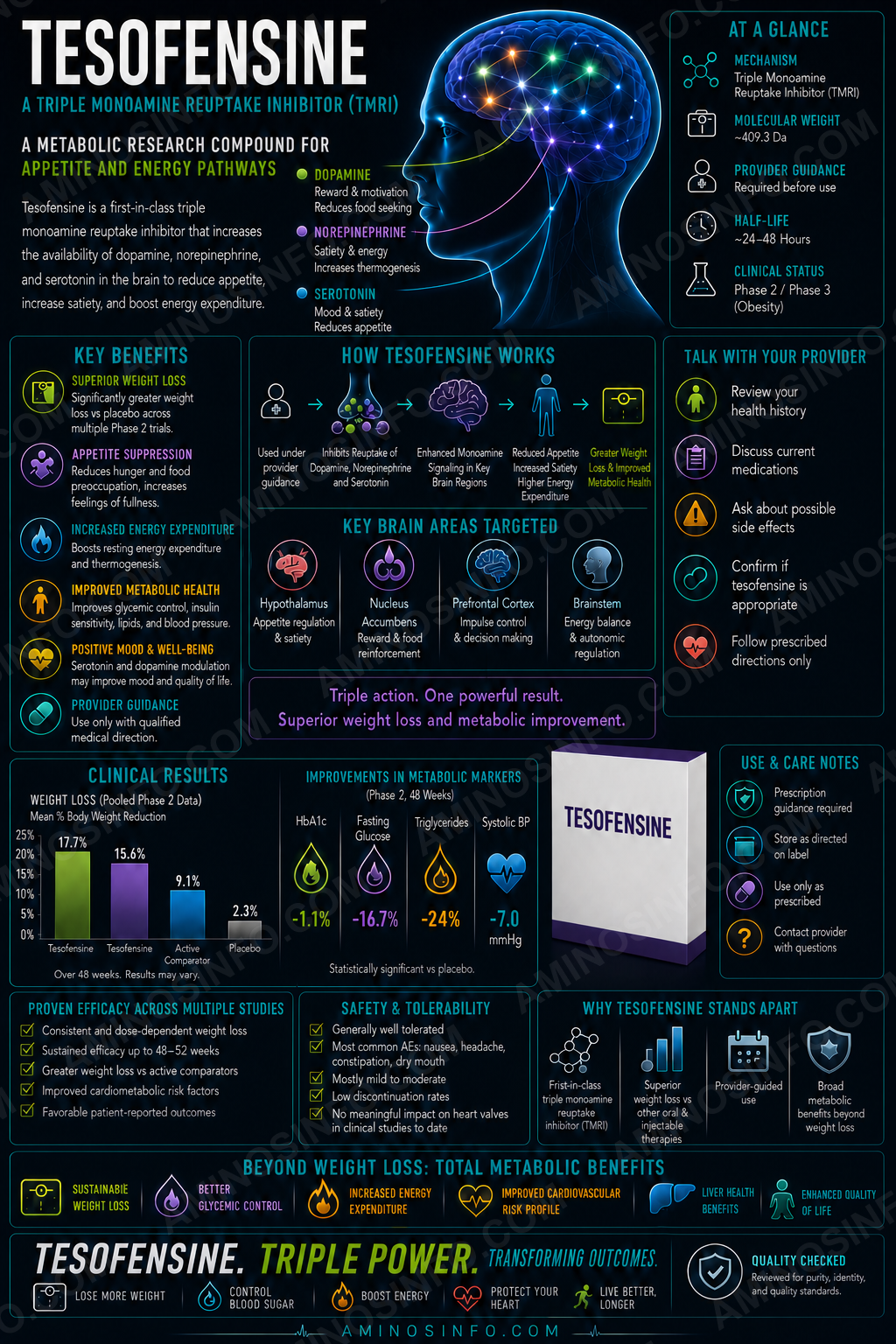
Tesofensine, also known as NS2330, is an investigational centrally acting monoamine reuptake inhibitor from the phenyltropane chemical family. It blocks the neuronal transporters responsible for clearing norepinephrine, dopamine, and serotonin from synapses.
It was originally developed for neurological disorders, including Parkinson’s disease and Alzheimer’s disease. Weight loss observed during those programs redirected development toward obesity.
Small-molecule phenyltropane
NET, DAT, and SERT inhibition
C₁₇H₂₃Cl₂NO
Approximately 328.3 g/mol
402856-42-2
No
Researchers investigate tesofensine in relation to:
- Obesity and weight reduction
- Appetite suppression and satiety
- Food reward and craving
- Energy expenditure
- Hypothalamic obesity
- Prader–Willi syndrome through the Tesomet combination
- Monoamine-transporter neuropharmacology
🧬 Chemical Structure
Chemical class
Tesofensine is a chlorinated phenyltropane derivative with a rigid bicyclic tropane scaffold. The scaffold is chemically related to other monoamine-transporter ligands but has its own transporter potency, pharmacokinetic profile, and stereochemistry.
Systematic chemical name
(1R,2R,3S,5S)-3-(3,4-dichlorophenyl)-8-methyl-8-azabicyclo[3.2.1]octane-2-carboxamide
Chemical naming can vary by database and salt representation. The stereochemical configuration must be explicitly controlled.
⚛️ Molecular Weight and 🧫 Formula
| Free-base molecular formula | C17H23Cl2NO |
|---|---|
| Free-base molecular weight | Approximately 328.3 g/mol |
| Common free-base CAS number | 402856-42-2 |
| PubChem CID | 11370864 |
| Chiral centers | Multiple; stereochemical identity is essential |
| Peptide sequence | None |
Tesofensine citrate
| Citrate formula | C23H31Cl2NO8 |
|---|---|
| Citrate molecular weight | Approximately 520.4 g/mol |
| Citrate CAS number | 861205-83-6 |
| PubChem CID | 11421038 |
Salt-form warning
A label or COA must distinguish free-base tesofensine from tesofensine citrate or another salt. A milligram of salt does not contain a milligram of free-base active ingredient.
📅 Discovery Timeline and Research History
1990s: Neurological-drug development
NeuroSearch developed NS2330 as a monoamine reuptake inhibitor for neurological disease.
Early 2000s: Parkinson’s and Alzheimer’s programs
Tesofensine was evaluated in Parkinson’s disease and Alzheimer’s disease. Neurological efficacy was insufficient for continued development, but unintended weight loss was repeatedly observed.
2006: Obesity phase II study begins
The TIPO-1 randomized, placebo-controlled obesity study was initiated in Denmark.
2008: Phase II obesity results published
The trial reported dose-related weight loss over 24 weeks in adults with obesity receiving a hypocaloric diet.
2010–2011: Mechanistic appetite studies
Animal research characterized serotonin, norepinephrine, and dopamine contributions to reduced food intake.
2013: Expression of Concern
The Lancet issued an Expression of Concern regarding irregularities at two of the five study sites in the phase II trial.
2014: Rights transferred to Saniona
Saniona acquired rights to tesofensine and continued development directly and through partners.
2019–2022: Tesomet studies
Tesofensine was combined with metoprolol to limit heart-rate effects in hypothalamic obesity and Prader–Willi syndrome research.
2021: FDA orphan-drug designations
Tesofensine plus metoprolol received orphan-drug designation for Prader–Willi syndrome and hypothalamic obesity. Orphan designation is not approval.
2023–2026: Mexican regulatory review continues
Mexico’s technical committee issued a favorable opinion in 2023, but company disclosures through April 2026 continued to describe the market-authorization application as under review.
🧠 Mechanism of Action
1. Norepinephrine transporter inhibition
Blocking NET increases noradrenergic signaling involved in alertness, appetite suppression, sympathetic tone, and energy expenditure.
2. Dopamine transporter inhibition
DAT inhibition may reduce food seeking, craving, and the motivational salience of palatable food, but it also raises concerns about stimulation, insomnia, mood effects, and misuse potential.
3. Serotonin transporter inhibition
SERT inhibition can increase satiety and reduce meal size, while also creating potential serotonergic drug interactions.
4. Combined monoamine action
The weight-loss effect appears to depend on simultaneous modulation of all three monoamines rather than one isolated transporter.
5. Central rather than peripheral action
Tesofensine crosses into the central nervous system and acts on brain networks controlling appetite, reward, arousal, and autonomic output.
🎯 Transporter and Receptor Profile
| Target | Primary relevance | Evidence status |
|---|---|---|
| NET / SLC6A2 | Norepinephrine reuptake, appetite, sympathetic activity | Direct inhibitor |
| DAT / SLC6A3 | Dopamine reuptake, reward, craving, motivation | Direct inhibitor |
| SERT / SLC6A4 | Serotonin reuptake and satiety | Direct inhibitor |
| Dopamine D2/D3 receptors | Downstream availability changes in imaging studies | Not a primary direct agonist |
| 5-HT receptors | Downstream satiety signaling | Indirect; not a primary receptor agonist |
| Adrenergic receptors | Downstream sympathetic effects | Indirect |
| GLP-1 receptor | Not the mechanism | No direct agonism |
Potency interpretation
Reported transporter inhibition values vary with assay species, substrate, membrane preparation, temperature, and whether the parent drug or active metabolite is tested.
Appetite, Satiety, and Food-Reward Research
Reduced food intake
Diet-induced-obesity studies consistently found reduced caloric intake after tesofensine.
Meal-pattern effects
The compound can reduce meal size, slow eating rate, and extend satiety between meals.
Food reward
Dopaminergic effects may reduce the rewarding value of food and food-seeking behavior.
Macronutrient preference
Animal studies examined changes in preference for high-fat or palatable food, but translation to human eating behavior is incomplete.
Not a metabolic hormone
Tesofensine does not mimic GLP-1, GIP, leptin, amylin, or insulin.
Hypothalamic and GABAergic Research
Lateral hypothalamus
A 2024 mouse study found that tesofensine altered activity of lateral-hypothalamic neurons involved in feeding.
GABAergic neurons
The study reported silencing of selected GABAergic neurons associated with reduced food intake and body weight.
Network-level interpretation
This does not mean tesofensine is a GABA receptor drug. The GABAergic change appears downstream of monoamine-transporter inhibition.
Sex differences
Preclinical responses may differ by sex, hormonal state, diet, and obesity phenotype.
Energy-Expenditure Research
Sympathetic activation
Noradrenergic signaling may increase thermogenesis and resting or nocturnal energy expenditure.
Human evidence
Small mechanistic studies suggested that weight loss may not be explained by reduced intake alone.
Cardiovascular overlap
The same sympathetic pathways that may increase energy expenditure can raise heart rate and create cardiovascular risk.
Not an exercise substitute
Tesofensine does not reproduce the cardiovascular, muscular, metabolic, and functional benefits of physical activity.
Phase II Obesity Trial
Trial design
The TIPO-1 trial was a randomized, double-blind, placebo-controlled study conducted at five Danish obesity centers. Participants received a hypocaloric diet plus placebo or once-daily tesofensine.
Reported weight loss
| Group | Reported mean weight change at 24 weeks |
|---|---|
| Placebo | Approximately −2.0% |
| Tesofensine 0.25 mg | Approximately −4.5% |
| Tesofensine 0.5 mg | Approximately −9.2% |
| Tesofensine 1.0 mg | Approximately −10.6% |
Body composition
Reported weight loss was largely attributed to fat-mass reduction rather than lean-mass loss.
Common adverse events
Dry mouth, nausea, constipation, insomnia, diarrhea, and increased heart rate were reported.
Blood pressure and pulse
Average blood-pressure changes were limited in the published report, but pulse increased, especially at higher doses.
Interpretation
The reported efficacy was notable for its era, but the later Expression of Concern and lack of successful broad phase III approval substantially limit certainty.
Expression of Concern and Trial-Integrity Issues
What happened?
In 2013, The Lancet published an Expression of Concern regarding the phase II obesity paper after concerns about trial conduct at two participating sites.
Why it matters
Clinical efficacy estimates depend on reliable randomization, source data, adverse-event reporting, and participant records.
Was the paper retracted?
No. The article remains published, but the Expression of Concern is part of the record.
How results should be presented
The numerical weight-loss results may be summarized only with explicit disclosure of the Expression of Concern.
Need for confirmation
A large independently monitored phase III program would be necessary to establish benefit–risk with confidence.
Tesomet and Hypothalamic-Obesity Research
What is Tesomet?
Tesomet is a fixed-dose combination of tesofensine and metoprolol. Metoprolol is included to reduce heart-rate and sympathetic effects.
Hypothalamic obesity
Hypothalamic injury can produce severe hyperphagia, reduced energy expenditure, autonomic dysfunction, and rapid weight gain that responds poorly to conventional therapy.
Randomized trial
A 2022 randomized study evaluated 0.5 mg tesofensine plus 50 mg metoprolol in adults with hypothalamic obesity and reported weight-loss and appetite signals with cardiovascular monitoring.
Prader–Willi syndrome
Tesomet has also been developed for Prader–Willi syndrome, a genetic disorder associated with hyperphagia and severe obesity.
Orphan designation
The FDA granted orphan-drug designation to the combination for Prader–Willi syndrome and hypothalamic obesity. Orphan designation provides development incentives but does not establish approval, safety, or efficacy.
Parkinson’s and Alzheimer’s Development History
Parkinson’s disease
Tesofensine was studied for motor and nonmotor symptoms but did not demonstrate sufficient therapeutic benefit for continued development.
Alzheimer’s disease
Clinical studies investigated cognition and function but did not establish an effective Alzheimer’s treatment.
Weight-loss signal
Unexpected weight loss in neurological trial participants helped motivate obesity development.
Clinical lesson
A side effect observed in one disease population can become a therapeutic hypothesis, but it still requires dedicated efficacy and safety trials.
Cardiovascular Effects and Safety
Heart rate
Increased resting pulse is one of the clearest dose-related concerns.
Blood pressure
Average trial changes were not dramatic, but individual responses, ambulatory blood pressure, underlying hypertension, and interactions remain important.
Sympathetic activation
NET inhibition may produce palpitations, tachycardia, vasoconstriction, sweating, or blood-pressure elevation.
Arrhythmia risk
Patients with arrhythmias, structural heart disease, coronary disease, uncontrolled hypertension, or prolonged QT require particular caution in any development program.
Metoprolol strategy
Tesomet uses beta-blockade to reduce heart-rate effects, but adding metoprolol introduces its own contraindications and monitoring needs.
Long-term outcomes unknown
No cardiovascular-outcomes trial has established reduced myocardial infarction, stroke, hospitalization, or mortality.
Psychiatric and Neurological Safety
Insomnia and activation
Increased monoamine signaling can produce insomnia, restlessness, tremor, or agitation.
Mood effects
Clinical programs monitor depression, anxiety, irritability, mania, psychosis, and suicidality because of central monoaminergic activity.
Misuse potential
DAT inhibition raises theoretical concern for reinforcing or stimulant-like effects. Tesofensine is not established as having the same abuse profile as cocaine or amphetamine, but formal abuse-liability evaluation is relevant.
Serotonin toxicity
Combining tesofensine with serotonergic drugs could theoretically increase serotonin-syndrome risk.
Seizure threshold
Central stimulatory compounds may affect seizure risk, particularly with other medications or neurological disease.
Pharmacokinetics and Active Metabolite
Long apparent half-life
Tesofensine has a long elimination half-life, supporting once-daily dosing but also causing accumulation and slow washout.
Active metabolite
NS2360, a desmethyl metabolite, contributes to monoamine-transporter inhibition and overall exposure.
Steady state
Long half-life means that effects and adverse reactions may increase over multiple weeks rather than appearing immediately.
Drug interactions
Metabolic interactions, monoamine oxidase inhibitors, serotonergic medicines, stimulants, decongestants, and cardiovascular drugs require systematic evaluation.
Weight-loss persistence
Long-term maintenance after discontinuation has not been adequately established.
Regulatory Status
United States
Tesofensine is not FDA approved. FDA records list the tesofensine–metoprolol orphan indications as designated but not approved.
Compounding status
FDA enforcement materials have identified tesofensine as ineligible for use in human drug compounding under the cited 503A circumstances.
Mexico
A favorable technical opinion was issued in 2023. Saniona’s April 2026 disclosure stated that the market-authorization application remained under review.
Other regions
Regulatory status varies, but tesofensine should not be described as broadly approved without jurisdiction-specific documentation.
Evidence Limitations and Clinical Interpretation
Expression of Concern
The principal phase II obesity paper carries an unresolved publication warning.
Limited phase III confirmation
There is no broad internationally accepted phase III package establishing long-term efficacy and safety for common obesity.
Small safety database
Rare cardiovascular, psychiatric, neurological, and interaction risks may not emerge in modest-size trials.
Changing obesity-treatment landscape
Modern incretin therapies have extensive phase III and cardiovascular-outcome data, changing the benefit–risk threshold for a centrally acting monoamine drug.
Weight loss is not the only endpoint
Regulators also consider blood pressure, pulse, psychiatric safety, cardiovascular outcomes, discontinuation, weight regain, quality of life, and long-term adherence.
Online dosing claims
Commercial protocols often extrapolate from trial doses without pharmaceutical-grade product, clinical monitoring, or validated risk management.
🧪 Laboratory Testing Methods
| Method | Purpose | Important limitation |
|---|---|---|
| HPLC / UPLC assay | Measures tesofensine concentration and separates related impurities. | Area purity alone does not prove identity or potency. |
| LC-HRMS | Confirms molecular ion and elemental composition. | Does not alone establish stereochemistry. |
| MS/MS fragmentation | Supports structural identity. | Structural isomers may require orthogonal methods. |
| NMR spectroscopy | Confirms tropane scaffold, substitutions, and salt form. | Trace impurities may be below detection. |
| Chiral HPLC or SFC | Measures enantiomeric and diastereomeric purity. | Requires qualified stereochemical standards. |
| Optical rotation | Supports stereochemical consistency. | Not adequate as the sole stereochemistry test. |
| Ion chromatography | Quantifies citrate, chloride, or other counterions. | Does not measure free-base potency by itself. |
| Water by Karl Fischer | Quantifies moisture and hydrates. | Moisture correction is required for potency. |
| Residual solvents by GC | Measures synthesis and crystallization solvents. | Does not assess transporter activity. |
| Elemental impurities by ICP-MS | Measures metals from catalysts and processing. | Specifications depend on intended exposure. |
| Single-crystal X-ray diffraction | Definitively supports stereochemistry and solid form. | Not routinely practical for every batch. |
| XRPD and DSC | Characterize polymorph, crystallinity, and thermal behavior. | Solid form can change during storage. |
| NET, DAT, and SERT uptake assays | Confirm transporter-inhibition potency. | Assay systems can produce different IC50 values. |
| Broad receptor and ion-channel panel | Evaluates off-target pharmacology. | In-vitro findings require exposure context. |
| hERG assay | Evaluates a key cardiac ion-channel risk. | Does not replace full cardiac-safety testing. |
| CYP inhibition and induction panel | Assesses metabolic drug-interaction potential. | Clinical interactions require human confirmation. |
| NS2360 impurity/metabolite assay | Distinguishes parent drug from active desmethyl metabolite. | The metabolite may be both impurity and pharmacologically relevant analyte. |
| Dissolution and content uniformity | Required for oral-tablet performance. | Raw API purity cannot validate finished tablets. |
| Stability-indicating assay | Tracks oxidation, hydrolysis, epimerization, salt conversion, and degradants. | Requires validated forced-degradation studies. |
| Microbial limits | Assesses nonsterile finished-product quality. | Does not establish chemical identity. |
📄 How to Interpret a Tesofensine COA
- Confirm that the substance is a small molecule, not a peptide: No amino-acid sequence should be listed.
- Identify the exact form: Free base, citrate, another salt, hydrate, or solvate.
- Verify formula and molecular weight for the stated form: C₁₇H₂₃Cl₂NO and approximately 328.3 g/mol for the free base; C₂₃H₃₁Cl₂NO₈ and approximately 520.4 g/mol for citrate.
- Confirm stereochemistry: Chiral purity is essential and cannot be inferred from ordinary HPLC.
- Require LC-MS and NMR identity testing.
- Review related substances: Synthetic intermediates, desmethyl compounds, epimers, positional isomers, degradants, and residual reagents.
- Measure assay on an anhydrous, salt-corrected basis: “99% chromatographic purity” is not the same as 99% active free base.
- Review residual solvents, elemental impurities, water, counterion content, polymorph, and stability.
- For tablets, require content uniformity, dissolution, dose accuracy, and stability of the finished dosage form.
- Use NET, DAT, and SERT functional assays for pharmacological consistency.
- Do not infer medical efficacy: A COA cannot prove safe weight loss, appetite control, cardiovascular safety, or clinical approval.
📊 Tesofensine vs GLP-1/GIP Drugs vs Phentermine vs Bupropion/Naltrexone
| Feature | Tesofensine | Semaglutide/Tirzepatide | Phentermine | Bupropion/Naltrexone |
|---|---|---|---|---|
| Main mechanism | NET/DAT/SERT inhibition | Incretin-receptor agonism | Sympathomimetic appetite suppression | Reward and hypothalamic signaling |
| Route | Oral | Mostly injection; some oral semaglutide indications | Oral | Oral |
| Main concern | Pulse, psychiatric and monoamine interactions | GI, gallbladder, pancreatitis-related warnings | Cardiovascular and stimulant risks | Nausea, blood pressure, seizure risk |
| FDA approved for obesity? | No | Yes, specific products | Yes, short-term | Yes |
Tesofensine vs Sibutramine vs Lorcaserin vs Rimonabant
| Compound | Mechanism | Historical issue |
|---|---|---|
| Tesofensine | Triple monoamine reuptake inhibition | Investigational; pulse and trial-integrity concerns |
| Sibutramine | Serotonin/norepinephrine reuptake inhibition | Withdrawn after cardiovascular-outcome concerns |
| Lorcaserin | 5-HT2C receptor agonist | Withdrawn after cancer-signal review |
| Rimonabant | CB1 receptor antagonist | Psychiatric adverse effects |
Tesofensine vs Tesomet
| Feature | Tesofensine alone | Tesomet |
|---|---|---|
| Components | Tesofensine | Tesofensine + metoprolol |
| Purpose | Weight reduction | Weight reduction with heart-rate control |
| Main development area | Common obesity | Hypothalamic obesity and Prader–Willi syndrome |
| Additional risks | Monoamine-related | Monoamine risks plus beta-blocker risks |
| FDA approval | No | No; orphan designated for selected indications |
Tesofensine vs Peptides
| Attribute | Tesofensine | Research peptide |
|---|---|---|
| Chemical type | Small organic molecule | Amino-acid chain |
| Sequence | None | Defined amino-acid sequence |
| Primary identity tests | NMR, LC-MS, chiral chromatography | LC-MS/MS, sequencing, amino-acid analysis |
| Oral stability | Suitable for oral drug development | Often degraded orally |
| COA warning | Must verify stereochemistry and salt form | Must verify sequence and peptide content |
🔗 Related Compounds and Pathways
- NS2360: Active desmethyl metabolite of tesofensine.
- Metoprolol: Beta-1 blocker combined with tesofensine in Tesomet.
- NET, DAT, and SERT: The three primary monoamine transporters.
- Sibutramine: Historical monoamine-based obesity drug withdrawn over cardiovascular concerns.
- Phentermine: Sympathomimetic appetite suppressant.
- Bupropion/naltrexone: Centrally acting approved obesity combination.
- GLP-1 and GIP pathways: Mechanistically distinct metabolic-hormone systems.
- Lateral-hypothalamic GABA neurons: Downstream feeding network studied in 2024.
🖼️ Original Diagram Specifications
Diagram 1: Tesofensine chemical identity
Show the dichlorophenyl tropane scaffold, chiral centers, free-base formula, citrate salt, and a bold label stating “small molecule—not a peptide.”
Diagram 2: Triple-transporter mechanism
Show NET, DAT, and SERT presynaptic transporters blocked by tesofensine, increasing norepinephrine, dopamine, and serotonin in the synaptic cleft.
Diagram 3: Appetite and reward pathway
Show hypothalamic satiety, lateral-hypothalamic feeding neurons, mesolimbic food reward, and reduced meal size and food seeking.
Diagram 4: Benefit–risk balance
Show appetite suppression and possible energy expenditure on one side, with tachycardia, insomnia, psychiatric effects, and monoamine interactions on the other.
Diagram 5: Phase II evidence caveat
Show the published 24-week dose-response results with an overlay reading “Lancet Expression of Concern issued in 2013.”
Diagram 6: Tesomet strategy
Show tesofensine reducing appetite and metoprolol limiting beta-1-mediated heart-rate increase, with separate safety warnings for both components.
Diagram 7: COA workflow
Show salt form, stereochemistry, LC-MS, NMR, chiral HPLC, assay, impurities, water, counterions, transporter potency, tablet dissolution, and stability.
❓ Frequently Asked Questions
Is tesofensine a peptide?
No. Tesofensine is a small-molecule phenyltropane drug candidate.
Does tesofensine have an amino-acid sequence?
No.
What is its molecular formula?
The free-base formula is C₁₇H₂₃Cl₂NO.
What is its molecular weight?
Approximately 328.3 g/mol for the free base and approximately 520.4 g/mol for tesofensine citrate.
What is its CAS number?
402856-42-2 is commonly used for the free base; 861205-83-6 for the citrate salt.
How does tesofensine work?
It inhibits norepinephrine, dopamine, and serotonin transporters, increasing monoamine signaling involved in appetite, satiety, reward, and autonomic activity.
Does tesofensine cause weight loss?
A phase II trial reported substantial dose-related weight loss, but the publication later received a Lancet Expression of Concern and broad phase III confirmation is lacking.
Is tesofensine FDA approved?
No.
Is tesofensine approved in Mexico?
As of April 2026, Saniona described the Mexican market-authorization application as still under review.
What is Tesomet?
Tesomet combines tesofensine with metoprolol to reduce heart-rate effects.
Does orphan-drug designation mean FDA approval?
No. It provides development incentives for a rare-disease indication but is not approval.
Does tesofensine work like semaglutide or tirzepatide?
No. Tesofensine is a central monoamine-transporter inhibitor; semaglutide and tirzepatide act through incretin receptors.
Can tesofensine raise heart rate?
Yes. Increased pulse was a prominent dose-related finding.
Can tesofensine interact with antidepressants?
Potentially. Combining monoaminergic or serotonergic drugs may increase cardiovascular, psychiatric, or serotonin-toxicity risks.
Is tesofensine a stimulant?
It has centrally activating monoaminergic properties, although its pharmacology is not identical to amphetamine.
Can tesofensine be compounded legally in the United States?
It is not FDA approved, and FDA enforcement materials have identified tesofensine as ineligible in the cited 503A compounding context.
Does 99% HPLC purity prove authentic tesofensine?
No. Salt form, stereochemistry, molecular structure, assay, related substances, water, residual solvents, and transporter potency require separate confirmation.
Final Thoughts
Tesofensine is an investigational small-molecule inhibitor of the norepinephrine, dopamine, and serotonin transporters. It is not a peptide. The free base has the formula C₁₇H₂₃Cl₂NO and a molecular weight of approximately 328.3 g/mol.
The compound produced notable dose-related weight loss in a 24-week phase II obesity trial and has continued in specialized development through the tesofensine–metoprolol combination. However, the principal phase II publication carries a Lancet Expression of Concern, cardiovascular and psychiatric safety require careful evaluation, and no broad U.S. approval exists.
Legitimate tesofensine material should be tested for exact salt form, stereochemical identity, LC-MS and NMR structure, chiral purity, assay, related compounds, NS2360, residual solvents, elemental impurities, water, counterions, solid form, transporter potency, finished-tablet dissolution, and stability. A COA cannot establish safe weight loss, cardiovascular safety, legal prescribing status, or clinical approval.
📚 References
- PubChem. Tesofensine compound record.
- PubChem. Tesofensine citrate compound record.
- Astrup A, et al. Effect of tesofensine on bodyweight loss, body composition, and quality of life in obese patients. Lancet. 2008.
- The Lancet Editors. Expression of concern—tesofensine obesity trial. Lancet. 2013.
- Axel AMD, et al. Tesofensine, a Novel Triple Monoamine Reuptake Inhibitor, Induces Appetite Suppression. 2010.
- Perez CI, et al. Tesofensine silences GABAergic neurons in the lateral hypothalamus. 2024.
- Huynh K, et al. Randomized controlled trial of Tesomet for weight loss in hypothalamic obesity. European Journal of Endocrinology. 2022.
- ClinicalTrials.gov. TIPO-1: Effect of Tesofensine on Weight Reduction in Patients With Obesity.
- ClinicalTrials.gov. Tesofensine and metoprolol in hypothalamic obesity.
- U.S. FDA Orphan Drug Database. Tesofensine plus metoprolol for Prader–Willi syndrome.
- Saniona. Tesofensine development status.
- Doggrell SA. Tesofensine—a novel potent weight loss medicine. Expert Opinion on Investigational Drugs. 2009.
- Sjödin A, et al. Tesofensine and energy expenditure in overweight and obese subjects. International Journal of Obesity.
- Bello NT, et al. Feeding behavioral analysis of tesofensine in diet-induced obese rats. Obesity.
- Hansen HH, et al. Characterization of monoamine contributions to tesofensine-induced hypophagia. Neuropharmacology.
- Hansen HH, et al. Tesofensine reduces food intake and body weight in diet-induced obese rats. Pharmacology Biochemistry and Behavior.
- van de Giessen E, et al. Striatal dopamine D2/3 receptor availability after chronic tesofensine treatment. Neuropsychopharmacology.
- Appel L, et al. Tesofensine, a novel triple monoamine reuptake inhibitor: positron emission tomography and transporter occupancy. European Neuropsychopharmacology.
- Tipper CM, et al. Pharmacokinetic and pharmacodynamic profile of tesofensine and NS2360. Clinical Pharmacokinetics.
- NeuroSearch A/S. NS2330 clinical-development reports in Parkinson’s disease and Alzheimer’s disease.
- Hauser RA, et al. Multicenter study of tesofensine in Parkinson’s disease. Movement Disorders.
- Rinne JO, et al. Tesofensine in patients with Alzheimer’s disease: randomized clinical evaluation. Alzheimer Disease and Associated Disorders.
- Rebello CJ, Greenway FL. Obesity medications in development. Expert Opinion on Investigational Drugs. 2020.
- Bray GA, Frühbeck G, Ryan DH, Wilding JPH. Management of obesity. Lancet.
- Wilding JPH, et al. Once-weekly semaglutide in adults with overweight or obesity. New England Journal of Medicine. 2021.
- Jastreboff AM, et al. Tirzepatide once weekly for the treatment of obesity. New England Journal of Medicine. 2022.
- Lincoff AM, et al. Semaglutide and cardiovascular outcomes in obesity without diabetes. New England Journal of Medicine. 2023.
- James WPT, et al. Effect of sibutramine on cardiovascular outcomes in overweight and obese subjects. New England Journal of Medicine. 2010.
- Greenway FL, et al. Naltrexone plus bupropion for weight loss. Lancet. 2010.
- Gadde KM, et al. Effects of low-dose phentermine plus topiramate in overweight and obese adults. Lancet. 2011.
- Smith SR, et al. Lorcaserin for weight management. New England Journal of Medicine.
- Topol EJ, et al. Rimonabant for prevention of cardiovascular events: CRESCENDO trial. Lancet.
- Ryan DH, Kahan S. Guideline recommendations for obesity management. Medical Clinics of North America.
- Garvey WT, et al. American Association of Clinical Endocrinology obesity guidelines. Endocrine Practice.
- Wharton S, et al. Obesity in adults: clinical practice guideline. CMAJ.
- Heymsfield SB, Wadden TA. Mechanisms, pathophysiology, and management of obesity. New England Journal of Medicine.
- Morton GJ, Meek TH, Schwartz MW. Neurobiology of food intake in health and disease. Nature Reviews Neuroscience.
- Saper CB, Chou TC, Elmquist JK. The need to feed: homeostatic and hedonic control of eating. Neuron.
- Berthoud HR, Münzberg H, Morrison CD. Blaming the brain for obesity. Gastroenterology.
- Kenny PJ. Reward mechanisms in obesity. Neuron.
- Volkow ND, Wang GJ, Baler RD. Reward, dopamine and the control of food intake. Trends in Cognitive Sciences.
- Rothman RB, Baumann MH. Monoamine transporters and psychostimulant drugs. European Journal of Pharmacology.
- Kristensen AS, et al. SLC6 neurotransmitter transporters: structure, function, and regulation. Pharmacological Reviews.
- Torres GE, Gainetdinov RR, Caron MG. Plasma membrane monoamine transporters. Nature Reviews Neuroscience.
- Howell LL, Kimmel HL. Monoamine transporters and psychostimulant addiction. Biochemical Pharmacology.
- Boyer EW, Shannon M. The serotonin syndrome. New England Journal of Medicine.
- Stahl SM. Mechanism of action of serotonin–norepinephrine–dopamine reuptake inhibitors. CNS Spectrums.
- Grundy D, et al. Safety pharmacology assessment of cardiac ion channels. British Journal of Pharmacology.
- ICH E14. Clinical evaluation of QT/QTc interval prolongation and proarrhythmic potential.
- ICH S7B. Nonclinical evaluation of delayed ventricular repolarization.
- ICH M10. Bioanalytical Method Validation.
- ICH Q2(R2). Validation of Analytical Procedures.
- ICH Q3A(R2). Impurities in New Drug Substances.
- ICH Q3B(R2). Impurities in New Drug Products.
- ICH Q3C. Impurities: Guideline for Residual Solvents.
- ICH Q3D. Elemental Impurities.
- ICH Q1A(R2). Stability Testing of New Drug Substances and Products.
- ICH Q6A. Specifications for New Drug Substances and Products.
- United States Pharmacopeia General Chapter <621>: Chromatography.
- United States Pharmacopeia General Chapter <467>: Residual Solvents.
- United States Pharmacopeia General Chapter <731>: Loss on Drying.
- United States Pharmacopeia General Chapter <921>: Water Determination.
- United States Pharmacopeia General Chapter <905>: Uniformity of Dosage Units.
- United States Pharmacopeia General Chapter <711>: Dissolution.
- United States Pharmacopeia General Chapters <232> and <233>: Elemental Impurities.
- U.S. Food and Drug Administration. Warning letter discussing tesofensine and human-drug compounding. 2025.
- Saniona AB. 2026 disclosure describing Mexican market authorization as under review.
Chemistry, transporter pharmacology, obesity efficacy, trial-integrity concerns, Tesomet development, cardiovascular and psychiatric safety, regulatory status, and analytical methods were reviewed in July 2026. Tesofensine remains unapproved by the U.S. FDA.