Semaglutide (Ozempic / Wegovy / Rybelsus): What It Is, How It Works, Benefits, and Research Overview
A comprehensive review of semaglutide, the long-acting GLP-1 receptor agonist used in injectable and oral products for type 2 diabetes, weight management, cardiovascular-risk reduction, chronic kidney disease, and selected liver-disease indications.
What Is Semaglutide?
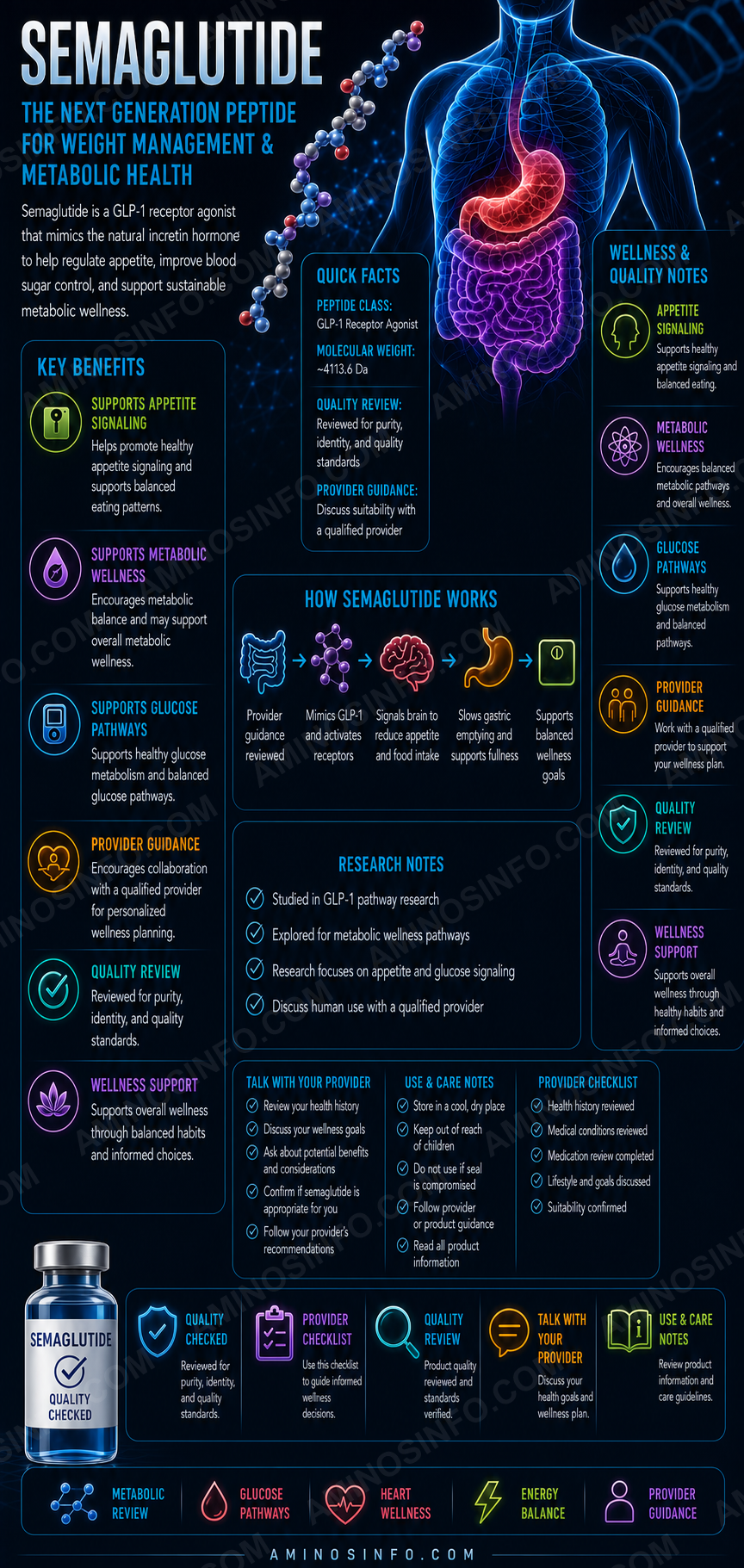
Semaglutide is a synthetic, long-acting analogue of human glucagon-like peptide-1. It activates the GLP-1 receptor and shares approximately 94% sequence identity with native GLP-1.
Ozempic, Wegovy, Rybelsus
Acylated GLP-1 analogue
GLP-1 receptor
31 amino acids
C₁₈₇H₂₉₁N₄₅O₅₉
About 4113.6 Da
Depending on the product, semaglutide is used for glycemic control, chronic weight management, cardiovascular-risk reduction, kidney-risk reduction in type 2 diabetes with chronic kidney disease, and selected liver-disease indications.
🧬 Structure, Sequence, and Molecular Properties
🧪 Peptide sequence
HAEGTFTSDVSSYLEGQAAKEFIAWLVRGRG
The backbone is based on human GLP-1(7–37). Its defining modifications are:
- Aib at position 8, improving resistance to DPP-4 degradation
- Lysine-to-arginine substitution at position 34
- Lys26 attachment to γ-glutamate and a two-unit hydrophilic spacer
- C18 octadecanedioic-acid side chain for albumin association
- No disulfide bridge
| Molecular formula | C₁₈₇H₂₉₁N₄₅O₅₉ |
|---|---|
| Molecular weight | Approximately 4113.6 Da |
| CAS number | 910463-68-2 |
| Sequence identity to human GLP-1 | Approximately 94% |
| Plasma half-life | Approximately one week |
| Long-acting feature | C18 fatty-diacid acylation and albumin binding |
Semaglutide lasts longer than liraglutide because it has stronger albumin association, a longer fatty-diacid side chain, a hydrophilic spacer, and improved resistance to enzymatic degradation.
Approved Semaglutide Products
| Product | Form | Main roles |
|---|---|---|
| Ozempic | Weekly injection | Type 2 diabetes, cardiovascular-risk reduction, and kidney-risk reduction in eligible adults |
| Rybelsus | Daily oral tablet | Type 2 diabetes and product-specific cardiovascular-risk use |
| Ozempic tablets | Newer oral formulation | Type 2 diabetes and specified cardiovascular indications under current labeling |
| Wegovy injection | Weekly injection | Weight management, cardiovascular-risk reduction, and selected liver-disease use |
| Wegovy tablets | Oral weight-management presentation | Adult weight reduction and product-specific cardiovascular-risk use |
📅 Discovery and Approval Timeline
- 2017: Ozempic injection approved for type 2 diabetes.
- 2019: Rybelsus became the first FDA-approved oral GLP-1 receptor agonist.
- 2021: Wegovy injection approved for chronic weight management in adults.
- 2022: Wegovy expanded to adolescents 12 years and older with obesity.
- March 2024: Wegovy approved to reduce cardiovascular death, nonfatal heart attack, and nonfatal stroke in eligible adults with established cardiovascular disease and overweight or obesity.
- 2025: Ozempic labeling expanded for kidney-risk reduction in adults with type 2 diabetes and CKD.
- August 2025: Wegovy received a selected MASH-related liver indication.
- 2025–2026: Oral semaglutide indications and product presentations expanded following SOUL and additional FDA reviews.
🧠 How Does Semaglutide Work?
Appetite and satiety
Semaglutide acts in brain regions involved in hunger, fullness, food reward, and meal size.
Insulin secretion
It increases insulin secretion when blood glucose is elevated.
Glucagon regulation
It reduces inappropriate glucagon release during hyperglycemia, decreasing hepatic glucose output.
Gastric emptying
It slows gastric emptying, particularly after initial dosing, supporting satiety and postprandial glucose control.
Organ protection
Cardiovascular and kidney benefits likely reflect combined effects on glucose, weight, blood pressure, inflammation, albuminuria, vascular stress, and direct tissue signaling.
Type 2 Diabetes Evidence
The SUSTAIN program established weekly injectable semaglutide across monotherapy, combination therapy, insulin comparisons, and active-comparator studies.
- SUSTAIN-6: Reduced major adverse cardiovascular events in high-risk adults with type 2 diabetes.
- SUSTAIN-7: Produced greater A1C and weight reductions than dulaglutide at the studied doses.
- PIONEER program: Demonstrated efficacy of oral semaglutide across multiple diabetes populations.
- SOUL: Oral semaglutide significantly reduced major adverse cardiovascular events in high-risk type 2 diabetes.
Weight-Management Evidence
STEP 1
Semaglutide 2.4 mg weekly plus lifestyle intervention produced approximately 14.9% mean weight loss at 68 weeks versus about 2.4% with placebo.
STEP 2
Adults with type 2 diabetes lost less weight on average than adults without diabetes but substantially more than placebo.
STEP 3 and STEP 4
Semaglutide added to intensive behavioral therapy produced additional loss, while continued treatment maintained and deepened weight reduction. Switching to placebo led to regain.
STEP TEENS
Adolescents experienced substantial BMI reduction and cardiometabolic improvement.
Chronic-treatment model
Stopping semaglutide commonly results in partial weight regain, consistent with obesity being a chronic relapsing disease.
Cardiovascular Evidence
SELECT
SELECT enrolled adults with established cardiovascular disease and overweight or obesity without diabetes. Semaglutide 2.4 mg reduced cardiovascular death, nonfatal myocardial infarction, or nonfatal stroke by approximately 20% relative to placebo.
FDA implication
This supported Wegovy’s cardiovascular-risk reduction indication in eligible adults.
Diabetes evidence
SUSTAIN-6 and SOUL support cardiovascular benefit with injectable and oral semaglutide in defined type 2 diabetes populations.
Chronic Kidney Disease Evidence
FLOW
FLOW enrolled adults with type 2 diabetes and chronic kidney disease. Semaglutide reduced major kidney-disease events, kidney failure, substantial sustained kidney-function loss, or cardiovascular death.
- Slower eGFR decline
- Lower major cardiovascular-event risk
- Lower all-cause mortality
- Reduced albuminuria
Current Ozempic injection labeling includes kidney-risk reduction in adults with type 2 diabetes and CKD.
Oral Semaglutide and Absorption Technology
Peptides are normally degraded in the digestive tract and absorbed poorly. Conventional oral semaglutide uses the absorption enhancer SNAC—sodium N-(8-[2-hydroxybenzoyl]amino) caprylate—to protect semaglutide locally and support gastric absorption.
Exposure depends on fasting conditions, water volume, and the waiting period before food, beverages, or other medicines. Newer oral semaglutide products have product-specific strengths and switching rules and should not be dosed by extrapolating from older Rybelsus tablets.
MASH and Liver-Disease Evidence
Semaglutide reduces liver fat, body weight, insulin resistance, inflammation, and liver-enzyme abnormalities. Biopsy trials have shown meaningful improvement in steatohepatitis resolution, although fibrosis findings vary by dose, population, and duration.
FDA expanded Wegovy labeling in 2025 for a selected MASH-related population. This indication does not automatically apply to Ozempic, Rybelsus, or every semaglutide product.
Heart Failure and Functional Outcomes
In STEP-HFpEF, semaglutide improved symptoms, physical limitations, exercise capacity, inflammation, and body weight in adults with obesity-related heart failure with preserved ejection fraction. Similar benefits were observed in participants with type 2 diabetes.
These findings do not by themselves create a broad FDA-approved heart-failure indication.
FDA-Approved Dosing Overview
Ozempic injection
| Stage | Dose |
|---|---|
| Starting | 0.25 mg weekly for 4 weeks |
| Initial maintenance | 0.5 mg weekly |
| Further increases | 1 mg, then 2 mg weekly if needed and tolerated |
| Maximum | 2 mg weekly |
Wegovy injection
| Weeks | Dose |
|---|---|
| 1–4 | 0.25 mg weekly |
| 5–8 | 0.5 mg weekly |
| 9–12 | 1 mg weekly |
| 13–16 | 1.7 mg weekly |
| Maintenance | 1.7 mg or 2.4 mg weekly depending on indication and tolerability |
Oral product dosing varies substantially. Follow the exact current label for Rybelsus, Ozempic tablets, or Wegovy tablets.
Warnings, Contraindications, and Side Effects
Boxed warning
Semaglutide causes thyroid C-cell tumors in rodents. Human relevance is unknown. It is contraindicated with a personal or family history of medullary thyroid carcinoma or MEN 2.
Common effects
- Nausea
- Diarrhea
- Vomiting
- Constipation
- Abdominal pain
- Dyspepsia
- Reduced appetite
- Headache
- Fatigue
Important warnings
- Acute pancreatitis
- Gallbladder disease
- Severe gastrointestinal reactions
- Not recommended in severe gastroparesis
- Acute kidney injury from dehydration
- Hypoglycemia with insulin or sulfonylureas
- Serious hypersensitivity
- Diabetic-retinopathy complications with rapid glucose improvement
- Increased heart rate
- Pulmonary aspiration during anesthesia or deep sedation
- Intestinal obstruction reported postmarketing
🧪 Laboratory Testing Methods
| Method | Purpose | Limitation |
|---|---|---|
| RP-HPLC / UPLC | Separates intact peptide from deletion, oxidation, deacylation, and process impurities | Area purity does not prove full identity or active content |
| LC-HRMS | Confirms intact mass and formula | Does not alone prove sequence, stereochemistry, or attachment site |
| MS/MS mapping | Confirms sequence, Aib8, Arg34, spacer, and Lys26 acylation | Requires a qualified reference standard |
| Amino-acid analysis | Confirms composition and supports net-content assignment | Does not prove residue order |
| Chiral analysis | Detects epimerization | Hydrolysis may introduce artifacts |
| Lipid/linker analysis | Confirms γ-Glu, spacer, C18 diacid, and Lys26 attachment | Incorrect modifications may preserve approximate mass |
| SEC-HPLC | Measures aggregates | Small oligomers may require orthogonal methods |
| Net peptide-content assay | Measures actual semaglutide mass | Must correct for water, salts, and excipients |
| GLP-1R cAMP assay | Confirms functional potency | Receptor density affects apparent EC50 |
| Albumin-binding assay | Confirms long-acting design | Does not fully predict human PK |
| Sterility/endotoxin/particles | Required for injectable finished product | Raw purity cannot establish injectable safety |
| SNAC, dissolution, content uniformity | Required for oral finished products | Raw API identity cannot establish oral bioavailability |
| Device delivery | Confirms pen dose accuracy | Not established by API testing |
| Stability-indicating assay | Tracks oxidation, deamidation, hydrolysis, aggregation, and deacylation | Requires validated forced-degradation studies |
📄 How to Interpret a Semaglutide COA
- Verify the complete GLP-1 analogue sequence.
- Confirm Aib at position 8 and Arg at position 34.
- Confirm Lys26 attachment of γ-Glu, spacer units, and C18 fatty diacid.
- Confirm intact mass of approximately 4113.6 Da.
- Use LC-HRMS and MS/MS peptide mapping.
- Confirm stereochemistry; epimers may share the same mass.
- Measure deletion peptides, deacylated material, oxidation, deamidation, hydrolysis, and aggregates.
- Report net peptide content; 99% HPLC purity is not the number of active milligrams.
- Confirm GLP-1 receptor potency and albumin binding.
- For injection, require sterility, endotoxin, particles, fill accuracy, pen performance, and stability.
- For tablets, require SNAC content, dissolution, content uniformity, moisture control, and validated absorption performance.
- A raw-material COA does not prove equivalence to Ozempic, Wegovy, Rybelsus, or another approved semaglutide product.
📊 Comparison Tables
Semaglutide vs Liraglutide vs Tirzepatide
| Feature | Semaglutide | Liraglutide | Tirzepatide |
|---|---|---|---|
| Targets | GLP-1R | GLP-1R | GIPR + GLP-1R |
| Injection frequency | Weekly | Daily | Weekly |
| Oral option | Yes | No | No approved oral product |
| FDA approved | Yes | Yes | Yes |
Ozempic vs Wegovy vs Rybelsus
| Feature | Ozempic | Wegovy | Rybelsus |
|---|---|---|---|
| Active ingredient | Semaglutide | Semaglutide | Semaglutide |
| Main role | Diabetes, CV, kidney risk | Weight, CV, selected liver indication | Oral diabetes therapy |
| Traditional route | Weekly injection | Weekly injection; oral presentation also available | Daily tablet |
| Interchangeable | No—product-specific dosing and labeling apply | ||
Semaglutide vs Retatrutide
| Feature | Semaglutide | Retatrutide |
|---|---|---|
| Targets | GLP-1R | GIPR + GLP-1R + GCGR |
| Status | FDA approved | Investigational |
| Pivotal obesity loss | About 14.9% in STEP 1 | Higher phase 3 averages reported |
| Outcome trials | SELECT and FLOW completed | Long-term outcomes still developing |
Raw Peptide vs Approved Product
| Attribute | Raw semaglutide | Approved product |
|---|---|---|
| Identity | Vendor claim and testing | FDA-reviewed manufacturing |
| Potency | Requires receptor assay | Validated release specification |
| Microbiology | May lack finished controls | Sterility and particle controls for injections |
| Oral performance | Not established | Validated enhancer, dissolution, and bioavailability |
| Clinical equivalence | Not established by COA | Supported by approved NDA or ANDA |
🖼️ Original Diagram Specifications
- Peptide architecture: GLP-1 backbone, Aib8, Arg34, Lys26 linker, spacers, and C18 fatty diacid.
- Mechanism: Brain, pancreas, stomach, liver, kidney, and cardiovascular effects.
- Product map: Ozempic, Wegovy, Rybelsus, oral Ozempic, and oral Wegovy.
- STEP 1: Approximately 14.9% versus 2.4% mean weight loss.
- SELECT and FLOW: Cardiovascular and kidney outcome reductions.
- Oral absorption: SNAC-mediated gastric absorption.
- COA workflow: Sequence, mass, mapping, potency, formulation testing, and stability.
❓ Frequently Asked Questions
Is semaglutide a peptide?
Yes. It is a chemically modified 31-amino-acid GLP-1 analogue.
What are the main brands?
Ozempic, Wegovy, and Rybelsus.
What is the formula?
C₁₈₇H₂₉₁N₄₅O₅₉.
What is the molecular weight?
Approximately 4113.6 Da.
What is the CAS number?
910463-68-2.
Is it FDA approved?
Yes, in several injectable and oral products.
What is Ozempic used for?
Type 2 diabetes and defined cardiovascular and kidney-risk indications.
What is Wegovy used for?
Weight management, cardiovascular-risk reduction, and selected liver-disease use under current labeling.
What is Rybelsus?
An oral semaglutide tablet formulated with an absorption enhancer.
How much weight loss occurred in STEP 1?
Approximately 14.9% on average at 68 weeks.
Does semaglutide reduce cardiovascular events?
Yes, in defined high-risk populations supported by SUSTAIN-6, SELECT, and SOUL.
Does it protect the kidneys?
FLOW demonstrated kidney benefit in adults with type 2 diabetes and CKD.
What are common side effects?
Nausea, diarrhea, vomiting, constipation, abdominal pain, and reduced appetite.
How is it different from tirzepatide?
Semaglutide activates GLP-1 receptors; tirzepatide activates GIP and GLP-1 receptors.
Can semaglutide products be combined?
No. They contain the same active ingredient.
Does 99% HPLC purity prove equivalence?
No. Identity, modification chemistry, active content, potency, sterility or tablet performance, and approved manufacturing are also required.
Final Thoughts
Semaglutide is one of the most extensively studied GLP-1 receptor agonists. Its product family now spans weekly injections and oral tablets for diabetes, obesity, cardiovascular-risk reduction, chronic kidney disease, and selected liver-disease indications.
The STEP program established substantial weight loss, while SUSTAIN, SELECT, FLOW, SOUL, and STEP-HFpEF demonstrated meaningful cardiovascular, kidney, metabolic, and functional benefits.
Semaglutide also carries important risks, including the boxed thyroid C-cell tumor warning, gastrointestinal intolerance, pancreatitis, gallbladder disease, dehydration-related kidney injury, diabetic-retinopathy complications, hypoglycemia with selected medicines, delayed gastric emptying, and aspiration risk.
Analytical authentication requires confirmation of sequence, Aib8, Arg34, Lys26-linked spacer and C18 fatty diacid, intact mass, stereochemistry, impurity profile, net content, GLP-1 receptor potency, albumin binding, and formulation-specific performance.
📚 References
- FDA. Ozempic Prescribing Information, 2025–2026.
- FDA. Wegovy Prescribing Information, 2026.
- FDA. Rybelsus and Ozempic Tablets Prescribing Information, 2026.
- FDA. Cardiovascular-risk reduction approval for Wegovy, March 8, 2024.
- FDA. Wegovy MASH-related approval, August 15, 2025.
- Wilding JPH, et al. Once-Weekly Semaglutide in Adults with Overweight or Obesity. NEJM. 2021.
- Davies M, et al. Semaglutide 2.4 mg in Adults with Obesity and Type 2 Diabetes. Lancet. 2021.
- Wadden TA, et al. Semaglutide and Intensive Behavioral Therapy. JAMA. 2021.
- Rubino D, et al. Continued Semaglutide and Weight-Loss Maintenance. JAMA. 2021.
- Weghuber D, et al. Semaglutide in Adolescents with Obesity. NEJM. 2022.
- Lincoff AM, et al. Semaglutide and Cardiovascular Outcomes in Obesity. NEJM. 2023.
- Perkovic V, et al. Semaglutide in Type 2 Diabetes and CKD. NEJM. 2024.
- McGuire DK, et al. Oral Semaglutide and Cardiovascular Outcomes. NEJM. 2025.
- Marso SP, et al. Semaglutide and Cardiovascular Outcomes in Type 2 Diabetes. NEJM. 2016.
- Pratley RE, et al. Semaglutide versus Dulaglutide. Lancet Diabetes Endocrinol. 2018.
- Husain M, et al. Oral Semaglutide and Cardiovascular Outcomes. NEJM. 2019.
- Kosiborod MN, et al. Semaglutide in HFpEF and Obesity. NEJM. 2023.
- Newsome PN, et al. Semaglutide in NASH. NEJM. 2021.
- Lau J, et al. Discovery of Once-Weekly Semaglutide. J Med Chem. 2015.
- Knudsen LB, Lau J. Discovery and Development of Liraglutide and Semaglutide. Front Endocrinol. 2019.
- PubChem. Semaglutide, CID 56843331.
- Holst JJ. The Physiology of GLP-1. Physiological Reviews.
- Drucker DJ. Mechanisms and Therapeutic Application of GLP-1. Cell Metabolism.
- Müller TD, et al. GLP-1 Molecular Physiology. Nature Reviews Drug Discovery.
- Baggio LL, Drucker DJ. Biology of Incretins. Gastroenterology.
- Buckley ST, et al. Gastric Absorption of Oral Semaglutide. Science Translational Medicine.
- ICH Q1A(R2), Q2(R2), Q3A, Q3B, Q3C, Q6B, and M10.
- USP <621>, <71>, <85>, and <788>.
Chemistry, current product formulations, diabetes, obesity, cardiovascular, kidney, oral, heart-failure, liver, safety, and analytical information reviewed in July 2026.