Orexin-B (Hypocretin-2): What It Is, How It Works, Benefits, and Research Overview
A corrected, evidence-graded review of Orexin-B, including its 28-amino-acid sequence, C-terminal amidation, molecular properties, OX1R and OX2R pharmacology, sleep–wake stability, narcolepsy biology, reward and motivation, metabolic and autonomic signaling, therapeutic drug development, safety, analytical testing, and COA interpretation.
What Is Orexin-B?
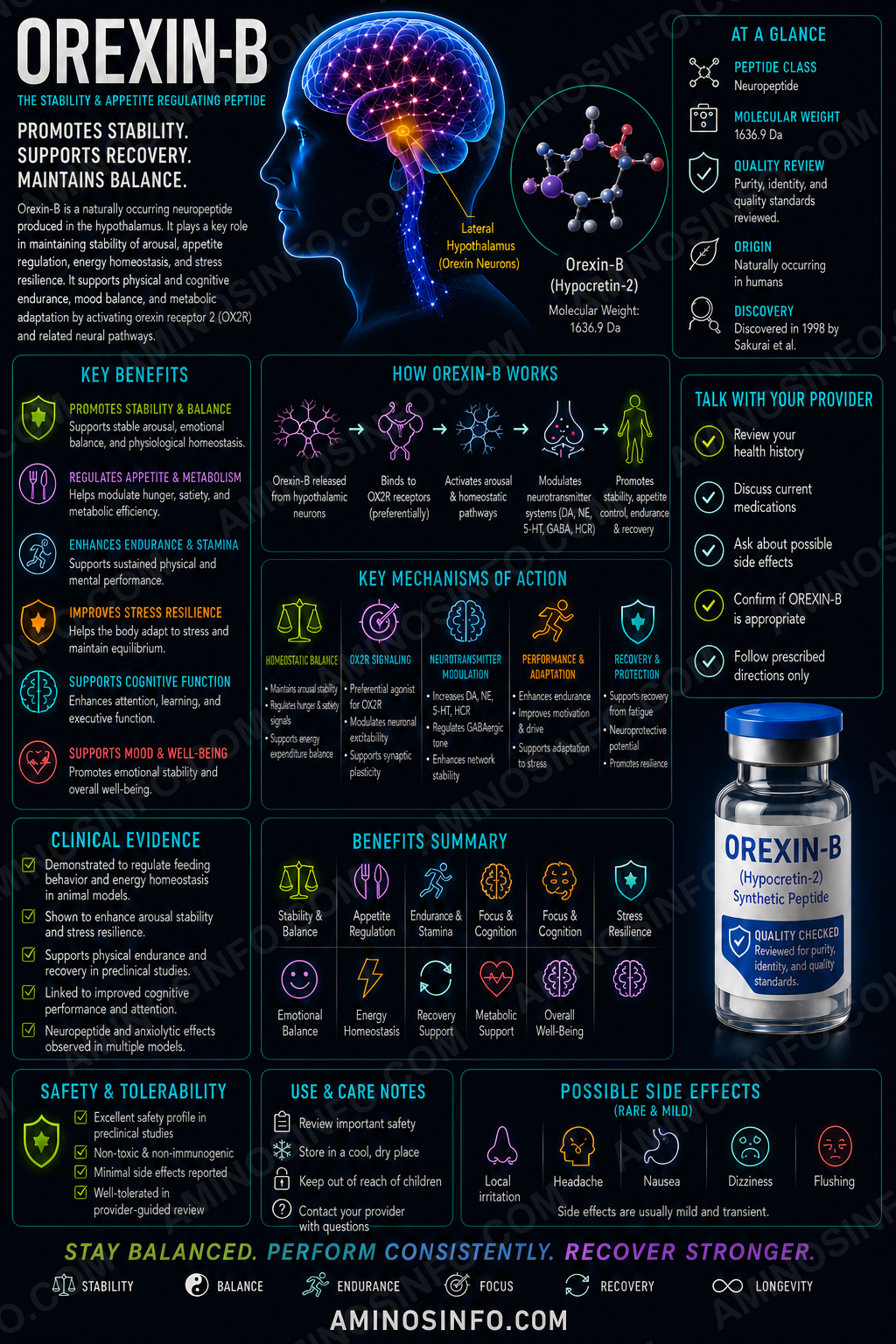
Orexin-B, also called Hypocretin-2, is a naturally occurring 28-amino-acid, C-terminally amidated neuropeptide produced from the prepro-orexin precursor. It is synthesized by a relatively small population of neurons concentrated in the lateral hypothalamic, perifornical, and posterior hypothalamic regions.
Despite their limited number, orexin neurons project widely throughout the brain and spinal cord. They coordinate wakefulness with motivation, energy status, emotional salience, autonomic activity, and environmental demands.
Orexin-B, Hypocretin-2
28 amino acids
Linear, C-terminally amidated
OX2R
Wake-state stability
No
🧬 Molecular Structure
🧪 Human Orexin-B sequence
Arg-Ser-Gly-Pro-Pro-Gly-Leu-Gln-Gly-Arg-Leu-Gln-Arg-Leu-Leu-Gln-Ala-Ser-Gly-Asn-His-Ala-Ala-Gly-Ile-Leu-Thr-Met-NH₂
One-letter notation:
RSGPPGLQGRLQRLLQASGNHAAGILTM-NH₂
Structural characteristics
- 28 amino acids
- Linear peptide
- No intramolecular disulfide bonds
- C-terminal methioninamide
- Two helical regions connected by a short linker in solution studies
- Highly basic and hydrophilic overall, with a hydrophobic C-terminal region
⚛️ Molecular Weight and 🧫 Formula
| Molecular formula | C123H212N44O35S |
|---|---|
| Average molecular weight | Approximately 2,899.4 g/mol |
| Peptide length | 28 amino acids |
| C-terminal modification | Amidated |
| Common CAS number | 205640-91-1 |
| Disulfide bonds | None |
Orexin-B with a free C-terminal carboxyl group is not chemically identical to native amidated Orexin-B and may have altered potency. Oxidation of the C-terminal methionine also creates a distinct impurity.
📅 Discovery Timeline and Research History
1998: Independent discovery
Two research groups independently identified the same hypothalamic peptide system. One named the peptides orexins because of their feeding effects; the other named them hypocretins because of their hypothalamic origin and sequence relationship to secretin-family peptides.
1998: OX1R and OX2R characterized
Orexin-A and Orexin-B were identified as endogenous ligands for two G-protein-coupled receptors.
1999: Human prepro-orexin gene described
The human HCRT gene and precursor organization were characterized.
1999–2000: Narcolepsy link established
Canine OX2R mutations and orexin-neuron loss in human narcolepsy established the orexin system as central to sleep–wake stability.
2000s: Circuit functions expand
Research connected orexin signaling to histamine, norepinephrine, serotonin, acetylcholine, dopamine, feeding, stress, reward, and autonomic control.
2014 onward: Orexin antagonists enter insomnia care
Dual orexin receptor antagonists validated the system as a therapeutic target for reducing wake drive.
2020s: OX2R agonist development accelerates
Intravenous and oral OX2R-selective agonists demonstrated wake-promoting and anticataplectic effects in narcolepsy studies.
2023: TAK-994 phase 2 results
An oral OX2R agonist improved sleepiness and cataplexy but development was limited by hepatotoxicity.
2025–2026: New oral agonists advance
Oveporexton, ALKS 2680, cleminorexton, E2086, and other OX2R agonists entered advanced clinical-development programs. These are synthetic receptor agonists, not native Orexin-B.
Prepro-Orexin Processing and Neuron Distribution
Prepro-orexin precursor
The human HCRT gene encodes a precursor protein of approximately 131 amino acids. Proteolytic processing produces Orexin-A and Orexin-B.
Orexin-A
Orexin-A is a 33-amino-acid peptide with an N-terminal pyroglutamate, C-terminal amidation, and two intramolecular disulfide bonds.
Orexin-B
Orexin-B is a simpler 28-amino-acid linear amidated peptide.
Neuron location
Orexin neurons are concentrated in the lateral hypothalamus, perifornical region, and posterior hypothalamus.
Projection targets
- Tuberomammillary nucleus
- Locus coeruleus
- Dorsal raphe
- Basal forebrain
- Ventral tegmental area
- Paraventricular hypothalamus
- Brainstem autonomic nuclei
- Spinal cord
🧠 Mechanism of Action
OX1R
OX1R has high affinity for Orexin-A and substantially lower potency for Orexin-B. It couples mainly to Gq/11, although signaling can vary by cell type.
OX2R
OX2R binds Orexin-A and Orexin-B with similarly high affinity and can couple to Gq/11, Gi/o, and other pathways depending on the cellular environment.
Excitatory cellular effects
Orexin receptor activation can increase intracellular calcium, close potassium channels, activate sodium/calcium exchange, and increase neuronal firing.
State-dependent signaling
The effect depends on receptor subtype, brain region, circadian phase, metabolic state, and concurrent neurotransmitter input.
🎯 Receptor and Pathway Profile
| Target or pathway | Orexin-B relationship |
|---|---|
| OX2R / HCRTR2 | High-affinity primary receptor; central to wake stability and cataplexy control. |
| OX1R / HCRTR1 | Lower-potency activation than Orexin-A; relevant in selected reward and arousal circuits. |
| Gq/11 | Activates phospholipase C and intracellular calcium signaling. |
| Gi/o | Particularly relevant to OX2R in selected cells. |
| ERK/MAPK | Cellular activation, plasticity, and transcriptional signaling. |
| Histamine neurons | Major OX2R-rich wake-promoting target in the tuberomammillary nucleus. |
| Monoamine and cholinergic systems | Indirectly coordinates norepinephrine, serotonin, dopamine, and acetylcholine signaling. |
Wakefulness and Sleep-State Stability
Sustained wakefulness
Orexin neurons are most active during active wakefulness and especially during motivated behavior.
State stabilization
The orexin system prevents abrupt transitions between wake, non-REM sleep, and REM sleep. Its key role is stability rather than simply total wake time.
OX2R importance
Genetic and pharmacological evidence indicates that OX2R is especially important for maintaining wakefulness. OX1R contributes to arousal, stress, and motivation but cannot fully compensate for OX2R loss.
Histaminergic activation
OX2R activation in the tuberomammillary nucleus excites histamine neurons, which strongly promote wakefulness.
Regional circuit differences
Recent animal research suggests OX2R signaling in the tuberomammillary nucleus and basal forebrain stabilizes wakefulness, while signaling in ventrolateral periaqueductal and related regions suppresses cataplexy-like episodes.
Narcolepsy and Hypersomnolence Research
Narcolepsy type 1
Narcolepsy type 1 is characterized by severe loss of orexin-producing neurons, low cerebrospinal-fluid Orexin-A, excessive daytime sleepiness, REM-sleep instability, and cataplexy.
Peptide deficiency versus receptor loss
In most human narcolepsy type 1, receptors remain present while endogenous orexin input is lost. This creates a strong rationale for receptor agonist replacement.
Why native Orexin-B is difficult therapeutically
- Rapid peptide degradation
- Poor oral bioavailability
- Limited blood–brain barrier penetration
- Short duration
- Potential need for invasive delivery
OX2R agonist proof of concept
Danavorexton, an intravenous OX2R-selective agonist, increased wakefulness in narcolepsy studies. Oral TAK-994 improved sleepiness and cataplexy but produced liver-toxicity concerns.
Current direction
Modern programs aim to create orally available, brain-penetrant OX2R agonists with durable wake-promoting effects and acceptable liver safety.
Arousal, Attention, and Neurotransmitter Systems
Norepinephrine
Orexin excites locus coeruleus neurons, supporting vigilance, attention, and sympathetic readiness.
Histamine
Strong OX2R-mediated activation of histaminergic neurons promotes wakefulness and cortical activation.
Serotonin
Orexin projections to the dorsal raphe influence behavioral state, mood, and stress-related activity.
Acetylcholine
Basal-forebrain and brainstem cholinergic systems help produce cortical activation and REM-related physiology.
Dopamine
Orexin input to the ventral tegmental area influences motivation, reward prediction, salience, and goal-directed behavior.
Cognitive claims require caution
Greater wakefulness may improve performance in sleepy individuals, but it does not automatically improve memory, judgment, or cognition in rested healthy people.
Motivation, Reward, and Addiction Biology
Reward-linked orexin neurons
Lateral hypothalamic orexin neurons are strongly linked to reward seeking and conditioned motivation.
Ventral tegmental area
Orexin receptor signaling can increase excitability and plasticity in dopamine neurons.
Drug-seeking models
Orexin antagonists reduce reinstatement and seeking behavior in selected cocaine, opioid, alcohol, and nicotine models.
OX1R versus OX2R
OX1R is often more prominent in cue-driven reward and stress-related drug seeking, while OX2R contributes to arousal and selected reinforcement processes.
Potential overactivation risk
Enhancing orexin signaling could theoretically increase compulsive reward seeking or stress-driven behavior in susceptible contexts.
Feeding, Energy Balance, and Metabolism
Original feeding discovery
Central orexin administration increased food intake in early rodent experiments, leading to the name “orexin,” derived from the Greek word for appetite.
Energy expenditure
Orexin signaling also increases spontaneous activity, sympathetic tone, and energy expenditure. Therefore, orexin activity cannot be described simply as appetite stimulation.
Glucose sensing
Orexin neurons respond to glucose, amino acids, ghrelin, leptin, and other metabolic signals.
Brown adipose tissue
Orexin circuits influence thermogenesis and brown-adipose activity through sympathetic pathways.
Body-weight complexity
Orexin deficiency can be associated with obesity despite reduced food intake because physical activity and energy expenditure fall.
No established metabolic therapy
Native Orexin-B is not an approved treatment for obesity, diabetes, fatigue, or metabolic disease.
Stress, Cardiovascular, and Autonomic Signaling
Sympathetic activation
Orexin signaling can increase sympathetic nerve activity, heart rate, blood pressure, respiration, and thermogenesis.
Stress integration
Orexin neurons receive input related to threat, arousal, emotion, and metabolic need, helping coordinate behavioral and physiological readiness.
Hypothalamic–pituitary–adrenal axis
Orexin can influence corticotropin-releasing pathways and stress-hormone responses.
Cardiovascular effects
Effects depend on brain region and route. Central orexin signaling often raises blood pressure and sympathetic activity, while peripheral receptor biology may differ.
Hyperarousal concern
Excessive activation could contribute to insomnia, anxiety, palpitations, hypertension, or impaired recovery from stress.
Orexin Agonists and Antagonists
Antagonists for insomnia
Dual orexin receptor antagonists reduce wake drive and are approved for insomnia. Examples include suvorexant, lemborexant, and daridorexant.
OX2R agonists for narcolepsy
Selective OX2R agonists aim to replace the missing orexin wake signal in narcolepsy type 1.
Danavorexton
An intravenous OX2R agonist that produced marked wake-promoting effects in early human studies.
TAK-994
An oral OX2R agonist that improved sleepiness and cataplexy in phase 2 but was associated with hepatotoxicity.
Oveporexton and newer compounds
Newer oral agents have been developed with the goal of maintaining wake efficacy while avoiding liver toxicity.
2026 development landscape
Advanced programs include oveporexton, ALKS 2680, cleminorexton, E2086, and other OX2R-selective compounds in narcolepsy and central hypersomnolence trials.
Native peptide versus drug analogue
Clinical success of a synthetic OX2R agonist would validate the receptor target, not the safety or practicality of unapproved native Orexin-B products.
Evidence Limitations and Clinical Interpretation
Native Orexin-B is mainly a research reagent
Most mechanistic studies use intracerebroventricular application, brain slices, cultured cells, or direct regional administration.
Route strongly affects results
Central injection bypasses the blood–brain barrier and cannot be equated with nasal, oral, subcutaneous, or intravenous use.
Orexin-A and Orexin-B are often studied together
Many reviews describe the overall orexin system, making it easy to overattribute system-wide findings specifically to Orexin-B.
Receptor selectivity is relative
Orexin-B’s preference for OX2R does not make it a perfectly selective pharmacological probe.
Wakefulness is not identical to cognition
Improved alertness in narcolepsy does not establish enhancement in rested healthy individuals.
Drug-development evidence is compound specific
Results with TAK-994, danavorexton, oveporexton, or ALKS 2680 cannot be used to claim that native Orexin-B has the same pharmacokinetics or safety.
Safety and Regulatory Considerations
No standardized human safety profile
No approved label defines dose, route, contraindications, interactions, pregnancy safety, or chronic adverse effects for Orexin-B.
Expected pharmacological risks
- Insomnia and sleep fragmentation
- Hyperarousal, agitation, or anxiety
- Increased heart rate or blood pressure
- Sympathetic overactivation
- Thermoregulatory changes
- Altered feeding or reward behavior
Peptide-delivery limitations
Native Orexin-B is rapidly degraded and has limited access to the brain after peripheral administration.
Drug-class liver warning
Hepatotoxicity observed with TAK-994 does not prove that OX2R activation itself is hepatotoxic, but it demonstrates that individual agonists require extensive off-target and liver-safety evaluation.
Product-quality risk
Unapproved material may contain nonamidated peptide, deletion sequences, oxidized methionine, incorrect sequence variants, endotoxin, or inaccurate content.
Regulatory status
Orexin-B itself is not FDA approved.
🧪 Laboratory Testing Methods
| Method | Purpose | Important limitation |
|---|---|---|
| RP-HPLC / UPLC | Separates Orexin-B from deletion peptides, nonamidated material, oxidation products, and aggregates. | Area purity does not establish identity or content. |
| LC-HRMS | Confirms intact molecular mass and elemental composition. | Sequence isomers may share mass. |
| MS/MS sequencing | Confirms all 28 residues and the C-terminal methioninamide. | Highly basic peptides may require optimized fragmentation. |
| Peptide mapping | Provides orthogonal sequence and modification confirmation. | Requires a suitable cleavage strategy. |
| NMR spectroscopy | Evaluates helical structure, conformation, and aggregation. | Requires high-purity material at sufficient concentration. |
| C-terminal amidation assay | Distinguishes native amidated Orexin-B from free-acid peptide. | Requires targeted MS or reference standards. |
| Methionine-oxidation assay | Detects methionine sulfoxide and related degradants. | Oxidation can occur during sample handling. |
| Net peptide-content assay | Measures actual Orexin-B amount. | Must correct for water, counterions, and residual solvents. |
| OX2R functional assay | Measures calcium flux, β-arrestin, or second-messenger activity. | Cell background and receptor density affect potency. |
| OX1R counter-screen | Measures relative receptor preference. | Orexin-B is not absolutely OX2R specific. |
| Protease and plasma stability | Measures degradation and metabolite formation. | Does not by itself predict brain exposure. |
| Brain/plasma pharmacokinetics | Measures systemic exposure and CNS penetration. | Native peptide human data are limited. |
| Microbial limits, sterility, and endotoxin | Evaluate route-specific microbiological quality. | Requirements depend on final dosage form. |
| Stability-indicating assay | Tracks oxidation, deamidation, hydrolysis, aggregation, and potency. | Requires defined formulation and storage conditions. |
📄 How to Interpret an Orexin-B COA
- Verify the complete 28-amino-acid sequence: RSGPPGLQGRLQRLLQASGNHAAGILTM.
- Confirm C-terminal amidation: The native peptide ends in Met-NH₂.
- Confirm formula and molecular weight: C₁₂₃H₂₁₂N₄₄O₃₅S and approximately 2,899.4 g/mol.
- Use MS/MS or peptide mapping: HPLC and intact mass alone cannot prove sequence.
- Review methionine oxidation: The C-terminal methionine is a key stability liability.
- Review deletion and truncation impurities: Long synthetic peptides can contain closely related sequences.
- Measure net peptide content: Purity percentage is not the labeled milligram amount.
- Review receptor potency: An OX2R assay and OX1R counter-screen can help confirm functional identity.
- Match microbiological testing to route: Injectable or intranasal finished products require route-specific testing.
- Do not infer efficacy: A COA cannot prove wakefulness, narcolepsy treatment, cognition, brain penetration, or safety.
📊 Orexin-B vs Orexin-A
| Feature | Orexin-B | Orexin-A |
|---|---|---|
| Length | 28 amino acids | 33 amino acids |
| Structure | Linear, amidated | Pyroglutamyl, amidated, two disulfide bonds |
| OX1R activity | Lower potency | High affinity |
| OX2R activity | High affinity | High affinity |
| Main experimental emphasis | OX2R-linked wake stability | Broader orexin-system signaling |
| FDA approved? | No | No |
Orexin-B vs OX2R Agonists
| Feature | Native Orexin-B | Synthetic OX2R agonists |
|---|---|---|
| Type | 28-amino-acid endogenous peptide | Engineered peptide or small molecule |
| Oral bioavailability | Poor | Designed to be oral in newer programs |
| Brain penetration | Limited after peripheral delivery | Engineered for CNS exposure |
| Duration | Short | Optimized |
| Clinical evidence | No approved therapeutic use | Multiple active clinical programs |
Orexin Agonists vs Antagonists
| Class | Effect | Main therapeutic goal |
|---|---|---|
| OX2R agonist | Restores wake drive | Narcolepsy and hypersomnolence |
| Dual orexin receptor antagonist | Reduces orexin wake signaling | Insomnia |
| OX1R antagonist | Reduces selected reward and stress signaling | Investigational addiction/anxiety applications |
| Native Orexin-B | Predominantly activates OX2R | Laboratory research |
Orexin-B vs Modafinil vs Solriamfetol vs Pitolisant
| Compound | Main mechanism | Clinical status |
|---|---|---|
| Orexin-B | Endogenous OX2R-preferring agonist | Research peptide |
| Modafinil | Wake-promoting mechanism involving dopamine transport and broader systems | FDA approved for selected sleepiness disorders |
| Solriamfetol | Dopamine/norepinephrine reuptake inhibition | FDA approved |
| Pitolisant | Histamine H3 inverse agonist/antagonist | FDA approved for narcolepsy |
🔗 Related Peptides, Receptors, and Drugs
- Orexin-A: Companion peptide derived from the same precursor.
- OX1R/HCRTR1: Orexin-A-preferring receptor involved in arousal, reward, and stress.
- OX2R/HCRTR2: High-affinity receptor for both orexins and major wake-stability target.
- Danavorexton: Intravenous OX2R-selective agonist.
- TAK-994: Oral OX2R agonist with efficacy and hepatotoxicity findings.
- Oveporexton: Newer oral OX2R-selective agonist.
- ALKS 2680: Oral OX2R agonist in advanced clinical research.
- Suvorexant, lemborexant, daridorexant: Approved dual orexin receptor antagonists for insomnia.
🖼️ Original Diagram Specifications
Diagram 1: Orexin-B molecular structure
Show the full 28-residue linear peptide with C-terminal Met-NH₂, highlighting basic and hydrophobic regions and the absence of disulfide bonds.
Diagram 2: Prepro-orexin processing
Show the HCRT gene, prepro-orexin precursor, proteolytic cleavage, Orexin-A, and Orexin-B.
Diagram 3: Receptor selectivity
Show Orexin-A activating OX1R and OX2R strongly, while Orexin-B activates OX2R strongly and OX1R more weakly.
Diagram 4: Wakefulness circuit
Show orexin neurons projecting to histamine, norepinephrine, serotonin, dopamine, and acetylcholine systems.
Diagram 5: Narcolepsy mechanism
Show orexin-neuron loss, unstable wake/REM boundaries, daytime sleepiness, cataplexy, and OX2R agonist replacement.
Diagram 6: Agonist–antagonist therapeutic map
Show OX2R agonism promoting wakefulness and dual receptor antagonism promoting sleep.
Diagram 7: COA workflow
Show full sequence, amidation, HRMS, MS/MS, methionine oxidation, net content, OX2R potency, OX1R counter-screen, microbiology, and stability.
❓ Frequently Asked Questions
Is Orexin-B a peptide?
Yes. It is a naturally occurring 28-amino-acid neuropeptide.
What is its exact sequence?
RSGPPGLQGRLQRLLQASGNHAAGILTM-NH₂.
What is its molecular formula?
C₁₂₃H₂₁₂N₄₄O₃₅S.
What is its molecular weight?
Approximately 2,899.4 g/mol.
Is Orexin-B amidated?
Yes. Its C-terminal methionine is amidated.
Is Orexin-B selective for OX2R?
It strongly prefers OX2R but can activate OX1R at lower potency.
Is Orexin-B FDA approved?
No.
Does Orexin-B promote wakefulness?
Yes in experimental systems, especially through OX2R-rich wake circuits.
Does it treat narcolepsy?
Native Orexin-B is not an approved treatment. Synthetic OX2R agonists are being developed for narcolepsy.
Does Orexin-B cross the blood–brain barrier?
Peripheral brain penetration is limited, which is one reason newer small-molecule agonists are being developed.
Does it increase cognition?
It may improve vigilance when sleepiness is caused by orexin deficiency, but no evidence establishes cognitive enhancement in healthy rested people.
Does it cause insomnia?
Excessive or mistimed orexin signaling could theoretically produce insomnia and hyperarousal.
What is the difference between Orexin-B and Orexin-A?
Orexin-B is linear and OX2R-preferring. Orexin-A is disulfide-stabilized and strongly activates both receptors.
Does 99% HPLC purity prove Orexin-B identity?
No. Sequence, amidation, exact mass, methionine oxidation, net content, and receptor activity require separate confirmation.
Final Thoughts
Orexin-B is a well-defined endogenous 28-amino-acid neuropeptide that helps stabilize wakefulness and coordinate arousal with motivation, energy balance, reward, and autonomic readiness. Its strongest receptor activity is at OX2R, but it is not completely inactive at OX1R.
The biology of Orexin-B helped establish OX2R as one of the most promising targets in modern sleep medicine. However, native Orexin-B is poorly suited as a conventional drug because it is rapidly degraded, not orally bioavailable, and has limited peripheral access to the brain. Current clinical programs therefore use engineered OX2R agonists rather than the native peptide.
Legitimate Orexin-B material should be verified for the complete 28-residue sequence, C-terminal amidation, exact mass, methionine oxidation, truncation impurities, net peptide content, OX2R potency, OX1R counter-screening, route-specific microbiological quality, and stability.
📚 References
- Sakurai T, et al. Orexins and orexin receptors: a family of hypothalamic neuropeptides and G protein-coupled receptors that regulate feeding behavior. Cell. 1998.
- de Lecea L, et al. The hypocretins: hypothalamus-specific peptides with neuroexcitatory activity. Proceedings of the National Academy of Sciences. 1998.
- Sakurai T, et al. Structure and function of human prepro-orexin gene. 1999.
- UniProt. Human hypocretin neuropeptide precursor.
- PubChem. Orexin-B compound record.
- RCSB Protein Data Bank. Solution structure of human hypocretin-2/Orexin-B.
- Soya S, Sakurai T. Evolution of the Orexin Neuropeptide System: Structure and Function. 2020.
- Tsujino N, Sakurai T. Role of orexin in modulating arousal, feeding, and motivation. 2013.
- Scammell TE, Winrow CJ. Orexin receptors: pharmacology and therapeutic opportunities. 2011.
- Wang C, et al. The orexin/receptor system: molecular mechanism and therapeutic potential. 2018.
- Chatterjee O, et al. A molecular network map of orexin–orexin receptor signaling. 2022.
- Chow M, et al. The hypocretin/orexin system in sleep disorders. 2016.
- Nixon JP, et al. Sleep disorders, obesity, and aging: the role of orexin. 2015.
- Núñez A, et al. Hypocretin/Orexin neuropeptides and control of sleep–wake states. 2009.
- Thompson MD, et al. Orexin receptor multimerization and functional interactions. 2017.
- International Union of Basic and Clinical Pharmacology. Orexin receptor function, nomenclature, and pharmacology. Pharmacological Reviews. 2012.
- Lin L, et al. The sleep disorder canine narcolepsy is caused by a mutation in the hypocretin receptor 2 gene. Cell. 1999.
- Chemelli RM, et al. Narcolepsy in orexin knockout mice. Cell. 1999.
- Peyron C, et al. A mutation in a case of early-onset narcolepsy and generalized absence of hypocretin peptides in human narcoleptic brains. Nature Medicine. 2000.
- Thannickal TC, et al. Reduced number of hypocretin neurons in human narcolepsy. Neuron. 2000.
- Mignot E. Genetic and familial aspects of narcolepsy. Neurology.
- Scammell TE. Narcolepsy. New England Journal of Medicine.
- Saper CB, Fuller PM. Wake–sleep circuitry. Current Opinion in Neurobiology.
- Sakurai T. The neural circuit of orexin/hypocretin: maintaining sleep and wakefulness. Nature Reviews Neuroscience.
- Yamanaka A, et al. Hypothalamic orexin neurons regulate arousal according to energy balance in mice. Neuron.
- Adamantidis AR, et al. Neural substrates of awakening probed with optogenetic control of hypocretin neurons. Nature.
- Carter ME, et al. Tuning arousal with optogenetic modulation of locus coeruleus neurons. Nature Neuroscience.
- Ishikawa T, et al. An orexin agonist promotes wakefulness and inhibits cataplexy through distinct brain regions. 2025.
- Evans R, et al. Danavorexton, an OX2R-selective agonist, improves narcolepsy symptoms. 2022.
- Dauvilliers Y, et al. Oral Orexin Receptor 2 Agonist in Narcolepsy Type 1. New England Journal of Medicine. 2023.
- Lammers GJ, et al. Effects of oveporexton on cognition in narcolepsy type 1. 2025.
- Arif Z, et al. Orexin receptor 2 agonists: a pathophysiologic approach to narcolepsy. 2025.
- Saitoh T, et al. The present and future of synthetic orexin receptor agonists. 2023.
- ClinicalTrials.gov. TAK-861 in narcolepsy type 1.
- ClinicalTrials.gov. ALKS 2680 phase 3 study in narcolepsy type 1.
- ClinicalTrials.gov. ALKS 2680 phase 3 study in narcolepsy type 2.
- ClinicalTrials.gov. Cleminorexton in central hypersomnolence disorders.
- ClinicalTrials.gov. E2086 in adults with narcolepsy.
- Mahler SV, et al. Motivational activation: a unifying hypothesis of orexin/hypocretin function. Nature Neuroscience.
- Aston-Jones G, et al. Lateral hypothalamic orexin neurons: a role in reward seeking and addiction. Brain Research.
- James MH, et al. Orexin/hypocretin regulation of addiction. British Journal of Pharmacology.
- Harris GC, Aston-Jones G. Arousal and reward: a dichotomy in orexin function. Trends in Neurosciences.
- Willie JT, et al. Distinct narcolepsy syndromes in orexin receptor-2 and orexin null mice. Neuron.
- Mieda M, et al. Differential roles of orexin receptor-1 and -2 in sleep/wake regulation. Journal of Neuroscience.
- Mochizuki T, et al. Behavioral-state instability in orexin knockout mice. Journal of Neuroscience.
- España RA, Scammell TE. Sleep neurobiology from a clinical perspective. Sleep.
- Boss C, Roch C. Orexin receptor antagonists and sleep promotion. Expert Opinion on Therapeutic Patents.
- Coleman PJ, et al. The discovery of suvorexant. Journal of Medicinal Chemistry.
- Rosenberg R, et al. Daridorexant in insomnia disorder. Lancet Neurology.
- International Council for Harmonisation. ICH Q2(R2): Validation of Analytical Procedures.
- International Council for Harmonisation. ICH Q3A and Q3B: Impurities in New Drug Substances and Products.
- International Council for Harmonisation. ICH Q3C: Residual Solvents.
- International Council for Harmonisation. ICH Q1A(R2): Stability Testing of New Drug Substances and Products.
- International Council for Harmonisation. ICH M10: Bioanalytical Method Validation.
- United States Pharmacopeia General Chapter <621>: Chromatography.
- United States Pharmacopeia General Chapter <71>: Sterility Tests.
- United States Pharmacopeia General Chapter <85>: Bacterial Endotoxins Test.
- United States Pharmacopeia General Chapters <232> and <233>: Elemental Impurities.
Identity, structure, receptor pharmacology, wakefulness, narcolepsy, reward, metabolism, autonomic signaling, therapeutic development, safety, and analytical evidence were reviewed in July 2026. Native Orexin-B remains an unapproved research peptide.