HNG ([Gly14]-Humanin / S14G-Humanin): What It Is, How It Works, Benefits, and Research Overview
A detailed, evidence-graded review of HNG, including its 24-amino-acid S14G Humanin sequence, mitochondrial-derived-peptide origins, anti-apoptotic protein interactions, extracellular receptor signaling, neuroprotection, glucose and lipid metabolism, cardiovascular models, aging biology, cancer concerns, safety, analytical testing, and COA interpretation.
What Is HNG?
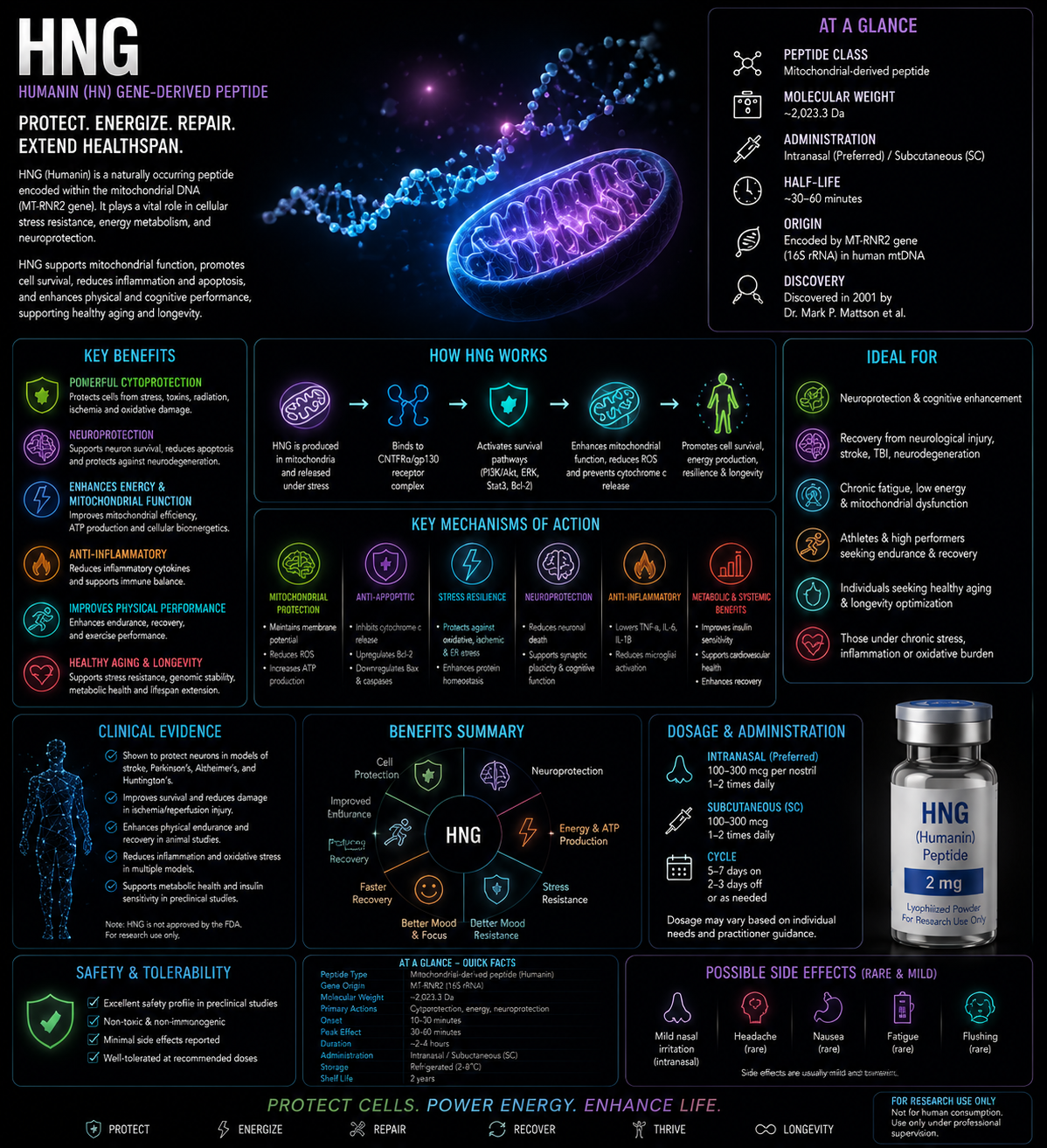
HNG is a synthetic analogue of the mitochondrial-derived peptide Humanin. It is also called [Gly14]-Humanin, S14G-Humanin, HN-S14G, or Humanin-G.
The defining change is replacement of serine at position 14 of the canonical 24-amino-acid Humanin sequence with glycine. This single substitution increases cytoprotective potency in several assays, although the often-repeated “1,000-fold more potent” statement is assay dependent.
Humanin
Ser14 → Gly
24 amino acids
≈2,657.2 g/mol
No
🧬 Structure and Sequence
Humanin
MAPRGFSCLLLLTSEIDLPVKRRA
HNG
MAPRGFSCLLLLTGEIDLPVKRRA
The only sequence change is Humanin Ser14 → HNG Gly14.
| Calculated molecular formula | C118H202N34O31S2 |
|---|---|
| Calculated average molecular weight | Approximately 2,657.2 g/mol |
| Length | 24 amino acids |
| N-terminus | Free methionine unless otherwise specified |
| C-terminus | Free alanine carboxyl group unless otherwise specified |
📅 Discovery Timeline
2001: Humanin was identified as a neuronal survival factor against familial Alzheimer’s-related insults. 2001–2002: S14G-Humanin was developed as a more potent analogue. 2005: HNG protected against amyloid-related memory impairment in mice. 2009: Humanin-family signaling was linked to insulin sensitivity. 2010: acute HNG reduced myocardial ischemia–reperfusion injury in mice. 2011: S14G-Humanin reduced amyloid accumulation partly through neprilysin. 2016 onward: aging, metabolism, mitochondrial, cardiac, and cancer studies expanded.
Mitochondrial Origin
The Humanin open reading frame lies within the mitochondrial 16S rRNA gene, MT-RNR2. Translation biology is complex because mitochondrial and cytosolic genetic codes differ, and nuclear Humanin-like sequences may also contribute related peptides. Experimental HNG itself is a chemically synthesized S14G analogue.
🧠 Mechanism of Action
| Target or pathway | Research role |
|---|---|
| BAX | Limits mitochondrial outer-membrane permeabilization and apoptosis. |
| tBID | Reduces pro-apoptotic mitochondrial signaling. |
| IGFBP-3 | Links Humanin to IGF, metabolism, and survival signaling. |
| FPR2/FPRL1 | Cell-surface GPCR implicated in survival and inflammatory signaling. |
| CNTFRα–WSX-1–gp130 | Tripartite receptor complex linked to STAT3 activation. |
| PI3K/AKT, AMPK, eNOS | Metabolic, endothelial, and cardiovascular pathways. |
Anti-Apoptotic and Mitochondrial Research
HNG reduces apoptosis in neuronal, cardiac, endothelial, pancreatic, renal, and other experimental cell models. Reported effects include lower reactive oxygen species, preserved mitochondrial membrane potential and respiration, and reduced cytochrome-c/caspase signaling.
Neuroprotection and Alzheimer’s Models
Humanin was originally identified for protection against amyloid-related neuronal death. HNG protected against amyloid- and scopolamine-associated memory impairment in mice and reduced amyloid burden in transgenic models, partly through increased neprilysin. HNG also improved insulin and autophagy-related pathways in APP/PS1 mice. No controlled human dementia trial has established efficacy.
Metabolic Research
Rodent studies report improved peripheral insulin sensitivity, glucose-stimulated insulin secretion, visceral-fat reduction, body-composition improvements, and regulation of hepatic triglyceride secretion. These findings do not establish treatment of diabetes, obesity, fatty liver disease, or dyslipidemia in humans.
Cardiovascular Research
HNG reduced infarct size and improved function in mouse ischemia–reperfusion models, with AMPK/eNOS activation and reduced mitochondrial dysfunction. A porcine study found infarct reduction under one ischemia duration, but efficacy disappeared when ischemia was prolonged. Recent mouse studies report reduced remodeling in heart failure and diabetic cardiomyopathy.
Aging and Healthspan Research
Endogenous Humanin levels have been reported to decline with age and to correlate with longevity-associated phenotypes in some species and human cohorts. HNG improved metabolic-aging markers in middle-aged mice. These associations do not prove human lifespan extension.
Kidney and Diabetic-Complication Research
S14G-Humanin reduced renal injury, oxidative stress, inflammatory markers, and abnormal kidney measures in diabetic rodents. Recent studies also report endothelial protection under high-glucose stress.
Cancer and Cell-Survival Concerns
Because HNG activates anti-apoptotic, IGF-related, STAT3, and PI3K/AKT pathways, cancer safety is a major concern. Experimental Humanin signaling promoted triple-negative breast-tumor progression and may protect malignant cells from treatment-related stress. HNG has not undergone adequate carcinogenicity or oncology-interaction testing.
Evidence Limitations
- Most evidence is preclinical.
- Human studies generally measure endogenous Humanin rather than administer HNG.
- Potency claims are assay specific.
- Many studies use pretreatment before injury.
- Large-animal efficacy has varied with injury severity.
- Cell-survival signaling can be beneficial or harmful depending on context.
Safety and Regulatory Considerations
No standardized human dose, route, contraindication, interaction profile, pregnancy safety data, or long-term toxicology exists. Potential concerns include tumor promotion, altered insulin and lipid biology, cardiovascular interactions, immune effects, and product impurities such as native Humanin, deletion peptides, oxidized methionine/cysteine, aggregates, endotoxin, or inaccurate content.
🧪 Testing Methods
| Method | Purpose |
|---|---|
| RP-HPLC / UPLC | Separates HNG from Humanin, deletion peptides, oxidation products, and aggregates. |
| LC-HRMS | Confirms intact mass and formula. |
| MS/MS sequencing | Confirms all 24 residues and Gly14. |
| Peptide mapping | Provides orthogonal S14G confirmation. |
| Chiral analysis | Confirms L-amino-acid stereochemistry. |
| Net peptide-content assay | Measures actual HNG amount. |
| Oxidation assays | Quantify Met1 and Cys8 oxidation, dimers, and disulfides. |
| Aggregation analysis | Measures oligomers and insoluble particles. |
| BAX/tBID, FPR2, STAT3, and cell-survival assays | Evaluate proposed biological activity. |
| Sterility, endotoxin, microbial, and stability testing | Route-specific product-quality evaluation. |
📄 COA Interpretation
- Verify sequence MAPRGFSCLLLLTGEIDLPVKRRA.
- Confirm Gly at position 14.
- Confirm C₁₁₈H₂₀₂N₃₄O₃₁S₂ and approximately 2,657.2 g/mol for the unmodified free peptide.
- Verify free termini unless modifications are intentionally specified.
- Use MS/MS or peptide mapping; HPLC and intact mass alone do not prove position 14.
- Quantify native Humanin contamination, methionine/cysteine oxidation, disulfide dimers, and aggregates.
- Measure net peptide content separately from purity.
- Match microbiological testing to route.
- Do not infer neuroprotection, metabolic benefit, cardioprotection, longevity, or cancer safety from a COA.
📊 Comparison Tables
| Feature | HNG | Humanin | MOTS-c | Elamipretide / SS-31 |
|---|---|---|---|---|
| Type | S14G Humanin analogue | Endogenous mitochondrial peptide | Endogenous mitochondrial peptide | Synthetic mitochondria-targeted tetrapeptide |
| Length | 24 aa | 24 aa | 16 aa | 4 residues |
| Main research | Cytoprotection, metabolism, aging | Stress resistance | Metabolic adaptation | Cardiolipin and membrane function |
| FDA approved? | No | No | No | No |
| Feature | HNG | Humanin |
|---|---|---|
| Position 14 | Gly | Ser |
| Sequence | MAPRGFSCLLLLTGEIDLPVKRRA | MAPRGFSCLLLLTSEIDLPVKRRA |
| Potency | Higher in selected assays | Baseline sequence |
| Endogenous? | No | Yes |
🖼️ Original Diagram Specifications
- Humanin-to-HNG sequence alignment highlighting Ser14→Gly.
- Dual intracellular and extracellular mechanism diagram.
- Mitochondrial apoptosis pathway with BAX/tBID inhibition.
- Metabolic signaling across brain, liver, muscle, adipose tissue, and beta cells.
- Cardiac ischemia pathway with timing-dependent HNG effects.
- Benefit–risk balance: normal-cell protection versus malignant-cell protection.
- COA workflow: sequence, S14G, HRMS, MS/MS, oxidation, aggregation, content, microbiology, stability.
❓ Frequently Asked Questions
Is HNG a peptide?
Yes, a synthetic 24-amino-acid Humanin analogue.
What is the exact sequence?
MAPRGFSCLLLLTGEIDLPVKRRA.
What does S14G mean?
Serine 14 is replaced with glycine.
Is HNG FDA approved?
No.
Is it 1,000 times stronger than Humanin?
That magnitude has been reported in selected assays but is not universal.
Does it improve longevity?
No human lifespan-extension evidence exists.
Could it promote cancer?
Humanin-family survival signaling promoted tumor progression in an experimental model, so cancer safety is unresolved.
Does 99% HPLC prove identity?
No. Position-14 sequencing, exact mass, oxidation, aggregation, and content require orthogonal testing.
Final Thoughts
HNG is a well-defined and potent S14G analogue of Humanin. Its research spans neuronal survival, amyloid toxicity, insulin action, adiposity, cardiac injury, heart failure, diabetic complications, inflammation, and aging biology. Its broad cell-survival activity creates a genuine benefit–risk tension because pathways that protect neurons and cardiomyocytes may also protect malignant cells.
📚 References
- Hashimoto Y, et al. Humanin discovery and protection against familial Alzheimer’s-related insults. PNAS. 2001.
- Tajima H, et al. S14G-Humanin prevents amyloid-beta-induced memory impairment. 2005.
- Niikura T, et al. S14G-Humanin reduces amyloid accumulation through neprilysin. 2011.
- Yen K, et al. The emerging role of Humanin in stress resistance. 2013.
- Lee C, et al. Humanin: a harbinger of mitochondrial-derived peptides? 2013.
- Gong Z, et al. Humanin and age-related diseases. 2014.
- Xiao J, et al. Humanin: functional interfaces with IGF-I. 2016.
- Zhu S, et al. Molecular structure and role of Humanin. 2022.
- Coradduzza D, et al. Humanin and its pathophysiological roles in aging. 2023.
- Muzumdar RH, et al. Humanin as a central regulator of insulin action. 2009.
- Muzumdar RH, et al. Acute Humanin therapy attenuates myocardial ischemia–reperfusion injury. 2010.
- Klein LE, et al. Humanin analogue decreases oxidative stress and preserves cardiac mitochondria. 2013.
- Thummasorn S, et al. Humanin cardioprotection and direct mitochondrial protection. 2016–2018.
- Sharp TE, et al. S14G-Humanin in a porcine myocardial ischemia model. 2020.
- Zhao Q, et al. S14G-Humanin in heart failure. 2023.
- Chen X, et al. S14G-Humanin in diabetic cardiomyopathy. 2021.
- Han K, et al. HNG improves insulin signaling and autophagy in APP/PS1 mice. 2018.
- Cobb LJ, et al. Mitochondrial-derived peptides, age, apoptosis, and insulin sensitivity. 2016.
- Yen K, et al. Humanin as a regulator of lifespan and healthspan. 2020.
- Moreno Ayala MA, et al. Humanin promotes experimental triple-negative breast-cancer progression. 2020.
- Guo B, et al. Humanin suppresses apoptosis by interfering with BAX. Nature. 2003.
- Zhai D, et al. Humanin binds BID and blocks BAX/BAK activation.
- Ikonen M, et al. Humanin interaction with IGFBP-3.
- Ying G, et al. Humanin uses FPRL1/FPR2 as a functional receptor.
- Hashimoto Y, et al. Humanin signaling through CNTFRα–WSX-1–gp130.
- Ozgul M, et al. Stability determination of intact Humanin-G by LC-MS/MS. 2023.
- ICH Q2(R2), Q3A/B, Q3C, Q1A(R2), and M10.
- USP <621>, <71>, <85>, <232>, and <233>.
Identity, sequence, molecular properties, apoptosis, receptor signaling, neuroprotection, metabolism, cardiovascular, aging, cancer, safety, and analytical evidence were reviewed in July 2026. HNG remains an unapproved investigational peptide analogue.