
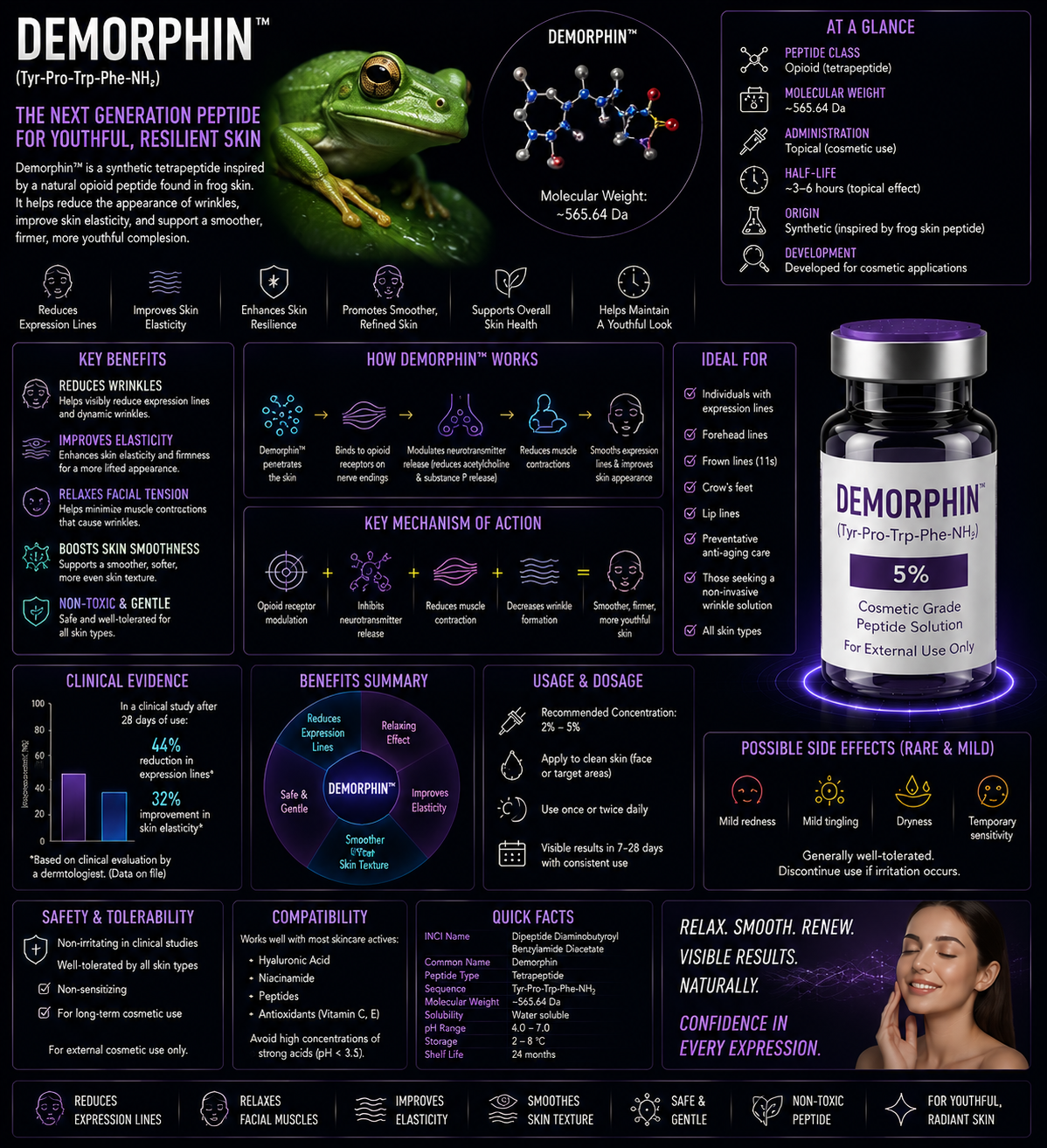
Demorphin: What It Is, How It Works, Benefits, and Research Overview What Is Demorphin? Demorphin refers to a group of naturally occ
Demorphin: What It Is, How It Works, Benefits, and Research Overview
What Is Demorphin?
Demorphin refers to a group of naturally occurring opioid peptides derived from the precursor protein β-casein found in mammalian milk, particularly cow or human milk. These peptides are classified as exorphins, meaning they are externally derived peptides that can bind opioid receptors, mimicking the effects of endogenous opioids like endorphins.
Researchers investigate demorphins for potential roles in:
- Pain modulation and analgesia
- Neurochemical signaling and stress regulation
- Gut-brain axis modulation
- Mood, behavior, and emotional regulation (pubmed.ncbi.nlm.nih.gov)
Important: Demorphins are not FDA approved as a drug. They are largely studied in preclinical and mechanistic research, with some observational work on their effects in neonates, gut physiology, and neurobiology.
What Are Demorphins Made Of?
Demorphins are short opioid peptides, usually 4–7 amino acids in length, generated by enzymatic digestion of β-casein:
- Examples include sequences like Tyr-Pro-Phe-Pro-Gly-Pro-Ile (demorphin-7)
- Smaller fragments such as demorphin-4 also exist
- These peptides retain opioid activity by binding to µ-opioid receptors (pubmed.ncbi.nlm.nih.gov)
Key features:
- Derived from dietary milk proteins
- Exhibit opioid-like activity but weaker than morphine
- Can influence central and peripheral opioid signaling depending on absorption
How Does Demorphin Work?
Demorphin works by interacting with the opioid receptor system, particularly:
1. µ-Opioid Receptor Activation
- Binds to µ-opioid receptors in the central nervous system and gastrointestinal tract
- Modulates pain perception, reward, and stress responses
- Triggers mild analgesic and mood-related signaling (pubmed.ncbi.nlm.nih.gov)
2. Gut-Brain Axis Signaling
- May cross the intestinal epithelium under certain conditions
- Influences enteric nervous system signaling
- Possible role in behavioral modulation and neurodevelopment in neonates
3. Endogenous Opioid Mimicry
- Demorphins mimic natural endorphins
- Can transiently activate opioid pathways, potentially reducing perceived stress or discomfort
Potential Benefits (Investigational)
- Mild Analgesia and Pain Modulation
- Can reduce perception of pain in preclinical models
- Mood and Behavioral Modulation
- Potential role in stress and anxiety regulation
- Neurodevelopment Support
- Studied in neonatal physiology for gut-brain signaling and early behavioral effects
- Gastrointestinal Signaling
- May influence intestinal motility and gut function
- Sleep and Relaxation Effects
- Potential sedative-like properties due to µ-opioid receptor interaction
Administration
- Naturally occurs in milk
- Experimental or supplemental forms are peptides administered in research studies
- Not standardized for clinical use
Side Effects and Safety
Because demorphins remain investigational:
- Effects in humans are largely untested outside of observational or mechanistic studies
- Theoretical risk of opioid-like side effects if absorbed in high quantities
- No standardized dosing or safety profile established
- Likely safe in normal dietary amounts from milk, but concentrated research preparations are experimental (pubmed.ncbi.nlm.nih.gov)
Demorphin vs Other Opioid Peptides
| Peptide | Source | Primary Action | Administration | FDA Approved? |
|---|---|---|---|---|
| Demorphin | β-casein in milk | µ-opioid receptor agonist | Experimental, dietary | No |
| Casomorphin | β-casein | µ-opioid receptor agonist | Experimental, dietary | No |
| Endorphin | Endogenous | Pain modulation | Produced naturally | N/A |
| Enkephalin | Endogenous | Pain and stress signaling | Produced naturally | N/A |
Researchers differentiate demorphins as diet-derived opioid peptides versus endogenous peptides like endorphins and enkephalins.
Frequently Asked Questions
What is demorphin used for?
- Studied for pain modulation, gut-brain signaling, mood regulation, and neonatal neurodevelopment, primarily in research.
Is demorphin an opioid?
- Yes, it is a weak exogenous opioid peptide derived from milk.
Can demorphin get you “high”?
- Unlikely in normal dietary amounts; concentrated or experimental forms may modulate opioid receptors, but effects are mild.
Is demorphin safe?
- Generally safe when consumed in milk or dietary sources; concentrated peptides are investigational.
Final Thoughts
Demorphins are milk-derived opioid peptides that mimic endogenous endorphins and interact with µ-opioid receptors. They are being studied for pain modulation, behavioral and mood effects, gut-brain signaling, and neurodevelopment. While naturally occurring in milk and generally safe in dietary amounts, concentrated forms remain investigational, with limited human data and no clinical approval.
