DSIP (Delta Sleep-Inducing Peptide): What It Is, How It Works, Benefits, and Research Overview
A corrected, evidence-graded review of DSIP, also called emideltide, including its nine-amino-acid sequence, molecular properties, discovery history, unresolved endogenous status, sleep and circadian research, stress, endocrine, pain and withdrawal studies, human insomnia evidence, safety, analytical testing, and COA interpretation.
What Is DSIP?
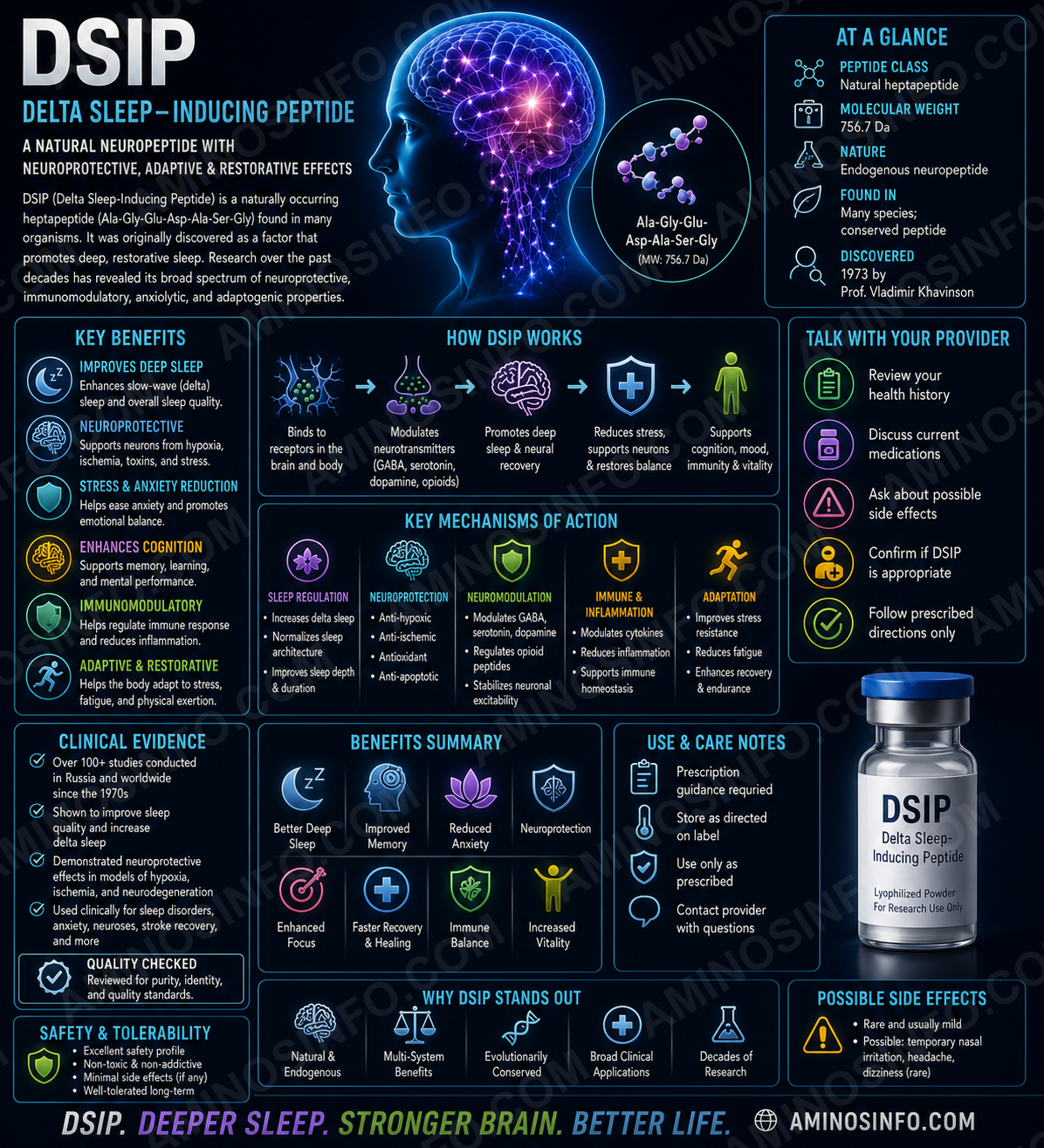
Delta sleep-inducing peptide (DSIP), also known by the international nonproprietary name emideltide, is a synthetic nonapeptide originally isolated from cerebral venous blood collected from rabbits after electrical stimulation of a thalamic region associated with sleep.
It was named for early reports that it increased electroencephalographic delta-wave activity and promoted slow-wave sleep under selected experimental conditions.
Trp-Ala-Gly-Gly-Asp-Ala-Ser-Gly-Glu
WAGGDASGE
9 amino acids
C₃₅H₄₈N₁₀O₁₅
Approximately 848.8 g/mol
No
Researchers have investigated DSIP in relation to sleep initiation, slow-wave sleep, circadian regulation, stress adaptation, thermoregulation, pain thresholds, endocrine signaling, withdrawal, and immune function. These areas remain experimental.
🧬 Molecular Structure
🧪 Complete amino-acid sequence
L-Tryptophyl-L-Alanyl-Glycyl-Glycyl-L-Aspartyl-L-Alanyl-L-Seryl-Glycyl-L-Glutamic Acid
Trp-Ala-Gly-Gly-Asp-Ala-Ser-Gly-Glu
WAGGDASGE
Terminal chemistry
The standard published reference compound is represented as:
H-Trp-Ala-Gly-Gly-Asp-Ala-Ser-Gly-Glu-OH
It has a free N-terminal amino group and free C-terminal glutamic-acid carboxyl group unless a salt or modified analogue is explicitly specified.
Structural characteristics
- Nine standard L-amino acids, with glycine residues achiral
- Linear peptide
- No cysteine residues
- No disulfide bonds
- Three glycine residues, contributing flexibility
- Two acidic residues near the C-terminus
- One N-terminal tryptophan, vulnerable to oxidation
⚛️ Molecular Weight and 🧫 Formula
| Molecular formula | C35H48N10O15 |
|---|---|
| Average molecular weight | Approximately 848.8 g/mol |
| Monoisotopic mass | Approximately 848.3304 Da |
| Common CAS number | 62568-57-4 |
| PubChem CID | 68816 |
| INN | Emideltide |
Conflicting commercial records
Some vendor pages list 15-amino-acid products, incorrect formulas, or different molecular weights under the DSIP name. Those records do not match the classical WAGGDASGE nonapeptide characterized in the sleep literature.
📅 Discovery Timeline and Research History
1970s: Initial isolation
DSIP was isolated from cerebral venous blood of rabbits after electrical stimulation of the intralaminar thalamic region. Early transfer experiments suggested sleep-promoting activity.
Late 1970s–early 1980s: Chemical characterization
The active material was characterized as the nonapeptide Trp-Ala-Gly-Gly-Asp-Ala-Ser-Gly-Glu with a molecular weight near 849 Da.
1984: Major review
A broad review summarized sleep, endocrine, pain, thermoregulatory, cardiovascular, and immune findings across species.
1984–1987: Insomnia studies
Small human studies examined single and repeated injections in chronic insomnia, reporting some improvements but inconsistent methodology and weak statistical robustness.
1988: Sleep-onset mechanism research
Researchers proposed that DSIP may coordinate peripheral physiological changes preparing the organism for sleep rather than acting as a simple hypnotic.
1992: Controlled chronic-insomnia trial
A placebo-controlled study reported higher sleep efficiency and shorter sleep latency, but the authors characterized the effects as weak and potentially influenced by incidental placebo changes.
2006: “Unresolved riddle” review
A review emphasized that DSIP’s endogenous existence, precursor, receptor, and physiological role remained obscure.
Current status
No modern phase 3 program or FDA-approved DSIP medicine exists, and contemporary sleep guidelines do not include it as established insomnia therapy.
Endogenous Existence and Distribution Controversy
Original isolation claim
The peptide was initially purified from rabbit cerebral venous blood, supporting the possibility of endogenous production.
DSIP-like immunoreactivity
Antibody-based studies reported DSIP-like material in brain, pituitary, peripheral tissues, plasma, and milk.
Antibody cross-reactivity
Immunoreactivity does not prove the presence of free WAGGDASGE. Antibodies may recognize related peptides, larger proteins, degradation fragments, or structurally similar sequences.
No confirmed precursor gene
A dedicated human precursor protein that clearly generates classical DSIP has not been established.
No definitive receptor
No cloned receptor has been accepted as the specific DSIP receptor.
Modern analytical need
Definitive proof would require targeted high-resolution mass spectrometry with isotopically labeled standards, sequence confirmation, and careful discrimination from related fragments.
🧠 Proposed Mechanism of Action
1. Sleep-state modulation
DSIP may alter the probability or stability of sleep stages rather than acting as a direct sedative.
2. Circadian dependence
Responses vary with time of day, baseline arousal, prior sleep deprivation, species, and route.
3. Autonomic preparation
Changes in heart rate, blood pressure, temperature, and peripheral physiology may precede observable sleep.
4. Neuroendocrine signaling
DSIP has been linked experimentally to growth hormone, corticotropin, cortisol-related pathways, luteinizing hormone, and other endocrine systems.
5. Neuromodulator interactions
Older research proposed interactions with serotonin, GABA, opioid, adrenergic, and other neurotransmitter systems, but no single mechanism explains all findings.
6. Stress-response modulation
DSIP may affect physiological adaptation to restraint, hypoxia, withdrawal, and other stressors in animal models.
🎯 Receptor and Signaling Profile
| Target or pathway | Evidence status |
|---|---|
| Specific DSIP receptor | Not identified. |
| GABA receptors | Indirect interaction proposed; no validated direct agonist profile. |
| Serotonin pathways | Changes reported in selected models; direct receptor binding not established. |
| Opioid system | Functional interactions proposed in pain and withdrawal studies. |
| Adrenergic system | Possible involvement in autonomic and stress responses. |
| Hypothalamic-pituitary axis | Hormonal changes reported in animal and early human research. |
| Growth hormone | Association with sleep-related GH secretion remains inconsistent. |
| Validated human target-engagement biomarker | None established. |
Sleep and EEG Research
Slow-wave sleep
Early studies reported increased slow-wave or delta sleep in rabbits, rats, mice, and some human experiments.
Species differences
In cats, some studies observed stronger effects on REM sleep rather than delta sleep.
Baseline dependence
DSIP sometimes had greater effects in disturbed, stressed, or sleep-deprived subjects than in healthy sleepers.
Not consistently sedating
Some studies reported improved daytime alertness rather than residual sedation.
Conflicting replication
Other experiments found minor, absent, or variable effects on EEG sleep architecture.
Sleep homeostasis
DSIP may influence recovery sleep or sleep onset under selected conditions rather than causing sleep in a dose-dependent hypnotic manner.
Human Insomnia Studies
Early injection studies
Small studies reported improvements in sleep latency, sleep efficiency, sleep structure, subjective tiredness, or daytime performance after DSIP injections.
Repeated dosing
Some investigators described a gradual normalization of sleep over several administrations.
1992 placebo-controlled study
Objective sleep efficiency increased and sleep latency shortened relative to placebo, but the effects were weak and partly attributable to incidental changes in the placebo group.
Methodological limitations
- Small samples
- Old diagnostic criteria
- Limited allocation and blinding details
- Multiple outcome measures
- Variable timing and dosing
- No modern replication
- No long-term safety evaluation
No established insomnia treatment
Current evidence is insufficient to position DSIP alongside cognitive behavioral therapy for insomnia, orexin antagonists, approved hypnotics, or established circadian treatments.
Circadian and Thermoregulatory Research
Time-of-day effects
DSIP responses may differ when administered in the morning versus evening.
Core temperature
Animal studies reported changes in thermoregulation before or during sleep-related effects.
Sleep–wake transition
Researchers proposed that DSIP may facilitate peripheral readiness for sleep onset rather than acting only within cortical sleep circuits.
Circadian versus hypnotic action
A circadian modulator can produce different effects depending on timing, unlike a conventional sedative that generally suppresses arousal at any time.
No circadian-phase biomarker
DSIP has not been shown to reliably shift dim-light melatonin onset, core-temperature nadir, or circadian phase in modern human studies.
Stress and Autonomic Research
Stress adaptation
Animal studies examined DSIP during restraint, environmental stress, hypoxia, and altered sleep schedules.
Heart rate and blood pressure
Changes in autonomic measures have been reported, though direction and magnitude vary by model.
Hypothalamic-pituitary-adrenal axis
DSIP may alter stress-hormone responses, but consistent human evidence is lacking.
Behavioral stress
Some models reported reduced stress-related behavior or improved recovery.
No proven anxiolytic effect
DSIP has not been established as a treatment for generalized anxiety disorder, panic disorder, PTSD, or depression.
Endocrine and Hormone Research
Growth hormone
Because slow-wave sleep is associated with growth-hormone pulses, investigators examined whether DSIP coordinates sleep-related GH release. Findings were mixed.
ACTH and corticosteroids
Changes in pituitary-adrenal signaling were reported in selected animal studies.
Luteinizing hormone and reproductive signaling
Older literature described possible endocrine effects, but no clinical fertility role has been established.
Prolactin and other hormones
Reports vary by species, stress state, dose, and sampling time.
No endocrine indication
DSIP is not an approved therapy for growth-hormone deficiency, adrenal disease, infertility, thyroid dysfunction, or hypogonadism.
Pain and Analgesia Research
Pain threshold
DSIP increased pain threshold or altered nociceptive responses in selected animal models.
Opioid interaction
Functional interaction with endogenous opioid pathways has been proposed.
Sleep–pain relationship
Improved sleep can reduce pain sensitivity, making it difficult to separate direct analgesia from indirect sleep effects.
No human analgesic evidence
DSIP has not been proven to treat acute pain, neuropathic pain, fibromyalgia, migraine, or postoperative pain.
Alcohol and Opioid-Withdrawal Research
Alcohol withdrawal
Older experimental and regional literature investigated DSIP for sleep disturbance, autonomic activation, craving, and stress during alcohol withdrawal.
Opioid withdrawal
Animal studies examined DSIP-related effects on withdrawal severity and opioid-system adaptation.
Possible mechanisms
- Sleep stabilization
- Stress-axis modulation
- Opioid-system interaction
- Autonomic regulation
- Pain-threshold changes
No detoxification role
DSIP is not an approved treatment for alcohol or opioid withdrawal and should not replace medically supervised withdrawal management, benzodiazepine protocols, buprenorphine, methadone, clonidine, or emergency care.
Immune and Antioxidant Research
Lymphokine and immune findings
Older studies reported effects on immune mediators and lymphocyte-related signaling.
Antioxidant claims
Some preclinical literature proposes reduced oxidative stress or improved resilience under stress.
Indirect effects
Sleep and circadian regulation can influence immunity, so observed immune changes may be secondary.
No immune indication
DSIP is not an established treatment for infection, autoimmune disease, immune deficiency, cancer, or inflammatory disorders.
Pharmacokinetic and Delivery Limitations
Peptide degradation
As a linear nonapeptide, DSIP is susceptible to peptidases in blood, tissues, and mucosal surfaces.
Blood–brain barrier uncertainty
Central effects after peripheral administration have been reported, but reliable human brain penetration has not been established.
Routes studied historically
Research has used intravenous, subcutaneous, intraperitoneal, intracerebral, and other experimental routes.
Intranasal claims
Commercial intranasal use claims are not supported by an approved formulation or modern human pharmacokinetic program.
Unknown human pharmacology
Bioavailability, half-life, clearance, metabolism, active fragments, food effects, and exposure-response relationships remain inadequately characterized.
Evidence Limitations and Clinical Interpretation
Older literature
Most DSIP research predates modern trial reporting, receptor deconvolution, validated bioanalytics, and contemporary sleep scoring standards.
Unresolved endogenous identity
The natural biological role of free WAGGDASGE remains uncertain.
No receptor
Without a validated receptor, potency assays, target-engagement markers, dose selection, and off-target screening are difficult.
Mixed human findings
Some insomnia studies were positive, while others found only minor or weak effects.
Publication bias
Positive early reports may be more visible than negative experiments.
No modern development program
There is no large, independently replicated clinical program demonstrating efficacy and safety.
Safety and Regulatory Considerations
No established human safety profile
No FDA-approved label defines dosage, route, contraindications, interactions, pregnancy safety, or chronic adverse effects.
Potential neurological effects
- Headache
- Dizziness
- Daytime sleepiness or altered alertness
- Vivid dreams or sleep-architecture changes
- Mood or behavioral changes
- Unknown seizure effects
Potential cardiovascular and autonomic effects
- Changes in blood pressure
- Changes in heart rate
- Temperature dysregulation
- Interaction with sedatives or alcohol
Potential endocrine effects
Because early research reported hormonal changes, interactions with endocrine disease or hormone therapy cannot be excluded.
Pregnancy and pediatric use
Safety has not been established.
Product-quality risk
Unapproved products may contain incorrect sequence, oxidized tryptophan, deletion peptides, Asp-related degradants, endotoxin, residual solvents, or inaccurate content.
Regulatory status
DSIP is not FDA approved.
🧪 Laboratory Testing Methods
| Method | Purpose | Important limitation |
|---|---|---|
| RP-HPLC / UPLC | Separates full-length DSIP from deletion peptides, free amino acids, and degradants. | Area purity does not prove identity or net content. |
| LC-HRMS | Confirms intact mass and elemental composition. | Sequence isomers and epimers may share mass. |
| MS/MS sequencing | Confirms WAGGDASGE residue order. | Requires careful interpretation of acidic and glycine-rich fragments. |
| Edman degradation | Orthogonally confirms N-terminal sequence. | Less sensitive for trace impurities. |
| Amino-acid analysis | Confirms composition and supports net-content measurement. | Does not establish sequence order. |
| Chiral amino-acid analysis | Confirms L-amino-acid configuration and detects epimers. | Hydrolysis can introduce artifacts. |
| Tryptophan-oxidation assay | Detects kynurenine, oxindolylalanine, and related oxidative products. | Requires stability-indicating LC-MS. |
| Aspartimide and isoaspartate assay | Detects Asp-related synthesis and storage degradants. | Specialized methods are required. |
| Net peptide-content assay | Measures actual DSIP quantity. | Must correct for water, counterions, and residual solvents. |
| Counterion analysis | Quantifies TFA, acetate, sodium, or other salts. | Does not establish biological activity. |
| Sleep-EEG bioassay | Measures sleep-stage or EEG effects in a research model. | No standardized validated release-potency assay exists. |
| Autonomic and endocrine panel | Evaluates blood pressure, temperature, hormone, and stress responses. | Effects are highly timing- and species-dependent. |
| Broad receptor screen | Tests direct binding to known neurotransmitter and peptide receptors. | A negative panel does not identify the true target. |
| Plasma and protease stability | Measures degradation and active fragments. | Animal matrices do not fully predict humans. |
| Brain/plasma pharmacokinetics | Measures systemic and CNS exposure. | Modern human data are inadequate. |
| Microbial limits, sterility, and endotoxin | Evaluate route-specific microbiological quality. | Requirements depend on the final dosage form. |
| Stability-indicating assay | Tracks oxidation, hydrolysis, epimerization, aggregation, and potency loss. | Requires qualified reference standards. |
📄 How to Interpret a DSIP COA
- Verify the exact sequence: Trp-Ala-Gly-Gly-Asp-Ala-Ser-Gly-Glu, or WAGGDASGE.
- Confirm nine residues: A 15-residue product is not classical DSIP.
- Confirm the free-peptide formula and mass: C₃₅H₄₈N₁₀O₁₅ and approximately 848.8 g/mol.
- Confirm terminal chemistry: H-WAGGDASGE-OH unless a defined modified analogue is intended.
- Use MS/MS or an orthogonal sequence method: HPLC and intact mass alone cannot prove sequence.
- Confirm L-stereochemistry of the chiral residues.
- Review tryptophan oxidation, Asp degradation, deletion peptides, free amino acids, aggregation, water, counterions, and residual solvents.
- Measure net peptide content: “99% purity” is not the labeled number of milligrams.
- Require relevant functional testing: A sleep or signaling assay can support batch consistency, but no accepted potency standard exists.
- Do not infer efficacy: A COA cannot prove insomnia treatment, deep-sleep enhancement, stress reduction, pain relief, withdrawal benefit, or human safety.
📊 DSIP vs Melatonin vs Orexin Antagonists vs GABA Hypnotics
| Feature | DSIP | Melatonin | Orexin antagonists | GABA hypnotics |
|---|---|---|---|---|
| Type | Experimental nonapeptide | Endogenous indole hormone | Small-molecule receptor antagonists | Small-molecule positive modulators |
| Main proposed action | Unresolved sleep-state modulation | Circadian signaling via MT1/MT2 | Block wake-promoting orexin signaling | Enhance GABA-A inhibition |
| Validated receptor | No | Yes | Yes | Yes |
| Modern human evidence | Weak and limited | Moderate for selected circadian uses | Strong for approved insomnia indications | Strong for approved short-term use |
| FDA approved? | No | Supplement status; some agonists approved | Yes, specific drugs | Yes, specific drugs |
DSIP vs Selank vs Semax vs Pinealon
| Peptide | Main research focus | Primary target certainty |
|---|---|---|
| DSIP | Sleep, stress, circadian physiology | Very low |
| Selank | Anxiety and neuroimmune signaling | Incomplete |
| Semax | Neuroprotection and neurotrophic signaling | Incomplete |
| Pinealon | Gene regulation, oxidative stress, cognition | Low |
DSIP vs Orexin-A vs Orexin-B
| Feature | DSIP | Orexin-A | Orexin-B |
|---|---|---|---|
| Main effect | Proposed sleep support | Wakefulness and arousal | Wakefulness stability |
| Sequence length | 9 amino acids | 33 amino acids | 28 amino acids |
| Known receptor | No | OX1R and OX2R | Primarily OX2R |
| Physiological certainty | Unresolved | Strong | Strong |
DSIP vs Evidence-Based Insomnia Care
| Approach | Established role | Difference from DSIP |
|---|---|---|
| CBT-I | First-line chronic-insomnia treatment | Strong durable human evidence |
| Sleep scheduling and circadian treatment | Useful for selected sleep disorders | Evidence-based timing strategies |
| Approved orexin antagonists | Insomnia treatment | Defined receptors, doses, and risks |
| Approved hypnotics | Selected short-term or targeted use | Established pharmacology |
| DSIP | Experimental peptide | No established efficacy, receptor, or safety framework |
🔗 Related Peptides and Pathways
- Melatonin: Endogenous circadian hormone with defined receptors.
- Orexin-A and Orexin-B: Wake-promoting hypothalamic neuropeptides.
- GABA: Major inhibitory neurotransmitter involved in sleep.
- Serotonin: Modulates sleep–wake architecture and circadian signaling.
- Growth hormone: Associated with slow-wave sleep.
- ACTH and cortisol: Stress-axis hormones examined in DSIP research.
- Endogenous opioid peptides: Proposed functional interaction in pain and withdrawal.
- DSIP-like immunoreactivity: Antibody signal that may not represent free WAGGDASGE.
🖼️ Original Diagram Specifications
Diagram 1: DSIP sequence
Show WAGGDASGE with N-terminal tryptophan, glycine-rich center, acidic C-terminal region, formula, and molecular weight.
Diagram 2: Discovery experiment
Show thalamic stimulation in a rabbit, cerebral venous blood collection, peptide isolation, and transfer into a recipient animal.
Diagram 3: Endogenous-identity uncertainty
Show antibody-detected DSIP-like immunoreactivity branching into free DSIP, precursor fragment, related peptide, or cross-reactive protein.
Diagram 4: Proposed sleep-preparation model
Show DSIP influencing thermoregulation, autonomic tone, endocrine rhythms, and sleep-stage probability without a known receptor.
Diagram 5: Human evidence ladder
Show early animal studies, small insomnia trials, weak placebo-controlled findings, absent modern phase 2/3 trials, and no approval.
Diagram 6: DSIP versus established sleep pathways
Compare unknown DSIP target with melatonin receptors, orexin receptors, and GABA-A receptors.
Diagram 7: COA workflow
Show sequence, HRMS, MS/MS, stereochemistry, tryptophan oxidation, Asp degradation, net content, counterions, functional assay, microbiology, and stability.
❓ Frequently Asked Questions
Is DSIP a peptide?
Yes. Classical DSIP is a synthetic nine-amino-acid peptide.
What is its exact sequence?
Trp-Ala-Gly-Gly-Asp-Ala-Ser-Gly-Glu, abbreviated WAGGDASGE.
What is its molecular formula?
C₃₅H₄₈N₁₀O₁₅ for the free peptide.
What is its molecular weight?
Approximately 848.8 g/mol.
What is its CAS number?
62568-57-4.
What is emideltide?
Emideltide is the international nonproprietary name associated with DSIP.
Is DSIP naturally produced in humans?
Its endogenous existence as free WAGGDASGE remains unresolved.
What receptor does DSIP bind?
No specific receptor has been conclusively identified.
Does DSIP increase deep sleep?
Some early studies reported increased slow-wave sleep, but results were inconsistent.
Does DSIP treat insomnia?
Small older trials reported weak or mixed effects. It is not an established insomnia treatment.
Does DSIP cause sedation?
Not consistently. Some studies reported improved daytime alertness rather than residual sedation.
Does DSIP increase growth hormone?
Research is inconsistent, and no endocrine indication has been established.
Does DSIP reduce stress?
Animal studies suggest stress-related effects, but human clinical benefit is unproven.
Is DSIP FDA approved?
No.
Can DSIP help opioid or alcohol withdrawal?
No approved withdrawal benefit has been established.
Does 99% HPLC purity prove authentic DSIP?
No. Sequence, stereochemistry, molecular mass, oxidation, degradation products, net content, and functional consistency require separate confirmation.
Final Thoughts
DSIP is a chemically defined nonapeptide with the sequence WAGGDASGE, formula C₃₅H₄₈N₁₀O₁₅, and average molecular weight of approximately 848.8 g/mol. It has a long but scientifically unresolved history in sleep and stress research.
Early animal and small human studies reported changes in slow-wave sleep, sleep latency, sleep efficiency, daytime alertness, autonomic physiology, pain thresholds, endocrine signaling, and withdrawal responses. However, findings were inconsistent, the natural precursor and receptor remain unknown, and modern controlled human evidence is lacking.
Legitimate DSIP material should be tested for exact nine-residue sequence, L-stereochemistry, molecular mass, tryptophan oxidation, Asp-related degradation, deletion peptides, net peptide content, counterions, residual solvents, relevant functional consistency, route-specific microbiological quality, and stability. Analytical purity cannot establish deep-sleep enhancement, insomnia treatment, stress reduction, withdrawal benefit, or human safety.
📚 References
- PubChem. Delta Sleep-Inducing Peptide compound record.
- Graf MV, Kastin AJ. Delta-sleep-inducing peptide (DSIP): a review. Neuroscience & Biobehavioral Reviews. 1984.
- Graf MV, Kastin AJ. Delta-sleep-inducing peptide: an update. Peptides. 1986.
- Kovalzon VM, Strekalova TV. Delta sleep-inducing peptide: a still unresolved riddle. Peptides. 2006.
- Yehuda S, et al. DSIP—a tool for investigating the sleep onset mechanism. International Journal of Neuroscience. 1988.
- Bes F, et al. Effects of delta sleep-inducing peptide on sleep of chronic insomniac patients. Neuropsychobiology. 1992.
- Schneider-Helmert D. DSIP in insomnia. European Neurology. 1984.
- Schneider-Helmert D, et al. Effects of delta-sleep-inducing peptide on 24-hour sleep and waking functions. 1987.
- Iyer KS, et al. Evidence for a role of DSIP in slow-wave-sleep-related growth-hormone release. 1988.
- Schoenenberger GA, Monnier M. Characterization of a delta-electroencephalogram sleep-inducing peptide. Proceedings of the National Academy of Sciences.
- Monnier M, et al. Humoral sleep factor studies in rabbits and cerebral venous blood.
- Charnay Y, et al. Immunohistochemical localization of DSIP-like material in hypothalamic neurons.
- Graf MV, Kastin AJ. Distribution and physiological actions of DSIP-like immunoreactivity. Peptides.
- Schneider-Helmert D. Sleep laboratory investigations of DSIP in normal and insomniac subjects.
- Tobler I, et al. Effects of DSIP on sleep architecture in laboratory animals.
- Borbely AA. A two-process model of sleep regulation. Human Neurobiology.
- Achermann P, Borbély AA. Sleep homeostasis and models of sleep regulation. Journal of Biological Rhythms.
- Dijk DJ. Regulation and functional correlates of slow-wave sleep. Journal of Clinical Sleep Medicine.
- Scammell TE, Arrigoni E, Lipton JO. Neural circuitry of wakefulness and sleep. Neuron.
- Saper CB, Fuller PM. Wake–sleep circuitry: an overview. Current Opinion in Neurobiology.
- Brown RE, Basheer R, McKenna JT, Strecker RE, McCarley RW. Control of sleep and wakefulness. Physiological Reviews.
- Adamantidis AR, Gutierrez Herrera C, Gent TC. Oscillating circuitries in the sleeping brain. Nature Reviews Neuroscience.
- Siegel JM. REM sleep. Principles and Practice of Sleep Medicine.
- Walker MP. The role of slow-wave sleep in memory processing. Neuron.
- Diekelmann S, Born J. The memory function of sleep. Nature Reviews Neuroscience.
- Van Cauter E, Plat L. Physiology of growth hormone secretion during sleep. Journal of Pediatrics.
- Van Cauter E, Spiegel K. Circadian and sleep control of endocrine function. Lancet.
- Czeisler CA, Gooley JJ. Sleep and circadian rhythms in humans. Cold Spring Harbor Symposia.
- Lewy AJ, et al. Melatonin and human circadian rhythms. Chronobiology International.
- Dubocovich ML, Markowska M. Functional MT1 and MT2 melatonin receptors. Endocrine.
- Sakurai T. The role of orexin in motivated behaviours. Nature Reviews Neuroscience.
- Mahoney CE, Cogswell A, Koralnik IJ, Scammell TE. The neurobiological basis of narcolepsy. Nature Reviews Neuroscience.
- de Lecea L, et al. The hypocretins: hypothalamus-specific peptides with neuroexcitatory activity. Proceedings of the National Academy of Sciences.
- Sutcliffe JG, de Lecea L. The hypocretins: setting the arousal threshold. Nature Reviews Neuroscience.
- Riemann D, et al. European guideline for the diagnosis and treatment of insomnia. Journal of Sleep Research.
- Sateia MJ, et al. Clinical practice guideline for the pharmacologic treatment of chronic insomnia. Journal of Clinical Sleep Medicine.
- Qaseem A, et al. Management of chronic insomnia disorder in adults. Annals of Internal Medicine.
- Edinger JD, Means MK. Cognitive-behavioral therapy for primary insomnia. Clinical Psychology Review.
- Trauer JM, et al. Cognitive behavioral therapy for chronic insomnia: systematic review and meta-analysis. Annals of Internal Medicine.
- Herring WJ, et al. Orexin receptor antagonists for insomnia. Lancet Neurology.
- Muehlan C, et al. Daridorexant pharmacology and clinical development. Drugs.
- Roehrs T, Roth T. Insomnia pharmacotherapy. Neurotherapeutics.
- Finan PH, Goodin BR, Smith MT. The association of sleep and pain. Journal of Pain.
- Haack M, Simpson N, Sethna N, Kaur S, Mullington J. Sleep deficiency and chronic pain. Pain.
- Koob GF, Volkow ND. Neurobiology of addiction. Lancet Psychiatry.
- American Society of Addiction Medicine. Clinical practice guideline on alcohol withdrawal management.
- Substance Abuse and Mental Health Services Administration. Medications for opioid use disorder.
- McEwen BS. Physiology and neurobiology of stress and adaptation. Physiological Reviews.
- Chrousos GP. Stress and disorders of the stress system. Nature Reviews Endocrinology.
- Besedovsky L, Lange T, Born J. Sleep and immune function. Pflügers Archiv.
- Irwin MR. Sleep and inflammation. Nature Reviews Immunology.
- Fosgerau K, Hoffmann T. Peptide therapeutics: current status and future directions. Drug Discovery Today.
- Lau JL, Dunn MK. Therapeutic peptides: historical perspectives and current development trends. Bioorganic & Medicinal Chemistry.
- Craik DJ, Fairlie DP, Liras S, Price D. The future of peptide-based drugs. Chemical Biology & Drug Design.
- International Council for Harmonisation. ICH Q2(R2): Validation of Analytical Procedures.
- International Council for Harmonisation. ICH Q3A and Q3B: Impurities in New Drug Substances and Products.
- International Council for Harmonisation. ICH Q3C: Residual Solvents.
- International Council for Harmonisation. ICH Q1A(R2): Stability Testing of New Drug Substances and Products.
- International Council for Harmonisation. ICH M10: Bioanalytical Method Validation.
- United States Pharmacopeia General Chapter <621>: Chromatography.
- United States Pharmacopeia General Chapter <71>: Sterility Tests.
- United States Pharmacopeia General Chapter <85>: Bacterial Endotoxins Test.
- United States Pharmacopeia General Chapters <232> and <233>: Elemental Impurities.
Identity, chemistry, discovery, endogenous-status controversy, sleep, insomnia, circadian, stress, endocrine, pain, withdrawal, safety, and analytical evidence were reviewed in July 2026. DSIP remains an unapproved investigational peptide with no conclusively identified receptor.