Cortexin: What It Is, How It Works, Benefits, and Research Overview
A corrected, evidence-graded review of Cortexin, including its animal-derived cortical peptide-complex composition, molecular-weight distribution, proposed neuroprotective and neuromodulatory mechanisms, stroke and cognition research, pediatric and psychiatric literature, safety, analytical testing, and mixture-specific COA interpretation.
What Is Cortexin?
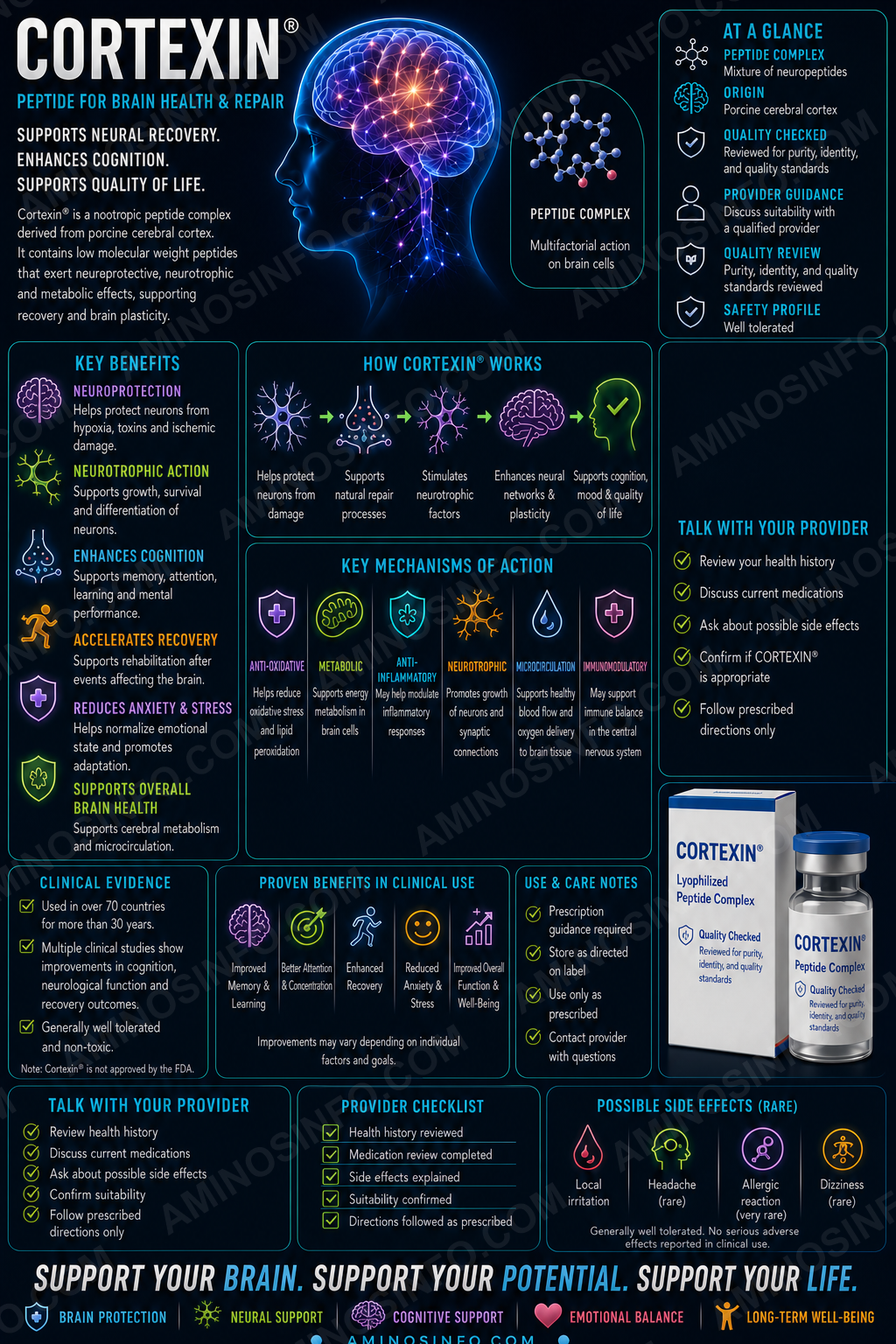
Cortexin is an animal-derived injectable peptide complex manufactured from cerebral cortex tissue, traditionally described as originating from young cattle or pigs. It is marketed in Russia and some regional markets for neurological and neurodevelopmental conditions.
The commercial product is generally presented as a lyophilized powder for intramuscular administration. Official product information describes an adult vial containing 10 mg of Cortexin active complex with glycine as a stabilizing excipient.
Animal-derived peptide complex
Cerebral cortex tissue
10 mg per adult vial
Glycine
Intramuscular injection
No
🧬 Composition, Structure, Sequence, Formula, and Molecular Weight
🧪 Is there a single sequence?
No. Cortexin contains a population of peptides rather than one defined chain. A correct article or COA should not assign Cortexin one sequence such as AEDP, one formula, or one exact molecular mass.
Reported composition
- Water-soluble polypeptide fractions
- Free amino acids
- Peptides derived from animal cerebral cortex tissue
- Glycine as a formulation excipient in the commercial lyophilizate
⚛️ Molecular-weight distribution
Published and manufacturer-associated descriptions commonly characterize the active complex as containing fractions below approximately 10 kDa. Some sources describe a broader distribution beginning near 1 kDa, while older product descriptions may include material below 10,000 Da without a sharply defined lower boundary.
| Single amino-acid sequence | None |
|---|---|
| Single molecular formula | None |
| Single exact molecular weight | None |
| Reported molecular-weight range | Predominantly low-molecular-weight fractions below approximately 10 kDa |
| Biological source | Animal cerebral cortex tissue |
| Typical adult vial | 10 mg active peptide complex plus glycine excipient |
| Universal CAS number | Not scientifically appropriate for the heterogeneous active mixture |
Cortexin versus Cortagen
Cortagen is the defined tetrapeptide Ala-Glu-Asp-Pro (AEDP), developed from cerebral-cortex peptide research. Cortagen is not the same substance as the full Cortexin peptide mixture.
📅 Discovery Timeline and Research History
1980s: Development in the Soviet/Russian military-medical research system
Cortexin was reportedly developed through work at the S. M. Kirov Military Medical Academy in the former Soviet Union.
1990s: Regional registration and clinical use
Russian sources describe registration around 1999 and use in neurology, pediatrics, rehabilitation, and cognitive disorders.
2000s: Expanded regional clinical literature
Studies examined acute ischemic stroke, chronic cerebral ischemia, traumatic brain injury, pediatric developmental disorders, epilepsy, and cognitive dysfunction.
2010s: Mechanistic studies
Laboratory research evaluated oxidative stress, apoptosis, neurotrophic signaling, neurotransmitter balance, and protease inhibition.
2021: Comparative preclinical ischemia study
A rat study compared Cortexin, Cerebrolysin, and Actovegin in acute brain ischemia and reported reduced necrotic injury and improved antioxidant measures with Cortexin.
2021–2022: Systematic review of animal-derived nootropics
A systematic review and meta-analysis found potentially favorable signals for Cortexin, Cerebrolysin, and Actovegin in cognitive disorders but emphasized conflicting evidence and study-quality limitations.
2025: Modern preclinical formulations study
A 2025 animal study evaluated standard, intranasal, and encapsulated Cortexin formulations in models of neurological injury and behavioral impairment.
Current status
Cortexin remains regionally marketed but lacks FDA or EMA approval and internationally standardized composition and potency specifications.
Manufacturing and Biological-Source Issues
Tissue extraction
Cortexin is produced through extraction, purification, fractionation, and lyophilization of low-molecular-weight compounds from animal brain tissue.
Batch heterogeneity
Biological starting material varies with animal species, age, tissue collection, processing conditions, proteolysis, purification, and storage.
Species authentication
A robust quality program should confirm the declared species and exclude undeclared animal material.
Pathogen control
Animal-derived neural-tissue products require stringent controls for bacteria, viruses, mycoplasma, endotoxin, adventitious agents, and transmissible spongiform encephalopathy risk.
Prion concern
Small peptides are not themselves prions, but sourcing from central nervous system tissue makes validated sourcing and clearance controls particularly important.
Standardization challenge
Two batches can have similar total peptide content and HPLC patterns while differing in biologically active constituents.
🧠 Proposed Mechanism of Action
1. Neuroprotective signaling
Preclinical studies report reduced neuronal injury in ischemia, oxidative stress, and toxin models.
2. Oxidative-stress regulation
Cortexin has been associated with improved antioxidant-enzyme activity, reduced lipid peroxidation, and improved tissue resistance to hypoxia.
3. Apoptosis and protease modulation
A 2017 study reported relatively selective inhibition of brain caspase-8, with weaker or absent effects on several other proteases.
4. Neurotransmitter balance
Regional literature proposes modulation of glutamate, GABA, dopamine, serotonin, and related systems, but direct mixture-wide receptor pharmacology is not fully mapped.
5. Neurotrophic and plasticity effects
Animal studies report effects on neurite growth, synaptic function, cognition, and recovery after injury.
6. Anti-inflammatory effects
Reduced inflammatory and glial responses have been reported in selected experimental models.
🎯 Receptor and Signaling Profile
| Target or pathway | Evidence status |
|---|---|
| Single defined receptor | None established for the complete mixture. |
| Caspase-8 | Inhibition reported in a brain-enzyme study. |
| Oxidative-stress pathways | Improved antioxidant markers in animal ischemia models. |
| Glutamate/GABA balance | Frequently proposed in regional pharmacology literature; not comprehensively quantified by modern receptor panels. |
| BDNF and neurotrophic pathways | Changes reported in some models; mixture-specific causality remains uncertain. |
| Inflammatory cytokines | Modulation reported in preclinical models. |
| Apoptosis signaling | Reduced neuronal apoptosis reported in selected studies. |
| Active peptide identities | Not comprehensively established. |
Stroke and Cerebral-Ischemia Research
Acute ischemic stroke
Regional clinical studies have reported improvements in neurological scores, cognition, and recovery when Cortexin was added to standard treatment.
Chronic cerebral ischemia
Trials and observational studies have examined cognitive, balance, fatigue, headache, and functional outcomes.
Preclinical infarct research
Rat studies reported smaller necrotic zones, improved antioxidant activity, and reduced neuronal injury after experimental cerebral ischemia.
Clinical-trial limitations
Many reports have limited blinding, unclear allocation concealment, small samples, multiple endpoints, short follow-up, or publication in journals with limited international indexing.
No replacement for acute stroke care
Cortexin does not replace emergency imaging, thrombolysis, thrombectomy, antiplatelet therapy, blood-pressure management, or rehabilitation.
Cognition, Dementia, and Vascular Impairment Research
Vascular cognitive impairment
Cortexin is frequently studied in patients with cerebrovascular disease and cognitive symptoms.
Systematic-review findings
A systematic review of animal-derived nootropics found possible cognitive benefit but emphasized conflicting studies, heterogeneity, and insufficient high-quality evidence.
Dementia evidence
Evidence is not strong enough to establish Cortexin as a disease-modifying treatment for Alzheimer’s disease, vascular dementia, Lewy-body dementia, or frontotemporal dementia.
Outcome-measure concerns
Some studies rely on brief cognitive scales, clinician-rated improvement, or unblinded assessments that may overestimate benefit.
No biomarker validation
No robust evidence shows that Cortexin reduces amyloid, tau, neurofilament light, brain atrophy, or progression to dementia.
Traumatic Brain Injury and Encephalopathy Research
Regional indications
Russian prescribing information includes traumatic brain injury and its consequences among the listed uses.
Proposed benefits
Studies have examined headache, dizziness, cognition, mood, attention, fatigue, and neurological recovery.
Evidence limitations
Heterogeneous injury severity, co-interventions, spontaneous recovery, and limited blinding complicate interpretation.
No established international guideline role
Cortexin is not a standard treatment in major U.S. or European traumatic-brain-injury guidelines.
Pediatric and Neurodevelopmental Research
Regional pediatric use
Cortexin is marketed in pediatric formulations and used regionally for developmental delay, perinatal CNS injury, attention problems, speech delay, and learning difficulties.
Reported outcomes
Some multicenter or observational studies report improvements in cognitive, language, motor, or behavioral measures.
Major limitations
- Variable diagnostic criteria
- Natural developmental change
- Concurrent therapy and education
- Open-label designs
- Limited placebo controls
- Short follow-up
No FDA-approved pediatric indication
Cortexin is not an FDA-approved treatment for ADHD, autism, cerebral palsy, developmental delay, speech delay, or perinatal brain injury.
Psychiatric and Behavioral Research
Depression and anxiety
Regional studies have explored Cortexin as an adjunct in mood, stress, and vascular-neuropsychiatric conditions.
Schizophrenia and cognitive symptoms
Some literature examines cognition or negative symptoms, but evidence remains limited and heterogeneous.
Animal behavioral models
A 2025 study reported effects in rodent models of neurological and behavioral impairment using multiple formulations.
No established psychiatric indication
Cortexin should not replace evidence-based psychotherapy, antidepressants, antipsychotics, mood stabilizers, or emergency psychiatric care.
Epilepsy and Seizure Research
Regional adjunctive use
Cortexin has been studied as an adjunct in epilepsy and pediatric seizure disorders.
Excitation–inhibition hypothesis
Proposed effects include modulation of GABAergic and glutamatergic signaling.
Evidence uncertainty
It is not clear which peptide fractions are responsible, whether effects differ by epilepsy type, or how Cortexin interacts with antiseizure medications.
No replacement for antiseizure therapy
Stopping or modifying prescribed antiseizure medication based on Cortexin claims can be dangerous.
Preclinical Neuroprotection Research
Experimental ischemia
Cortexin reduced tissue necrosis and improved antioxidant-system measures in rodent models.
Apoptosis
Studies report reduced neuronal apoptosis and selective inhibition of caspase-8 activity.
Motor and sensory recovery
Recent animal studies reported improved neurological scores, motor coordination, and sensory tests after experimental injury.
Histology
Reduced neuronal damage and higher proportions of morphologically preserved neurons have been reported.
Translation limitation
Animal neuroprotection frequently fails to translate into effective human stroke or neurodegenerative therapies.
Evidence Quality and Clinical Interpretation
Systematic-review conclusion
Animal-derived nootropics may show potential, but the published clinical evidence is conflicting and heterogeneous.
Regional publication bias
Positive studies are disproportionately published in Russian-language and regional literature, while negative or inconclusive results may be less visible.
Product standardization
Clinical results cannot be generalized confidently without proof that the tested product, batch composition, source species, and manufacturing process match current material.
Comparator quality
“Standard therapy plus Cortexin” versus standard therapy alone may be vulnerable to expectation, performance, and assessment bias when blinding is incomplete.
Broad indication problem
Claims spanning stroke, dementia, TBI, epilepsy, developmental disorders, and psychiatric conditions are biologically and clinically ambitious for one incompletely characterized mixture.
No broad Western regulatory approval
The absence of FDA and EMA approval reflects unresolved questions about composition, efficacy, international-quality evidence, and standardization.
Safety and Regulatory Considerations
Reported short-term tolerability
Regional studies and product information commonly describe Cortexin as generally well tolerated, with allergic or injection-related reactions reported infrequently.
Potential adverse effects
- Injection-site pain or inflammation
- Allergic or hypersensitivity reactions
- Rash or urticaria
- Agitation, sleep disturbance, or headache
- Fever or systemic reaction
- Unknown immune response to animal-derived peptides
Animal-derived product risks
- Batch heterogeneity
- Adventitious-agent contamination
- Species-related impurities
- Immunogenicity
- Residual high-molecular-weight proteins
- Endotoxin or microbial contamination
Pregnancy and lactation
High-quality safety data are insufficient.
Drug interactions
Comprehensive interaction studies are not available.
U.S. regulatory status
Cortexin is not FDA approved and should not be represented as an FDA-authorized injectable peptide product.
🧪 Laboratory Testing Methods
| Method | Purpose | Important limitation |
|---|---|---|
| Size-exclusion chromatography | Measures molecular-weight distribution and excludes excessive high-molecular-weight material. | Does not identify individual sequences. |
| RP-HPLC / UPLC fingerprint | Compares batch chromatographic profiles. | A similar fingerprint does not prove identical biological activity. |
| LC-HRMS peptidomics | Identifies and quantifies peptide features and sequences. | Complex mixtures require advanced databases and extensive validation. |
| Data-independent acquisition proteomics | Creates a reproducible batch-specific peptide map. | Unknown source proteins and modifications complicate interpretation. |
| Amino-acid analysis | Measures total amino-acid composition and peptide content. | Cannot establish sequence identities. |
| Total nitrogen / quantitative peptide assay | Supports total active-complex measurement. | May include free amino acids and excipient-related contributions. |
| Glycine assay | Confirms excipient quantity. | Does not measure the active peptide complex. |
| SDS-PAGE and capillary electrophoresis | Detects larger proteins and batch differences. | Low-molecular-weight peptides may be difficult to resolve. |
| Species authentication by targeted proteomics | Confirms declared bovine or porcine source. | Requires validated species-specific markers. |
| Residual-DNA testing | Measures animal genomic contamination. | Low DNA does not exclude all biological risks. |
| Host-cell protein / high-MW protein assay | Detects incompletely removed proteins. | No universal Cortexin specification exists. |
| Viral and adventitious-agent testing | Evaluates biological-source safety. | Must be tailored to source species and manufacturing process. |
| TSE/BSE sourcing documentation | Controls prion-related sourcing risk. | Documentation must be supported by validated sourcing and processing. |
| Sterility and bacterial endotoxin | Required for injectable finished product quality. | Passing sterility does not prove composition or efficacy. |
| Particulate matter and reconstitution testing | Assesses injectable-product quality and dissolution. | Does not measure active-fraction consistency. |
| Bioassay panel | May assess cell survival, neurite growth, antioxidant effects, or enzyme inhibition. | No internationally standardized Cortexin potency assay exists. |
| Stability-indicating peptide fingerprint | Tracks hydrolysis, oxidation, aggregation, and profile drift. | Requires qualified batch-reference standards. |
📄 How to Interpret a Cortexin COA
- Reject any COA listing one sequence, formula, or exact molecular weight: Cortexin is a mixture.
- Verify source species and tissue: The manufacturer should document the declared animal source and cerebral-cortex origin.
- Review molecular-weight distribution: The batch should conform to a validated low-molecular-weight profile, with limits on high-molecular-weight proteins.
- Require a chromatographic and mass-spectrometric fingerprint: One total-peptide result is inadequate.
- Confirm total active peptide content separately from glycine: Excipient mass must not be reported as active Cortexin.
- Review residual DNA, high-molecular-weight proteins, host-tissue contaminants, and process impurities.
- Require sterility, endotoxin, particulate, reconstitution, and container-closure testing for an injectable product.
- Review adventitious-agent and TSE/BSE controls: Neural-tissue sourcing requires especially rigorous biological safety documentation.
- Use a validated biological fingerprint or potency panel: A mixture may pass chemistry tests while losing activity.
- Do not infer clinical efficacy: A COA cannot prove stroke recovery, cognitive improvement, pediatric benefit, or safety.
📊 Cortexin vs Cortagen vs Cerebrolysin vs Semax
| Feature | Cortexin | Cortagen | Cerebrolysin | Semax |
|---|---|---|---|---|
| Type | Animal-brain peptide mixture | Defined AEDP tetrapeptide | Porcine-brain peptide hydrolysate | Defined synthetic heptapeptide analogue |
| Single sequence? | No | Yes | No | Yes |
| Source | Cerebral cortex tissue | Synthetic | Porcine brain | Synthetic |
| Main research | Broad neuroprotection and cognition | Neuronal bioregulation | Stroke, dementia, TBI | Neuroprotection and cognition |
| FDA approved? | No | No | No | No |
Cortexin vs Defined Synthetic Peptides
| Quality attribute | Cortexin mixture | Defined synthetic peptide |
|---|---|---|
| Identity | Fingerprint and distribution | Exact sequence and mass |
| Formula | No single formula | Defined formula |
| Potency | Multi-assay biological fingerprint | Target-specific assay possible |
| Batch consistency | More difficult | Generally easier |
| Biological-source risk | Present | Absent if fully synthetic |
Cortexin vs Evidence-Based Acute Stroke Care
| Approach | Established role | Difference from Cortexin |
|---|---|---|
| Thrombolysis | Reperfusion in eligible acute ischemic stroke | International randomized evidence and guideline support |
| Mechanical thrombectomy | Large-vessel-occlusion treatment | Strong outcome evidence |
| Antiplatelet and vascular prevention | Secondary prevention | Established risk–benefit framework |
| Rehabilitation | Functional recovery | Core standard of care |
| Cortexin | Regional adjunctive peptide complex | Limited international-quality evidence |
Cortexin vs Evidence-Based Cognitive Care
| Approach | Established role | Difference from Cortexin |
|---|---|---|
| Exercise, sleep, hearing correction, vascular control | Supports cognitive health | Human evidence and known safety |
| Cholinesterase inhibitors | Symptomatic treatment in selected dementias | Approved medicines |
| Anti-amyloid antibodies | Selected early Alzheimer’s disease | Human biomarker and outcome evidence |
| Cortexin | Animal-derived peptide complex | No established disease-modifying evidence |
🔗 Related Peptides and Compounds
- Cortagen: Defined AEDP tetrapeptide developed from cortex-derived peptide research.
- Cerebrolysin: Porcine-brain peptide hydrolysate with overlapping indications and quality challenges.
- Actovegin: Deproteinized calf-blood derivative, not a peptide equivalent.
- Semax: Defined synthetic melanocortin-derived neuroactive peptide.
- Selank: Defined synthetic anxiolytic peptide.
- Pinealon: Short neuroregulatory tripeptide.
- BDNF and NGF: Full neurotrophic proteins sometimes cited as conceptual comparators.
- Caspase-8: Enzyme inhibited in one Cortexin mechanistic study.
🖼️ Original Diagram Specifications
Diagram 1: Cortexin mixture map
Show a vial containing many different low-molecular-weight peptides and amino acids rather than one peptide chain.
Diagram 2: Manufacturing workflow
Show animal cerebral cortex sourcing, tissue extraction, hydrolysis/fractionation, purification, low-molecular-weight filtration, lyophilization, and vial filling.
Diagram 3: Proposed multi-target mechanism
Show oxidative stress, apoptosis, neurotransmitter balance, inflammation, metabolism, and synaptic plasticity converging on neuronal survival.
Diagram 4: Stroke evidence pathway
Show experimental ischemia, oxidative injury, neuronal death, Cortexin-associated preclinical effects, and the gap to proven clinical outcomes.
Diagram 5: Defined peptide versus mixture
Compare one exact synthetic sequence with a heterogeneous Cortexin fingerprint.
Diagram 6: Biological-source risk controls
Show species authentication, pathogen testing, residual DNA, high-molecular-weight proteins, TSE/BSE controls, sterility, and endotoxin.
Diagram 7: COA workflow
Show molecular-weight distribution, HPLC fingerprint, LC-MS peptidomics, total peptide content, glycine, source verification, adventitious agents, potency panel, sterility, and stability.
❓ Frequently Asked Questions
Is Cortexin a peptide?
It is a mixture of multiple low-molecular-weight peptides and amino acids, not one defined peptide.
What is Cortexin’s amino-acid sequence?
There is no single sequence.
What is its molecular formula?
There is no single molecular formula for the active mixture.
What is its molecular weight?
It has a molecular-weight distribution, commonly described as predominantly below approximately 10 kDa.
What is Cortexin made from?
Animal cerebral cortex tissue, processed into a low-molecular-weight peptide complex.
Is Cortexin the same as Cortagen?
No. Cortagen is the defined AEDP tetrapeptide; Cortexin is a complex mixture.
Is Cortexin FDA approved?
No.
Is Cortexin approved anywhere?
It is marketed as a prescription medicine in Russia and some regional markets.
What is Cortexin studied for?
Stroke, cerebral ischemia, cognition, TBI, epilepsy, pediatric neurodevelopment, and neuroprotection.
Does Cortexin treat dementia?
Evidence is insufficient to establish a disease-modifying dementia treatment.
Does Cortexin help stroke recovery?
Regional clinical and animal studies report possible benefit, but internationally robust evidence remains limited.
Can a COA list 99% purity for Cortexin?
A single 99% HPLC purity value is not meaningful enough for a heterogeneous peptide mixture.
What should a Cortexin COA include?
Molecular-weight distribution, chromatographic and LC-MS fingerprints, total peptide content, glycine content, species authentication, biological-source safety, sterility, endotoxin, potency, and stability.
Is animal-brain sourcing a safety concern?
It requires rigorous pathogen, adventitious-agent, residual-protein, species, and TSE/BSE controls.
Can Cortexin replace standard neurological care?
No. It should not replace evidence-based stroke, epilepsy, dementia, psychiatric, or rehabilitation care.
Final Thoughts
Cortexin is a regionally marketed animal-derived cerebral-cortex peptide complex, not a single peptide. Its active material is characterized by a distribution of low-molecular-weight polypeptides and amino acids rather than one sequence, formula, or exact mass.
Preclinical and regional clinical studies report possible neuroprotective, cognitive, antioxidant, anti-apoptotic, and recovery-related effects. However, the evidence is heterogeneous, composition is incompletely defined, international replication is limited, and Cortexin is not FDA or EMA approved.
A legitimate Cortexin quality program must use mixture-appropriate analytics: molecular-weight distribution, chromatographic fingerprinting, LC-MS peptidomics, total active-peptide content, glycine quantification, species authentication, biological-source safety, high-molecular-weight impurity controls, sterility, endotoxin, potency testing, and stability. A single HPLC purity number or one peptide sequence cannot authenticate Cortexin.
📚 References
- Geropharm. Cortexin official product information.
- Alsulaimani RA, et al. The efficacy and safety of animal-derived nootropics in cognitive disorders: systematic review and meta-analysis. 2021.
- Kurkin DV, et al. Neuroprotective action of Cortexin, Cerebrolysin and Actovegin in acute brain ischemia. PLoS One. 2021.
- Kurkin DV, et al. Neurotropic Effects of Cortexin on Models of Mental and Neurological Disorders. Biomedicines. 2025.
- Yakovlev AA, et al. Peptide drug Cortexin inhibits brain caspase-8. 2017.
- Khavinson V, et al. Neuroprotective Effects of Tripeptides—Epigenetic Regulators of Gene Expression. Pharmaceuticals. 2021.
- El Husseini N, et al. Cognitive impairment after ischemic and hemorrhagic stroke: an American Heart Association/American Stroke Association scientific statement. Stroke. 2023.
- Li Y, et al. Efficacy and safety of treatments for post-stroke cognitive impairment: systematic review. 2023.
- Hainsworth AH, et al. Therapeutic approaches to vascular cognitive impairment. 2021.
- Kreiger K, et al. Novel therapies for post-stroke cognitive impairment. 2025.
- Russian patent RU2357744C1. Cortexin composition and historical development description.
- Gusev EI, et al. Cortexin in the treatment of acute ischemic stroke: regional multicenter clinical literature.
- Skvortsova VI, et al. Neuroprotective therapy in acute cerebral ischemia: studies of peptide preparations.
- Chukanova EI. Cortexin in chronic cerebral ischemia and cognitive disorders.
- Stakhovskaya LV, et al. Peptide neuroprotection in stroke rehabilitation.
- Shamalov NA, et al. Adjunctive neuroprotective treatment in acute ischemic stroke.
- Gromova OA, et al. Cortexin: molecular mechanisms and targets of neuroprotective activity.
- Gromova OA, et al. Peptide composition and neurotrophic activity of animal-derived cerebral preparations.
- Gomazkov OA. Peptide regulation and brain repair mechanisms.
- Khavinson VK. Peptide regulation of aging and organ-specific bioregulation.
- Coulter PM, et al. Identification of cortexin, a neuron-specific protein. Journal of Neurochemistry. 1993. Note: this unrelated gene/protein named “cortexin” should not be confused with the pharmaceutical peptide complex.
- Gauthier S, et al. Management of vascular cognitive impairment and dementia. Canadian Consensus Conference literature.
- van der Flier WM, Skoog I, Schneider JA, et al. Vascular cognitive impairment. Nature Reviews Disease Primers.
- O’Brien JT, Thomas A. Vascular dementia. Lancet.
- Long JM, Holtzman DM. Alzheimer disease: an update on pathobiology and treatment strategies. Cell.
- Masters CL, et al. Alzheimer’s disease. Nature Reviews Disease Primers.
- Maas AIR, et al. Traumatic brain injury: integrated approaches to improve prevention, clinical care, and research. Lancet Neurology.
- McCrory P, et al. Consensus statement on concussion in sport.
- Stafstrom CE, Carmant L. Seizures and epilepsy: an overview. Cold Spring Harbor Perspectives in Medicine.
- Thijs RD, et al. Epilepsy in adults. Lancet.
- Lord C, et al. Autism spectrum disorder. Lancet.
- Faraone SV, et al. Attention-deficit/hyperactivity disorder. Nature Reviews Disease Primers.
- Rutter M. Developmental catch-up, and natural change in pediatric outcome studies.
- Dirnagl U, Iadecola C, Moskowitz MA. Pathobiology of ischemic stroke. Trends in Neurosciences.
- Lo EH. A new penumbra: transitioning from injury into repair after stroke. Nature Medicine.
- Green DR, Kroemer G. The pathophysiology of mitochondrial cell death. Science.
- Elmore S. Apoptosis: a review of programmed cell death. Toxicologic Pathology.
- Radi E, et al. Apoptosis and oxidative stress in neurodegeneration. Journal of Neurochemistry.
- Salter MW, Stevens B. Microglia emerge as central players in brain disease. Nature Medicine.
- Paolicelli RC, et al. Microglia and synaptic remodeling. Science.
- Fosgerau K, Hoffmann T. Peptide therapeutics: current status and future directions. Drug Discovery Today.
- Lau JL, Dunn MK. Therapeutic peptides: historical perspectives and current development trends. Bioorganic & Medicinal Chemistry.
- Craik DJ, Fairlie DP, Liras S, Price D. The future of peptide-based drugs. Chemical Biology & Drug Design.
- World Health Organization. Guidelines on viral safety evaluation of biotechnology products derived from cell lines of human or animal origin.
- European Medicines Agency. Guideline on minimizing the risk of transmitting animal spongiform encephalopathy agents via medicinal products.
- U.S. Food and Drug Administration. Guidance for industry: characterization and qualification of cell substrates and biological starting materials.
- International Council for Harmonisation. ICH Q5A(R2): Viral Safety Evaluation of Biotechnology Products.
- International Council for Harmonisation. ICH Q5C: Stability Testing of Biotechnological/Biological Products.
- International Council for Harmonisation. ICH Q6B: Specifications for Biotechnological and Biological Products.
- International Council for Harmonisation. ICH Q2(R2): Validation of Analytical Procedures.
- International Council for Harmonisation. ICH Q3C: Residual Solvents.
- International Council for Harmonisation. ICH Q1A(R2): Stability Testing.
- United States Pharmacopeia General Chapter <71>: Sterility Tests.
- United States Pharmacopeia General Chapter <85>: Bacterial Endotoxins Test.
- United States Pharmacopeia General Chapter <788>: Particulate Matter in Injections.
- United States Pharmacopeia General Chapter <621>: Chromatography.
- United States Pharmacopeia General Chapter <1055>: Biotechnology-Derived Articles—Peptide Mapping.
- United States Pharmacopeia General Chapters <232> and <233>: Elemental Impurities.
Composition, regional labeling, regulatory status, ischemia, cognition, caspase, preclinical, safety, biological-source, and analytical evidence were reviewed in July 2026. Cortexin remains unapproved by the U.S. FDA and is a heterogeneous animal-derived peptide complex rather than a single defined peptide.