Colivelin: What It Is, How It Works, Benefits, and Research Overview
A corrected, evidence-graded review of Colivelin, including its 26-amino-acid hybrid sequence, molecular properties, ADNF-9 and Humanin origins, CaMKIV and JAK2/STAT3 signaling, anti-apoptotic mechanisms, Alzheimer’s disease, ALS, ischemia, alcohol-related fetal injury, reproductive and metabolic research, safety, analytical testing, and COA interpretation.
What Is Colivelin?
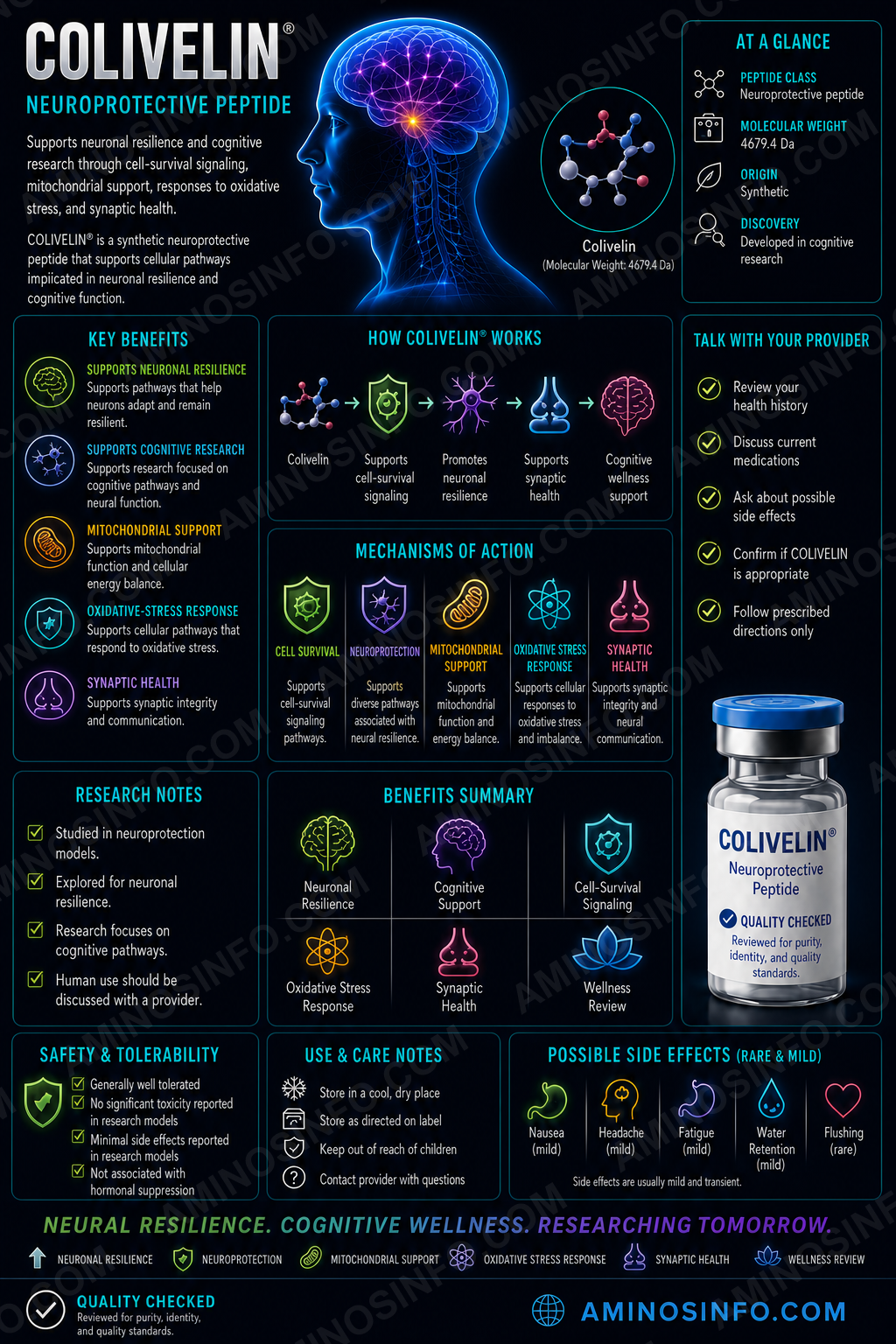
Colivelin is a synthetic hybrid neuroprotective peptide designed to combine two distinct survival-peptide systems:
- ADNF-9, a nine-amino-acid fragment of activity-dependent neurotrophic factor
- AGA-(C8R)HNG17, a potent 17-amino-acid Humanin-derived fragment
The two fragments are fused into one continuous 26-residue peptide:
SALLRSIPAPAGASRLLLLTGEIDLP
26 amino acids
SALLRSIPAPAGASRLLLLTGEIDLP
C₁₁₉H₂₀₆N₃₂O₃₅
Approximately 2,645.1 g/mol
867021-83-8
No
🧬 Molecular Structure
🧪 Complete amino-acid sequence
Ser-Ala-Leu-Leu-Arg-Ser-Ile-Pro-Ala-Pro-Ala-Gly-Ala-Ser-Arg-Leu-Leu-Leu-Leu-Thr-Gly-Glu-Ile-Asp-Leu-Pro
SALLRSIPAPAGASRLLLLTGEIDLP
Hybrid-domain map
| Residues | Sequence | Origin |
|---|---|---|
| 1–9 | SALLRSIPA | ADNF-9 |
| 10–26 | PAGASRLLLLTGEIDLP | AGA-(C8R)HNG17 Humanin derivative |
Structural characteristics
- 26 standard L-amino acids
- Linear peptide
- No cysteine residues
- No disulfide bonds
- No terminal amidation in the standard reference structure
- Highly hydrophobic leucine-rich central segment
- Two arginine residues contributing positive charge
⚛️ Molecular Weight and 🧫 Formula
| Molecular formula | C119H206N32O35 |
|---|---|
| Average molecular weight | Approximately 2,645.1 g/mol |
| Peptide length | 26 amino acids |
| Disulfide bonds | None |
| Common CAS number | 867021-83-8 |
| PubChem CID | 90477169 |
Salt forms
Research suppliers may provide Colivelin as a trifluoroacetate or acetate salt. Salt and moisture increase total vial mass without increasing active peptide content, so net peptide content must be reported separately.
📅 Discovery Timeline and Research History
1999–2001: ADNF and Humanin identified
Activity-dependent neurotrophic factor fragments and Humanin were independently recognized as potent neuronal-survival peptides.
2001: Humanin reported
Humanin was identified in a screen for molecules capable of suppressing neuronal death caused by familial Alzheimer’s disease-related insults.
Early 2000s: Potent Humanin analogues developed
Researchers introduced substitutions and truncations that increased Humanin-family potency, including S14G and C8R-related variants.
2005: Colivelin introduced
Colivelin was reported as a fusion of ADNF-9 and AGA-(C8R)HNG17, producing stronger neuroprotection than either component alone in several cellular models.
2006: ALS-model study
Colivelin prolonged survival and improved motor-neuron preservation in G93A-SOD1 transgenic mice.
2008: Nasal treatment in Alzheimer’s models
Intranasal Colivelin improved memory impairment and altered cholinergic activity in mouse models.
2009–2010: Alcohol-related apoptosis research
Colivelin reduced ethanol-induced apoptosis in fetal-brain and neuronal systems.
2010s: Ischemia, retinal, reproductive, and metabolic research
Studies expanded into cerebral ischemia, retinal injury, ovarian function, mitochondrial stress, and systemic cell-survival biology.
2020s: Humanin-family reviews and translational interest
Colivelin remains one of the most potent experimental Humanin-family analogues, but no established phase 1–3 human clinical program has emerged.
ADNF-9 and Humanin Origins
ADNF-9
ADNF-9, also called SALLRSIPA, is a nine-residue fragment derived from activity-dependent neuroprotective protein signaling. It is active at very low concentrations in selected neurotoxicity models.
Humanin
Humanin is a mitochondria-derived peptide associated with cellular stress resistance, metabolism, apoptosis regulation, and neuronal protection.
HNG and C8R modifications
The Humanin portion used in Colivelin incorporates potency-enhancing substitutions associated with S14G-Humanin and C8R-related variants.
AGA truncation
The AGA designation reflects a shortened and modified Humanin-derived fragment retaining a high-potency survival core.
Synergy concept
Colivelin was designed so that one molecule could simultaneously engage ADNF-associated and Humanin-associated survival pathways.
🧠 Proposed Mechanism of Action
Dual-pathway survival signaling
Dominant-negative experiments suggested that both CaMKIV and STAT3 contribute to Colivelin’s rescue effects.
Membrane-receptor signaling
The Humanin family has been associated with a receptor complex involving CNTFRα, WSX-1, and gp130, leading to JAK2 and STAT3 activation.
Intracellular apoptosis proteins
Humanin-family peptides can interact with pro-apoptotic proteins such as BAX, tBID, and IGFBP-3. Direct Colivelin interactions require compound-specific confirmation.
Calcium-regulated signaling
The ADNF-derived region is associated with CaMKIV and calcium-dependent survival pathways.
🎯 Receptor and Pathway Profile
| Target or pathway | Evidence status |
|---|---|
| JAK2/STAT3 | Strongly implicated in the Humanin-derived component and Colivelin protection. |
| CaMKIV | Strongly implicated in the ADNF-derived component. |
| CNTFRα–WSX-1–gp130 complex | Humanin-family membrane-receptor model; direct Colivelin binding is less completely characterized. |
| BAX and tBID | Humanin-family intracellular anti-apoptotic targets; Colivelin-specific binding remains less defined. |
| IGFBP-3 | Potential Humanin-family interaction partner. |
| Caspase pathways | Reduced activation in several injury models. |
| Mitochondrial membrane integrity | Preserved in selected experimental systems. |
| Single exclusive receptor | Not established. |
JAK2/STAT3 Signaling
STAT3 activation
Colivelin activates STAT3 in neuronal models, supporting transcription of survival-related genes.
JAK2 involvement
JAK2 lies upstream of STAT3 in the canonical Humanin receptor pathway.
Dominant-negative evidence
Expression of dominant-negative STAT3 reduced Colivelin-mediated rescue, supporting functional involvement.
Survival-gene effects
STAT3 can regulate BCL-2-family proteins, antioxidant defense, inflammation, mitochondrial function, and cell survival.
Context-dependent risk
Persistent STAT3 activation can also support tumor growth, immune evasion, and fibrosis, making chronic safety evaluation essential.
CaMKIV Signaling
ADNF-related pathway
ADNF-derived peptides are associated with calcium/calmodulin-dependent protein kinase signaling.
CaMKIV
CaMKIV regulates neuronal survival, transcription, plasticity, and stress responses.
Dominant-negative evidence
Blocking CaMKIV reduced part of Colivelin’s rescue activity, indicating that the ADNF region remains biologically functional within the hybrid peptide.
Synergistic mechanism
Concurrent CaMKIV and STAT3 activation may explain why Colivelin can outperform its isolated parent fragments in selected assays.
Anti-Apoptotic and Mitochondrial Research
Amyloid-related apoptosis
Colivelin prevented neuronal death caused by amyloid-beta and familial Alzheimer’s disease-related gene insults in cell models.
Mitochondrial injury
Humanin-family signaling can stabilize mitochondria and reduce cytochrome-c release.
Caspase activation
Colivelin reduced downstream caspase-associated apoptosis in several toxin and stress models.
Oxidative stress
Experimental findings suggest improved cellular resistance to reactive oxygen species and metabolic stress.
Survival tradeoff
Preventing apoptosis may protect neurons, but chronic inhibition of cell death could theoretically preserve damaged, senescent, or malignant cells.
Alzheimer’s Disease-Model Research
Familial Alzheimer’s insults
Colivelin suppressed neuronal death induced by mutant amyloid precursor protein and presenilin-associated experimental systems.
Amyloid-beta toxicity
Very low concentrations protected cultured neurons from amyloid-beta-related death.
Memory models
Systemic, intracerebroventricular, and intranasal Colivelin improved memory impairment caused by soluble amyloid-beta or cholinergic disruption in mice.
Synaptic plasticity
Studies reported protection of synaptic function, calcium homeostasis, and memory-related performance.
Amyloid deposition
Some longer-term mouse studies reported reduced pathological changes, although findings remain preclinical and model dependent.
No human Alzheimer’s evidence
Colivelin has not been shown to improve cognition, daily function, amyloid PET, tau biomarkers, or disease progression in people.
Memory and Cholinergic Research
Cholinergic transmission
Intranasal Colivelin altered acetylcholine-related signaling and improved memory in pharmacologically impaired mice.
Scopolamine models
Colivelin reduced memory impairment caused by muscarinic blockade.
Amyloid-induced memory deficits
Behavioral improvement was also reported after soluble amyloid-beta challenge.
Brain access
Behavioral effects after nasal or systemic delivery suggest access to relevant neural pathways, but exact pharmacokinetics remain poorly defined.
No healthy-person nootropic evidence
No controlled human study establishes memory enhancement in healthy individuals.
ALS Research
G93A-SOD1 mice
Colivelin prolonged survival in transgenic mice expressing a familial ALS-associated SOD1 mutation.
Motor-neuron preservation
Histological analysis reported increased spinal motor-neuron survival.
Disease onset and progression
Some functional measures suggested delayed deterioration or improved survival.
Model limitations
SOD1-related ALS represents only a minority of human ALS, and many agents successful in this model have failed clinically.
No human ALS efficacy
Colivelin has not been shown to slow ALS Functional Rating Scale decline, improve respiratory survival, or extend life in patients.
Stroke and Ischemia Research
Cerebral ischemia
Colivelin has been studied in focal and global ischemia models for neuronal survival and functional recovery.
Retinal ischemia
Humanin-family peptides have also been examined in retinal ganglion-cell and ischemic injury models.
Mechanisms
Potential mechanisms include mitochondrial stabilization, STAT3 activation, reduced apoptosis, and anti-inflammatory signaling.
Timing matters
Neuroprotective effects depend heavily on dose, timing, route, reperfusion status, and injury severity.
No emergency treatment role
Colivelin does not replace reperfusion therapy, antiplatelet treatment, blood-pressure management, or rehabilitation.
Alcohol-Related Fetal and Neuronal Injury Research
Fetal-brain apoptosis
Colivelin prevented ethanol-induced apoptosis in fetal mouse brain and cultured neuronal systems.
Oxidative and mitochondrial stress
Ethanol exposure can disrupt mitochondria, increase oxidative stress, and activate caspases; Colivelin reduced selected injury markers.
Developmental implications
The findings generated interest in fetal alcohol spectrum disorder mechanisms.
No prenatal treatment evidence
Colivelin has no established safety in pregnancy and should not be interpreted as protection against alcohol exposure during pregnancy.
Reproductive and Ovarian Research
Ovarian aging
Humanin-family peptides have been studied for follicular survival, ovarian reserve, and age-related reproductive decline.
Granulosa-cell survival
Colivelin may reduce apoptosis in ovarian or reproductive cell models.
Chemotherapy-related injury
Experimental studies have explored whether Humanin analogues protect ovarian tissue during cytotoxic stress.
Potential tradeoff
Protecting normal cells during chemotherapy could theoretically also protect malignant cells, so oncology-specific evaluation is critical.
No fertility treatment evidence
Colivelin has not been shown to improve fertility, live-birth rates, ovarian reserve, or IVF outcomes in humans.
Metabolic and Peripheral Research
Humanin-family metabolic signaling
Humanin analogues can influence insulin sensitivity, glucose regulation, inflammation, and cellular stress responses.
Colivelin-specific evidence
Compared with Humanin and HNG, direct Colivelin metabolic research is more limited.
Cardiovascular and endothelial research
Humanin-family peptides have shown protection in ischemia/reperfusion and vascular models, but compound-specific attribution is necessary.
No metabolic indication
Colivelin is not an approved therapy for diabetes, obesity, cardiovascular disease, mitochondrial disease, or aging.
Brain Delivery and Pharmacokinetic Limitations
Intranasal administration
Intranasal delivery improved memory in mouse models and was intended to bypass some blood–brain barrier limitations.
Systemic administration
Peripheral injections produced central behavioral effects in some studies.
Protease sensitivity
As a 26-residue linear peptide, Colivelin remains vulnerable to enzymatic degradation.
Hydrophobic region
The leucine-rich sequence may affect solubility, aggregation, membrane interactions, and formulation behavior.
No human pharmacokinetics
Absorption, bioavailability, plasma half-life, brain exposure, clearance, metabolism, and active fragments are unknown in humans.
Brain penetrant claim
Animal efficacy suggests functional CNS exposure under some conditions, but it does not establish reliable human brain penetration.
Evidence Limitations and Clinical Interpretation
Preclinical evidence dominates
No established controlled human trial has demonstrated clinical safety or efficacy.
Connected research groups
Much of the foundational work came from closely connected Humanin and ADNF laboratories.
Model concentration
Cell rescue, transgenic ALS mice, amyloid challenge, and toxin models do not reproduce full human disease complexity.
Potency claims vary
Femtomolar potency is highly assay dependent and should not be translated directly into dosing claims.
Mechanism partly inherited
Some receptor and intracellular-target claims are extrapolated from Humanin or ADNF rather than directly demonstrated for Colivelin.
No long-term toxicology
Comprehensive reproductive, developmental, immunogenicity, genotoxicity, carcinogenicity, and chronic-organ safety studies are lacking.
Safety and Regulatory Considerations
No established human safety profile
No approved label defines dosage, route, contraindications, interactions, pregnancy safety, or chronic adverse effects.
Potential neurological risks
- Headache, agitation, or sleep disruption
- Maladaptive survival of injured neurons
- Abnormal plasticity
- Seizure or excitability effects
- Unknown psychiatric effects
Potential proliferative risks
- Persistent STAT3 activation
- Tumor-cell survival
- Immune evasion
- Fibrosis
- Protection of malignant cells from apoptosis
Potential immune and formulation risks
- Immunogenicity
- Aggregation
- Endotoxin contamination
- Residual solvents
- Incorrect salt or peptide content
Pregnancy caution
Despite fetal-neuroprotection research, no human pregnancy safety data exist.
Regulatory status
Colivelin is not FDA approved.
🧪 Laboratory Testing Methods
| Method | Purpose | Important limitation |
|---|---|---|
| RP-HPLC / UPLC | Separates full-length Colivelin from deletion peptides, truncations, and degradants. | Area purity does not prove identity or content. |
| LC-HRMS | Confirms intact mass and elemental composition. | Sequence isomers may share mass. |
| MS/MS sequencing | Confirms all 26 residues and fusion order. | Leucine/isoleucine differentiation requires careful analysis. |
| Peptide mapping | Provides orthogonal sequence coverage. | Requires a suitable cleavage strategy. |
| Amino-acid analysis | Confirms composition and supports net-content measurement. | Does not establish sequence order. |
| Chiral amino-acid analysis | Detects D-amino-acid epimers. | Hydrolysis can introduce artifacts. |
| SEC-MALS or analytical ultracentrifugation | Evaluates aggregation and oligomerization. | Small peptides require optimized methods. |
| Net peptide-content assay | Measures actual Colivelin quantity. | Must correct for water, TFA, acetate, and residual solvents. |
| STAT3 phosphorylation assay | Measures one reported functional response. | Not specific to Colivelin identity. |
| CaMKIV pathway assay | Assesses ADNF-derived signaling. | No validated release-potency standard exists. |
| Amyloid-toxicity rescue assay | Evaluates neuroprotective potency. | Cell line and amyloid preparation strongly affect results. |
| Caspase and mitochondrial assays | Measure anti-apoptotic activity. | Cannot establish clinical efficacy. |
| Broad cytokine and proliferation panel | Assesses STAT3-related off-target and growth effects. | Short assays cannot replace chronic toxicology. |
| Plasma and protease stability | Measures degradation and active fragments. | Animal matrices do not fully predict humans. |
| Brain/plasma pharmacokinetics | Measures systemic and CNS exposure. | Human pharmacokinetics are unavailable. |
| Microbial limits, sterility, and endotoxin | Evaluate route-specific microbiological quality. | Requirements depend on final dosage form. |
| Stability-indicating assay | Tracks hydrolysis, oxidation, aggregation, epimerization, and potency loss. | Requires qualified reference standards. |
📄 How to Interpret a Colivelin COA
- Verify the exact 26-residue sequence: SALLRSIPAPAGASRLLLLTGEIDLP.
- Confirm hybrid order: ADNF-9 must be N-terminal and the Humanin-derived segment C-terminal.
- Confirm formula and molecular weight: C₁₁₉H₂₀₆N₃₂O₃₅ and approximately 2,645.1 g/mol.
- Verify terminal chemistry: The standard reference structure has free peptide termini unless a modified analogue is explicitly intended.
- Use MS/MS or peptide mapping: HPLC and intact mass alone cannot prove sequence.
- Review truncations, deletion sequences, leucine/isoleucine assignment, epimers, aggregates, salt content, water, and residual solvents.
- Measure net peptide content: A “99% purity” result is not the labeled number of milligrams.
- Require functional testing: STAT3, CaMKIV, or validated neuroprotection assays may support potency.
- Review proliferation and cytokine data: Routine purity testing does not address chronic STAT3-related risk.
- Do not infer efficacy: A COA cannot prove Alzheimer’s treatment, ALS survival benefit, brain penetration, memory enhancement, or human safety.
📊 Colivelin vs Humanin vs HNG vs ADNF-9
| Feature | Colivelin | Humanin | HNG | ADNF-9 |
|---|---|---|---|---|
| Length | 26 amino acids | 21–24 amino acids | Humanin analogue | 9 amino acids |
| Sequence origin | ADNF + Humanin hybrid | Mitochondrial-derived peptide | S14G Humanin analogue | ADNF fragment |
| Main signaling | CaMKIV + STAT3 | STAT3 and apoptosis proteins | High-potency Humanin signaling | CaMKIV-related survival |
| Main research | AD, ALS, ischemia, alcohol injury | Aging, metabolism, neuroprotection | Metabolism and cytoprotection | Neuroprotection |
| FDA approved? | No | No | No | No |
Colivelin vs P021 vs FGL vs DNSP-11
| Compound | Main proposed pathway | Main research theme |
|---|---|---|
| Colivelin | CaMKIV + JAK2/STAT3 | Broad neuroprotection |
| P021 | LIF/BDNF/GSK3β | Neurogenesis, tau, cognition |
| FGL | NCAM–FGFR1 | Plasticity and memory |
| DNSP-11 | Unknown receptor; ERK and mitochondria | Dopaminergic-neuron support |
Colivelin vs Approved Alzheimer’s Care
| Approach | Established role | Difference from Colivelin |
|---|---|---|
| Cholinesterase inhibitors | Symptomatic treatment | Approved human medicines |
| Memantine | Moderate-to-severe dementia symptoms | Approved human medicine |
| Anti-amyloid antibodies | Selected early Alzheimer’s disease | Human biomarker and outcome evidence |
| Colivelin | Experimental neuroprotective peptide | No established human efficacy or safety |
Colivelin vs Evidence-Based ALS Care
| Approach | Established role | Difference from Colivelin |
|---|---|---|
| Riluzole | Modest survival benefit | Approved human therapy |
| Edaravone | Slows functional decline in selected patients | Approved human therapy |
| Tofersen | SOD1-ALS treatment | Genotype-specific approved therapy |
| Colivelin | Experimental survival peptide | Mouse evidence only |
🔗 Related Peptides and Pathways
- Humanin: Parent mitochondrial-derived survival peptide.
- HNG / S14G-Humanin: Potent Humanin analogue.
- ADNF-9: N-terminal component of Colivelin.
- ADNP / NAP: Related activity-dependent neuroprotective peptide system.
- JAK2/STAT3: Humanin-related survival pathway.
- CaMKIV: ADNF-related signaling pathway.
- BAX and tBID: Pro-apoptotic proteins targeted by Humanin-family peptides.
- CNTFRα, WSX-1, and gp130: Proposed Humanin membrane-receptor complex.
🖼️ Original Diagram Specifications
Diagram 1: Colivelin hybrid sequence
Show residues 1–9 as ADNF-9 and residues 10–26 as AGA-(C8R)HNG17, with the fusion junction highlighted.
Diagram 2: Parent-peptide development
Show ADNF → ADNF-9 and Humanin → HNG/C8R fragment → Colivelin.
Diagram 3: Dual signaling model
Show Colivelin activating CaMKIV through the ADNF region and JAK2/STAT3 through the Humanin region.
Diagram 4: Mitochondrial apoptosis
Show amyloid or toxin stress, BAX/tBID, mitochondrial permeabilization, cytochrome-c release, caspases, and Colivelin protection.
Diagram 5: Alzheimer’s-model pathway
Show amyloid-beta, neuronal stress, synaptic dysfunction, cholinergic impairment, and Colivelin-associated rescue.
Diagram 6: Benefit–risk balance
Show neuronal survival and repair on one side and chronic STAT3 activation, tumor survival, fibrosis, and abnormal-cell preservation on the other.
Diagram 7: COA workflow
Show sequence, fusion order, HRMS, MS/MS, amino-acid analysis, aggregation, net content, STAT3/CaMKIV potency, microbiology, and stability.
❓ Frequently Asked Questions
Is Colivelin a peptide?
Yes. It is a synthetic 26-amino-acid hybrid neuroprotective peptide.
What is its exact sequence?
SALLRSIPAPAGASRLLLLTGEIDLP.
What is its molecular formula?
C₁₁₉H₂₀₆N₃₂O₃₅.
What is its molecular weight?
Approximately 2,645.1 g/mol.
What is its CAS number?
867021-83-8 is commonly used.
What is Colivelin made from?
ADNF-9 fused to a potent 17-amino-acid Humanin-derived fragment.
Is Colivelin the same as Humanin?
No. Humanin contributes only the C-terminal region of the hybrid.
What pathways does Colivelin activate?
Its strongest reported pathways are CaMKIV and JAK2/STAT3.
Does Colivelin treat Alzheimer’s disease?
No human therapeutic efficacy has been established.
Does it improve memory?
Mouse studies reported improvements in induced memory impairment. Human evidence is unavailable.
Does Colivelin help ALS?
It prolonged survival in a G93A-SOD1 mouse model, but no human ALS benefit has been established.
Can Colivelin be administered intranasally?
Intranasal administration has been studied in mice, but no approved human protocol exists.
Is Colivelin brain penetrant?
Animal behavioral effects suggest functional CNS exposure under some conditions, but reliable human brain penetration has not been established.
Is Colivelin FDA approved?
No.
Could Colivelin increase cancer risk?
The risk is unknown. Persistent STAT3 and anti-apoptotic signaling could theoretically support tumor-cell survival, and long-term carcinogenicity studies are lacking.
Does 99% HPLC purity prove authentic Colivelin?
No. Complete sequence, fusion order, molecular mass, net content, aggregation, and functional signaling require separate confirmation.
Final Thoughts
Colivelin is a chemically defined 26-residue hybrid peptide engineered to combine ADNF-9 and a high-potency Humanin-derived fragment. Its principal research significance is simultaneous engagement of CaMKIV- and JAK2/STAT3-associated survival pathways.
Preclinical studies report protection against amyloid-related neuronal death, memory impairment, mutant-SOD1 toxicity, ischemia, and alcohol-induced apoptosis. However, no robust human evidence establishes Colivelin as a treatment for Alzheimer’s disease, ALS, stroke, fetal alcohol injury, infertility, or aging.
Legitimate Colivelin material should be verified for its complete sequence, correct fusion order, molecular mass, stereochemical integrity, deletion peptides, aggregation, salt and water content, net peptide amount, STAT3 and CaMKIV pathway activity, route-specific microbiological quality, and stability.
📚 References
- Chiba T, et al. Characterization of Colivelin-Mediated Neuroprotection in Alzheimer’s Disease-Relevant Models. Journal of Neuroscience. 2005.
- Chiba T, et al. Characterization of Colivelin-Mediated Neuroprotection. Journal of Neuroscience. 2005.
- Chiba T, et al. Colivelin prolongs survival of an ALS model mouse. 2006.
- Matsuoka M, et al. Humanin and Colivelin: neuronal-death-suppressing peptides for Alzheimer’s disease and amyotrophic lateral sclerosis. 2006.
- Yamada M, et al. Nasal Colivelin Treatment Ameliorates Memory Impairment Related to Alzheimer’s Disease. Neuropsychopharmacology. 2008.
- Sari Y, et al. A novel peptide, Colivelin, prevents alcohol-induced apoptosis in fetal brain. Neuroscience. 2010.
- PubChem. Colivelin compound record.
- Tocris Bioscience. Colivelin sequence, formula, molecular weight, and biological activity.
- Kostomoiri M, et al. New labeled derivatives of the neuroprotective peptide Colivelin. 2015.
- Karachaliou CE, et al. Neuroprotective Action of Humanin and Humanin Analogues. Biology. 2023.
- Hashimoto Y, et al. A rescue factor abolishing neuronal cell death by a wide spectrum of familial Alzheimer’s disease genes and Aβ. Proceedings of the National Academy of Sciences. 2001.
- Hashimoto Y, et al. Humanin inhibits neuronal cell death by interacting with a cytokine-receptor complex. Journal of Neurochemistry.
- Ying G, et al. Humanin, a newly identified neuroprotective factor against Alzheimer’s disease. Molecular Neurobiology.
- Guo B, et al. Humanin peptide suppresses apoptosis by interfering with Bax activation. Nature.
- Zhai D, et al. Humanin binds and nullifies Bid activity by blocking Bax activation. Journal of Biological Chemistry.
- Ikonen M, et al. Interaction between Humanin and IGFBP-3 regulates cell survival and apoptosis. Proceedings of the National Academy of Sciences. 2003.
- Hashimoto Y, et al. A functional role of JAK2/STAT3 signaling in Humanin-mediated neuroprotection. Journal of Neurochemistry.
- Matsuoka M, et al. Humanin derives from mitochondrial and nuclear genomic sequences. Peptides.
- Widmer HR, et al. ADNF-9 and activity-dependent neuroprotective peptide biology. Journal of Neurochemistry.
- Brenneman DE, et al. Activity-dependent neurotrophic factor: structure and neuroprotective activity. Journal of Pharmacology and Experimental Therapeutics.
- Gozes I, et al. Activity-dependent neuroprotective protein and NAP-derived peptides. Pharmacology & Therapeutics.
- Gozes I. NAP and ADNP in neuroprotection and neurodevelopment. Frontiers in Endocrinology.
- Davati A, et al. CaMKIV signaling in neuronal survival and plasticity. Neuroscience.
- Bito H, Deisseroth K, Tsien RW. CREB phosphorylation and CaMK signaling in neurons. Cell.
- Sheng M, Thompson MA, Greenberg ME. CREB activation by CaMKIV. Science.
- Levy DE, Darnell JE. STATs: transcriptional control and biological impact. Nature Reviews Molecular Cell Biology.
- Yu H, Pardoll D, Jove R. STATs in cancer inflammation and immunity. Nature Reviews Cancer.
- Johnson DE, O’Keefe RA, Grandis JR. Targeting the IL-6/JAK/STAT3 signalling axis in cancer. Nature Reviews Clinical Oncology.
- Wake MS, Watson CJ. STAT3 in mammary gland development and cancer. Journal of Mammary Gland Biology.
- Long JM, Holtzman DM. Alzheimer disease: an update on pathobiology and treatment strategies. Cell.
- Masters CL, et al. Alzheimer’s disease. Nature Reviews Disease Primers.
- Selkoe DJ, Hardy J. The amyloid hypothesis of Alzheimer’s disease. EMBO Molecular Medicine.
- Haass C, Selkoe DJ. Soluble protein oligomers in neurodegeneration. Nature Reviews Molecular Cell Biology.
- Francis PT. The interplay of neurotransmitters in Alzheimer’s disease. CNS Spectrums.
- Hampel H, et al. The cholinergic system in Alzheimer’s disease. Brain.
- Roberson ED, Mucke L. 100 years and counting: prospects for defeating Alzheimer’s disease. Science.
- Rosen DR, et al. Mutations in Cu/Zn superoxide dismutase gene are associated with familial ALS. Nature.
- Gurney ME, et al. Motor neuron degeneration in mice expressing mutant SOD1. Science.
- McGoldrick P, Joyce PI, Fisher EMC, Greensmith L. Rodent models of ALS. Biochimica et Biophysica Acta.
- Hardiman O, et al. Amyotrophic lateral sclerosis. Nature Reviews Disease Primers.
- Brown RH, Al-Chalabi A. Amyotrophic lateral sclerosis. New England Journal of Medicine.
- Miller RG, et al. Riluzole for amyotrophic lateral sclerosis. Cochrane Database.
- Writing Group and Edaravone ALS 19 Study Group. Safety and efficacy of edaravone in ALS. Lancet Neurology.
- Miller TM, et al. Trial of antisense oligonucleotide tofersen for SOD1 ALS. New England Journal of Medicine.
- Dirnagl U, Iadecola C, Moskowitz MA. Pathobiology of ischaemic stroke. Trends in Neurosciences.
- Lo EH. A new penumbra: transitioning from injury into repair after stroke. Nature Medicine.
- Green DR, Kroemer G. The pathophysiology of mitochondrial cell death. Science.
- Tait SWG, Green DR. Mitochondria and cell death. Cold Spring Harbor Perspectives in Biology.
- Elmore S. Apoptosis: a review of programmed cell death. Toxicologic Pathology.
- Mattson SN, et al. Fetal alcohol spectrum disorders: a review. Neuropsychology Review.
- May PA, et al. Prevalence of fetal alcohol spectrum disorders. JAMA.
- Riley EP, Infante MA, Warren KR. Fetal alcohol spectrum disorders. Neuropsychology Review.
- Cohen P, et al. Humanin: a mitochondrial-derived peptide with metabolic and cytoprotective functions. Trends in Endocrinology and Metabolism.
- Muzumdar RH, et al. Humanin improves insulin sensitivity in mice. PLoS One.
- Yen K, et al. The mitochondrial-derived peptide Humanin and aging. Aging.
- Lee C, et al. Mitochondrial-derived peptides in metabolism and aging. Cell Metabolism.
- Fosgerau K, Hoffmann T. Peptide therapeutics: current status and future directions. Drug Discovery Today.
- Lau JL, Dunn MK. Therapeutic peptides: historical perspectives and current development trends. Bioorganic & Medicinal Chemistry.
- Craik DJ, Fairlie DP, Liras S, Price D. The future of peptide-based drugs. Chemical Biology & Drug Design.
- International Council for Harmonisation. ICH Q2(R2): Validation of Analytical Procedures.
- International Council for Harmonisation. ICH Q3A and Q3B: Impurities in New Drug Substances and Products.
- International Council for Harmonisation. ICH Q3C: Residual Solvents.
- International Council for Harmonisation. ICH Q1A(R2): Stability Testing of New Drug Substances and Products.
- International Council for Harmonisation. ICH M10: Bioanalytical Method Validation.
- United States Pharmacopeia General Chapter <621>: Chromatography.
- United States Pharmacopeia General Chapter <71>: Sterility Tests.
- United States Pharmacopeia General Chapter <85>: Bacterial Endotoxins Test.
- United States Pharmacopeia General Chapters <232> and <233>: Elemental Impurities.
Identity, sequence, hybrid origin, CaMKIV, STAT3, apoptosis, Alzheimer’s, ALS, ischemia, alcohol-injury, reproductive, safety, and analytical evidence were reviewed in July 2026. Colivelin remains an unapproved investigational peptide.