
:root{--ink:#16202a;--muted:#5c6975;--line:#dce3e8;--panel:#f6f8fa;--warning-bg:#fff8e8;--danger-bg:#fff0f0} *{box-sizing:border-box} body
Eloralintide Mechanism and Trials: A Detailed Research Overview
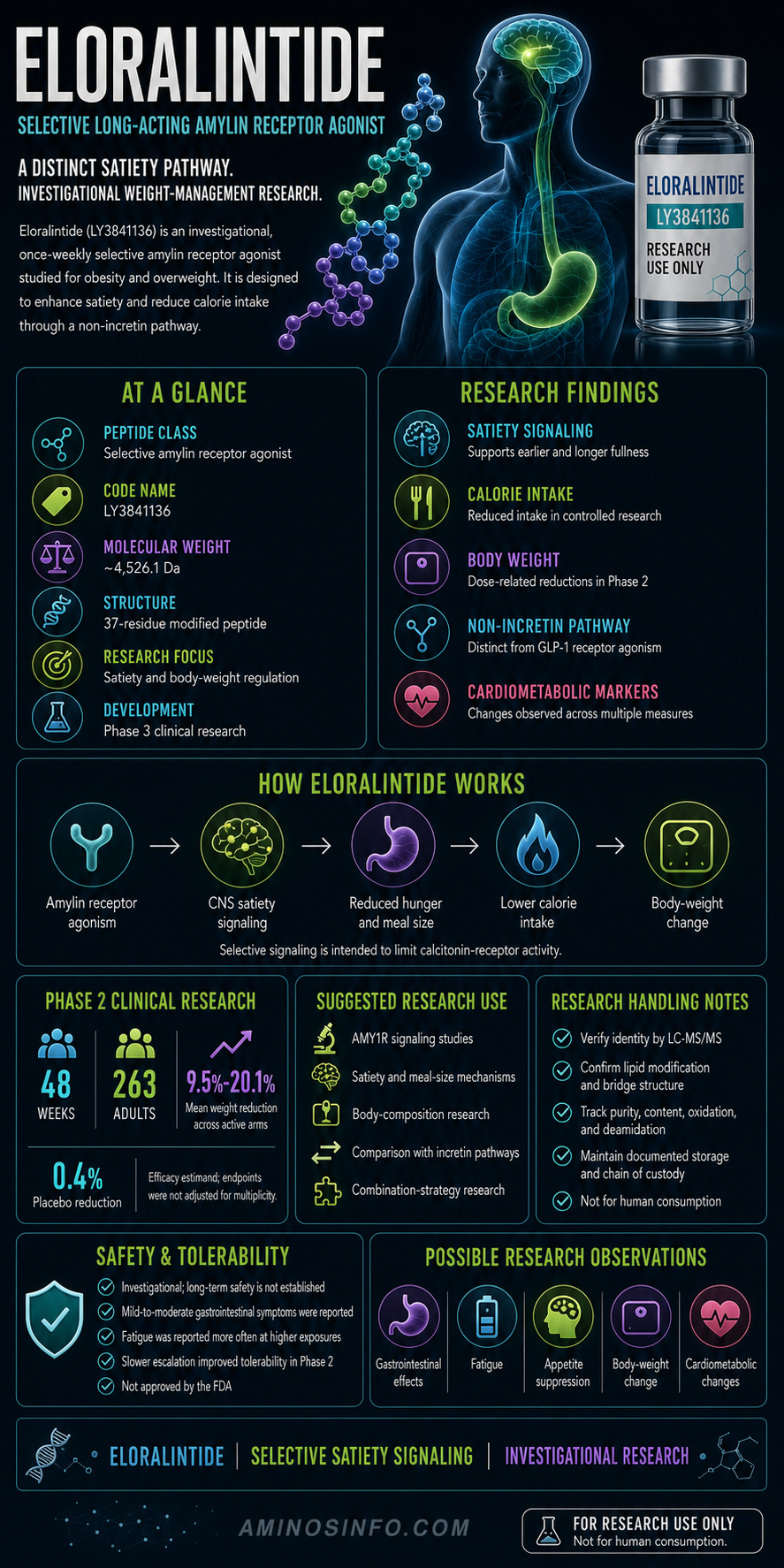
This evidence-graded guide examines eloralintide mechanism and trials, including selective amylin-receptor pharmacology, preclinical findings, Phase 1 and Phase 2 results, Phase 3 development, safety questions, and analytical testing limits.
What Eloralintide Is
Therefore, eloralintide, also called LY3841136, is a long-acting investigational amylin-receptor agonist that Eli Lilly is studying for obesity and related metabolic disease.
Amylin is a pancreatic hormone that works alongside insulin. In addition, it supports meal termination, fullness, reduced food intake, post-meal glucagon control, and short-term slowing of gastric emptying.
- Satiation and meal termination
- Fullness between meals
- Reduced food intake
- Postprandial glucagon regulation
- Transient slowing of gastric emptying
LY3841136
Long-acting synthetic amylin analogue
Amylin receptors
Once-weekly subcutaneous injection
About 14 days
No
Eloralintide Structure and Public Chemistry Information
What public sources support
- Eloralintide is a synthetic analogue of human amylin.
- Its amino-acid chain has been modified to support once-weekly dosing.
- It was engineered to improve receptor selectivity, reduce immunogenicity risk, and improve pharmaceutical developability.
- It is more potent at amylin receptors than at the calcitonin receptor.
What remains proprietary or unconfirmed
| Complete amino-acid sequence | Not publicly disclosed in the primary clinical and preclinical publications reviewed |
|---|---|
| Molecular formula | Not publicly disclosed |
| Exact molecular weight | Not publicly disclosed |
| Disulfide pattern | Not publicly disclosed |
| Lipid or half-life extension chemistry | Not fully disclosed |
| Official CAS number | No authoritative public reference confirmed |
Eloralintide Development Timeline
Early amylin research
Early work with native amylin and pramlintide established the hormone’s role in appetite and glucose regulation.
Lilly discovery program
Next, Lilly developed LY3841136 as a selective amylin-receptor agonist intended to support strong weight reduction with long exposure.
2022–2024: Phase 1 multiple-dose study
From 2022 through 2024, a 12-week study evaluated once-weekly doses in adults with obesity or overweight.
June 2025: Early proof-of-concept data
Moreover, in June 2025, Lilly presented early Phase 1 results that showed dose-related weight reduction over 12 weeks.
November 2025: Phase 2 publication
Later in 2025, a 48-week Phase 2 trial reported dose-dependent weight loss, including about 20.1% at the highest fixed dose.
December 2025: Phase 3 initiation
By December 2025, Lilly had advanced eloralintide into late-stage obesity studies.
2026: Expanded phase 3 program
By contrast, during 2026, the program expanded into populations with and without type 2 diabetes and into obesity-related knee osteoarthritis.
Current status
Eloralintide remains investigational and has not received FDA approval.
Eloralintide Mechanism of Action
1. Satiation
First, eloralintide may reduce meal size by strengthening meal-termination signals.
2. Satiety
Its prolonged exposure may extend fullness between meals and lower daily energy intake.
3. Food reward
Moreover, amylin signaling can affect reward pathways that influence motivation for highly palatable foods.
4. Glucagon regulation
Early clinical data also showed an overall reduction in fasting glucagon, although the pattern was not consistently dose related.
5. Gastric effects
Finally, higher doses caused a modest early gastric effect that moved back toward baseline with repeated dosing.
Amylin-Receptor Selectivity
Amylin receptor architecture
Amylin receptors form when the calcitonin receptor combines with a receptor activity-modifying protein, or RAMP.
| Receptor complex | Components | Eloralintide relevance |
|---|---|---|
| AMY1 | CTR + RAMP1 | Reported preferential affinity and potency |
| AMY2 | CTR + RAMP2 | Amylin-receptor activity |
| AMY3 | CTR + RAMP3 | Lower relative affinity and potency than AMY1 in reported profiling |
| Calcitonin receptor | CTR without RAMP | Substantially lower potency than at amylin receptors |
Why selectivity may matter
However, lilly researchers propose that stronger amylin-receptor selectivity and weaker calcitonin-receptor activity may support tolerability. Clinical outcomes also depend on absorption, exposure, titration, and study design.
Hypothesis, not final proof
Therefore, receptor selectivity remains a plausible explanation rather than final proof of a direct tolerability advantage.
Brain Pathways and Appetite Regulation
Area postrema
The area postrema detects circulating amylin signals and contributes to both satiation and nausea-related responses.
Nucleus of the solitary tract
Meanwhile, brainstem networks help coordinate meal termination, autonomic function, and gastric responses.
Hypothalamus
Hypothalamic pathways also influence longer-term appetite and energy balance.
Reward circuitry
In addition, reward circuits can change food-seeking behavior and the appeal of highly palatable foods.
Selective-receptor hypothesis
Researchers still need direct human evidence to determine how selective AMY1 signaling shapes these effects.
Preclinical Eloralintide Research
Food intake
For example, in diet-induced-obese rats, eloralintide reduced food intake.
Body weight
Repeated dosing also produced dose-dependent weight reduction.
Body composition
Moreover, the reported animal weight loss came mainly from fat mass rather than lean mass.
Gastrointestinal tolerability model
At exposures that produced similar weight loss, eloralintide caused less conditioned taste avoidance than cagrilintide in rats.
Species translation limitation
However, rodent taste-avoidance models cannot establish human nausea rates or long-term treatment persistence.
Phase 1 Eloralintide Trial Evidence
Study design
A randomized, placebo-controlled, blinded study enrolled 100 adults with obesity or overweight.
Doses
By contrast, participants received weekly investigational doses for 12 weeks without gradual titration.
Weight reduction
Across dose groups, mean body-weight reduction ranged from about 2.6% to 11.3% at week 12.
Common adverse events
- Decreased appetite
- Headache
- Fatigue
- Diarrhea
- Nausea
- Vomiting
- Injection-site reactions
Gastrointestinal profile
Finally, gastrointestinal events occurred mainly at higher doses. Indirect comparisons with other drug classes remain unreliable.
Phase 2 Eloralintide Trial Results
Trial design
However, the 48-week randomized, double-blind, placebo-controlled study enrolled 263 adults with obesity or overweight and at least one related condition, without type 2 diabetes.
Study groups
- Placebo
- 1 mg fixed dose
- 3 mg fixed dose
- 6 mg fixed dose
- 9 mg fixed dose
- 6-to-9 mg escalation
- 3-to-6-to-9 mg escalation
| Phase 2 finding | Reported result |
|---|---|
| 1 mg fixed dose | Approximately 9.5% mean weight reduction |
| Highest 9 mg fixed dose | Approximately 20.1% mean weight reduction |
| Placebo | Approximately 0.2 kg weight reduction |
| Study duration | 48 weeks |
Metabolic effects
In addition to body weight, investigators reported improvements in waist circumference, blood pressure, lipids, glycemic measures, and inflammatory markers.
Plateau
Higher-dose groups had not reached a clear weight-loss plateau by week 48.
Tolerability
In addition, the most common events were mild to moderate gastrointestinal symptoms and fatigue. Slower escalation reduced adverse-event frequency.
Phase 3 Eloralintide Development
Obesity without type 2 diabetes
The ClinicalTrials.gov registry lists a large placebo-controlled study in adults with obesity or overweight without type 2 diabetes.
Obesity with type 2 diabetes
For example, another Phase 3 study is evaluating adults with obesity or overweight and type 2 diabetes.
Knee osteoarthritis
Meanwhile, a master protocol is examining obesity and painful knee osteoarthritis.
Long-term outcomes
Ultimately, Phase 3 trials must confirm durability, safety, lean-mass effects, discontinuation patterns, and weight maintenance.
Eloralintide Combination Research
Eloralintide plus tirzepatide
As a result, lilly is studying eloralintide alone and with tirzepatide to test whether amylin and GIP/GLP-1 signaling produce additive weight reduction.
Potential advantages
- Complementary appetite pathways
- Greater total weight reduction
- Potentially improved fat-mass selectivity
- Possibility of lower doses of each component
Potential disadvantages
- Additive gastrointestinal effects
- Greater complexity of dose escalation
- More difficult attribution of adverse events
- Unknown long-term risk
Macupatide combination research
In addition, a separate study is evaluating eloralintide with macupatide, another investigational metabolic candidate.
Body Composition and Metabolic Effects
Fat mass
Moreover, preclinical studies found that fat-mass reduction drove most of the observed weight loss.
Lean mass
However, long-term human evidence has not yet established superior preservation of lean tissue.
Waist circumference
Meanwhile, phase 2 waist changes suggest meaningful improvement in central adiposity.
Blood pressure and lipids
By contrast, investigators also reported favorable changes in blood pressure and lipids, although cardiovascular-outcome benefit remains unproven.
Inflammatory markers
Moreover, inflammatory markers improved, likely in part because of fat loss.
Gastric Emptying and Glucagon Effects
Transient gastric effect
Likewise, acetaminophen testing suggested modest slowing after the first higher dose. However, the effect moved back toward baseline with repeated administration.
Potential tolerability benefit
Finally, this pattern may support tolerability, but researchers still need direct comparisons before drawing conclusions about nausea, reflux, medication absorption, or aspiration risk.
Fasting glucagon
However, fasting glucagon decreased overall, although the response varied and did not show a clear dose relationship.
Eloralintide Side Effects and Safety Questions
Most common reported effects
- Reduced appetite
- Fatigue
- Headache
- Nausea
- Diarrhea
- Vomiting
- Injection-site reactions
Mood-related events
Therefore, early studies reported mood-related events, so larger trials should continue to monitor psychiatric outcomes.
Potential amylin-class concerns
- Excessive appetite suppression
- Delayed gastric emptying
- Dehydration
- Hypoglycemia when combined with insulin
- Changes in oral medication absorption
Long-term uncertainty
In addition, long-term cardiovascular, pancreatic, gallbladder, psychiatric, immunogenicity, and weight-regain risks remain uncertain.
Pharmacokinetics and Weekly Exposure
Long half-life
For example, eloralintide has an estimated half-life of about two weeks.
Slow absorption
As a result, slow absorption produces a relatively flat weekly concentration profile.
Low peak-to-trough fluctuation
Moreover, in Phase 1, steady-state peak-to-trough ratios remained low.
Potential tolerability relevance
Therefore, flatter exposure may reduce sharp concentration peaks, although direct proof of a tolerability advantage remains limited.
Accumulation
Finally, the long half-life creates accumulation and delayed washout during titration or adverse events.
Eloralintide Regulatory Status
United States
Eloralintide is not FDA approved.
Clinical development
Meanwhile, phase 3 development began in late 2025 and continues through registered clinical studies.
No approved brand name
Therefore, no approved brand name, commercial dosing schedule, or prescribing information exists.
Research-market claims
By contrast, a vendor material cannot be assumed equivalent to Lilly’s clinical molecule without complete structural evidence and matching pharmaceutical controls.
Eloralintide Laboratory Testing and COA Interpretation
Analytical methods and their limits
| Method | Purpose | Important limitation |
|---|---|---|
| RP-HPLC / UPLC | Separates intact drug substance from deletion peptides, oxidation products, aggregates, and process impurities. | Cannot prove eloralintide identity without a disclosed reference structure. |
| LC-HRMS | Confirms intact mass relative to an authentic reference standard. | No public reference mass is currently available for independent comparison. |
| MS/MS peptide mapping | Confirms sequence and modification sites. | Requires access to the proprietary sequence and qualified standard. |
| Reduced/nonreduced mapping | Confirms disulfide architecture if present. | Public disulfide details public sources do not disclose. |
| Amino-acid analysis | Confirms composition and net peptide content. | Cannot prove sequence or identity by itself. |
| Chiral amino-acid analysis | Detects epimers and D-amino-acid impurities. | Requires known expected stereochemistry. |
| Modification-site analysis | Confirms any lipid, linker, or half-life extension chemistry. | The public modification architecture is incomplete. |
| SEC-HPLC | Measures aggregates and high-molecular-weight species. | Small oligomers may require orthogonal testing. |
| DLS and particle analysis | Assesses self-association and particle formation. | Formulation conditions strongly affect results. |
| Net peptide-content assay | Measures actual active mass. | Requires authentic calibrator and salt correction. |
| AMY1 cAMP assay | Measures preferred amylin-receptor activity. | Does not alone establish selectivity. |
| AMY2 and AMY3 assays | Measures broader amylin-receptor activity. | Receptor-expression differences alter potency values. |
| Calcitonin-receptor assay | Confirms lower CTR potency relative to amylin receptors. | Critical for the claimed selectivity profile. |
| Selectivity-ratio analysis | Compares AMY1, AMY3, and CTR potency. | Requires standardized cell systems. |
| Albumin-binding assay | Evaluates long-acting exposure if lipidated. | The public half-life extension mechanism is not fully disclosed. |
| Plasma stability | Measures proteolysis and chemical degradation. | Species and matrix differences matter. |
| Immunogenicity assay | Measures anti-drug antibodies in clinical development. | Requires validated human samples and drug-tolerance controls. |
| Sterility and endotoxin | Required for finished injectable products. | Raw-peptide purity cannot establish injectable safety. |
| Particulate matter | Measures visible and subvisible particles. | Requires final formulation testing. |
| Stability-indicating assay | Tracks oxidation, deamidation, aggregation, hydrolysis, and potency loss. | Requires full proprietary impurity knowledge. |
How to Interpret an Eloralintide COA
- Do not accept an unsupported public sequence: The complete authentic sequence has not been publicly disclosed in the primary literature reviewed.
- Require an authentic Lilly-linked or legally licensed reference standard: Without one, identity cannot be conclusively established.
- Require complete structural disclosure: Sequence, nonstandard residues, disulfides, amidation, linker, lipidation, and counterion.
- Confirm intact mass and MS/MS mapping against the disclosed reference.
- Confirm stereochemistry: Epimers can share the same nominal mass.
- Measure aggregates, deletion peptides, oxidation, deamidation, hydrolysis, and process impurities.
- Report net peptide content rather than HPLC area alone.
- Test AMY1, AMY2, AMY3, and calcitonin-receptor potency separately.
- Confirm the claimed receptor-selectivity ratio.
- For injectable products, require sterility, endotoxin, particles, fill accuracy, container closure, and stability.
- Do not infer clinical equivalence: A generic COA cannot prove equivalence to Lilly’s clinical-trial drug.
Eloralintide Comparison Tables
| Feature | Eloralintide | Cagrilintide | Pramlintide | Petrelintide |
|---|---|---|---|---|
| Main target | Selective amylin receptors | Amylin and calcitonin receptors | Amylin receptors | Long-acting amylin analogue |
| Dosing concept | Weekly | Weekly | With meals | Weekly |
| Public sequence | Not disclosed | Publicly described | Publicly described | Limited public chemistry |
| FDA approved? | No | No | Yes, diabetes adjunct | No |
Eloralintide vs GLP-1 and GIP/GLP-1 Therapies
| Feature | Eloralintide | Semaglutide | Tirzepatide |
|---|---|---|---|
| Primary receptors | Amylin receptors | GLP-1R | GIPR + GLP-1R |
| Primary appetite mechanism | Satiation and fullness | Appetite and reward suppression | Dual incretin appetite and metabolic signaling |
| Route | Weekly injection | Weekly injection | Weekly injection |
| FDA approved? | No | Yes, specific products | Yes, specific products |
Eloralintide vs Eloralintide + Tirzepatide
| Attribute | Eloralintide alone | Combination |
|---|---|---|
| Targets | Amylin receptors | Amylin + GIP + GLP-1 pathways |
| Potential benefit | Alternative to incretin therapy | Greater additive weight loss |
| Main concern | Unknown long-term safety | Additive GI and metabolic effects |
| Status | Phase 3 | Phase 2 |
Eloralintide Raw Material vs Clinical-Trial Drug Product
| Quality attribute | Raw material | Clinical drug product |
|---|---|---|
| Identity | Requires proprietary reference | Sponsor-controlled identity |
| Potency | Full receptor panel required | Validated release specifications |
| Microbiology | Bioburden as applicable | Sterility, endotoxin, particles |
| Exposure | Not established by COA | Supported by clinical PK |
| Clinical equivalence | Cannot be established independently without full disclosure | Defined by sponsor manufacturing and trials |
Suggested Original Diagram Concepts
These concepts describe possible future visuals. Likewise, no image is embedded in this article.
Diagram 1: Public versus proprietary identity
Finally, show a generic modified amylin peptide silhouette with labels for known features and question marks for undisclosed sequence and modification chemistry.
Diagram 2: Selective receptor mechanism
However, show strong AMY1 signaling, lower AMY3 signaling, and much lower calcitonin-receptor activity.
Diagram 3: Appetite pathway
Therefore, show area postrema, brainstem, hypothalamus, reward system, reduced meal size, and prolonged fullness.
Diagram 4: Phase 1 and phase 2 results
In addition, show up to 11.3% loss at 12 weeks and 20.1% at 48 weeks.
Diagram 5: Pharmacokinetic profile
For example, show slow absorption, approximately 14-day half-life, and flat once-weekly exposure.
Diagram 6: Eloralintide versus cagrilintide
As a result, compare selective amylin-receptor activity with broader amylin/calcitonin-receptor activation.
Diagram 7: COA verification workflow
Moreover, show proprietary reference standard, sequence disclosure, HRMS, MS/MS, receptor-selectivity panel, aggregation, sterility, and stability.
Eloralintide Mechanism and Trials: Frequently Asked Questions
Is eloralintide a peptide?
Yes. Meanwhile, eloralintide is a synthetic long-acting analogue of human amylin.
What is its development code?
Its development code is LY3841136.
What is its exact sequence?
By contrast, public primary sources do not disclose the complete authentic sequence.
What is its molecular formula?
Likewise, no authoritative public molecular formula has been confirmed.
What is its molecular weight?
Finally, no authoritative public molecular weight has been confirmed.
Is eloralintide FDA approved?
No. Eloralintide remains investigational.
How much weight loss did phase 2 report?
However, the Phase 2 study reported up to about 20.1% mean weight reduction at 48 weeks in the highest fixed-dose group.
How much weight loss occurred in phase 1?
Therefore, phase 1 reports described up to about 11.3% mean weight reduction at 12 weeks across evaluated groups.
What receptors does it activate?
In addition, it activates amylin receptors more strongly than the calcitonin receptor, with reported preference for AMY1.
How is it administered in trials?
For example, clinical trials have studied once-weekly subcutaneous administration.
What is its half-life?
As a result, its estimated half-life is about two weeks.
What are the most common side effects?
Moreover, common events included reduced appetite, fatigue, headache, nausea, diarrhea, vomiting, and injection-site reactions.
How is it different from cagrilintide?
Meanwhile, eloralintide developers designed for greater amylin-receptor selectivity and weaker calcitonin-receptor activity.
Can a vendor prove eloralintide identity with HPLC?
No. By contrast, hPLC purity alone cannot prove identity, especially when the authentic structure remains proprietary.
Conclusion: Eloralintide Mechanism and Trials
Likewise, eloralintide mechanism and trials have produced strong early evidence for weekly amylin-receptor agonism. Finally, phase 1 showed substantial short-term weight reduction, while Phase 2 reported about 20.1% at the highest fixed dose over 48 weeks.
Moreover, the program’s main scientific distinction is receptor selectivity combined with slow absorption and a long half-life. However, Phase 3 must confirm durability, safety, tolerability, and body-composition outcomes.
Finally, independent authentication remains unusually difficult because public sources do not disclose the full reference structure. Therefore, a credible identity claim would require an authentic standard, complete structural information, sequence-sensitive testing, impurity analysis, and receptor-selectivity data.
References and Authoritative Sources
Clinical, pharmacology, and quality sources
- Billings LK, et al. Eloralintide, a selective amylin receptor agonist for the treatment of obesity: a 48-week phase 2 trial. Lancet. 2025.
- Briere DA, et al. Eloralintide (LY3841136), a novel amylin receptor agonist for the treatment of obesity: from discovery to clinical proof of concept. Molecular Metabolism. 2025.
- Bhattachar S, et al. Eloralintide, a selective, long-acting amylin receptor agonist for treatment of obesity: Phase 1 proof of concept. Diabetes, Obesity and Metabolism. 2026.
- Eli Lilly and Company. What to know about eloralintide. November 2025.
- Eli Lilly and Company. Eloralintide demonstrated meaningful weight loss in phase 2. November 6, 2025.
- ClinicalTrials.gov: NCT06230523, Phase 2 eloralintide obesity trial.
- ClinicalTrials.gov. NCT07321886, phase 3 obesity trial without type 2 diabetes.
- ClinicalTrials.gov. NCT07282600, phase 3 obesity trial with type 2 diabetes.
- ClinicalTrials.gov. NCT07353931, obesity and knee osteoarthritis studies.
- ClinicalTrials.gov. NCT06916065, eloralintide plus tirzepatide study.
- ClinicalTrials.gov. NCT07215559, macupatide and eloralintide combination study.
- Briere DA, et al. Eloralintide reduced food intake and body weight primarily through fat-mass loss in obese rats. Molecular Metabolism. 2025.
- Bhattachar S, et al. Phase 1 pharmacokinetic and tolerability analysis of eloralintide. Diabetes. 2025.
- Boyle CN, Zheng Y, Lutz TA. Mediators of amylin action in metabolic control. Journal of Clinical Medicine. 2022.
- Mathiesen DS, et al. Amylin and calcitonin as therapeutic strategies for body weight and liver fat. Frontiers in Endocrinology. 2020.
- Hay DL, et al. Amylin receptors: molecular composition and pharmacology. Pharmacological Reviews.
- Poyner DR, et al. International Union of Pharmacology recommendations for calcitonin-family receptors. Pharmacological Reviews.
- Lutz TA. The role of amylin in the control of energy homeostasis. American Journal of Physiology.
- Mietlicki-Baase EG. Amylin-mediated control of energy balance. Physiology & Behavior.
- Hayes MR, et al. Amylin and energy balance: brainstem and reward pathways. Endocrinology.
- Roth JD, et al. Amylin receptor agonism and body-weight regulation. Endocrinology.
- Young AA. Amylin’s physiology and role in diabetes. Current Opinion in Endocrinology.
- Aronne L, et al. Progressive reduction in body weight after pramlintide treatment. Journal of Clinical Endocrinology and Metabolism. 2007.
- Smith SR, et al. Sustained weight loss with pramlintide. Diabetes Care. 2008.
- Lau DCW, et al. Once-weekly cagrilintide for weight management. Lancet. 2021.
- Garvey WT, et al. Cagrilintide and semaglutide in adults with obesity. New England Journal of Medicine. 2025.
- Frias JP, et al. Cagrilintide plus semaglutide in type 2 diabetes. Lancet. 2023.
- Drucker DJ. Mechanisms of action and therapeutic application of GLP-1. Cell Metabolism.
- Müller TD, et al. GLP-1 molecular physiology and therapeutic applications. Nature Reviews Drug Discovery.
- Jastreboff AM, et al. Tirzepatide once weekly for obesity. New England Journal of Medicine.
- Wilding JPH, et al. Semaglutide in adults with overweight or obesity. New England Journal of Medicine.
- Heymsfield SB, Wadden TA. Mechanisms and management of obesity. New England Journal of Medicine.
- Morton GJ, et al. Neurobiology of food intake. Nature Reviews Neuroscience.
- Kenny PJ. Reward mechanisms in obesity. Neuron.
- International Council for Harmonisation. ICH Q1A(R2): Stability Testing.
- ICH Q2(R2): Validation of Analytical Procedures
- International Council for Harmonisation. ICH Q3A and Q3B: Impurities.
- International Council for Harmonisation. ICH Q3C: Residual Solvents.
- International Council for Harmonisation. ICH Q6B: Specifications for Biotechnological Products.
- International Council for Harmonisation. ICH M10: Bioanalytical Method Validation.
- United States Pharmacopeia General Chapter <621>: Chromatography.
- United States Pharmacopeia General Chapter <71>: Sterility Tests.
- Additional context: United States Pharmacopeia General Chapter <85>: Bacterial Endotoxins Test
- Moreover, united States Pharmacopeia General Chapter <788>: Particulate Matter in Injections.
However, identity limitations, receptor pharmacology, phase 1 and phase 2 findings, phase 3 development, safety, pharmacokinetics, and analytical recommendations were reviewed in July 2026.